For Most Brands, Tariffs Are Scary. American Giant Sees a Marketing Opportunity
Since their announcement on April 2, the tariffs proposed by the Trump administration have led to volumes of rhetoric both for and against. Hedge fund titan Bill Ackman dubbed the tariffs “economic nuclear winter.” The United Auto Workers union called them a “powerful tool… for undoing the injustice of anti-worker trade deals.” The Commerce Ministry of China—which has responded to America’s 104% tariff with a 84% tariff of its own—has termed the import duty “a mistake.”
So heated is the tariff debate that brand marketers—with the exception of Ford Motor Company and its recent “Committed to America” campaign—are mostly steering clear of it. But for Bayard Winthrop, founder of apparel brand American Giant, the battle royale over tariffs looked, among other things, like a marketing opportunity.
On April 5, customers of American Giant received an email from Winthrop titled “A Note on Tariffs.” In 64 words, the message reminded recipients that the brand’s clothing has been “made here since 2011” and that “we’ve been making things here because we felt it was the right thing to do.”
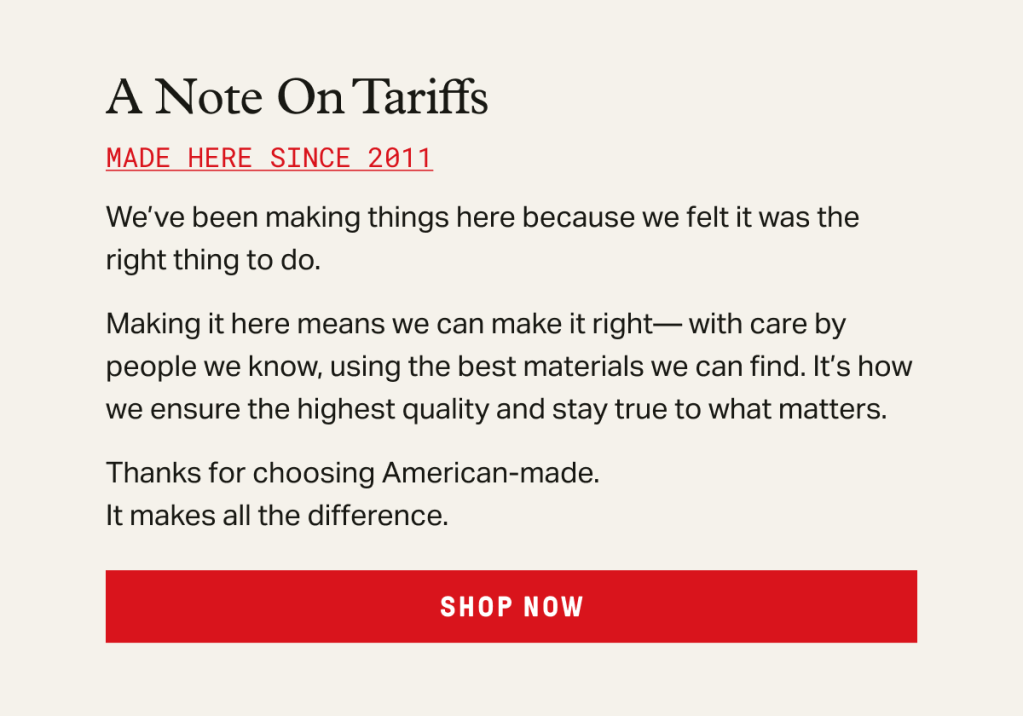
“I just wanted to make the point that, before [made in America] became this political hot potato and a very polarizing thing, it’s been a core part of our values from the very beginning of the business,” Winthrop told ADWEEK. “We’ve been committed to quality in American jobs for 14 years now.”
Winthrop could have sent an “I told you so” message and been well within his rights. After all, his decision to keep American Giant’s production wholly on U.S. soil was risky, given how much apparel-brand margins now depend on cheap labor in countries like Bangladesh, Vietnam and China. (American Giant customers are willing to pay more for American-made goods—$148 for its signature hoodie, for example—which removes the brand from the low-cost, high-volume model that fast-fashion brands depend on.)
But Winthrop’s message—promotional though it was—exercised rhetorical restraint, and for two reasons. One, domestic manufacturing is a personal ethos for Winthrop, 55, who’s deeply nostalgic for the high-quality, American-made clothing he saw hanging from the racks of Caldor and Sears when he was a kid.
More to the point, perhaps, Winthrop said he’s genuinely concerned about what he sees as the country’s over-reliance on offshore manufacturing, a problem brought to the fore during the Covid pandemic, when the shortage of face masks and hand sanitizer become a national security issue. For the sake of reigniting local economies with blue-collar jobs, Winthrop would like to encourage other companies, including his competitors, to think about re-shoring efforts.
Some apparently are. “We’ve [had] a number of brands that have reached out to us, saying, ‘Hey, we want to get some kind of a U.S. supply chain in place—can you help?’” he said.
Winthrop doesn’t believe that the Trump administration’s tariffs will lead to an American manufacturing renaissance, though he does hope that their shock effect will lead to greater awareness of China as a “bad actor,” and give rise to new and better trade deals.
For now, that outcome is uncertain, as is what effect, if any, Winthrop’s email will have on the fortunes of American Giant. One customer did hit “reply,” furious over what he perceived to be Winthrop’s support of Trump. That customer missed the point.
“I don’t give a shit about the administration,” Winthrop said. “I care about figuring out the way all of us can try to support communities and towns in this country that need work.”
https://www.adweek.com/commerce/brands-tariffs-made-in-america-clothing-american-giant/