From Jobs and Clow to Now: How TBWA\MAL Is Evolving Apple’s Marketing Legacy
Nearly a decade ago, after taking the helm of Apple’s dedicated agency, TBWA\Media Arts Lab, global chief executive Katrien De Bauw and global chief creative officer Brent Anderson went to lunch with the agency’s founder and legendary creative leader, Lee Clow.
Clow, who established TBWA\Media Arts Lab (MAL) in 2006, is most famous for helping to redefine Apple’s advertising with campaigns such as “1984,” which introduced Macintosh computers, and “Think Different” in 1997.
After hearing Clow’s stories of collaborating with the late Apple co-founder Steve Jobs, De Bauw left that meeting with a sense of trepidation, telling Anderson, “‘We better not f-ck this up.’”
“I could really feel the weight,” she told ADWEEK. “You walk in standing on the shoulders of giants. It comes with a huge responsibility.”
De Bauw and Anderson have led MAL for almost half of its existence, having started at the agency within a day of each other in 2016. Over that period, they’ve helped MAL expand both its global presence and the type of work it does for Apple, while aiming to raise its creative game. Earlier this year, as evidence of their achievements, Cannes Lions named Apple its Creative Marketer of the Year.
However, the pressure remains high to keep pace with Apple’s constant evolution.
“The MAL organization has changed to be able to deliver what Apple needs today, but also what we think it may need tomorrow,” De Bauw said. “If you only deliver what the client’s asking, then you’re always a little behind. You’ve got to take some chances and risks.”
A foundation of trust
MAL’s origins can be traced back to the storied friendship and creative partnership between Jobs and Clow, who was previously creative director at Chiat/Day, where he oversaw the “1984” ad.
Jobs, who was “unrelenting in his vision for Apple and his expectation for [its] advertising and marketing,” came to rely upon “Clow’s pure creative expression and ability to simplify and reduce,” Anderson said.
Clow proposed the idea of setting up a bespoke agency for Apple as the brand was preparing for a big milestone: the launch of the first iPhone in 2007.
“There was a need for a coordinated launch across multiple markets for the iPhone, the likes of which had never been seen before,” Anderson said. “It had to be flawless.”
Jobs was receptive to the idea, with one stipulation: that he continue to work with Clow and talent from Chiat/Day. And so, MAL was born.
Though Jobs died in 2011 and Clow retired in 2019, MAL is still based on a similar “relationship of trust and dedication to [Apple’s] mission,” Anderson said. Many of the practices that Clow and his team established nearly 20 years ago, such as regular meetings with senior Apple executives to discuss the brand’s challenges and future, persist today.
Aside from MAL, the tech giant also has an internal creative studio called Apple Marcom, behind campaigns such as Apple TV+’s stunt in Grand Central Station earlier this year for its hit show Severance. MAL and Marcom get separate briefs from Apple marketing leader Tor Myhren, fostering a “healthy competition” between the two entities, according to Anderson.
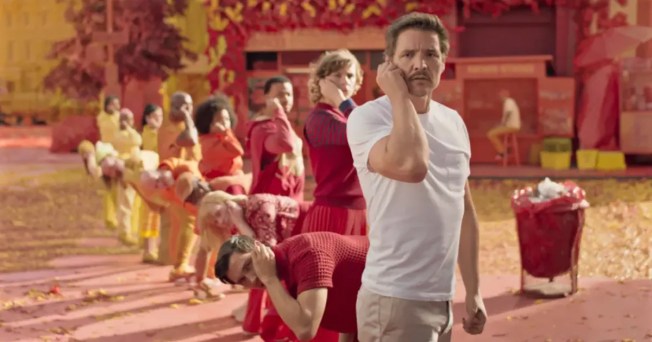
Even with an in-house studio, Apple sees the value in maintaining a partnership with an external agency, De Bauw explained. With an office in Los Angeles, MAL is physically separate from Apple, which is based in Cupertino. Apple turns to MAL for an independent perspective.
“We’re the outsiders on the inside,” De Bauw said. “[Myhren] wants us to push back, question, and bring consumers’ point of view into Apple to make the right decisions about whatever we’re working on. He’ll sit us down and say, ‘This needs to be fixed.’ And we do the same with them.”
That open dynamic extends to the partnership between De Bauw and Anderson, they said, describing it as “yin and yang.”
“Trust needs to exist between agency and client, and it needs to exist between leadership in any organization,” Anderson said. “I am totally comfortable with [De Bauw] doing the things that she is uniquely capable of to make us the best version of ourselves, and I feel that same way from her.”
Experimenting across the world
An enduring and trusting relationship with Apple has encouraged greater experimentation within MAL, Anderson said.
“One of the benefits of being a dedicated agency is you have time to build things and the opportunity to fail in the process. If we make a mistake, it’s not like, now we’re going to lose the business,” he said. “We’ve got to make changes and learn from those mistakes.”
Changing this model isn’t on the table, a MAL spokesperson told ADWEEK: “Apple will always need a bespoke agency. It’s part of their creative philosophy, to have an ‘insider on the outside.’”
That spirit of experimentation goes back to the name, Media Arts Lab, that Clow hung above the agency’s door two decades ago. It’s a constant reminder of the type of work the agency should strive for, Anderson said.
“Are we performing artistically in all types of media, and are we actually a laboratory where you learn things and experiment?” Anderson said.
Since joining, MAL’s leaders have made a concerted effort to foster creativity and improve the output and talent of its teams far beyond its home base. As Apple has grown into the giant it is today, so, too has MAL’s footprint: The agency now has offices in Los Angeles, London, Miami, Shanghai, Singapore, Sydney, Tokyo, and Seoul. International teams have created lauded work, such as a music video for K-pop group Aespa, a manga adaptation, Lucha Libre films in Mexico, and a dark comedy directed by Korean filmmaker Park Chan-wook.
“We have offices around the world with unbelievable talent that delivers quality work no matter where you are. That didn’t exist 10 years ago,” De Bauw said.
De Bauw and Anderson have also helped expand the type of work the agency delivers for Apple. While MAL initially created mostly films, now “we do everything from influencer to performance marketing to integrated campaigns to social to long-form and branded entertainment,” De Bauw said. Its content spans “6 seconds to 6 minutes to 27 minutes,” Anderson added.
The “Shot on iPhone” campaign, which marked its 10th anniversary this year, is an example of that evolution. Initially, it comprised out-of-home ads, but MAL progressed the platform into video, social media, and long-form films, such as Danny Boyle’s movie 28 Days Later. In June, “Shot on iPhone” won a Creative Effectiveness Grand Prix at Cannes Lions.
Pioneering storytelling
Lately, MAL has been busy pioneering a new form of storytelling for Apple. Collaborating with Marcom, the agency has created films and series that demonstrate Apple Immersive Video, a technology designed for virtual reality viewing that uses 3D video and spatial audio to place viewers in the center of the scene.
Last year, Apple released six immersive experiences, including Submerged, a 17-minute film from Academy Award-winning director Edward Berger that took viewers inside a World War II-era submarine. It also created a music video for The Weeknd and a concert experience with Metallica. Next up is an immersive horror film.
“Those experiences became a demonstration of a foundationally new way of telling stories,” Anderson said. “All the rules have changed.”
Apple’s technological evolution may be changing some rules, but for MAL, a few principles will always remain the same. The team learned those from Apple: the importance of experimentation, craft, emotional storytelling—and, above all, simplicity.
“Clear and simple wins every time. Nobody is better at that than Apple. We try to match the excellence and experience of their communication in the same way people have that experience with their products,” Anderson said. “As an industry, we need to be better and faster at stripping away artifice and just trying to get to the heart of the matter.”
https://www.adweek.com/agencies/apple-media-arts-lab-steve-jobs-lee-clow-evolving-marketing/