How MilkPEP and Gale Rebranded ‘Got Milk?’ for a New Generation
When the national milk processors’ organization MilkPEP and the agency Gale embarked on the challenge of repositioning milk for a new generation—and during a global pandemic, no less—they knew they needed to think differently than their “Got Milk?” predecessors.
“Got Milk?” is one of the most effective advertising campaigns in American history. It was clever. It was trendy. It was omnipresent. Most of all, it was memorable. But “Got Milk?” debuted at a different time, for a different generation—before the internet, social media and data analytics changed the way marketers build brands and engage with consumers (and before a trip to the supermarket or coffee shop presented shoppers with an overwhelming number of plant-based milk choices). A 2020s refresh of that iconic campaign using the same marketing and advertising tactics, even if forged in the crucible of TikTok, would have been a strategic misstep.
Understanding this, MilkPEP (short for Milk Processor Education Program) and Gale made an important decision early on: Be prepared to learn and pivot. Measure, monitor and formally review progress. Commit to surrendering assumptions and revising both the grand vision and activation strategy in real-time. Mix humility with agility.

“Everyone wants to be more performance-marketing driven,” said Brad Simms, president and CEO of award-winning Gale. “But modern brand marketing is just as effective as performance marketing if you’re audience-focused, take the right optimization cues and move with pace.”
With a test-and-learn ethos, MilkPEP and Gale introduced “You’re Gonna Need Milk for That,” a brand campaign centered around milk as a high-performance sports drink, in 2021. The team was eager to see how milk would resonate with both professional athletes and fitness-minded consumers alike, as good old-fashioned cow’s milk is full of nutrients that help with hydration and muscle recovery. The campaign spanned broadcast, outdoor, digital and social media, major sports league sponsorships and celebrity athlete endorsements, even featuring professional climber Kai Lightner scaling a wall on top of a 30-story building in a short film. And though it was technically launched under a revived “Got Milk?,” “You’re Gonna Need Milk for That” marked a definitive new chapter for milk producers.
Doing bodies good
The results so far are promising. U.S. multi-outlet and convenience store milk sales reached $15.7 billion in 2022, a gain of almost 10% from the year earlier. Refrigerated white milk had a remarkable year, with sales increasing by 11% to $14 billion, according to data analytics and market research company Information Resources Inc.
When Yin Woon Rani became CEO of MilkPEP in late 2019, milk marketing was responsible for driving about 1.7 gallons of milk sold at retail value per marketing dollar spent. By 2022, that figure had increased to 3.8 gallons.
While the campaign is still ongoing, MilkPEP and Gale’s experience offers five takeaways—with five choreographed pivots—that can be useful to brands looking to embrace the best of both brand and performance marketing, and become quick and nimble marketers.
Strategize with a clean sheet of paper
Pivot: Year-over-year planning to zero-based planning.
Past campaign performance can serve as a helpful starting point for strategic discussions: Did it work last year? If so, let’s do more of it this year. But that approach can also be restricting, forcing otherwise ambitious marketers to think in “year-over-year” terms, Rani told Adweek.
“We took a zero-based attitude,” said Rani, who joined MilkPEP just before the pandemic. “The blank page is freeing because it allows us to think about what the audience needs to see and what is motivating them.”
The “zero-based” method, though intuitively simple, represented a major pivot for MilkPEP: New ideas and decisions were justified for each new cycle based on demonstrable performance and audience need, as opposed to the more common method of using a previous year’s media mix or marketing strategy as the jumping-off point, then adjusting up or down.
This meant shifting from a program that skewed toward linear TV and print to one dominated by social media, programmatic and outdoor advertising.
“We let things earn their way onto the plan and fall out of the plan with no biases,” said Rani, who joined MilkPEP after more than two decades of marketing experience, particularly in CPG. “The most important thing is whether something works. Not whether we did it last year or didn’t do it last year.”
Understand the job your product performs
Pivot: Mass market to target market.
In the 1990s, “Got Milk?” targeted everyone. That was sort of the point. But this time, MilkPEP and Gale wanted to appeal to a specific customer. To better understand milk’s true target audience, they turned to an obvious opportunity that had been overlooked: athletics.
“No one really knows what Selenium does,” Simms joked. “But when you put milk’s nutrients in consumer language, you start to uncover the superpower of milk. Yes, everyone knows it’s good for your teeth and bones, but that’s very limiting.”
With a shift in market focus, milk producers suddenly found themselves competing against sports drink and bottled water brands that had been crowding out their milk cartons in refrigerated cases for years. To Rani and Simms, however, this was an opportunity to reframe milk as the “original sports drink” that has been “fueling athletes for centuries,” a messaging strategy that allowed them to pit milk’s benefits head-to-head against the competition.
“Milk doesn’t have an awareness problem; it has a bit of an attitude problem,” Rani said. “This was an opportunity to make people think about the category differently and to reconsider something that, frankly, was taken for granted.”
Right-size your ‘measurement house’
Pivot: Broad data gathering and measurement to focused data gathering and measurement.
Every company has data with unique value to their business. Often, however, there’s a disconnect between the data and the value that can be created from the data.
Rather than get bogged down by the massive amount of data available from milk processors and digital platforms, MilkPEP and Gale wanted to be nimble in what they measure and how they measure it.
“MilkPEP measures so many things; it’s almost overwhelming,” Simms noted. “But part of the job is to make sure that we’re pulling the right things out of the data to activate against.”
For the purposes of the campaign, MilkPEP and Gale chose to monitor the overall sales of milk as well as consumers’ consumption of milk as revealed by self-reported third-party data. Consumer sentiment and attitudes toward milk is also important, particularly perceptions around “milk as a performance drink” or “milk helping everyday performance.” Basic media and messaging performance is critical as well. To stay focused and effective, Gale uses a research platform, Ask Gale, to understand whether and how their creative work is resonating—who they are reaching with what message, in what channel and how often.
“You have to be thoughtful about your measurement house,” Rani said. “We want to have accountability to report how we are doing, but sometimes that can overshadow our ability to find the data that inspires things that haven’t been done before—the creative activations that haven’t been seen before.”
Be attentive to both strong and faint signals
Pivot: Men to women.
A central theme in MilkPEP’s “Gonna Need Milk” campaign is how milk’s unique nutritional attributes fuel extraordinary athletic accomplishments. It was only natural that MilkPEP formed a “Team Milk” made up of professional athletes across the sports world, with National Football League players including JuJu Smith-Schuster, Terry McLaurin and Justin Herbert among the notable stars rounding out the roster.
An NFL partnership was intriguing to MilkPEP because the league’s two primary growth audiences are women and youths. Yet after notching several successful activations on social media with NFL players, MilkPEP and Gale analyzed the data and realized they needed to pivot. Turns out, they were reaching more dads than women and youths.
“We love dads, but they’re easy to get and they weren’t the audience we were going for,” Simms said. “Doubling down on the NFL with NFL players wasn’t the right move.”
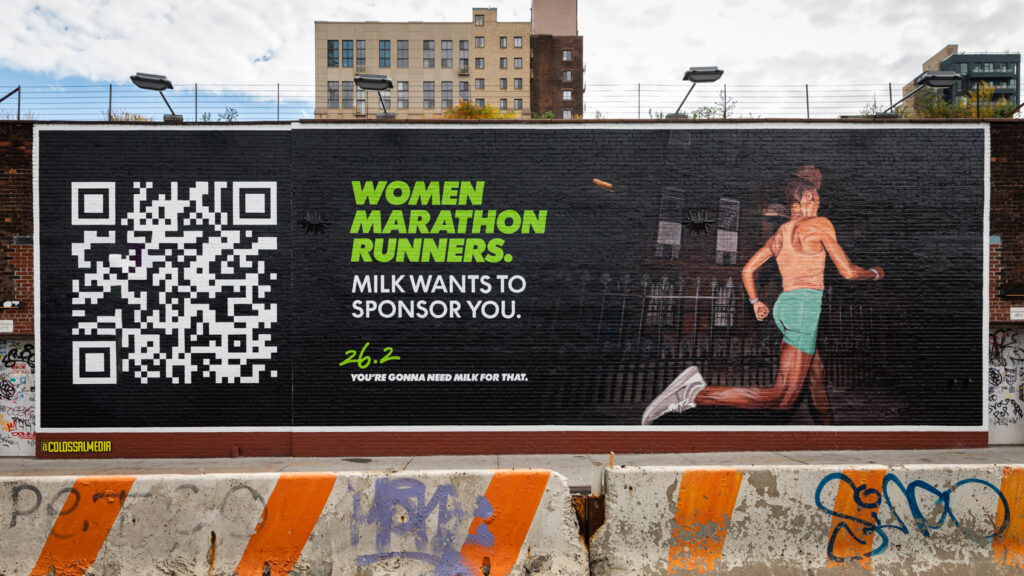
The team shifted their attention to flag football and women’s tackle football, ultimately signing up Boston Renegades star Adrienne Smith to Team Milk. The pivot proved successful and illustrated the importance of being attentive to both the strong and faint signals you receive from the data.

Know your customers, not just their demographic data
Pivot: Schools to gaming.
Initially, MilkPEP and Gale worked off the assumption that schools are the ideal platform to reposition milk as a super drink. Schools have been providing milk to students for generations. As they tested their hypothesis in actual schools, they soon realized that they needed to meet their customers where they are in addition to where they’re most “engaged.” Gaming environments offered substantially more active engagement.
“I have a 16-year-old who I can say is much more engaged with the gaming space than they are with the cafeteria at their school,” Rani said.
In 2022, milk was a presenting sponsor at TwitchCon San Diego, giving them a preferred vantage point to reach tweens and teens. The move was also consistent with the brand repositioning. With the rise of esports, gaming and performance are intertwined.
Though milk’s brand marketing challenges are unique, lots of companies find themselves in a similar spot. The key, as MilkPEP and Gale discovered, is relentlessly focusing on results in the context of strategy. Reassess plans, learn from experiences and continually improve. Most of all, borrow liberally from the performance marketer’s playbook.
https://www.adweek.com/brand-marketing/how-milkpep-and-gale-rebranded-got-milk-for-a-new-generation/