How Pabst Blue Ribbon Beer Will Revive Its Portland Music Fest After 7 Years
#SMW is right around the corner. Join us April 9-11 in NYC to get up to speed on all the latest strategies, technologies and trends you need to be following. Register now.
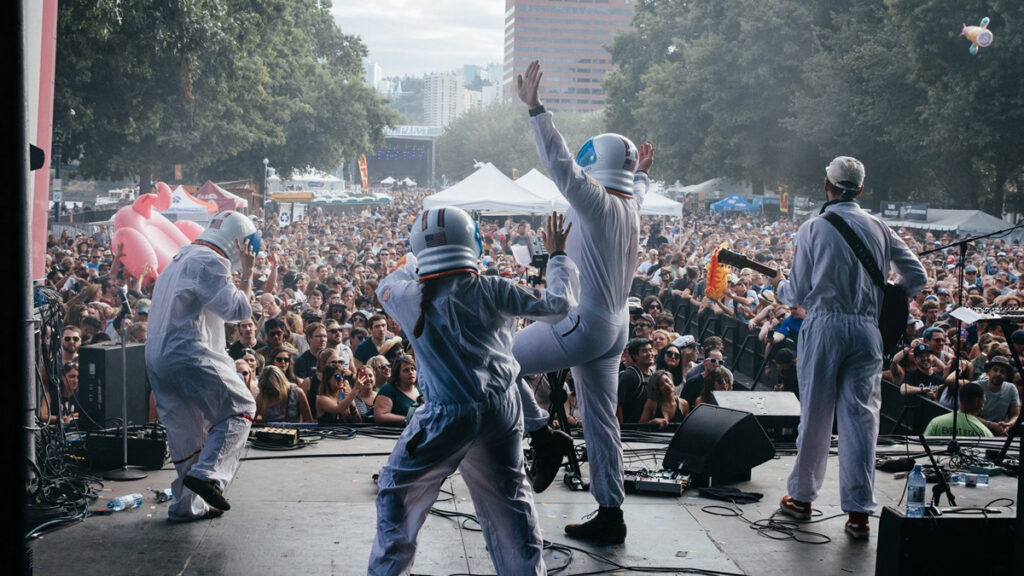
Reviving a music festival that last rocked Portland, Ore., in 2017, Pabst Blue Ribbon beer jumps feet-first into the post-pandemic experiential wave with a two-day event coming this summer featuring Billy Idol, T-Pain, Violent Femmes, Big Thief and numerous local favorites.
After a successful four-year run—and expansion to Denver, Atlanta and Philadelphia—the brand retired the outdoor concert, dubbed Project Pabst, to focus on less-labor-intensive ways to hype the blue-collar bargain beer.
But the current heady environment for live events, along with fan and partner interest, helped convince executives to bring it back. Project Pabst will be a centerpiece of the brand’s marketing this year, along with promos around its 180th anniversary.
“Not a year has gone by that there hasn’t been a conversation about the event,” PBR’s brand director, Rachel Keeton, told ADWEEK. “It just kept rising to the top.”
Project Pabst, reserved for consumers 21 and older, will host 20 bands across two stages, with no overlapping set times to avoid “noise bleed” and FOMO (fear of missing out), Keeton said. Tickets go on sale today, costing $115 per day, and organizers expect as many as 20,000 people to head to Waterfront Park along the picturesque Willamette River July 27 and 28.
“We were really mindful of the fee structure as the cost of everything, including seeing your favorite band, just keeps going up,” Keeton said. “And we’re trying to make this event as welcoming as possible, thinking about consumer pain points.”
PBR’s ground zero
Pabst can trace its music bona fides to partnerships with the Tied Down hardcore festival in Detroit, punk label Pure Noise Records and various artists and tours going back decades. Throwing its own event wasn’t a stretch, with Keeton noting many artists and music fans on the staff, but it was a massive undertaking.

Among the challenges were looking for the white space in the hotly competitive live music arena—early festivals featured Iggy Pop, Beck, Nas, Lizzo, Blondie and Weezer.
The 2024 lineup needed to be eclectic enough to lure in legacy PBR fans and new recruits, mixing rising stars with pioneering rockers like Idol, whose Rebel Yell double-platinum record is marking its 40th anniversary. Pabst aims to appeal to the next generation of beer drinkers with musical genres ranging from hip-hop and rock to indie and alternative.
Similarly, on-site activations needed to span age demos. The brand is developing a dive bar experience—per its humble Milwaukee-born, working-class roots—along with interactive displays and art installations. PBR commissioned a 25-foot-tall unicorn statue, an updated version of the past festival mascot, to anchor the venue.
The plan is to focus on Portland for the comeback, with a robust retail program as part of the marketing, although Keeton didn’t rule out adding more cities in the future. Portland, better known for its craft brew scene, was chosen in the first place because its residents incongruously fueled the PBR revitalization in the early 2000s, per the brand.
The diverse city played a pivotal role in the beer’s “renaissance from dated grandpa tipple to essential hipster accessory,” per The Oregonian.
Gen Ex(perience)
Project Pabst’s return comes as the live events business has hit a post-Covid peak, promising experiences that can’t be replicated by artificial intelligence and can serve as counterprogramming to tech-induced isolation.
Concert behemoth Live Nation recently reported its biggest year in history in ticket sales and attendance, fueled in no small part by Taylor Swift’s Eras and Beyoncé’s Renaissance tours.
The entertainment company, with Ticketmaster under its wing, said concert attendance was up 20% in 2023, compared to the year prior, when some 145 million consumers showed up for more than 50,000 events. Sales at Ticketmaster, although the subject of Department of Justice investigations, climbed 13% from 2022, to 620 million tickets.
And there are early signs that the surge will continue, as Live Nation said 57 million tickets have sold so far this year, a bump of 6% over 2023, with arenas and amphitheaters showing double-digit gains.

Goldman Sachs predicts that the global live music market will grow 7% per year, reaching $38.3 billion in 2030, with music festivals identified as the increasingly “dominant segment.” And saying that experiences are high priorities, 35% of Generation Z are willing to go into debt to pay for their entertainment, per a StubHub study.
Owning the IP
Building an event from the ground up means a heavy investment of time, effort and money from a brand, which is why so many marketers latch onto existing festivals and concerts like Bonnaroo, Outside Lands, Stagecoach and Electric Daisy Carnival. But being one of many sponsors, an ongoing reality, makes it tough to stand out.
“The power play is exclusivity (in a brand category),” said Kyle Nolan, co-founder at Sturdy, a production house that engineered an art-centric hot air balloon installation at last year’s Coachella for a Bad Bunny-Liquid I.V.-Patrón collaboration. “A presenting sponsorship gets you into all the PR and marketing, and the exposure can be worth all the money it costs.”

There are also benefits to developing an owned festival like Project Pabst, in essence creating intellectual property, because it signals a “go big” moment that yields months’ worth of original content, promo opportunities and social fodder, Nolan said.
“When you’re not a music or entertainment brand—that’s not your core product—it’s a big risk,” Nolan said. “But if you’re embedded in music and culture, and now your name is associated with every part of an event, that can be huge.”
https://www.adweek.com/creativity/how-pabst-blue-ribbon-beer-will-revive-its-portland-music-fest-after-7-years/