How the Biggest Streaming Services Stack Up Heading Into 2025
The stage is set! Advertisers, don’t miss this cultural moment. ADWEEK House The Big Game is headed to New Orleans on February 7. RSVP.
This article was originally published Dec. 12
ADWEEK previously reported that the streaming war was entering its messy era—and 2024 did not disappoint.
This year saw Prime Video’s ad inventory shake up the TV upfront, streamers push further into sports—or try to in the case of Disney, Warner Bros. Discovery, and Fox’s joint venture, Venu—and free, ad-supported streamers such as Tubi continue to fight for share and deliver big advertising dollars.
As part of ADWEEK’s regular year-in-review coverage, we take a deep dive into the major streaming services, seeing how they compare and the storylines that matter heading into 2025.
Here are the biggest takeaways from the state of streaming:

Netflix’s busy year
On its third-quarter earnings call in October, Netflix announced that it had added 5.1 million paid subscribers, reaching over 282 million viewers for more than 14% year-over-year growth.
In addition to its continued password crackdown, Netflix’s ad tier, which is in 12 countries worldwide, is also helping the streamer gain share, with its advertising president, Amy Reinhard, telling ADWEEK the ad-supported plan now reaches around 70 million monthly active users.
Moving forward, Netflix is looking to expand its measurement capabilities, build new ad formats and programmatic offerings, and double its ads revenue in 2025, when the streamer promises to reach critical scale on its ads plan.
Disney+’s ad tier numbers revealed
Disney has more than 236 million total direct-to-consumer subscribers across its portfolio, with nearly 123 million coming from Disney+ (excluding India) and 52 million from Hulu.
The company is also looking to reach more of those subscribers through one seamless experience, with Disney+’s Hulu and ESPN tiles now letting subscribers access those services—and upgrade their accounts—all in one place. In addition to more than 5,000 live events airing through the ESPN tile in the first 90 days of its debut on Disney+, the tile is set to reach atypical sports fans and families through alt casts and bespoke programming.
Disney’s global ads president, Rita Ferro, recently told ADWEEK that around 50% of Disney+ signups go to its ad tier each month. With the increased viewership, the company is also looking to reach more midmarket advertisers, recently adjusting its ad sales team structure to bring more self-service video inventory to brands that previously didn’t advertise on the streamer.
Prime Video brings streaming inventory back to Earth
In January, Prime Video debuted its ad tier, automatically enrolling its subscribers and shaking up the streaming ad market. Amazon reports that its ad-supported Prime Video tier has around 115 million ad-supported U.S. viewers (and more than 200 million worldwide).
That influx of inventory helped bring streaming prices down in the most recent upfront, with buyers saying CPM (cost per thousand viewers reached) discounts ranged anywhere from the mid-teens to 45%, depending on where the pricing started. For instance, when Netflix launched its ad tier around two years ago, it was seeking CPMs of roughly $65. This time around, with a buyer’s market, the streamer’s numbers were below $30.
Although there are discounts, volume is way up. In Magna’s latest ads forecast, the company noted that ad-supported streaming “grew dramatically.” In the U.S., the proportion of ad tier users grew from 5% to 17% for Netflix, from 10% to 30% for Disney+, and from 0% to 80% for Prime Video.
Looking ahead, Prime Video is expanding its ads into new markets in 2025, including Brazil, India, Japan, the Netherlands, and New Zealand. The company is also continuing to find new opportunities to incorporate shoppable and tech with its sports offerings, including telling ADWEEK exclusively that it will bring the National Basketball Association to Black Friday along with its yearly National Football League matchup.
Max-ing out on new markets
Over the past nine months, Max has launched in 73 new countries across Latin America, Europe, and Asia, and the company added 7.2 million new subscribers in the third quarter, bringing Warner Bros. Discovery’s total DTC subs to more than 110 million globally.
In a recent earnings call, CEO David Zaslav attributed the accelerated subscriber growth to projects such as House of the Dragon and The Penguin, as well as titles like Dune: Prophecy, The White Lotus, The Last of Us, and Peacemaker.
Meanwhile, WBD’s chief financial officer, Gunnar Wiedenfels, said the global subscriber growth came down to several factors, including the 2024 Paris Summer Olympic Games, traction from international launches, and momentum on bundle deals with Disney+, Max, and Hulu.
As the industry further consolidates amid increased competition and decreasing linear assets (both WBD and Paramount had multibillion-dollar write-downs in 2024 related to depreciating linear properties), bundles are an increasingly attractive business plan. Peacock, Netflix, and Apple TV+ also announced a bundle earlier this year.
Paramount+‘s complicated 2024
Paramount+ added 3.5 million new subscribers in its most recent quarter, bringing its total to 72 million. This makes Paramount+ the fifth-largest streaming service, behind Netflix, Amazon Prime, Disney+, and Max.
The news comes amid a tumultuous time behind the scenes for the company, with Paramount currently undergoing an acquisition by Skydance Media, which is expected to close in the first half of 2025. As a result of the merger, the company has promised to cut 15% of its workforce in order to find cost savings.
As the company looks to balance its budget, it’s also engaged in an ongoing dispute with Nielsen, failing to reach a new contract with the legacy measurement giant.
Peacock goes for gold
Like many other companies, NBCUniversal is continuing to use live sports to fuel its streamer. For instance, viewers streamed more than 23.5 billion minutes of 2024 Olympics coverage across NBCU’s portfolio, with most of that taking place on Peacock. To date, NBCU’s streamer has ridden a wave of viewership from the Olympics and NFL to now reach 36 million subscribers.
The company is leaning into streaming even more following parent company Comcast recently announcing that it has packaged several of its cable properties into a new company, extricating them from the conglomerate. The move will likely change Peacock’s relationship with NBCU cable stations, although that remains to be seen.
Looking Tubi a contender
Alhough SVODs (subscription video-on-demand platforms) get a lot of attention, the free ad-supported streamers are continuing to gain more share in the market and grow their ad numbers.
Reporting its fiscal-first-quarter earnings in November, Fox said that Tubi, which captured 1.8% of streaming in October, saw a 19% ad sales bump in the first quarter. The streamer is also on pace to cross the $1 billion in revenue mark in the fiscal year.
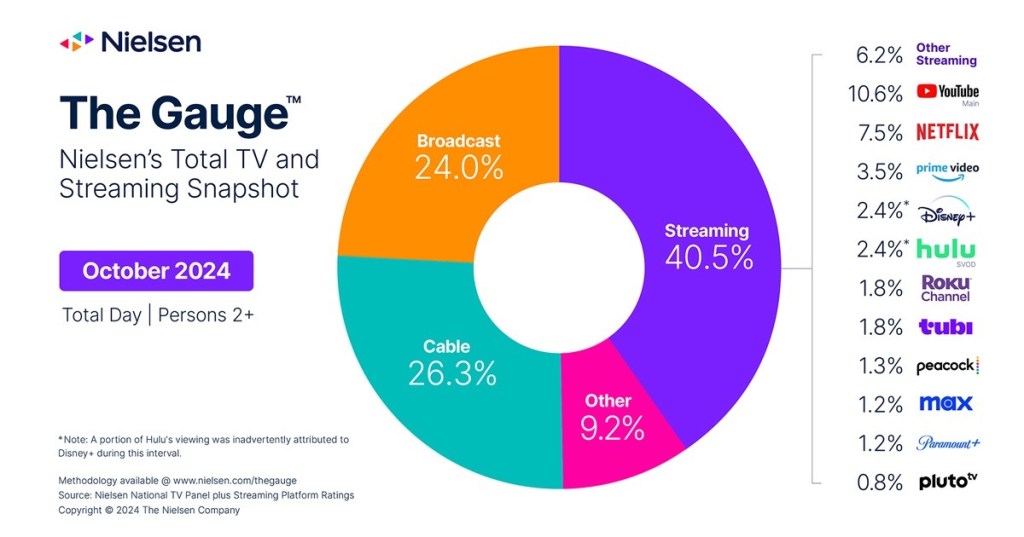
Tubi announced this year that it reached nearly 80 million monthly active users, which is metric terminology that other streamers throughout the industry will become increasingly familiar with in 2025.
For instance, Netflix, which won’t report its subscriber numbers starting in the first quarter of 2025, will continue sharing the MAU numbers for its ad tier, the company’s ads president told ADWEEK.
An all-out sports blitz
With sports being one of the last forms of appointment TV, one of the only properties where CPMs rose in the upfront, and the programming that’s continually experiencing men’s and women’s ratings records, many streamers are getting in the game and seeing results.
For instance, YouTube TV’s NFL Sunday Ticket is helping the company remain near the top of the streaming charts, and Amazon’s Thursday Night Football is reportedly averaging 13.61 million viewers on Prime Video thus far this season, 9% higher than ratings at the same point last year.
But on the way to a potential all-streaming future, some are also crying foul.
After Amazon swooped in to take WBD’s share of the NBA and Women’s National Basketball Association market, joining in an 11-year deal along with Disney’s ESPN and NBCU, WBD brought a lawsuit to the NBA over the plan, later settling for a new pact that includes rights to show NBA content on its Bleacher Report and House of Highlights outlets, as well as various overseas distribution.
Meanwhile, Fox, Disney, and WBD planned to launch their joint Venu streamer in 2024 before a lawsuit from sports-first streamer Fubo hindered the project. Now, Venu sits in limbo. However, Fox chief financial officer Steven Tomsic recently noted during UBS’ Global Media and Communications Conference that the companies will await the result of their appeal in early 2025.
Lastly, Netflix, which is set to stream two exclusive NFL games on Christmas Day, had a recent snafu with its live Jake Paul and Mike Tyson boxing match facing buffering issues. However, ADWEEK learned that the streamer has been bolstering its systems to be ready for the games.
Although there may be some bumps along the way, when it comes to streaming sports, 2025 is game time.
https://www.adweek.com/convergent-tv/how-biggest-streaming-services-stack-up-heading-into-2025/