Jim Cramer Talks SpinCo, John Oliver, and 20 Years of Mad Money
It was 20 years ago today(ish) that Jim Cramer taught the CNBC audience to play. The stock market that is.
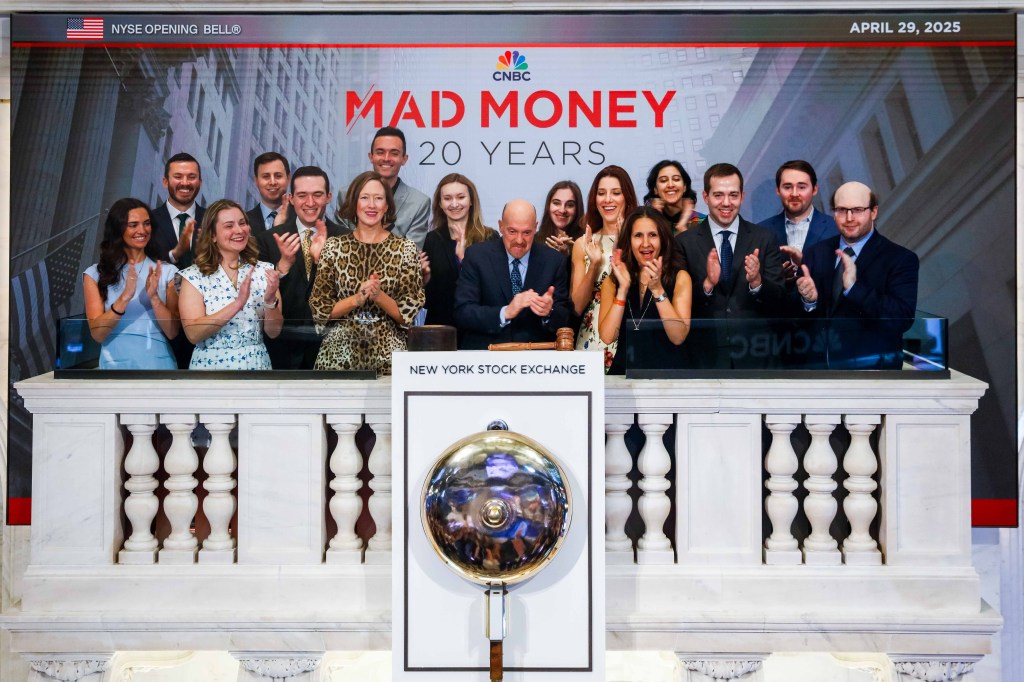
On Tuesday, the Mad Money host rang in his signature show’s platinum anniversary by ringing the opening bell of the New York Stock Exchange alongside his longtime senior executive producer, Regina Gilgan.
And Cramer will continue making stock calls—the good, bad, and the ugly—for the CNBC audience for years to come. Speaking with TVNewser ahead of their NYSE appearance, Cramer and Gilgan confirmed that they’re sticking with the network after it leaves the NBCUniversal News Group family later this year. Along with MSNBC, CNBC is bound for SpinCo—the spin-off company that will house most of NBCU’s cable assets.
That move has widely been interpreted as NBCU’s attempt to divest itself of an increasingly shaky investment. But where others see a crisis, Cramer sees potential opportunity in CNBC’s SpinCo era.
“It’s hard to feel important when you’re with a company where all anyone focuses on is their losses,” he says. “You put out this product, and you know that it’s good for viewers and you’d like to think that you’re making an impact. But if you’re not making an impact for the company that you work for, it becomes a little bit blunted.”
“I look at it like a sports team,” Cramer continues, musing about the possibilities afforded by sticking with SpinCo. “I feel like no matter what I did, I couldn’t score a run. Now, suddenly, we can put points on the board. And I’m excited about that.”
Mad Money is certainly an important brand in CNBC’s portfolio. Since its 2005 launch, the show has developed one of cable television’s most loyal audiences and continues to offer a take on financial coverage that’s been imitated (and parodied) but never exactly replicated.
As the face of the show, Cramer has become both a business world celebrity and a lightning rod for his approach to stock market tips and tricks, which included a controversial call about Bear Sterns on the cusp of the 2008 financial crisis. Over the past two decades, he’s been criticized by tycoons, journalists, and comedian journalists… but through it all he’s remained a business unto himself.
In a freewheeling interview, Cramer and Gilgan reflect on how Mad Money started, where it’s going next, and how they really feel about being regularly ridiculed by John Oliver and the Last Week Tonight team.
(This interview has been edited for length and clarity)
Let’s jump back to 2005 when Mad Money debuted on CNBC. It was such a different world—and TV landscape—from where we are now. Did you think that you’d still be talking about the show 20 years later?
Regina Gilgan: The honest answer to that is no. We’ve gotten used to it now, but 20 years ago no one had ever picked stocks on television before and that’s the basic element of the show! Also Jim was this really unique personality who had been on television a bunch, but hadn’t really been unleashed. That’s the thing that’s helped us be on the air for so long—he has an incredible ability to connect directly with people.
The visual language of the show was unique at the time as well. Did you go through any trial and error in figuring out how it would look?
Jim Cramer: I had the good fortune of having had a radio show, but moving into the television medium was something exciting and new. [Former ABC News president] Roone Arledge used to say, “You have to pop, so when they’re turning the dial they have to stop.” You were very conscious that you had to do things that were out of your comfort zone to get people to stop, listen, and learn.
Gilgan: You know, Jim still doesn’t really have a chair on-set. We also used steadicams, which are common now, but not so much then. We built a visual vocabulary with our viewers where the camera kind of lived and breathed with Jim, and that helped the show feel personal. It’s also the reason why Jim can hardly walk down the street without people coming up to him, whether it’s a CEO, a security guard, or a taxi driver. Our goal has always been to democratize the market and speak to people in a different way.
Jim, to your point about going from radio to television, it’s interesting that we’re now seeing podcasts give way to video podcasts. Do you see that as part of your legacy?
Cramer: If you’re already doing radio and TV, there’s a nice synergy between the two in terms of what podcasts are becoming. I go to weddings for my kids’ friends and someone always say, “I heard this thing on a podcast.” It’s almost to the point where I go, “Are you kidding me?” [Laughs] But it’s also a common parlance, and a method to convey thoughts like the streaming product I do for my investment club. Younger people find different things to watch—they just have an aversion to the traditional. Fortunately, we aren’t traditional, so they don’t share that aversion with us.
Mad Money has become enough of a brand that you could probably take your talents to Substack or some other independent venture. What’s the thing you value about CNBC that keeps you there?
Cramer: We have an amazing team and I think that a stripped-down version that you would do independently wouldn’t be as fun or as exciting. We’re also on a network that people know how to find and watch in any form they want, and I think that that really matters.
Gilgan: We do these college tours regularly, and the most recent one we did was at the University of Miami. A reporter wrote a piece about it and talked to all these kids on campus as they watched the show, and they had great things to say about Jim. Then he asked them, “Where do you watch Mad Money?” And not a single one of them watches it on cable! So all these young viewers are hardcore Mad Money fans, but they don’t watch it in the place that we started 20 years ago. That’s a reminder to us that you can always break through in different places and with different groups of people.
Jim, you’ve made some bad calls over the years and have been criticized for it. How do you internalize those critiques?
Cramer: I remember when I said that the Silicon Valley Bank was a good investment. And, by the way, everyone thought it was good. But I shouldn’t have said it—it doesn’t matter what everyone else said, what matters is what I say.
I got attacked for it, and a very good friend of mine asked me whether I was going to apologize. I told him, “Of course I am.” So I talked about what I did wrong and how I can learn from it. It’s important to learn from your mistakes. Now, you could argue that if all I do is talk about why I’m so bad, people will stop paying attention to me! But I certainly do acknowledge when I’m wrong on the show.
Gilgan: Obviously we get things wrong and Jim gets things wrong. But I don’t know of another show that does a “Day of Atonement” episode, which we’ve done for many years. Jim has an encyclopedia-like knowledge of the market, but if he doesn’t know something he always says, “I’ve got to go back and look that up.”
Cramer: I was a professional investor for 20 years, so I know there’s no hiding when you get something wrong. The difference was that when I was at a hedge fund or at Goldman Sachs and you screwed up, you screwed up with somebody else’s money. Then you’d have to tell them, “I’m wearing a hair suit publicly, but I don’t mind. As long as we can learn from it.”
What does the next 20 years of Mad Money look like?
Cramer: In terms of the medium, what’s going to be able to happen is that you’re going to be able to figure out how to watch TV only for what you care about. If you own stock in Microsoft, and all you want to hear about is Microsoft, you’ll be able to follow anyone that talks about it. It’s going to be personalized news, and a lot more siloed, which I don’t necessarily know is a good thing. I think it’s important that you try to hit a lot of stocks, and that you try to be rigorous about them.
Gilgan: For me, it’s about the mission. As long as we have 100 people calling in each night waiting to hear what Jim has to say, then we’ll be here for them. We have this incredible connection with people, and a grassroots research department that listens to what our viewers are thinking.
As a regular viewer of Last Week Tonight, I do have to ask you both how you feel about being one of John Oliver’s favorite targets.
Gilgan: So Jim always talks about the fact that his wife [Lisa Cadette Detwiler] loves the Baconator at Wendy’s…
Cramer: Which is true! She loves bacon.
Gilgan: A little while ago, there was this Last Week Tonight segment that was all about that.
Cramer: My trainer mentioned it to me! He was like, “Did you watch John Oliver the other night? It was about Lisa and the Baconator and how often you talk about it.” I panicked and said she hadn’t seen it yet. The next day, Lisa asked me, “Did you say something about me on the job?” I told her she could look it up on YouTube. She called me right back and said, “That was not funny—it was very hurtful.” I thought she was joking, but she wasn’t. So I said, “I’m so sorry.”
To this day she’s resentful. We went to Wendy’s last week and she said, “I am deliberately going to have the double cheeseburger without the bacon so that you don’t make fun of it.” I took a picture of her eating it, and she told me, “If you tweet that, I will kill you.” So I did not tweet it. [Laughs]
Gilgan: It’s just a reminder that you need to have a very thick skin and a very good sense of humor to work on this show. Luckily, Jim and I have that. Whether it’s South Park or The Simpsons, we’ve been put through the wringer. There’s an element of it that’s in good fun. Not always! But on most days.
Maybe you and John could have a peacemaking summit as part of Mad Money’s 20th anniversary.
Cramer: What I’m told is that there’s somebody on his staff that loves the show. That makes me feel great because you’ve got a product that had been niche and we’ve tried to make it mass without compromising the quality. That’s been our goal—and I think we’ve succeeded.
https://www.adweek.com/tvnewser/jim-cramer-john-oliver-mad-money-20-years/