Live-Streamers Killed the Vertical-Video Star
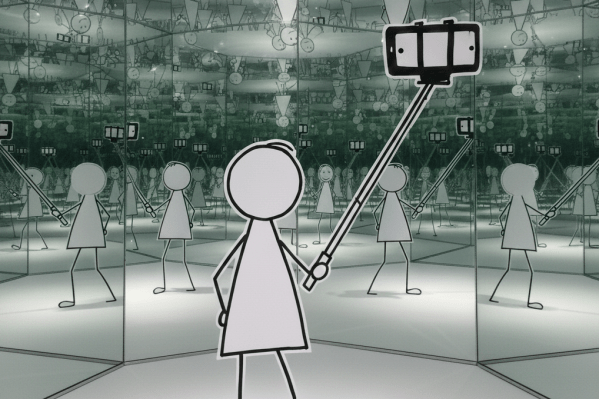
This story was originally published in On Background with Mark Stenberg, a free, weekly newsletter that explores the key themes shaping the media industry. You can sign up for it here.
By now you have surely heard of Clavicular, the live-streaming looksmaxxer whose internet-addled argot and obsession with physical appearance briefly captured the national spotlight.
Or perhaps you have lately caught wind of TBPN, the live-stream technology podcast whose cohosts have attracted a wave of incredulous press coverage, documenting everything from their eye-popping sponsorship rates to their surprise Super Bowl spot.
If both have escaped your attention, maybe you saw Kai Cenat hosting an unlicensed PlayStation 5 giveaway in Union Square, IShowSpeed challenging Tyreek Hill to a footrace, or Clix in a shootaround earlier this month with Chris Paul?
If none of these names ring a bell, well then congratulations—your daily screen time must still be a single-digit number.
But for a growing cohort of the terminally online, not to mention a broad swath of younger audiences, live-streamers like the ones above have become household names.
Unlike TikTok, whose capacity to mint digital superstars came as a result of introducing a new format, i.e. vertical video, live-streaming is by no means a new technology. The home base of the medium, Twitch, launched in 2011 and was acquired three years later, by Amazon, for $970 million.
Pioneers of the form, such as the political pundit Hasan Piker and the gaming phenom Ninja, have built established followings over more than a decade of consistent streaming. And many others, including a crop of ambitious, if premature publishers, have sought to establish themselves in the space—though largely to mixed results.
.newsletter-subscription-form-wrapper p:empty{ display: none !important } .newsletter-subscription-form-wrapper button br{ display: none !important }But in recent months, the medium seems to have broken containment, morphing from a fringe format into a bona fide kingmaker. A channel that formerly felt like the provenance solely of gamers and its Gen Alpha acolytes has lately crossed into the mainstream.
“The velocity with which streamers are able to build internet fame (TBPN, Clavicular, etc) feels notable right now,” said social media strategist Rachel Karten, on X earlier this month. “TikTok used to have that edge (Charli D’Amelio, Alix Earle, etc.), but the ecosystem of streaming, clipping, and showing up every single day is very hard to beat.”
The logic, at least in theory, is easy enough to follow. The medium has taken off because it appeals to both an emerging set of desires from audiences and an existing set of incentives from algorithms.
For viewers, live-streaming offers a refuge from the growing glut of AI-generated content on their feeds. In a social media landscape where the difference between real and artificial has grown nearly imperceptible, the unmistakable humanity of real-time video is a refreshing draw, according to Karten.
Similarly, part of the appeal of TikTok when it initially emerged was that, compared to Instagram at the time, vertical video felt far less polished. If Instagram offered manicured mood boards, the amateur quality of front-facing video on TikTok promised a more realistic portrayal of life.
But compared to live-streaming, whose real-time nature necessarily involves flubs, technical glitches, and periods of dead air, TikTok practically feels like a Hollywood production. Sure, the video you just scrolled past might appear to have captured an authentic surprise or genuine prank, but who knows how many takes it really took to produce?
Live-streams also offer consistency in a way that vertical video, controlled as it is by the omnipotent algorithm, could never rival.
The best streamers go live on a routine basis, on a predictable schedule that encourages repeat viewership and builds loyalty. They often, impressively, stream for hours at a time, which gives their channels the feel of television more so than of social media. Creators who produce content explicitly for TikTok, Reels, and Shorts, meanwhile, can only hope that their hard work finds its way onto your feed.
Indeed, the whims of the algorithm are the other explaining factor behind the rise of the live-stream.
The arrival of TikTok fundamentally flipped the logic of content creation, as it rewards hits without penalizing misses. The algorithm surfaces the best material while suppressing the rest, meaning creators have found themselves incentivized to aim for quantity rather than quality.
Until recently, that has meant creating hundreds or thousands of discrete videos, each one a standalone product. But the emergence of the video podcast, as well as the repurposing of the live-stream, has changed that equation.
Now, rather than produce 100 individual videos, creators could simply film a podcast or shoot a live-stream, then cut that source material down into 100 clips. The latter requires far fewer resources but offers the same odds of virality. It also turns the process of production—the filming itself, the live-stream—into a product, effectively yielding two deliverables for the price of one.
The result is a content supply chain with monetization at every link.
Imagine a podcast creator who hosts a ticketed show, live-streams the event, captures the programming as a video and audio podcast, shares photos of the event on social, transcribes the text into a newsletter, and posts it online. Not only have they translated one moment into five different mediums—they have also monetized each one, each step of the way.
For creators, turning podcasts into live-streams adds another source of monetization, distribution, and discovery upstream of the actual product they set out to produce, a low lift with a potentially large benefit.
This reality has begun infiltrating the podcast landscape. According to Tom Webster, a partner at the podcast trade organization Sounds Profitable, bigger publishers are already starting to test the waters with live-streaming, as it brings engagement to a channel that has historically been one-directional.
“A lot of this stems from how much consumption is now taking place on the living room TV,” Webster said. “Bill Simmons is already doing the live to live-stream to podcast to social pipeline.”
Of course, on some level this emerging trend simply closes a loop: Just as streaming-service bundles are recreating cable, live-stream video is simply live television with worse unit economics.
But such a comparison glosses over the key insight at the heart of this transformation, which is that when faced with an abundance of dubious content, audiences will gravitate toward what they can trust.
Talking Heds
Permutive Permutations (Exclusive): The publisher data platform Permutive named Dave Rosner as its first chief marketing officer earlier this month, according to Permutive CEO Joe Root. Rosner was previously the chief marketing officer at Audigent, where he helped pioneer the practice of “programmatic curation,” which effectively enables supply-side platforms and their publisher partners to use their first-party data in private advertising deals. Permutive has lately made curation a major focus of its business, a key factor in bringing Rosner aboard is to help promote those efforts.
“I’m a strong believer that curation has opened up a new wave of innovation across the industry,” Rosner said. “I saw that at Audigent, and we’re seeing a new chapter open up at Permutive.”
Starter Story Sold (Exclusive): On Monday, the media arm of the enterprise software firm HubSpot acquired the media startup Starter Story, adding the founder-led publisher to its growing stable of YouTube-centric media titles. Financial details were not disclosed, but Starter Story is a profitable three-person outfit with a seven-figure revenue, according to founder Pat Walls. The tie-up is notable because it is another proof point of the growing role of YouTube as a media incubator. Starter Story, which has 800,000 subscribers on the platform, saw its business take off when it began treating YouTube as its home base. For HubSpot Media, the platform has also become a valuable source of customer acquisition: Last year, YouTube-driven lead generation grew 68%, while newsletter-driven leads increased 53%, per its vice president of media and content Jonathan Hunt.
Raptive’s Rapture: The publisher network Raptive, which represents and helps monetize over 6,500 independent websites, passed a heady milestone earlier this week, having paid out more than $4 billion to its partner sites. Together, Raptive reaches 224 million users per month, making it one of the largest digital media companies in the world, as well as an invaluable voice for the massive long-tail of digital content creators. Too many conversations about digital media focus on an exceedingly small number of publishers, when in fact content creators like the ones that make up Raptive are as vital to the digital ecosystem as small businesses are to the broader economy.
The Economist’s Dilemma: Friend of the newsletter Maxwell Tani had an insightful piece on Sunday about the challenges, relatively speaking, facing The Economist. The publisher famously does not byline any of its stories, choosing instead to attribute all of its reporting to the monolithic Economist brand. This strategy, which has served the publisher since its launch in 1843, now puts it directly at odds with some of the influential trends reshaping the digital media landscape—namely, the atomization of media outlets into a collection of journalist-creators. I would argue that The Economist, more so than most publishers, has such a distinct brand, and even such a specific, overt ideology, that it alone might be able to persist in this approach. How the publisher navigates these next few years, however, will be a fascinating litmus test for the durability of editorial institutions.
Social Media Week Returns: In just a few weeks, ADWEEK will once again be hosting Social Media Week, by far the coolest event in our portfolio and one whose insights can legitimately help make or break your brand. I will be on-site, moderating panels and trying not to look washed, and would love to see you there. So join ADWEEK, on April 14 – 16 in New York, to tap into the cutting-edge tactics powering social for the top brands, media outlets, agencies, and creators in the world. Click here to learn more.
Pulled Quotes
“Impartial reporting is out; jestergooning is in.”
Substack cofounder Hamish McKenzie, promoting his forthcoming book
READ MORE
“If what you do involves anything related to the human capacity for reason, reflection, insight, creativity, or thought, you will be meat for the coltan mines.”
Harper’s Magazine writer Sam Kriss, on who succeeds in a world of technological parity
READ MORE
“‘Dad,’ Alice often says at dinner, ‘get off your phone.’”
Bloomberg’s Max Chafkin, on Gen Alpha’s surprising disinterest in screens
READ MORE
“The only reason we’re still talking to these people is we need them and we need them now. The problem for these guys is they are that good.”
An anonymous Defense official, on why the Pentagon can’t quit Anthropic
READ MORE
Quote/Unquote
Magdalene Taylor is the senior editor of Playboy and author of the Substack newsletter Many Such Cases, which explores sex and relationships. Under Taylor, Playboy recently launched a Substack, offering a blend of new writing alongside a mix of archival material, fiction, personal essays, and longform content.
This interview has been edited.
Mark Stenberg: Why did Playboy launch a Substack?
Magdalene Taylor: We want to reintroduce Playboy as a literary publication to an audience of people who read. I see what we’re doing as very much in the tradition of what Playboy has historically done. We wanted it to be as contemporary and fun and sexy as makes sense, but also have a lot of respect and a bit of nostalgia.
Mark: Is this part of a broader shift at the publisher? The writing has felt very contemporary.
Magdalene: Since I joined in April, we have focused on what it means for Playboy to exist in an editorial capacity. We have released two print issues, something on hiatus since 2020, and revitalized the website. We are on TikTok, on Reddit, and now on Substack. Really though, Playboy has always been a place that publishes really good writing, alongside sexy pictures.
Mark: It feels like we are living through a particularly fraught moment for sex and romance. What makes Playboy qualified to try and make sense of it?
Magdalene: I’ve been trying to dissect this moment for years, to untangle what has happened with gender. I feel aligned with Playboy in that mission. On the one hand there is gooning, and on the other there are people afraid of sex scenes in movies. There is a polarity between hypersexuality and puritanism. Playboy is a vision of sexuality that can be fun and playful and unashamed without being excessive.
Mark: I had heard the jokes about how good the writing was but never actually read any of it before. I was surprised to see an interview with the Reverend Jesse Jackson that you resurfaced after his death.
Magdalene: If somebody was a significant figure from 1955 onward, there’s a good chance that they were interviewed for Playboy, wrote for Playboy, or posed for Playboy. It has a long tradition of publishing both erotic content and stories that were the first of their kind to defend civil liberties and articulate political stances that people now see as a given. Playboy has always been a particular voice of sexuality’s place in a civilized world.
Mark: Did you reach out to Substack before launching, just to make sure you were in the clear?
Magdalene: We did talk with Substack ahead of the launch, mostly to see what they thought would be best practices. We wanted to make sure that we wouldn’t be shadow-banned or get in any trouble for having nudity—we don’t have any sort of exception, that’s just their policy.
Mark: Do you have a dream interview or story you would like to see written? Magdalene: My dream would be to interview Camille Paglia.
https://www.adweek.com/media/live-streaming-killed-vertical-video/