Meet Vidhya Srinivasan: the Google Exec With the Toughest Job in Advertising
When she was a kid, Vidhya Srinivasan, Google’s vice president and general manager of ads, was sure of one thing: She wanted to be a doctor.
She had a large family in India—lots of cousins and older relatives, including her grandmother Vatsala. The household had plenty of engineers already. Besides, Vatsala liked the idea of a physician granddaughter who’d be on hand to care for her.
But Srinivasan’s plans were in trouble before she was even out of high school.
“I took biology,” she said, “and hated it.”
Fortunately, Srinivasan had also taken her first coding class. “That completely changed my mind,” she said, recalling the rush she got watching the results. “I could write programs and get them to do things I wanted. I had so much power and control.”
Today, Srinivasan has more power and control than her younger self thought possible. In November 2023, Google tapped her to run its advertising division, the golden revenue goose of a company that grossed nearly $306 billion last year.
The power of the office alone has been enough to make Srinivasan, 44, the focus of attention. So has the timing of her promotion. Google may stand at the summit of the tech world, but winds blow hard at the top.
Google faces multiple challenges to its dominance in digital advertising. It’s contending with criticism from both regulators and industry experts that the Privacy Sandbox, its privacy-friendly replacement for the third-party cookie, isn’t up to scratch. And as AI plays an increasingly powerful but largely opaque role in ad tools like Performance Max, critics charge that Google has a trust problem.
These tensions meld with digital’s relentless march forward to make Srinivasan’s job among the most demanding in adtech.
One of Vidhya’s biggest challenges is restoring advertiser trust.
David Deal, veteran branding and marketing consultant
“Digital advertising is complex and constantly evolving, and leadership in this space requires lifelong learning,” Prabhakar Raghavan, Google senior vice president of knowledge and information, told ADWEEK. “Vidhya is exactly the type of leader that Google and the industry need at this critical moment.”
But Google needs more than a digital whiz kid; it also needs a diplomat.
“There’s a lot of mistrust between the advertising community right now and the Google ads platform, and that’s a shame,” said Search Engine Roundtable founder Barry Schwartz, referring to the revelation, made in the course of the Department of Justice’s antitrust case, that Google had secretly raised ad rates. “Advertisers always had an inkling that something was off,” he said.
Building trust is among the objectives Srinivasan has set for herself.
“In my role, it becomes about balancing all the different realities that we have,” she said. “Whether it’s leveraging AI or the new sorts of queries coming into search—and doing all of this with user privacy and user trust in the forefront of everything.”
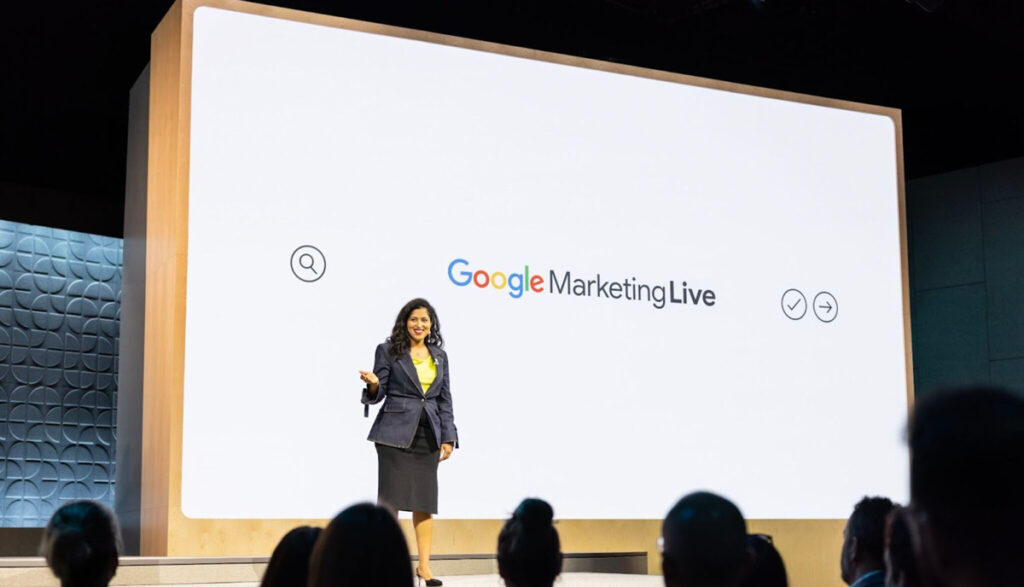
Figuring it out quickly
Srinivasan brings a considerable skill set to meet the tasks ahead of her. She trained at the Indian Institute of Technology, Madras, where she built a computer from scratch with her (all-male) classmates. After earning an MA at Georgia Tech, she spent 10 years as an engineer at IBM followed by another six at Amazon Web Services. Her current post at Google is her third, and one that represents her methodical career approach that started with leading measurement, advertiser platforms and then consumer platforms like search, travel, shopping, Gmail and Discover feed.
“It’s a privilege to run a business like this,” she said. “It is also true that it happened in increments.”
Allan Thygesen, who ran the ads business for the Americas and worked closely with Srinivasan when she joined Google in 2019, recalls what a quick study she was.
“She knows her stuff—and if she doesn’t, she figures it out very quickly,” said Thygesen, today CEO of DocuSign. “For her to come in from the outside and assume a senior leadership position speaks to how I and everyone at Google experienced her. I wasn’t at all surprised when she got handed everything.”
And everything is, well, an awful lot. Google’s advertising revenues—nearly $66 billion in Q4 alone—constitute 77% of its earnings. It’s a titanic responsibility—and perhaps a scary one?
“I don’t know if I’d use ‘scary,’” Srinivasan said. “I do feel the weight of responsibility.”
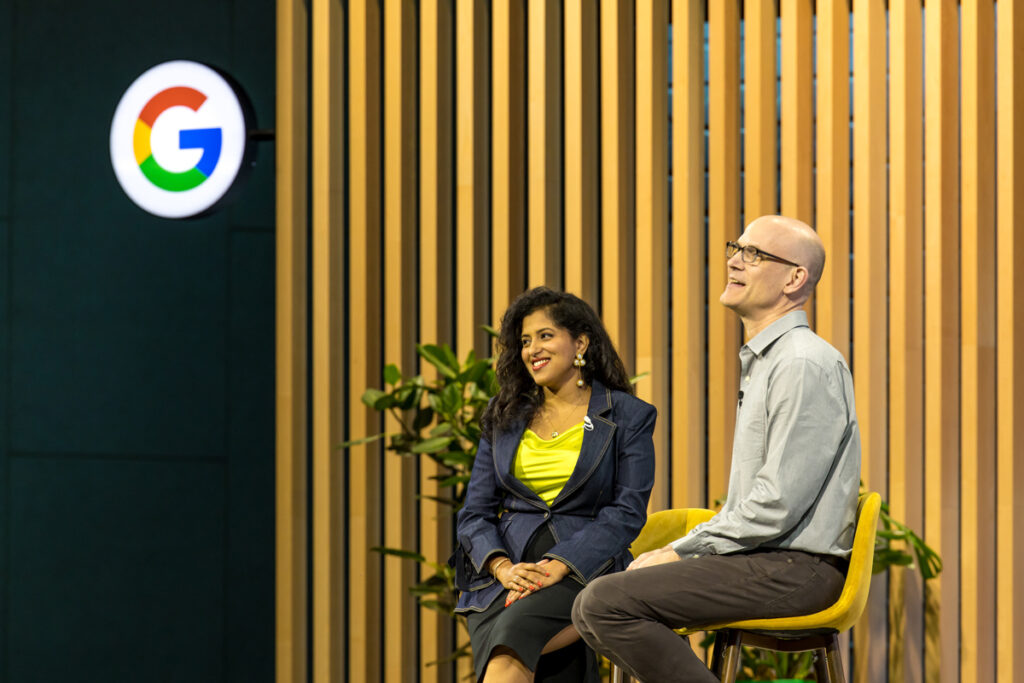
Great expectations
So did her predecessor. In a 2019 internal email (disclosed as part of the antitrust trial that wrapped up on May 3), Google’s former head of its ads business Jerry Dischler gave a sense of the pressure that the advertising division was under to meet Wall Street’s expectations. “If we don’t hit plan,” he wrote “… we get punished pretty badly in the market.”
But Srinivasan insisted: “I have never felt any kind of external pressure to do anything just for revenue.”
Even so, the expectations of the job are obviously there. Revenue, Srinivasan said, is “one aspect of it. [But] it is also a social responsibility because of the role ads play in society [and] for all the businesses we support—especially the smaller businesses and businesses run by marginalized communities. For them, it’s harder to be discovered.”
She added: “if you care about your user—in my case, both consumers as well as advertisers—it gives you energy and motivation.”
Nazli Alagheband, who’s now Srinivasan’s chief of staff, picked up on these qualities when she first saw Srinivasan host a town hall in 2019.
“The thing that’s unique about Vidya is she’s able to go from the highest level of [talking about] how a product is used with our advertisers, all the way down to the code level, and in a very graceful way,” said Alagheband. “She’s engineer, product manager, customer support agent and salesperson all at the same time.”
The challenges accumulate
While Google still has a grip on some 90% of the search market, it is no longer an unassailable monolith. According to marketing platform SOCi, 62% of Gen Zers searching for something use TikTok and 67% turn to Instagram. “Amazon is also a search engine,” said Sujata Ramnarayan, marketing lecturer at Santa Clara University’s Leavey School of Business, “and if people start using ChatGPT more, that itself becomes a search engine.”
There’s also Perplexity AI—part chatbot, part search engine—whose backers include Jeff Bezos. Perplexity CEO Aravind Srinivas has told Reuters that “Google is going to be viewed as something that’s legacy and old.”
Srinivasan is quick to say that Google’s challengers are many: “More than ever, people have an incredible amount of options.” But she maintains that “continuous innovation and evolution”—and the Search Generative Experience specifically—will allow Google to hold onto its ground.
Another issue looming large on Srinivasan’s horizon is Google’s replacement for the third-party cookie, a means of tracking consumers that privacy advocates have forced into retirement. The Privacy Sandbox, Google’s collection of tools intended to take the cookie’s place, is generating mixed reviews. In April, Google had to delay cookie deprecation for a third time, pushing back the deadline to 2025.
Srinivasan said that “the team … are trying to reconcile the feedback across industry regulators and developers. When that happens, we’ll be ready with our Sandbox offerings.”
Meanwhile, Srinivasan must also contend with conflicting views advertisers have about Google’s AI-powered ad tools, which can “be used to choose or generate creative assets—engaging text, eye-catching images and compelling videos,” Srinivasan wrote in a March post for Think With Google.
Some, like veteran industry speaker and consultant Brad Geddes, are not impressed with the creative work that the AI cooks up. “Most of it’s just pulled off the advertiser’s website,” he said. “Google’s not creating; they’re reallocating.”
“Generative AI gets so many things wrong, and that [can] screw up your advertising,” added SEO strategist Mike Grehan. “And if I’m the advertiser, sorry, I’m not paying for that.”
But the generative AI in advertising isn’t yet a revenue driver for Google. The bigger issue revolves around trusting Performance Max, which determines where to serve ads to best effect. How does it work? That’s actually the issue.
“If you speak to advertisers, they all pretty much say the same thing,” said Schwartz. “Performance Max is a black box.”
“One of Vidhya’s biggest challenges is restoring advertiser trust,” said veteran branding and marketing consultant David Deal. “Google has alienated advertisers, who have a long list of grievances ranging from a lack of transparency to being strong-armed into adopting AI-powered campaign types. Google has a lot of work to do.”
Is Srinivasan concerned about the trust issues—in particular those surrounding AI?
“Very much,” she said.
Srinivasan said she’s in touch with advertisers several times a week in an effort to get them to be comfortable with the emerging technology. In addition, “we work on making sure the AI models themselves have guardrails in place in terms of what they can and cannot do,” she said. “We do adversarial testing of these models to find flaws. And on top of that, we want advertisers to remain in control. It’s a process of evolution and getting comfortable. That’s going to take some time.”
Never mind the boys
On the job seven months, Srinivasan still has some time to grow fully into her mammoth responsibility—but not forever, of course. Yet even when discussing the formidable tasks ahead, she never wavers in her confidence.
Srinivasan credits her grandmother for that.
Widowed at 40, Vatsala raised four daughters and put them through college. She also watched over a young Vidhya while her mother worked. Though Srinivasan grew up surrounded by boys, she reaped the benefits of “seeing a very strong woman leading the household and [making] big decisions.”
“It made it easier for me in my future life,” she said, ‘because I was comfortable in a predominantly male environment. The question: ‘Can women be strong?’ was not something I knew was a question.”
https://www.adweek.com/programmatic/meet-vidhya-srinivasan-the-google-exec-with-the-toughest-job-in-advertising/