Mobile Network Three Has a Timely Message for Smartphone Haters
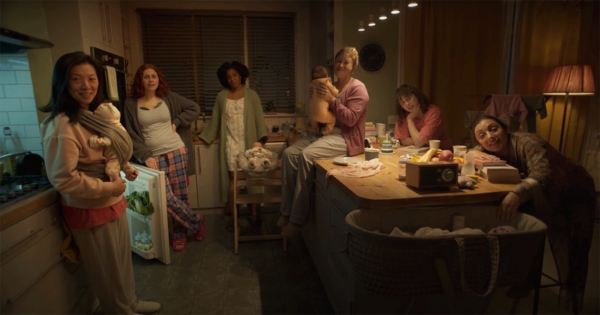
It’s the middle of the night, and a woman is struggling to get her baby to sleep. At a low moment, she walks into her kitchen and finds a group of other mothers who are also awake and ready to offer encouragement.
“You’re doing great. Trust me,” one mom says.
“Mine literally only sleeps to techno,” another chimes in.
Cue the comforting tune of “Lean on Me” by Bill Withers, as the next scene reveals an empty kitchen and the actual source of the women’s words: a group chat called Midnight Mums’ Club.
The slice of life captured in the new ad from Three, one of the U.K.’s largest mobile network operators, might be familiar to many mothers who lean on their group chats in stressful or confusing moments. But it’s not just moms who will relate to the campaign, which celebrates the power of belonging to personal networks, especially those facilitated by smartphones.
This is the fourth iteration of Three’s “Life Needs a Big Network” platform, created by London-based agency Wonderhood Studios. Debuting on Friday during the UEFA Euro 2024 championship’s opening game between Germany and Scotland, it is the brand’s biggest marketing push since the campaign’s launch in 2021.
A second ad follows a young man named Dev who is waiting for a job interview. To calm his nerves, he retreats to a stall where he encounters his entire family, who pump him up before his big moment.
This spot represents the all-too-common family group chat, a virtual space that can be “slightly chaotic and hilarious, multi-generational, sometimes with different political opinions—but ultimately there’s a lot of love,” said Aidan McClure, co-founder and chief creative officer of Wonderhood.
Along with these TV ads, the integrated campaign will run across cinema, radio, out-of-home and digital, with in-store activations and social media content spotlighting local community groups.
Positive connectivity
Three’s message focusing on “the positive impact of connected human networks,” per McClure, is timely amid growing public disquiet around the dangers of spending too much time online.
Some countries, including the U.K. and France, are considering legislation that would curb social media or smartphone use for children, with multiple studies pointing to the mental health impact of viewing harmful content online.
Brands are also catching onto this trend. Riding the wave of ‘90s nostalgia for the childhoods of millennials, Nokia recently revived its classic flip phone. And in April, Heineken partnered with Nokia manufacturer Human Mobile Devices (HMD) to release The Boring Phone, which can only send and receive calls and text messages and isn’t connected to the internet.
For a mobile network like Three, this movement presents an interesting conundrum. The brand has to “shift a bit with the way the world is going,” said McClure. “It’s all about personal networks, not broadcasting to the entire world on social media.”
Changing the brand’s image
Three’s campaign also comes during a proposed merger between the company and rival Vodafone. The deal would create the U.K.’s largest mobile phone operator, but the Competition and Markets Authority (CMA) is investigating it over concerns that consumers could face higher prices and reduced quality of service.
Three chief executive Robert Finnegan argued last month that the merger with Vodafone was “vital” to create a “best-in-class network” for the country.
On the marketing front, it is “business as usual” for Three as it continues to build on the “Life Needs a Big Network” platform, McClure said.
Over the past three years, Three’s campaign has aimed to change its image as a youthful, London-centric brand and broaden its appeal to a wider audience.
“People felt that it was not a proper network and was very value-driven,” McClure explained.
Earlier ads in the campaign focused on the “life” part of the tagline, depicting everyday, sometimes silly moments of connection, such as two grandmothers laughing at a filter on their phones.
Now the emphasis is on the word “network,” which opens up creative possibilities to tell human stories and infuse the brand with more emotional resonance, McClure said.
Since its 2021 launch, the campaign has contributed to Three’s highest levels of consideration among consumers since 2016, per the brand’s data.
“We have evolved our brand platform, ‘Life Needs a Big Network,’ to focus on the human networks that our customers value so dearly, and the sense of connection they bring to their lives,” Aislinn O’Connor, director of marketing at Three UK and Ireland, said in a statement. “Central to this is our network supporting your network in day-to-day life and the moments that really matter.”
https://www.adweek.com/brand-marketing/mobile-network-three-smartphone-haters/