Planned Parenthood Aims to Galvanize a New Generation Behind Reproductive Rights
With abortion access high on the agenda during this election year, Planned Parenthood Federation of America (PPFA) and Planned Parenthood Action Fund are launching a campaign to galvanize a new generation of activists in support of reproductive rights.
The reproductive health organization has revamped its platform “Bans Off Our Bodies,” which debuted in 2019, this time with a more diverse, wide-reaching approach that addresses the current national climate. The timing is deliberate, as in addition to the presidential election in November, the Supreme Court is expected to decide this month on the first major reproductive rights case since the 2022 Dobbs ruling, which ended the federal right to abortion.
Developed by women-owned agency Schaaf, the revamped “Bans Off Our Bodies” campaign will comprise out-of-home, social media and activations at events across the country, starting with Governors Ball in New York this weekend.
Planned Parenthood’s goal is to create a grassroots movement that “encourages people to use their voice and stand up for reproductive freedom,” said Kendra Schaaf, the agency’s founder and CEO. The agency declined to disclose this year’s ad spend.
The conversation around reproductive rights has shifted since Planned Parenthood introduced “Bans Off My Body” in 2019. In the two years since the Dobbs ruling, which overturned the Roe v. Wade decision that had guaranteed a national right to abortion, 21 states have banned all or some access to abortion. Meanwhile, other reproductive health and rights, including access to birth control and IVF treatment, have come under attack.
By the end of June, the Supreme Court is also expected to issue a ruling on a case that could limit access to the abortion pill mifepristone.
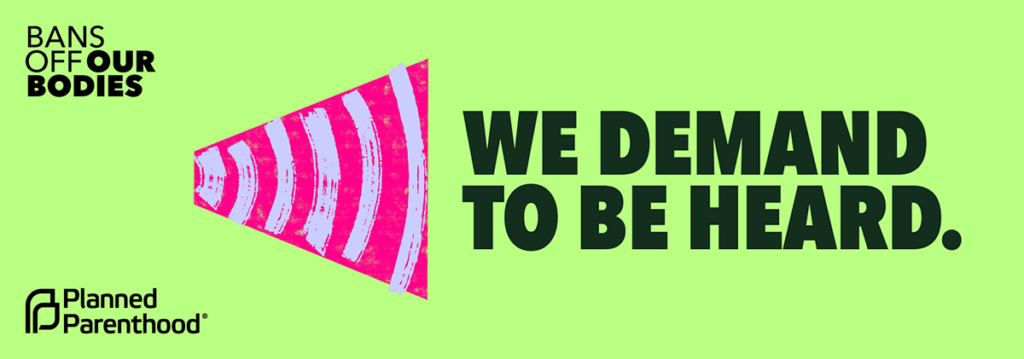
Planned Parenthood hired the Schaaf agency late last year to refresh the “Bans” platform and become more relevant for a situation in which abortion access is even more limited. The subtle shift in campaign title using “Our Bodies” instead of “My Body” reflects the “more holistic” approach that targets a wider audience, including women, men, trans and nonbinary people aged between 18 and 40, Schaaf explained.
“Our audience is all people who support reproductive freedom. It’s broader than abortion,” Schaaf said. “Today there are attacks on people’s bodies of all different shapes, sizes, creeds and colors.”
Despite the upcoming election, with politicians on both sides debating this issue, Schaaf insisted that “Bans Off Our Bodies” is nonpartisan.
“It’s not intended to comment on what’s happening at the state or national level as it relates to political candidates,” she said. “The intention is not to be divisive but to bring people together. Depending on where you are in the country, this moment in time can feel very isolating.”
The campaign emphasizes that those who support reproductive freedom are in the majority. An ABC News/Washington Post poll conducted last year found that 66% of Americans said the mifepristone pill should remain on the market, and 78% said the decision whether to have an abortion should be left to a woman and her doctor rather than regulated by law.
Staying optimistic
Above all, “Bans Off Our Bodies” is meant to be participatory. The team opted for a socially driven, experiential approach with the goal to “create something that anyone can pick up and use,” said Meg Farquhar, the agency’s executive creative director and partner.
Every element of the creative assets, from the fonts to the graphics, was designed to be simple so that other people could easily replicate them and create their own protest ads to share on social media or in-person, Farquhar added.
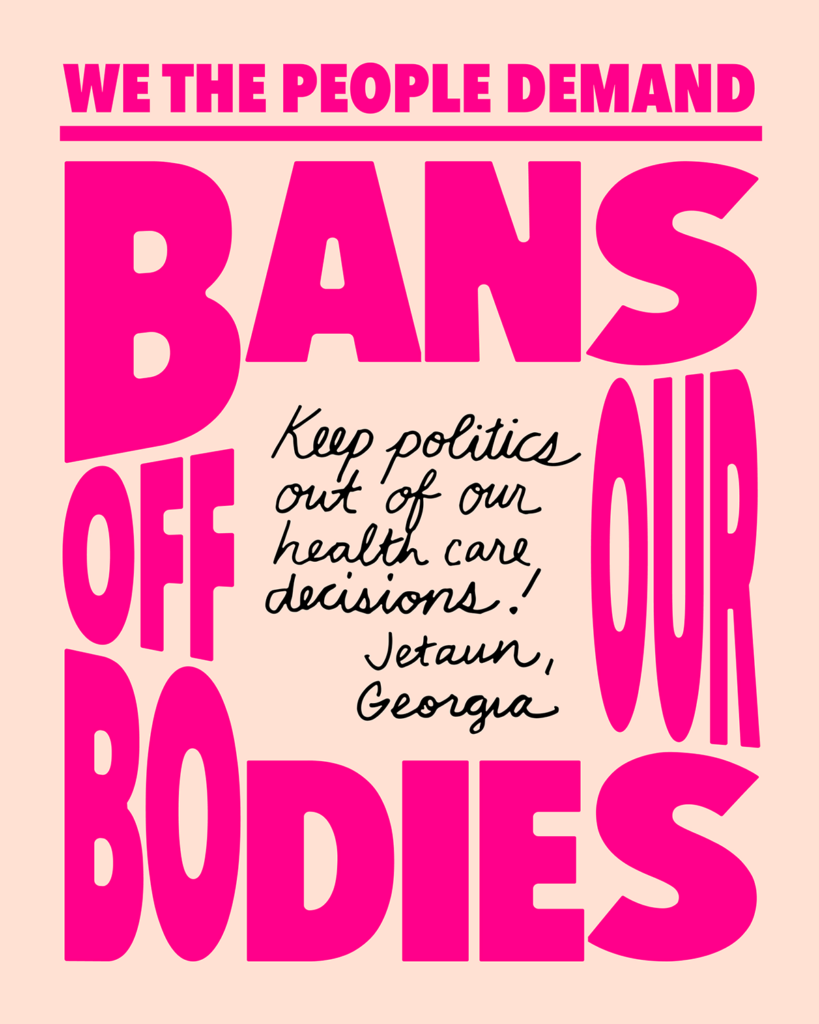
At Governors Ball in New York on June 7-9, Planned Parenthood will host an area with an 8-foot-tall 3D frame in which people can write their wishes and demands for reproductive freedom and take photos to share on social media.
In New York neighborhoods including the East Village, South Bronx, Bushwick, Astoria and Harlem, Planned Parenthood will set up additional spaces where people can write their demands. There will also be out-of-home ads running in cities including Columbus, Atlanta and Miami.
Farquhar said the organization is still in talks with celebrities and music artists who could back the initiative. In 2019, pop stars Ariana Grande, Billie Eilish and Dua Lipa were among a group of nearly 140 musicians who signed an open letter in support of abortion rights as part of Planned Parenthood’s campaign.
This year’s effort also strikes a more “uplifting” tone to stand out amid a national mood that is largely negative and weary, said Farquhar.
“We wanted to create something broad that could encompass all people, but do it in an uplifting and positive way. There’s a lot of sadness and exhaustion,” she said. “To bring new people into the fight, we have to be optimistic.”
“As we predicted, the anti-abortion agenda that ended our federal abortion rights two years ago when the Supreme Court overturned Roe v. Wade continues to relentlessly attack our health and rights even further,” Melanie Newman, svp for communications and culture at Planned Parenthood Federation of America and Planned Parenthood Action Fund, said in a statement.
“Today, 78% of Americans agree that unqualified public officials have no place in our medical decisions. We are rising up to rewrite our rights and shout, ‘Bans Off Our Bodies.’”
https://www.adweek.com/brand-marketing/planned-parenthood-reproductive-rights-bans-off-our-bodies/