Restaurants Are Innovating With Takeout in Mind. Here’s Why.
Don’t miss Brandweek, Adweek’s ultimate experience for marketers, September 11-14 in Miami. Connect with peers and gain insights and inspiration from top brand marketers and industry icons at Glossier, Coca-Cola, Taco Bell and more. Register.
Earlier this month, Carvel—the ice cream chain that invented soft serve in 1934—announced plans to redesign its 350 stores. It wasn’t exactly a surprising development.
Like any retail establishment that’s been around a long time (Carvel turns 90 next year), periodic store refreshes are standard procedure. When Carvel’s prototype opens in Gainesville, Fla., early next year, customers who wander inside will see new colors, digital menu boards, a spruced-up seating area, and a new soft-serve machine that offers eight flavors.
“Almost anytime you upgrade a shop, you see a lift in sales,” chief brand officer Jim Salerno told Adweek. “It’s always exciting for the guests to have something new.”
But one of the added elements is about more than just a periodic update. A new freezer case will stand at the ready for customers who’ve already ordered online and are coming just to pick up their orders and leave. Takeout traffic now makes up a sizable percentage of Carvel’s business. And if it hadn’t been for Covid-19, Carvel probably wouldn’t have so many customers who want it—and the brand probably wouldn’t have needed that new freezer case.
“What we learned from the pandemic was we had a pretty good delivery business—it increased significantly during Covid, and that, for the most part, has remained,” Salerno said. “So it was good timing for us.”
Carvel has plenty of company. In recent weeks, several national restaurant chains have either announced store redesigns or begun implementing plans that have been on the drawing board for a year or more. For these brands, not only did Covid-19 change the consumption patterns of their customers, but the emergence from three years of pandemic conditions has also furnished the optimal timing for design changes that cater to them.
Restaurant brands “are coming out of Covid, so that’s encouraging them to look at what they are currently doing in today’s market,” observed John Stanton, who teaches food marketing at St. Joseph’s University in Philadelphia. “They’re watching the way customers change—and change to be consistent with their new behavior.”
The temporary is now permanent
Specifically, that new behavior means an increase in to-go orders. According to the National Restaurant Association’s 2023 State of the Restaurant Industry report, 60% of restaurateurs say that takeout makes up a larger percentage of their sales than it did in 2019. Polling more than 380,000 restaurants, the same report revealed that what had been a “pandemic pivot” toward takeout and delivery has now become “permanent.”
On Aug. 15, Wendy’s cut the ribbon on the first two of its “Global Next Gen” restaurants, which opened in Kansas and Oklahoma. Markedly different from the burger chain’s 7,000 existing locations with their red corner pillars and honey-colored wood siding, the locations contain the most dramatic changes inside, where the emphasis is clearly on taking out instead of dining in. Larger, dual-sided galley kitchens can serve up 50% more food, much of it destined for a dedicated pickup window. There are also self-service kiosks and shelves for customers to fetch their orders and leave.
Speaking with Adweek, Wendy’s president and international chief development officer Abigail Pringle explained that takeout’s growing share of business was the impetus behind the infrastructural changes. “The focus on digital ordering has accelerated over the past few years as customers have become more comfortable with delivery, online and mobile ordering,” she said. “We expect this trend to continue.”
Some 200 stores will feature the new design between now and 2024, according to the company.
Meanwhile, aside from burgers …
Americans’ pandemic-forged yen for takeout has led to design tweaks for brands in other segments, too. Papa Johns announced a new look for its international stores earlier this year, which closely resembles the domestic-store remodeling plan it spoke to Adweek about at the end of 2021.
Developed to streamline takeout, the package includes pickup shelves and large plate-glass windows through which customers waiting for their pies can watch the action in the kitchen. (Oversized lettering spanning the wall over the window announces, “Welcome to the Dough Show.”) The new design eliminates menu boards, too. “Over 80% of our purchases [now] happen online, [so] there isn’t necessarily a need for menu boards,” said then-chief commercial officer Max Wetzel. (Wetzel stepped down in March.)
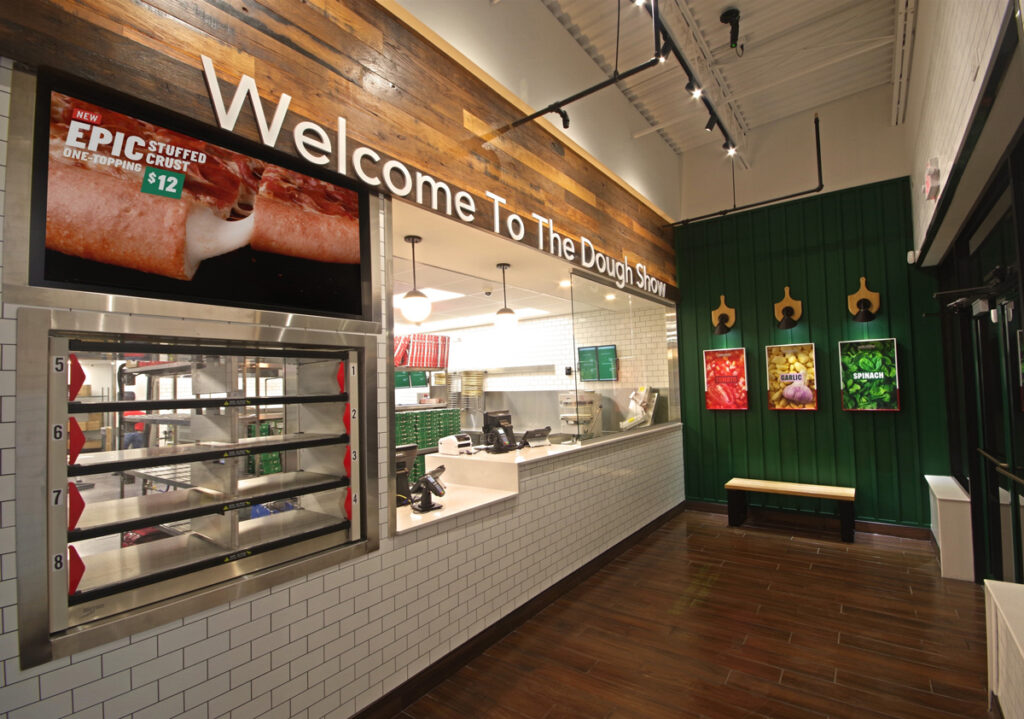
With the redesign now rolling out across the system, chief international and development officer Amanda Clark told Adweek that headquarters has “received very positive feedback on our new restaurant design” and that “franchisees are attracted to [its] operational efficiencies … they are better able to manage fluctuations in order type and volume.”
For its part, casual-dining pioneer TGI Fridays was—at least as of 2022—also at the drafting table with the to-go business in mind. Speaking at a conference last year, CEO Ray Blanchette detailed a scaled-down prototype called Fridays on the Fly, a 2,500-square foot restaurant designed to better handle takeout orders placed during off-peak hours.
On Aug. 30, CMO Brandon Coleman III replaced Blanchette in the CEO’s office, so it was not clear at press time if the experimental Fridays was still going to fly at headquarters, which did not respond to Adweek’s request for an update.
The role of indulgence
Upscale ice cream brand Häagen-Dazs also went public with redesign plans recently, though the reasoning wasn’t solely about takeout. Eating ice cream at home is already a long-established tradition in America, with various surveys indicating that 7 in 10 of us have ice cream in our freezers at all times, and two-thirds most often eat it on the sofa in front of the TV.
With a creative assist from Chase Design Group, Häagen-Dazs had updated its packaging in 2021 and planned for retail locations to follow suit. Dispensing with the mall-ish look that featured stark colors (white, black and burgundy), the updated stores feature blond wood and gold-colored “tapestry” wallpaper that warms up the environment in hopes of drawing more customers inside.
But while the new store plans had been in the works for a while, Häagen-Dazs marketing director Rachel Jaiven told Adweek that the wind-down of the pandemic did feel like the right time to begin implementing them. In the pandemic’s first two years especially, Americans who’d canceled travel plans and found themselves cooped up at home fought the doldrums by indulging themselves in upmarket skin care products, clothing purchases and alcohol. Those tendencies remain, and Häagen-Dazs hopes its new store design will speak to them.
“Consumers [still] want to treat themselves, but they don’t want it to break the bank,” Jaiven said. “There is an affordable luxury of being able to go in and get a beautiful dessert made by Häagen-Dazs. That is definitely a trend that we see, this idea of affordable, casual luxury.”
This story is part of The New Dynamics of Marketing Innovation special feature.
https://www.adweek.com/brand-marketing/restaurants-are-innovating-with-takeout-in-mind-heres-why/