Salesforce President Ariel Kelman’s 25-Year Playbook for Marketing at Scale
In our tech-powered world, technology marketers cannot afford to lose sight of client trust. And yet, they do.
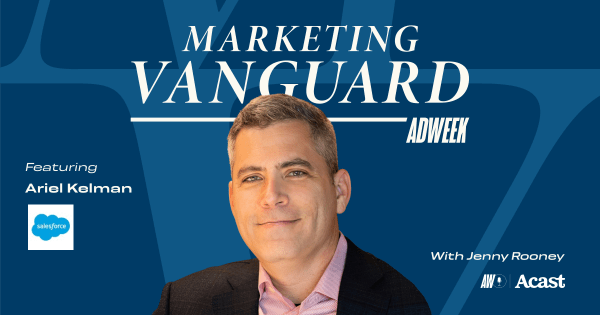
On this episode of the Marketing Vanguard podcast, Ariel Kelman, president and CMO of Salesforce, reveals why customer success storytelling matters more than ever, how to ground AI in trusted first-party data, and the key strategies for balancing AI automation with human creativity.
What you’ll learn:
- How to ground AI agents in customer data to drive measurable outcomes
- Why CMO leadership must pioneer AI adoption before mandating it across teams
- AI’s productivity paradox: Why it enables both more output alongside better work-life balance
- How to position your brand’s trust as a competitive moat in the AI era
- The framework for balancing centralized brand strategy with decentralized field execution
- Why “show, don’t tell” beats feature-focused marketing when launching complex products
Ariel Kelman is the president and CMO of Salesforce, leading global marketing strategy across one of the enterprise software industry’s most diverse and expansive product portfolios. With a background spanning product management, startup leadership and tenures at AWS and Oracle, Ariel brings two decades of expertise in B2B tech marketing, customer success positioning and AI-driven business transformation.
His work at Salesforce—from pioneering early SaaS adoption strategies to spearheading the AgentForce platform launch—has shaped how enterprise organizations approach AI implementation and customer engagement at scale, making his POV essential for CMOs navigating the intersection of brand, demand generation, and artificial intelligence.
Episode Highlights:
[12:54] How Show, Don’t Tell Cuts Through AI Hype — Ariel highlights that, in crowded AI markets, letting proven customers tell stories is exponentially more credible than marketing claims about platform superiority, speeds, or power — a lesson Salesforce operationalized through AgentForce City at Dreamforce. Rather than explaining technical specifications, Salesforce constructed an interactive village where attendees walked into real customer implementations: Williams Sonoma using AI agents for shopping, and so on.
This “show, don’t tell” approach succeeds because decades of tech industry overpromising have made B2B buyers deeply skeptical; only peer proof shifts perception and preference. This strategy transforms marketing from persuasion to evidence-gathering, dramatically shortening sales cycles and improving win rates.
[21:50] Leadership Must Try AI Before Expecting Their Team To — Ariel identifies the biggest barrier to AI adoption in marketing organizations as psychological resistance to change, not technological capability. Assigning teams to “find one AI efficiency initiative” fails because it ignores change aversion; instead, executive leaders must become visible pioneers, experimenting with tools themselves and sharing results transparently with their organizations.
For CMOs managing organizational change, leading by example removes the psychological burden of “moving someone’s cheese” and transforms AI adoption from mandate to aspiration.
[24:55] Without Unified Customer Data, AI Will Fail — Ariel stresses that first-party data activation is foundational to AI success. In his opinion, it’s a prerequisite even more critical than technology selection as generic AI outputs fail when grounded in incomplete or siloed customer information. CMOs must ensure their customer data platform harmonizes all signals (purchase history, product usage, support interactions, web behavior, location) into a single source of truth accessible to AI engines without compromising security or privacy.
Without this foundation, AI agents will generate irrelevant follow-ups to customers with open support tickets, deliver location-generic event invitations, or miss high-propensity opportunities buried in unconnected systems.
[27:14] Learn From Other CMOs’ Failures, Not Just Their Wins — Ariel reveals that his most actionable insights come from peer networks where CMOs discuss hard organizational problems — centralization versus decentralization, attribution models, brand-versus-demand-gen budget splits and which AI tools actually deliver ROI — but emphasizes that failures teach more than successes.
When leaders openly share what didn’t work (organizational structures that looked good on paper but failed in execution, AI tools hyped but underutilized, attribution models that broke under scrutiny), CMOs gain pattern recognition to avoid repeating mistakes. For CMOs building their leadership practice, construct a personal network of 5-10 peers at comparable companies and establish regular cadences to discuss what’s failing, not just what’s winning. This vulnerability-based learning accelerates decision-making, de-risks major structural changes, and prevents expensive pivots.
https://www.adweek.com/brand-marketing/salesforce-president-ariel-kelmans-25-year-playbook-for-marketing-at-scale/