Scope3 Takes on IAS, DoubleVerify With Custom AI Agents for Brand Safety
Nominations are open for The AI Trailblazers awards! We’re accepting nominees with a talent for driving AI innovation. Place nominations before Jan. 31.
Scope3 has launched an AI-powered brand safety and suitability product, taking on incumbents DoubleVerify and Integral Ad Science.
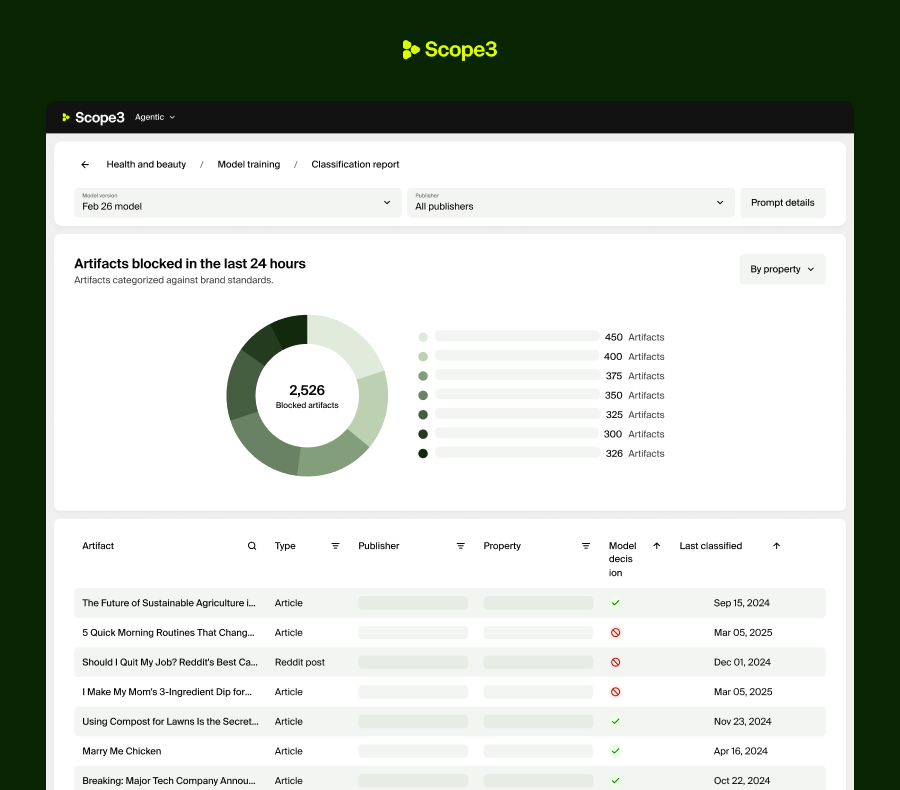
Scope3’s Brand Standards lets advertisers build their own AI agents—programs that can take autonomous action on behalf of users—for brand safety. The agents can use criteria like a brand’s specific values, business goals, and target audience demographics, and business goals, to evaluate brand suitability fit down to the individual piece of content on a given webpage or interface.
The system scans ad inventory in real time, filtering out unsuitable content and ensuring ads flow through verified supply paths with as few intermediaries as possible. It also provides explanations to advertisers and publishers for why content is approved or blocked, and humans can adjust brand parameters.
“It’s a radically improved way of thinking about brand safety and suitability,” said Scope3 CEO Brian O’Kelley. “It gives big brands the ability to create bespoke brand safety and suitability agents … it can also take other core needs of brands—like sustainability [into consideration].”
Scope3 hopes that the approach will reduce unnecessary content blocking, reduce ad waste, and improve accountability in digital advertising.
Meta, Amazon DSP, publishing giant Dotdash Meredith, and SSP Index Exchange are among the first to integrate the tool.

A ‘rethinking’ of brand suitability
The launch comes just weeks after a damning Adalytics report revealed that ads for major brands appeared on a site known to host child sexual abuse material (CSAM), sparking scrutiny over existing brand safety tools. The report put IAS and DoubleVerify under fire.
O’Kelley told ADWEEK that IAS and DoubleVerify run ads before fully classifying content, exposing advertisers to unnecessary risks. Scope3’s Brand Standards product does not allow ads to be served on unclassified content.
Also, current brand safety approaches rely too heavily on keyword blocking—a blunt approach that can inadvertently block suitable content like news.
Brand Standards represent a “much needed rethinking of what current brand safety and ad verification providers do,” said Ruben Schreurs, group CEO at media analytics firm Ebiquity.
Ebiquity’s Effective and Responsible Advertising Curriculum, a digital rulebook for helping advertisers ensure their investments are both effective and compliant with various standards and regulations, will be integrated into Brand Standards.

A flexible platform for agent-driven media activity
Brand Standards runs on Scope3’s new Agentic Media Platform, unveiled Thursday, which lets publishers, agencies, SSPs, and adtech firms apply AI-driven decision-making across programmatic, direct buys, and private marketplaces. It also lets advertisers manage ad placements across multiple supply-side platforms (SSPs) from a single system.
Scope3 joins a growing contingent of AI agent platforms, with offerings from Amazon Web Services, Google, and Microsoft cropping up in recent months.
With Scope3’s platform, users can integrate third-party software or AI agents, or build their own agents on the platform, which can then be deployed to manage a variety of different activities.
For instance, an advertiser might use the platform to integrate with SSP Index Exchange to set up a PMP that taps an AI agent to help optimize for media quality and price.
“We, on the sell side, have so much rich signal from our publisher integrations,” said CEO Index Andrew Casale. “We have full URL [data on ad placements], we have device information, we have all kinds of slot and page information. And all of that rich signal is able to be pushed over to the Scope3 system … to run super sophisticated brand suitability and other forms of targeting and optimization that historically were a lot harder to do at scale.”
Index Exchange is a launch partner for the program and models built on the new platform may be trained on its data.
Using AI to push sustainability
O’Kelley brushed aside potential concerns about a blowback over the energy-intensive computing power of its new AI programs, saying the demands of the Agentic Media Platform would be offset by the eventual reduction in ad waste it would facilitate.
“If we don’t fix the problems with programmatic outright, we’re wasting millions of tons of carbon,” he said.
In tests with Agentic Media Platform, O’Kelley said that Scope3 was able to reduce the overall carbon footprint of a campaign by about 30% on average.
“If we could do this for every single impression, we’re talking about a million to two million metric tons of carbon a year that we’d reduce,” he added.

https://www.adweek.com/programmatic/scope3-ias-doubleverify-ai-agents-brand-safety/