Scope3 Tool Shows How Reducing Carbon Impacts Media Performance
Green adtech firm Scope3 launched a new dashboard, Media Reporting, to show how cutting carbon emissions will impact campaign performance—a missing link that could spur more buyers to adopt greener media planning solutions.
The Media Reporting dashboard includes a simulator that forecasts how removing particularly high-emitting publishers affects performance metrics like click-through rate, cost per acquisition and viewability, which gives brands putting together greener media plans some visibility into how their advertising goals might be impacted.
“We’ve been doing this in a bespoke consulting fashion for some time,” said Anne Coghlan, co-founder and chief operating officer at Scope3. “This product that we’ve built gives the ability for a brand to pull in its own data and understand what happens when it takes steps to reduce emissions. How will this impact performance?”
Scope3 developed Media Reporting earlier this year and has four brands actively using the product.
The industry has been trying to reduce carbon from the programmatic supply chain over the past two years. But brands have been slow to make changes, demand-side platform executives said at the Green Media Summit in April.

How the dashboard works
Scope3 clients see the dashboard once they upload a post-campaign report.
Brands can also connect Scope3 to their buying platform directly via application-programming interfaces so that campaign emissions can be calculated in real-time with Scope3 updating the dashboard daily, Coghlan said.
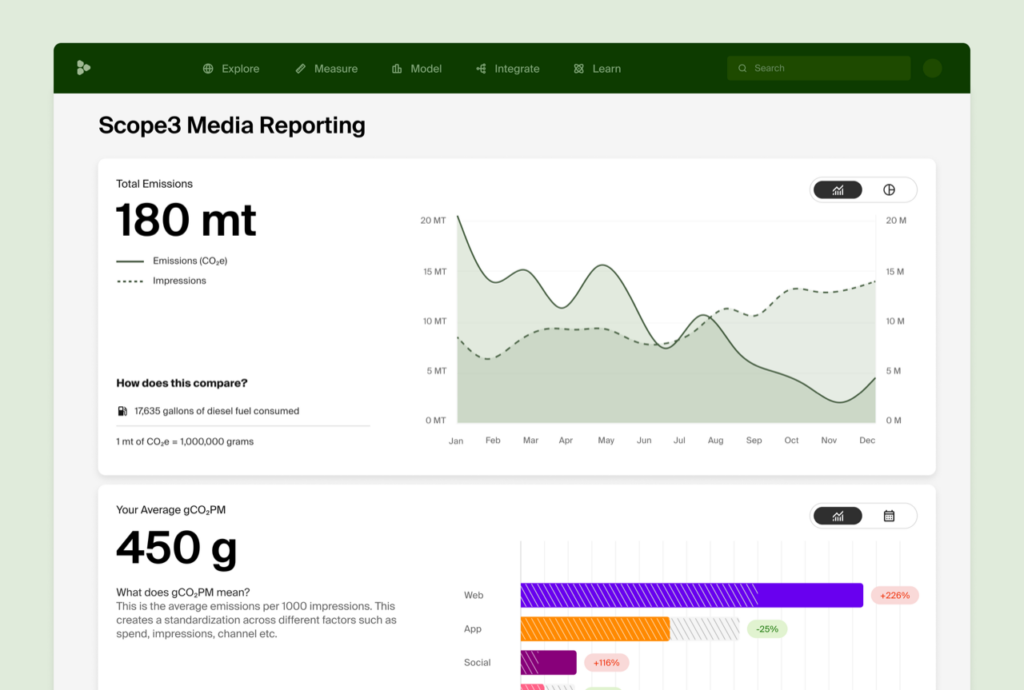
Once data is uploaded, brands can see total emissions and average emissions per thousand impressions, and compare their campaign emissions to previous campaigns and the rest of the industry using aggregated data.
Brands also can see which publishers release the most carbon and what percent of a campaign’s impressions are going to high emitters, an industry feature that has vexed publishers for its lack of feedback.
This dashboard is available for all media types, including walled gardens. Last month, Snapchat became the first social platform to partner directly with Scope3. For other walled gardens, where there is less impression-level transparency compared to the open web, Scope3 is more reliant on publicly available data, like information in Meta’s corporate sustainability report.
However, the simulator tool only applies to programmatic web and display inventory.
Lower carbon, lower CPA
The simulator identifies climate risk in a prospective campaign, defined as both high-carbon websites and websites considered made-for-advertising. Then, the simulator estimates how much lower emissions would be for the total campaign if these publishers were cut out, and how performance would be impacted.
Scope3 determines the link between performance and emissions by modeling on a digital twin of the ad ecosystem, a Scope3 spokesperson said.
One Scope3 client found that when simulating the removal of climate risk from campaigns, there would have been a 16% reduction in carbon and a 6% decrease in CPA. Another client showed a reduction in carbon with a slight decrease in CTRs (due to removing MFA sites that are designed to inflate CTRs), the spokesperson said.
Across an aggregate of campaigns, which can give a fuller picture compared with one-offs, Scope3 tested over 32 million total impressions of web inventory in the U.S., with brands seeing reductions in carbon of 11% to 36%. Across most of the studies, performance remained consistent or improved: These drove increases of between 3% and 27% in viewability, and eCPMs (effective CPMs) decreased from 2% to 4% of emissions of their media buying.
Scope3 will charge for the service either as a per-impression fee or a flat software-as-a-service fee, depending on client preference, Coghlan said.
Fulfilling an industry need
The relationship between cutting emissions and advertising performance has been lacking and could be responsible for buyers’ slow uptake, said Ariel Deitz, vice president of enterprise sales at Nexxen.
“If this new product proves performance for advertisers, this can be useful,” Deitz said. “We’re tying green media to KPIs [key performance indicators] that advertisers are accustomed to measuring.”
However, the granular, real-time dashboard of the carbon emissions of campaigns could eventually max out its utility, especially because carbon emissions are unlikely to fluctuate daily, said Laura Wade, global head of sustainability strategy at EssenceMediacom.
“Because the data is modeled, there is not much variation day by day,” Wade said, also noting that using a dashboard comes with its own carbon emission. “To pull data [every day] is excessive.”
https://www.adweek.com/programmatic/scope3-tool-shows-how-reducing-carbon-impacts-media-performance/