On Thursday, OpenAI released an early Windows version of its first ChatGPT app for Windows, following a Mac version that launched in May. Currently, it’s only available to subscribers of Plus, Team, Enterprise, and Edu versions of ChatGPT, and users can download it for free in the Microsoft Store for Windows.
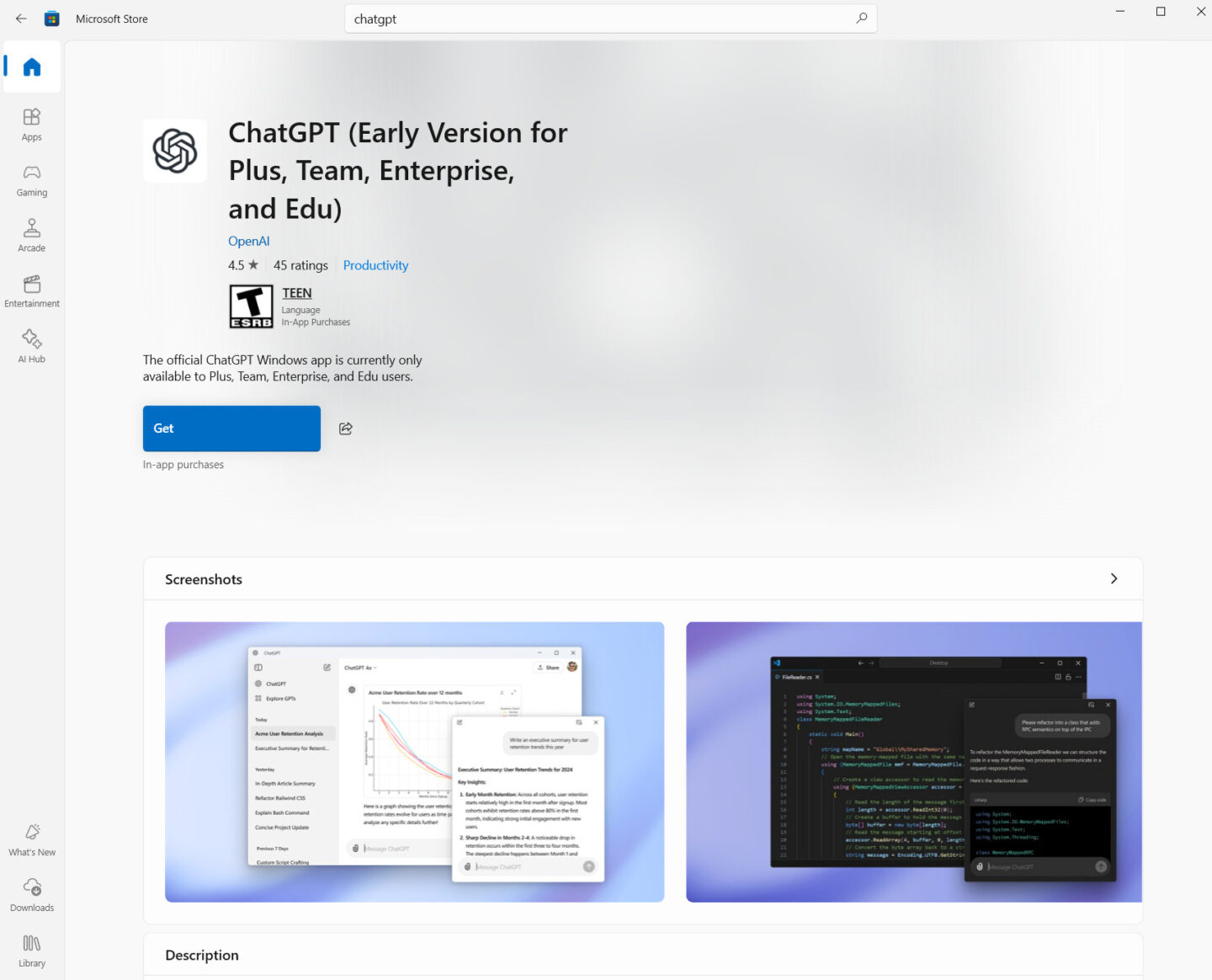
OpenAI is positioning the release as a beta test. “This is an early version, and we plan to bring the full experience to all users later this year,” OpenAI writes on the Microsoft Store entry for the app. (Interestingly, ChatGPT shows up as being rated “T for Teen” by the ESRB in the Windows store, despite not being a video game.)
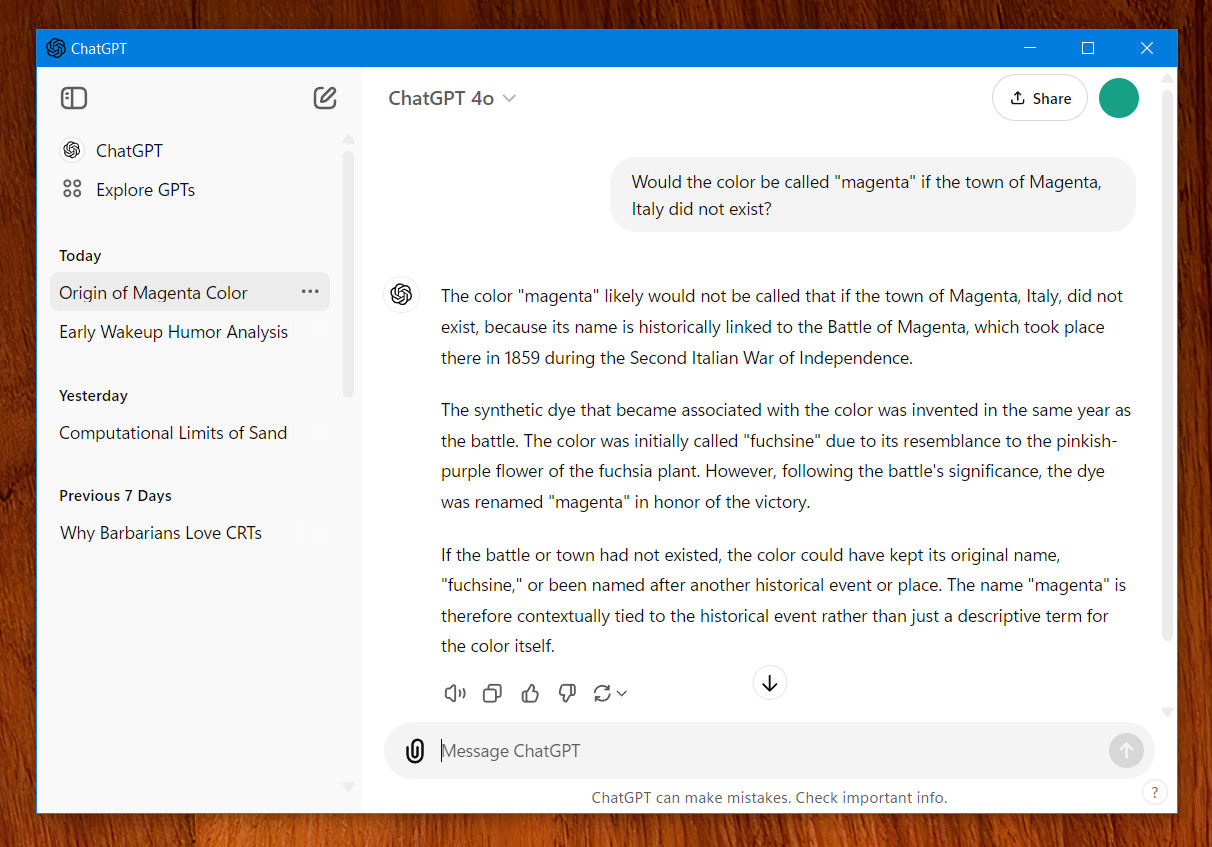
A screenshot of the new Windows ChatGPT app captured on October 18, 2024.
Credit: Benj Edwards
A screenshot of the new Windows ChatGPT app captured on October 18, 2024. Credit: Benj Edwards
Upon opening the app, OpenAI requires users to log into a paying ChatGPT account, and from there, the app is basically identical to the web browser version of ChatGPT. You can currently use it to access several models: GPT-4o, GPT-4o with Canvas, 01-preview, 01-mini, GPT-4o mini, and GPT-4. Also, it can generate images using DALL-E 3 or analyze uploaded files and images.
If you’re running Windows 11, you can instantly call up a small ChatGPT window when the app is open using an Alt+Space shortcut (it did not work in Windows 10 when we tried). That could be handy for asking ChatGPT a quick question at any time.
A screenshot of the new Windows ChatGPT app listing in the Microsoft Store captured on October 18, 2024.
Credit: Benj Edwards
A screenshot of the new Windows ChatGPT app listing in the Microsoft Store captured on October 18, 2024. Credit: Benj Edwards
And just like the web version, all the AI processing takes place in the cloud on OpenAI’s servers, which means an Internet connection is required.
So as usual, chat like somebody’s watching, and don’t rely on ChatGPT as a factual reference for important decisions—GPT-4o in particular is great at telling you what you want to hear, whether it’s correct or not. As OpenAI says in a small disclaimer at the bottom of the app window: “ChatGPT can make mistakes.”
Adobe shows off 3D rotation tool for flat drawings
“That’s wizardry”
The on-stage demo showed off rotations for a number of varied images, from largely symmetrical dragons, horses, and bats to more complex shapes like a sketch of a bread basket or a living cup of fries (complete with arms, legs, eyes, and a mouth). In each case, the machine-learning algorithm does an admirable job assuming unseen parts of the model from what’s available in the original 2D view, extrapolating a full set of legs on a side-view horse or the bottom of the Fry Man’s shoes, for instance.
Vertical rotation lets you see the bottom of Fry Man’s shoes here.
Vertical rotation lets you see the bottom of Fry Man’s shoes here. Credit: Adobe
Still, we’re sure the vector models on stage were chosen to show Project Turntable in its best light. Without a public testable version, it’s hard to say how it would handle weird edge cases or drawings that don’t closely match objects in its training data (which we don’t know the extent of).
Even so, what was shown on stage has some obvious appeal for working artists. After seeing the on-stage video, Ars Creative Director Aurich Lawson exclaimed on our internal Slack, “That’s wizardry. I don’t know how well it really works—I bet not nearly as good as that demo a lot of the time—but I’m impressed.”
Project Turntable is also notable because it augments original work by human artists rather than replacing it with images created whole cloth by AI. While Project Turntable saves those artists the effort of drawing their 2D objects and characters from multiple angles, that human artist is still responsible for the overall style and look of that original work. Maintaining that human style seems to be a key point for Adobe, which points out that “even after the rotation, the vector graphics stay true to the original shape so you don’t lose any of the design’s essence.”
Adobe’s Brian Domingo told the Creative Bloq blog there’s still no guarantee that Project Turntable will ever be released commercially. Given the obvious enthusiasm of the demo crowd at the MAX conference, though, we think it’s safe to assume that Adobe will do whatever it can to get this feature ready for prime time as soon as possible.
ServiceNow: AI e automazione per accelerare la transizione digitale ed energetica
Dalla trasformazione digitale della sanità e del settore medico-ospedaliero nazionale, alla transizione energetica delle imprese, fino al rapporto tra dati e territori, cresce il ruolo dell’intelligenza artificiale (AI) e dell’automazione per favorire efficienza, sicurezza e sostenibilità.
Di seguito i vantaggi offerti dalla piattaforma di ServiceNow con gli interventi a ComoLake 2024 di Francesco Belardinelli, Senior Enterprise Account Executive, Enrico Leporini, Sales Director – Energy & Utility, Telco, e Amedeo Muro, Enterprise Sales Director.
L’AI per ridurre la frammentazione del dato sanitario
F. Belardinelli
Il servizio sanitario nazionale è un elemento strategico per il Paese, perché rappresenta un beneficio economico, sociale e culturale per tutti noi, che abbiamo il compito di renderlo più sostenibile e sicuro.
<!-- ARUBA - 300x250 -->
“Un sistema che muta costantemente e che ha a che fare con una domanda universale che cambia col tempo e con il succedersi degli eventi. Un sistema che deve offrire servizi, una molteplicità di servizi, declinati in funzione dei territori, e che ha necessità di essere supportato nel suo funzionamento da soluzioni tecnologiche innovative, che abilitano le trasformazioni di processo di cui il sistema stesso ha bisogno”, ha spiegato Francesco Belardinelli, Senior Enterprise Account Executive di ServiceNow.
“Una transizione che a sua volta deve essere governata, che deve essere pervasiva, semplice e sicura e in questo l’intelligenza artificiale può dare un grande contributo”, ha proseguito Belardinelli.
“Per risolvere poi il problema della frammentazione del dato – ha affermato il Senior Enterprise Account Executive di ServiceNow – c’è da affrontare la questione della mancanza di una visione unica dell’informazione relativa alla salute dei cittadini. Qui possiamo impiegare tecnologie che rendono più facile l’accesso a questi dati, più immediato il loro utilizzo e l’intelligenza artificiale può essere il fattore abilitante”.
“Possiamo chiamarla liquidità dei dati o dell’informazione, che questa tecnologia può favorire e rendere concreta, con grandi vantaggi per la Pubblica Amministrazione. ServiceNow sta investendo su questo e l’apertura dei due nuovi Data Center a Roma e Milano supporteranno il processo di innovazione a partire da servizi di prossimità alle amministrazioni pubbliche e alle strutture sanitarie, rendendo l’intero settore della sanità più efficiente, sicure e sostenibile”, ha concluso Belardinelli.
Il supporto alla trasformazione energetica e digitale delle imprese
E. Leporini
“ServiceNow è una piattaforma versatile in grado di integrarsi con il mondo esterno e in grado di automatizzare i processi. È costituta da tre elementi principali: è unica, ha un unico modello di dati e un unico codice. Questi insieme permettono a ServiceNow di accelerare il time to market riducendo il tempo della delivery“, ha detto Enrico Leporini, Sales Director di ServiceNow.
“Immaginiamo un’azienda energetica che ha bisogno di monitorare un grande numero di asset (reti di distribuzioni, infrastrutture critiche). ServiceNow è in grado di monitorare questi oggetti tutti insieme in maniera centralizzata, in real time ed in grado non solo di gestirne il ciclo di vita, ma anche di intervenire in maniera predittiva nel momento in cui si verifica una serie di guasti. Questo riduce i costi e tempi di intervento e quindi maggiore efficienza. Nel mondo energy inoltre le normative sono molto stringenti, evolvono e cambiamo in continuazione. Noi monitoriamo i cambiamenti delle normative che regolamentano il mercato, dando una maggiore sicurezza per chi poi deve gestire questi KPI e intervenire per tempo ed evitare eventuali sanzioni amministrative“, ha proseguito Leporini.
Tre gli elementi chiave secondo Sales Director che ServiceNow può garantire: “la riduzione dei tempi di intervento (i cosiddetti SLA), la riduzione dei costi operativi e la riduzione dei tempi di intervento.E questo può avvenire grazie all’intelligenza artificiale generativa di ServiceNow, che si distingue dal mercato in quanto è l’insieme di 3 elementi fondamentali: i dati, l’AI e l’automazione”.
“Automazione, che è il cuore della piattaforma, perché riesce in real time ad automatizzare tutta una serie di processi e questo chiaramente agevola una maggiore efficienza e favorisce la riduzione dei costi dell’implementazione stessa”, ha precisato Leporini.
La piattaforma di ServiceNow per incrementare l’efficienza della PA
A. Muro
“L’artificial intelligence ed in particolare la piattaforma generative AI di ServiceNow ci consentono di dare un valore nuovo al concetto di efficienza“, ha affermato Amedeo Muro, Enterprise Sales Director di ServiceNow.
Muro nel suo intervento ha parlato di processi di digitalizzazione e servizi al cittadino, di come la generative AI e l’artificial intelligence di ServiceNow si integra con il tema della sicurezza dei dati e della formazione del personale riconvertendo le competenze in ambito digitale rispetto alle potenzialità che l’IA generativa consente e offre.
“L’incremento dell’efficienza va dal 32 al 35%, dipende da chi usa questa tecnologia e dai territori dove è impiegata la tecnologia – ha proseguito il Direttore – è evidente che non ci può essere incremento di efficienza senza che all’adozione della tecnologia non segua un cambio di organizzazione. Una trasformazione essenziale“.
“Come riusciamo a rendere tutto questo in termini di casi d’uso e soprattutto rispetto alla PA come riusciamo a farlo? La piattaforma di ServiceNow consente all’utilizzatore, sia esso la Pubblica Amministrazione e del comparto privato, di utilizzare questa mole di dati, di qualità e sicurezza, dettando quelle che sono delle attività di processo, dei flow aziendali che diventano a loro volta dei flow disegnati dall’utente stesso“, ha aggiunto Muro.
“Un cambiamento epocale dal punto di vista dell’innovazione, perché non si scrivono più dei codici, ma si detta allo strumento il codice che deve essere eseguito. In termini di efficientamento della PA – ha precisato Muro – la nostra piattaforma consente anche di valorizzarre e ottimizzare le risorse umane, offrendo strumenti adatti“.
“Sono tantissime le PA italiane che stanno utilizzando i nostri strumenti, con i migliori risultati. ServiceNow investe da sempre in ricerca e sviluppo e siamo coerenti con i frutti del lavoro dei nostri laboratori“, ha quindi concluso il Direttore di ServiceNow.
Cheap AI “video scraping” can now extract data from any screen recording
Video scraping is just one of many new tricks possible when the latest large language models (LLMs), such as Google’s Gemini and GPT-4o, are actually “multimodal” models, allowing audio, video, image, and text input. These models translate any multimedia input into tokens (chunks of data), which they use to make predictions about which tokens should come next in a sequence.
A term like “token prediction model” (TPM) might be more accurate than “LLM” these days for AI models with multimodal inputs and outputs, but a generalized alternative term hasn’t really taken off yet. But no matter what you call it, having an AI model that can take video inputs has interesting implications, both good and potentially bad.
Breaking down input barriers
Willison is far from the first person to feed video into AI models to achieve interesting results (more on that below, and here’s a 2015 paper that uses the “video scraping” term), but as soon as Gemini launched its video input capability, he began to experiment with it in earnest.
In February, Willison demonstrated another early application of AI video scraping on his blog, where he took a seven-second video of the books on his bookshelves, then got Gemini 1.5 Pro to extract all of the book titles it saw in the video and put them in a structured, or organized, list.
Converting unstructured data into structured data is important to Willison, because he’s also a data journalist. Willison has created tools for data journalists in the past, such as the Datasette project, which lets anyone publish data as an interactive website.
To every data journalist’s frustration, some sources of data prove resistant to scraping (capturing data for analysis) due to how the data is formatted, stored, or presented. In these cases, Willison delights in the potential for AI video scraping because it bypasses these traditional barriers to data extraction.
Student was punished for using AI—then his parents sued teacher and administrators
The motion said the punishment had “a significant, severe, and continuing impact on RNH’s future earning capacity, earning potential, and acceptance into an elite college or university course of study given his exemplary academic achievements.” The parents allege that “Defendants exceeded the authority granted to them in an abuse of authority, discretion, and unfettered state action by unfairly and unjustly acting as investigator, judge, jury, and executioner in determining the extreme and outrageous sanctions imposed upon these Students.”
Now “a senior at the top of his class,” RNH is “a three-sport varsity student-athlete, maintains a high grade point average, scored 1520 on his SAT, earned a perfect score on the ACT, and should receive a National Merit Scholarship Corporation Letter of Commendation,” the motion said. “In addition to his high level of academic and athletic achievement, RNH has substantial community service hours including working with cognitively impaired children playing soccer with the Special Needs Athletic Partnership known as ‘SNAP.'”
School defends “relatively lenient” discipline
In their motion to dismiss, school officials defended “the just and legitimate discipline rendered to RNH.”
“This lawsuit is not about the expulsion, or even the suspension, of a high school student,” the school response said. “Instead, the dispute concerns a student, RNH, dissatisfied with a letter grade in AP US History class, having to attend a ‘Saturday’ detention, and his deferral from NHS—rudimentary student discipline administered for an academic integrity violation. RNH was given relatively lenient and measured discipline for a serious infraction, using Artificial Intelligence (‘AI’) on a project, amounting to something well less than a suspension. The discipline was consistent with the applicable Student Handbook.”
Deepfake lovers swindle victims out of $46M in Hong Kong AI scam
The police operation resulted in the seizure of computers, mobile phones, and about $25,756 in suspected proceeds and luxury watches from the syndicate’s headquarters. Police said that victims originated from multiple countries, including Hong Kong, mainland China, Taiwan, India, and Singapore.
A widening real-time deepfake problem
Realtime deepfakes have become a growing problem over the past year. In August, we covered a free app called Deep-Live-Cam that can do real-time face-swaps for video chat use, and in February, the Hong Kong office of British engineering firm Arup lost $25 million in an AI-powered scam in which the perpetrators used deepfakes of senior management during a video conference call to trick an employee into transferring money.
News of the scam also comes amid recent warnings from the United Nations Office on Drugs and Crime, notes The Record in a report about the recent scam ring. The agency released a report last week highlighting tech advancements among organized crime syndicates in Asia, specifically mentioning the increasing use of deepfake technology in fraud.
The UN agency identified more than 10 deepfake software providers selling their services on Telegram to criminal groups in Southeast Asia, showing the growing accessibility of this technology for illegal purposes.
Some companies are attempting to find automated solutions to the issues presented by AI-powered crime, including Reality Defender, which creates software that attempts to detect deepfakes in real time. Some deepfake detection techniques may work at the moment, but as the fakes improve in realism and sophistication, we may be looking at an escalating arms race between those who seek to fool others and those who want to prevent deception.
Christopher Ren does a solid Elon Musk impression.
Ren is a product manager at Reality Defender, a company that makes tools to combat AI disinformation. During a video call last week, I watched him use some viral GitHub code and a single photo to generate a simplistic deepfake of Elon Musk that maps onto his own face. This digital impersonation was to demonstrate how the startup’s new AI detection tool could work. As Ren masqueraded as Musk on our video chat, still frames from the call were actively sent over to Reality Defender’s custom model for analysis, and the company’s widget on the screen alerted me to the fact that I was likely looking at an AI-generated deepfake and not the real Elon.
Sure, I never really thought we were on a video call with Musk, and the demonstration was built specifically to make Reality Defender’s early-stage tech look impressive, but the problem is entirely genuine. Real-time video deepfakes are a growing threat for governments, businesses, and individuals. Recently, the chairman of the US Senate Committee on Foreign Relations mistakenly took a video call with someone pretending to be a Ukrainian official. An international engineering company lost millions of dollars earlier in 2024 when one employee was tricked by a deepfake video call. Also, romance scams targeting everyday individuals have employed similar techniques.
“It’s probably only a matter of months before we’re going to start seeing an explosion of deepfake video, face-to-face fraud,” says Ben Colman, CEO and cofounder at Reality Defender. When it comes to video calls, especially in high-stakes situations, seeing should not be believing.
Giannelli (ServiceNow): “Aumentare la produttività attraverso AI e automazione”
Non solo l’AI, anche l’automazione garantisce grandi vantaggi produttivi per le imprese
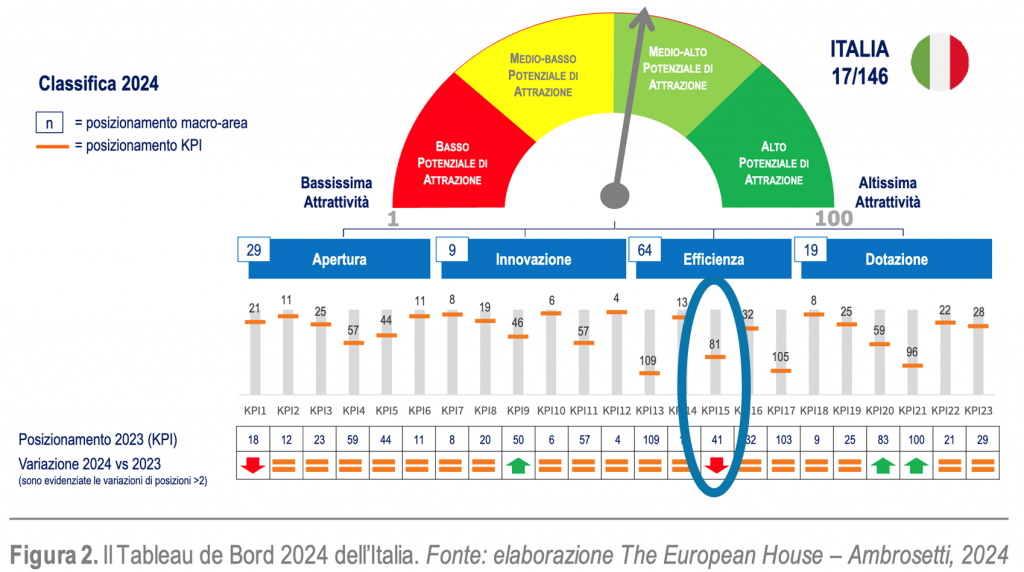
“L’Italia si trova all’81° posto nella classifica mondiale della produttività sulle 146 economie più sviluppate. Siamo migliorati su tantissime cose, soprattutto sul digitale, ma sulla produttività abbiamo ancora molto da fare. Le proiezioni di diversi istituti dicono che per il 2050 il rapporto lavoratori-pensionati sarà ‘uno a uno’, tant’è vero che state vedendo già oggi come l’età pensionabile si sta alzando a dismisura, l’ultimo valore è 70 anni, speriamo di non arrivare oltre. Questo vuol dire che è importante lavorare meglio, che è importante inserire all’interno dei processi e dei servizi che vengono dati ai dipendenti, ai clienti, ai cittadini, alle persone, una parola che è stata detta prima molte volte, che, vi sorprenderò, non è intelligenza artificiale, ma automazione. Un’automazione classica, indipendentemente dal settore e dall’industria. Che garantisce grandi vantaggi in termini di aumento di produttività. Stiamo parlando di un 25% in più, semplicemente con un’automazione dei processi, semplicemente con algoritmi di intelligenza artificiale, che sono disponibili anche sulla nostra piattaforma da anni”, ha dichiarato Filippo Giannelli, AreaVP Italy & Israel, Country Leader Italy di ServiceNow, in occasione di ComoLake 2024.
Trasformare il business attraverso l’intelligenza artificiale della piattaforma ServiceNow
“Se ci mettiamo il superpotere dell’intelligenza artificiale generativa, questo numero può arrivare fino a +32%. Stiamo parlando di un terzo in più e può aiutare il sistema Paese. Secondo noi – ha proseguito Giannelli – questi due numeri combinati portano ad avere anche un time to value dei servizi del 28%, che vuol dire che ci mettiamo il 28% del tempo in meno a dare nuovi servizi. Sono numeri importanti. Quello che stiamo facendo noi è proprio cercare di trasformare la parte business attraverso l’intelligenza artificiale. La nostra è una piattaforma che entra nei gangli dei processi nei servizi alla persona, per poter far sì di guidare quella che noi non definiamo digital transformation, ma business transformation, che è un approccio totalmente differente”.
Il ruolo determinante dei chatbot per accrescere la produttività aziendale nei servizi
“Perché una donna che chiede la maternità deve metterci cinque giorni per avere un’approvazione? Perché deve leggersi centinaia e centinaia di pagine di policy? Perché non interagire direttamente con un chatbot, con un agente che mi permette di capire esattamente cosa serve, quando serve? Un agente che esamina immediatamente questa richiesta e la fa approvare in tempo quasi reale, garantendo così il rispetto dei diritti, perché parliamo anche di questo. Proprio per aiutare la produttività, noi come ServiceNow stiamo investendo sull’Italia molto in questo, tanto è vero che abbiamo aperto due data center, uno a Milano, uno a Roma, per poter sollecitare e supportare la trasformazione dei servizi a livello del territorio nazionale”, ha aggiunto il manager di ServiceNow.
<!-- ARUBA - 300x250 -->
L’investimento di Roma e Milano mira a soddisfare la crescente domanda nazionale e contribuisce ad aumentare l’agilità dei clienti, ne migliora la produttività e permette loro di lavorare meglio, grazie a una infrastruttura altamente innovativa. I data center saranno a disposizione dei clienti ServiceNow alla fine di ottobre.
“Per fare tutto questo – ha concluso Giannelli – ci vuole un cambiamento, il famoso change managemente la capacità e l’impegno a superare le tante resistenze che in ogni epoca storica rallentano il cambiamento”.
Guido Barbieri (EI Towers): ‘Alle prese con l’integrazione dell’AI nei nostri processi’
EI Towers, la tower company controllata da F2I al 60% e MFE al 40% che gestisce le infrastrutture di trasmissione televisiva digitale terrestre di tutte le emittenti televisive tranne Rai, è partner infrastrutturale di tutte le radio private FM e DAB e ha realizzato una rete nazionale Internet of Things con tecnologia non cellulare e quindi con alta efficienza energetica.
“Negli ultimi tempi abbiamo investito molto nelle infrastrutture legate allo sport, lavoriamo con Lega Serie A, Lega Serie B e i loro partner – ha detto Guido Barbieri, amministratore delegato EI Towers intervenendo a ComoLakes – Trasportiamo tutti i segnali video e audio dagli stadi ai centri di produzione e poi da lì ai takers. L’amata e odiata VAR è all’interno del nostro campus di Lissone”.
“Come tutti siamo alle prese con l’introduzione dell’Intelligenza Artificiale nei nostri processi e con i relativi trade off – aggiunge Barbieri – Il trade off fra efficienza e bilancio energetico, tra efficienza e sicurezza, trade off etico fra efficienza e impatto etico sulla forza lavoro. E devo dire che in questo ambito abbiamo incontrato una famiglia di applicazioni di AI per cui questo trade off non si pone. Immagini di eventi sportivi disputati in Europa e fuori vengono portati in Italia. L’immagine arricchita e integrata dall’Intelligenza Artificiale e viene riportata sui dispositivi”.
<!-- ARUBA - 300x250 -->
“Non esiste un’AI senza solida infrastruttura, che è tale se ben progettata, anche se non è immune da imprevisti – ha aggiunto Barbieri – In queste situazioni è determinante l’intervento umano, con la sua esperienza e con la capacità di poter prendere la decisione in maniera veloce e l’ambizione di risolvere il problema. In poche parole, il senso di responsabilità. L’IA deve essere, dunque governata dall’umano”.
L’ad di EI Towers apre all’integrazione con RaiWay
“Siamo in attesa di un qualcosa che è logico succeda e che è nelle carte da tempo ma ancora non c’è nulla di attivato”. Così Guido Barbieri, amministratore delegato di Ei Towers, riferendosi all’ipotesi di nozze con RaiWay, come riportato oggi dal Messaggero.
Come ricorda il quotidiano, Ei Towers, controllata dal fondo F21 e da Mfe, la società a cui fanno capo le tv Mediaset, gestisce 2.400 siti dedicati all’ospitalità di impianti di trasmissione e antenne di diffusione del segnale per tv, radio e telecomunicazioni. RaiWay è invece la controllata della Rai che possiede le torri di trasmissione del segnale della tv pubblica.
“Le premesse ci sono con il DPCM che consente alla Rai di scendere nel capitale della società delle torri. Leggo di un potenziale placement che dovrebbe andare di pari passo all’avvio del progetto”, ha aggiunto Barbieri.
Il manager ha sottolineato tuttavia che al momento non ci sono tempistiche fissate: “Spero sia qualcosa che si attivi abbastanza presto ma non ci sono ancora dettagli”.
Reports: Tesla’s prototype Optimus robots were controlled by humans
Don’t ask me, I’m just a robot
Perhaps the strongest indication that human assistance was in play at the event was the Optimus units’ ability to carry on quick, extemporaneous conversations with human attendees. While AI models have shown rapid advances in naturalistic vocal communications recently, the smoothness and intonation of the Optimus conversations—and their ability to make out questions among a noisy crowd of humans—strongly suggested a human helping behind the scenes.
When Scoble confronted one Optimus robot directly about their autonomy (or lack thereof), the human operator played coy. “I can’t disclose just how much [is controlled by AI],” the unit said in a video posted by Scoble. “That’s something you’ll have to find out later.”
Other human controllers were more forthcoming under direct questioning from partygoers, though. In one video from the event a drink-serving Optimus unit admits, “Today, I’m assisted by a human. I’m not yet fully autonomous.”
Misdirection
Musk very pointedly avoided discussing the autonomy of the current Optimus prototypes during his “We, Robot” remarks. Instead, he simply pointed out that “the Optimus robots will walk among you… I mean, it’s a wild experience just to have humanoid robots, and they’re there, just in front of you.”
But that introduction came after lengthy remarks in which Musk extrapolated from the “rapid progress” in Optimus prototypes to a future where affordable, fully autonomous Optimus robots would be able to do “anything you want.” Given that juxtaposition, it’s no wonder even some experts were willing to believe the partying prototypes on display were operating largely on their own.
“Fooled me,” Deepwater Asset Management Managing Partner Gene Munster admitted on social media after hearing reports of Optimus’ teleoperation. That admission came just hours after Munster posted about how the event was “just the start of mega AI use cases.” In reality, when it comes to fully autonomous humanoid robots, Optimus seems to still largely be approaching the starting line.