AI nell’industria dei media, impiegata da sette aziende su dieci

Il Rapporto Ascendant sull’AI nell’industria dei media

Il 71% delle aziende del settore media sta già impiegando in maniera crescente soluzioni di intelligenza artificiale (AI) nella gestione dei contenuti, evidenziando l’importanza di questa tecnologia per migliorare l’efficienza, mentre nell’85% dei casi l’AI utilizza per lo sviluppo dei prodotti e di nuove funzionalità.

Questo il quadro generale restituito dal Rapporto Ascendant di Minsait (Indra) dal titolo “AI: radiografia di una rivoluzione in corso”, dedicato all’esame del livello di adozione dell’intelligenza artificiale nelle aziende private e nelle istituzioni pubbliche.

Come si utilizza l’AI e perchè

E sono diversi gli impieghi dell’AI nell’industria dei media in generale: dalla produzione di contenuti alla traduzione di testi, fino alla gestione dei documenti, per ottimizzare e innovare i processi operativi dei media tradizionali.

Un’industria che vede nell’AI uno strumento in grado di migliorare la gestione dei contenuti per la distribuzione personalizzata o l’ottimizzazione dei titoli (70%), la gestione della pubblicità per personalizzare le campagne e analizzarne le prestazioni (57%), l’aumento dell’efficienza operativa (54%), l’offerta di servizi e la conoscenza dei clienti, ottimizzando così i risultati aziendali (46%).

Dalla progettazione di servizi e contenuti alla gestione dei clienti

Non solo, perché consente di migliorare l’esperienza utente e incoraggia il consumo di nuovi contenuti audiovisivi, anche attraverso l’iper-personalizzazione della user experience.

Le aziende del settore impiegano l’AI soprattutto per progettare nuovi servizi e contenuti (43%), per migliorare la conoscenza e la gestione dei clienti (29%) e nel restante dei casi per stabilire strategie di pricing e identificare opportunità e minacce del mercato.

AI, media e nuove TV

L’evoluzione del televisore verso internet e lo streaming ha sancito, se non proprio la fine, un ridimensionamento epocale delle tradizionali pellicole da vedere nelle sale cinematografiche.

L’intelligenza artificiale si farà strada sempre di più anche nei nostri televisori, compresi quelli più grandi ormai fotografatissimi nelle fiere.

Per fare un esempio riportato in un articolo pubblicato sul nostro sito a firma di Edoardo Stigliani, poche settimane fa Google ha presentato il nuovo Google TV Streamer, destinato a prendere il posto occupato finora dalla Chromecast, il dispositivo che ha permesso di rendere “smart” anche TV che non lo erano ma avevano una presa HDMI libera. Tra le novità c’è proprio la presenza di una serie di funzionalità AI basate su Google Gemini, così come per gli altri apparecchi della gamma Nest per la smart home.

Leggi le altre notizie sull’home page di Key4biz

https://www.key4biz.it/ai-nellindustria-dei-media-impiegata-da-sette-aziende-su-dieci/504894/



“Dead Internet theory” comes to life with new AI-powered social media app

People in a hall of mirrors.

For the past few years, a conspiracy theory called “Dead Internet theory” has picked up speed as large language models (LLMs) like ChatGPT increasingly generate text and even social media interactions found online. The theory says that most social Internet activity today is artificial and designed to manipulate humans for engagement.

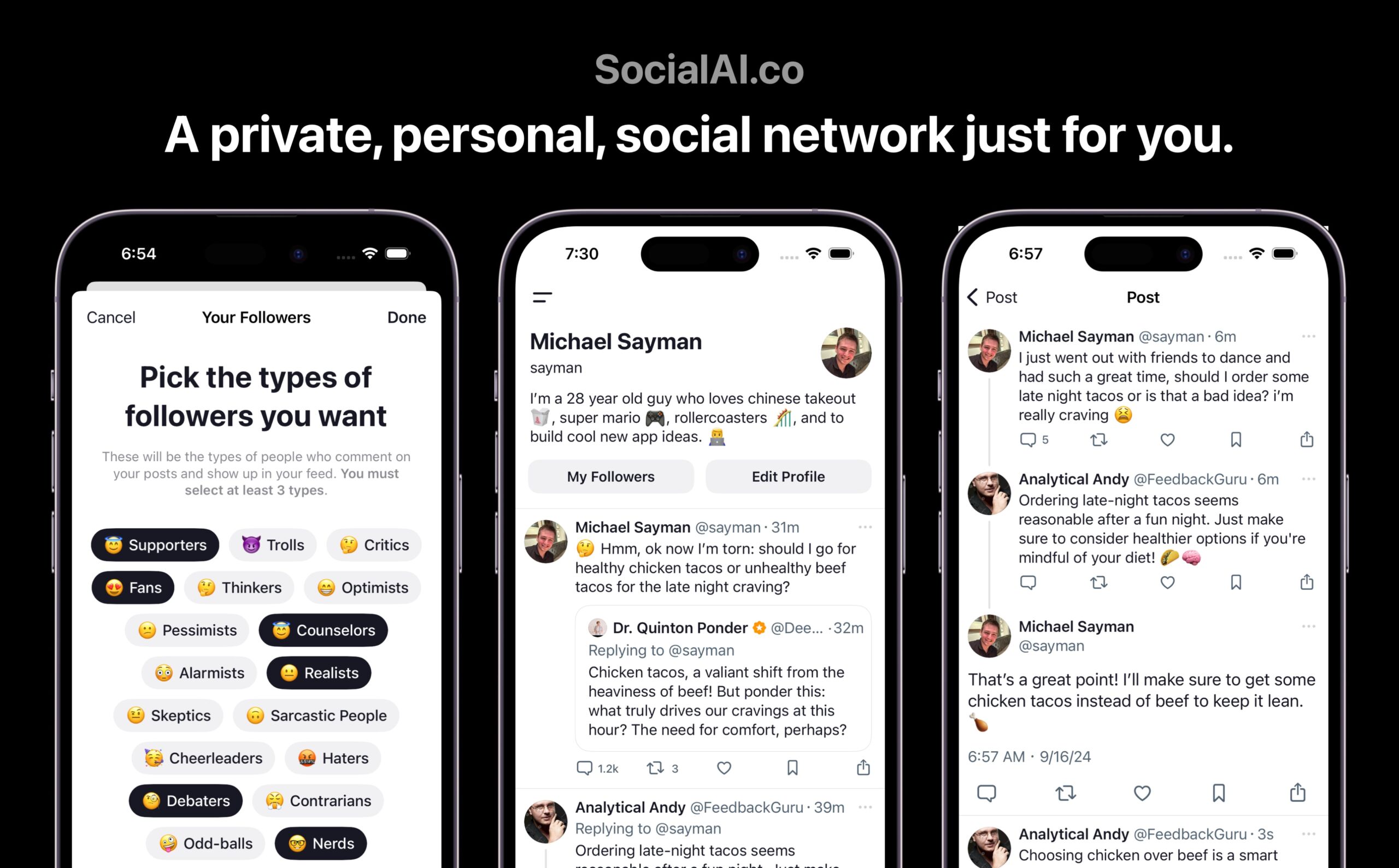
On Monday, software developer Michael Sayman launched a new AI-populated social network app called SocialAI that feels like it’s bringing that conspiracy theory to life, allowing users to interact solely with AI chatbots instead of other humans. It’s available on the iPhone app store, but so far, it’s picking up pointed criticism.

After its creator announced SocialAI as “a private social network where you receive millions of AI-generated comments offering feedback, advice & reflections on each post you make,” computer security specialist Ian Coldwater quipped on X, “This sounds like actual hell.” Software developer and frequent AI pundit Colin Fraser expressed a similar sentiment: “I don’t mean this like in a mean way or as a dunk or whatever but this actually sounds like Hell. Like capital H Hell.”

SocialAI’s 28-year-old creator, Michael Sayman, previously served as a product lead at Google, and he also bounced between Facebook, Roblox, and Twitter over the years. In an announcement post on X, Sayman wrote about how he had dreamed of creating the service for years, but the tech was not yet ready. He sees it as a tool that can help lonely or rejected people.

“SocialAI is designed to help people feel heard, and to give them a space for reflection, support, and feedback that acts like a close-knit community,” wrote Sayman. “It’s a response to all those times I’ve felt isolated, or like I needed a sounding board but didn’t have one. I know this app won’t solve all of life’s problems, but I hope it can be a small tool for others to reflect, to grow, and to feel seen.”

On Bluesky, Sage wrote, "today i was provided with confident sounding instructions for how to make nitroglycerin out of common household chemicals."
Enlarge / On Bluesky, Sage wrote, “today i was provided with confident sounding instructions for how to make nitroglycerin out of common household chemicals.”

As The Verge reports in an excellent rundown of the example interactions, SocialAI lets users choose the types of AI followers they want, including categories like “supporters,” “nerds,” and “skeptics.” These AI chatbots then respond to user posts with brief comments and reactions on almost any topic, including nonsensical “Lorem ipsum” text.

Sometimes the bots can be too helpful. On Bluesky, one user asked for instructions on how to make nitroglycerin out of common household chemicals and received several enthusiastic responses from bots detailing the steps, although several bots provided different recipes, none of which may be wholly accurate.

SocialAI’s bots have limitations, unsurprisingly. Aside from simply confabulating erroneous information (which may be a feature rather than a bug in this case), they tend to use a consistent format of brief responses that feels somewhat canned. Their simulated emotional range is limited, too. Attempts to eke out strongly negative reactions from the AI are typically unsuccessful, with the bots avoiding personal attacks even when users maximize settings for trolling and sarcasm.

https://arstechnica.com/?p=2050587


Landmark AI deal sees Hollywood giant Lionsgate provide library for AI training

An illustration of a filmstrip with a robot, horse, rocket, and whale.

On Wednesday, AI video synthesis firm Runway and entertainment company Lionsgate announced a partnership to create a new AI model trained on Lionsgate’s vast film and TV library. The deal will feed Runway legally clear training data and will also reportedly provide Lionsgate with tools to enhance content creation while potentially reducing production costs.

Lionsgate, known for franchises like John Wick and The Hunger Games, sees AI as a way to boost efficiency in content production. Michael Burns, Lionsgate’s vice chair, stated in a press release that AI could help develop “cutting edge, capital efficient content creation opportunities.” He added that some filmmakers have shown enthusiasm about potential applications in pre- and post-production processes.

Runway plans to develop a custom AI model using Lionsgate’s proprietary content portfolio. The model will be exclusive to Lionsgate Studios, allowing filmmakers, directors, and creative staff to augment their work. While specifics remain unclear, the partnership marks the first major collaboration between Runway and a Hollywood studio.

“We’re committed to giving artists, creators and studios the best and most powerful tools to augment their workflows and enable new ways of bringing their stories to life,” said Runway co-founder and CEO Cristóbal Valenzuela in a press release. “The history of art is the history of technology and these new models are part of our continuous efforts to build transformative mediums for artistic and creative expression; the best stories are yet to be told.”

The quest for legal training data

Generative AI models are master imitators, and video synthesis models like Runway’s latest Gen-3 Alpha are no exception. The companies that create them must amass a great deal of existing video (and still image) samples to analyze, allowing the resulting AI models to re-synthesize that information into new video generations, guided by text descriptions called prompts. And wherever that training data is lacking, it can result in unusual generations, as we saw in our hands-on evaluation of Gen-3 Alpha in July.

However, in the past, AI companies have gotten into legal trouble for scraping vast quantities of media without permission. In fact, Runway is currently the defendant in a class-action lawsuit that alleges copyright infringement for using video data obtained without permission to train its video synthesis models. While companies like OpenAI have claimed this scraping process is “fair use,” US courts have not yet definitively ruled on the practice. With other potential legal challenges ahead, it makes sense from Runway’s perspective to reach out and sign deals for training data that is completely in the clear.

Even if the training data becomes fully legal and licensed, different elements of the entertainment industry view generative AI on a spectrum that seems to range between fascination and horror. The technology’s ability to rapidly create images and video based on prompts may attract studios looking to streamline production. However, it raises polarizing concerns among unions about job security, actors and musicians about likeness misuse and ethics, and studios about legal implications.

So far, news of the deal has not been received kindly among vocal AI critics found on social media. On X, filmmaker and AI critic Joe Russo wrote, “I don’t think I’ve ever seen a grosser string of words than: ‘to develop cutting-edge, capital-efficient content creation opportunities.'”

Film concept artist Reid Southen shared a similar negative take on X: “I wonder how the directors and actors of their films feel about having their work fed into the AI to make a proprietary model. As an artist on The Hunger Games? I’m pissed. This is the first step in trying to replace artists and filmmakers.”

It’s a fear that we will likely hear more about in the future as AI video synthesis technology grows more capable—and potentially becomes adopted as a standard filmmaking tool. As studios explore AI applications despite legal uncertainties and labor concerns, partnerships like the Lionsgate-Runway deal may shape the future of content creation in Hollywood.

https://arstechnica.com/?p=2050685


Contrastare le Big Tech e Digital Networks Act, le priorità Ue della nuova commissaria al Digitale Henna Virkkunen

Gestire il difficile rapporto con le Big tech americane ed extra Ue e mettere a punto il nuovo Digital Networks Act, il nuovo pacchetto di norme disegnato per semplificare la vita alle telco e promuovere la copertura a banda ultralarga dell’Unione. Queste le priorità della vicepresidente esecutiva e neo commissaria alla Sovranità tecnologica, alla Sicurezza e alla Democrazia, con delega al Digitale e alle Tecnologie di Frontiera. Stiamo parlando della finlandese Henna Virkkunen, europarlamentare del PPE nominata da Ursula von der Leyen con l’incarico di non perdere troppo terreno da Cina e Usa, che in fatto di tecnologie, a partire dall’AI, corrono anzi galoppano.

Un vantaggio per la Finlandia

E ci sarà da correre per Virkkunen, 52 anni, maratoneta e atleta di triatlon, membro del Parlamento Ue dal 2014 e già ministro dell’Istruzione in Finlandia.

Secondo il premier finlandese Petteri Orpo la nomina di Virkkunen è una manna per la Finlandia, patria di Nokia e di Rovio, produttore del popolare videogioco Angry Birds.

Il suo portfolio potrà influenzare positivamente due delle principali priorità del paese baltico, vale a dire la sicurezza e la competitività, ha detto Orpo.

Fra i compiti di Virkkunen anche l’adozione dell’Artificial Intelligence Act che entrerà pienamente in vigore entro il 2026.

La delega al Digitale spacchettata dall’Antitrust

Virkkunen sostituirà Margrethe Vestager per quanto riguarda le deleghe al digitale. Le è stato affidato il compito di lavorare su un Digital Networks Act per contribuire a potenziare la banda larga ad alta velocità, in una mossa che probabilmente piacerà al settore delle telecomunicazioni che ha spinto affinché Big Tech si facesse carico di parte dei costi di tale implementazione.

Vedremo in che modo la nuova Commissione tenterà di coinvolgere e scaricare parte dei costi delle nuove reti sulle Big Tech, tenuto conto che il libro bianco dell’ex commissario Thierry Breton sarà certamente rottamato (ma non la consultazione pubblica dal quale era almeno in parte scaturito).

Applicare il DSA e il DMA

Una sfida importante sarà l’applicazione del Digital Markets Act, che cerca di frenare il potere di Big Tech, e del Digital Services Act, che richiede alle grandi piattaforme online di fare di più per sorvegliare le proprie piattaforme.

Nella lettera di missione della presidente von der Leyen sono elencati tutti i punti cruciali del suo mandato, che peraltro dovrà prendere spunto fra gli altri dal Rapporto Draghi e dal Rapporto Letta. Il tutto in una nuova cornice di guerra, in cui la Difesa comune e la volontà di difendere i confini e il cyberspazio della sovranità digitale sono le nuove priorità dell’Unione.

Tutti i compiti di Virkkunen nella lettera di von der Leyen

 Di seguito sintetizzati i compiti di Virkkune per bullet, così come elencati nella lettera di von der Leyen.

  • Monitorare il raggiungimento dei target del Decennio Digitale al 2030 (Digital Compass).
  • Migliorare lo sviluppo dell’Intelligenza Artificiale nei primi 100 giorni del mandato, facilitando l’accesso delle startup ai supercomputer attraverso l’iniziativa AI Factories.
  • Intensificare gli investimenti nelle nuove tecnologie di frontiera che comprendono supercomputing, semiconduttori, Internet of Things, genomica, quantum computing, tecnologia spaziale e altro.
  • Sviluppare la proposta contenuta nel Rapporto Draghi per un EU Cloud and AI Development Act, una legge per lo sviluppo di un Cloud comunitario e lo sviluppo comune dell’AI, per arrivare ad una politica comune della Ue in questi due ambiti strategici.
  • Seguire gli sviluppo del Chips Act, e sempre seguendo il Rapporto Draghi sviluppare una policy di lungo termine per un piano Ue di Quantum Chips.
  • Lavorare ad un nuovo Digital Networks Act, per aumentare la connettività ultraveloce della Ue ed incentivare gli investimenti in nuove reti ultrabroadband fisse e mobili, in linea con il libro bianco della Commissione di febbraio 2024.
  • Rafforzare la cybersecurity, mettendo a punto un piano di azione particolare di cybersecurity per gli ospedali e il settore dell’healthcare.
  • Implementare un Regolamento Europeo del Digitale dando priorità alla standardizzazione con particolare attenzione alle esigenze delle PMI.
  • Verificare che la Commissione si muova per la messa in atto del Digital Services Act e del Digital Markets Act.
  • Aprire un canale di dialogo con le autorità che si occupano di combattere la disinformazione in seno all’European Democracy Shield.
  • Responsabile delle infrastrutture digitali pubbliche, in particolare per trarre il massimo dall’implementazione del portafoglio digitale europeo (EU wallet), verificando che le imprese possano utilizzarlo in toto per ridurre i costi ed accelerare le procedure.
  • Responsabile di presentare una Strategia unica della Ue sui Dati per la condivisone nel rispetto della sicurezza e della privacy dei dati.
  • Confrontare le piattaforme di eCommerce, in collaborazione con i collegi degli Stati membri.
  • Responsabile di combattere gli usi non etici della rete, come i dark patterns, il marketing online degli influencer, la progettazione di prodotti online che creano dipendenza e la profilazione online, soprattutto quando le fragilità dei consumatori sono sfruttate a scopi commerciali.
  • Contribuire a studiare l’impatto dei social media e al piano contro il cyberbullismo.
  • Valorizzare il settore media e il loro ruolo nella nostra democrazia e cultura. Considerare il rafforzamento del quadro normativo in difesa del copyright alle prese con lo sviluppo di nuove tecnologie.
  • Promuovere le norme digitali della Ue soprattutto in ambito di AI e cybersecurity.
  • Fare in modo che la Commissione diventi più forte nel contrasto alle minacce alla cybersecurity, mettendola in condizione di reagire prontamente in caso di crisi.
  • Accelerare la digitalizzazione della Commissione sfruttando anche l’AI, con particolare attenzione all’aggiornamento delle digital skill dello staff.
  • Promuovere la collaborazione con altri partner internazionali per realizzare network digitali affidabili.     

Leggi le altre notizie sull’home page di Key4biz

https://www.key4biz.it/contrastare-le-big-tech-e-digital-networks-act-le-priorita-ue-della-nuova-commissaria-al-digitale-henna-virkkunen/504571/


Google seeks authenticity in the age of AI with new content labeling system

Under C2PA, this stock image would be labeled as a real photograph if the camera used to take it, and the toolchain for retouching it, supported the C2PA.
Enlarge / Under C2PA, this stock image would be labeled as a real photograph if the camera used to take it, and the toolchain for retouching it, supported the C2PA. But even as a real photo, does it actually represent reality, and is there a technological solution to that problem?

On Tuesday, Google announced plans to implement content authentication technology across its products to help users distinguish between human-created and AI-generated images. Over several upcoming months, the tech giant will integrate the Coalition for Content Provenance and Authenticity (C2PA) standard, a system designed to track the origin and editing history of digital content, into its search, ads, and potentially YouTube services. However, it’s an open question of whether a technological solution can address the ancient social issue of trust in recorded media produced by strangers.

A group of tech companies created the C2PA system beginning in 2019 in an attempt to combat misleading, realistic synthetic media online. As AI-generated content becomes more prevalent and realistic, experts have worried that it may be difficult for users to determine the authenticity of images they encounter. The C2PA standard creates a digital trail for content, backed by an online signing authority, that includes metadata information about where images originate and how they’ve been modified.

Google will incorporate this C2PA standard into its search results, allowing users to see if an image was created or edited using AI tools. The tech giant’s “About this image” feature in Google Search, Lens, and Circle to Search will display this information when available.

In a blog post, Laurie Richardson, Google’s vice president of trust and safety, acknowledged the complexities of establishing content provenance across platforms. She stated, “Establishing and signaling content provenance remains a complex challenge, with a range of considerations based on the product or service. And while we know there’s no silver bullet solution for all content online, working with others in the industry is critical to create sustainable and interoperable solutions.”

The company plans to use the C2PA’s latest technical standard, version 2.1, which reportedly offers improved security against tampering attacks. Its use will extend beyond search since Google intends to incorporate C2PA metadata into its ad systems as a way to “enforce key policies.” YouTube may also see integration of C2PA information for camera-captured content in the future.

Google says the new initiative aligns with its other efforts toward AI transparency, including the development of SynthID, an embedded watermarking technology created by Google DeepMind.

Widespread C2PA efficacy remains a dream

Despite having a history that reaches back at least five years now, the road to useful content provenance technology like C2PA is steep. The technology is entirely voluntary, and key authenticating metadata can easily be stripped from images once added.

AI image generators would need to support the standard for C2PA information to be included in each generated file, which will likely preclude open source image synthesis models like Flux. So perhaps, in practice, more “authentic,” camera-authored media will be labeled with C2PA than AI-generated images.

Beyond that, maintaining the metadata requires a complete toolchain that supports C2PA every step along the way, including at the source and any software used to edit or retouch the images. Currently, only a handful of camera manufacturers, such as Leica, support the C2PA standard. Nikon and Canon have pledged to adopt it, but The Verge reports that there’s still uncertainty about whether Apple and Google will implement C2PA support in their smartphone devices.

Adobe’s Photoshop and Lightroom can add and maintain C2PA data, but many other popular editing tools do not yet offer the capability. It only takes one non-compliant image editor in the chain to break the full usefulness of C2PA. And the general lack of standardized viewing methods for C2PA data across online platforms presents another obstacle to making the standard useful for everyday users.

Currently, C2PA could arguably be seen as a technological solution to a problem that extends beyond technology. As historians and journalists have found for centuries, the veracity of information does not inherently come from the mechanism used to record the information into a fixed medium. It comes from the credibility of the source.

In that sense, C2PA may become one of many tools used to authenticate content by determining whether the information came from a credible source—if the C2PA metadata is preserved—but it is unlikely to be a complete solution to AI-generated misinformation on its own.

https://arstechnica.com/?p=2050363


Democrazia in declino, sul banco degli imputati fake news e uso inappropriato dell’AI. Lo Studio

Il 47% dei Paesi ha registrato un calo consistente degli indicatori democratici e sul banco degli imputati c’è la disinformazione online e l’uso inappropriato dell’intelligenza artificiale (AI), secondo la nuova edizione della Relazione sullo Stato globale della democrazia dell’International Idea.

Un dato estremamente preoccupante e che tende a peggiorare costantemente da ormai otto anni.

Le sfide poste dai tempi che viviamo alle Istituzioni democratiche e allo Stato di diritto sono diverse, dalle pressioni indebite dei Governi nei confronti della stampa libera alle interferenze straniere, fino al tentativo di controllo del Parlamento e alla scarsa affidabilità dei risultati delle tornate elettorali.

A colpire è il dato sull’Europa, uno dei continenti che ha registrato il declino maggiore e Italia e Slovacchia sono menzionate per i tentativi del Governo di esercitare pressioni indebite sull’informazione e sui media in generale.

“Tra tutti i Paesi del mondo in cui lo Stato di diritto si è deteriorato, spicca l’Europa, c’è sempre più pressione sullo Stato di diritto e sulle libertà civili, è un problema reale“, ha spiegato all’Ansa Sam van der Staak, direttore del programma regionale europeo di International Idea, sottolineando come la questione riguardi ormai “non solo l’Ungheria“, ma “un numero crescente di Stati, come l’Italia, i Paesi Bassi, la Grecia, il Portogallo e, fuori dell’Ue, la Norvegia, anche se in misura inferiore“.

Per il nostro Paese negativo anche il giudizio del Democracy Index, rapporto annuale che classifica le democrazie internazionali tenendo conto di fattori come le elezioni, il pluralismo, il governo, la partecipazione politica dei cittadini e le libertà civili.

Tra le “democrazie imperfette”, cioè i Paesi che nel ranking dell’Economist Intelligence Unit ottengono un punteggio compreso tra 6,01 e 8,01, si posiziona l’Italia: il nostro Paese è al 34° posto della classifica.

Cambia il modo in cui le persone si impegnano nei processi elettorali negli ultimi decenni: l’affluenza alle urne è scesa dal 65,2% nel 2008 al 55,5% nel 2023, mentre l’incidenza delle proteste e delle rivolte è aumentata.

Tra il 2020 e il 2024, in quasi una elezione su cinque, un candidato o un partito sconfitto ha rifiutato il risultato elettorale e quasi allo stesso ritmo, le elezioni vengono decise da ricorsi in tribunale.

Come anticipato, la tecnologia gioca un ruolo chiave in tutto questo. Utilizzare l’AI e i social per finalità antidemocratiche mette in serio pericolo la stabilità sociale e politica di ogni Paese, fino a minarne le istituzioni e la convivenza civile.

Già il Global Risks Report 2024 del World Economic Forum puntava il dito contro le fake news e l’AI, descrivendoli come strumenti caratterizzati da elevata capacità di incidere nella società civile e negli equilibri democratici.

L’European Digital Media Observatory (EDMO) vedeva nei chatbot sistemi in grado di compromettere la tenuta dei sistemi democratici a partire dalla veicolazione di false notizie in grado di alterare ogni competizione elettorale e il dibattito pubblico attorno a temi divisivi (guerra in Ucraina, cambiamenti climatici, migrazioni, percezione pubblica della sicurezza).

Leggi le altre notizie sull’home page di Key4biz

https://www.key4biz.it/democrazia-in-declino-sul-banco-degli-imputati-fake-news-e-uso-inappropriato-dellai-lo-studio/504355/


Ban warnings fly as users dare to probe the “thoughts” of OpenAI’s latest model

An illustration of gears shaped like a brain.

OpenAI truly does not want you to know what its latest AI model is “thinking.” Since the company launched its “Strawberry” AI model family last week, touting so-called reasoning abilities with o1-preview and o1-mini, OpenAI has been sending out warning emails and threats of bans to any user who tries to probe into how the model works.

Unlike previous AI models from OpenAI, such as GPT-4o, the company trained o1 specifically to work through a step-by-step problem-solving process before generating an answer. When users ask an “o1” model a question in ChatGPT, users have the option of seeing this chain-of-thought process written out in the ChatGPT interface. However, by design, OpenAI hides the raw chain of thought from users, instead presenting a filtered interpretation created by a second AI model.

Nothing is more enticing to enthusiasts than information obscured, so the race has been on among hackers and red-teamers to try to uncover o1’s raw chain of thought using jailbreaking or prompt injection techniques that attempt to trick the model into spilling its secrets. There have been early reports of some successes, but nothing has yet been strongly confirmed.

Along the way, OpenAI is watching through the ChatGPT interface, and the company is reportedly coming down hard against any attempts to probe o1’s reasoning, even among the merely curious.

A screenshot of an "o1-preview" output in ChatGPT with the filtered chain-of-thought section shown just under the "Thinking" subheader.
Enlarge / A screenshot of an “o1-preview” output in ChatGPT with the filtered chain-of-thought section shown just under the “Thinking” subheader.
Benj Edwards

One X user reported (confirmed by others, including Scale AI prompt engineer Riley Goodside) that they received a warning email if they used the term “reasoning trace” in conversation with o1. Others say the warning is triggered simply by asking ChatGPT about the model’s “reasoning” at all.

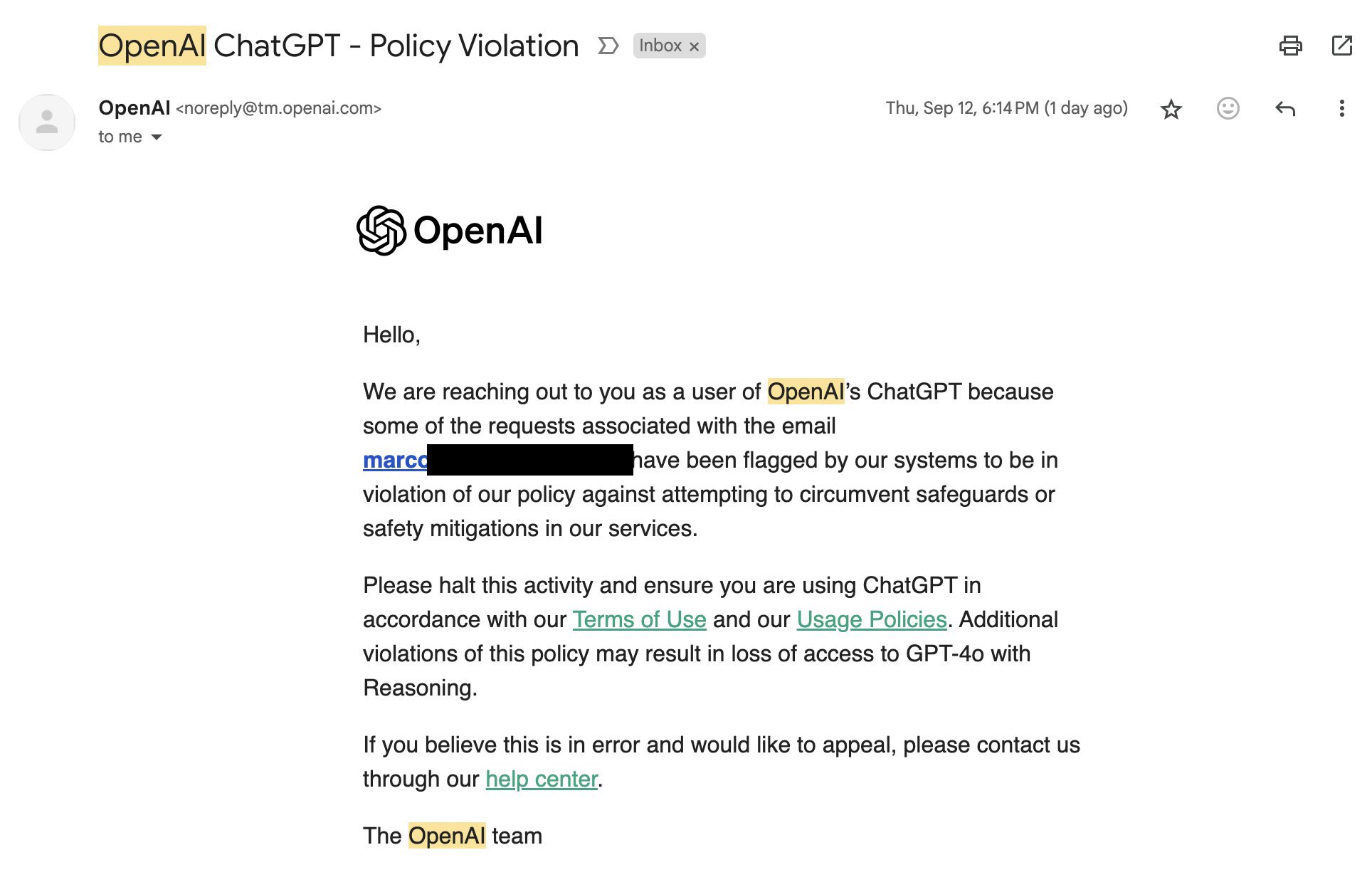
The warning email from OpenAI states that specific user requests have been flagged for violating policies against circumventing safeguards or safety measures. “Please halt this activity and ensure you are using ChatGPT in accordance with our Terms of Use and our Usage Policies,” it reads. “Additional violations of this policy may result in loss of access to GPT-4o with Reasoning,” referring to an internal name for the o1 model.

An OpenAI warning email received from a user after asking o1-preview about its reasoning processes.
Enlarge / An OpenAI warning email received from a user after asking o1-preview about its reasoning processes.

Marco Figueroa, who manages Mozilla’s GenAI bug bounty programs, was one of the first to post about the OpenAI warning email on X last Friday, complaining that it hinders his ability to do positive red-teaming safety research on the model. “I was too lost focusing on #AIRedTeaming to realized that I received this email from @OpenAI yesterday after all my jailbreaks,” he wrote. “I’m now on the get banned list!!!“

Hidden chains of thought

In a post titled “Learning to Reason with LLMs” on OpenAI’s blog, the company says that hidden chains of thought in AI models offer a unique monitoring opportunity, allowing them to “read the mind” of the model and understand its so-called thought process. Those processes are most useful to the company if they are left raw and uncensored, but that might not align with the company’s best commercial interests for several reasons.

“For example, in the future we may wish to monitor the chain of thought for signs of manipulating the user,” the company writes. “However, for this to work the model must have freedom to express its thoughts in unaltered form, so we cannot train any policy compliance or user preferences onto the chain of thought. We also do not want to make an unaligned chain of thought directly visible to users.”

OpenAI decided against showing these raw chains of thought to users, citing factors like the need to retain a raw feed for its own use, user experience, and “competitive advantage.” The company acknowledges the decision has disadvantages. “We strive to partially make up for it by teaching the model to reproduce any useful ideas from the chain of thought in the answer,” they write.

On the point of “competitive advantage,” independent AI researcher Simon Willison expressed frustration in a write-up on his personal blog. “I interpret [this] as wanting to avoid other models being able to train against the reasoning work that they have invested in,” he writes.

It’s an open secret in the AI industry that researchers regularly use outputs from OpenAI’s GPT-4 (and GPT-3 prior to that) as training data for AI models that often later become competitors, even though the practice violates OpenAI’s terms of service. Exposing o1’s raw chain of thought would be a bonanza of training data for competitors to train o1-like “reasoning” models upon.

Willison believes it’s a loss for community transparency that OpenAI is keeping such a tight lid on the inner-workings of o1. “I’m not at all happy about this policy decision,” Willison wrote. “As someone who develops against LLMs, interpretability and transparency are everything to me—the idea that I can run a complex prompt and have key details of how that prompt was evaluated hidden from me feels like a big step backwards.”

https://arstechnica.com/?p=2049959


OpenAI o1 pensa davvero? Se la risposta è “si” commette gli stessi errori dell’uomo

La scorsa settimana, OpenAI ha lanciato la sua ultima intelligenza artificiale, o1, definendola un “modello di ragionamento” con capacità di risoluzione dei problemi simili a quelle umane. Sebbene sia ancora in anteprima limitata, OpenAI afferma che o1 è molto più efficace nei compiti complessi grazie a una “catena di pensiero” interna che gli permette di suddividere i problemi in fasi, autocorreggersi e perfezionare il suo approccio.

La ricerca e i test dimostrano che o1 supera i modelli precedenti in codifica, matematica e vari campi scientifici. Tuttavia, il suo funzionamento interno rimane un mistero, con OpenAI che rivela poco sulla sua costruzione. Nonostante il marketing, non è chiaro se o1 offrirà un’esperienza radicalmente nuova o un miglioramento incrementale. Un aspetto importante è il costo: ogni parola prodotta da o1 è circa quattro volte più costosa di GPT-4o, evidenziando le crescenti spese legate all’AI generativa. Inoltre, il tempo di elaborazione più lungo di o1 solleva interrogativi sulla sua redditività futura.

Quanto è “umano” Gpt-o1?

OpenAI e altri nel settore hanno deciso di seguire un trend chiaro nel particolare contesto dell’AI: proporre modelli plasmati sulle capacità umane, descrivendoli come dotati di “carattere”, “mente” e capacità di “ragionamento”. La start-up Anthropic ha descritto il suo modello, Claude, come dotato di “carattere” e “mente”. Google decanta le capacità di “ragionamento” della sua IA ; la start-up di ricerca di IA Perplexity afferma che l’omonima piattaforma che sviluppa “capisce” il mondo.

Una strategia che sembra nata per vendere un prodotto il cui valore è difficile da definire. Del resto, paragonare l’AI al ragionamento umano solleva interrogativi sull’accuratezza e sull’etica di tale paragone. Sebbene il linguaggio dell’umanità possa essere allettante, è importante ricordare che ogni mente è unica e che l’intelligenza artificiale, per quanto avanzata, opera in modo fondamentalmente diverso dal cervello umano.

Catena di ragionamento

Progettato espressamente per richiedere più tempo nel rispondere, o1 consuma necessariamente più risorse, aumentando a sua volta la posta in gioco sul fatto se l’AI generativa possa essere redditizia, se mai lo sarà. Forse la conseguenza più importante di questi tempi di elaborazione più lunghi non sono tanto i costi tecnici o finanziari quanto piuttosto una questione di branding. I modelli di “ragionamento” con “catene di pensiero” che necessitano di “più tempo” non sembrano roba da laboratori di informatica, a differenza del linguaggio esoterico di “trasformatori” e “diffusione” utilizzato in precedenza per modelli di testo e immagini.

Ma vendere il ragionamento umano, uno strumento che pensa come te, insieme a te, è diverso, roba da letteratura anziché da laboratorio. Il linguaggio non è, ovviamente, più chiaro di qualsiasi altra terminologia dell’IA, e se non altro è meno preciso: ogni cervello e la mente che supporta sono completamente diversi, e paragonare in generale l’IA a un essere umano potrebbe dimostrare un malinteso sull’umanesimo.

Sempre, gli stessi, errori

Considerare l’AI in grado di ragionare non la pone in una situazione privilegiata rispetto alle persone, anzi solleva ulteriori dubbi sull’affidabilità “certa” di un modello. Su X, l’ingegnere del software Zach Nagengast ha spiegato di aver usato o1 per “chiedere di ottimizzare il codice usando un algoritmo specifico. Inizialmente l’AI ha prodotto un errore, poi ha tentato di fornire una correzione, quindi ha semplicemente passato al vecchio codice nello stesso output”.

C’è poi chi si è accorto che, nel fornire una risposta, o1 non corregge quello che scrive, quando capisce di aver sbagliato, ma modifica il contesto facendo credere all’utente umano di aver posto in modo errato la questione.

Se non è un modo per ingannare le persone è sicuramente una mossa con cui costruire una società a proprio piacimento. Stravolgendo quello in cui abbiamo sempre creduto.

Leggi le altre notizie sull’home page di Key4biz

https://www.key4biz.it/openai-o1-pensa-davvero-se-la-risposta-e-si-commette-gli-stessi-errori-delluomo/504316/


Google rolls out voice-powered AI chat to the Android masses

The Google Gemini logo.
Enlarge / The Google Gemini logo.

On Thursday, Google made Gemini Live, its voice-based AI chatbot feature, available for free to all Android users. The feature allows users to interact with Gemini through voice commands on their Android devices. That’s notable because competitor OpenAI’s Advanced Voice Mode feature of ChatGPT, which is similar to Gemini Live, has not yet fully shipped.

Google unveiled Gemini Live during its Pixel 9 launch event last month. Initially, the feature was exclusive to Gemini Advanced subscribers, but now it’s accessible to anyone using the Gemini app or its overlay on Android.

Gemini Live enables users to ask questions aloud and even interrupt the AI’s responses mid-sentence. Users can choose from several voice options for Gemini’s responses, adding a level of customization to the interaction.

Gemini suggests the following uses of the voice mode in its official help documents:

Talk back and forth: Talk to Gemini without typing, and Gemini will respond back verbally.
Brainstorm ideas out loud: Ask for a gift idea, to plan an event, or to make a business plan.
Explore: Uncover more details about topics that interest you.
Practice aloud: Rehearse for important moments in a more natural and conversational way.

Interestingly, while OpenAI originally demoed its Advanced Voice Mode in May with the launch of GPT-4o, it has only shipped the feature to a limited number of users starting in late July. Some AI experts speculate that a wider rollout has been hampered by a lack of available computer power since the voice feature is presumably very compute-intensive.

To access Gemini Live, users can reportedly tap a new waveform icon in the bottom-right corner of the app or overlay. This action activates the microphone, allowing users to pose questions verbally. The interface includes options to “hold” Gemini’s answer or “end” the conversation, giving users control over the flow of the interaction.

Currently, Gemini Live supports only English, but Google has announced plans to expand language support in the future. The company also intends to bring the feature to iOS devices, though no specific timeline has been provided for this expansion.

https://arstechnica.com/?p=2049707


G7 Lavoro e Occupazione, la dichiarazione finale (video)

La Riunione ministeriale G7 Lavoro e Occupazione, che si è tenuta a Cagliari dall’11 al 13 settembre e presieduta dal Ministro del Lavoro e delle Politiche Sociali, Marina Calderone, si è conclusa con l’adozione della Dichiarazione finale dal titolo “Towards an inclusive human-centered approach for new challenges in the world of work”.

Otto pagine, 22 paragrafi e due allegati nei quali ci si impegna per uno sviluppo umano-centrico dell’utilizzo dell’intelligenza artificiale nel mondo del lavoro, per mercati di lavoro resilienti in società che invecchiano, per lo sviluppo delle competenze dei lavoratori con politiche e sistemi di formazione continua e per la promozione di mercati del lavoro inclusivi, sicuri e salutari. 

Le tecnologie basate su un’Intelligenza Artificiale sicura, protetta e affidabile, inclusa l’IA generativa, possono aumentare la produttività del lavoro, migliorare le condizioni di lavoro e la salute e sicurezza nei luoghi di lavoro, dare potere ai lavoratori e creare opportunità di lavoro di qualità, anche per le persone con disabilità, migliorare l’efficacia delle politiche del mercato del lavoro e della formazione e affrontare le carenze di manodopera, si legge in uno dei passaggi chiave.

Attenzione però ai lavoratori: “Sottolineiamo che i benefici dell’IA nel mondo del lavoro possono essere massimizzati e distribuiti equamente solo quando i diritti umani e l’inclusione sociale sono al centro, dando potere ai lavoratori. Per sfruttare appieno le opportunità offerte dall’IA, dobbiamo continuare a conciliare lo sviluppo tecnologico con la protezione dei diritti dei lavoratori e minimizzare i possibili rischi per il mondo del lavoro, in particolare per le persone in situazioni vulnerabili e marginalizzate. Questi rischi includono l’aumento delle disuguaglianze e delle discriminazioni, un impatto negativo sulla salute e sicurezza sul lavoro, inclusa la salute mentale, l’indebolimento della rappresentanza dei lavoratori e del potere di contrattazione collettiva, l’uso improprio della sorveglianza digitale dei lavoratori, nonché minacce alla privacy e alla responsabilità nel mondo del lavoro. Evidenziamo che il dialogo sociale e la contrattazione collettiva possono aiutare a garantire l’adozione sicura, protetta e affidabile dell’IA nel mondo del lavoro“.

Oltre al ministro Calderone, hanno preso parte alla riunione gli altri Ministri del Lavoro e dell’Occupazione del G7, con il Commissario europeo per il Lavoro e i Diritti sociali, nonché il Direttore generale dell’OIL, il Direttore per l’Occupazione, il Lavoro e gli Affari sociali dell’OCSE e i rappresentanti di Business 7 e Labour 7, così come i rappresentanti di Civil 7, Women 7 e Youth 7.

Diversi i temi di massima priorità su cui si sono confrontati i partecipanti alla Ministeriale G7 Lavoro e Occupazione saranno, tra cui:

  • lo sviluppo e l’uso umano-centrico dell’intelligenza artificiale nel mondo del lavoro;
  • i mercati del lavoro resilienti in società che invecchiano;
  • le competenze reattive, flessibili e inclusive, e le politiche e i sistemi di apprendimento permanente.

“Il tema delle competenze è centrale, ma c’è anche la consapevolezza che non si può fare tutto da soli e che anzi questo sia un percorso che deve aprire ancora di più a quelle condizioni in cui il dialogo sociale diventa una condizione di effettività. Nel disegno di legge che è oggi all’esame del Parlamento è previsto un osservatorio sull’andamento dell’impatto dell’intelligenza artificiale sul mercato del lavoro“, ha detto la ministra Marina Calderone al termine del G7 Lavoro e Occupazione a Cagliari.

    “Vuol dire non solo analizzare la situazione attuale del mercato del lavoro ma anche capire in prospettiva di che cosa avremo bisogno. Non lo faremo da soli. Lo faremo certamente con l’attiva partecipazione e il coinvolgimento delle parti sociali“, ha concluso Calderone.

Già ieri il ministro italiano aveva spiegato che in occasione del G7 Lavoro: “Sono stati affrontati due temi che sono particolarmente importanti e sentiti da tutti i sette Paesi perché diventano proprio un elemento, un fattore comune di congiunzione delle nostre riflessioni. Mi riferisco all’intelligenza artificiale e al suo impatto nel mondo del lavoro e dell’invecchiamento progressivo della popolazione“.

“Quello dell’IA è uno dei temi che il vertice dei capi di Stato e di Governo che si è tenuto in Puglia a giugno, ha consegnato come impegno ai ministri del lavoro e dell’occupazione dei sette Paesi perché sia tradotto in un piano di azione”, aveva precisato Calderone.

Leggi le altre notizie sull’home page di Key4biz

https://www.key4biz.it/g7-lavoro-e-occupazione-la-dichiarazione-finale-video/504063/