Notion killing Skiff-influenced email app since most users use AI agents instead
However, Notion urged users to export drafts and scheduled emails by September 21, since those won’t automatically carry over to an alternative app. Notion noted that users can also save their Notion Mail setups and “export your snippets and auto label instructions to use elsewhere.”
“If you have auto label set up in Notion Mail, you won’t have to rebuild it. Create a Custom Agent in a few clicks, and we’ll bring your existing rules over for you,” the X post explained. “And if you’re already running Notion agents to manage email, they’ll continue running. Your email connection in Notion stays in place.”
Organizations that relied on Notion Mail in a regulated environment might have to transition from Notion Mail earlier.
“If you rely on HIPAA coverage, you should plan to transition off Notion Mail by June 30, 2026,” Notion’s support page reads.
Skiff reportedly served 2 million users, giving rivals like Proton Mail a run for their money before the Notion acquisition. As a Gmail client that didn’t support end-to-end encryption, Notion’s AI-centric approach to email lacked the privacy focus that Skiff carried as an email provider. Still, Notion Mail was built with Skiff’s infrastructure and by former Skiff executives, making its impending demise feel like a sort of swan song for Skiff.
Although Notion is killing its Skiff-influenced email client, it may continue leveraging the human resources and other productivity ideas (around calendars and storage, for instance) gained through its Skiff acquisition as it tries to compete more strongly against rivals like Google Workspace. Notion, however, has strayed from releasing direct follow-up products to Skiff’s portfolio.
Google finally releases a Finance Android app, promises iOS version later in 2026
Google Finance is not a new product—it has been around for 20 years, long enough that it initially relied on Flash to display charts and graphs. The website has gotten a few major updates over the years, but it has never had a mobile app until now. Google has released the first standalone app for Google Finance, which is currently exclusive to Android, with iOS planned for later this year.
The app is available globally in the Play Store, but that’s not the only update to Google’s financial tracker. The AI-powered makeover for the Finance website is also leaving beta, making Google’s chatbot a core part of the experience. Naturally, the mobile app includes a heaping helping of generative AI that aims to make sense of irrational financial markets.
If you’ve checked out the new Finance web experience, you’ll see a lot of familiar features in the app. You can create watchlists, monitor real-time market data, and keep up with financial news in one place. While perusing graphs of stock performance, Finance will use AI to generate “key moments” that can explain why the numbers changed. This feature initially launched in the Finance web interface in May.
Google Finance on Android
The mobile app also gets Google’s new AI research tool, accessible via the “Ask” button floating at the bottom of the UI. This allows users to converse with Google’s money-tuned bot about stocks. The bottom bar also includes a History section where you can easily access your past chats.
Anthropic says Alibaba must be punished for largest Claude cloning attack
Anthropic accused Alibaba of “brazenly” racing to make a copycat Claude, seemingly unfazed by Trump’s threats to crack down on foreign efforts to copy US frontier models despite depending on US investors.
“Alibaba is listed on the New York Stock Exchange, maintains business operations in the United States, and is accountable to US investors and regulators,” Anthropic’s letter noted, “yet this activity unfolded in the weeks after” Trump’s memo warned that cloning attempts were “unacceptable.”
Ars could not immediately reach Alibaba for comment.
Anthropic wants firms like Alibaba punished
Alibaba is already preparing to clash with Trump, though. In a lawsuit filed Tuesday, Alibaba accused the Trump administration of blacklisting the company after falsely linking the company to the Chinese military, Reuters reported. Alibaba is seeking to remove the Trump designation, which they claimed has “no basis in fact or law.”
“Alibaba is governed by an independent board, none of whom has any military affiliation,” Alibaba said. “Its products and services are built for retail, logistics, and enterprise information technology—not weapons, defense, or intelligence.”
Anthropic appears unconvinced, however, that Alibaba isn’t working with the Chinese government. In the letter, Anthropic warned that without stronger interventions, these distillation attacks will “help China reach Mythos Preview-level capabilities sooner.”
To keep the US ahead of China, Anthropic recommended that Congress pass legislation with three objectives. First, antitrust laws must be updated to allow AI firms to share information about evolving Chinese tactics to deter more threats.
Second, the US needs more export controls on chips to hamstring Chinese access to advanced compute so that they simply can’t train on US model outputs. That could make conducting distillation attacks pointless, Anthropic suggested.
Finally, Congress should pass laws penalizing Chinese labs’ “bad behavior” so that it’s “more difficult and costly” to rely on distillation attacks to advance Chinese models. Penalties could include limiting Chinese firms from accessing US models or advanced US chips or from relying on data centers outside of China, Anthropic suggested.
AI enablement and control platform Runlayer has raised $30 million in a Series A funding round that brings the total raised by the company to $42 million.
Founded in 2025, New York-based Runlayer offers a platform that functions as a secure control layer for AI tools across enterprise environments.
The solution monitors AI access and usage, allowing employees to build agents, use them across enterprise systems, and delegate work to agents.
It delivers the tools, permissions, and company context needed for control, enabling agent management from a single control plane that covers identity, permissions, and policy enforcement, while delivering real-time visibility into actions.
According to Runlayer, its platform can also identify and block prompt injections, tool poisoning, data exfiltration, output manipulation, intent drift, shadow MCPs, and unmanaged agents, to block risks and direct employees towards approved tooling.
Runlayer’s new investment round was led by Felicis, with additional support from Khosla Ventures. The company will use the funds to expand its engineering and go-to-market teams.
Advertisement. Scroll to continue reading.
The startup emerged from stealth in November 2025 and has already been adopted by Fortune 500s and high-growth companies.
“AI-maximalist companies already understand the future is not a handful of power users experimenting with agents, but entire workforces operating alongside them. The challenge is that most companies still do not have a secure, scalable way to make that possible. That is the problem Runlayer exists to solve,” said Runlayer co-founder and CEO Andrew Berman.
Agentic AI Security: Wrong Context, Wrong Decisions at Machine Speed
Context is the central plank of AI in general, and agentic AI in particular. If an AI system doesn’t have the correct context, it cannot make the correct decisions.
Security is moving toward reliance on the autonomous and automatic action of agentic AI. It has little choice. The increasing speed, volume and efficiency of attacks automated by adversarial use of both generative and agentic AI will only be matched by defensive AI with as little slow human intervention (the proverbial man-in-the-loop) as possible.
But defensive agentic AI can get it wrong and make bad decisions through lack of context. We’re not yet ready for fully autonomous AI.
Emanuel Salmona, CEO at Nagomi Security
“The problem that keeps me up at night is simple: an agent is only as good as the context it operates on,” explains Emanuel Salmona, CEO and co-founder at Nagomi Security. “Give it an accurate, correlated view of your environment – your assets, your controls, your exposures, your threat landscape – and it can make decisions that genuinely reduce risk. Give it incomplete data and it will still act. Confidently. Quickly. Incorrectly. Automation without verified context is just a faster way to be wrong at scale.”
Confidence is provided by the LLM used by the agentic system (it’s what LLMs are designed and trained to do). Speed comes from the machine-speed performance of artificial intelligence. Potential inaccuracy is determined by the accuracy of the context it uses. Context is king. Inadequate context can lead to bad decisions confidently, quickly, and implemented automatically.
This reliance on context applies to all agentic AI used in business, including customer service automation, software development, financial operations, sales operations, and personal assistants – and autonomous SOC applications. Give them the wrong context and they will give you bad decisions.
Context
Context is of little relevance to LLMs. Context here is fundamentally the user’s prompt – to which the LLM responds in accordance with its training. The LLM’s context is this prompt window, comprising both query and response; and it is stateless.
Advertisement. Scroll to continue reading.
Agentic AI has a goal. Its context is stateful and includes anything and everything it is allowed to see and use to achieve its goal. If the context it is given does not include the relevance of a specific device to business continuity, the response it provides will not take that into consideration – it could make immediate shutdown its conclusion, unaware of the catastrophic business effect of shutting down that device at this moment.
Agentic AI does not stop until it achieves its goal. Put simply, based on the context it is given, it presents a possible response to a received alert to an LLM in the form of a prompt. If the LLM does not agree with the validity of the prompt it receives, its own response is added to the agent’s context – and a new proposal/prompt is issued based on the new context.
Eventually, the prompt and prompt response will agree, and the agent will, if so designed, enact the proposal automatically and, where allowed, autonomously. Since the end could in theory allow device isolation or shutdown, autonomous automatic shutdown could be the result (the end) governed by the context (the means). In agentic AI, the end must not justify the means; the means must justify the end. If the context is lacking, the decision of the AI will almost certainly also be lacking.
If the agent designer and developer gets the context right, agentic AI can be a massive boon to the security of the user. If the context is wrong or inadequate, any autonomous action could be catastrophic. The precise context must be defined by the agent’s goal. But getting it right is very difficult.
Too much context for an agent is similar to sensory overload for a human: slower reasoning and degraded performance, goal drift and loss of focus, oscillation between incompatible actions (the agent may get stuck in a never-ending loop), and potential hallucinations as it attempts to connect loosely related bits of data.
Too little context is even more problematic. Just as humans might guess the answer to a problem by assuming bits of data that seem logical, so an agent that is instructed to achieve a goal might invent data to bridge the gap in its contextual knowledge. Operational accuracy and reliability may be lost through more hallucination. That hallucination could be a very bad decision delivered confidently.
The real world is constantly changing, so an agent’s context must continually be updated. Here, its ability to learn and adapt its own context can help. For example, a professional assistant in the US could be instructed to initiate a video meeting with an engineer in Europe. If it does so using its US timezone, it could be out of sync with Europe. The engineer’s personal assistant might reject this and reply, ‘I can only accept calls within this (UTC) timeframe’. The US assistant receives this, and the knowledge could become part of its context for future reference.
The ease with which context can be improved and expanded offers hope that the use of agentic AI will improve. It will make bad decisions to begin with but will get better with usage – but the ability to do so must be built into the system.
The problem for agentic security
Using AI to automate the work of the SOC provides an example of potential agentic issues.
The primary purpose of the original SOC is to manually triage alerts and find and respond to those that are most urgent and dangerous to the business and its IT infrastructure. This is costly and time-consuming while the time-to-disaster is collapsing. The appeal of using AI to increase the speed of triaging and reduce its cost is obvious.
SOC analysts already receive an abundance of alerts from multiple sources: EDR, NDR and XDR, SIEM and SOAR, IAM and threat information platforms. And we should include the SBOMs that should be provided with all new software and should provide vulnerability details. Getting data is not the problem. Interpreting and using data is the problem.
The difficulty for agentic AI in security is twofold. Firstly, it can only operate within the data it is given (which is its context). The conclusion it reaches while analyzing an alert within the confines of its context is entirely dependent on the adequacy of that context. To make it more difficult, adequate context is continually changing since business and infrastructure is continually changing.
Secondly, even if the context is good, the recommendation from the agent is usually poor – its reasoning is not competently explained to the user. Even with a human in the loop, the information provided by the AI may simply be, ‘this alert means there is a critical issue with this device, act now’, or perhaps ‘critical’ or ‘mild’, or ‘8 out of 10’ or ‘3 out of 10’.
The attraction of feeding alerts into an agentic system to perform machine-speed autonomous triaging is obvious. But the process comes with a major flaw. “No board would accept a set of numbers without an audit trail, yet many accept intelligence that shapes approvals and decisions with no method of visibility,” says Adam Irwin, managing partner at Heligan Strategic Advisory.
Agentic automation feeds raw alerts to the agent without the benefit of SOC expert triaging and then makes a decision on those alerts that is accepted by management without the benefit of visible reasoning. We question what we see on paper but automatically assume that our AI is correct. We are likely to assume that an autonomous SOC is accurate, but we have no proof that it is.
One alternative approach
Obbe Knoop, founder and CEO at Lanxit, has a different approach – his Security Decision Intelligence Layer uses artificial intelligence, but is not an agentic AI system. He believes that agentic AI is not sufficiently mature to be trusted with autonomous action; decisions and actions should currently be left in the hands of human experts. But those experts are being hamstrung by receiving too much data, too little reasoning, and little or no context.
“I take an alert and I pull in all the context that I need to make a decision,” he explains. “I go to the VPN gateway, I go to the identity solution, for example Okta, I go to Active Directory, I go to CrowdStrike, I pull in threat intel, I look at the target’s CMDB, and I look at the business structure, purpose and employees.”
Obbe Knoop, founder and CEO at Lanxit
Knoop gathers the context, fresh every time at the time of use. His product analyzes alerts in that current context and makes a recommendation within minutes. But it doesn’t simply say, this is critical or this is not critical; it explains why it has made its conclusion, and what the user should do about the situation. It will even say, “I don’t have enough context to make a clear decision on this alert” rather than hallucinate a recommended but ultimately guessed action.
What it will not do is take any autonomous automated action on behalf of the user. The final decision on what action to take in response to a detected issue is left to the user, but with more understanding of what is happening, why it is an issue, and a recommendation on how it could be solved – all delivered in plain English.
Does he believe AI will eventually have the maturity to be allowed autonomous action? “Probably,” he says. “But we’re not there yet.” He offers autonomous vehicles as an example. They are largely but not completely trusted. In some regions, users are still required by law to keep hands on the steering wheel, just in case. His solution is to give as much accurate and current information as possible on a potential vulnerability with recommendations on how to solve it, but to allow the user to keep hands on the wheel.
This context-based decision-making is good in many ways, but still has one potential drawback. While CMDBs are often and mostly accurate, this is not guaranteed to be always true. Without constant and possibly fallible human oversight and manual maintenance wherever and whenever necessary, they can drift. An automatically interrogated CMDB may not always provide ground truth for the system’s current context.
Context to AI is like batter to a cake. If you don’t have the right ingredients mixed in the right amounts, you almost certainly won’t like the outcome.
Current state of AI decision-making
Our descriptions here are simplified, while AI and its use is evolving rapidly. LLMs are being given short-term memories, so they can have their own (limited) context, if only for the current session. Agentic AI concepts are also advancing in better context gathering, better decisions and usage with fewer hallucinations. Furthermore, the general acceptance that accurate interpretation of data is more important than sheer volume of data has become more widely recognized. Nevertheless, accurate and relevant context is the axis upon which all else revolves.
AI has been around for many years; but the current state of accessible AI is only a few years old. We should not expect it to behave as a mature technology, and yet we do. We don’t know how it will evolve, in either design or use, over the next few years. What is already clear, however, is the current state of agentic AI can offer huge benefits or surprising failures depending on how we develop and manage it. Getting the context within which it operates is essential for beneficial performance. This is possible, but as we have seen, it is very difficult to achieve because of all the pitfalls discussed above.
What is needed going forward is more efficient and reliable methods for gathering and aligning relevant context to each agentic goal, and better descriptions delivered by the AI on how and why decisions are made – with detailed explanations on the users’ options for next steps. There are signs that this is happening. We have security intelligence systems. We have autonomous agentic AI. If we combine the two in a single product and monitor its performance for a few years, we will be in a better position to understand how much and where we can allow autonomous decision making to become autonomous action taking.
BCE: “Solo il 7% delle imprese europee fa uso intensivo dell’AI”. Ue indietro perché non investe
Sempre più imprese fanno uso dell’AI in Europa, ma solo il 7% in maniera “intensiva”
L’intelligenza artificiale (AI) diventerà davvero una leva strategica per la crescita economia e la competitività delle imprese solo quando il suo utilizzo passerà da occasionale o moderato a intensivo nell’impiego di questa tecnologia nei processi chiave, quelli cioè che poi generano valore per un’organizzazione perché incrementano la produttività.
Secondo la nuova indagine della Banca centrale europea (Bce), la diffusione dell’AI è costante, nell’ultimo trimestre del 2025, oltre il 70% delle aziende ha dichiarato di utilizzarla. Quasi la metà delle aziende che non utilizzavano l’AI nel 2025 prevede di investirci nel 2026.
Il problema è che la maggior parte di queste la utilizza solo occasionalmente o moderatamente: “solo il 7% delle aziende dell’area euro ne fa un uso intensivo”.
L’uso intensivo è particolarmente diffuso nei servizi, soprattutto in quelli ad alta tecnologia e ad alta intensità di conoscenza, come il settore dell’informazione e della comunicazione. Qui ci sono sviluppatori e fornitori di strumenti di intelligenza artificiale che offrono competenze elevate, che hanno inoltre accesso a un’abbondanza di dati e infrastrutture informatiche che accrescono i loro skills.
L’impiego intensivo è però costoso
L’uso intensivo dell’AI è però legato anche ad un livello di spesa maggiore: “oltre l’84% delle aziende che dichiarano un utilizzo intensivo ha investito in questa tecnologia. La stessa cosa vale solo per il 33% delle aziende che ne fanno un uso moderato”.
Guardando al futuro, secondo l’indagine, il 99% delle aziende che utilizzano AI in modo intensivo prevede di continuare ad investire entro il 2026, destinando circa il 20% del proprio investimento totale ad attività correlate.
Questo è un dato significativo, perché come spiega la Bce, l’impatto macroeconomico dell’AI dipenderà dalla capacità/possibilità che le aziende vadano oltre la fase di sperimentazione iniziale, proseguendo con l’utilizzo della tecnologia in modo intensivo nelle loro attività principali. Mancano sostanzialmente le risorse finanziarie.
Fuggetta (Politecnico di Milano): “Il problema dell’AI in Europa è il capitale“
Un problema non nuovo, di cui ha parlato anche Alfonso Fuggetta, Professore di Informatica al Politecnico di Milano, su La Matinale Européenne: “Il problema dell’AI in Europa è il capitale e questo è un problema europeo, non della sola Ue: riguarda gli Stati, i fondi pensione, le banche e gli azionisti”.
Tutti puntano il dito contro Bruxelles, ma un conto sono le regole, un altro i soldi. Come già detto da Mario Draghi in più di un’occasione, all’Unione europea servirebbe un mercato unico dei capitali.
Il rapporto Draghi ha evidenziato che le startup di intelligenza artificiale nate nell’Ue hanno raccolto il 6% dei finanziamenti globali nel 2024, rispetto al 61% negli Stati Uniti. Lo Stanford AI Index conferma la stessa proporzione per il 2025: 285,9 miliardi di dollari di investimenti privati nell’AI negli Stati Uniti, 12,4 miliardi di dollari in Cina e 20,9 miliardi di dollari in tutta Europa (UE + Regno Unito + Svizzera + Norvegia insieme). Considerando solo l’AI generativa, gli Stati Uniti hanno speso 163,6 miliardi di dollari, mentre Cina ed Europa insieme ne hanno spesi solo 4,7 miliardi.
Urso: “Nell’uso dell’AI siamo sotto la media Ue“
Per quel che riguarda l’Italia, stamattina il ministro delle Imprese e del Made in Italy, Adolfo Urso, parlando al ‘Made Future Industry Award 2026’ al ministero, ha dichiarato: “I dati ci dicono che la digitalizzazione complessiva del sistema produttivo è ancora bassa. Si sta recuperando ma va fatto in modo più convinto e sistemico. Allo stesso modo, l’adozione di tecnologie strategiche come l’Intelligenza artificiale resta al di sotto della media Ue siamo: anche qui siamo in recupero, ma abbiamo ancora tanta strada da fare”.
Secondo quanto riportato nella III edizione dell’Osservatorio Ecm AI, studio coordinato da Irtop Consulting e Banca Generali, nel 2025 il mercato dell’AI in Italia ha raggiunto un valore di circa 1,8 miliardi di euro, in crescita del 50% rispetto all’anno precedente, con una diffusione crescente nei processi aziendali e nei servizi e un progressivo orientamento verso modelli sempre più automatizzati e data-driven.
La domanda di soluzioni AI risulta concentrata principalmente nelle grandi imprese, che rappresentano oltre il 60% della spesa complessiva, mentre cresce il contributo della Pubblica Amministrazione, sostenuto da investimenti in digitalizzazione e innovazione.
Once you put it that way, it’s very easy to see why some workers would say, “Oh yeah, I found a thing that AI is good for and I use it, and that’s fine. I’m even excited about it.” And why other workers would be like, “This is making me miserable.” It’s the difference between the words on the Greek temple, “Know thyself,” and your boss shining 16 cameras in your face and going, “I know you better than you do. And by the way, I think you could work an extra hour a day without breaking a sweat.”
Ars Technica: You make a point of emphasizing that you are not fundamentally anti-AI, despite sharply criticizing the industry.
Cory Doctorow: I have many comrades who describe themselves as anti-AI, and I’ve had some very spirited, productive, but heated debates with those people because I don’t think AI is exceptional. That means that I don’t think it’s exceptionally evil. The argument that it’s the fruit of the poisonous tree, that it was made by bad people in bad ways, so you shouldn’t use it—I think it’s very foolish. That is not the merit on which we judge technology.
You can talk about whether giving money to these companies is bad. I think it is. You can talk about whether the environmental impact of using foundation models is unsustainable and unsupportable. I think, by and large, it is. But that is not to say that statistical inference using convoluted deep neural networks is bad or—and this is where I get into many arguments—that scraping the web to train a convoluted neural network is bad. I think it’s fine. Scraping is good, actually.
I think it’s very dangerous to say, “The way that we’re going to fix the problems we have with AI is to make it illegal to make a record of what’s on the Internet.” I think that’s catastrophic. That’s how we never again will know what was on CBS News before it turned into Chud News. Everything Nate Silver ever published on his website was just zeroed out by Disney. You can only see it at the Internet Archive because we scrape. It’s just bonkers to say, “It is theft to make transient copies of works, to analyze those transient copies, to publish the results of your analysis.”
GM installs robots at flagship EV factory after laying off 1,300 workers
Dozens of new robot arms have been installed at General Motors’ flagship electric vehicle factory in Detroit—even as 1,300 workers remain out of work following what was supposed to be a temporary layoff. The latest automation push has spurred union pushback over a potentially existential issue for automakers and their workers.
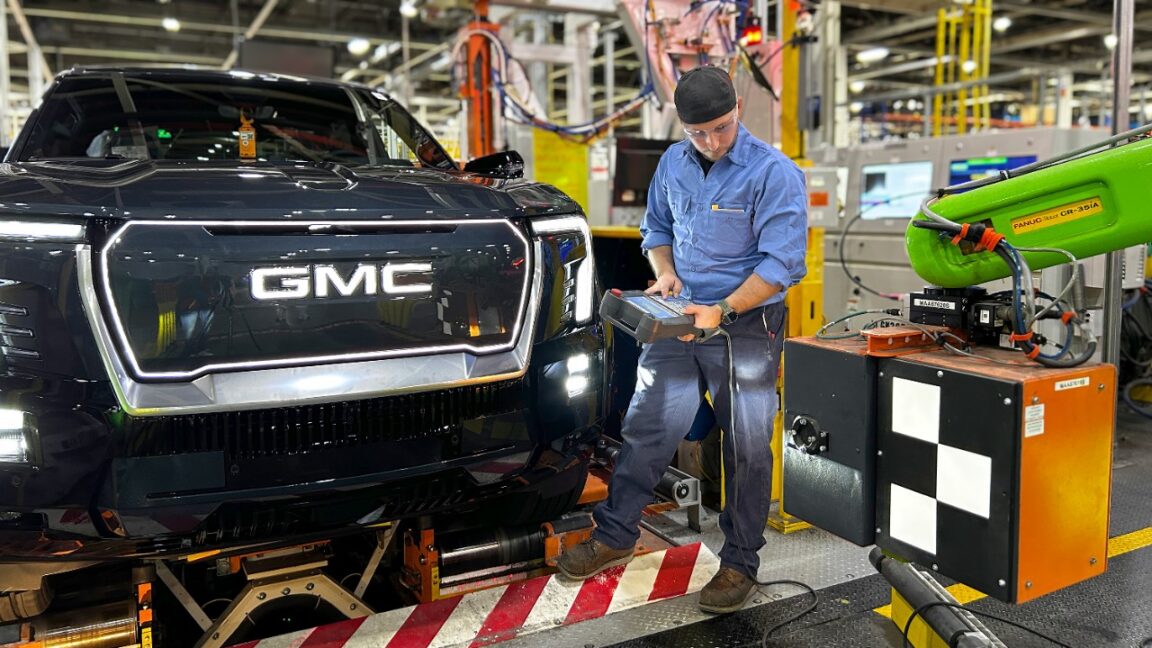
General Motors installed approximately 50 robot arms at GM’s Factory Zero plant in Detroit, Michigan, according to reporting by Crain’s Detroit Business. Made by the Japanese robotics company FANUC, the robots are designed to help attach various components to vehicles during the assembly line process. But leaders at United Auto Workers (UAW), the primary US union for autoworkers, reacted with anger to the new robotic presence, given how GM has not yet called back any of the workers affected by supposedly temporary layoffs in March.
More than 1,000 union members are still “laid off indefinitely,” James Cotton, president of UAW Local 22, told The Detroit News. He said that the company could bring some of those members back to work instead of installing the 50 robots.
The temporary layoffs were preceded by permanent layoffs involving another 1,200 workers at GM’s Factory Zero in October 2025.
Many automakers, including Stellantis NV and Ford Motor Company, have deployed assembly-line robots, such as Fanuc robot arms, as they push to automate more of their US operations. Hyundai Motor Company plans to deploy Atlas humanoid robots made by Boston Dynamics—which Hyundai acquired in 2020—to start working in the automaker’s flagship EV facility in Georgia by 2028.
Andrew Bergman, a Local 22 member and union organizer who was among those laid off by GM, described corporate leaders in the automotive industry as prioritizing profits over human workers.
“Technological development has the capability of making work safer for the working class and enabling workers to have a shorter work week without losing pay,” Bergman told The Detroit News. “But in the bosses’ and billionaires’ hands it’s used to pad profits and lay off workers.”
The Detroit News also highlighted how corporate leaders and workers conveyed “strikingly different messages” about AI, robotics, and automation during separate gatherings held in Detroit during the same week of June.
While the Reindustrialize Summit featured startup founder speeches about how robots could “empower our industrial base with superhuman manufacturing,” the UAW Constitutional Convention featured UAW president Shawn Fain warning against “the threat of humanoid robotics and mass automation” undermining worker employment and wages at a time of rising wealth inequality.
I Built a Content Engine That Creates 21 Social Posts a Week Using the Buffer API
Last year, I built Unstream, a side project that helps music fans find better ways to support the artists they actually love beyond the streaming apps. The first iteration came together over a weekend of vibe coding, but there have been a lot of iterative improvements and refinements that have caused marketing to take a back seat.
My marketing strategy, if you could call it that, was impulse posting. I’d think of something, drop everything to write it, push it to Threads or Instagram, then try to get back to what I was actually doing. It worked occasionally. It wasn’t sustainable.
Then I realized I’d been sitting on a content engine the whole time with my database of artists, a log of every feature I’d shipped, and all I had to do was automate the assembly. Here’s how I did it.
The raw material was hiding in the product
When I built Unstream, I ended up with two useful data pools without really thinking of them as content.
The first was a database of indie artists. About a month before I built the automation, I’d added a way for artists to claim and verify their profiles on Unstream. They could curate their own links and confirm their presence on different platforms. One hundred and fourteen artists signed up, giving me a clean, verified list of smaller independent musicians, and every way you can support them directly.
The second was more established artists. I used Claude Code to build a script — originally just for SEO — that pulled from the WikiInfo and MusicBrainz APIs to generate pages for musicians at a certain level of prominence. They aren’t quite Taylor Swift-popular, but that second- or third-tier of working artists most people don’t realize they can support outside of Spotify. I also filtered out anyone who wasn’t active anymore to highlight musicians who actually benefit from that support right now.
And then there was a third source of content I almost overlooked: a shipped features log. Every time I ship something, I add an entry with the feature, the date the feature rolled out, and a rough description. It powers a changelog in the app and is also a running list of things worth talking about on Unstream’s socials, at least when I get around to it.
If I had to distill the workflow, here’s the order it runs in:
GitHub Actions fires the job on a schedule: every Monday at 9 a.m.
The artist databases and features log supply the raw material
My templates (drafted with Claude Code, following my voice-and-tone guidelines) shape each post
The Buffer API schedules and publishes everything across Instagram, Threads, and Bluesky
⚡ To be clear: Claude didn’t write these posts. I built a small set of templates (some with Claude’s help) that the automation reuses for every post — closer to a daily syndication of artist and feature updates than AI churning out content.
It’s a bit more involved than those four lines, though, so here’s everything that goes into running the automation.
Claude Code is what I’ve been using to build Unstream from the start. It helped me write the scripts that populated my artist databases, and it helped me build the TypeScript automation that assembles the posts from my templates. It was the natural choice because I was already working in it every day, so there was no context-switching involved.
The Buffer API is how I schedule and publish posts. Once the automation generates a week of content, it pushes everything to Buffer, which handles the publishing across Instagram, Threads, and Bluesky. The API also lets me do platform-specific things, like adding Threads posts to the Music topic and appending hashtags on Instagram and Bluesky, without having to manually adjust each post.
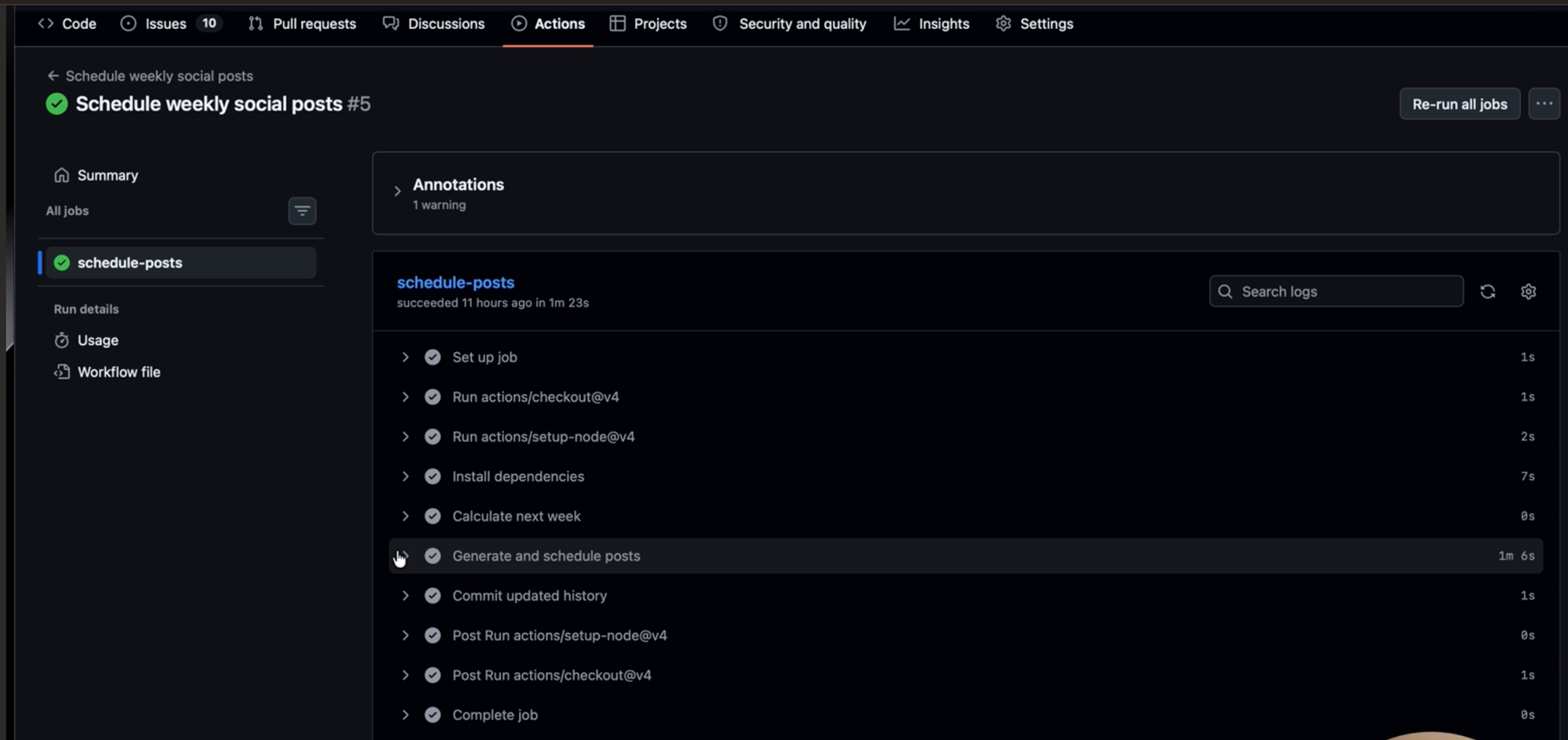
GitHub Actions is where the job runs. I have one action — “schedule weekly social posts” — that fires every Monday at 9 a.m. It calculates the upcoming calendar week, runs the TypeScript script, and that’s it. No need for a manual trigger means there’s no scheduled task I need to revisit.
iA Writer, a distraction-free text editor, is where I do spot-checks. All the generated posts and the upcoming schedule are stored as Markdown files in the repo, so I can pull them up in iA Writer whenever I want to review what’s going out. It’s not a required step since the system runs fine without me looking, but it’s nice to have a window into it.
MusicBrainz is the large music database I use to populate platform links and artist data for the more established artists. It’s one of the APIs that powers Unstream’s search, so the content pipeline is pulling from the same data source the product itself uses.
Inside the automation that generates 21 posts each week
Every Monday at 9 a.m., GitHub Actions fires the script. Then:
Step 1: Pick the artists
The TypeScript script starts by selecting six artists: three from the verified indie pool and three from the established artist pages. Indie artists come from the 114 musicians who’ve claimed their Unstream profiles. Established artists come from the WikiInfo and MusicBrainz-generated pool.
Each artist gets flagged as “promoted” once they’ve been featured. They won’t appear again until every artist in the pool has had a turn. This is one of the details that make the system work in the long term. More on that in a bit.
Step 2: Build the seven-day content calendar
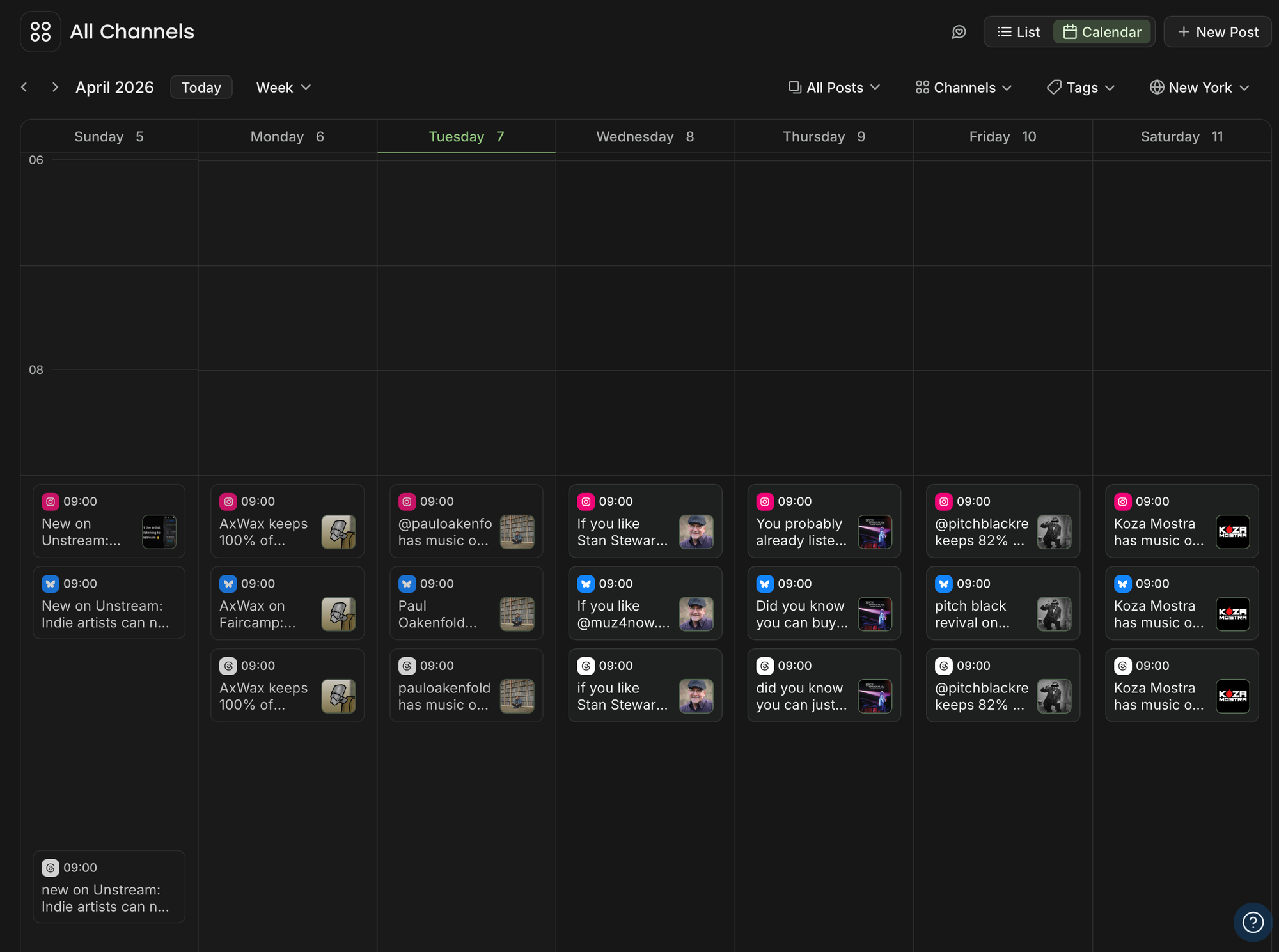
The six artists get organized into a seven-day schedule, one post per day. Indie and established artists alternate every other day for variety. The seventh day is reserved for a feature spotlight, pulled from my shipped features file.
This runs across three platforms: Instagram, Threads, and Bluesky — for a total of 21 posts per week. It’s the same content calendar, adapted for each platform.
Step 3: Generate the post content
This is where the TypeScript (code written in plain text) file does the heavy lifting. For each post, it handles the business logic: pulling the artist’s Instagram handle if they have one, listing the platform names where you can support them, and generating copy from a set of standard post templates.
The copy varies based on the type of artist. For indie artists, the angle is exposure and awareness (check out this artist, here’s how you can support them). For established artists, it’s more like, “That artist you love on Spotify? You can support them better through these platforms”. Feature posts are straightforward — what’s new and why it matters.
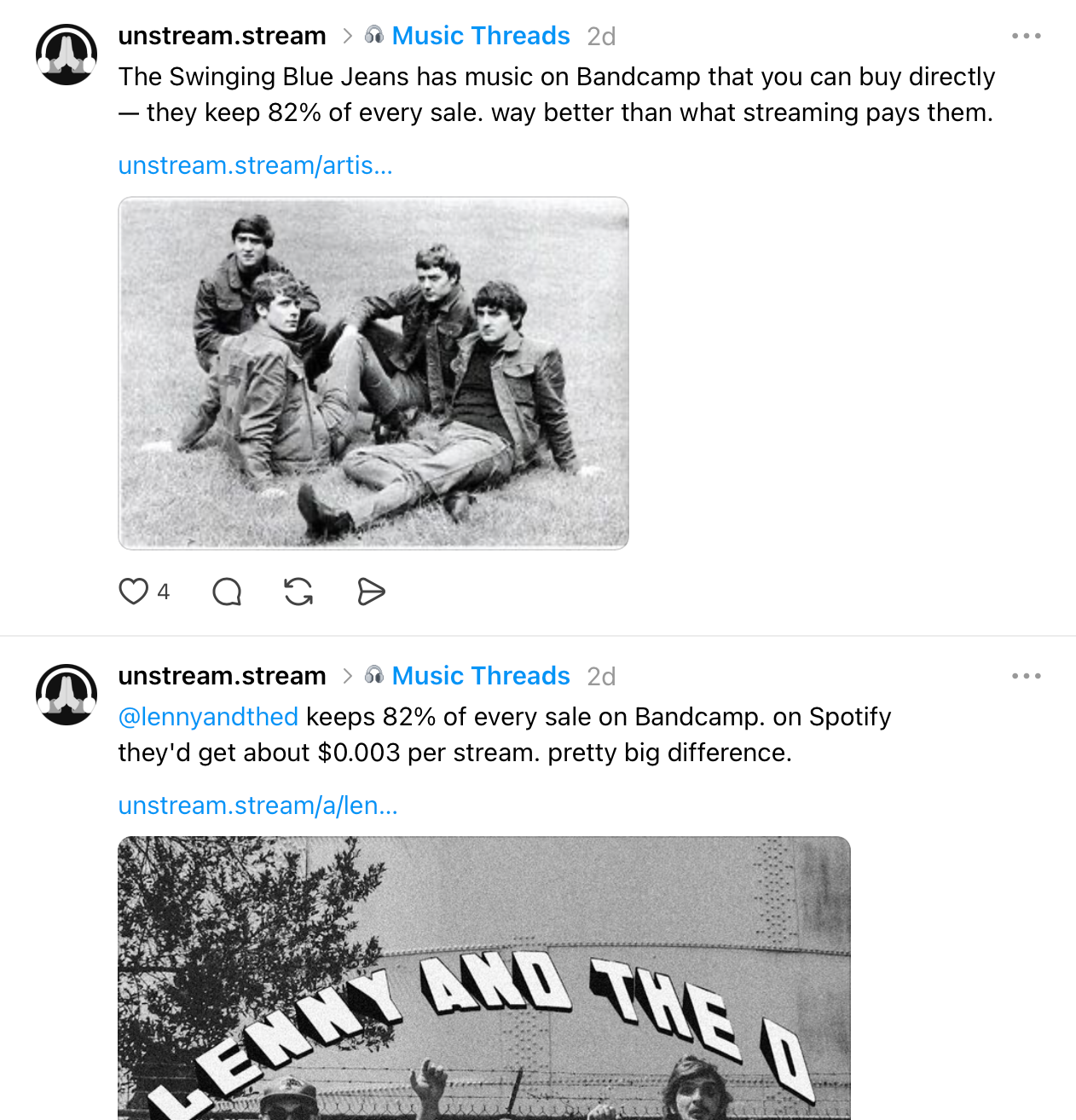
Artist photos get pulled automatically, either from the artist’s verified page on Unstream or from the same search API that powers the platform itself. Hashtags get applied in the code for Instagram and Bluesky. Threads posts get added to the Music topic.
To give you a sense of the range: my upcoming queue right now includes Neccos for Breakfast (a friend of mine from Threads), Steve Reich (a composer I very much love), and Bear McCreary (who has scored a bunch of sci-fi TV shows). It’s pulling from all over the place, which is exactly the point.
Step 4: Schedule through the Buffer API
At the end of the script, all the generated content is written and scheduled through the Buffer API. Posts land in my Buffer queue at 9 a.m. daily across all three platforms.
The result: I open Buffer and see a full week of content, ready to go.
Step 5: The deduplication layer
This is the part that makes the system sustainable, rather than something that runs out of steam after a few weeks.
Every artist gets flagged as promoted once they’ve been featured. The system won’t pick them again until every other artist in the pool has had a turn. Once everyone’s been covered, the whole list resets and the cycle starts over.
Features work the same way. Each entry in the shipped features file has a true/false “announced” tracker. It flips to true once that feature has been posted about. When everything’s been announced, the whole list resets to false, and we go again.
The nice thing about this approach is that the system naturally expands. As more indie artists verify their profiles and more features ship, the content pool grows without any extra work from me. I don’t need to feed it new material — the product growth feeds the content engine.
Teaching the automation to sound like me
One thing I knew from the start: if the posts sounded like generic AI, this whole thing would be pointless. Consistency only matters to me if the content actually sounds like it came from someone who cares about what they’re saying.
So before I wrote a single template, I spent time teaching Claude how I actually talk. I did it in a few steps:
First, I had it trained on my entire back catalog of published blog posts. They live at bgreen.lol, but I keep local copies as Markdown files, so I pointed Claude at those to get a feel for how I write long-form.
Then I pulled my last 50 Threads posts using an alpha version of the Buffer API. Blog posts and Threads posts are different animals — the blog shows how I think, but Threads shows how I write short. Since the social posts were going to be short, that second sample mattered just as much.
From there, I had Claude study the tone across both, with a few instructions: stick to the talking points I cared about, and bias toward my Threads voice and shorter lengths, since these were meant to be quick posts, not essays.
All of that became a voice-and-tone.md file — a set of guidelines describing how I talk about music, artists, and Unstream. Claude then proposed the boilerplate templates, and I made a few manual tweaks to get them exactly to my liking.
The templates give the posts structure, but the voice guidelines are what give them personality. They’re what make the difference between a post that reads like a press release and one that sounds like me sharing something I’m genuinely excited about.
The results so far
Each post gets a handful of likes and reposts, and Threads posts land somewhere between a few dozen and a few hundred views. But it’s OK because I have a different goal for my workflow.
I went from posting impulsively whenever I remembered to posting 21 times a week across three platforms, all without touching my workflow. Consistency was always Step 0, as you can’t grow anything organically on social if you’re not showing up. Now I’m showing up every day across three platforms without it costing me the time I need to actually build the product.
The system is also getting better on its own. Every artist who verifies their profile and every feature I ship expands the content pool without any extra work, so the pipeline and the product are growing together.
Next up: I’m thinking about expanding to TikTok and posting artist photos there. Adding a new platform is mostly just adding another API call, so it should be fairly straightforward.
What you can steal from this, even if your stack looks nothing like mine
My setup is specific to my project, which is to be expected, but the underlying approach works for anyone who’s building something and struggling to market it consistently. Here’s what can apply to most situations:
You probably already have your content. I started with a database I’d already built for product reasons. If you work with any sort of structured data — a list of customers, projects, testimonials, features you’ve shipped, partners you work with — you already have the raw material for a content engine. You just might not be thinking of it that way yet.
The two-bucket approach keeps things interesting. I alternate between content that promotes other people (the artists) and content that promotes my product (the features). That balance is what makes it feel like a feed worth following instead of a billboard.
If you’re a freelancer, one bucket could be client wins, and the other could be things you’ve learned. If you’re running social for a SaaS company, one bucket is customer stories, and the other is product updates.
Deduplication is what makes it sustainable. Without the tracking logic that prevents repeats and cycles through the full pool, this system would have run out of steam in a few weeks. That’s the difference between a one-time batch of content and an engine that keeps running.
Voice guidelines are non-negotiable. If you’re using AI to draft content, the voice file is the single most important piece. Without it, you get generic posts that could belong to anyone. With it, you get content that sounds like a real person with real opinions.
Start with “good enough.” My engagement numbers aren’t super impressive and I’m OK with that. I went from zero consistency to daily posts across three platforms, and the system gets better as my content pool grows.
If you’re taking Buffer’s API for a spin, we’ve got resources to get you moving. Our developer docs cover the GraphQL schema, auth flow, and quick-start examples. The Buffer MCP server docs walk through plugging it into Claude or any MCP-compatible AI agent.
Nadella (Microsoft) contro i signori dell’AI, meglio i modelli low cost e a sorpresa apre a DeepSeek
Il CEO di Microsoft Nadella contro il modello Silicon Valley: “L’AI non può essere nelle mani di pochi”
Per anni Satya Nadella è stato considerato il grande regista silenzioso della rivoluzione dell’intelligenza artificiale (AI). È stato lui, prima di molti altri, a intuire il potenziale di OpenAI e a investire decine di miliardi di dollari per trasformare ChatGPT da una promettente startup in uno dei protagonisti assoluti della nuova economia digitale. Oggi, però, il CEO di Microsoft sembra voler prendere le distanze proprio dalla traiettoria che ha contribuito a costruire.
In una lunga intervista al Wall Street Journal, Nadella ha delineato una visione alternativa dell’AI, criticando implicitamente il modello dominante che negli ultimi anni ha guidato la corsa all’intelligenza artificiale: pochi attori globali, modelli sempre più grandi, consumi energetici enormi, investimenti senza limiti e una narrazione pubblica spesso costruita attorno a scenari apocalittici.
Il messaggio è chiaro: l’attuale paradigma non è sostenibile né economicamente né socialmente.
La critica ai “signori dell’AI” e a un modello di sviluppo orientato al gigantismo
Senza mai citare direttamente OpenAI, Anthropic o Google, Nadella mette in discussione il presupposto su cui si fonda la corsa ai cosiddetti modelli di frontiera, i sistemi più avanzati e costosi oggi disponibili. Secondo il manager indiano-americano, il rischio è che una ristretta élite tecnologica finisca per concentrare nelle proprie mani una quantità eccessiva di potere cognitivo, economico e politico.
La proposta di Nadella è quasi una contro-rivoluzione rispetto all’immaginario dominante della Silicon Valley. Negli ultimi anni il settore ha vissuto una sorta di competizione permanente per costruire modelli sempre più potenti, alimentati da quantità crescenti di dati, chip e capacità computazionale. L’idea implicita era semplice: più grande è il modello, migliore sarà il risultato.
“Non si può dire che tutti i lavori impiegatizi spariranno, che l’intelligenza artificiale potrebbe diventare un’arma e allo stesso tempo chiedere di costruire data center sempre più grandi”, osserva Nadella. Una critica diretta a quella retorica che negli ultimi anni ha alternato promesse di prosperità illimitata a previsioni catastrofiche sulla fine del lavoro umano o addirittura sull’estinzione della specie.
Dietro questa affermazione si intravede una questione fondamentale: la governance dell’AI. Chi decide come apprendono questi sistemi? Chi controlla i dati? E chi stabilisce le regole? Fino ad oggi le risposte sono rimaste concentrate nelle mani di pochissimi soggetti privati. I cittadini non accetteranno oltre modo questa situazione.
Piccolo è più bello (e meno costoso)
Microsoft sembra invece voler scommettere su una logica diversa. Nelle ultime settimane l’azienda ha presentato una serie di modelli a basso costo e nuove funzionalità che permettono agli utenti di scegliere quale AI utilizzare a seconda delle esigenze. L’obiettivo è ridurre la dipendenza dai sistemi più costosi e abbassare drasticamente il prezzo dell’intelligenza artificiale.
Secondo Nadella il futuro non sarà dominato da un singolo “cervello universale“, ma da una pluralità di modelli con differenti livelli di costo, specializzazione e prestazioni.
Una visione che richiama l’evoluzione di internet: da una rete inizialmente controllata da pochi grandi operatori a un ecosistema distribuito di servizi, applicazioni e piattaforme.
Copilot cambia pelle e mette l’utente al centro
In questo scenario anche Copilot assume un ruolo diverso. Lanciato inizialmente come risposta di Microsoft a ChatGPT di OpenAI, il prodotto non sembra più destinato a diventare il modello AI dominante del mercato. Piuttosto, potrebbe trasformarsi in una piattaforma neutrale capace di orchestrare diversi modelli e diversi fornitori.
La nuova strategia consiste nel mettere l’utente al centro, lasciandogli la possibilità di scegliere quale intelligenza artificiale utilizzare per ogni attività. Se questa impostazione verrà confermata, Copilot assomiglierà meno a un concorrente diretto di ChatGPT e più a un sistema operativo dell’intelligenza artificiale, capace di integrare modelli differenti e di gestire flussi di lavoro complessi.
È un cambiamento significativo perché sposta il valore dalla costruzione del modello alla gestione dell’ecosistema.
Il caso DeepSeek e la guerra dei prezzi
L’elemento più sorprendente della strategia di Microsoft riguarda però DeepSeek. L’azienda cinese è diventata negli ultimi mesi il simbolo di un approccio radicalmente diverso all’AI: modelli meno costosi, maggiore efficienza e costi operativi ridotti rispetto ai colossi americani.
Microsoft starebbe valutando la possibilità di ospitare una versione di DeepSeek all’interno del proprio ecosistema.
Se ciò accadesse, sarebbe un segnale fortissimo. Da un lato significherebbe riconoscere che il valore dell’AI non coincide necessariamente con il possesso del modello più potente. Dall’altro aprirebbe una vera e propria guerra dei prezzi contro OpenAI e Anthropic (che comunque è già iniziata), costrette a giustificare costi molto più elevati.
Dietro la disputa tecnica si nasconde una questione strategica: se modelli più economici riescono a offrire prestazioni sufficientemente buone per la maggior parte delle applicazioni aziendali, l’intero modello economico dell’AI di frontiera rischia di entrare in crisi.
Una svolta o una necessità per Microsoft?
La domanda inevitabile è se questa nuova filosofia rappresenti una convinzione profonda o una necessità strategica.
Negli ultimi tempi Microsoft ha perso terreno nella corsa ai modelli più avanzati. In parole povere, Copilot non ce l’ha fatta. OpenAI continua a guidare il mercato consumer con ChatGPT, Google ha recuperato rapidamente terreno con Gemini e Anthropic si è ritagliata uno spazio importante nel settore enterprise.
Microsoft dispone di enormi risorse finanziarie e di una posizione dominante nel software aziendale, ma non possiede oggi un modello proprietario capace di competere apertamente con i leader del settore.
In questo contesto, trasformare i modelli in una commodity (cioè una risorsa ampiamente disponibile, il cui solo possesso non costituisce più una fonte di vantaggio competitivo, come è stato nei decenni per l’energia elettrica, la connettività Internet e il cloud computing) e spostare il valore verso la piattaforma potrebbe essere anche una risposta pragmatica a una corsa che l’azienda non è riuscita a vincere sul piano tecnologico.
In altre parole: se non puoi controllare il miglior modello, puoi cercare di controllare l’infrastruttura che collega tutti i modelli. E qui per noi utilizzatori si genera un ennesimo rischio. Come ha spiegato bene Crescenzo Coppola via social: “Sostenere che l’AI sia una commodity è una mezza verità. È una commodity nell’accesso. Ma può trasformarsi in una dipendenza nell’infrastruttura e in una vulnerabilità nei processi“.
La vera battaglia è guadagnarsi “il permesso sociale”
Al di là delle strategie industriali, il punto più interessante dell’intervista riguarda il rapporto tra AI e società.
Nadella sostiene che il settore abbia ormai esaurito il tempo delle promesse e delle narrazioni futuristiche. Adesso deve dimostrare concretamente di poter creare opportunità economiche, proteggere i lavoratori e distribuire i benefici della tecnologia. Qui Microsoft probabilmente cercherà di giocare la sua prossima partita per ottenere un vantaggio competitivo sulle altre società tecnologiche.
“Dobbiamo guadagnarci il permesso sociale”, ha affermato il CEO del gigante di Redmond. È forse la frase più importante di tutta l’intervista. La vera sfida non è costruire modelli più grandi. È convincere la società, noi tutti, che l’AI possa essere uno strumento di progresso condiviso e non l’ennesima concentrazione di potere nelle mani di pochi. Una sfida notevole, se pensiamo che in fondo Microsoft è da tutti e da sempre considerata parte di quei “pochi”.