Il nuovo motore di ricerca di OpenAI cambia il web? Sfida a Google e marketers
Molti pensano che ChatGPT sia già un motore di ricerca: possiamo digitare query simili a quelle che scriviamo su Google ma con un grosso limite: la conoscenza del chatbot è ferma allo scorso autunno. Per questo si è vociferato in passato della possibilità che OpenAI potesse presentare un vero e proprio motore di ricerca che, nella notte italiana, ha preso il nome di SeatchGPT.
“Ottenere risposte sul web può richiedere molto impegno, spesso richiedendo più tentativi per ottenere risultati pertinenti”, ha affermato l’azienda in un post sul proprio sito. “Riteniamo che migliorando le capacità conversazionali dei nostri modelli con informazioni in tempo reale dal web, trovare ciò che stai cercando può diventare più rapido e semplice”.
Per ora il servizio è in anteprima con un accesso limitato a 10.000 tester.
Allenato su fatti verificati
I chatbot AI attingono a immense quantità di ciò che è noto come dati di addestramento da una varietà di fonti, tra cui Internet. “SearchGPT risponderà rapidamente e direttamente alle tue domande con informazioni aggiornate dal web, fornendoti al contempo link chiari a fonti pertinenti”, ha affermato la società, aggiungendo che gli utenti potranno porre domande di follow-up alle loro query per informazioni più complete.
Un chiaro segnale a Google, il perno della ricerca web, che rappresenta circa il 90% dell’attività di ricerca su internet. A maggio, Big G ha iniziato a integrare nei risultati “standard” ciò che chiama AI Overviews, riepiloghi basati su Gemini che compaiono sopra la carrellata di link. All’inizio, AI Overviews ha restituito alcuni risultati imbarazzanti, ma Google si è rapidamente riorganizzato e ora le sue pagine di ricerca mostrano regolarmente la nuova funzione in mercati selezionati, tra cui gli Stati Uniti.
Ieri, Microsoft ha svelato il suo approccio alla fusione di AI e ricerca, chiamato Bing Generative Search. Per ora, è disponibile solo per “una piccola percentuale di domande degli utenti”. Insomma, ne vedremo delle belle.
[embedded content]
Scenario complesso per OpenAI
OpenAI dovrà procedere con una certa cautela visto che muove i primi passi nello scenario della ricerca web, che può essere molto complesso. Di recente, Perplexity, un ulteriore concorrente è stato criticato per aver rubato contenuti da pubblicazioni tra cui Wired e Forbes. OpenAI è già stata colpita da un’azione legale per i dati di training che ha immesso in ChatGPT. A dicembre, il New York Times ha intentato una causa contro la startup, sostenendo che sta “utilizzando i contenuti del Times illecitamente per creare prodotti che sostituiscono il Times e gli rubano il pubblico”.
Non è un caso che per SearchGPT, OpenAI stia lavorando con editori e creatori, così che il motore possa citare ed elencare le fonti, in modo trasparente. Un primo partner dell’iniziativa è The Atlantic, che ha già dato il via libera per consentire al servizio di cibarsi dei suoi contenuti da proporre nelle risposte.
On Thursday, Google DeepMind announced that AI systems called AlphaProof and AlphaGeometry 2 reportedly solved four out of six problems from this year’s International Mathematical Olympiad (IMO), achieving a score equivalent to a silver medal. The tech giant claims this marks the first time an AI has reached this level of performance in the prestigious math competition—but as usual in AI, the claims aren’t as clear-cut as they seem.
Google says AlphaProof uses reinforcement learning to prove mathematical statements in the formal language called Lean. The system trains itself by generating and verifying millions of proofs, progressively tackling more difficult problems. Meanwhile, AlphaGeometry 2 is described as an upgraded version of Google’s previous geometry-solving AI modeI, now powered by a Gemini-based language model trained on significantly more data.
According to Google, prominent mathematicians Sir Timothy Gowers and Dr. Joseph Myers scored the AI model’s solutions using official IMO rules. The company reports its combined system earned 28 out of 42 possible points, just shy of the 29-point gold medal threshold. This included a perfect score on the competition’s hardest problem, which Google claims only five human contestants solved this year.
A math contest unlike any other
The IMO, held annually since 1959, pits elite pre-college mathematicians against exceptionally difficult problems in algebra, combinatorics, geometry, and number theory. Performance on IMO problems has become a recognized benchmark for assessing an AI system’s mathematical reasoning capabilities.
Google states that AlphaProof solved two algebra problems and one number theory problem, while AlphaGeometry 2 tackled the geometry question. The AI model reportedly failed to solve the two combinatorics problems. The company claims its systems solved one problem within minutes, while others took up to three days.
Google says it first translated the IMO problems into formal mathematical language for its AI model to process. This step differs from the official competition, where human contestants work directly with the problem statements during two 4.5-hour sessions.
Google reports that before this year’s competition, AlphaGeometry 2 could solve 83 percent of historical IMO geometry problems from the past 25 years, up from its predecessor’s 53 percent success rate. The company claims the new system solved this year’s geometry problem in 19 seconds after receiving the formalized version.
Limitations
Despite Google’s claims, Sir Timothy Gowers offered a more nuanced perspective on the Google DeepMind models in a thread posted on X. While acknowledging the achievement as “well beyond what automatic theorem provers could do before,” Gowers pointed out several key qualifications.
“The main qualification is that the program needed a lot longer than the human competitors—for some of the problems over 60 hours—and of course much faster processing speed than the poor old human brain,” Gowers wrote. “If the human competitors had been allowed that sort of time per problem they would undoubtedly have scored higher.”
Gowers also noted that humans manually translated the problems into the formal language Lean before the AI model began its work. He emphasized that while the AI performed the core mathematical reasoning, this “autoformalization” step was done by humans.
Regarding the broader implications for mathematical research, Gowers expressed uncertainty. “Are we close to the point where mathematicians are redundant? It’s hard to say. I would guess that we’re still a breakthrough or two short of that,” he wrote. He suggested that the system’s long processing times indicate it hasn’t “solved mathematics” but acknowledged that “there is clearly something interesting going on when it operates.”
Even with these limitations, Gowers speculated that such AI systems could become valuable research tools. “So we might be close to having a program that would enable mathematicians to get answers to a wide range of questions, provided those questions weren’t too difficult—the kind of thing one can do in a couple of hours. That would be massively useful as a research tool, even if it wasn’t itself capable of solving open problems.”
https://arstechnica.com/?p=2039221
OpenAI hits Google where it hurts with new SearchGPT prototype
Benj Edwards / OpenAI
Arguably, few companies have unintentionally contributed more to the increase of AI-generated noise online than OpenAI. Despite its best intentions—and against its terms of service—its AI language models are often used to compose spam, and its pioneering research has inspired others to build AI models that can potentially do the same. This influx of AI-generated content has further reduced the effectiveness of SEO-driven search engines like Google. In 2024, web search is in a sorry state indeed.
It’s interesting, then, that OpenAI is now offering a potential solution to that problem. On Thursday, OpenAI revealed a prototype AI-powered search engine called SearchGPT that aims to provide users with quick, accurate answers sourced from the web. It’s also a direct challenge to Google, which also has tried to apply generative AI to web search (but with little success).
The company says it plans to integrate the most useful aspects of the temporary prototype into ChatGPT in the future. ChatGPT (and Microsoft Copilot) can already perform web searches using Bing, but SearchGPT seems to be OpenAI’s purpose-built interface for AI-assisted web searching.
SearchGPT attempts to streamline the process of finding information online by combining OpenAI’s AI models (like GPT-4o) with real-time web data. Like ChatGPT, users can reportedly ask SearchGPT follow-up questions, with the AI model maintaining context throughout the conversation.
Perhaps most importantly from an accuracy standpoint, the SearchGPT prototype (which we have not tested ourselves) reportedly includes features that attribute web-based sources prominently. Responses include in-line citations and links, while a sidebar displays additional source links.
OpenAI has not yet said how it is obtaining its real-time web data and whether it’s partnering with an existing search engine provider (like it does currently with Bing for ChatGPT) or building its own web-crawling and indexing system.
A way around publishers blocking OpenAI
ChatGPT can already perform web searches using Bing, but since last August when OpenAI revealed a way to block its web crawler, that feature hasn’t been nearly as useful as it could be. Many sites, such as Ars Technica (which blocks the OpenAI crawler as part of our parent company’s policy), won’t show up as results in ChatGPT because of this.
SearchGPT appears to untangle the association between OpenAI’s web crawler for scraping training data and the desire for OpenAI chatbot users to search the web. Notably, in the new SearchGPT announcement, OpenAI says, “Sites can be surfaced in search results even if they opt out of generative AI training.”
Even so, OpenAI says it is working on a way for publishers to manage how they appear in SearchGPT results so that “publishers have more choices.” And the company says that SearchGPT’s ability to browse the web is separate from training OpenAI’s AI models.
An uncertain future for AI-powered search
OpenAI claims SearchGPT will make web searches faster and easier. However, the effectiveness of AI-powered search compared to traditional methods is unknown, as the tech is still in its early stages. But let’s be frank: The most prominent web-search engine right now is pretty terrible.
Over the past year, we’ve seen Perplexity.ai take off as a potential AI-powered Google search replacement, but the service has been hounded by issues with confabulations and accusations of plagiarism among publishers, including Ars Technica parent Condé Nast.
Unlike Perplexity, OpenAI has many content deals lined up with publishers, and it emphasizes that it wants to work with content creators in particular. “We are committed to a thriving ecosystem of publishers and creators,” says OpenAI in its news release. “We hope to help users discover publisher sites and experiences, while bringing more choice to search.”
In a statement for the OpenAI press release, Nicholas Thompson, CEO of The Atlantic (which has a content deal with OpenAI), expressed optimism about the potential of AI search: “AI search is going to become one of the key ways that people navigate the internet, and it’s crucial, in these early days, that the technology is built in a way that values, respects, and protects journalism and publishers,” he said. “We look forward to partnering with OpenAI in the process, and creating a new way for readers to discover The Atlantic.”
OpenAI has experimented with other offshoots of its AI language model technology that haven’t become blockbuster hits (most notably, GPTs come to mind), so time will tell if the techniques behind SearchGPT have staying power—and if it can deliver accurate results without hallucinating. But the current state of web search is inviting new experiments to separate the signal from the noise, and it looks like OpenAI is throwing its hat in the ring.
OpenAI is currently rolling out SearchGPT to a small group of users and publishers for testing and feedback. Those interested in trying the prototype can sign up for a waitlist on the company’s website.
https://arstechnica.com/?p=2039302
We made a cat drink a beer with Runway’s AI video generator, and it sprouted hands
In June, Runway debuted a new text-to-video synthesis model called Gen-3 Alpha. It converts written descriptions called “prompts” into HD video clips without sound. We’ve since had a chance to use it and wanted to share our results. Our tests show that careful prompting isn’t as important as matching concepts likely found in the training data, and that achieving amusing results likely requires many generations and selective cherry-picking.
An enduring theme of all generative AI models we’ve seen since 2022 is that they can be excellent at mixing concepts found in training data but are typically very poor at generalizing (applying learned “knowledge” to new situations the model has not explicitly been trained on). That means they can excel at stylistic and thematic novelty but struggle at fundamental structural novelty that goes beyond the training data.
What does all that mean? In the case of Runway Gen-3, lack of generalization means you might ask for a sailing ship in a swirling cup of coffee, and provided that Gen-3’s training data includes video examples of sailing ships and swirling coffee, that’s an “easy” novel combination for the model to make fairly convincingly. But if you ask for a cat drinking a can of beer (in a beer commercial), it will generally fail because there aren’t likely many videos of photorealistic cats drinking human beverages in the training data. Instead, the model will pull from what it has learned about videos of cats and videos of beer commercials and combine them. The result is a cat with human hands pounding back a brewsky.
A few basic prompts
During the Gen-3 Alpha testing phase, we signed up for Runway’s Standard plan, which provides 625 credits for $15 a month, plus some bonus free trial credits. Each generation costs 10 credits per one second of video, and we created 10-second videos for 100 credits a piece. So the quantity of generations we could make were limited.
We first tried a few standards from our image synthesis tests in the past, like cats drinking beer, barbarians with CRT TV sets, and queens of the universe. We also dipped into Ars Technica lore with the “moonshark,” our mascot. You’ll see all those results and more below.
We had so few credits that we couldn’t afford to rerun them and cherry-pick, so what you see for each prompt is exactly the single generation we received from Runway.
“A highly-intelligent person reading “Ars Technica” on their computer when the screen explodes”
“commercial for a new flaming cheeseburger from McDonald’s”
“The moonshark jumping out of a computer screen and attacking a person”
“A cat in a car drinking a can of beer, beer commercial”
“Will Smith eating spaghetti” triggered a filter, so we tried “a black man eating spaghetti.” (Watch until the end.)
“Robotic humanoid animals with vaudeville costumes roam the streets collecting protection money in tokens”
“A basketball player in a haunted passenger train car with a basketball court, and he is playing against a team of ghosts”
“A herd of one million cats running on a hillside, aerial view”
“video game footage of a dynamic 1990s third-person 3D platform game starring an anthropomorphic shark boy”
https://arstechnica.com/?p=2036379
G7: al via la fase pilota per il monitoraggio del Codice di Condotta sull’AI
Entra nel vivo la fase pilota del sistema di monitoraggio del Codice di Condotta G7 per le organizzazioni che sviluppano sistemi di Intelligenza Artificiale avanzati. Questa iniziativa, promossa dal G7 e coordinata dalla Presidenza italiana attraverso il lavoro del Dipartimento per la trasformazione digitale, è un passo fondamentale per garantire lo sviluppo e l’uso sicuro, etico e trasparente dell’IA a livello globale. Lo scrive il Dipartimento per la Trasformazione Digitale.
L’attività segue l’impegno preso dai leader del G7 il 15 marzo a Trento, durante la seconda giornata della Riunione Ministeriale su Industria, Tecnologia e Digitale, guidata dal Sottosegretario di Stato alla Presidenza del Consiglio con delega all’innovazione tecnologica Alessio Butti.
Il Codice di Condotta Internazionale per le organizzazioni che sviluppano sistemi di IA Avanzati, approvato nel 2023 nel contesto del Processo di Hiroshima, mira a garantire che l’IA sia progettata, sviluppata e utilizzata rispettando i valori democratici dei Paesi del G7.
Le organizzazioni che sviluppano sistemi di IA avanzata sono invitate a partecipare attivamente alla fase pilota, che durerà fino al 6 settembre 2024. I feedback raccolti durante questo periodo saranno fondamentali per migliorare ulteriormente il sistema di monitoraggio prima del rilascio della sua versione finale entro la fine dell’anno.
The first GPT-4-class AI model anyone can download has arrived: Llama 405B
In the AI world, there’s a buzz in the air about a new AI language model released Tuesday by Meta: Llama 3.1 405B. The reason? It’s potentially the first time anyone can download a GPT-4-class large language model (LLM) for free and run it on their own hardware. You’ll still need some beefy hardware: Meta says it can run on a “single server node,” which isn’t desktop PC-grade equipment. But it’s a provocative shot across the bow of “closed” AI model vendors such as OpenAI and Anthropic.
“Llama 3.1 405B is the first openly available model that rivals the top AI models when it comes to state-of-the-art capabilities in general knowledge, steerability, math, tool use, and multilingual translation,” says Meta. Company CEO Mark Zuckerberg calls 405B “the first frontier-level open source AI model.”
In the AI industry, “frontier model” is a term for an AI system designed to push the boundaries of current capabilities. In this case, Meta is positioning 405B among the likes of the industry’s top AI models, such as OpenAI’s GPT-4o, Claude’s 3.5 Sonnet, and Google Gemini 1.5 Pro.
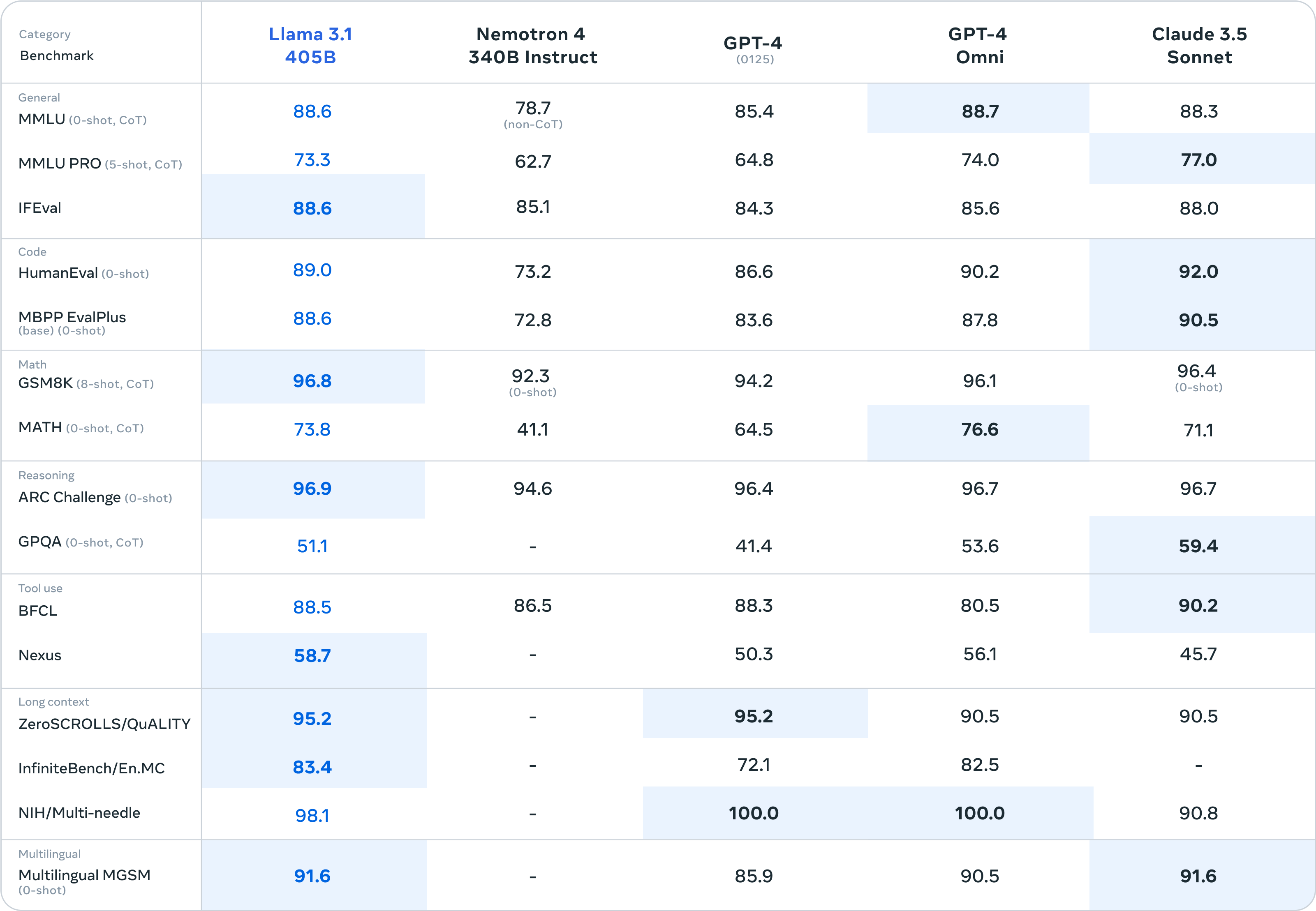
A chart published by Meta suggests that 405B gets very close to matching the performance of GPT-4 Turbo, GPT-4o, and Claude 3.5 Sonnet in benchmarks like MMLU (undergraduate level knowledge), GSM8K (grade school math), and HumanEval (coding).
But as we’ve noted many times since March, these benchmarks aren’t necessarily scientifically sound and don’t convey the subjective experience of interacting with AI language models. In fact, this traditional slate of AI benchmarks is so generally useless to laypeople that even Meta’s PR department just posted a few images of numerical charts without attempting explain their significance in any detail.
Enlarge/ A Meta-provided chart that shows Llama 3.1 405B benchmark results versus other major AI models.
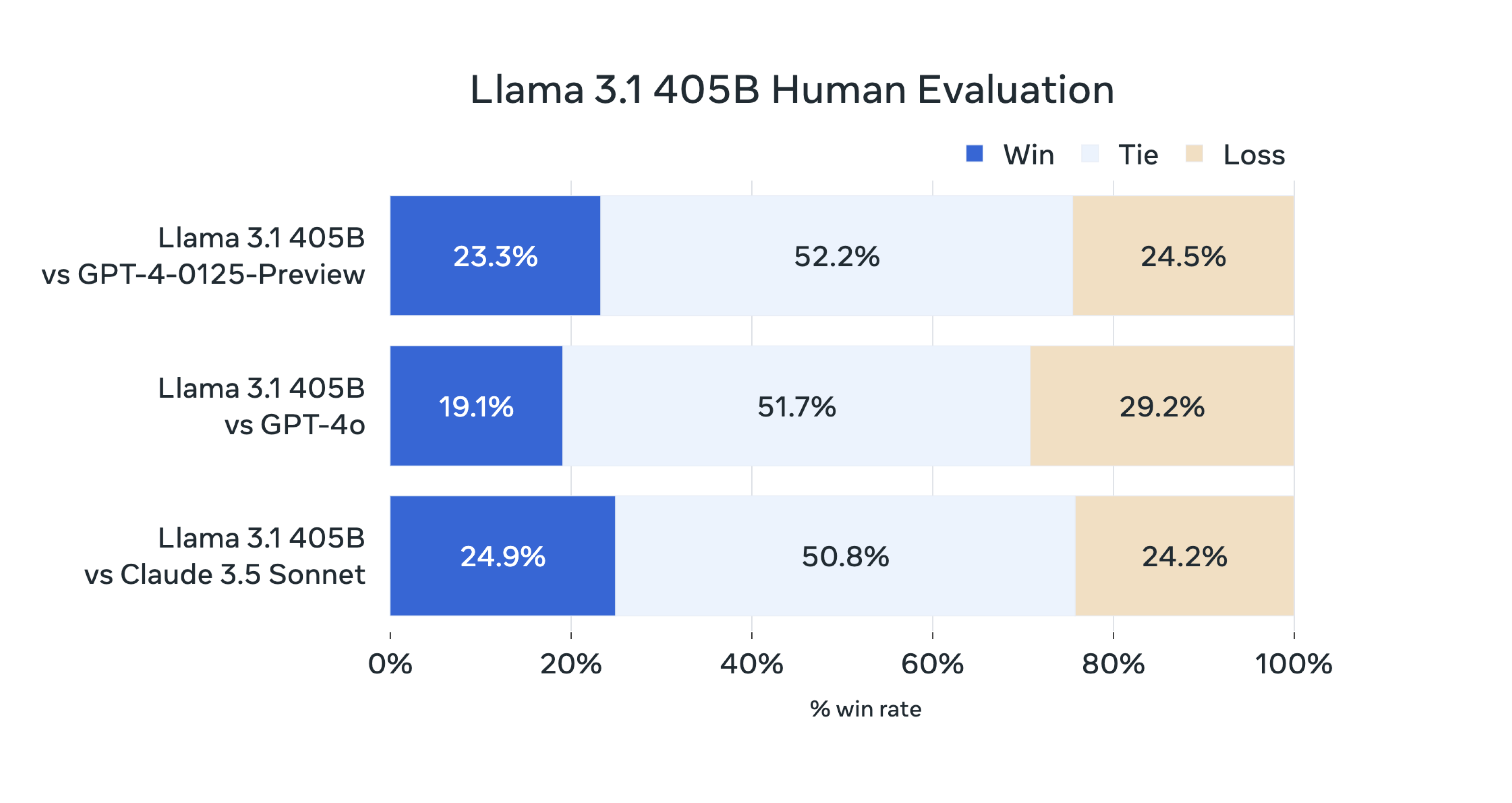
We’ve instead found that measuring the subjective experience of using a conversational AI model (through what might be called “vibemarking”) on A/B leaderboards like Chatbot Arena is a better way to judge new LLMs. In the absence of Chatbot Arena data, Meta has provided the results of its own human evaluations of 405B’s outputs that seem to show Meta’s new model holding its own against GPT-4 Turbo and Claude 3.5 Sonnet.
Enlarge/ A Meta-provided chart that shows how humans rated Llama 3.1 405B’s outputs compared to GPT-4 Turbo, GPT-4o, and Claude 3.5 Sonnet in its own studies.
Whatever the benchmarks, early word on the street (after the model leaked on 4chan yesterday) seems to match the claim that 405B is roughly equivalent to GPT-4. It took a lot of expensive computer training time to get there—and money, of which the social media giant has plenty to burn. Meta trained the 405B model on over 15 trillion tokens of training data scraped from the web (then parsed, filtered, and annotated by Llama 2), using more than 16,000 H100 GPUs.
So what’s with the 405B name? In this case, “405B” means 405 billion parameters, and parameters are numerical values that store trained information in a neural network. More parameters translate to a larger neural network powering the AI model, which generally (but not always) means more capability, such as better ability to make contextual connections between concepts. But larger-parameter models have a tradeoff in needing more computing power (AKA “compute”) to run.
We’ve been expecting the release of a 400 billion-plus parameter model of the Llama 3 family since Meta gave word that it was training one in April, and today’s announcement isn’t just about the biggest member of the Llama 3 family: There’s an entirely new iteration of improved Llama models with the designation “Llama 3.1.” That includes upgraded versions of its smaller 8B and 70B models, which now feature multilingual support and an extended context length of 128,000 tokens (the “context length” is roughly the working memory capacity of the model, and “tokens” are chunks of data used by LLMs to process information).
Meta says that 405B is useful for long-form text summarization, multilingual conversational agents, and coding assistants and for creating synthetic data used to train future AI language models. Notably, that last use-case—allowing developers to use outputs from Llama models to improve other AI models—is now officially supported by Meta’s Llama 3.1 license for the first time.
Abusing the term “open source”
Llama 3.1 405B is an open-weights model, which means anyone can download the trained neural network files and run them or fine-tune them. That directly challenges a business model where companies like OpenAI keep the weights to themselves and instead monetize the model through subscription wrappers like ChatGPT or charge for access by the token through an API.
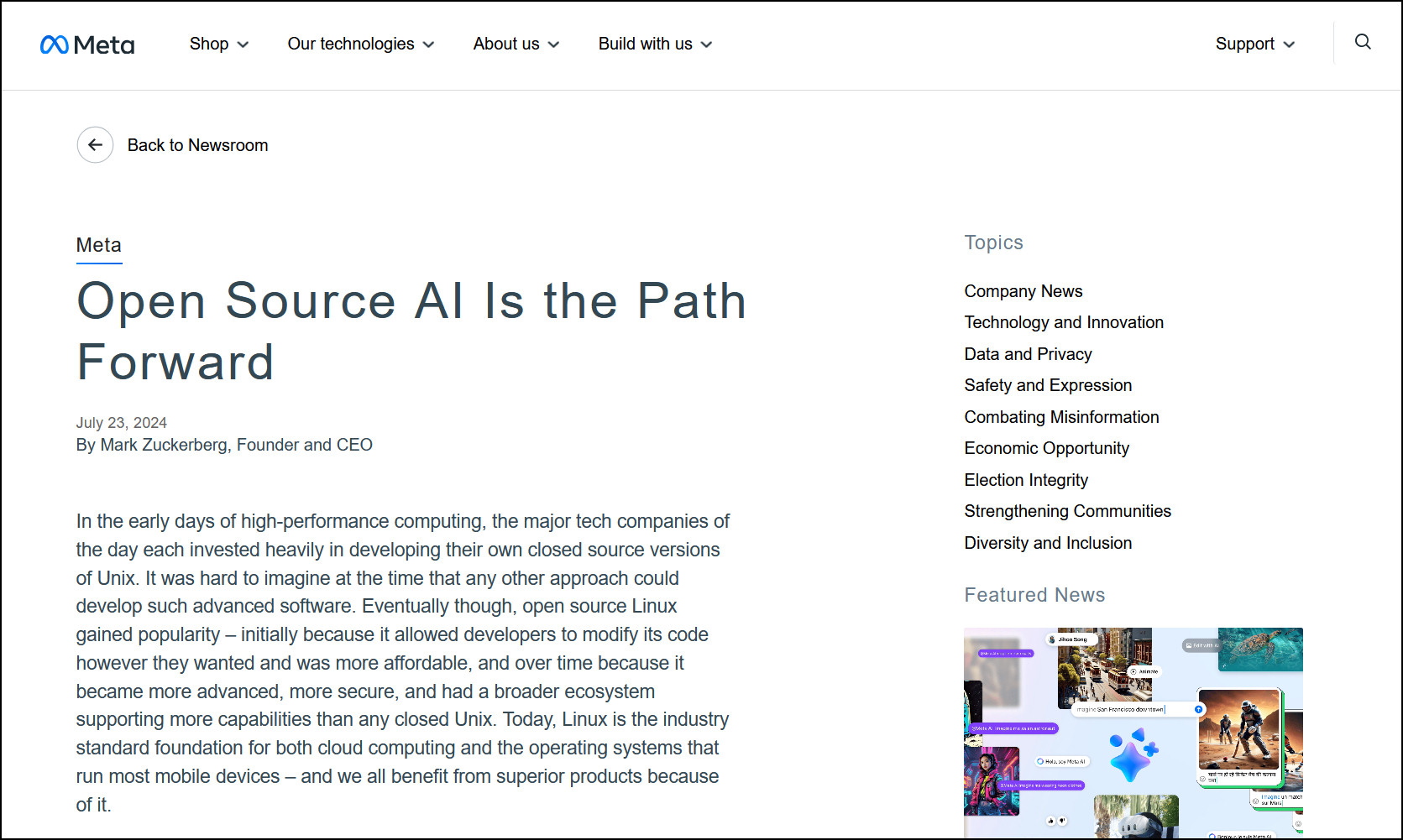
Fighting the “closed” AI model is a big deal to Mark Zuckerberg, who simultaneously released a 2,300-word manifesto today on why the company believes in open releases of AI models, titled, “Open Source AI Is the Path Forward.” More on the terminology in a minute. But briefly, he writes about the need for customizable AI models that offer user control and encourage better data security, higher cost-efficiency, and better future-proofing, as opposed to vendor-locked solutions.
All that sounds reasonable, but disrupting your competitors using a model subsidized by a social media war chest is also an efficient way to play spoiler in a market where you might not always win with the most cutting-edge tech. Open releases of AI models benefit Meta, Zuckerberg says, because he doesn’t want to get locked into a system where companies like his have to pay a toll to access AI capabilities, drawing comparisons to “taxes” Apple levies on developers through its App Store.
Enlarge/ A screenshot of Mark Zuckerberg’s essay, “Open Source AI Is the Path Forward,” published on July 23, 2024.
So, about that “open source” term. As we first wrote in an update to our Llama 2 launch article a year ago, “open source” has a very particular meaning that has traditionally been defined by the Open Source Initiative. The AI industry has not yet settled on terminology for AI model releases that ship either code or weights with restrictions (such as Llama 3.1) or that ship without providing training data. We’ve been calling these releases “open weights” instead.
Unfortunately for terminology sticklers, Zuckerberg has now baked the erroneous “open source” label into the title of his potentially historic aforementioned essay on open AI releases, so fighting for the correct term in AI may be a losing battle. Still, his usage annoys people like independent AI researcher Simon Willison, who likes Zuckerberg’s essay otherwise.
“I see Zuck’s prominent misuse of ‘open source’ as a small-scale act of cultural vandalism,” Willison told Ars Technica. “Open source should have an agreed meaning. Abusing the term weakens that meaning which makes the term less generally useful, because if someone says ‘it’s open source,’ that no longer tells me anything useful. I have to then dig in and figure out what they’re actually talking about.”
The Llama 3.1 models are available for download through Meta’s own website and on Hugging Face. They both require providing contact information and agreeing to a license and an acceptable use policy, which means that Meta can technically legally pull the rug out from under your use of Llama 3.1 or its outputs at any time.
https://arstechnica.com/?p=2038486
“Osiris”, la ChatGPT della Cia
La Cia ha sviluppato la gen AI Osiris
Utilizzare l’intelligenza artificiale (AI) significa acquisire notevoli vantaggi operativi, nel salvare delle vite umane, nel vincere una guerra o nell’evitare disastri di varia natura. Lo stesso vale per le agenzie governative di intelligence.
La celebre Central intelligence agency, più comunemente conosciuta con il suo acronimo inglese “Cia”, l’agenzia di intelligence civile del Governo degli Stati Uniti, ha da molti anni impiegato soluzioni di AI nei suoi piani operativi, almeno dal 2001.
In particolare, i principali ambiti di applicazione sono stati relativi all’elaborazione del linguaggio naturale, ad esempio nell’analisi di contenuti testuali, alla visione artificiale e all’analisi dei contenuti audiovisivi.
Per rimanere al passo con i tempi, la Cia ha voluto però sviluppare una propria AI generativa, qualcosa di molto simile a ChatGPT di OpenAI, e il suo progetto di punta si chiama “Osiris”.
In un’intervista rilasciata a TechCrunch, Lakshmi Raman, responsabile dell’Unità della Cia dedicata all’AI, ha spiegato che “pensando alle enormi quantità di dati che dobbiamo consumare all’interno dell’agenzia, il triage dei contenuti è un’area in cui l’intelligenza artificiale generativa può fare la differenza“.
L’AI Osiris è tarata proprio su questa esigenza ed è stata sviluppata con l’obiettivo di sintetizzare una sempre maggiore mole di dati, per ora solo non classificati, con la possibilità di affinare sempre di più ogni indagine.
In migliaia di analisti hanno già impiegato Osiris, non solo nella Cia, ma anche nelle altre 18 agenzie di intelligence degli Stati Uniti.
Le mani di aziende note nello sviluppo di Osiris
Tutto lavoro della Cia? Raman non ha rivelato niente di compromettente, ovviamente, non ha negato in maniera assoluta il coinvolgimento di aziende terze, ma ha precisato che la Cia sta lavorando a delle partnership con brand noti del settore tecnologico.
“Sfruttiamo servizi commerciali e dobbiamo essere in grado di lavorare a stretto contatto con l’industria privata, per essere in grado non solo di fornire i servizi e le soluzioni più avanzati di cui avete sentito parlare, ma anche per disporre di servizi di nicchia offerti da fornitori non tradizionali”, ha aggiunto Raman.
Si percepisce un senso di urgenza tra le agenzie di intelligence negli Stati Uniti, perché l’AI è considerata strategica nel monitoraggio e l’analisi degli scenari geopolitici mondiali ormai in stato permanente di tensione, ma anche nel contrasto e la lotta attiva alle organizzazioni terroristiche e le milizie armate che combattono contro i Paesi della sfera occidentale, fino alle campagne di disinformazione orchestrate da entità statali straniere, come Cina e Russia.
Nel 2023, lo Special Competitive Studies Project, un potente gruppo consultivo focalizzato sull’AI applicata alla sicurezza nazionale, ha dato due anni di tempo alle agenzie di intelligence nazionali per andare oltre la fase sperimentale e i progetti pilota, adottando le soluzioni fin qui sviluppate di AI generativa su larga scala.
La Cia fa ancora paura, come l’AI
Ovviamente i problemi non mancano, soprattutto legati ai timori crescenti dell’opinione pubblica che vede queste potenti tecnologie in mano ad entità come la Cia e altre agenzie di sicurezza ed intelligence, spesso percepite come ostili.
Nel febbraio 2022, i senatori Ron Wyden e Martin Heinrich hanno rivelato in una lettera pubblica che la Cia avrebbe un archivio dati segreto e non divulgato che includerebbe informazioni raccolte sui cittadini statunitensi.
L’anno scorso, un rapporto dell’Office of the Director of National Intelligence ha invece mostrato che le agenzie di intelligence statunitensi, inclusa la Cia, acquistano regolarmente dati sugli americani da broker di dati come LexisNexis e Sayari Analytics e con scarsi controlli da parte delle unità governative preposte a questo tipo di vigilanza.
Raman ha ribadito e sottolineato che la CIA non solo rispetta tutte le leggi degli Stati Uniti, ma “segue anche tutte le linee guida etiche” e utilizza l’intelligenza artificiale “in un modo che mitiga i pregiudizi”.
“Costruire un’IA responsabile significa che abbiamo bisogno che tutti gli stakeholder siano coinvolti; ciò significa sviluppatori di IA, ciò significa il nostro ufficio per la privacy e le libertà civili”, ha sottolineato il direttore della Cia.
Speriamo vivamente che tutto questo trovi riscontro nella realtà.
AI, Nvidia sta lavorando alla versione cinese del suo nuovo chip
Nvidia sta lavorando su una versione dei suoi nuovi chip AI di punta per il mercato cinese. Il nuovo prodotto sarebbe compatibile con gli attuali controlli sulle esportazioni statunitensi. Lo scrive la Reuters, aggiungendo che il colosso dei chip AI ha presentato a marzo la sua serie di chip “Blackwell”, che dovrebbe essere prodotta in serie nel corso dell’anno.
All’interno della serie, il B200 è 30 volte più veloce del suo predecessore in alcune attività, come fornire risposte dai chatbot.
Obiettivo non perdere il mercato cinese
Nvidia lavorerà con Inspur, uno dei suoi principali partner distributori in Cina, sul lancio e la distribuzione del chip che è provvisoriamente chiamato “B20”. Le spedizioni del “B20” dovrebbero iniziare nel secondo trimestre del 2025, aggiunge la Reuters.
Washington ha rafforzato i controlli sulle esportazioni di semiconduttori all’avanguardia verso la Cina nel 2023, cercando di impedire scoperte nel campo dei supercalcoli che aiuterebbero l’esercito cinese.
Da allora, Nvidia ha sviluppato tre chip su misura per il mercato cinese.
Controlli Usa sull’export spingono i produttori cinesi
L’avvento di controlli più severi sulle esportazioni statunitensi ha aiutato il colosso tecnologico cinese Huawei e startup come Enflame, sostenuta da Tencent, a farsi strada nel mercato interno dei processori IA avanzati.
Una versione di un chip della serie Blackwell di Nvidia per il mercato cinese aumenterebbe gli sforzi dell’azienda statunitense per respingere queste sfide.
Nvidia, ricavi dalla Cina in calo del 26% in un anno
Il chip più avanzato di Nvidia per il mercato cinese, l’H20, inizialmente ha avuto un avvio debole quando le consegne sono iniziate quest’anno e l’azienda statunitense lo ha valutato inferiore a un chip rivale di Huawei.
Ma le vendite ora stanno crescendo rapidamente.
Nvidia è sulla buona strada per vendere oltre 1 milione dei suoi chip H20 in Cina quest’anno, per un valore di oltre 12 miliardi di dollari, secondo una stima del gruppo di ricerca SemiAnalysis.
Detto questo, si prevede che gli Stati Uniti continueranno a mantenere alta la pressione sui controlli delle esportazioni legate ai semiconduttori.
Gli Stati Uniti vogliono che i Paesi Bassi e il Giappone limitino ulteriormente le attrezzature per la produzione di chip alla Cina.
I titoli dei chip a livello globale sono crollati la scorsa settimana dopo che Bloomberg News ha riferito che l’amministrazione Biden stava valutando una misura chiamata regola del prodotto diretto estero che consentirebbe agli Stati Uniti di impedire la vendita di un prodotto se fosse stato realizzato utilizzando la tecnologia americana.
Musk svela il cluster di addestramento AI più potente al mondo giusto in tempo per le presidenziali Usa
Elon Musk non è mai stato uno che lesina sulle ambizioni, e lo ha dimostrato ancora una volta con l’attivazione del “più potente cluster di addestramento AI al mondo”. Situato a Memphis, questo gigante tecnologico vanta 100.000 GPU Nvidia H100 raffreddate a liquido, collegate da un singolo fabric RDMA per un’elaborazione senza precedenti.
L’obiettivo di Musk è chiaro: creare “l’intelligenza artificiale più potente al mondo sotto ogni parametro” entro dicembre di quest’anno. Un traguardo che verrebbe raggiunto grazie all’addestramento di Grok 3, l’ultima iterazione del suo Large Language Model (LLM).
Un gigante che brucia le tappe
Nonostante le previsioni iniziali che ipotizzavano l’apertura della “Gigafactory of Compute” per l’autunno del 2025, il supercluster è già operativo con un anno di anticipo. Un’accelerazione dovuta, forse, all’impazienza di Musk di attendere il lancio di chip H200 o B100 più potenti. Supermicro, fornitore di gran parte dell’hardware, ha elogiato il lavoro svolto dal team di xAI.
This is a significant advantage in training the world’s most powerful AI by every metric by December this year
In termini di potenza GPU, il Memphis Supercluster va oltre qualsiasi altro sistema presente sullo scenario dell’addestramento AI. Supercomputer come Frontier (37.888 GPU AMD), Aurora (60.000 GPU Intel) e Microsoft Eagle (14.400 GPU Nvidia H100) sono i concorrenti, che almeno dal punto di vista dell’hardware non hanno molto da dire in confronto a ciò che ha messo Musk su piazza.
Grok 3: l’intelligenza artificiale del futuro secondo Musk
Con la sua potenza di calcolo, il Memphis Supercluster avrà il compito di addestrare Grok 3, un LLM che punta a superare ogni limite precedente in termini di intelligenza artificiale. Se i piani di Musk si concretizzeranno, Grok 3 potrebbe rappresentare un punto di svolta rivoluzionario nel campo dell’AI, aprendo la strada a nuove applicazioni. La tempistica di lancio del cluster non è banale e anticipa di qualche mese il cruciale voto delle presidenziali americane.
Sappiamo già che l’American Political action committee (American Pac), una sorta di supercomitato elettorale americano a favore del Partito Repubblicano, riceverà 45 milioni di dollari al mese da Elon Musk. Il magnate non ha mai nascosto il suo appoggio al tycoon e non è detto che l’AI non possa servire anche a tale scopo. Subito dopo il fallito attentato in Pennsylvania, X Stories, la funzionalità che crea titoli e descrizioni delle notizie più calde su X, aveva generato vere e proprie bufale sul social, amplificando la diffusione di teorie complottiste. Sapere che Musk ha in mano la potenza di calcolo più potente al mondo per far muovere le sue iniziative di AI non ci lascia molto sereni.
Corsa alla Casa Bianca
Peraltro, gli Usa non sono l’Unione Europea. Al momento, la regolamentazione dell’AI negli Stati Uniti è un panorama complesso e in evoluzione, con diverse autorità e livelli di governo che svolgono ruoli differenti. Sono state introdotte alcune proposte di legge al Congresso che mirano a regolamentare specifici aspetti dell’AI, ma al momento non è stata approvata una sola legge federale completa. Questo lascia lo scenario oltreoceano aperto a molti usi ed eventuali incomprensioni, quando invece servirebbe maggiore tutela da qui all’Election Day del 5 novembre.
Astronomers discover technique to spot AI fakes using galaxy-measurement tools
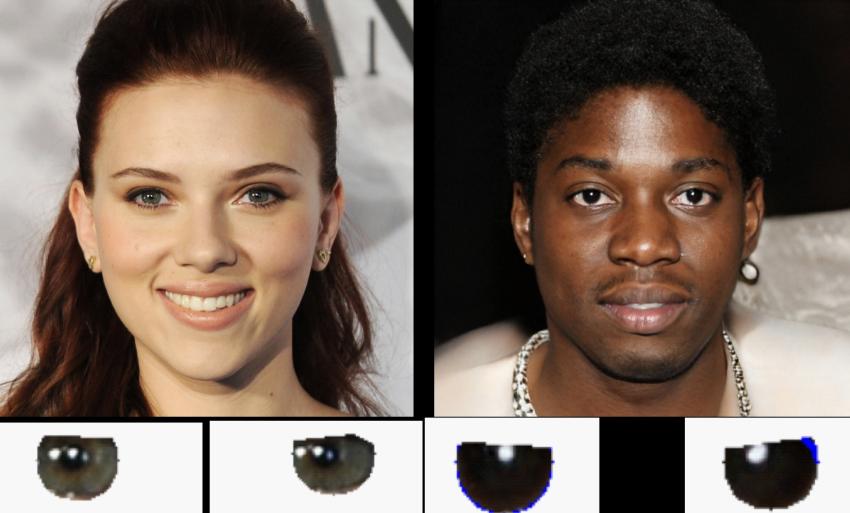
Enlarge/ Researchers write, “In this image, the person on the left (Scarlett Johansson) is real, while the person on the right is AI-generated. Their eyeballs are depicted underneath their faces. The reflections in the eyeballs are consistent for the real person, but incorrect (from a physics point of view) for the fake person.”
In 2024, it’s almost trivial to create realistic AI-generated images of people, which has led to fears about how these deceptive images might be detected. Researchers at the University of Hull recently unveiled a novel method for detecting AI-generated deepfake images by analyzing reflections in human eyes. The technique, presented at the Royal Astronomical Society’s National Astronomy Meeting last week, adapts tools used by astronomers to study galaxies for scrutinizing the consistency of light reflections in eyeballs.
Adejumoke Owolabi, an MSc student at the University of Hull, headed the research under the guidance of Dr. Kevin Pimbblet, professor of astrophysics.
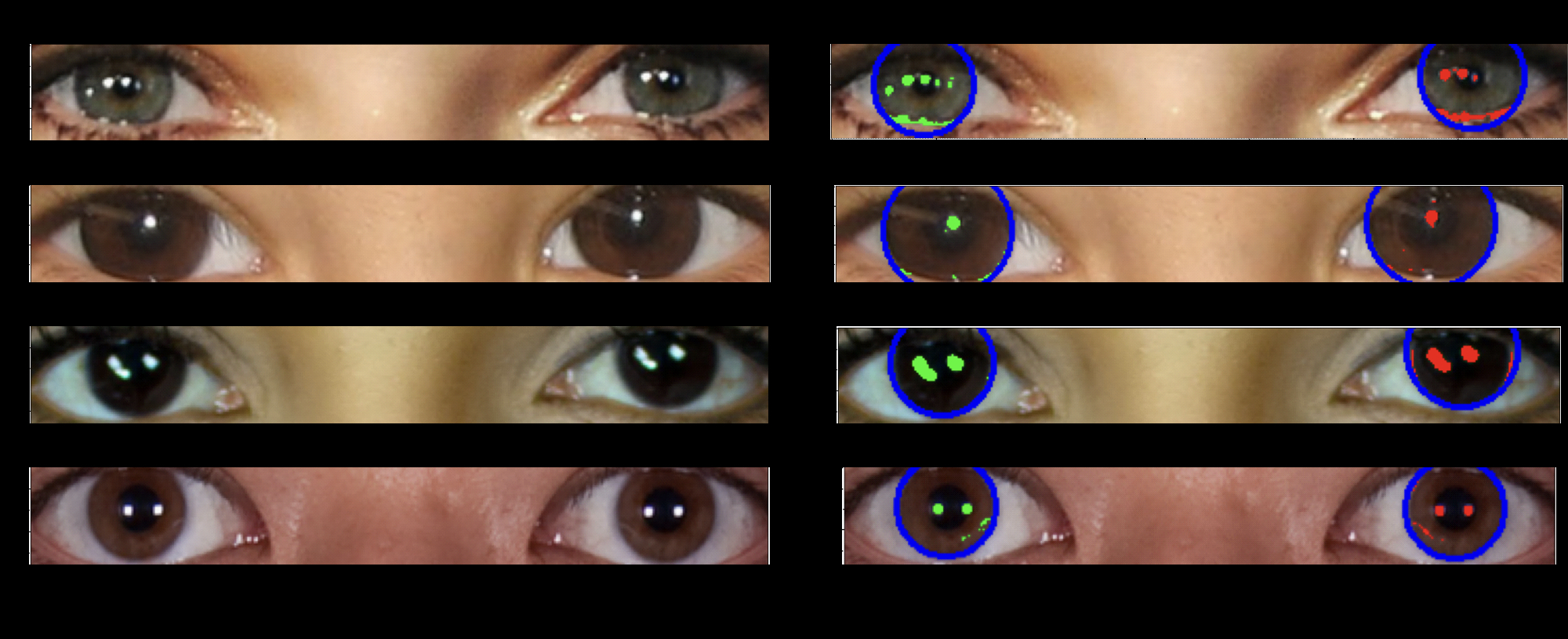
Their detection technique is based on a simple principle: A pair of eyes being illuminated by the same set of light sources will typically have a similarly shaped set of light reflections in each eyeball. Many AI-generated images created to date don’t take eyeball reflections into account, so the simulated light reflections are often inconsistent between each eye.
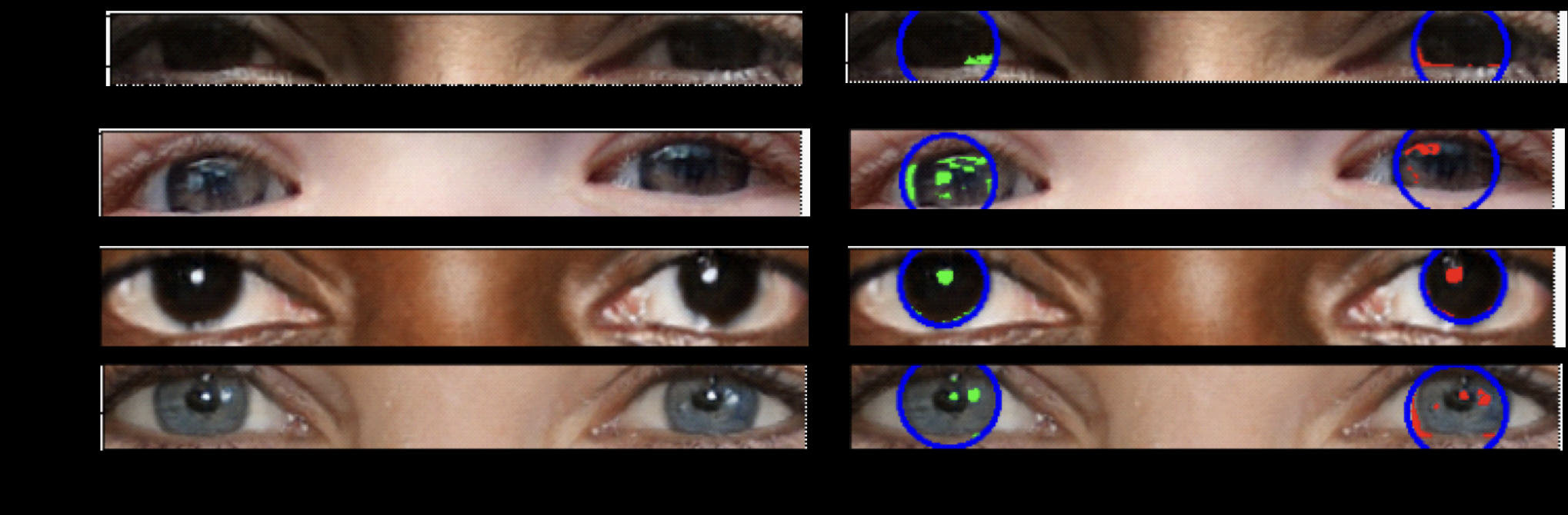
Enlarge/ A series of real eyes showing largely consistent reflections in both eyes.
In some ways, the astronomy angle isn’t always necessary for this kind of deepfake detection because a quick glance at a pair of eyes in a photo can reveal reflection inconsistencies, which is something artists who paint portraits have to keep in mind. But the application of astronomy tools to automatically measure and quantify eye reflections in deepfakes is a novel development.
Automated detection
In a Royal Astronomical Society blog post, Pimbblet explained that Owolabi developed a technique to detect eyeball reflections automatically and ran the reflections’ morphological features through indices to compare similarity between left and right eyeballs. Their findings revealed that deepfakes often exhibit differences between the pair of eyes.
The team applied methods from astronomy to quantify and compare eyeball reflections. They used the Gini coefficient, typically employed to measure light distribution in galaxy images, to assess the uniformity of reflections across eye pixels. A Gini value closer to 0 indicates evenly distributed light, while a value approaching 1 suggests concentrated light in a single pixel.
Enlarge/ A series of deepfake eyes showing inconsistent reflections in each eye.
In the Royal Astronomical Society post, Pimbblet drew comparisons between how they measured eyeball reflection shape and how they typically measure galaxy shape in telescope imagery: “To measure the shapes of galaxies, we analyze whether they’re centrally compact, whether they’re symmetric, and how smooth they are. We analyze the light distribution.”
The researchers also explored the use of CAS parameters (concentration, asymmetry, smoothness), another tool from astronomy for measuring galactic light distribution. However, this method proved less effective in identifying fake eyes.
A detection arms race
While the eye-reflection technique offers a potential path for detecting AI-generated images, the method might not work if AI models evolve to incorporate physically accurate eye reflections, perhaps applied as a subsequent step after image generation. The technique also requires a clear, up-close view of eyeballs to work.
The approach also risks producing false positives, as even authentic photos can sometimes exhibit inconsistent eye reflections due to varied lighting conditions or post-processing techniques. But analyzing eye reflections may still be a useful tool in a larger deepfake detection toolset that also considers other factors such as hair texture, anatomy, skin details, and background consistency.
While the technique shows promise in the short term, Dr. Pimbblet cautioned that it’s not perfect. “There are false positives and false negatives; it’s not going to get everything,” he told the Royal Astronomical Society. “But this method provides us with a basis, a plan of attack, in the arms race to detect deepfakes.”