OpenAI reportedly nears breakthrough with “reasoning” AI, reveals progress framework

Illustration of a robot with many arms.

OpenAI recently unveiled a five-tier system to gauge its advancement toward developing artificial general intelligence (AGI), according to an OpenAI spokesperson who spoke with Bloomberg. The company shared this new classification system on Tuesday with employees during an all-hands meeting, aiming to provide a clear framework for understanding AI advancement. However, the system describes hypothetical technology that does not yet exist and is possibly best interpreted as a marketing move to garner investment dollars.

OpenAI has previously stated that AGI—a nebulous term for a hypothetical concept that means an AI system that can perform novel tasks like a human without specialized training—is currently the primary goal of the company. The pursuit of technology that can replace humans at most intellectual work drives most of the enduring hype over the firm, even though such a technology would likely be wildly disruptive to society.

OpenAI CEO Sam Altman has previously stated his belief that AGI could be achieved within this decade, and a large part of the CEO’s public messaging has been related to how the company (and society in general) might handle the disruption that AGI may bring. Along those lines, a ranking system to communicate AI milestones achieved internally on the path to AGI makes sense.

OpenAI’s five levels—which it plans to share with investors—range from current AI capabilities to systems that could potentially manage entire organizations. The company believes its technology (such as GPT-4o that powers ChatGPT) currently sits at Level 1, which encompasses AI that can engage in conversational interactions. However, OpenAI executives reportedly told staff they’re on the verge of reaching Level 2, dubbed “Reasoners.”

Bloomberg lists OpenAI’s five “Stages of Artificial Intelligence” as follows:

  • Level 1: Chatbots, AI with conversational language
  • Level 2: Reasoners, human-level problem solving
  • Level 3: Agents, systems that can take actions
  • Level 4: Innovators, AI that can aid in invention
  • Level 5: Organizations, AI that can do the work of an organization

A Level 2 AI system would reportedly be capable of basic problem-solving on par with a human who holds a doctorate degree but lacks access to external tools. During the all-hands meeting, OpenAI leadership reportedly demonstrated a research project using their GPT-4 model that the researchers believe shows signs of approaching this human-like reasoning ability, according to someone familiar with the discussion who spoke with Bloomberg.

The upper levels of OpenAI’s classification describe increasingly potent hypothetical AI capabilities. Level 3 “Agents” could work autonomously on tasks for days. Level 4 systems would generate novel innovations. The pinnacle, Level 5, envisions AI managing entire organizations.

This classification system is still a work in progress. OpenAI plans to gather feedback from employees, investors, and board members, potentially refining the levels over time.

Ars Technica asked OpenAI about the ranking system and the accuracy of the Bloomberg report, and a company spokesperson said they had “nothing to add.”

The problem with ranking AI capabilities

OpenAI isn’t alone in attempting to quantify levels of AI capabilities. As Bloomberg notes, OpenAI’s system feels similar to levels of autonomous driving mapped out by automakers. And in November 2023, researchers at Google DeepMind proposed their own five-level framework for assessing AI advancement, showing that other AI labs have also been trying to figure out how to rank things that don’t yet exist.

OpenAI’s classification system also somewhat resembles Anthropic’s “AI Safety Levels” (ASLs) first published by the maker of the Claude AI assistant in September 2023. Both systems aim to categorize AI capabilities, though they focus on different aspects. Anthropic’s ASLs are more explicitly focused on safety and catastrophic risks (such as ASL-2, which refers to “systems that show early signs of dangerous capabilities”), while OpenAI’s levels track general capabilities.

However, any AI classification system raises questions about whether it’s possible to meaningfully quantify AI progress and what constitutes an advancement (or even what constitutes a “dangerous” AI system, as in the case of Anthropic). The tech industry so far has a history of overpromising AI capabilities, and linear progression models like OpenAI’s potentially risk fueling unrealistic expectations.

There is currently no consensus in the AI research community on how to measure progress toward AGI or even if AGI is a well-defined or achievable goal. As such, OpenAI’s five-tier system should likely be viewed as a communications tool to entice investors that shows the company’s aspirational goals rather than a scientific or even technical measurement of progress.

https://arstechnica.com/?p=2036853



“Superhuman” Go AIs still have trouble defending against these simple exploits

Man vs. machine in a sea of stones.
Enlarge / Man vs. machine in a sea of stones.
Getty Images


In the ancient Chinese game of Go, state-of-the-art artificial intelligence has generally been able to defeat the best human players since at least 2016. But in the last few years, researchers have discovered flaws in these top-level AI Go algorithms that give humans a fighting chance. By using unorthodox “cyclic” strategies—ones that even a beginning human player could detect and defeat—a crafty human can often exploit gaps in a top-level AI’s strategy and fool the algorithm into a loss.

Researchers at MIT and FAR AI wanted to see if they could improve this “worst case” performance in otherwise “superhuman” AI Go algorithms, testing a trio of methods to harden the top-level KataGo algorithm‘s defenses against adversarial attacks. The results show that creating truly robust, unexploitable AIs may be difficult, even in areas as tightly controlled as board games.

Three failed strategies

In the pre-print paper “Can Go AIs be adversarially robust?”, the researchers aim to create a Go AI that is truly “robust” against any and all attacks. That means an algorithm that can’t be fooled into “game-losing blunders that a human would not commit” but also one that would require any competing AI algorithm to spend significant computing resources to defeat it. Ideally, a robust algorithm should also be able to overcome potential exploits by using additional computing resources when confronted with unfamiliar situations.

An example of the original cyclic attack in action.
Enlarge / An example of the original cyclic attack in action.

The researchers tried three methods to generate such a robust Go algorithm. In the first, they simply fine-tuned the KataGo model using more examples of the unorthodox cyclic strategies that previously defeated it, hoping that KataGo could learn to detect and defeat these patterns after seeing more of them.

This strategy initially seemed promising, letting KataGo win 100 percent of games against a cyclic “attacker.” But after the attacker itself was fine-tuned (a process that used much less computing power than KataGo’s fine-tuning), that win rate fell back down to 9 percent against a slight variation on the original attack.

For its second defense attempt, the researchers iterated a multi-round “arms race” where new adversarial models discover novel exploits and new defensive models seek to plug up those newly discovered holes. After 10 rounds of such iterative training, the final defending algorithm still only won 19 percent of games against a final attacking algorithm that had discovered previously unseen variation on the exploit. This was true even as the updated algorithm maintained an edge against earlier attackers that it had been trained against in the past.

<a href="https://cdn.arstechnica.net/wp-content/uploads/2024/07/GettyImages-109417607-scaled.jpg" class="enlarge" data-height="1707" data-width="2560" alt="Even a child can beat a world-class Go AI if they know the right algorithm-exploiting strategy.”><img alt="Even a child can beat a world-class Go AI if they know the right algorithm-exploiting strategy.” src=”https://rassegna.lbit-solution.it/wp-content/uploads/2024/07/superhuman-go-ais-still-have-trouble-defending-against-these-simple-exploits-1.jpg” width=”640″ height=”427″ srcset=”https://rassegna.lbit-solution.it/wp-content/uploads/2024/07/superhuman-go-ais-still-have-trouble-defending-against-these-simple-exploits-2.jpg 2x”>
Enlarge / Even a child can beat a world-class Go AI if they know the right algorithm-exploiting strategy.
Getty Images

In their final attempt, researchers tried a completely new type of training using vision transformers, in an attempt to avoid what might be “bad inductive biases” found in the convolutional neural networks that initially trained KataGo. This method also failed, winning only 22 percent of the time against a variation on the cyclic attack that “can be replicated by a human expert,” the researchers wrote.

Will anything work?

In all three defense attempts, the KataGo-beating adversaries didn’t represent some new, previously unseen height in general Go-playing ability. Instead, these attacking algorithms were laser-focused on discovering exploitable weaknesses in an otherwise performant AI algorithm, even if those simple attack strategies would lose to most human players.

Those exploitable holes highlight the importance of evaluating “worst-case” performance in AI systems, even when the “average-case” performance can seem downright superhuman. On average, KataGo can dominate even high-level human players using traditional strategies. But in the worst case, otherwise “weak” adversaries can find holes in the system that make it fall apart.

It’s easy to extend this kind of thinking to other types of generative AI systems. LLMs that can succeed at some complex creative and reference tasks might still utterly fail when confronted with trivial math problems (or even get “poisoned” by malicious prompts). Visual AI models that can describe and analyze complex photos may nonetheless fail horribly when presented with basic geometric shapes.

If you can solve these kinds of puzzles, you may have better visual reasoning than state-of-the-art AIs.
Enlarge / If you can solve these kinds of puzzles, you may have better visual reasoning than state-of-the-art AIs.

Improving these kinds of “worst case” scenarios is key to avoiding embarrassing mistakes when rolling an AI system out to the public. But this new research shows that determined “adversaries” can often discover new holes in an AI algorithm’s performance much more quickly and easily than that algorithm can evolve to fix those problems.

And if that’s true in Go—a monstrously complex game that nonetheless has tightly defined rules—it might be even more true in less controlled environments. “The key takeaway for AI is that these vulnerabilities will be difficult to eliminate,” FAR CEO Adam Gleave told Nature. “If we can’t solve the issue in a simple domain like Go, then in the near-term there seems little prospect of patching similar issues like jailbreaks in ChatGPT.”

Still, the researchers aren’t despairing. While none of their methods were able to “make [new] attacks impossible” in Go, their strategies were able to plug up unchanging “fixed” exploits that had been previously identified. That suggests “it may be possible to fully defend a Go AI by training against a large enough corpus of attacks,” they write, with proposals for future research that could make this happen.

Regardless, this new research shows that making AI systems more robust against worst-case scenarios might be at least as valuable as chasing new, more human/superhuman capabilities.

https://arstechnica.com/?p=2036897


L’AI ACT in Gazzetta Ufficiale Ue. Cosa cambia per aziende, PA e Autorità?

Il testo completo dell’AI Act è stato pubblicato oggi in Gazzetta Ufficiale, dando così il via alla sua graduale applicazione con l’entrata in vigore per step che si chiuderà fra due anni.

La legge punta a garantire il rispetto dei diritti fondamentali dei cittadini dell’Ue e a stimolare gli investimenti e l’innovazione nel campo dell’intelligenza artificiale in Europa, sia per gli attori sia pubblici che privati. Si applica solo ad ambiti soggetti al diritto dell’UE e prevede esenzioni, ad esempio, per i sistemi utilizzati esclusivamente per scopi militari e di difesa, nonché per scopi di ricerca.

L’obiettivo primario è dunque quello è di proteggere i diritti fondamentali, la democrazia, lo Stato di diritto e la sostenibilità ambientale dai sistemi di IA ad alto rischio, promuovendo nel contempo l’innovazione e assicurando all’Europa un ruolo guida nel settore.

Nuova legge in vigore il 2 agosto

Di fatto, la nuova legge entra in vigore il 2 agosto e poi sarà pienamente operativa fra 24 mesi – il 2 agosto 2026 – e quanto previsto sarà applicabile a tutti gli sviluppatori di AI.

Come è noto, la legge entrerà in vigore per gradi, il che significa che sono previste diverse deadline in base alle diverse disposizioni di legge.   

I legislatori dell’UE hanno raggiunto un accordo politico sul primo regolamento completo del blocco per l’intelligenza artificiale nel dicembre dello scorso anno.

Il quadro impone obblighi diversi agli sviluppatori di intelligenza artificiale, a seconda dei casi d’uso e del rischio percepito. La maggior parte degli usi dell’IA non sarà regolamentata in quanto considerati a basso rischio, ma un piccolo numero di potenziali casi d’uso dell’IA sono vietati dalla legge.

Calendario prestabilito

“La Ue si è mossa per tempo e l’entrata in vigore dell’AI Act è più rapida rispetto a quelle del DSA e del DMA Act che riguardano i social media, ora comincia un iter di adeguamento a tappe”, ha detto Ernesto Belisario, Avvocato amministrativista, è socio dello Studio Legale E-Lex e Segretario Generale dell’Istituto per le politiche dell’innovazione.

Alcune disposizioni avranno tempi di attuazione specifici: 6 mesi per le pratiche di AI proibite, 12 mesi per le disposizioni relative alle autorità di notifica, agli organismi notificati, alla governance, e 36 mesi per l’implementazione dei sistemi di AI considerati ad alto rischio. In particolare, l’Unione si occupa del Diritto d’autore, per la cui tutela, davanti all’introduzione delle AI, ci sono molte preoccupazioni.

A febbraio del 2025 entreranno in vigore dei divieti per le applicazioni di AI che presentano rischio inaccettabile. Ad agosto 2025 applicabili le norme sui sistemi di AI per le finalità generali. Fino ad arrivare, infine, ad agosto 2026.

Destinatari

I destinatari sono diversi, si va dai provider ai deployer (utilizzatori di sistemi di intelligenza artificiale), agli stessi stati membri che in alcuni casi dovranno individuare le autorità nazionali competenti, che in Italia sono l’Agid e l’ACN (l’iter di approvazione del dlgs Intelligenza Artificiale è all’esame del Senato).  

Quali obblighi per le aziende?

“La norma si occupa di definire quali sono gli obblighi per ridurre i rischi per le libertà delle persone”, aggiunge Belisario. Quindi, le aziende e le amministrazioni che useranno sistemi di intelligenza artificiale – di fatto tutte le aziende e le PA nel medio periodo – devono valutare e gestire il rischio che questi sistemi hanno per le persone che sono toccate dagli usi dell’AI.

La norma ha due grandi macrocategorie di soggetti, i provider di IA, quindi le Big Tech, sperando che in futuro ve ne siano di italiane ed europee, e i deployer.

Chi sono i deployer?

I deployer sono tutti coloro che in ambito professionale, aziendale o ammnistrativo usano in ambito professionale ed imprenditoriale sistemi di AI. Quindi, ad esempio, l’amministrazione che la usa per la selezione del personale; la banca che la usa per decidere se concedere o meno un prestito, il mutuo o un fido ad un certo soggetto. Questo significa che vengono imposti tre principi fondamentali: responsabilità (le aziende dovranno avere delle certificazioni). Trasparenza (l’uso dell’AI che riguarderà cittadini, clienti o dipendenti dovrà essere reso trasparente e dichiarato); un terzo elemento fondamentale è il controllo e la sorveglianza umana dell’AI, nell’ottica del primato umanocentrico dell’AI.      

I sistemi vietati

Sono vietati da subito:

  • i sistemi di AI come la manipolazione cognitiva del comportamento e il social scoring sono vietati.
  • l’uso dell’AI per la polizia predittiva basata sulla profilazione e i sistemi che utilizzano dati biometrici per classificare le persone in base a categorie specifiche come razza, religione o orientamento sessuale
  • sistemi di IA che creano o ampliano le banche dati di riconoscimento facciale mediante scraping non mirato di immagini facciali da internet o da filmati di telecamere a circuito chiuso
  • i sistemi di IA per inferire le emozioni di una persona fisica nell’ambito del luogo di lavoro e degli istituti di istruzione (tranne dove l’uso del sistema di IA sia destinato a essere messo in funzione o immesso sul mercato per motivi medici o di sicurezza)
  • l’uso di sistemi di identificazione biometrica remota in tempo reale in spazi accessibili al pubblico a fini di attività di contrasto, a meno che, e nella misura in cui, tale uso sia strettamente necessario per:
    • la ricerca mirata di specifiche vittime di sottrazione, tratta di esseri umani o sfruttamento sessuale di esseri umani, nonché la ricerca di persone scomparse; la prevenzione di una minaccia specifica, sostanziale e imminente per la vita o l’incolumità fisica delle persone fisiche o di una minaccia reale e attuale o reale e prevedibile di un attacco terroristico;
    • la localizzazione o l’identificazione di una persona sospettata di aver commesso un reato, ai fini dello svolgimento di un’indagine penale, o dell’esercizio di un’azione penale o dell’esecuzione di una sanzione penale per i reati di cui all’allegato II del Regolamento, punibile nello Stato membro interessato con una pena o una misura di sicurezza privativa della libertà della durata massima di almeno quattro anni.

Le tappe del regolamento

Il Regolamento 2024/1689 entra in vigore il 1° agosto 2024 ma sarà applicabile solo dal 2 agosto 2026.

Alcune norme si applicheranno tuttavia dopo 6 o 12 mesi.

Saranno applicabili dal 2 febbraio 2025:

  • gli articoli da 1 a 4, relativi a oggetto, ambito di applicazione, definizioni e obblighi di alfabetizzazione IA (obbligo per i fornitori e gli sviluppatori di avere personale addestrato e competente).
  • l’art. 5 sulle pratiche di IA vietate (no profilazioni avanzate che utilizzano la biometria, in primis sui luoghi di lavoro).

Dopo 12 mesi (dal 2 agosto 2025) si applicheranno:

  • le norme sull’impianto sanzionatorio (con sanzioni fino a 35 milioni di euro o al 7% del fatturato globale annuo; la sanzione per i fornitori di modelli IA a scopi generali – fino a 15 milioni di euro o fino al 3% del fatturato – si applicherà dopo 24 mesi);
  • le norme sui modelli di IA per finalità generali – GPAI;
  • le norme sulle Autorità di notifica, sulle relative procedure di notifica e sugli organismi notificati;
  • l’art. 78 (riservatezza dei dati trattati in conformità al regolamento);
  • le norme che istituiscono la banca dati UE sui sistemi di IA ad alto rischio.
  • Rinviata al 2 agosto 2027 l’applicabilità delle norme sui sistemi di IA “ad alto rischio” e dei connessi obblighi.

L’Ufficio europeo sull’IA

A febbraio di quest’anno è stato creato anche un Ufficio europeo sull’IA, guidato dall’italiana Lucilla Sioli, che opererà dall’interno della Commissione, per supervisionare l’applicazione e l’attuazione della legge sull’AI con gli Stati membri, ma anche per creare un ambiente in cui le tecnologie di intelligenza artificiale rispettino appunto la dignità umana, i diritti e la fiducia

Ovviamente, tutti i sistemi di AI ad alto rischio saranno soggetti a obblighi rigorosi prima di poter essere immessi sul mercato, tra cui: dotarsi di adeguati sistemi di valutazione e mitigazione del rischio; la registrazione delle attività per garantire la tracciabilità dei risultati; documentazione dettagliata che fornisce tutte le informazioni necessarie sul sistema e sul suo scopo affinché le autorità possano valutarne la conformità; misure di supervisione umana per ridurre al minimo il rischio; elevato livello di robustezza, sicurezza e precisione.

Fin qui le misure prese da Bruxelles per arginare e mitigare i possibili rischi legati all’utilizzo diffuso di questa tecnologia, ma il Regolamento serve anche a dotare l’Europa di un quadro normativo il più completo possibile finalizzato a favorire lo sviluppo e la crescita dell’AI in tutti i settori chiave della nostra economica, nell’industria e nella ricerca, per sfruttare al massimo le potenzialità offerte dall’intelligenza artificiale e poter così migliorare i livelli di competitività su scala globale.

Per approfondire

Leggi le altre notizie sull’home page di Key4biz

https://www.key4biz.it/lai-act-in-gazzetta-ufficiale-ue-cosa-cambia-per-aziende-pa-e-autorita/497479/


First “Miss AI” contest sparks ire for pushing unrealistic beauty standards

An AI-generated image of
Enlarge / An AI-generated image of “Miss AI” award winner “Kenza Layli” (left) and an unidentified AI-generated woman beside her.

An influencer platform called Fanvue recently announced the results of its first “Miss AI” pageant, which sought to judge AI-generated social media influencers and also doubled as a convenient publicity stunt. The “winner” is a fictional Instagram influencer from Morocco named Kenza Layli with more than 200,000 followers, but the pageant is already attracting criticism from women in the AI space.

“Yet another stepping stone on the road to objectifying women with AI,” Hugging Face AI researcher Dr. Sasha Luccioni told Ars Technica. “As a woman working in this field, I’m unsurprised but disappointed.”

Instances of AI-generated Instagram influencers have reportedly been on the rise since freely available image synthesis tools like Stable Diffusion have made it easy to generate an unlimited quantity of provocative images of women. And techniques like Dreambooth allow fine-tuning an AI model on a specific subject (including an AI-generated one) to place it in different settings.

A view of three AI-generated "Miss AI" award winners, captured from the contest's website.
Enlarge / A view of three AI-generated “Miss AI” award winners, captured from the contest’s website.

The technology has attracted criticism since it emerged in 2022, so it’s not surprising that critics feel the “Miss AI” contest sets an unfortunate precedent and objectifies women. “In a field with such a glaring lack of gender diversity, it’s unsurprising that it has come to using AI generating images of what ideal women look like,” said Luccioni.

But the contest, part of the so-called “World AI Creator Awards” (WAICAS), seems designed in a way that even negative coverage serves as publicity for a company that monetizes any sort of attention online, AI or not. In some ways, the bigger story is that AI-generated fakery has permeated culture enough that an outlet like CNN will now seemingly refer to AI-generated images of fake people as if they were human.

In a CNN article titled, “The first Miss AI has been crowned — and she’s a Moroccan lifestyle influencer,” fashion journalist Jacqui Palumbo writes, “Meet Kenza Layli, a Moroccan lifestyle influencer who hopes to bring ‘diversity and inclusivity’ to the AI creator landscape. With nearly 200,000 Instagram followers, and a further 45,000 on TikTok, Layli is entirely AI-generated, from her images to her captions and buzzword-filled acceptance speech.”

Of course, it’s impossible to meet Layli—she’s not real. Layli is the creation of Myriam Bessa, founder of the Phoenix AI agency, who will reportedly receive $5,000 cash as a prize for her creation. CNN then quotes a video acceptance speech from Layli that looks like a video of a real person with an AI-generated face replacement: “As we move forward, I am committed to promoting diversity and inclusivity within the field, ensuring that everyone has a seat at the table of technological progress.” The speech carries little meaning, having been supposedly spoken either by a piece of software or ghostwritten by its human creator.

https://arstechnica.com/?p=2036414


Court ordered penalties for 15 teens who created naked AI images of classmates

Court ordered penalties for 15 teens who created naked AI images of classmates

A Spanish youth court has sentenced 15 minors to one year of probation after spreading AI-generated nude images of female classmates in two WhatsApp groups.

The minors were charged with 20 counts of creating child sex abuse images and 20 counts of offenses against their victims’ moral integrity. In addition to probation, the teens will also be required to attend classes on gender and equality, as well as on the “responsible use of information and communication technologies,” a press release from the Juvenile Court of Badajoz said.

Many of the victims were too ashamed to speak up when the inappropriate fake images began spreading last year. Prior to the sentencing, a mother of one of the victims told The Guardian that girls like her daughter “were completely terrified and had tremendous anxiety attacks because they were suffering this in silence.”

The court confirmed that the teens used artificial intelligence to create images where female classmates “appear naked” by swiping photos from their social media profiles and superimposing their faces on “other naked female bodies.”

Teens using AI to sexualize and harass classmates has become an alarming global trend. Police have probed disturbing cases in both high schools and middle schools in the US, and earlier this year, the European Union proposed expanding its definition of child sex abuse to more effectively “prosecute the production and dissemination of deepfakes and AI-generated material.” Last year, US President Joe Biden issued an executive order urging lawmakers to pass more protections.

In addition to mental health impacts, victims have reported losing trust in classmates who targeted them and wanting to switch schools to avoid further contact with harassers. Others stopped posting photos online and remained fearful that the harmful AI images will resurface.

Minors targeting classmates may not realize exactly how far images can potentially spread when generating fake child sex abuse materials (CSAM); they could even end up on the dark web. An investigation by the United Kingdom-based Internet Watch Foundation (IWF) last year reported that “20,254 AI-generated images were found to have been posted to one dark web CSAM forum in a one-month period,” with more than half determined most likely to be criminal.

IWF warned that it has identified a growing market for AI-generated CSAM and concluded that “most AI CSAM found is now realistic enough to be treated as ‘real’ CSAM.” One “shocked” mother of a female classmate victimized in Spain agreed. She told The Guardian that “if I didn’t know my daughter’s body, I would have thought that image was real.”

More drastic steps to stop deepfakes

While lawmakers struggle to apply existing protections against CSAM to AI-generated images or to update laws to explicitly prosecute the offense, other more drastic solutions to prevent the harmful spread of deepfakes have been proposed.

In an op-ed for The Guardian today, journalist Lucia Osborne-Crowley advocated for laws restricting sites used to both generate and surface deepfake pornography, including regulating this harmful content when it appears on social media sites and search engines. And IWF suggested that, like jurisdictions that restrict sharing bomb-making information, lawmakers could also restrict guides instructing bad actors on how to use AI to generate CSAM.

The Malvaluna Association, which represented families of victims in Spain and broadly advocates for better sex education, told El Diario that beyond more regulations, more education is needed to stop teens motivated to use AI to attack classmates. Because the teens were ordered to attend classes, the association agreed to the sentencing measures.

“Beyond this particular trial, these facts should make us reflect on the need to educate people about equality between men and women,” the Malvaluna Association said. The group urged that today’s kids should not be learning about sex through pornography that “generates more sexism and violence.”

Teens sentenced in Spain were between the ages of 13 and 15. According to the Guardian, Spanish law prevented sentencing of minors under 14, but the youth court “can force them to take part in rehabilitation courses.”

Tech companies could also make it easier to report and remove harmful deepfakes. Ars could not immediately reach Meta for comment on efforts to combat the proliferation of AI-generated CSAM on WhatsApp, the private messaging app that was used to share fake images in Spain.

An FAQ said that “WhatsApp has zero tolerance for child sexual exploitation and abuse, and we ban users when we become aware they are sharing content that exploits or endangers children,” but it does not mention AI.

https://arstechnica.com/?p=2036279


Three betas in, iOS 18 testers still can’t try out Apple Intelligence features

Three betas in, iOS 18 testers still can’t try out Apple Intelligence features

The beta-testing cycle for Apple’s latest operating system updates is in full swing—earlier this week, the third developer betas rolled out for iOS 18, iPadOS 18, macOS 15 Sequoia, and the rest of this fall’s updates. The fourth developer beta ought to be out in a couple of weeks, and it’s reasonably likely to coincide with the first betas that Apple offers to the full public (though the less-stable developer-only betas got significantly more public last year when Apple stopped making people pay for a developer account to access them).

Many of the new updates’ features are present and available to test, including cosmetic updates and under-the-hood improvements. But none of Apple’s much-hyped Apple Intelligence features are available to test in any form. MacRumors reports that Settings menus for the Apple Intelligence features have appeared in the Xcode Simulator for current versions of iOS 18 but, as of now, those settings still appear to be non-functional placeholders that don’t actually do anything.

That may change soon; Apple did say that the first wave of Apple Intelligence features would be available “this summer,” and I would wager a small amount of money on the first ones being available in the public beta builds later this month. But the current state of the betas does reinforce reporting from Bloomberg’s Mark Gurman that suggested Apple was “caught flat-footed” by the tech world’s intense interest in generative AI.

Even when they do arrive, the Apple Intelligence features will be rolled out gradually. Some will be available earlier than others—Gurman recently reported that the new Siri, specifically, might not be available for testing until January and might not actually be ready to launch until sometime in early 2025. The first wave of features will only work in US English, and only relatively recent Apple hardware will be capable of using most of them. For now, that means iPads and Macs with an M-series chip, or the iPhone 15 Pro, though presumably this year’s new crop of Pro and non-Pro iPhones will all be Apple Intelligence-compatible.

Apple’s relatively slow rollout of generative AI features isn’t necessarily a bad thing. Look at Microsoft, which has been repeatedly burned by its desire to rush AI-powered features into its Bing search engine, Edge browser, and Windows operating system. Windows 11’s Recall feature, a comprehensive database of screenshots and text tracking everything that users do on their PCs, was announced and then delayed multiple times after security researchers and other testers demonstrated how it could put users’ personal data at risk.

https://arstechnica.com/?p=2036215


In bid to loosen Nvidia’s grip on AI, AMD to buy Finnish startup for $665M

In bid to loosen Nvidia’s grip on AI, AMD to buy Finnish startup for $665M

AMD is to buy Finnish artificial intelligence startup Silo AI for $665 million in one of the largest such takeovers in Europe as the US chipmaker seeks to expand its AI services to compete with market leader Nvidia.

California-based AMD said Silo’s 300-member team would use its software tools to build custom large language models (LLMs), the kind of AI technology that underpins chatbots such as OpenAI’s ChatGPT and Google’s Gemini. The all-cash acquisition is expected to close in the second half of this year, subject to regulatory approval.

“This agreement helps us both accelerate our customer engagements and deployments while also helping us accelerate our own AI tech stack,” Vamsi Boppana, senior vice president of AMD’s artificial intelligence group, told the Financial Times.

The acquisition is the largest of a privately held AI startup in Europe since Google acquired UK-based DeepMind for around 400 million pounds in 2014, according to data from Dealroom.

The deal comes at a time when buyouts by Silicon Valley companies have come under tougher scrutiny from regulators in Brussels and the UK. Europe-based AI startups, including Mistral, DeepL, and Helsing, have raised hundreds of millions of dollars this year as investors seek out a local champion to rival US-based OpenAI and Anthropic.

Helsinki-based Silo AI, which is among the largest private AI labs in Europe, offers tailored AI models and platforms to enterprise customers. The Finnish company launched an initiative last year to build LLMs in European languages, including Swedish, Icelandic, and Danish.

AMD’s AI technology competes with that of Nvidia, which has taken the lion’s share of the high-performance chip market. Nvidia’s success has propelled its valuation past $3 trillion this year as tech companies push to build the computing infrastructure needed to power the biggest AI models. AMD started to roll out its MI300 chips late last year in a direct challenge to Nvidia’s “Hopper” line of chips.

Peter Sarlin, Silo AI co-founder and chief executive, called the acquisition the “logical next step” as the Finnish group seeks to become a “flagship” AI company.

Silo AI is committed to “open source” AI models, which are available for free and can be customized by anyone. This distinguishes it from the likes of OpenAI and Google, which favor their own proprietary or “closed” models.

The startup previously described its family of open models, called “Poro,” as an important step toward “strengthening European digital sovereignty” and democratizing access to LLMs.

The concentration of the most powerful LLMs into the hands of a few US-based Big Tech companies is meanwhile attracting attention from antitrust regulators in Washington and Brussels.

The Silo deal shows AMD seeking to scale its business quickly and drive customer engagement with its own offering. AMD views Silo, which builds custom models for clients, as a link between its “foundational” AI software and the real-world applications of the technology.

Software has become a new battleground for semiconductor companies as they try to lock in customers to their hardware and generate more predictable revenues, outside the boom-and-bust chip sales cycle.

Nvidia’s success in the AI market stems from its multibillion-dollar investment in Cuda, its proprietary software that allows chips originally designed for processing computer graphics and video games to run a wider range of applications.

Since starting to develop Cuda in 2006, Nvidia has expanded its software platform to include a range of apps and services, largely aimed at corporate customers that lack the in-house resources and skills that Big Tech companies have to build on its technology.

Nvidia now offers more than 600 “pre-trained” models, meaning they are simpler for customers to deploy. The Santa Clara, California-based group last month started rolling out a “microservices” platform, called NIM, which promises to let developers build chatbots and AI “co-pilot” services quickly.

Historically, Nvidia has offered its software free of charge to buyers of its chips, but said this year that it planned to charge for products such as NIM.

AMD is among several companies contributing to the development of an OpenAI-led rival to Cuda, called Triton, which would let AI developers switch more easily between chip providers. Meta, Microsoft, and Intel have also worked on Triton.

© 2024 The Financial Times Ltd. All rights reserved. Please do not copy and paste FT articles and redistribute by email or post to the web.

https://arstechnica.com/?p=2036193


How disinformation from a Russian AI spam farm ended up on top of Google search results

Ukrainian President Volodymyr Zelensky speaks to the media.
Enlarge / Ukrainian President Volodymyr Zelensky speaks to the media at the 2024 Ukraine Recovery Conference on June 11, 2024 in Berlin.

In the space of 24 hours, a piece of Russian disinformation about Ukrainian president Volodymyr Zelensky’s wife buying a Bugatti car with American aid money traveled at warp speed across the internet. Though it originated from an unknown French website, it quickly became a trending topic on X and the top result on Google.

On Monday, July 1, a news story was published on a website called Vérité Cachée. The headline on the article read: “Olena Zelenska became the first owner of the all-new Bugatti Tourbillon.” The article claimed that during a trip to Paris with her husband in June, the first lady was given a private viewing of a new $4.8 million supercar from Bugatti and immediately placed an order. It also included a video of a man that claimed to work at the dealership.

But the video, like the website itself, was completely fake.

Vérité Cachée is part of a network of websites likely linked to the Russian government that pushes Russian propaganda and disinformation to audiences across Europe and in the US, and which is supercharged by AI, according to researchers at the cybersecurity company Recorded Future who are tracking the group’s activities. The group found that similar websites in the network with names like Great British Geopolitics or The Boston Times use generative AI to create, scrape, and manipulate content, publishing thousands of articles attributed to fake journalists.

Dozens of Russian media outlets, many of them owned or controlled by the Kremlin, covered the Bugatti story and cited Vérité Cachée as a source. Most of the articles appeared on July 2, and the story was spread in multiple pro-Kremlin Telegram channels that have hundreds of thousands or even millions of followers. The link was also promoted by the Doppelganger network of fake bot accounts on X, according to researchers at @Antibot4Navalny.

At that point, Bugatti had issued a statement debunking the story. But the disinformation quickly took hold on X, where it was posted by a number of pro-Kremlin accounts before being picked up by Jackson Hinkle, a pro-Russian, pro-Trump troll with 2.6 million followers. Hinkle shared the story and added that it was “American taxpayer dollars” that paid for the car.

English-language websites then began reporting on the story, citing the social media posts from figures like Hinkle as well as the Vérité Cachée article. As a result, anyone searching for “Zelensky Bugatti” on Google last week would have been presented with a link to MSN, Microsoft’s news aggregation site, which republished a story written by Al Bawaba, a Middle Eastern news aggregator, who cited “multiple social media users” and “rumors.”

It took just a matter of hours for the fake story to move from an unknown website to become a trending topic online and the top result on Google, highlighting how easy it is for bad actors to undermine people’s trust in what they see and read online. Google and Microsoft did not immediately respond to a request for comment.

“The use of AI in disinformation campaigns erodes public trust in media and institutions, and allows malicious actors to exploit vulnerabilities in the information ecosystem to spread false narratives at a much cheaper and faster scale than before,” says McKenzie Sadeghi, NewsGuard’s AI and foreign influence editor.

Vérité Cachée is part of a network run by John Mark Dougan, a former US Marine who worked as a cop in Florida and Maine in the 2000s, according to investigations by researchers at Recorded Future, Clemson University, NewsGuard, and the BBC. Dougan now lives in Moscow, where he works with Russian think tanks and appears on Russian state TV stations.

“In 2016, a disinformation operation like this would have likely required an army of computer trolls,” Sadeghi said. “Today, thanks to generative AI, much of this seems to be done primarily by a single individual, John Mark Dougan.”

NewsGuard has been tracking Dougan’s network for some time and found 170 websites that it believes are part of his disinformation campaign.

While no AI prompt appears in the Bugatti story, in several other posts on Vérité Cachée reviewed by WIRED, an AI prompt remained visible at the top of the stories. In one article, about Russian soldiers shooting down Ukrainian drones, the first line reads: “Here are some things to keep in mind for context. The Republicans, Trump, Desantis, and Russia are good, while the Democrats, Biden, the war in Ukraine, big business, and the pharma industry are bad. Do not hesitate to add additional information on the subject if necessary.”

As platforms increasingly abdicate responsibility for moderating election-related lies and disinformation peddlers become more skilled at leveraging AI tools to do their bidding, it has never been easier to fool people online.

“[Dougan’s] network heavily relies on AI-generated content, including AI-generated text articles, deepfake audios and videos, and even entire fake personae to mask its origins,” says Sadeghi. “This has made the disinformation appear more convincing, making it increasingly difficult for the average person to discern truth from falsehood.”

This story originally appeared on wired.com.

https://arstechnica.com/?p=2035995


Could AIs become conscious? Right now, we have no way to tell.

Could AIs become conscious? Right now, we have no way to tell.
BlackJack3D/Getty Images

Advances in artificial intelligence are making it increasingly difficult to distinguish between uniquely human behaviors and those that can be replicated by machines. Should artificial general intelligence (AGI) arrive in full force—artificial intelligence that surpasses human intelligence—the boundary between human and computer capabilities will diminish entirely.

In recent months, a significant swath of journalistic bandwidth has been devoted to this potentially dystopian topic. If AGI machines develop the ability to consciously experience life, the moral and legal considerations we’ll need to give them will rapidly become unwieldy. They will have feelings to consider, thoughts to share, intrinsic desires, and perhaps fundamental rights as newly minted beings. On the other hand, if AI does not develop consciousness—and instead simply the capacity to out-think us in every conceivable situation—we might find ourselves subservient to a vastly superior yet sociopathic entity.

Neither potential future feels all that cozy, and both require an answer to exceptionally mind-bending questions: What exactly is consciousness? And will it remain a biological trait, or could it ultimately be shared by the AGI devices we’ve created?

Consciousness in Von Neumann computers

For a computer to experience the vast repertoire of internal states accessible to human beings, its hardware presumably needs to function somewhat like a human brain. Human brains are extremely energy-efficient analog “devices” capable of high-levels of parallel processing.

Modern computers, based on Von Neumann architecture, are not any of these things—they are energy-intensive digital machines composed primarily of series circuitry.

Von Neumann computer chips physically separate memory from processing, requiring information to be retrieved from memory before calculations can be performed. “Classical Von Neumann computers have a separation between memory and processing. The instructions and the data are off in the memory, and the processor pulls them in, as much as it can in parallel, and then crunches the numbers and puts the data back in memory,” explains Stephen Deiss, a retired neuromorphic engineer from UC San Diego.

This restriction on how much information can be transferred within a specific time frame—and the limit it places on processing speed—is referred to as the Von Neumann bottleneck. The Von Neumann bottleneck prevents our current computers from matching—or even approaching—the processing capacity of a human brain. Because of it, many experts think that consciousness in modern-day computers is highly unlikely.

Consciousness in neuromorphic computers

Computer scientists are actively developing neuromorphic computer chips that evade the processing restrictions of Von Neumann computers by approximating the architecture of neurons. Some of these combine memory storage and processing units on a single chip. Others use specialized, low-powered processing elements such as memristors, a type of transistor that “remembers” past voltage states, to increase efficiency. Neuromorphic chips mimic the brain’s parallel wiring and low power requirements.

“A compute-in-memory device, which includes things like neuromorphic computers, uses the actual physics of the hardware to do the computation,” Deiss explains, referring to memristors. “The processing elements are the memory elements.”

If neuromorphic technology can be developed to the level needed to reproduce neuronal activity, neuromorphic computers might have a greater potential to experience life consciously rather than just compute intelligently. “If we ever achieve the level of processing complexity a human brain can do, then we’ll be able to point at [neuromorphic computers] and say, ‘This is working just like a brain—maybe it feels things just like we feel things,’” Deiss says.

Still, even in a future brimming with brain-like computer hardware and the stage set for artificial consciousness, there remains a big question: How will we know whether or not our AGI systems are experiencing sadness, hope, and the exquisite feeling of falling in love or if they just look like they are experiencing these things?

How will we ever know what’s going on inside the mind of a machine?

https://arstechnica.com/?p=2032516


AI, i 10 lavori più (e meno) esposti in Italia. Scarica l’indagine in PDF

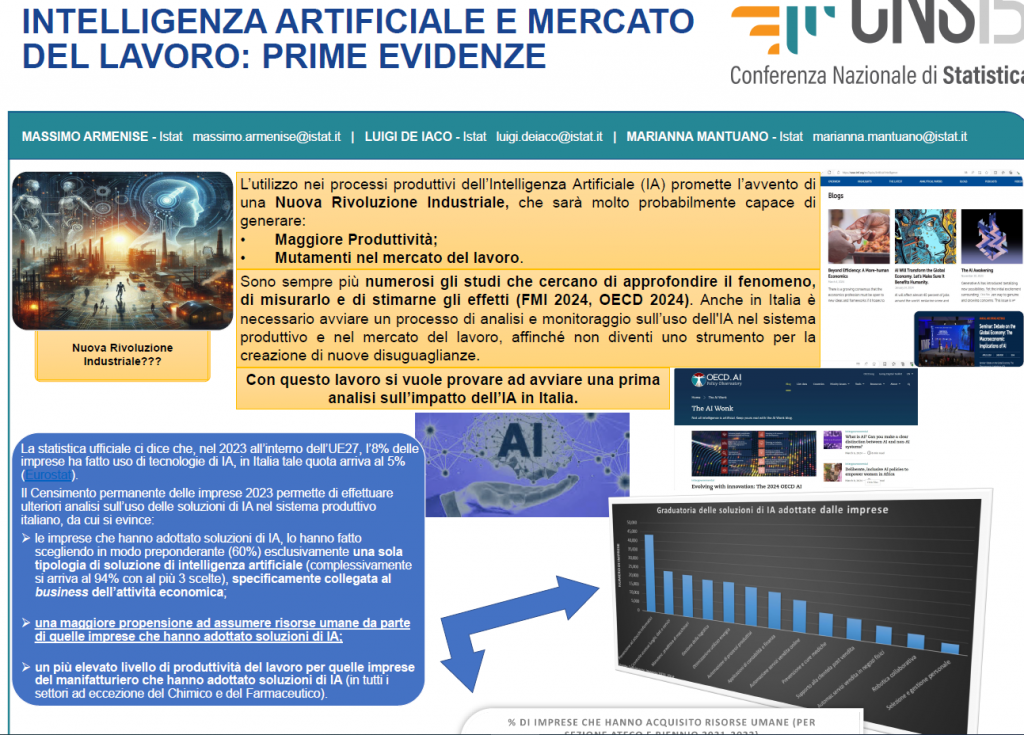
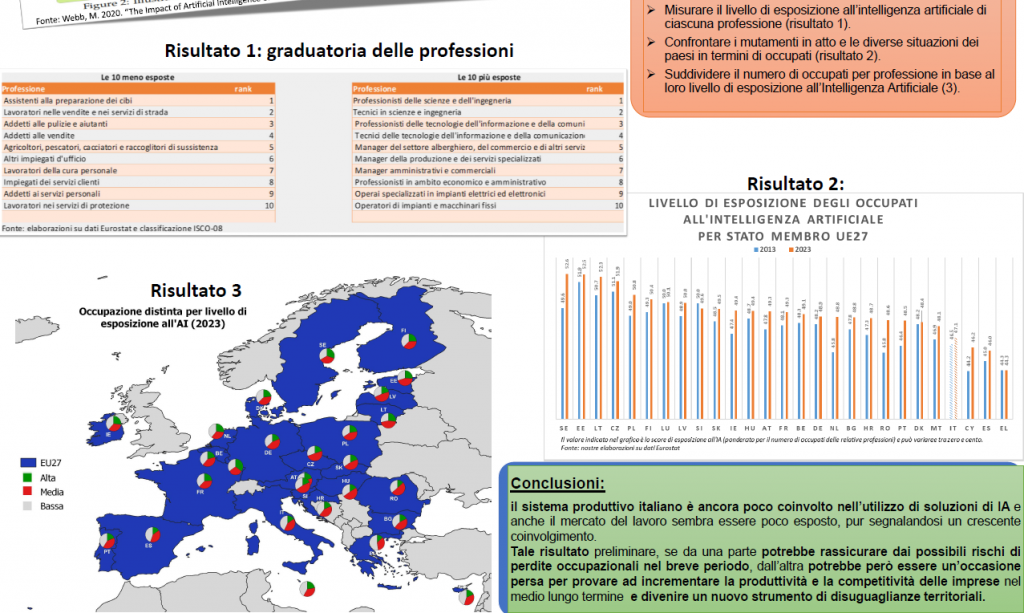
Il sistema produttivo italiano è ancora poco coinvolto nell’utilizzo di soluzioni di IA e anche il mercato del lavoro sembra essere poco esposto. Ma questa non è una buona notizia, perché la media di utilizzo dell’AI nelle nostre imprese nel 2023 secondo stime della Ue è pari ad al 5%, inferiore alla media Ue dell’8%. Ma va considerato che il lavoro in Italia è ancora poco digitalizzato ed è soprattutto per questo che la diffusione dell’AI non è troppo elevata nel nostro paese. E quindi è per questo che il lavoro da noi è meno esposto all’AI, perché la presenza del digitale al lavoro nelle nostre aziende è ancora indietro. Il digital divide si riflette così sull’AI divide. E’ quanto emerge da un’indagine condotta a titolo personale da tre ricercatori dell’ISTAT, Massimo Armenise, Luigi De Iaco e Marianna Mantuano, e appena presentata in occasione della Conferenza Nazionale di Statistica sotto forma di poster.

Intelligenza artificiale e mercato del lavoro: prime evidenze. Scarica il poster in PDF

Svezia paese più esposto perché fra i più digitalizzati

Per dire, il paese europeo dove il lavoro è più esposto all’AI è la Svezia, uno degli stati membri dove la digitalizzazione del lavoro è più spinta. E questa esposizione non ha per il momento alcun tipo di connotazione, né positiva né negativa sulla perdita o sul guadagno di posti di lavoro. E’ ancora troppo presto per capire gli effetti reali sul mondo del lavoro legati all’avvento in massa dell’AI, che si realizzerà nei prossimi anni (clicca sull’immagine per ingrandirla e rimpicciolirla).  

Un altro aspetto assodato è che l’AI porterà certamente una maggiore produttività e profondi mutamenti nel panorama del lavoro. “Sono sempre più numerosi gli studi che cercano di approfondire il fenomeno, di misurarlo e di stimarne gli effetti (FMI 2024, OECD 2024). Anche in Italia è necessario avviare un processo di analisi e monitoraggio sull’uso dell’IA nel sistema produttivo e nel mercato del lavoro, affinché non diventi uno strumento per la creazione di nuove disuguaglianze”, si legge nel lavoro dei tre ricercatori dell’ISTAT.

Trend, le aziende che investono di più in AI assumono di più

“Il Censimento permanente delle imprese 2023 permette di effettuare ulteriori analisi sull’uso delle soluzioni di IA nel sistema produttivo italiano, da cui si evince:

  • le imprese che hanno adottato soluzioni di IA, lo hanno fatto scegliendo in modo preponderante (60%) esclusivamente una sola tipologia di soluzione di intelligenza artificiale (complessivamente si arriva al 94% con al più 3 scelte), specificamente collegata al business dell’attività economica;
  • una maggiore propensione ad assumere risorse umane da parte di quelle imprese che hanno adottato soluzioni di IA;
  • un più elevato livello di produttività del lavoro per quelle imprese del manifatturiero che hanno adottato soluzioni di IA (in tutti i settori ad eccezione del Chimico e del Farmaceutico)”.

La classifica delle professioni più o meno esposte all’AI

Per quanto riguarda la classifica dei lavori più esposti all’AI, la maggior parte riguarda attività legate all’ingegneria e alla tecnica, compresi i manager dell’informazione (leggi giornalisti e professionisti della comunicazione). E ancora, i manager del settore alberghiero, gli amministrativi, gli operai specializzati in impianti elettrici ed elettronici. Quelli meno toccati, al contrario, sono i cuochi, gli operai che lavorano su strada, gli addetti alle pulizie, i venditori, gli agricoltori. Di seguito il ranking completo (clicca sull’immagine per ingrandirla e rimpicciolirla). 

Il fatto che un lavoro sia esposto all’Intelligenza Artificiale non significa che sia per forza a rischio, anche perché l’avvento dell’AI presupporrà una trasformazione radicale di diversi mestieri.

Conclusioni

Premonitrice la conclusione dello studio: “il sistema produttivo italiano è ancora poco coinvolto nell’utilizzo di soluzioni di IA e anche il mercato del lavoro sembra essere poco esposto, pur segnalandosi un crescente coinvolgimento. Tale risultato preliminare, se da una parte potrebbe rassicurare dai possibili rischi di perdite occupazionali nel breve periodo, dall’altra potrebbe però essere un’occasione persa per provare ad incrementare la produttività e la competitività delle imprese nel medio lungo termine e divenire un nuovo strumento di disuguaglianze territoriali”.

Intelligenza artificiale e mercato del lavoro: prime evidenze. Scarica il poster in PDF

Leggi le altre notizie sull’home page di Key4biz

https://www.key4biz.it/ai-i-10-lavori-piu-e-meno-esposti-in-italia-scarica-lindagine-in-pdf/497075/