Google’s “AI Overview” can give false, misleading, and dangerous answers

This is fine.
Enlarge / This is fine.
Getty Images


If you use Google regularly, you may have noticed the company’s new AI Overviews providing summarized answers to some of your questions in recent days. If you use social media regularly, you may have come across many examples of those AI Overviews being hilariously or even dangerously wrong.

Factual errors can pop up in existing LLM chatbots as well, of course. But the potential damage that can be caused by AI inaccuracy gets multiplied when those errors appear atop the ultra-valuable web real estate of the Google search results page.

“The examples we’ve seen are generally very uncommon queries and aren’t representative of most people’s experiences,” a Google spokesperson told Ars. “The vast majority of AI Overviews provide high quality information, with links to dig deeper on the web.”

After looking through dozens of examples of Google AI Overview mistakes (and replicating many ourselves for the galleries below), we’ve noticed a few broad categories of errors that seemed to show up again and again. Consider this a crash course in some of the current weak points of Google’s AI Overviews and a look at areas of concern for the company to improve as the system continues to roll out.

Treating jokes as facts

Some of the funniest example of Google’s AI Overview failing come, ironically enough, when the system doesn’t realize a source online was trying to be funny. An AI answer that suggested using “1/8 cup of non-toxic glue” to stop cheese from sliding off pizza can be traced back to someone who was obviously trying to troll an ongoing thread. A response recommending “blinker fluid” for a turn signal that doesn’t make noise can similarly be traced back to a troll on the Good Sam advice forums, which Google’s AI Overview apparently trusts as a reliable source.

In regular Google searches, these jokey posts from random Internet users probably wouldn’t be among the first answers someone saw when clicking through a list of web links. But with AI Overviews, those trolls were integrated into the authoritative-sounding data summary presented right at the top of the results page.

What’s more, there’s nothing in the tiny “source link” boxes below Google’s AI summary to suggest either of these forum trolls are anything other than good sources of information. Sometimes, though, glancing at the source can save you some grief, such as when you see a response calling running with scissors “cardio exercise that some say is effective” (that came from a 2022 post from Little Old Lady Comedy).

Bad sourcing

Sometimes Google’s AI Overview offers an accurate summary of a non-joke source that happens to be wrong. When asking about how many Declaration of Independence signers owned slaves, for instance, Google’s AI Overview accurately summarizes a Washington University of St. Louis library page saying that one-third “were personally enslavers.” But the response ignores contradictory sources like a Chicago Sun-Times article saying the real answer is closer to three-quarters. I’m not enough of a history expert to judge which authoritative-seeming source is right, but at least one historian online took issue with the Google AI’s answer sourcing.

Other times, a source that Google trusts as authoritative is really just fan fiction. That’s the case for a response that imagined a 2022 remake of 2001: A Space Odyssey, directed by Steven Spielberg and produced by George Lucas. A savvy web user would probably do a double-take before citing citing Fandom’s “Idea Wiki” as a reliable source, but a careless AI Overview user might not notice where the AI got its information.

https://arstechnica.com/?p=2025825


Bing outage shows just how little competition Google search really has

Google logo on a phone in front of a Bing logo in the background
Getty Images

Bing, Microsoft’s search engine platform, went down in the very early morning today. That meant that searches from Microsoft’s Edge browsers that had yet to change their default providers didn’t work. It also meant that services relying on Bing’s search API—Microsoft’s own Copilot, ChatGPT search, Yahoo, Ecosia, and DuckDuckGo—similarly failed.

Services were largely restored by the morning Eastern work hours, but the timing feels apt, concerning, or some combination of the two. Google, the consistently dominating search platform, just last week announced and debuted AI Overviews as a default addition to all searches. If you don’t want an AI response but still want to use Google, you can hunt down the new “Web” option in a menu, or you can, per Ernie Smith, tack “&udm=14” onto your search or use Smith’s own “Konami code” shortcut page.

If dismay about AI’s hallucinations, power draw, or pizza recipes concern you—along with perhaps broader Google issues involving privacy, tracking, news, SEO, or monopoly power—most of your other major options were brought down by a single API outage this morning. Moving past that kind of single point of vulnerability will take some work, both by the industry and by you, the person wondering if there’s a real alternative.

Search engine market share, as measured by StatCounter, April 2023–April 2024.
StatCounter

Upward of a billion dollars a year

The overwhelming majority of search tools offering an “alternative” to Google are using Google, Bing, or Yandex, the three major search engines that maintain massive global indexes. Yandex, being based in Russia, is a non-starter for many people around the world at the moment. Bing offers its services widely, most notably to DuckDuckGo, but its ad-based revenue model and privacy particulars have caused some friction there in the past. Before his company was able to block more of Microsoft’s own tracking scripts, DuckDuckGo CEO and founder Gabriel Weinberg explained in a Reddit reply why firms like his weren’t going the full DIY route:

… [W]e source most of our traditional links and images privately from Bing … Really only two companies (Google and Microsoft) have a high-quality global web link index (because I believe it costs upwards of a billion dollars a year to do), and so literally every other global search engine needs to bootstrap with one or both of them to provide a mainstream search product. The same is true for maps btw — only the biggest companies can similarly afford to put satellites up and send ground cars to take streetview pictures of every neighborhood.

Bing makes Microsoft money, if not quite profit yet. It’s in Microsoft’s interest to keep its search index stocked and API open, even if its focus is almost entirely on its own AI chatbot version of Bing. Yet if Microsoft decided to pull API access, or it became unreliable, Google’s default position gets even stronger. What would non-conformists have to choose from then?

https://arstechnica.com/?p=2026559


AI, uno strumento per creare contenuti di cui non abbiamo bisogno

All’OpenAI Spring Update, il CTO di OpenAI, Mira Murati ha presentato GPT-4o, un nuovo modello AI che arricchisce la suite con funzionalità “omni” per testo, visione e audio. Murati ha promesso implementazioni iterative per migliorare sia i prodotti per sviluppatori che quelli per i consumatori nei prossimi mesi.

Durante la dimostrazione delle capacità di traduzione in tempo reale di GPT-4o, il modello ha tradotto perfettamente dall’inglese all’italiano, dimostrando la sua sofisticata adattabilità linguistica. Molti credono che questa nuova funzionalità sostituirà Google Traduttore. Probabilmente, si tratta della prima volta in cui un prodotto di OpenAI è realmente utile.

Cerchiamo di spiegarci: la realizzazione di immagini partendo da prompt testuali è qualcosa di molto bello, un effetto wow che abbiamo imparato a gestire nel tempo ma che non porta ad un incremento della produttività sul lungo periodo. Per come sono stati pensati attualmente, i modelli di intelligenza artificiale sono troppo approssimativi per permettere di affidarci totalmente ad essi. Un esempio è Copilot, che su GPT ha fatto la sua fortuna.

[embedded content]

Se chiedo di creare un articolo basato su qualche nozione generale, il più delle volte ottengo “allucinazioni” evidenti o sottili, che richiedono di fare un doppio controllo sul contenuto prodotto. DI fatto, l’AI non ci sta rubando il posto di lavoro ma sta solo rendendoci più lenti nel compiere alcune operazioni. Non è tutto negativo: se butto dentro Copilot un testo già scritto e chiedo di darmi un titolo, lui lo fa e anche con varie alternative. Tutto questo può giustificare il clamore degli ultimi mesi? Direi di no. L’AI è uno strumento, non un creatore. Come ogni tool, può essere utilizzato per il bene o per il male ma c’è il rischio di avere una sovrabbondanza di contenuti, non tutti di alta qualità o di reale valore per gli utenti.

Immagini? Più scarabocchi

Tutti gli attuali generatori di grafiche non possono tenere il passo con il più scarso dei creativi al mondo. Numeri sbagliato di dita nelle mani delle persone, occhi disallineati, testi e brand con errori di ortografia e molto altro: ancora una volta, l’AI può darci uno spunto per un lavoro, non eseguirlo del tutto. Non a caso, Adobe nell’aggiornare il suo modello Firefly ha detto che la parte più difficile è stata il dover migliorare la resa finale delle lettere che le persone vogliono far comparire nell’immagine. Se “Digital4Biz” diventa, per l’AI, “Dxgadl4iSpritz” forse abbiamo un problema. O semplicemente bisogna riconoscere i limiti di una tecnologia che non è per nulla gratis, non per il mondo.

Il consumo energetico dell’intelligenza artificiale è un tema complesso e in evoluzione. In generale, si stima che il settore dell’AI potrebbe consumare tra gli 85 e 134 terawattora (TWh) di energia all’anno entro il 2027. Per fare un paragone, la cifra equivale al consumo energetico annuo dell’Argentina o dei Paesi Bassi. I processi di addestramento dei modelli di intelligenza artificiale possono richiedere enormi quantità di calcolo, che a loro volta si traducono in un alto consumo energetico.

Non è tutto cloud

L’esecuzione di sistemi AI, come quelli utilizzati per il riconoscimento facciale o la traduzione automatica, richiedono anch’essa energia. I data center che ospitano i sistemi AI consumano molta corrente per il funzionamento dei server, il raffreddamento e la sicurezza. Tuttavia, è importante sottolineare che l’impatto ambientale dell’AI non si limita al consumo energetico. L’estrazione e la lavorazione dei materiali per la produzione di hardware possono avere un impatto significativo sull’ambiente, così come lo smaltimento dei rifiuti elettronici.

E la questione del consumo non si riduce solo al cloud. La prossima sfida dell’intelligenza artificiale sembra essere quella di portare tutta la capacità di calcolo e “inferenza” (trovare le correlazioni tra elementi) all’interno del dispositivo, che sia un computer o uno smartphone. Il risultato? Semiconduttori più performanti, schede grafiche più potenti e, a conti fatti, un drenaggio più veloce della batteria. L’innovazione nel campo delle nanotecnologie è evidente ma non tale da spostare avanti un’era del computing, fortemente permeata di AI, tenendo i consumi in linea con quelli di oggi.

Si va per casi d’uso

Parlando di un utilizzo professionale, per PMI e compartimenti più grandi, l’AI ha il vantaggio di poter leggere in una mole di dati in pochi secondi, individuando errori, collegamenti, spunti che all’occhio di una persona potrebbero sfuggire o richiedere ore e ore di lavoro, se non giorni. Circoscrivere l’addestramento di un LLM al tenant di un’organizzazione, al suo database informativo, è un caso d’uso di successo. Non sembrerà strano che la monetizzazione di Microsoft, in relazione a Copilot, arrivi proprio da una declinazione “pro” del suo chatbot. Supporto nella creazione di slide, riassunto delle email, sintesi di ciò che si è detto in un meeting, è parte valore che Redmond attribuisce alla sua iniziativa. Quando l’AI deve interpretare, analizzare, correlare, dati in un ambiente delimitato, dà il meglio di sé. Quando si ritrova dinanzi all’immenso universo del web, può perdersi. Ma in quello, siamo bravi anche noi. Altroché.

https://www.key4biz.it/ai-uno-strumento-per-creare-contenuti-di-cui-non-abbiamo-bisogno/491492/


Big tech, a Seoul l’accordo globale per la sicurezza dell’AI (switch off compreso)

Le grandi Big Tech globali hanno siglato un accordo a Seoul, in occasione dell’AI Safety Summit, per lo sviluppo sicuro dell’AI generativa, con una serie di impegni che prevedono, in caso di necessità, lo spegnimento (switch off) della tecnologia per mitigarne i rischi.  

L’accordo comprende big come Microsoft, Amazon e OpenAI, che hanno così siglato un accordo di portata storica che prevede impegni volontari per assicurare lo sviluppo sicuro dei loro modelli di AI.

Il patto si basa su precedenti impegni presi dalle aziende in fase di sviluppo dei sofwtare di AI generativa a partite da novembre.

L’accordo siglato a Seoul coinvolge diverse aziende di Usa, Cina, Canada, Uk, Francia Corea del Sud ed Emirati Arabi Uniti e prevede la sigla volontaria di impegni per lo sviluppo dei modelli AI più evoluti.

Sviluppo aperto

Laddove non lo abbiano già fatto, i creatori di modelli di intelligenza artificiale hanno accettato di pubblicare quadri di sicurezza che stabiliscono come misureranno le sfide dei loro modelli di frontiera, come prevenire l’uso improprio della tecnologia da parte di soggetti malintenzionati.

Questi quadri includeranno “linee rosse” per le aziende tecnologiche che definiscono i tipi di rischi associati ai sistemi di intelligenza artificiale di frontiera, che sarebbero considerati “intollerabili”. Questi rischi includono, ma non sono limitati, agli attacchi informatici automatizzati e alla minaccia delle armi biologiche.

Per rispondere a circostanze così estreme, le aziende hanno dichiarato di voler implementare un “kill switch” che bloccherebbe lo sviluppo dei loro modelli di intelligenza artificiale se non riescono a garantire la mitigazione di questi rischi.

“È la prima volta al mondo che così tante aziende leader nel settore dell’intelligenza artificiale provenienti da così tante parti diverse del globo accettino gli stessi impegni sulla sicurezza dell’intelligenza artificiale”, ha dichiarato martedì in una dichiarazione Rishi Sunak, il primo ministro del Regno Unito.

Trasparenza

“Questi impegni garantiscono che le principali aziende mondiali nel campo dell’intelligenza artificiale forniranno trasparenza e responsabilità sui loro piani per sviluppare un’intelligenza artificiale sicura”, ha aggiunto.

L’accordo di martedì amplia una serie di impegni precedenti assunti dalle aziende coinvolte nello sviluppo di software di intelligenza artificiale generativa lo scorso novembre.

Le aziende hanno concordato di ricevere input su queste soglie da “attori fidati”, compresi i loro governi nazionali, a seconda dei casi, prima di rilasciarle prima del prossimo vertice sull’intelligenza artificiale pianificato – l’AI Action Summit in Francia – all’inizio del 2025.

Modelli di frontiera

Gli impegni concordati martedì si applicano solo ai cosiddetti modelli di frontiera. Questo termine si riferisce alla tecnologia alla base dei sistemi di intelligenza artificiale generativa come la famiglia GPT di OpenAI di modelli linguistici di grandi dimensioni, che alimenta il popolare chatbot AI ChatGPT.

Da quando ChatGPT è stato introdotto per la prima volta nel mondo nel novembre 2022, i regolatori e i leader tecnologici sono diventati sempre più preoccupati per i rischi che circondano i sistemi di intelligenza artificiale avanzati in grado di generare contenuti testuali e visivi alla pari o migliori degli umani.

L’Unione Europea ha cercato di frenare lo sviluppo illimitato dell’IA con la creazione della sua legge sull’intelligenza artificiale, approvata martedì dal Consiglio dell’UE.

Il Regno Unito, tuttavia, non ha proposto leggi formali per l’intelligenza artificiale, optando invece per un approccio “leggero” alla regolamentazione dell’intelligenza artificiale, che prevede che i regolatori applichino le leggi esistenti alla tecnologia.

Il governo ha recentemente affermato che prenderà in considerazione la possibilità di legiferare per modelli di frontiera in futuro, ma non si è impegnato a rispettare una tempistica per l’introduzione di leggi formali.

La lista completa dei firmatari:

Amazon

Anthropic

Cohere

Google / Google DeepMind

G42

IBM

Inflection AI

Meta

Microsoft

Mistral AI

Naver

OpenAI

Samsung Electronics

Technology Innovation Institute

xAI

Zhipu.ai

https://www.key4biz.it/big-tech-a-seoul-laccordo-globale-per-la-sicurezza-dellai-switch-off-compreso/491497/


Here’s what’s really going on inside an LLM’s neural network

Here’s what’s really going on inside an LLM’s neural network
Aurich Lawson | Getty Images


With most computer programs—even complex ones—you can meticulously trace through the code and memory usage to figure out why that program generates any specific behavior or output. That’s generally not true in the field of generative AI, where the non-interpretable neural networks underlying these models make it hard for even experts to figure out precisely why they often confabulate information, for instance.

Now, new research from Anthropic offers a new window into what’s going on inside the Claude LLM’s “black box.” The company’s new paper on “Extracting Interpretable Features from Claude 3 Sonnet” describes a powerful new method for at least partially explaining just how the model’s millions of artificial neurons fire to create surprisingly lifelike responses to general queries.

Opening the hood

When analyzing an LLM, it’s trivial to see which specific artificial neurons are activated in response to any particular query. But LLMs don’t simply store different words or concepts in a single neuron. Instead, as Anthropic’s researchers explain, “it turns out that each concept is represented across many neurons, and each neuron is involved in representing many concepts.”

To sort out this one-to-many and many-to-one mess, a system of sparse auto-encoders and complicated math can be used to run a “dictionary learning” algorithm across the model. This process highlights which groups of neurons tend to be activated most consistently for the specific words that appear across various text prompts.

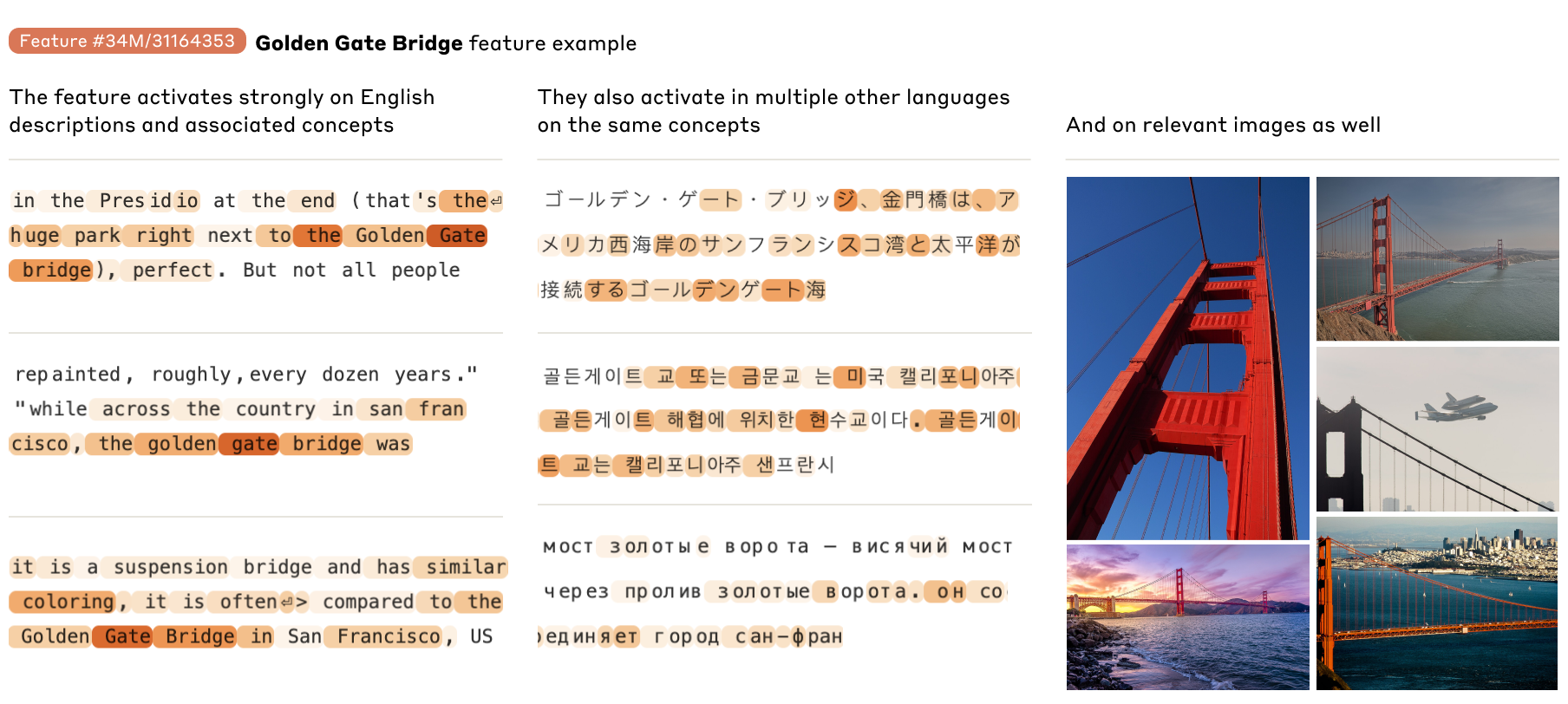
The same internal LLM "feature" describes the Golden Gate Bridge in multiple languages and modes.
Enlarge / The same internal LLM “feature” describes the Golden Gate Bridge in multiple languages and modes.

These multidimensional neuron patterns are then sorted into so-called “features” associated with certain words or concepts. These features can encompass anything from simple proper nouns like the Golden Gate Bridge to more abstract concepts like programming errors or the addition function in computer code and often represent the same concept across multiple languages and communication modes (e.g., text and images).

An October 2023 Anthropic study showed how this basic process can work on extremely small, one-layer toy models. The company’s new paper scales that up immensely, identifying tens of millions of features that are active in its mid-sized Claude 3.0 Sonnet model. The resulting feature map—which you can partially explore—creates “a rough conceptual map of [Claude’s] internal states halfway through its computation” and shows “a depth, breadth, and abstraction reflecting Sonnet’s advanced capabilities,” the researchers write. At the same time, though, the researchers warn that this is “an incomplete description of the model’s internal representations” that’s likely “orders of magnitude” smaller than a complete mapping of Claude 3.

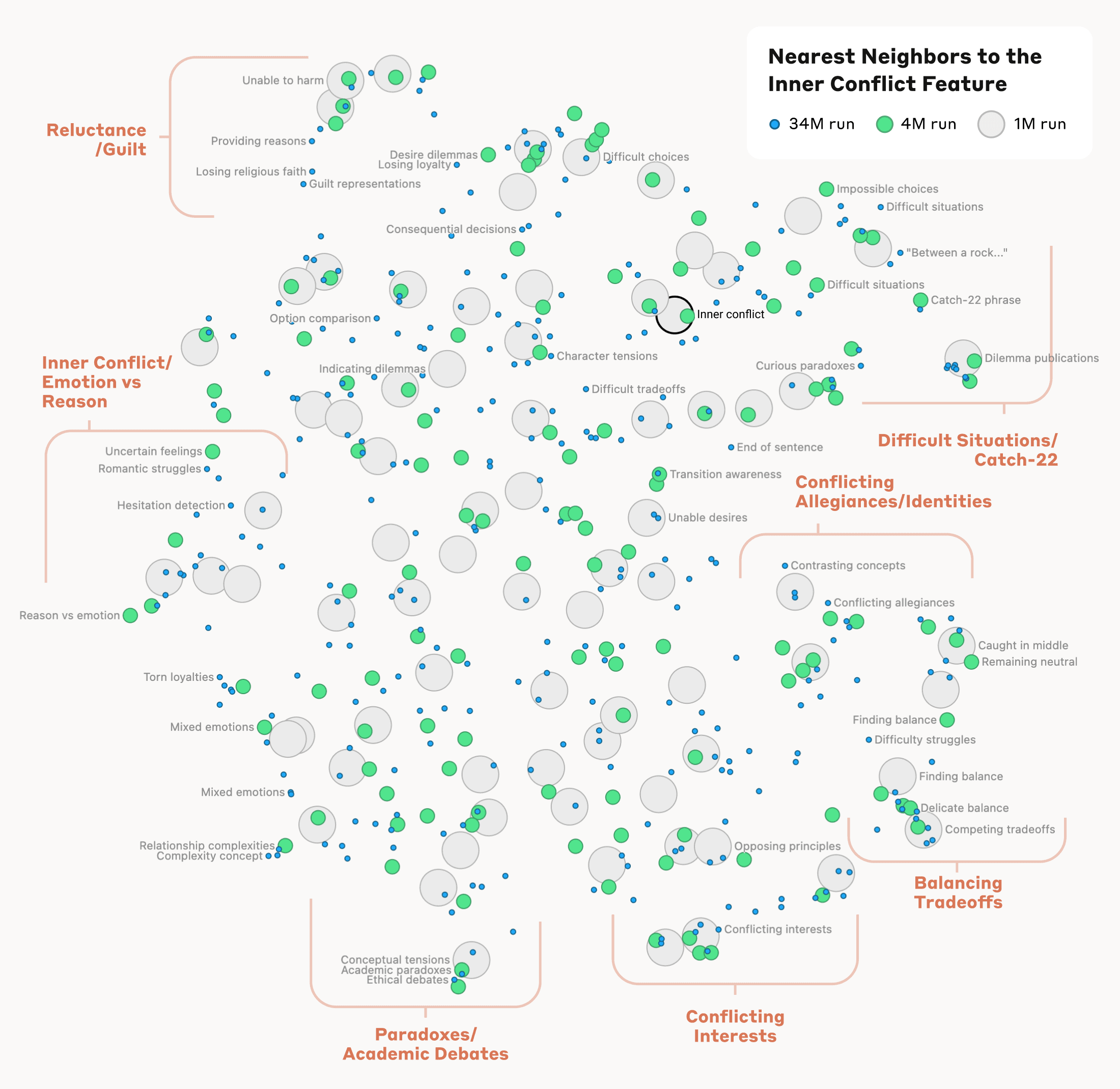
A simplified map shows some of the concepts that are "near" the "inner conflict" feature in Anthropic's Claude model.
Enlarge / A simplified map shows some of the concepts that are “near” the “inner conflict” feature in Anthropic’s Claude model.

Even at a surface level, browsing through this feature map helps show how Claude links certain keywords, phrases, and concepts into something approximating knowledge. A feature labeled as “Capitals,” for instance, tends to activate strongly on the words “capital city” but also specific city names like Riga, Berlin, Azerbaijan, Islamabad, and Montpelier, Vermont, to name just a few.

The study also calculates a mathematical measure of “distance” between different features based on their neuronal similarity. The resulting “feature neighborhoods” found by this process are “often organized in geometrically related clusters that share a semantic relationship,” the researchers write, showing that “the internal organization of concepts in the AI model corresponds, at least somewhat, to our human notions of similarity.” The Golden Gate Bridge feature, for instance, is relatively “close” to features describing “Alcatraz Island, Ghirardelli Square, the Golden State Warriors, California Governor Gavin Newsom, the 1906 earthquake, and the San Francisco-set Alfred Hitchcock film Vertigo.”

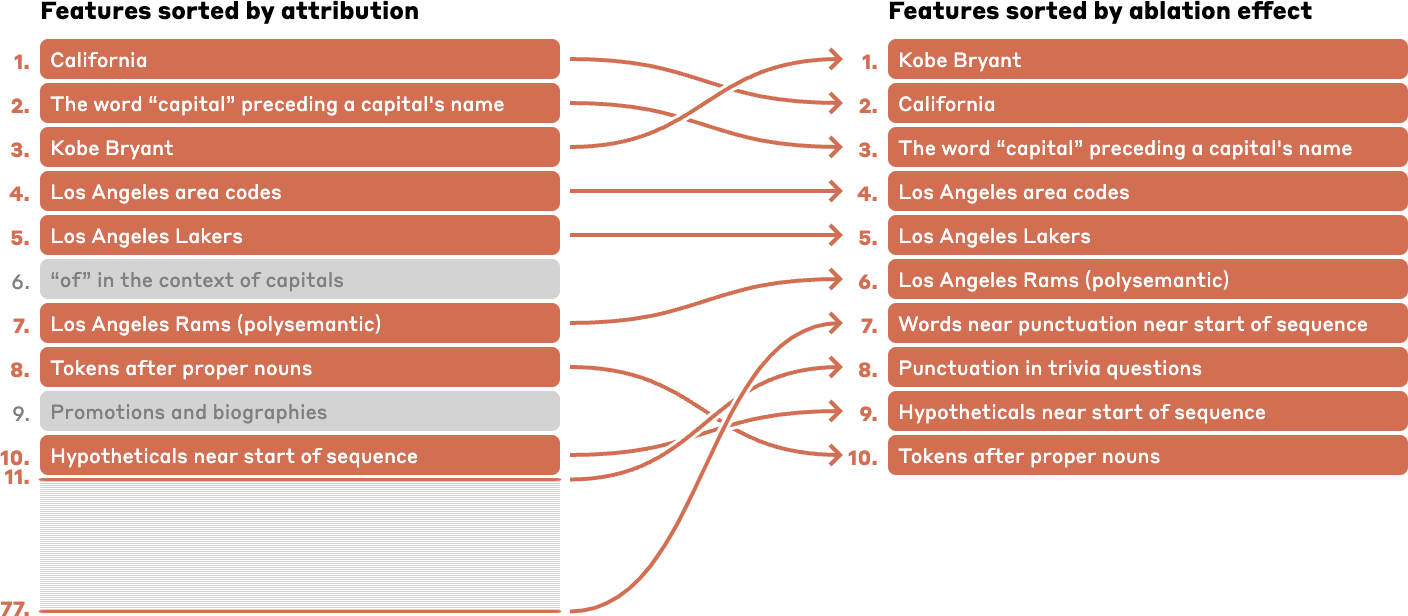
Some of the most important features involved in answering a query about the capital of Kobe Bryant's team's state.
Enlarge / Some of the most important features involved in answering a query about the capital of Kobe Bryant’s team’s state.

Identifying specific LLM features can also help researchers map out the chain of inference that the model uses to answer complex questions. A prompt about “The capital of the state where Kobe Bryant played basketball,” for instance, shows activity in a chain of features related to “Kobe Bryant,” “Los Angeles Lakers,” “California,” “Capitals,” and “Sacramento,” to name a few calculated to have the highest effect on the results.

https://arstechnica.com/?p=2026236


OpenAI pauses ChatGPT-4o voice that fans said ripped off Scarlett Johansson

<img src="https://rassegna.lbit-solution.it/wp-content/uploads/2024/05/openai-pauses-chatgpt-4o-voice-that-fans-said-ripped-off-scarlett-johansson.jpg" alt="Scarlett Johansson and Joaquin Phoenix attend Her premiere during the 8th Rome Film Festival at Auditorium Parco Della Musica on November 10, 2013, in Rome, Italy. “>
Enlarge / Scarlett Johansson and Joaquin Phoenix attend Her premiere during the 8th Rome Film Festival at Auditorium Parco Della Musica on November 10, 2013, in Rome, Italy.

OpenAI has paused a voice mode option for ChatGPT-4o, Sky, after backlash accusing the AI company of intentionally ripping off Scarlett Johansson’s critically acclaimed voice-acting performance in the 2013 sci-fi film Her.

In a blog defending their casting decision for Sky, OpenAI went into great detail explaining its process for choosing the individual voice options for its chatbot. But ultimately, the company seemed pressed to admit that Sky’s voice was just too similar to Johansson’s to keep using it, at least for now.

“We believe that AI voices should not deliberately mimic a celebrity’s distinctive voice—Sky’s voice is not an imitation of Scarlett Johansson but belongs to a different professional actress using her own natural speaking voice,” OpenAI’s blog said.

OpenAI is not naming the actress, or any of the ChatGPT-4o voice actors, to protect their privacy.

A week ago, OpenAI CEO Sam Altman seemed to invite this controversy by posting “her” on X (formerly Twitter) after announcing the ChatGPT audio-video features that he said made it more “natural” for users to interact with the chatbot.

Altman has said that Her, a movie about a man who falls in love with his virtual assistant, is among his favorite movies. He told conference attendees at Dreamforce last year that the movie “was incredibly prophetic” when depicting “interaction models of how people use AI,” The San Francisco Standard reported. And just last week, Altman touted GPT-4o’s new voice mode by promising, “it feels like AI from the movies.”

But OpenAI’s chief technology officer, Mira Murati, has said that GPT-4o’s voice modes were less inspired by Her than by studying the “really natural, rich, and interactive” aspects of human conversation, The Wall Street Journal reported.

In 2013, of course, critics praised Johansson’s Her performance as expressively capturing a wide range of emotions, which is exactly what Murati described as OpenAI’s goals for its chatbot voices. Rolling Stone noted how effectively Johansson naturally navigated between “tones sweet, sexy, caring, manipulative, and scary.” Johansson achieved this, the Hollywood Reporter said, by using a “vivacious female voice that breaks attractively but also has an inviting deeper register.”

Her director/screenwriter Spike Jonze was so intent on finding the right voice for his film’s virtual assistant that he replaced British actor Samantha Morton late in the film’s production. According to Vulture, Jonze realized that Morton’s “maternal, loving, vaguely British, and almost ghostly” voice didn’t fit his film as well as Johansson’s “younger,” “more impassioned” voice, which he said brought “more yearning.”

Late-night shows had fun mocking OpenAI’s demo featuring the Sky voice. The demo showed the chatbot seemingly flirting with engineers, giggling through responses like “Oh, stop it. You’re making me blush.” Where The New York Times described these demo interactions as Sky being “deferential and wholly focused on the user,” The Daily Show‘s Desi Lydic joked that Sky was “clearly programmed to feed dudes’ egos.”

OpenAI is likely hoping to avoid any further controversy amid plans to roll out more voices soon that its blog said will “better match the diverse interests and preferences of users.”

OpenAI did not immediately respond to Ars’ request for comment.

Voice actors versus AI

The OpenAI controversy arrives at a moment when many are questioning AI’s impact on creative communities, triggering early lawsuits from artists and book authors. Just this month, Sony opted all of its artists out of AI training to stop voice clones from ripping off top talents like Adele and Beyoncé.

Voice actors, too, have been monitoring increasingly sophisticated AI voice generators, waiting to see what threat AI might pose to future work opportunities. Recently, two actors sued an AI startup called Lovo that they claimed “illegally used recordings of their voices to create technology that can compete with their voice work,” The New York Times reported. According to that lawsuit, Lovo allegedly used the actors’ actual voice clips to clone their voices.

“We don’t know how many other people have been affected,” the actors’ lawyer, Steve Cohen, told The Times.

Rather than replacing voice actors, OpenAI’s blog said that they are striving to support the voice industry when creating chatbots that will laugh at your jokes or mimic your mood. On top of paying voice actors “compensation above top-of-market rates,” OpenAI said they “worked with industry-leading casting and directing professionals to narrow down over 400 submissions” to the five voice options in the initial rollout of audio-video features.

Their goals in hiring voice actors were to hire talents “from diverse backgrounds or who could speak multiple languages,” casting actors who had voices that feel “timeless” and “inspire trust.” To OpenAI, that meant finding actors who have a “warm, engaging, confidence-inspiring, charismatic voice with rich tone” that sounds “natural and easy to listen to.”

For ChatGPT-4o’s first five voice actors, the gig lasted about five months before leading to more work, OpenAI said.

“We are continuing to collaborate with the actors, who have contributed additional work for audio research and new voice capabilities in GPT-4o,” OpenAI said.

Arguably, these actors are helping to train AI tools that could one day replace them, though. Backlash defending Johansson—one of the world’s highest-paid actors—perhaps shows that fans won’t take direct mimicry of any of Hollywood’s biggest stars lightly, though.

While criticism of the Sky voice seemed widespread, some fans think that OpenAI has overreacted by pausing the Sky voice.

NYT critic Alissa Wilkinson wrote that it was only “a tad jarring” to hear Sky’s voice because “she sounded a whole lot” like Johansson. And replying to OpenAI’s X post announcing its decision to pull the voice feature for now, a clump of fans protested the AI company’s “bad decision,” with some complaining that Sky was the “best” and “hottest” voice.

At least one fan noted that OpenAI’s decision seemed to hurt the voice actor behind Sky most.

“Super unfair for the Sky voice actress,” a user called Ate-a-Pi wrote. “Just because she sounds like ScarJo, now she can never make money again. Insane.”

https://arstechnica.com/?p=2025464


What happened to OpenAI’s long-term AI risk team?

A glowing OpenAI logo on a blue background.
Benj Edwards

In July last year, OpenAI announced the formation of a new research team that would prepare for the advent of supersmart artificial intelligence capable of outwitting and overpowering its creators. Ilya Sutskever, OpenAI’s chief scientist and one of the company’s co-founders, was named as the co-lead of this new team. OpenAI said the team would receive 20 percent of its computing power.

Now OpenAI’s “superalignment team” is no more, the company confirms. That comes after the departures of several researchers involved, Tuesday’s news that Sutskever was leaving the company, and the resignation of the team’s other co-lead. The group’s work will be absorbed into OpenAI’s other research efforts.

Sutskever’s departure made headlines because although he’d helped CEO Sam Altman start OpenAI in 2015 and set the direction of the research that led to ChatGPT, he was also one of the four board members who fired Altman in November. Altman was restored as CEO five chaotic days later after a mass revolt by OpenAI staff and the brokering of a deal in which Sutskever and two other company directors left the board.

Hours after Sutskever’s departure was announced on Tuesday, Jan Leike, the former DeepMind researcher who was the superalignment team’s other co-lead, posted on X that he had resigned.

Neither Sutskever nor Leike responded to requests for comment. Sutskever did not offer an explanation for his decision to leave but offered support for OpenAI’s current path in a post on X. “The company’s trajectory has been nothing short of miraculous, and I’m confident that OpenAI will build AGI that is both safe and beneficial” under its current leadership, he wrote.

Leike posted a thread on X on Friday explaining that his decision came from a disagreement over the company’s priorities and how much resources his team was being allocated.

“I have been disagreeing with OpenAI leadership about the company’s core priorities for quite some time, until we finally reached a breaking point,” Leike wrote. “Over the past few months my team has been sailing against the wind. Sometimes we were struggling for compute and it was getting harder and harder to get this crucial research done.”

The dissolution of OpenAI’s superalignment team adds to recent evidence of a shakeout inside the company in the wake of last November’s governance crisis. Two researchers on the team, Leopold Aschenbrenner and Pavel Izmailov, were dismissed for leaking company secrets, The Information reported last month. Another member of the team, William Saunders, left OpenAI in February, according to an Internet forum post in his name.

Two more OpenAI researchers working on AI policy and governance also appear to have left the company recently. Cullen O’Keefe left his role as research lead on policy frontiers in April, according to LinkedIn. Daniel Kokotajlo, an OpenAI researcher who has coauthored several papers on the dangers of more capable AI models, “quit OpenAI due to losing confidence that it would behave responsibly around the time of AGI,” according to a posting on an Internet forum in his name. None of the researchers who have apparently left responded to requests for comment.

OpenAI declined to comment on the departures of Sutskever or other members of the superalignment team, or the future of its work on long-term AI risks. Research on the risks associated with more powerful models will now be led by John Schulman, who co-leads the team responsible for fine-tuning AI models after training.

The superalignment team was not the only team pondering the question of how to keep AI under control, although it was publicly positioned as the main one working on the most far-off version of that problem. The blog post announcing the superalignment team last summer stated: “Currently, we don’t have a solution for steering or controlling a potentially superintelligent AI, and preventing it from going rogue.”

OpenAI’s charter binds it to safely developing so-called artificial general intelligence, or technology that rivals or exceeds humans, safely and for the benefit of humanity. Sutskever and other leaders there have often spoken about the need to proceed cautiously. But OpenAI has also been early to develop and publicly release experimental AI projects to the public.

OpenAI was once unusual among prominent AI labs for the eagerness with which research leaders like Sutskever talked of creating superhuman AI and of the potential for such technology to turn on humanity. That kind of doomy AI talk became much more widespread last year after ChatGPT turned OpenAI into the most prominent and closely watched technology company on the planet. As researchers and policymakers wrestled with the implications of ChatGPT and the prospect of vastly more capable AI, it became less controversial to worry about AI harming humans or humanity as a whole.

The existential angst has since cooled—and AI has yet to make another massive leap—but the need for AI regulation remains a hot topic. And this week OpenAI showcased a new version of ChatGPT that could once again change people’s relationship with the technology in powerful and perhaps problematic new ways.

The departures of Sutskever and Leike come shortly after OpenAI’s latest big reveal—a new “multimodal” AI model called GPT-4o that allows ChatGPT to see the world and converse in a more natural and humanlike way. A livestreamed demonstration showed the new version of ChatGPT mimicking human emotions and even attempting to flirt with users. OpenAI has said it will make the new interface available to paid users within a couple of weeks.

There is no indication that the recent departures have anything to do with OpenAI’s efforts to develop more humanlike AI or to ship products. But the latest advances do raise ethical questions around privacy, emotional manipulation, and cybersecurity risks. OpenAI maintains another research group called the Preparedness team that focuses on these issues.

This story originally appeared on wired.com.

https://arstechnica.com/?p=2025250


OpenAI will use Reddit posts to train ChatGPT under new deal

An image of a woman holding a cell phone in front of the Reddit logo displayed on a computer screen, on April 29, 2024, in Edmonton, Canada.

Stuff posted on Reddit is getting incorporated into ChatGPT, Reddit and OpenAI announced on Thursday. The new partnership grants OpenAI access to Reddit’s Data API, giving the generative AI firm real-time access to Reddit posts.

Reddit content will be incorporated into ChatGPT “and new products,” Reddit’s blog post said. The social media firm claims the partnership will “enable OpenAI’s AI tools to better understand and showcase Reddit content, especially on recent topics.” OpenAI will also start advertising on Reddit.

The deal is similar to one that Reddit struck with Google in February that allows the tech giant to make “new ways to display Reddit content” and provide “more efficient ways to train models,” Reddit said at the time. Neither Reddit nor OpenAI disclosed the financial terms of their partnership, but Reddit’s partnership with Google was reportedly worth $60 million.

Under the OpenAI partnership, Reddit also gains access to OpenAI large language models (LLMs) to create features for Reddit, including its volunteer moderators.

Reddit’s data licensing push

The news comes about a year after Reddit launched an API war by starting to charge for access to its data API. This resulted in many beloved third-party Reddit apps closing and a massive user protest. Reddit, which would soon become a public company and hadn’t turned a profit yet, said one of the reasons for the sudden change was to prevent AI firms from using Reddit content to train their LLMs for free.

Earlier this month, Reddit published a Public Content Policy stating: “Unfortunately, we see more and more commercial entities using unauthorized access or misusing authorized access to collect public data in bulk, including Reddit public content. Worse, these entities perceive they have no limitation on their usage of that data, and they do so with no regard for user rights or privacy, ignoring reasonable legal, safety, and user removal requests.

In its blog post on Thursday, Reddit said that deals like OpenAI’s are part of an “open” Internet. It added that “part of being open means Reddit content needs to be accessible to those fostering human learning and researching ways to build community, belonging, and empowerment online.”

Reddit has been vocal about its interest in pursuing data licensing deals as a core part of its business. Its building of AI partnerships sparks discourse around the use of user-generated content to fuel AI models without users being compensated and some potentially not considering that their social media posts would be used this way. OpenAI and Stack Overflow faced pushback earlier this month when integrating Stack Overflow content with ChatGPT. Some of Stack Overflow’s user community responded by sabotaging their own posts.

OpenAI is also challenged to work with Reddit data that, like much of the Internet, can be filled with inaccuracies and inappropriate content. Some of the biggest opponents of Reddit’s API rule changes were volunteer mods. Some have exited the platform since, and following the rule changes, Ars Technica spoke with long-time Redditors who were concerned about Reddit content quality moving forward.

Regardless, generative AI firms are keen to tap into Reddit’s access to real-time conversations from a variety of people discussing a nearly endless range of topics. And Reddit seems equally eager to license the data from its users’ posts.

Advance Publications, which owns Ars Technica parent Condé Nast, is the largest shareholder of Reddit.

https://arstechnica.com/?p=2025270


Slack users horrified to discover messages used for AI training

Slack users horrified to discover messages used for AI training

After launching Slack AI in February, Slack appears to be digging its heels in, defending its vague policy that by default sucks up customers’ data—including messages, content, and files—to train Slack’s global AI models.

According to Slack engineer Aaron Maurer, Slack has explained in a blog that the Salesforce-owned chat service does not train its large language models (LLMs) on customer data. But Slack’s policy may need updating “to explain more carefully how these privacy principles play with Slack AI,” Maurer wrote on Threads, partly because the policy “was originally written about the search/recommendation work we’ve been doing for years prior to Slack AI.”

Maurer was responding to a Threads post from engineer and writer Gergely Orosz, who called for companies to opt out of data sharing until the policy is clarified, not by a blog, but in the actual policy language.

“An ML engineer at Slack says they don’t use messages to train LLM models,” Orosz wrote. “My response is that the current terms allow them to do so. I’ll believe this is the policy when it’s in the policy. A blog post is not the privacy policy: every serious company knows this.”

The tension for users becomes clearer if you compare Slack’s privacy principles with how the company touts Slack AI.

Slack’s privacy principles specifically say that “Machine Learning (ML) and Artificial Intelligence (AI) are useful tools that we use in limited ways to enhance our product mission. To develop AI/ML models, our systems analyze Customer Data (e.g. messages, content, and files) submitted to Slack as well as other information (including usage information) as defined in our privacy policy and in your customer agreement.”

Meanwhile, Slack AI’s page says, “Work without worry. Your data is your data. We don’t use it to train Slack AI.”

Because of this incongruity, users called on Slack to update the privacy principles to make it clear how data is used for Slack AI or any future AI updates. According to a Salesforce spokesperson, the company has agreed an update is needed.

“Yesterday, some Slack community members asked for more clarity regarding our privacy principles,” Salesforce’s spokesperson told Ars. “We’ll be updating those principles today to better explain the relationship between customer data and generative AI in Slack.”

The spokesperson told Ars that the policy updates will clarify that Slack does not “develop LLMs or other generative models using customer data,” “use customer data to train third-party LLMs” or “build or train these models in such a way that they could learn, memorize, or be able to reproduce customer data.” The update will also clarify that “Slack AI uses off-the-shelf LLMs where the models don’t retain customer data,” ensuring that “customer data never leaves Slack’s trust boundary, and the providers of the LLM never have any access to the customer data.”

These changes, however, do not seem to address a key concern for users who never explicitly consented to sharing chats and other Slack content for use in AI training.

Users opting out of sharing chats with Slack

This controversial policy is not new. Wired warned about it in April, and TechCrunch reported that the policy has been in place since at least September 2023.

But widespread backlash began swelling last night on Hacker News, where Slack users called out the chat service for seemingly failing to notify users about the policy change, instead quietly opting them in by default. To critics, it felt like there was no benefit to opting in for anyone but Slack.

From there, the backlash spread to social media, where SlackHQ hastened to clarify Slack’s terms with explanations that did not seem to address all the criticism.

“I’m sorry Slack, you’re doing fucking WHAT with user DMs, messages, files, etc?” Corey Quinn, the chief cloud economist for a cost management company called Duckbill Group, posted on X. “I’m positive I’m not reading this correctly.”

SlackHQ responded to Quinn after the economist declared, “I hate this so much,” and confirmed that he had opted out of data sharing in his paid workspace.

“To clarify, Slack has platform-level machine-learning models for things like channel and emoji recommendations and search results,” SlackHQ posted. “And yes, customers can exclude their data from helping train those (non-generative) ML models. Customer data belongs to the customer.”

Later in the thread, SlackHQ noted, “Slack AI—which is our generative AI experience natively built in Slack—[and] is a separately purchased add-on that uses Large Language Models (LLMs) but does not train those LLMs on customer data.”

https://arstechnica.com/?p=2025179


Sony Music opts out of AI training for its entire catalog

picture of Beyonce who is a Sony artist
Enlarge / The Sony Music letter expressly prohibits artificial intelligence developers from using its music — which includes artists such as Beyoncé.
Kevin Mazur/WireImage for Parkwood via Getty Images

Sony Music is sending warning letters to more than 700 artificial intelligence developers and music streaming services globally in the latest salvo in the music industry’s battle against tech groups ripping off artists.

The Sony Music letter, which has been seen by the Financial Times, expressly prohibits AI developers from using its music—which includes artists such as Harry Styles, Adele and Beyoncé—and opts out of any text and data mining of any of its content for any purposes such as training, developing or commercializing any AI system.

Sony Music is sending the letter to companies developing AI systems including OpenAI, Microsoft, Google, Suno, and Udio, according to those close to the group.

The world’s second-largest music group is also sending separate letters to streaming platforms, including Spotify and Apple, asking them to adopt “best practice” measures to protect artists and songwriters and their music from scraping, mining and training by AI developers without consent or compensation. It has asked them to update their terms of service, making it clear that mining and training on its content is not permitted.

Sony Music declined to comment further.

The letter, which is being sent to tech companies around the world this week, marks an escalation of the music group’s attempts to stop the melodies, lyrics and images from copyrighted songs and artists being used by tech companies to produce new versions or to train systems to create their own music.

The letter says that Sony Music and its artists “recognize the significant potential and advancement of artificial intelligence” but adds that “unauthorized use . . . in the training, development or commercialization of AI systems deprives [Sony] of control over and appropriate compensation.”

It says: “This letter serves to put you on notice directly, and reiterate, that [Sony’s labels] expressly prohibit any use of [their] content.”

Executives at the New York-based group are concerned that their music has already been ripped off, and want to set out a clearly defined legal position that would be the first step to taking action against any developer of AI systems it considers to have exploited its music. They argue that Sony Music would be open to doing deals with AI developers to license the music, but want to reach a fair price for doing so.

The letter says: “Due to the nature of your operations and published information about your AI systems, we have reason to believe that you and/or your affiliates may already have made unauthorized uses [of Sony content] in relation to the training, development or commercialization of AI systems.”

Sony Music has asked developers to provide details of all content used by next week.

The letter also reflects concerns over the fragmented approach to AI regulation around the world. Global regulations over AI vary widely, with some regions moving forward with new rules and legal frameworks to cover the training and use of such systems but others leaving it to creative industries companies to work out relationships with developers.

In many countries around the world, particularly in the EU, copyright owners are advised to state publicly that content is not available for data mining and training for AI.

The letter says the prohibition includes using any bot, spider, scraper or automated program, tool, algorithm, code, process or methodology, as well as any “automated analytical techniques aimed at analyzing text and data in digital form to generate information, including patterns, trends, and correlations.”

© 2024 The Financial Times Ltd. All rights reserved Not to be redistributed, copied, or modified in any way.

https://arstechnica.com/?p=2025114