LLMs keep leaping with Llama 3, Meta’s newest open-weights AI model

A group of pink llamas on a pixelated background.

On Thursday, Meta unveiled early versions of its Llama 3 open-weights AI model that can be used to power text composition, code generation, or chatbots. It also announced that its Meta AI Assistant is now available on a website and is going to be integrated into its major social media apps, intensifying the company’s efforts to position its products against other AI assistants like OpenAI’s ChatGPT, Microsoft’s Copilot, and Google’s Gemini.

Like its predecessor, Llama 2, Llama 3 is notable for being a freely available, open-weights large language model (LLM) provided by a major AI company. Llama 3 technically does not quality as “open source” because that term has a specific meaning in software (as we have mentioned in other coverage), and the industry has not yet settled on terminology for AI model releases that ship either code or weights with restrictions (you can read Llama 3’s license here) or that ship without providing training data. We typically call these releases “open weights” instead.

At the moment, Llama 3 is available in two parameter sizes: 8 billion (8B) and 70 billion (70B), both of which are available as free downloads through Meta’s website with a sign-up. Llama 3 comes in two versions: pre-trained (basically the raw, next-token-prediction model) and instruction-tuned (fine-tuned to follow user instructions). Each has a 8,192 token context limit.
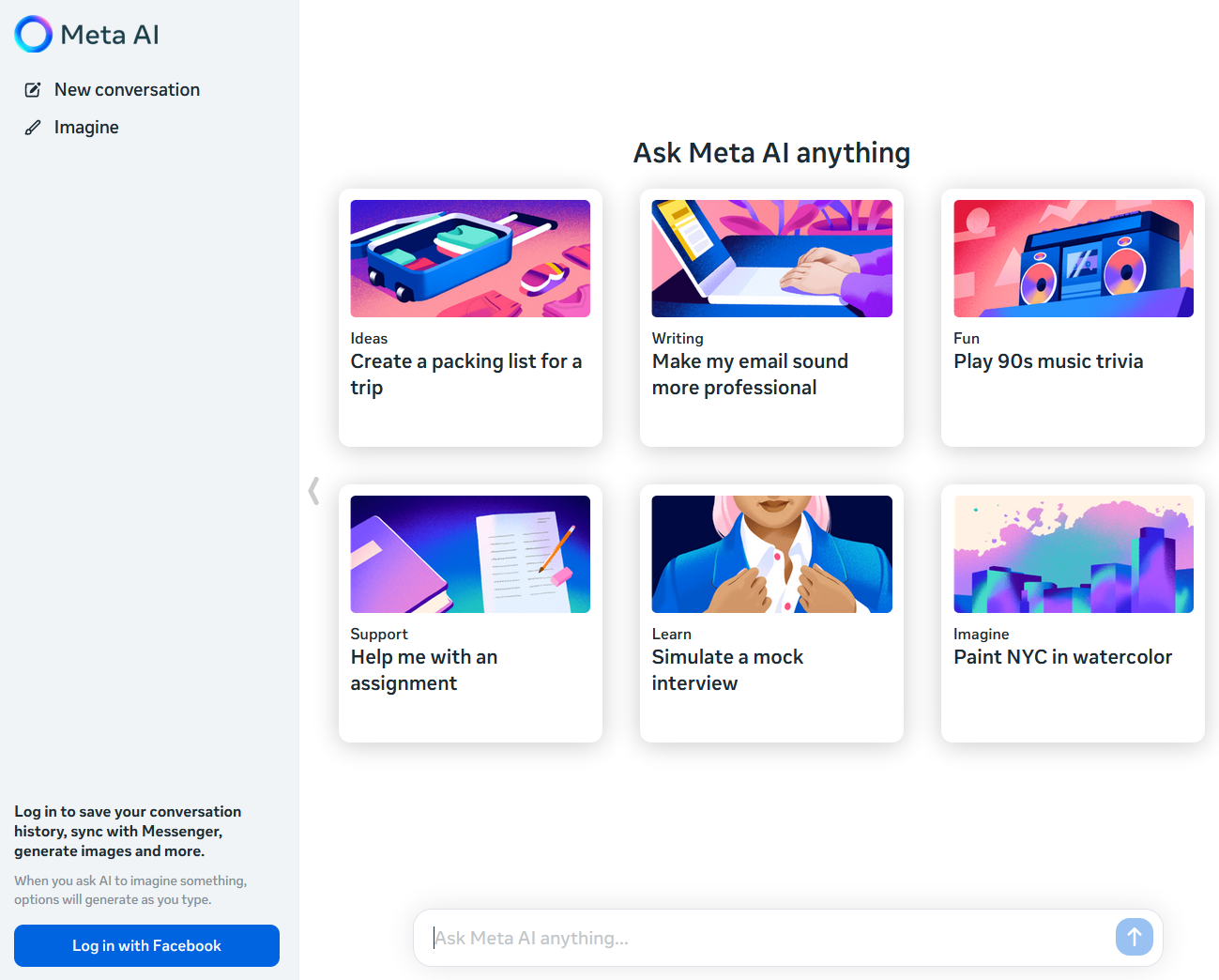
A screenshot of the Meta AI Assistant website on April 18, 2024.
Enlarge / A screenshot of the Meta AI Assistant website on April 18, 2024.
Benj Edwards

Meta trained both models on two custom-built, 24,000-GPU clusters. In a podcast interview with Dwarkesh Patel, Meta CEO Mark Zuckerberg said that the company trained the 70B model with around 15 trillion tokens of data. Throughout the process, the model never reached “saturation” (that is, it never hit a wall in terms of capability increases). Eventually, Meta pulled the plug and moved on to training other models.

“I guess our prediction going in was that it was going to asymptote more, but even by the end it was still leaning. We probably could have fed it more tokens, and it would have gotten somewhat better,” Zuckerberg said on the podcast.

Meta also announced that it is currently training a 400B parameter version of Llama 3, which some experts like Nvidia’s Jim Fan think may perform in the same league as GPT-4 Turbo, Claude 3 Opus, and Gemini Ultra on benchmarks like MMLU, GPQA, HumanEval, and MATH.

Speaking of benchmarks, we have devoted many words in the past to explaining how frustratingly imprecise benchmarks can be when applied to large language models due to issues like training contamination (that is, including benchmark test questions in the training dataset), cherry-picking on the part of vendors, and an inability to capture AI’s general usefulness in an interactive session with chat-tuned models.

But, as expected, Meta provided some benchmarks for Llama 3 that list results from MMLU (undergraduate level knowledge), GSM-8K (grade-school math), HumanEval (coding), GPQA (graduate-level questions), and MATH (math word problems). These show the 8B model performing well compared to open-weights models like Google’s Gemma 7B and Mistral 7B Instruct, and the 70B model also held its own against Gemini Pro 1.5 and Claude 3 Sonnet.
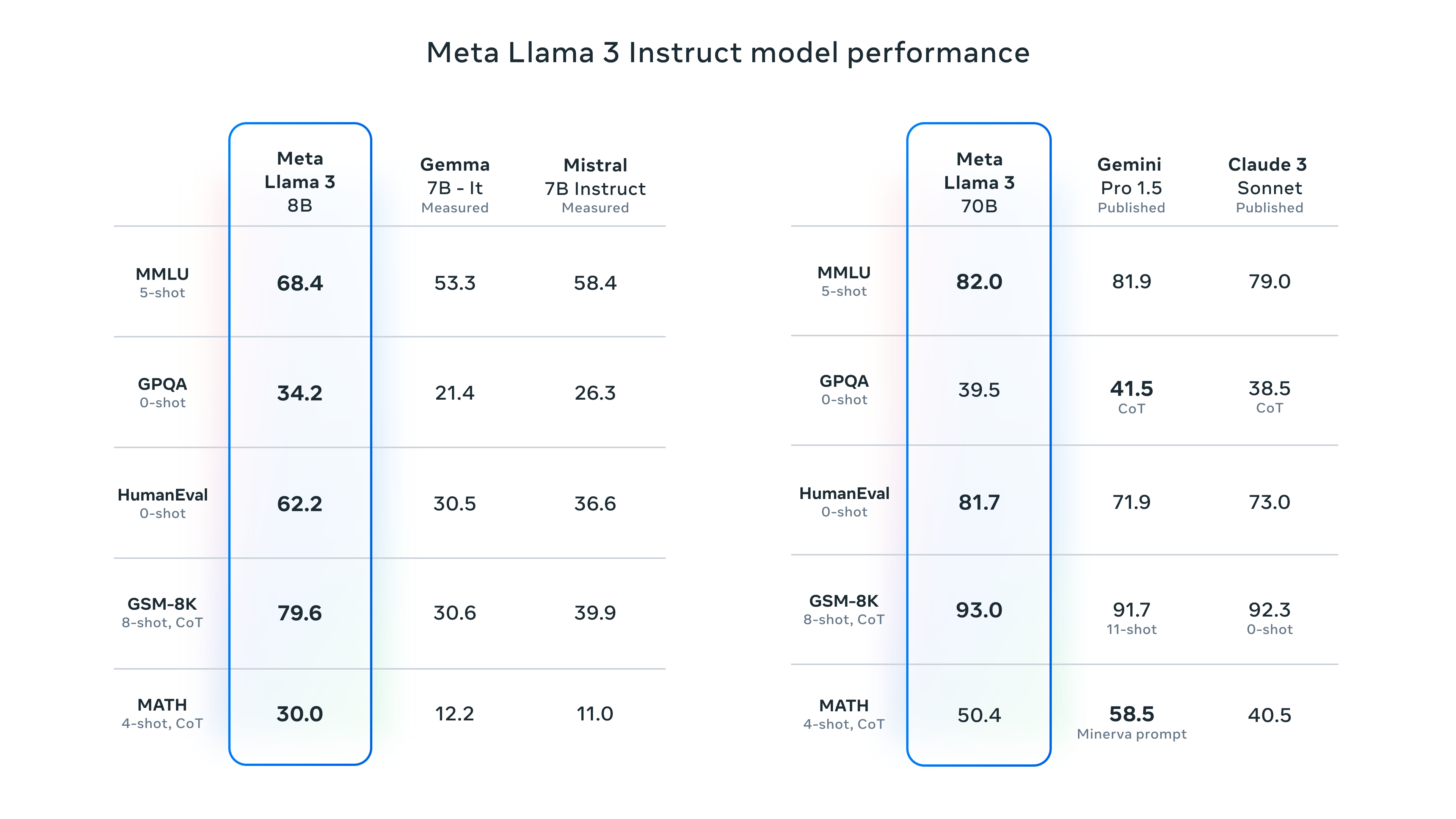
A chart of instruction-tuned Llama 3 8B and 70B benchmarks provided by Meta.
Enlarge / A chart of instruction-tuned Llama 3 8B and 70B benchmarks provided by Meta.

Meta says that the Llama 3 model has been enhanced with capabilities to understand coding (like Llama 2) and, for the first time, has been trained with both images and text—though it currently outputs only text. According to Reuters, Meta Chief Product Officer Chris Cox noted in an interview that more complex processing abilities (like executing multi-step plans) are expected in future updates to Llama 3, which will also support multimodal outputs—that is, both text and images.

Meta plans to host the Llama 3 models on a range of cloud platforms, making them accessible through AWS, Databricks, Google Cloud, and other major providers.

Also on Thursday, Meta announced that Llama 3 will become the new basis of the Meta AI virtual assistant, which the company first announced in September. The assistant will appear prominently in search features for Facebook, Instagram, WhatsApp, Messenger, and the aforementioned dedicated website that features a design similar to ChatGPT, including the ability to generate images in the same interface. The company also announced a partnership with Google to integrate real-time search results into the Meta AI assistant, adding to an existing partnership with Microsoft’s Bing.

https://arstechnica.com/?p=2018303



Feds appoint “AI doomer” to run AI safety at US institute

Feds appoint “AI doomer” to run AI safety at US institute

The US AI Safety Institute—part of the National Institute of Standards and Technology (NIST)—has finally announced its leadership team after much speculation.

Appointed as head of AI safety is Paul Christiano, a former OpenAI researcher who pioneered a foundational AI safety technique called reinforcement learning from human feedback (RLHF), but is also known for predicting that “there’s a 50 percent chance AI development could end in ‘doom.'” While Christiano’s research background is impressive, some fear that by appointing a so-called “AI doomer,” NIST may be risking encouraging non-scientific thinking that many critics view as sheer speculation.

There have been rumors that NIST staffers oppose the hiring. A controversial VentureBeat report last month cited two anonymous sources claiming that, seemingly because of Christiano’s so-called “AI doomer” views, NIST staffers were “revolting.” Some staff members and scientists allegedly threatened to resign, VentureBeat reported, fearing “that Christiano’s association” with effective altruism and “longtermism could compromise the institute’s objectivity and integrity.”

NIST’s mission is rooted in advancing science by working to “promote US innovation and industrial competitiveness by advancing measurement science, standards, and technology in ways that enhance economic security and improve our quality of life.” Effective altruists believe in “using evidence and reason to figure out how to benefit others as much as possible” and longtermists that “we should be doing much more to protect future generations,” both of which are more subjective and opinion-based.

On the Bankless podcast, Christiano shared his opinions last year that “there’s something like a 10–20 percent chance of AI takeover” that results in humans dying, and “overall, maybe you’re getting more up to a 50-50 chance of doom shortly after you have AI systems that are human level.”

“The most likely way we die involves—not AI comes out of the blue and kills everyone—but involves we have deployed a lot of AI everywhere… [And] if for some reason, God forbid, all these AI systems were trying to kill us, they would definitely kill us,” Christiano said.

Critics of so-called “AI doomers” have warned that focusing on any potentially overblown talk of hypothetical killer AI systems or existential AI risks may stop humanity from focusing on current perceived harms from AI, including environmental, privacy, ethics, and bias issues. Emily Bender, a University of Washington professor of computation linguistics who has warned about AI doomers thwarting important ethical work in the field, told Ars that because “weird AI doomer discourse” was included in Joe Biden’s AI executive order, “NIST has been directed to worry about these fantasy scenarios” and “that’s the underlying problem” leading to Christiano’s appointment.

“I think that NIST probably had the opportunity to take it a different direction,” Bender told Ars. “And it’s unfortunate that they didn’t.”

As head of AI safety, Christiano will seemingly have to monitor for current and potential risks. He will “design and conduct tests of frontier AI models, focusing on model evaluations for capabilities of national security concern,” steer processes for evaluations, and implement “risk mitigations to enhance frontier model safety and security,” the Department of Commerce’s press release said.

Christiano has experience mitigating AI risks. He left OpenAI to found the Alignment Research Center (ARC), which the Commerce Department described as “a nonprofit research organization that seeks to align future machine learning systems with human interests by furthering theoretical research.” Part of ARC’s mission is to test if AI systems are evolving to manipulate or deceive humans, ARC’s website said. ARC also conducts research to help AI systems scale “gracefully.”

Because of Christiano’s research background, some people think he is a good choice to helm the safety institute, such as Divyansh Kaushik, an associate director for emerging technologies and national security at the Federation of American Scientists. On X (formerly Twitter), Kaushik wrote that the safety institute is designed to mitigate chemical, biological, radiological, and nuclear risks from AI, and Christiano is “extremely qualified” for testing those AI models. Kaushik cautioned, however, that “if there’s truth to NIST scientists threatening to quit” over Christiano’s appointment, “obviously that would be serious if true.”

The Commerce Department does not comment on its staffing, so it’s unclear if anyone actually resigned or plans to resign over Christiano’s appointment. Since the announcement was made, Ars was not able to find any public announcements from NIST staffers suggesting that they might be considering stepping down.

In addition to Christiano, the safety institute’s leadership team will include Mara Quintero Campbell, a Commerce Department official who led projects on COVID response and CHIPS Act implementation, as acting chief operating officer and chief of staff. Adam Russell, an expert focused on human-AI teaming, forecasting, and collective intelligence, will serve as chief vision officer. Rob Reich, a human-centered AI expert on leave from Stanford University, will be a senior advisor. And Mark Latonero, a former White House global AI policy expert who helped draft Biden’s AI executive order, will be head of international engagement.

“To safeguard our global leadership on responsible AI and ensure we’re equipped to fulfill our mission to mitigate the risks of AI and harness its benefits, we need the top talent our nation has to offer,” Gina Raimondo, US Secretary of Commerce, said in the press release. “That is precisely why we’ve selected these individuals, who are the best in their fields, to join the US AI Safety Institute executive leadership team.”

VentureBeat’s report claimed that Raimondo directly appointed Christiano.

Bender told Ars that there’s no advantage to NIST including “doomsday scenarios” in its research on “how government and non-government agencies are using automation.”

“The fundamental problem with the AI safety narrative is that it takes people out of the picture,” Bender told Ars. “But the things we need to be worrying about are what people do with technology, not what technology autonomously does.”

https://arstechnica.com/?p=2017927


Words are flowing out like endless rain: Recapping a busy week of LLM news

An image of a boy amazed by flying letters.
Enlarge / An image of a boy amazed by flying letters.

Some weeks in AI news are eerily quiet, but during others, getting a grip on the week’s events feels like trying to hold back the tide. This week has seen three notable large language model (LLM) releases: Google Gemini Pro 1.5 hit general availability with a free tier, OpenAI shipped a new version of GPT-4 Turbo, and Mistral released a new openly licensed LLM, Mixtral 8x22B. All three of those launches happened within 24 hours starting on Tuesday.

With the help of software engineer and independent AI researcher Simon Willison (who also wrote about this week’s hectic LLM launches on his own blog), we’ll briefly cover each of the three major events in roughly chronological order, then dig into some additional AI happenings this week.

Gemini Pro 1.5 general release

On Tuesday morning Pacific time, Google announced that its Gemini 1.5 Pro model (which we first covered in February) is now available in 180-plus countries, excluding Europe, via the Gemini API in a public preview. This is Google’s most powerful public LLM so far, and it’s available in a free tier that permits up to 50 requests a day.

It supports up to 1 million tokens of input context. As Willison notes in his blog, Gemini 1.5 Pro’s API price at $7/million input tokens and $21/million output tokens costs a little less than GPT-4 Turbo (priced at $10/million in and $30/million out) and more than Claude 3 Sonnet (Anthropic’s mid-tier LLM, priced at $3/million in and $15/million out).

Notably, Gemini 1.5 Pro includes native audio (speech) input processing that allows users to upload audio or video prompts, a new File API for handling files, the ability to add custom system instructions (system prompts) for guiding model responses, and a JSON mode for structured data extraction.

“Majorly Improved” GPT-4 Turbo launch

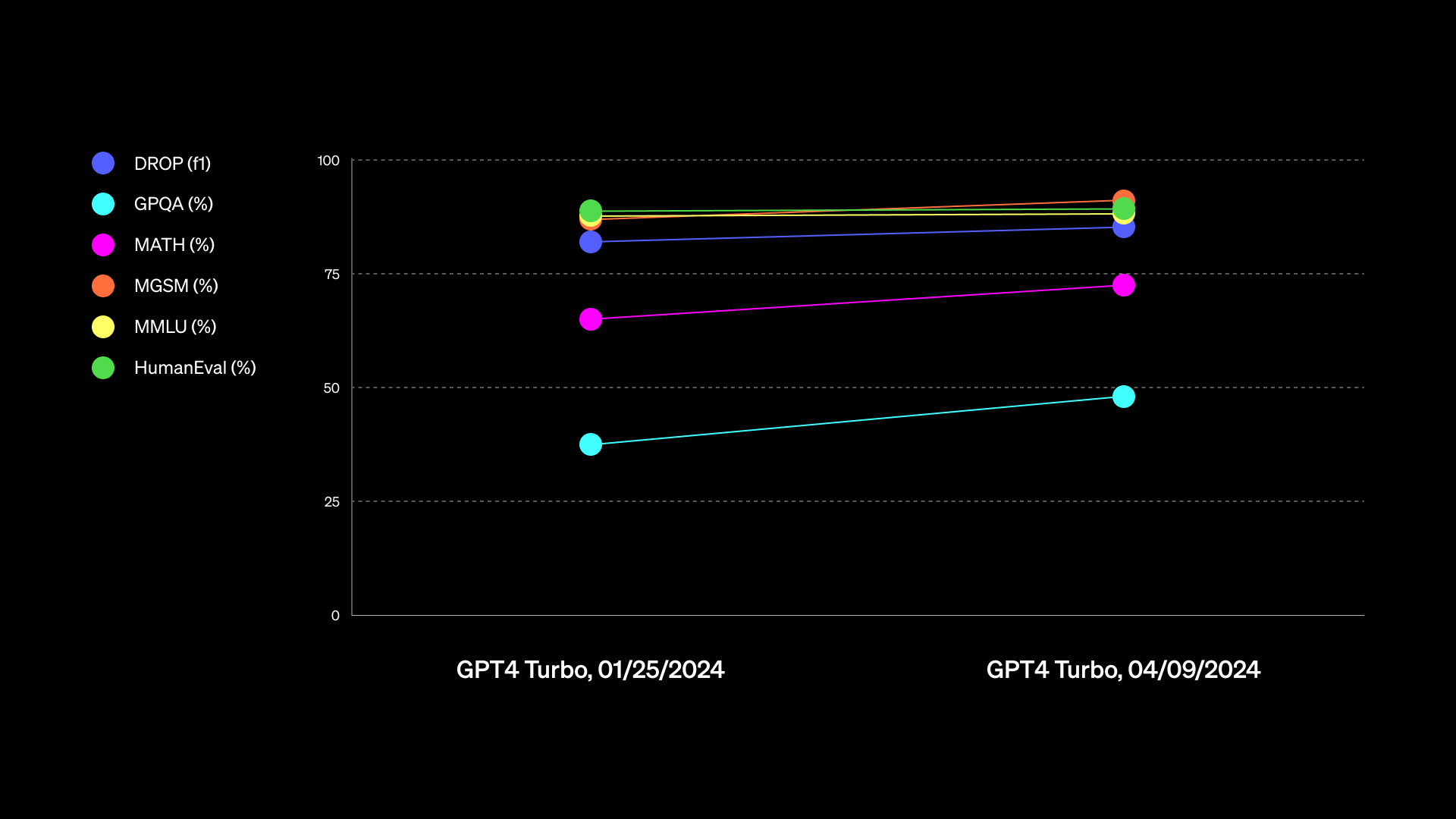
A GPT-4 Turbo performance chart provided by OpenAI.
Enlarge / A GPT-4 Turbo performance chart provided by OpenAI.

Just a bit later than Google’s 1.5 Pro launch on Tuesday, OpenAI announced that it was rolling out a “majorly improved” version of GPT-4 Turbo (a model family originally launched in November) called “gpt-4-turbo-2024-04-09.” It integrates multimodal GPT-4 Vision processing (recognizing the contents of images) directly into the model, and it initially launched through API access only.

Then on Thursday, OpenAI announced that the new GPT-4 Turbo model had just become available for paid ChatGPT users. OpenAI said that the new model improves “capabilities in writing, math, logical reasoning, and coding” and shared a chart that is not particularly useful in judging capabilities (that they later updated). The company also provided an example of an alleged improvement, saying that when writing with ChatGPT, the AI assistant will use “more direct, less verbose, and use more conversational language.”

The vague nature of OpenAI’s GPT-4 Turbo announcements attracted some confusion and criticism online. On X, Willison wrote, “Who will be the first LLM provider to publish genuinely useful release notes?” In some ways, this is a case of “AI vibes” again, as we discussed in our lament about the poor state of LLM benchmarks during the debut of Claude 3. “I’ve not actually spotted any definite differences in quality [related to GPT-4 Turbo],” Willison told us directly in an interview.

The update also expanded GPT-4’s knowledge cutoff to April 2024, although some people are reporting it achieves this through stealth web searches in the background, and others on social media have reported issues with date-related confabulations.

Mistral’s mysterious Mixtral 8x22B release

An illustration of a robot holding a French flag, figuratively reflecting the rise of AI in France due to Mistral. It's hard to draw a picture of an LLM, so a robot will have to do.
Enlarge / An illustration of a robot holding a French flag, figuratively reflecting the rise of AI in France due to Mistral. It’s hard to draw a picture of an LLM, so a robot will have to do.

Not to be outdone, on Tuesday night, French AI company Mistral launched its latest openly licensed model, Mixtral 8x22B, by tweeting a torrent link devoid of any documentation or commentary, much like it has done with previous releases.

The new mixture-of-experts (MoE) release weighs in with a larger parameter count than its previously most-capable open model, Mixtral 8x7B, which we covered in December. It’s rumored to potentially be as capable as GPT-4 (In what way, you ask? Vibes). But that has yet to be seen.

“The evals are still rolling in, but the biggest open question right now is how well Mixtral 8x22B shapes up,” Willison told Ars. “If it’s in the same quality class as GPT-4 and Claude 3 Opus, then we will finally have an openly licensed model that’s not significantly behind the best proprietary ones.”

This release has Willison most excited, saying, “If that thing really is GPT-4 class, it’s wild, because you can run that on a (very expensive) laptop. I think you need 128GB of MacBook RAM for it, twice what I have.”

The new Mixtral is not listed on Chatbot Arena yet, Willison noted, because Mistral has not released a fine-tuned model for chatting yet. It’s still a raw, predict-the-next token LLM. “There’s at least one community instruction tuned version floating around now though,” says Willison.

Chatbot Arena Leaderboard shake-ups

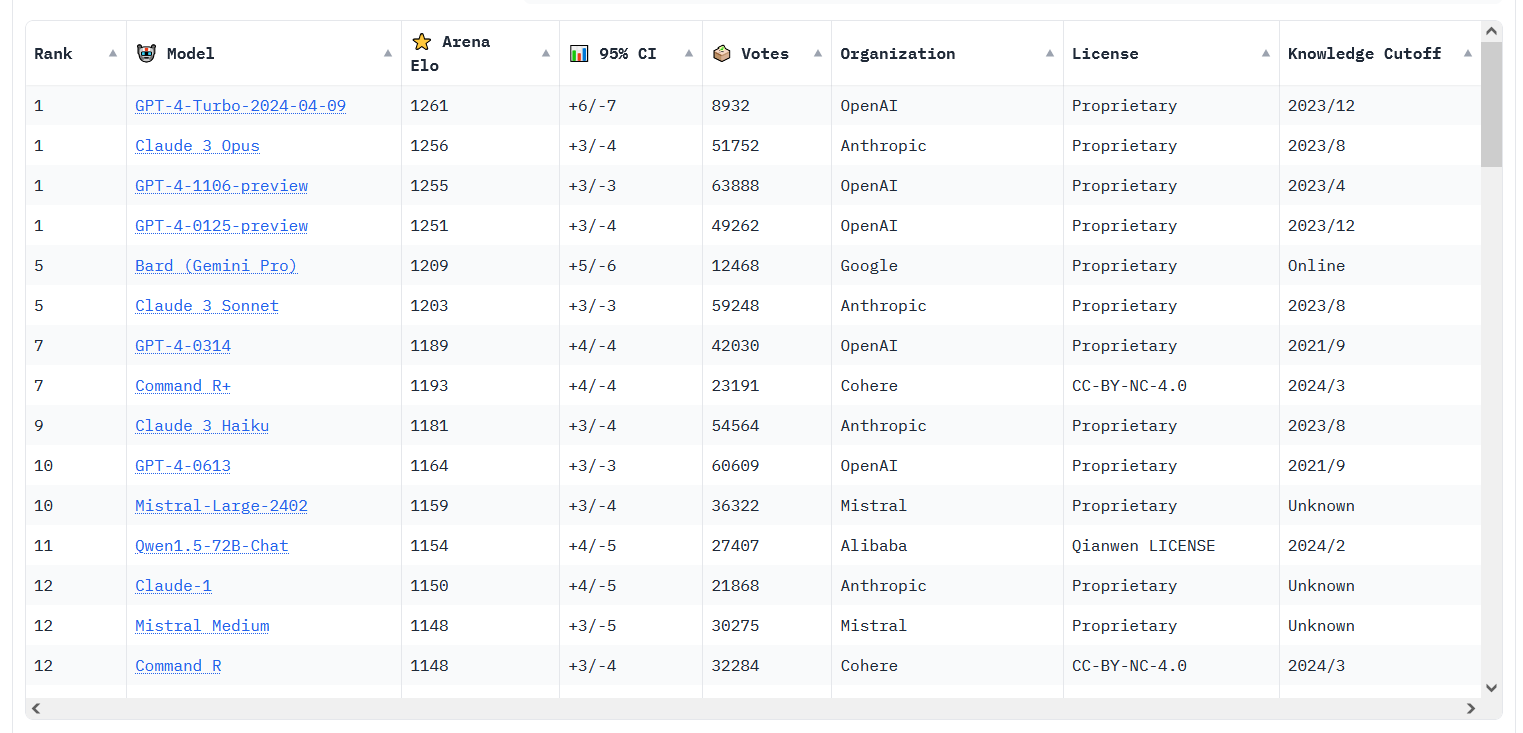
A Chatbot Arena Leaderboard screenshot taken on April 12, 2024.
Enlarge / A Chatbot Arena Leaderboard screenshot taken on April 12, 2024.
Benj Edwards

This week’s LLM news isn’t limited to just the big names in the field. There have also been rumblings on social media about the rising performance of open source models like Cohere’s Command R+, which reached position 6 on the LMSYS Chatbot Arena Leaderboard—the highest-ever ranking for an open-weights model.

And for even more Chatbot Arena action, apparently the new version of GPT-4 Turbo is proving competitive with Claude 3 Opus. The two are still in a statistical tie, but GPT-4 Turbo recently pulled ahead numerically. (In March, we reported when Claude 3 first numerically pulled ahead of GPT-4 Turbo, which was then the first time another AI model had surpassed a GPT-4 family model member on the leaderboard.)

Regarding this fierce competition among LLMs—of which most of the muggle world is unaware and will likely never be—Willison told Ars, “The past two months have been a whirlwind—we finally have not just one but several models that are competitive with GPT-4.” We’ll see if OpenAI’s rumored release of GPT-5 later this year will restore the company’s technological lead, we note, which once seemed insurmountable. But for now, Willison says, “OpenAI are no longer the undisputed leaders in LLMs.”

https://arstechnica.com/?p=2016005


Intel’s “Gaudi 3” AI accelerator chip may give Nvidia’s H100 a run for its money

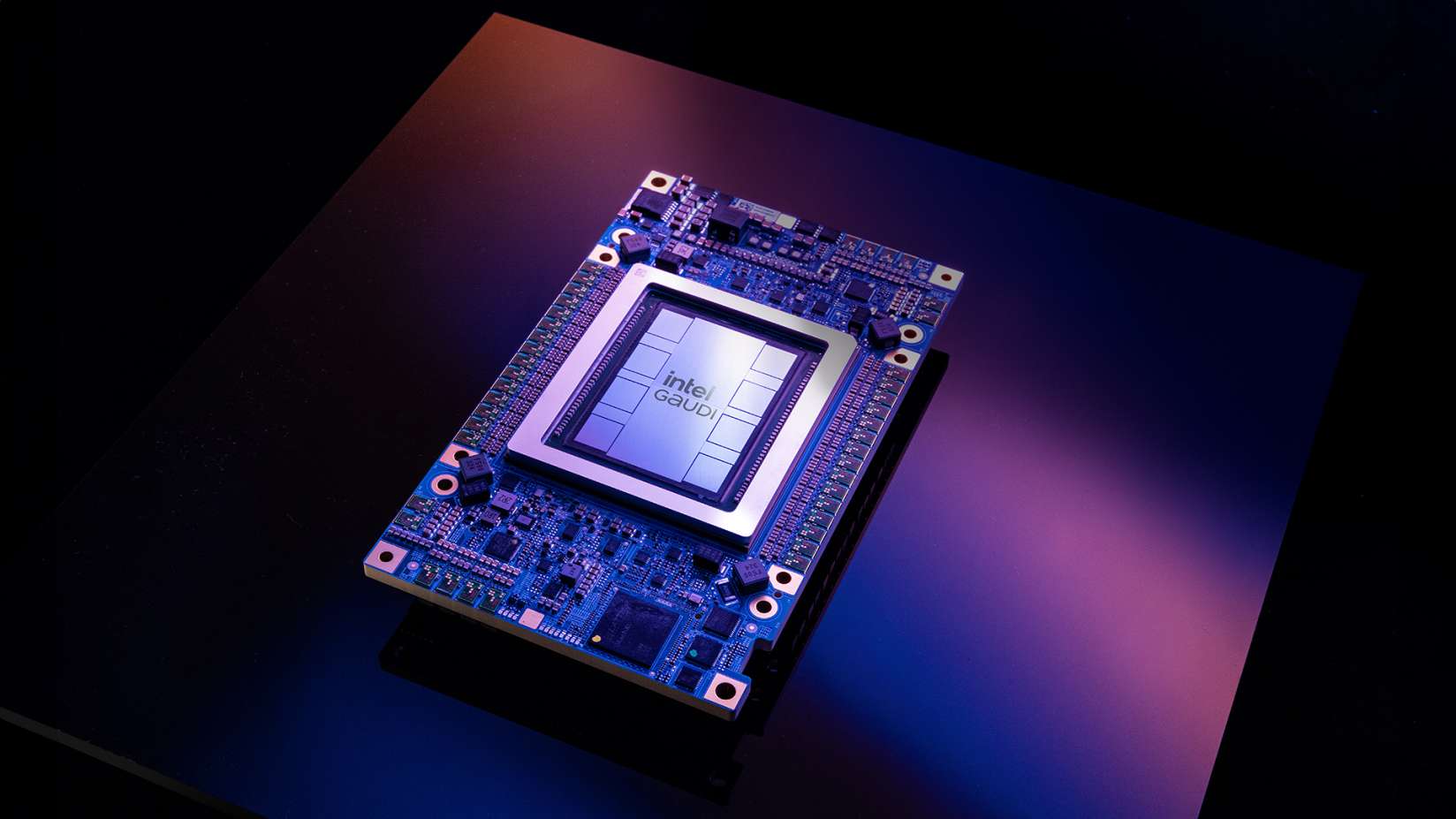
An Intel handout photo of the Gaudi 3 AI accelerator.
Enlarge / An Intel handout photo of the Gaudi 3 AI accelerator.

On Tuesday, Intel revealed a new AI accelerator chip called Gaudi 3 at its Vision 2024 event in Phoenix. With strong claimed performance while running large language models (like those that power ChatGPT), the company has positioned Gaudi 3 as an alternative to Nvidia’s H100, a popular data center GPU that has been subject to shortages, though apparently that is easing somewhat.

Compared to Nvidia’s H100 chip, Intel projects a 50 percent faster training time on Gaudi 3 for both OpenAI’s GPT-3 175B LLM and the 7-billion parameter version of Meta’s Llama 2. In terms of inference (running the trained model to get outputs), Intel claims that its new AI chip delivers 50 percent faster performance than H100 for Llama 2 and Falcon 180B, which are both relatively popular open-weights models.

Intel is targeting the H100 because of its high market share, but the chip isn’t Nvidia’s most powerful AI accelerator chip in the pipeline. Announcements of the H200 and the Blackwell B200 have since surpassed the H100 on paper, but neither of those chips is out yet (the H200 is expected in the second quarter of 2024—basically any day now).

Meanwhile, the aforementioned H100 supply issues have been a major headache for tech companies and AI researchers who have to fight for access to any chips that can train AI models. This has led several tech companies like Microsoft, Meta, and OpenAI (rumor has it) to seek their own AI-accelerator chip designs, although that custom silicon is typically manufactured by either Intel or TSMC. Google has its own line of tensor processing units (TPUs) that it has been using internally since 2015.

Given those issues, Intel’s Gaudi 3 may be a potentially attractive alternative to the H100 if Intel can hit an ideal price (which Intel has not provided, but an H100 reportedly costs around $30,000–$40,000) and maintain adequate production. AMD also manufactures a competitive range of AI chips, such as the AMD Instinct MI300 Series, that sell for around $10,000–$15,000.

Gaudi 3 performance

An Intel handout featuring specifications of the Gaudi 3 AI accelerator.
Enlarge / An Intel handout featuring specifications of the Gaudi 3 AI accelerator.

Intel says the new chip builds upon the architecture of its predecessor, Gaudi 2, by featuring two identical silicon dies connected by a high-bandwidth connection. Each die contains a central cache memory of 48 megabytes, surrounded by four matrix multiplication engines and 32 programmable tensor processor cores, bringing the total cores to 64.

The chipmaking giant claims that Gaudi 3 delivers double the AI compute performance of Gaudi 2 using 8-bit floating-point infrastructure, which has become crucial for training transformer models. The chip also offers a fourfold boost for computations using the BFloat 16-number format. Gaudi 3 also features 128GB of the less expensive HBMe2 memory capacity (which may contribute to price competitiveness) and features 3.7TB of memory bandwidth.

Since data centers are well-known to be power hungry, Intel emphasizes the power efficiency of Gaudi 3, claiming 40 percent greater inference power-efficiency across Llama 7B and 70B parameters, and Falcon 180B parameter models compared to Nvidia’s H100. Eitan Medina, chief operating officer of Intel’s Habana Labs, attributes this advantage to Gaudi’s large-matrix math engines, which he claims require significantly less memory bandwidth compared to other architectures.

Gaudi vs. Blackwell

An Intel handout photo of the Gaudi 3 AI accelerator.
Enlarge / An Intel handout photo of the Gaudi 3 AI accelerator.

Last month, we covered the splashy launch of Nvidia’s Blackwell architecture, including the B200 GPU, which Nvidia claims will be the world’s most powerful AI chip. It seems natural, then, to compare what we know about Nvidia’s highest-performing AI chip to the best of what Intel can currently produce.

For starters, Gaudi 3 is being manufactured using TSMC’s N5 process technology, according to IEEE Spectrum, narrowing the gap between Intel and Nvidia in terms of semiconductor fabrication technology. The upcoming Nvidia Blackwell chip will use a custom N4P process, which reportedly offers modest performance and efficiency improvements over N5.

Gaudi 3’s use of HBM2e memory (as we mentioned above) is notable compared to the more expensive HBM3 or HBM3e used in competing chips, offering a balance of performance and cost-efficiency. This choice seems to emphasize Intel’s strategy to compete not only on performance but also on price.

As far as raw performance comparisons between Gaudi 3 and the B200, that can’t be known until the chips have been released and benchmarked by a third party.

As the race to power the tech industry’s thirst for AI computation heats up, IEEE Spectrum notes that the next generation of Intel’s Gaudi chip, code-named Falcon Shores, remains a point of interest. It also remains to be seen whether Intel will continue to rely on TSMC’s technology or leverage its own foundry business and upcoming nanosheet transistor technology to gain a competitive edge in the AI accelerator market.

https://arstechnica.com/?p=2016421


US lawmaker proposes a public database of all AI training material

US lawmaker proposes a public database of all AI training material

Amid a flurry of lawsuits over AI models’ training data, US Representative Adam Schiff (D-Calif.) has introduced a bill that would require AI companies to disclose exactly which copyrighted works are included in datasets training AI systems.

The Generative AI Disclosure Act “would require a notice to be submitted to the Register of Copyrights prior to the release of a new generative AI system with regard to all copyrighted works used in building or altering the training dataset for that system,” Schiff said in a press release.

The bill is retroactive and would apply to all AI systems available today, as well as to all AI systems to come. It would take effect 180 days after it’s enacted, requiring anyone who creates or alters a training set not only to list works referenced by the dataset, but also to provide a URL to the dataset within 30 days before the AI system is released to the public. That URL would presumably give creators a way to double-check if their materials have been used and seek any credit or compensation available before the AI tools are in use.

All notices would be kept in a publicly available online database.

Schiff described the act as championing “innovation while safeguarding the rights and contributions of creators, ensuring they are aware when their work contributes to AI training datasets.”

“This is about respecting creativity in the age of AI and marrying technological progress with fairness,” Schiff said.

Currently, creators who don’t have access to training datasets rely on AI models’ outputs to figure out if their copyrighted works may have been included in training various AI systems. The New York Times, for example, prompted ChatGPT to spit out excerpts of its articles, relying on a tactic to identify training data by asking ChatGPT to produce lines from specific articles, which OpenAI has curiously described as “hacking.”

Under Schiff’s law, The New York Times would need to consult the database to ID all articles used to train ChatGPT or any other AI system.

Any AI maker who violates the act would risk a “civil penalty in an amount not less than $5,000,” the proposed bill said.

At a hearing on artificial intelligence and intellectual property, Rep. Darrell Issa (R-Calif.)—who chairs the House Judiciary Subcommittee on Courts, Intellectual Property, and the Internet—told Schiff that his subcommittee would consider the “thoughtful” bill.

Schiff told the subcommittee that the bill is “only a first step” toward “ensuring that at a minimum” creators are “aware of when their work contributes to AI training datasets,” saying that he would “welcome the opportunity to work with members of the subcommittee” on advancing the bill.

“The rapid development of generative AI technologies has outpaced existing copyright laws, which has led to widespread use of creative content to train generative AI models without consent or compensation,” Schiff warned at the hearing.

In Schiff’s press release, Meredith Stiehm, president of the Writers Guild of America West, joined leaders from other creative groups celebrating the bill as an “important first step” for rightsholders.

“Greater transparency and guardrails around AI are necessary to protect writers and other creators” and address “the unprecedented and unauthorized use of copyrighted materials to train generative AI systems,” Stiehm said.

Until the thorniest AI copyright questions are settled, Ken Doroshow, a chief legal officer for the Recording Industry Association of America, suggested that Schiff’s bill filled an important gap by introducing “comprehensive and transparent recordkeeping” that would provide “one of the most fundamental building blocks of effective enforcement of creators’ rights.”

A senior adviser for the Human Artistry Campaign, Moiya McTier, went further, celebrating the bill as stopping AI companies from “exploiting” artists and creators.

“AI companies should stop hiding the ball when they copy creative works into AI systems and embrace clear rules of the road for recordkeeping that create a level and transparent playing field for the development and licensing of genuinely innovative applications and tools,” McTier said.

AI copyright guidance coming soon

While courts weigh copyright questions raised by artists, book authors, and newspapers, the US Copyright Office announced in March that it would be issuing guidance later this year, but the office does not seem to be prioritizing questions on AI training.

Instead, the Copyright Office will focus first on issuing guidance on deepfakes and AI outputs. This spring, the office will release a report “analyzing the impact of AI on copyright” of “digital replicas, or the use of AI to digitally replicate individuals’ appearances, voices, or other aspects of their identities.” Over the summer, another report will focus on “the copyrightability of works incorporating AI-generated material.”

Regarding “the topic of training AI models on copyrighted works as well as any licensing considerations and liability issues,” the Copyright Office did not provide a timeline for releasing guidance, only confirming that their “goal is to finalize the entire report by the end of the fiscal year.”

Once guidance is available, it could sway court opinions, although courts do not necessarily have to apply Copyright Office guidance when weighing cases.

The Copyright Office’s aspirational timeline does seem to be ahead of when at least some courts can be expected to decide on some of the biggest copyright questions for some creators. The class-action lawsuit raised by book authors against OpenAI, for example, is not expected to be resolved until February 2025, and the New York Times’ lawsuit is likely on a similar timeline. However, artists suing Stability AI face a hearing on that AI company’s motion to dismiss this May.

https://arstechnica.com/?p=2016595


eCommerce in Italia, fatturato a 80 miliardi (+27%) nel 2023. L’impatto dell’AI atteso già quest’anno

eCommerce in forte crescita in Italia nel 2023, con un incremento del fatturato del 27,14% nel 2023 a quota 80,5 miliardi di euro. E’ quanto emerge dal report annuale di Casaleggio Associati sull’Ecommerce in Italia, dal titolo “AI-Commerce: le frontiere dell’Ecommerce con l’Intelligenza Artificiale”.

Per quanto riguarda il mix dei settori, a registrare la crescita maggiore è il comparto dei Marketplace (+55%) seguito dai Viaggi e Turismo (+42%), e da Animali (+37%).

Ci sono d’altro canto dei mercati che hanno subito l’impatto della crisi economica come il settore dell’Elettronica che ha visto una flessione del -3,5% e di Gioielli e Orologi che ha perso in termini di pezzi venduti (-4%) guadagnando tuttavia in termini di fatturato (+2%) grazie all’aumento dei prezzi.

A differenza del 2022, quando l’inflazione ha contribuito per metà della crescita, l’aumento dei prezzi medio sul settore Ecommerce nel 2023 è stato del 6,16% lasciando una cospicua crescita a volumi di 20,98%.

Il 2024 sarà l’anno dell’AI-Commerce: “L’Ecommerce del futuro forse non richiederà più ai clienti di cercare tra i prodotti dei vari siti, ma solo di descrivere le proprie esigenze al proprio agente AI personale che si occuperà del resto. Una nuova rivoluzione per il commercio elettronico.”, ha detto il presidente di CA Davide Casaleggio.

Effetto AI atteso già quest’anno

E’ chiaro che la rivoluzione dell’Intelligenza Artificiale ha coinvolto anche l’eCommerce, che sarà certamente investito anch’esso da questo epocale cambiamento.
Due terzi degli esercenti (67%) dichiarano che l’AI avrà un impatto significativo sul commercio elettronico entro la fine dell’anno, un terzo dice che la trasformazione è già in corso. Le prime innovazioni portate dall’intelligenza Artificiale sono oggi di efficienza dei processi aziendali come la creazione e gestione del content e delle immagini dei prodotti e l’automazione delle attività di advertising.

Le aziende che hanno integrato l’AI nei propri processi l’hanno adottata per la creazione di contenuti e immagini (per il 24% degli intervistati), per l’analisi dati e i forecast (16%), l’automazione di attività advertising (14%) e di altri processi (13%).

Per il 13% l’AI viene già utilizzata per la gestione del customer care e per il 10% per la personalizzazione del customer journey (10%). Infine il 9% degli intervistati la utilizza anche per progettazione di nuovi prodotti.

Tra le attività di marketing, quelle SEM (Search Engine Marketing) continuano a raccogliere la maggior parte degli investimenti (38%), al secondo posto con il 18% troviamo le attività SEO (Search Engine Optimization), al terzo posto l’Email Marketing con il 12%.

Tra i social ritenuti più efficaci ancora una volta Instagram risulta il primo con il 38% delle preferenze, seguito da Facebook (29%) e Whatsapp (24%). Da notare come la Top 3 sia costituita da aziende tutte appartenenti al gruppo Meta.

https://www.key4biz.it/ecommerce-in-italia-fatturato-a-80-miliardi-27-nel-2023-limpatto-dellai-atteso-gia-questanno/486377/


New AI music generator Udio synthesizes realistic music on demand

A screenshot of AI-generated songs listed on Udio on April 10, 2024.
Enlarge / A screenshot of AI-generated songs listed on Udio on April 10, 2024.
Benj Edwards

Between 2002 and 2005, I ran a music website where visitors could submit song titles that I would write and record a silly song around. In the liner notes for my first CD release in 2003, I wrote about a day when computers would potentially put me out of business, churning out music automatically at a pace I could not match. While I don’t actively post music on that site anymore, that day is almost here.

On Wednesday, a group of ex-DeepMind employees launched Udio, a new AI music synthesis service that can create novel high-fidelity musical audio from written prompts, including user-provided lyrics. It’s similar to Suno, which we covered on Monday. With some key human input, Udio can create facsimiles of human-produced music in genres like country, barbershop quartet, German pop, classical, hard rock, hip hop, show tunes, and more. It’s currently free to use during a beta period.

Udio is also freaking out some musicians on Reddit. As we mentioned in our Suno piece, Udio is exactly the kind of AI-powered music generation service that over 200 musical artists were afraid of when they signed an open protest letter last week.

But as impressive as the Udio songs first seem from a technical AI-generation standpoint (not necessarily judging by musical merit), its generation capability isn’t perfect. We experimented with its creation tool and the results felt less impressive than those created by Suno. The high-quality musical samples showcased on Udio’s site likely resulted from a lot of creative human input (such as human-written lyrics) and cherry-picking the best compositional parts of songs out of many generations. In fact, Udio lays out a five-step workflow to build a 1.5-minute-long song in a FAQ.

For example, we created an Ars Technica “Moonshark” song on Udio using the same prompt as one we used previously with Suno. In its raw form, the results sound half-baked and almost nightmarish (here is the Suno version for comparison). It’s also a lot shorter by default at 32 seconds compared to Suno’s 1-minute and 32-second output. But Udio allows songs to be extended, or you can try generating a poor result again with different prompts for different results.

After registering a Udio account, anyone can create a track by entering a text prompt that can include lyrics, a story direction, and musical genre tags. Udio then tackles the task in two stages. First, it utilizes a large language model (LLM) similar to ChatGPT to generate lyrics (if necessary) based on the provided prompt. Next, it synthesizes music using a method that Udio does not disclose, but it’s likely a diffusion model, similar to Stability AI’s Stable Audio.

From the given prompt, Udio’s AI model generates two distinct song snippets for you to choose from. You can then publish the song for the Udio community, download the audio or video file to share on other platforms, or directly share it on social media. Other Udio users can also remix or build on existing songs. Udio’s terms of service say that the company claims no rights over the musical generations and that they can be used for commercial purposes.

Although the Udio team has not revealed the specific details of its model or training data (which is likely filled with copyrighted material), it told Tom’s Guide that the system has built-in measures to identify and block tracks that too closely resemble the work of specific artists, ensuring that the generated music remains original.

And that brings us back to humans, some of whom are not taking the onset of AI-generated music very well. “I gotta be honest, this is depressing as hell,” wrote one Reddit commenter in a thread about Udio. “I’m still broadly optimistic that music will be fine in the long run somehow. But like, why do this? Why automate art?”

We’ll hazard an answer by saying that replicating art is a key target for AI research because the results can be inaccurate and imprecise and still seem notable or gee-whiz amazing, which is a key characteristic of generative AI. It’s flashy and impressive-looking while allowing for a general lack of quantitative rigor. We’ve already seen AI come for still images, video, and text with varied results regarding representative accuracy. Fully composed musical recordings seem to be next on the list of AI hills to (approximately) conquer, and the competition is heating up.

https://arstechnica.com/?p=2016112


Il decollo dell’intelligenza artificiale farà aumentare i prezzi del rame

A livello globale la produzione di rame è già oggi inferiore alla domanda e il boom dell’Intelligenza Artificiale rischia di peggiorare ulteriormente questo squilibrio fra domanda e offerta, facendo schizzare i prezzi verso l’alto.

Secondo gli analisti il trend è ormai segnato, si legge sul Wall Street Journal.

“Stiamo aggiungendo ancora più fonti di domanda”, ha detto lunedì in una conferenza Saad Rahim, capo economista di Trafigura, un colosso svizzero del commercio di materie prime.

“Prima è stata la transizione energetica, ora anche i data center e l’intelligenza artificiale. Questa crescita è improvvisamente esplosa”, ha detto Rahim, intervenendo a un panel al Commodities Global Summit del FT a Losanna, in Svizzera.

Il rame è un efficiente conduttore di elettricità e un ingrediente chiave nelle centrali elettriche e nei data center. La carenza di nuove attività minerarie ha portato a preoccupazioni per l’insufficienza delle forniture. Secondo l’International Copper Study Group, l’anno scorso il mercato del rame raffinato ha registrato un deficit di 27.000 tonnellate.

L’intelligenza artificiale potrebbe aggiungere un altro milione di tonnellate alla domanda di rame, ha detto Rahim. “Ci sono alcuni rischi reali in questo senso”.

I futures sul rame hanno chiuso venerdì a circa 4,24 dollari la libbra, il secondo valore più alto dell’anno, con un guadagno di oltre il 9% nel 2024.

https://www.key4biz.it/il-decollo-dellintelligenza-artificiale-fara-aumentare-i-prezzi-del-rame/486220/


Elon Musk: AI will be smarter than any human around the end of next year

Elon Musk, owner of Tesla and the X (formerly Twitter) platform, attends a symposium on fighting antisemitism titled 'Never Again : Lip Service or Deep Conversation' in Krakow, Poland on January 22nd, 2024. Musk, who was invited to Poland by the European Jewish Association (EJA) has visited the Auschwitz-Birkenau concentration camp earlier that day, ahead of International Holocaust Remembrance Day. (Photo by Beata Zawrzel/NurPhoto)
Enlarge / Elon Musk, owner of Tesla and the X (formerly Twitter) platform on January 22, 2024.

On Monday, Tesla CEO Elon Musk predicted the imminent rise in AI superintelligence during a live interview streamed on the social media platform X. “My guess is we’ll have AI smarter than any one human probably around the end of next year,” Musk said in his conversation with hedge fund manager Nicolai Tangen.

Just prior to that, Tangen had asked Musk, “What’s your take on where we are in the AI race just now?” Musk told Tangen that AI “is the fastest advancing technology I’ve seen of any kind, and I’ve seen a lot of technology.” He described computers dedicated to AI increasing in capability by “a factor of 10 every year, if not every six to nine months.”

Musk made the prediction with an asterisk, saying that shortages of AI chips and high AI power demands could limit AI’s capability until those issues are resolved. “Last year, it was chip-constrained,” Musk told Tangen. “People could not get enough Nvidia chips. This year, it’s transitioning to a voltage transformer supply. In a year or two, it’s just electricity supply.”

But not everyone is convinced that Musk’s crystal ball is free of cracks. Grady Booch, a frequent critic of AI hype on social media who is perhaps best known for his work in software architecture, told Ars in an interview, “Keep in mind that Mr. Musk has a profoundly bad record at predicting anything associated with AI; back in 2016, he promised his cars would ship with FSD safety level 5, and here we are, closing on an a decade later, still waiting.”

Creating artificial intelligence at least as smart as a human (frequently called “AGI” for artificial general intelligence) is often seen as inevitable among AI proponents, but there’s no broad consensus on exactly when that milestone will be reached—or on the exact definition of AGI, for that matter.

“If you define AGI as smarter than the smartest human, I think it’s probably next year, within two years,” Musk added in the interview with Tangen while discussing AGI timelines.

Even with uncertainties about AGI, that hasn’t kept companies from trying. ChatGPT creator OpenAI, which launched with Musk as a co-founder in 2015, lists developing AGI as its main goal. Musk has not been directly associated with OpenAI for years (unless you count a recent lawsuit against the company), but last year, he took aim at the business of large language models by forming a new company called xAI. Its main product, Grok, functions similarly to ChatGPT and is integrated into the X social media platform.

Booch gives credit to Musk’s business successes but casts doubt on his forecasting ability. “Albeit a brilliant if not rapacious businessman, Mr. Musk vastly overestimates both the history as well as the present of AI while simultaneously diminishing the exquisite uniqueness of human intelligence,” says Booch. “So in short, his prediction is—to put it in scientific terms—batshit crazy.”

So when will we get AI that’s smarter than a human? Booch says there’s no real way to know at the moment. “I reject the framing of any question that asks when AI will surpass humans in intelligence because it is a question filled with ambiguous terms and considerable emotional and historic baggage,” he says. “We are a long, long way from understanding the design that would lead us there.”

We also asked Hugging Face AI researcher Dr. Margaret Mitchell to weigh in on Musk’s prediction. “Intelligence … is not a single value where you can make these direct comparisons and have them mean something,” she told us in an interview. “There will likely never be agreement on comparisons between human and machine intelligence.”

But even with that uncertainty, she feels there is one aspect of AI she can more reliably predict: “I do agree that neural network models will reach a point where men in positions of power and influence, particularly ones with investments in AI, will declare that AI is smarter than humans. By end of next year, sure. That doesn’t sound far off base to me.”

https://arstechnica.com/?p=2015706


Ddl Intelligenza Artificiale: Sovranità digitale, Salute, Lavoro e Giustizia fra le priorità della bozza

Dalla sovranità digitale alla sanità, passando per la giustizia e il mondo del lavoro. Sono tante le novità in materia di Intelligenza Artificiale presenti nella bozza del Ddl in materia di prossima pubblicazione circolata oggi e che abbiamo potuto visionare.

Si tratta di 25 articoli, alcuni proposti dal DTD, Dipartimento della Trasformazione Digitale, che compongono la prima normativa italiana in materia di AI. I principi generali prevedono che i modelli di intelligenza artificiale non debbano ledere i diritti fondamentali della libertà previste dalla Costituzione, e non dovranno pregiudicare “lo svolgimento con metodo democratico delle vita istituzionale e politica”, si legge nella bozza, che sottolinea come la precondizione essenziale riguarda “la cybersicurezza lungo il ciclo di vita dei sistemi e dei modelli di intelligenza artificiale”.

Leggi anche: AI, nella bozza del Ddl AgID e ACN le Autorità designate per l’intelligenza artificiale

Prima la cybersecurity e poi la Privacy

Non è un caso che la cybersicurezza venga citata prima della privacy, che di fatto è posta dopo l’esigenza della security pur nell’affermazione della necessità di garantire un trattamento lecito, corretto e trasparente dei dati personali.

L’AI non è un tabù nemmeno per gli ‘under 14‘

L’accesso alle tecnologie di intelligenza artificiale è poi ammesso anche agli under 14, previo consenso dei genitori. Questa precisazione significa che l’uso di modelli come ChatGPT non è precluso ai nostri ragazzi, purché i genitori ne siano consapevoli. Ciò significa altresì che l’intelligenza artificiale nella visione del Governo non rappresenta una minaccia per i nostri ragazzi e che prevalgono quindi gli aspetti potenzialmente positivi e anche didattici della nuova tecnologia.     

L’Intelligenza Artificiale è vista altresì come un mezzo per accrescere “la sovranità tecnologica” della Nazione, si legge nella bozza, e il decreto si premura di precisare che lo Stato e le altre autorità pubbliche si premurano di favorire “la creazione di un mercato dell’intelligenza artificiale innovativo, equo, aperto e concorrenziale e di ecosistemi innovativi”.

Favorire trattamento dati in data center su territorio nazionale

Secondo una proposta del DTD si indirizzano le piattaforme di e-procurement delle amministrazioni pubbliche a scegliere “fornitori di sistemi e applicazioni di intelligenza artificiale generativa”, che privilegiano soluzioni che garantiscano la localizzazione ed elaborazione dei dati critici “presso data center posti sul territorio nazionale”.  In altre parole, in caso di gare pubbliche saranno privilegiati i sistemi di AI che processano e gestiscono i dati all’interno del territorio nazionale, in ottica di tutela e protezione dei dati dei cittadini.

Priorità alla salute: piattaforma nazionale dell’AGENAS

Fra le priorità della bozza di decreto, c’è la creazione di un sistema di intelligenza artificiale in ambito sanitario. Se il paziente va informato dell’uso di AI nell’ambito delle cure, sarà sempre complito del medico prendere la decisione finale, che non viene quindi delegata alla macchina.

La cura e la scelta terapeutica restano sempre in mano al personale sanitario, ad un professionista umano.

L’articolo 12 bis del decreto prevede la creazione di una piattaforma nazionale a finalità di cura e assistenza territoriale, la cui realizzazione e titolarità è affidata all’AGENAS, l’Agenzia nazionale per i servizi sanitari regionali.

AI e Lavoro: Osservatorio ad hoc al Ministero

L’uso dell’AI nel mondo del lavoro rappresenta la seconda priorità del regolamento. E’ prevista l’istituzione di un Osservatorio sull’adozione dei sistemi di AI in seno al Ministero del Lavoro, per monitorare l’impatto della tecnologia nei diversi comparti.

E ancora, per quanto riguarda le professioni intellettuali è necessario comunicare in maniera trasparente l’uso dell’AI ai clienti.

L’uso dell’AI nel mondo della Pubblica Amministrazione prevede sempre il primato del funzionario in carne ed ossa sulla macchina, e lo stesso vale nel campo della giustizia, dove il primato del magistrato resta indiscusso.

AI, in professioni intellettuali uso solo a supporto

 “L’utilizzo di sistemi di intelligenza artificiale nelle professioni intellettuali è consentito esclusivamente per esercitare attività strumentali e di supporto all’attività professionale richiesta e con prevalenza del lavoro intellettuale oggetto della prestazione d’opera”, si legge nella bozza. Inoltre, “per assicurare il rapporto fiduciario tra professionista e cliente, le informazioni relative ai sistemi di intelligenza artificiale utilizzati dal professionista sono comunicate al soggetto destinatario della prestazione intellettuale, con linguaggio chiaro, semplice ed esaustivo”.

Per quanto riguarda le pubbliche amministrazioni, la bozza del ddl prevede che utilizzino “l’intelligenza artificiale allo scopo di incrementare l’efficienza della propria attività, di ridurre i tempi di definizione dei procedimenti e di aumentare la qualità e la quantità dei servizi erogati ai cittadini e alle imprese, assicurando agli interessati la conoscibilità del suo funzionamento e la tracciabilità del suo utilizzo. L’utilizzo dell’intelligenza artificiale avviene in funzione strumentale e di supporto a quella umana, in ogni caso, nel rispetto dell’autonomia e del potere decisionale della persona che resta l’unica responsabile dei provvedimenti e dei procedimenti in cui sia stata utilizzata l’intelligenza artificiale”.

Fondi per il venture capital nei settori emergenti e della cybersicurezza

Il Dipartimento per la Trasformazione Digitale e l’ACN possono sottoscrivere “quote o azioni di uno o più fondi per il venture capital, istituiti dalla CDP Venture Capital Sgr per i seguenti importi:

  1. Fino ad un ammontare complessivo di i 89,1 milioni di euro, per l’anno 2024 nelle tecnologie emergenti dell’intelligenza artificiale, del quantum computing e della cybersicurezza, e delle tecnologie per esse abilitanti;  
  2. Fino ad un ammontare di 44, 7 milioni di euro per l’anno 2024 e di 14,7 milioni di euro per l’anno 2025, nel settore delle telecomunicazioni con particolare riferimento al 5G e alle sue evoluzioni, al mobile edge computing, alle architetture aperte basate su soluzioni software, ai sistemi di caching periferico per content delivery network (CDN), al Web3, all’elaborazione del segnale, anche in relazione ai profili di sicurezza e integrità delle reti di comunicazione elettroniche”.
  3.  

AI, bozza Ddl: nascerà Fondazione per sviluppo e trasferimento

“Al fine di attuare le strategie sull’innovazione digitale nel settore dell’intelligenza artificiale e favorire la ricaduta positiva dell’adozione delle tecnologie di intelligenza artificiale nell’ambito di tutti i comparti produttivi, dei servizi e della pubblica amministrazione, e’ istituita la ‘Fondazione per la ricerca industriale per il trasferimento tecnologico, la sperimentazione, lo sviluppo e l’adozione di sistemi di intelligenza artificiale’“. E’ quanto si legge in una bozza del ddl sull’Intelligenza artificiale.

“Lo scopo della fondazione – viene specificato – è individuato nella valorizzazione della ricerca industriale per il trasferimento tecnologico, della sperimentazione, dello sviluppo e dell’adozione di sistemi di intelligenza artificiale, nonché nel supporto alla formazione delle competenze in materia di intelligenza artificiale. Lo scopo della Fondazione può essere persegui o tramite iniziative volte alla valorizzazione economica dei risultati conseguiti con il supporto della Fondazione stessa, anche mediante accordi con gli altri organismi operanti nel settore della ricerca di base. Sono membri fondatori della fondazione la Presidenza del Consiglio, cui spetta la vigilanza, il Ministero dell’economia e delle finanze e il Ministero dell’università e della ricerca”.

L’ultima parte del regolamento riguarda la tutela degli utenti in materia di diritto d’autore.  

Reclusione da 1 a 5 anni per diffusione di contenuti manipolati

Previsto, infine, un inasprimento delle pene per reati commessi tramite intelligenza artificiale. Ad esempio, l’illecita diffusione di contenuti generati o manipolati artificialmente – falsificazione di voci e immagini di persone manipolati con l’AI, deepfakes – è punto con la reclusione da 1 a 5 anni. Inaspriti anche fra gli altri i termini in caso di aggiottaggio (da 2 a 7 anni se il fatto è commesso tramite sistemi di intelligenza artificiale), autoriciclaggio, manipolazione del mercato.

https://www.key4biz.it/ddl-intelligenza-artificiale-sovranita-digitale-salute-lavoro-e-giustizia-fra-le-priorita-della-bozza/486132/