Vincenzo Esposito, ad Microsoft Italia: Governare l’AI in Italia  

Vincenzo Esposito, ad di Microsoft Italia, illustra in un post a sua firma sul blog aziendale la sua visione dell’AI nel nostro paese. Di seguito il suo intervento tradotto in italiano.

Durante la sua presidenza del G7 nel 2024, l’Italia svolgerà un ruolo fondamentale nel continuare a far crescere la governance internazionale dell’IA. Ciò include il processo di intelligenza artificiale di Hiroshima avviato dal Giappone, l’adozione di linee guida internazionali e un codice di condotta per gestire i rischi e i benefici delle tecnologie avanzate di intelligenza artificiale e l’impatto dell’intelligenza artificiale sulle sfide sociali ed economiche. L’Italia ha l’opportunità unica di essere leader in questo e di modellare meccanismi di governance globale per garantire che l’IA rispetti i confini etici, promuovendo al contempo l’adozione dell’AI per servire positivamente l’umanità.

Liberare il genio creativo italiano: l’opportunità unica dell’intelligenza artificiale generativa

L’intelligenza artificiale generativa (AI) si sta rapidamente sviluppando come un potente ponte tra l’ingegno umano e l’abilità computazionale. L’intelligenza artificiale trascenderà la tecnologia. Ha un potenziale trasformativo per rivoluzionare diversi ambiti, tra cui l’assistenza sanitaria, l’istruzione, l’ambiente, l’industria, gli affari e l’economia in generale. Ci consentirà inoltre di aprire le porte a nuove opportunità di lavoro, promuovere una cultura di apprendimento continuo e aprire la strada a una produttività migliore e aumentata. In questo momento cruciale, l’Italia è pronta a cogliere l’attimo ed emergere come leader nell’intelligenza artificiale generativa. Proprio come l’olivo si adatta con grazia al suo ambiente, l’intelligenza artificiale si intreccia con la complessità dei dati, estraendo l’essenza della comprensione. Come le olive che producono olio prezioso, l’intelligenza artificiale coltiva intuizioni, spingendo i confini del potenziale umano per estrarre la pura essenza dell’intelligenza dal ricco terreno dell’informazione, unendo tradizione e innovazione.

Lo studio

Consideriamo l’intelligenza artificiale non semplicemente come uno strumento, ma come un catalizzatore, una forza che ci spinge verso una crescita inclusiva, uno sviluppo sostenibile e una creatività senza precedenti. Infatti, un recente studio, AI 4 Italy: Impacts and Prospects of Generative Artificial Intelligence for Italy and Made in Italy, condotto da The European House – Ambrosetti in collaborazione con Microsoft Italia, delinea i contributi che l’intelligenza artificiale generativa potrebbe apportare all’economia italiana. Nello specifico, lo studio rileva il potenziale dell’IA nel contribuire a generare fino a 312 miliardi di euro (339 miliardi di dollari) di valore aggiunto all’anno, pari al 18% del PIL italiano, per lo stesso numero di ore lavorate. Mantenendo questo costante valore aggiunto, l’adozione di strumenti di intelligenza artificiale generativa potrebbe liberare un totale di 5,4 miliardi di ore – equivalenti alle ore lavorative annuali totali di 3,2 milioni di persone, affrontando il calo di produttività dell’Italia derivante dall’invecchiamento della popolazione.

Se da un lato l’intelligenza artificiale generativa presenta possibilità entusiasmanti, dall’altro comporta anche sfide di natura etica, legale e sociale. È essenziale sviluppare e utilizzare l’intelligenza artificiale generativa in modo responsabile e affidabile, rispettando i valori, i diritti e la dignità umani e garantendo equità, trasparenza e responsabilità. In qualità di azienda tecnologica globale e pioniera nella ricerca e nell’innovazione dell’intelligenza artificiale, Microsoft è impegnata a promuovere e supportare l’intelligenza artificiale generativa responsabile in collaborazione con le parti interessate dell’industria e della società civile e tra i responsabili politici, sia in Italia che nel mondo.

Mentre l’Italia entra in questa rivoluzione tecnologica che ha il potere di ridefinire il tessuto stesso della nostra società e della nostra economia, vorremmo che il nostro Libro bianco Governing AI in Italy funga da bussola, guidandoci attraverso il panorama trasformativo dell’IA e facendo luce sulla complessità e le miriadi di opportunità che ci attendono. Il Libro bianco presenta anche storie di realtà italiane che stanno abbracciando l’intelligenza artificiale generativa. Le loro esperienze possono servire da ispirazione, evidenziando come l’ecosistema italiano abbia la capacità di guidare i progressi dell’IA.

In qualità di Presidente del G7, l’Italia assume un ruolo centrale e la nostra missione è coltivare un dialogo continuo e inclusivo sull’IA coinvolgendo tutte le parti interessate. Intraprendiamo insieme questo viaggio di trasformazione, traendo ispirazione dal nostro ricco patrimonio e alimentati dall’innovazione. Uniti negli intenti, immaginiamo un futuro in cui l’Italia sia all’avanguardia nell’intelligenza artificiale generativa, sfruttandone responsabilmente il potenziale. Le opportunità sono infinite e il momento di coglierle è adesso. Insieme diamo forma al futuro e liberiamo tutto il potenziale dell’intelligenza artificiale nelle nostre comunità ed economie in tutti i territori.

https://www.key4biz.it/vincenzo-esposito-ad-microsoft-italia-governare-lai-in-italia/486053/


Amazon sui massimi in Borsa dopo le scommesse sull’AI e i tagli in AWS

Amazon veleggia poco sotto i massimi in Borsa, chiudendo a 185,19 dollari per azione in apertura di settimana, vicino alla chiusura record di 186,57 dollari per azione nel luglio 2021.

I guadagni azionari arrivano dopo che l’azienda ha fatto grandi scommesse sull’intelligenza artificiale generativa e ha tagliato i costi con diversi licenziamenti nella sua divisione cloud di Amazon Web Services.

Le azioni di Amazon sono aumentate di oltre il 23% quest’anno e di oltre l’81% negli ultimi 12 mesi. L’analista di Morgan Stanley Brian Nowak ha alzato il suo target price da 200 dollari per azione a 215 dollari.

Amazon scommette molto sull’intelligenza artificiale

Amazon è in corsa con le altre Big Tech come Apple, Microsoft e Alphabet, la casa madre di Google, per sfruttare l’intelligenza artificiale. Il mese scorso, Amazon ha investito altri 2,75 miliardi di dollari in Anthropic, una startup di intelligenza artificiale con sede a San Francisco, portando il suo investimento totale in Anthropic a 4 miliardi di dollari.

L’azienda ha anche enfatizzato il modo in cui l’intelligenza artificiale la sta aiutando ad accelerare le consegne in ambito farmaceutico.

Licenziamenti presso Amazon Web Services

Centinaia di dipendenti sono stati licenziati all’inizio di questo mese presso Amazon Web Service (AWS), la divisione cloud computing del gruppo. La ragione principale per la riduzione dei costi è stata la lenta crescita delle vendite negli ultimi trimestri.

Negli ultimi due anni, quasi 30mila dipendenti hanno perso il lavoro in tutta l’azienda, il che ha contribuito alla crescita dei profitti di Amazon. L’ultimo rapporto sugli utili della società ha superato le aspettative, con ricavi che hanno raggiunto i 170 miliardi di dollari e utili per azione pari a 1 dollaro.

https://www.key4biz.it/amazon-sui-massimi-in-borsa-dopo-le-scommesse-sullai-e-i-tagli/486006/


MIT License text becomes viral “sad girl” piano ballad generated by AI

Illustration of a robot singing.

We’ve come a long way since primitive AI music generators in 2022. Today, AI tools like Suno.ai allow any series of words to become song lyrics, including inside jokes (as you’ll see below). On Wednesday, prompt engineer Riley Goodside tweeted an AI-generated song created with the prompt “sad girl with piano performs the text of the MIT License,” and it began to circulate widely in the AI community online.

The MIT License is a famous permissive software license created in the late 1980s, frequently used in open source projects. “My favorite part of this is ~1:25 it nails ‘WARRANTIES OF MERCHANTABILITY’ with a beautiful Imogen Heap-style glissando then immediately pronounces ‘FITNESS’ as ‘fistiff,'” Goodside wrote on X.

Suno (which means “listen” in Hindi) was formed in 2023 in Cambridge, Massachusetts. It’s the brainchild of Michael Shulman, Georg Kucsko, Martin Camacho, and Keenan Freyberg, who formerly worked at companies like Meta and TikTok. Suno has already attracted big-name partners, such as Microsoft, which announced the integration of an earlier version of the Suno engine into Bing Chat last December. Today, Suno is on v3 of its model, which can create temporally coherent two-minute songs in many different genres.

The company did not reply to our request for an interview by press time. In March, Brian Hiatt of Rolling Stone wrote a profile about Suno that describes the service as a collaboration between OpenAI’s ChatGPT (for lyric writing) and Suno’s music generation model, which some experts think has likely been trained on recordings of copyrighted music without license or artist permission.

It’s exactly this kind of service that upset over 200 musical artists enough last week that they signed an Artist Rights Alliance open letter asking tech companies to stop using AI tools to generate music that could replace human artists.

Considering the unknown provenance of the training data, ownership of the generated songs seems like a complicated question. Suno’s FAQ says that music generated using its free tier remains owned by Suno and can only be used for non-commercial purposes. Paying subscribers reportedly own generated songs “while subscribed to Pro or Premier,” subject to Suno’s terms of service. However, the US Copyright Office took a stance last year that purely AI-generated visual art cannot be copyrighted, and while that standard has not yet been resolved for AI-generated music, it might eventually become official legal policy as well.

The Moonshark song

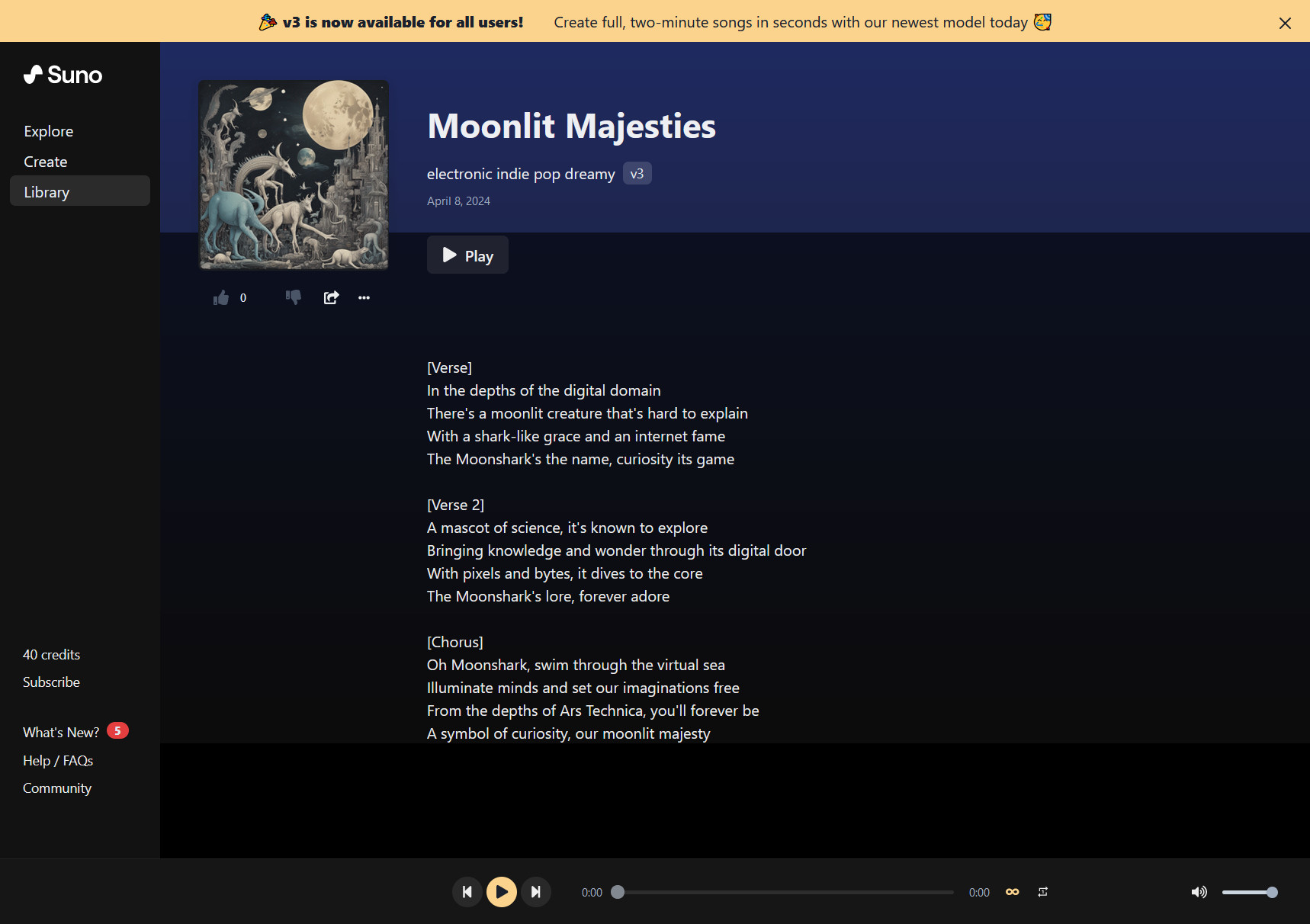
A screenshot of the Suno.ai website showing lyrics of an AI-generated "Moonshark" song.
Enlarge / A screenshot of the Suno.ai website showing lyrics of an AI-generated “Moonshark” song.
Benj Edwards

While using the service, Suno appears to have no trouble creating unique lyrics based on your prompt (unless you supply your own) and sets those words to stylized genres of music it generates based on its training dataset. It dynamically generates vocals as well, although they include audible aberrations. Suno’s output is not indistinguishable from high-fidelity human-created music yet, but given the pace of progress we’ve seen, that bridge could be crossed within the next year.

To get a sense of what Suno can do, we created an account on the site and prompted the AI engine to create songs about our mascot, Moonshark, and about barbarians with CRTs, two inside jokes at Ars. What’s interesting is that although the AI model aced the task of creating an original song for each topic, both songs start with the same line, “In the depths of the digital domain.” That’s possibly an artifact of whatever hidden prompt Suno is using to instruct ChatGPT when writing the lyrics.

Suno is arguably a fun toy to experiment with and doubtless a milestone in generative AI music tools. But it’s also an achievement tainted by the unresolved ethical issues related to scraping musical work without the artist’s permission. Then there’s the issue of potentially replacing human musicians, which has not been far from the minds of people sharing their own Suno results online. On Monday, AI influencer Ethan Mollick wrote, “I’ve had a song from Suno AI stuck in my head all day. Grim milestone or good one?”

https://arstechnica.com/?p=2015379


AI hardware company from Jony Ive, Sam Altman seeks $1 billion in funding

Jony Ive, the former Apple designer.

Former Apple design lead Jony Ive and current OpenAI CEO Sam Altman are seeking funding for a new company that will produce an “artificial intelligence-powered personal device,” according to The Information‘s sources, who are said to be familiar with the plans.

The exact nature of the device is unknown, but it will not look anything like a smartphone, according to the sources. We first heard tell of this venture in the fall of 2023, but The Information’s story reveals that talks are moving forward to get the company off the ground.

Ive and Altman hope to raise at least $1 billion for the new company. The complete list of potential funding sources they’ve spoken with is unknown, but The Information’s sources say they are in talks with frequent OpenAI investor Thrive Capital as well as Emerson Collective, a venture capital firm founded by Laurene Powell Jobs.

SoftBank CEO and super-investor Masayoshi Son is also said to have spoken with Altman and Ive about the venture. Financial Times previously reported that Son wanted Arm (another company he has backed) to be involved in the project.

Obviously, those are some of the well-established and famous names within today’s tech industry. Personal connections may play a role; for example, Jobs is said to have a friendship with both Ive and Altman. That might be critical because the pedigree involved could scare off smaller investors since the big names could drive up the initial cost of investment.

Although we don’t know anything about the device yet, it would likely put Ive in direct competition with his former employer, Apple. It has been reported elsewhere that Apple is working on bringing powerful new AI features to iOS 18 and later versions of the software for iPhones, iPads, and the company’s other devices.

Altman already has his hands in several other AI ventures besides OpenAI. The Information reports that there is no indication yet that OpenAI would be directly involved in the new hardware company.

https://arstechnica.com/?p=2015528


Publisher: OpenAI’s GPT Store bots are illegally scraping our textbooks

OpenAI logo

For the past few months, Morten Blichfeldt Andersen has spent many hours scouring OpenAI’s GPT Store. Since it launched in January, the marketplace for bespoke bots has filled up with a deep bench of useful and sometimes quirky AI tools. Cartoon generators spin up New Yorker–style illustrations and vivid anime stills. Programming and writing assistants offer shortcuts for crafting code and prose. There’s also a color analysis bot, a spider identifier, and a dating coach called RizzGPT. Yet Blichfeldt Andersen is hunting only for one very specific type of bot: Those built on his employer’s copyright-protected textbooks without permission.

Blichfeldt Andersen is publishing director at Praxis, a Danish textbook purveyor. The company has been embracing AI and created its own custom chatbots. But it is currently engaged in a game of whack-a-mole in the GPT Store, and Blichfeldt Andersen is the man holding the mallet.

“I’ve been personally searching for infringements and reporting them,” Blichfeldt Andersen says. “They just keep coming up.” He suspects the culprits are primarily young people uploading material from textbooks to create custom bots to share with classmates—and that he has uncovered only a tiny fraction of the infringing bots in the GPT Store. “Tip of the iceberg,” Blichfeldt Andersen says.

It is easy to find bots in the GPT Store whose descriptions suggest they might be tapping copyrighted content in some way, as Techcrunch noted in a recent article claiming OpenAI’s store was overrun with “spam.” Using copyrighted material without permission is permissible in some contexts but in others rightsholders can take legal action. WIRED found a GPT called Westeros Writer that claims to “write like George R.R. Martin,” the creator of Game of Thrones. Another, Voice of Atwood, claims to imitate the writer Margaret Atwood. Yet another, Write Like Stephen, is intended to emulate Stephen King.

When WIRED tried to trick the King bot into revealing the “system prompt” that tunes its responses, the output suggested it had access to King’s memoir On Writing. Write Like Stephen was able to reproduce passages from the book verbatim on demand, even noting which page the material came from. (WIRED could not make contact with the bot’s developer, because it did not provide an email address, phone number, or external social profile.)

OpenAI spokesperson Kayla Wood says it responds to takedown requests against GPTs made with copyrighted content but declined to answer WIRED’s questions about how frequently it fulfills such requests. She also says the company proactively looks for problem GPTs. “We use a combination of automated systems, human review, and user reports to find and assess GPTs that potentially violate our policies, including the use of content from third parties without necessary permission,” Wood says.

New disputes

The GPT store’s copyright problem could add to OpenAI’s existing legal headaches. The company is facing a number of high-profile lawsuits alleging copyright infringement, including one brought by The New York Times and several brought by different groups of fiction and nonfiction authors, including big names like George R.R. Martin.

Chatbots offered in OpenAI’s GPT Store are based on the same technology as its own ChatGPT but are created by outside developers for specific functions. To tailor their bot, a developer can upload extra information that it can tap to augment the knowledge baked into OpenAI’s technology. The process of consulting this additional information to respond to a person’s queries is called retrieval-augmented generation, or RAG. Blichfeldt Andersen is convinced that the RAG files behind the bots in the GPT Store are a hotbed of copyrighted materials uploaded without permission.

https://arstechnica.com/?p=2015113


Big del tech, al via un consorzio sull’impatto dell’AI nel mondo del lavoro

Un gruppo nutrito di Big Tech ha costituito l’AI-Enabled ICT Workforce Consortium, pensato per affrontare il tema dell’upskilling e del reskilling per tutti coloro che lavorano negli ambiti che saranno toccati direttamente dall’avvento dell’AI.

Cisco, Accenture, Eightfold, Google, IBM, Indeed, Intel, Microsoft e SAP sono le aziende dietro al progetto, che riceverà altresì i consigli dell’American Federation of Labor and Congress of Industrial Organizations, CHAIN5, Communications Workers of America, DIGITALEUROPE, la European Vocational Training Association, Khan Academy, and SMEUnited.

Come l’AI sta modificando i lavori

Tutte queste organizzazioni hanno unito le forze per valutare insieme come l’AI sta modificando i lavori e le conoscenze tecniche di chi lavora e i loro bisogni per avere successo.  

Si tratta in sostanza di una grande operazione di brainstorming, per capire in che modo l’AI inciderà sul mondo della produzione e del business.

Il Consorzio per la forza lavoro ICT abilitata all’intelligenza artificiale affronterà la “crescente esigenza di una forza lavoro competente e formata in vari aspetti dell’intelligenza artificiale” e la prima fase culminerà in un rapporto con “intuizioni utilizzabili per leader aziendali e lavoratori” che cercano modi per riqualificare e migliorare le competenze dei lavoratori in preparazione ad “ambienti abilitati all’intelligenza artificiale”.

Il ruolo del Consorzio

il Consorzio valuterà l’impatto dell’intelligenza artificiale su 56 ruoli lavorativi ICT e fornirà raccomandazioni sulla formazione. Si concentrerà su ruoli lavorativi che includono l’80% dei 45 principali titoli professionali ICT che hanno raccolto il maggior volume di offerte di lavoro per il periodo febbraio 2023-2024 negli Stati Uniti e in cinque dei più grandi paesi europei (vale a dire Francia, Germania, Italia, Spagna e Paesi Bassi) in base al numero della forza lavoro ICT secondo Indeed Hiring Lab.

“I membri del consorzio riconoscono universalmente l’urgenza e l’importanza dei loro sforzi congiunti con l’accelerazione dell’intelligenza artificiale in tutti gli aspetti del business e la necessità di costruire una forza lavoro inclusiva con opportunità di sostegno alla famiglia”, si legge nel comunicato. “Opportunità di sostegno familiare” presumibilmente significa posti di lavoro.

Il comunicato sottolinea che i membri del consorzio rappresentano uno spaccato di aziende “che innovano all’avanguardia nel campo dell’intelligenza artificiale e che comprendono anche l’impatto attuale e imminente dell’intelligenza artificiale sulla forza lavoro”. gran parte delle recenti azioni nel campo dell’intelligenza artificiale generativa.

https://www.key4biz.it/big-del-tech-al-via-un-consorzio-sullimpatto-dellai-nel-mondo-del-lavoro/485724/


After AI-generated porn report, Washington Lottery pulls down interactive web app

A user of the Washington Lottery's "Test Drive a Win" website says it used AI to generate (the unredacted version of) this image with her face on a topless body.
Enlarge / A user of the Washington Lottery’s “Test Drive a Win” website says it used AI to generate (the unredacted version of) this image with her face on a topless body.

The Washington State Lottery has taken down a promotional AI-powered web app after a local mother reported that the site generated an image with her face on the body of a topless woman.

The lottery’s “Test Drive a Win” website was designed to help visitors visualize various dream vacations they could pay for with their theoretical lottery winnings. The site included the ability to upload a headshot that would be integrated into an AI-generated tableau of what you might look like on that vacation.

But Megan (last name not given), a 50-year-old from Olympia suburb Tumwater, told conservative Seattle radio host Jason Rantz that the image of her “swim with the sharks” dream vacation on the website showed her face atop a woman sitting on a bed with her breasts exposed. The background of the AI-generated image seems to show the bed in some sort of aquarium, complete with fish floating through the air and sprawling undersea flora sitting awkwardly behind the pillows.

The corner of the image features the Washington Lottery logo.

“Our tax dollars are paying for that! I was completely shocked. It’s disturbing to say the least,” Megan told Rantz. “I also think whoever was responsible for it should be fired.”

“We don’t want something like this purported event to happen again”

The non-functional "Test Drive a Win" website as it appeared Thursday.
Enlarge / The non-functional “Test Drive a Win” website as it appeared Thursday.

In a statement provided to Ars Technica, a Washington Lottery spokesperson said that the lottery “worked closely with the developers of the AI platform to establish strict parameters to govern image creation.” Despite this, the spokesperson said they were notified earlier this week that “a single user of the AI platform was purportedly provided an image that did not adhere to those guidelines.”

Despite what the spokesperson said were “thousands” of inoffensive images that the site generated in over a month, the spokesperson said that “one purported user is too many and as a result we have shut down the site” as of Tuesday.

The spokesperson did not respond to specific questions about which AI models or third-party vendors may have been used to create the site or on the specific safeguards that were crafted in an attempt to prevent results like the one reported by Megan.

Speaking to Rantz, a lottery spokesperson said the organization had “agreed to a comprehensive set of rules” for the site’s AI images, “including that people in images be fully clothed.” Following the report of the topless image, the spokesperson said they “had the developers check all the parameters for the platform.” And while they were “comfortable with the settings,” the spokesperson told Rantz they “chose to take down the site out of an abundance of caution, as we don’t want something like this purported event to happen again.”

Not a quick fix?

On his radio show, Rantz expressed surprise that the lottery couldn’t keep the site operational after rejiggering the AI’s safety settings. “In my head I was thinking, well, presumably once they heard about this they went back to the backend guidelines and just made sure it said, ‘Hey, no breasts, no full-frontal nudity,’ those kinds of things, and then they fixed it, and then they went on with their day,” Rantz said.

But it might not be that simple to effectively rein in the endless variety of visual output an AI model can generate. While models like Stable Diffusion and DALL-E have filters in place to prevent the generation of sexual or violent images, researchers have found that those models still responded to problematic prompts by generating images that were judged as “unsafe” by an image classifier a significant minority of the time. Malicious users can also use prompt-engineering tricks to get around these built-in safeguards when using popular text-based image-generation models.

We’ve seen these kinds of AI image-safety issues blow back on major corporations, too, as when Facebook’s AI sticker generator put weapons in the hands of children’s cartoon characters. More recently, a Microsoft engineer publicly accused the company’s Copilot image-generation tool of randomly creating violent and sexual imagery even after the team was warned of the issue.
The Washington Lottery’s AI issue comes a week after a report found a New York City government chatbot confabulating incorrect advice about city laws and regulations. “It’s wrong in some areas and we gotta fix it,” New York City Mayor Eric Adams said this week. “Any time you use technology, you need to put it in the real environment to iron out the kinks. You can’t live in a lab. You can’t stay in a lab forever.” https://arstechnica.com/?p=2015007


Fake AI law firms are sending fake DMCA threats to generate fake SEO gains

Face composed of many pixellated squares, joining together
Enlarge / A person made of many parts, similar to the attorney who handles both severe criminal law and copyright takedowns for an Arizona law firm.
Getty Images

If you run a personal or hobby website, getting a copyright notice from a law firm about an image on your site can trigger some fast-acting panic. As someone who has paid to settle a news service-licensing issue before, I can empathize with anybody who wants to make this kind of thing go away.

Which is why a new kind of angle-on-an-angle scheme can seem both obvious to spot and likely effective. Ernie Smith, the prolific, ever-curious writer behind the newsletter Tedium, received a “DMCA Copyright Infringement Notice” in late March from “Commonwealth Legal,” representing the “Intellectual Property division” of Tech4Gods.

The issue was with a photo of a keyfob from legitimate photo service Unsplash used in service of a post about a strange Uber ride Smith once took. As Smith detailed in a Mastodon thread, the purported firm needed him to “add a credit to our client immediately” through a link to Tech4Gods, and said it should be “addressed in the next five business days.” Removing the image “does not conclude the matter,” and should Smith not have taken action, the putative firm would have to “activate” its case, relying on DMCA 512(c) (which, in many readings, actually does grant relief should a website owner, unaware of infringing material, “act expeditiously to remove” said material). The email unhelpfully points to the main page of the Internet Archive so that Smith might review “past usage records.”

A slice of the website for Commonwealth Legal Services, with every word of that phrase, including "for," called into question.
A slice of the website for Commonwealth Legal Services, with every word of that phrase, including “for,” called into question.
Commonwealth Legal Services

There are quite a few issues with Commonwealth Legal’s request, as detailed by Smith and 404 Media. Chief among them is that Commonwealth Legal, a firm theoretically based in Arizona (which is not a commonwealth), almost certainly does not exist. Despite the 2018 copyright displayed on the site, the firm’s website domain was seemingly registered on March 1, 2024, with a Canadian IP location. The address on the firm’s site leads to a location that, to say the least, does not match the “fourth floor” indicated on the website.

While the law firm’s website is stuffed full of stock images, so are many websites for professional services. The real tell is the site’s list of attorneys, most of which, as 404 Media puts it, have “vacant, thousand-yard stares” common to AI-generated faces. AI detection firm Reality Defender told 404 Media that his service spotted AI generation in every attorneys’ image, “most likely by a Generative Adversarial Network (GAN) model.”

Then there are the attorneys’ bios, which offer surface-level competence underpinned by bizarre setups. Five of the 12 supposedly come from acclaimed law schools at Harvard, Yale, Stanford, and University of Chicago. The other seven seem to have graduated from the top five results you might get for “Arizona Law School.” Sarah Walker has a practice based on “Copyright Violation and Judicial Criminal Proceedings,” a quite uncommon pairing. Sometimes she is “upholding the rights of artists,” but she can also “handle high-stakes criminal cases.” Walker, it seems, couldn’t pick just one track at Yale Law School.

Why would someone go to the trouble of making a law firm out of NameCheap, stock art, and AI images (and seemingly copy) to send quasi-legal demands to site owners? Backlinks, that’s why. Backlinks are links from a site that Google (or others, but almost always Google) holds in high esteem to a site trying to rank up. Whether spammed, traded, generated, or demanded through a fake firm, backlinks power the search engine optimization (SEO) gray, to very dark gray, market. For all their touted algorithmic (and now AI) prowess, search engines have always had a hard time gauging backlink quality and context, so some site owners still buy backlinks.

The owner of Tech4Gods told 404 Media’s Jason Koebler that he did buy backlinks for his gadget review site (with “AI writing assistants”). He disclaimed owning the disputed image or any images and made vague suggestions that a disgruntled former contractor may be trying to poison his ranking with spam links.

Asked by Ars if he had heard back from “Commonwealth Legal” now that five business days were up, Ernie Smith tells Ars: “No, alas.”

This post was updated at 4:50 p.m. Eastern to include Ernie Smith’s response.

https://arstechnica.com/?p=2014933


Google might make users pay for AI features in search results

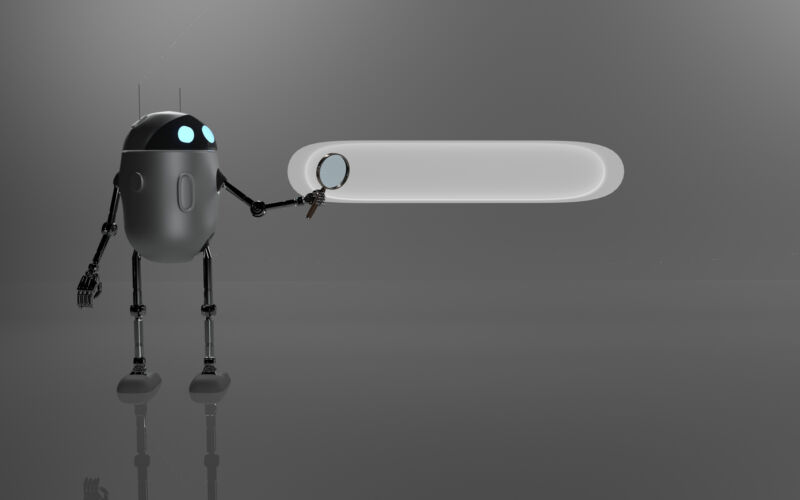
You think this cute little search robot is going to work for free?
Enlarge / You think this cute little search robot is going to work for free?

Google might start charging for access to search results that use generative artificial intelligence tools. That’s according to a new Financial Times report citing “three people with knowledge of [Google’s] plans.”

Charging for any part of the search engine at the core of its business would be a first for Google, which has funded its search product solely with ads since 2000. But it’s far from the first time Google would charge for AI enhancements in general; the “AI Premium” tier of a Google One subscription costs $10 more per month than a standard “Premium” plan, for instance, while “Gemini Business” adds $20 a month to a standard Google Workspace subscription.

While those paid products offer access to Google’s high-end “Gemini Advanced” AI model, Google also offers free access to its less performant, plain “Gemini” model without any kind of paid subscription.

When ads aren’t enough?

Under the proposed plan, Google’s standard search (without AI) would remain free, and subscribers to a paid AI search tier would still see ads alongside their Gemini-powered search results, according to the FT report. But search ads—which brought in a reported $175 billion for Google last year—might not be enough to fully cover the increased costs involved with AI-powered search. A Reuters report from last year suggested that running a search query through an advanced neural network like Gemini “likely costs 10 times more than a standard keyword search,” potentially representing “several billion dollars of extra costs” across Google’s network.

Cost aside, it remains to be seen if there’s a critical mass of market demand for this kind of AI-enhanced search. Microsoft’s massive investment in generative AI features for its Bing search engine has failed to make much of a dent in Google’s market share over the last year or so. And there has reportedly been limited uptake for Google’s experimental opt-in “Search Generative Experience” (SGE), which adds chatbot responses above the usual set of links in response to a search query.

“SGE never feels like a useful addition to Google Search,” Ars’ Ron Amadeo wrote last month. “Google Search is a tool, and just as a screwdriver is not a hammer, I don’t want a chatbot in a search engine.”

Regardless, the current tech industry mania surrounding anything and everything related to generative AI may make Google feel it has to integrate the technology into some sort of “premium” search product sooner rather than later. For now, FT reports that Google hasn’t made a final decision on whether to implement the paid AI search plan, even as Google engineers work on the backend technology necessary to launch such a service

Google also faces AI-related difficulties on the other side of the search divide. Last month, the company announced it was redoubling its efforts to limit the appearance of “spammy, low-quality content”—much of it generated by AI chatbots—in its search results.

In February, Google shut down the image generation features of its Gemini AI model after the service was found inserting historically inaccurate examples of racial diversity into some of its prompt responses.

https://arstechnica.com/?p=2014756


Copilot key is based on a button you probably haven’t seen since IBM’s Model M

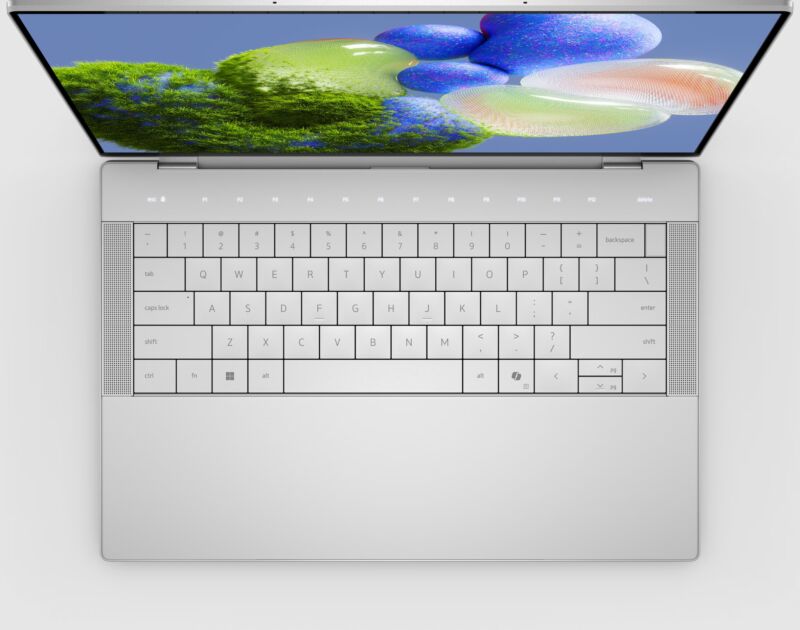
A Dell XPS 14 laptop with a Copilot key.
Enlarge / A Dell XPS 14 laptop. The Copilot key is to the right of the right-Alt button.

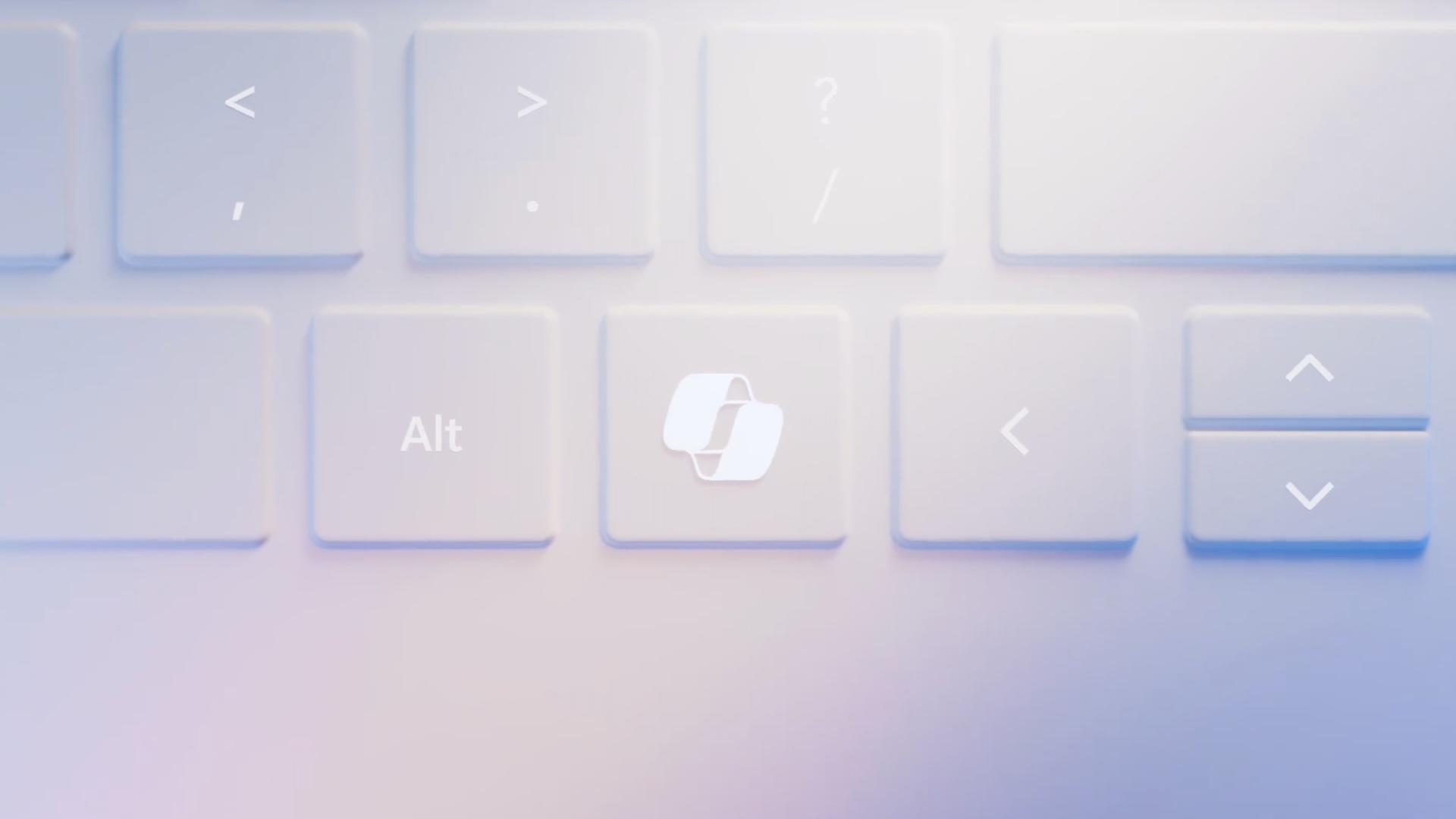
In January, Microsoft introduced a new key to Windows PC keyboards for the first time in 30 years. The Copilot key, dedicated to launching Microsoft’s eponymous generative AI assistant, is already on some Windows laptops released this year. On Monday, Tom’s Hardware dug into the new addition and determined exactly what pressing the button does, which is actually pretty simple. Pushing a computer’s integrated Copilot button is like pressing left-Shift + Windows key + F23 simultaneously.

Tom’s Hardware confirmed this after wondering if the Copilot key introduced a new scan code to Windows or if it worked differently. Using the scripting program AuthoHotkey with a new laptop with a Copilot button, Tom’s Hardware discovered the keystrokes registered when a user presses the Copilot key. The publication confirmed with Dell that “this key assignment is standard for the Copilot key and done at Microsoft’s direction.”

F23

Surprising to see in that string of keys is F23. Having a computer keyboard with a function row or rows that take you from F1 all the way to F23 is quite rare today. When I try to imagine a keyboard that comes with an F23 button, vintage keyboards come to mind, more specifically buckling spring keyboards from IBM.

IBM’s Model F, which debuted in 1981 and used buckling spring switches over a capacitive PCB, and the Model M, which launched in 1985 and used buckling spring switches over a membrane sheet, both offered layouts with 122 keys. These layouts included not one, but two rows of function keys that would leave today’s 60 percent keyboard fans sweating over the wasted space.

But having 122 keys was helpful for keyboards tied to IBM business terminals. The keyboard layout even included a bank of keys to the left of the primary alpha block of keys for even more forms of input.

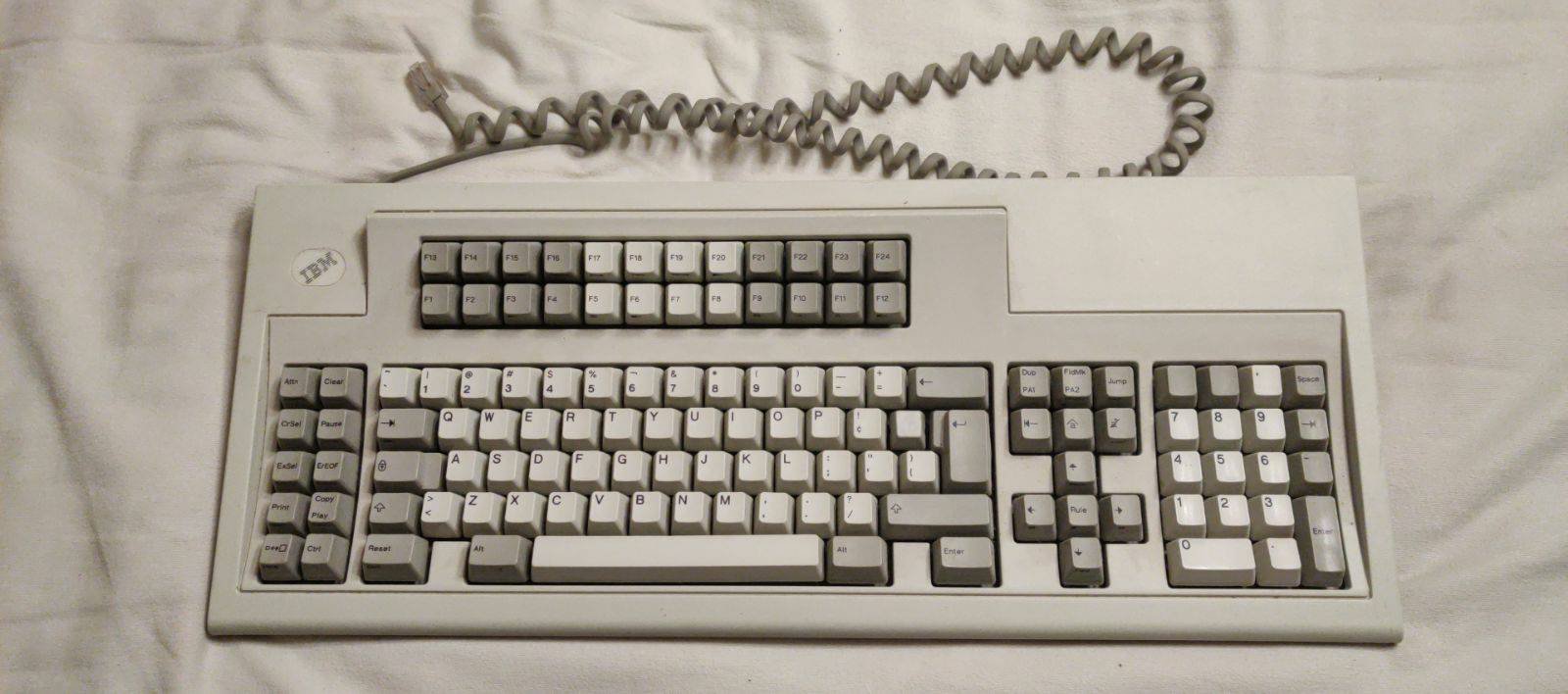
An IBM Model M keyboard with an F23 key.
Enlarge / An IBM Model M keyboard with an F23 key.

The 122-key keyboard layout with F23 lives on. Beyond people who still swear by old Model F and M keyboards, Model F Labs and Unicomp both currently sell modern buckling spring keyboards with built-in F23 buttons. Another reason a modern Windows PC user might have access to an F23 key is if they use a macro pad.

But even with those uses in mind, the F23 key remains rare. That helps explain why Microsoft would use the key for launching Copilot; users are unlikely to have F23 programmed for other functions. This was also likely less work than making a key with an entirely new scan code.

The Copilot button is reprogrammable

When I previewed Dell’s 2024 XPS laptops, a Dell representative told me that the integrated Copilot key wasn’t reprogrammable. However, in addition to providing some interesting information about the newest PC key since the Windows button, Tom’s Hardware’s revelation shows why the Copilot key is actually reprogrammable, even if OEMs don’t give users a way to do so out of the box. (If you need help, check out the website’s tutorial for reprogramming the Windows Copilot key.)

I suspect there’s a strong interest in reprogramming that button. For one, generative AI, despite all its hype and potential, is still an emerging technology. Many don’t need or want access to any chatbot—let alone Microsoft’s—instantly or even at all. Those who don’t use their system with a Microsoft account have no use for the button, since being logged in to a Microsoft account is required for the button to launch Copilot.

A rendering of the Copilot button.
Enlarge / A rendering of the Copilot button.

Additionally, there are other easy ways to launch Copilot on a computer that has the program downloaded, like double-clicking an icon or pressing Windows + C, that make a dedicated button unnecessary. (Ars Technica asked Microsoft why the Copilot key doesn’t just register Windows + C, but the company declined to comment. Windows + C has launched other apps in the past, including Cortana, so it’s possible that Microsoft wanted to avoid the Copilot key performing a different function when pressed on computers that use Windows images without Copilot.)

In general, shoehorning the Copilot key into Windows laptops seems premature. Copilot is young and still a preview; just a few months ago, it was called Bing Chat. Further, the future of generative AI, including its popularity and top uses, is still forming and could evolve substantially during the lifetime of a Windows laptop. Microsoft’s generative AI efforts could also flounder over the years. Imagine if Microsoft went all-in on Bing back in the day and made all Windows keyboards have a Bing button, for example. Just because Microsoft wants something to become mainstream doesn’t mean that it will.

This all has made the Copilot button seem more like a way to force the adoption of Microsoft’s chatbot than a way to improve Windows keyboards. Microsoft has also made the Copilot button a requirement for its AI PC certification (which also requires an integrated neural processing unit and having Copilot pre-installed). Microsoft plans to make Copilot keys a requirement for Windows 11 OEM PCs eventually, it told Ars Technica in January.

At least for now, the basic way that the Copilot button works means you can turn the key into something more useful. Now, the tricky part would be finding a replacement keycap to eradicate Copilot’s influence from your keyboard.

Listing image by Microsoft

https://arstechnica.com/?p=2014584