OpenAI holds back wide release of voice-cloning tech due to misuse concerns

AI speaks letters, text-to-speech or TTS, text-to-voice, speech synthesis applications, generative Artificial Intelligence, futuristic technology in language and communication.

Voice synthesis has come a long way since 1978’s Speak & Spell toy, which once wowed people with its state-of-the-art ability to read words aloud using an electronic voice. Now, using deep-learning AI models, software can create not only realistic-sounding voices, but also convincingly imitate existing voices using small samples of audio.

Along those lines, OpenAI just announced Voice Engine, a text-to-speech AI model for creating synthetic voices based on a 15-second segment of recorded audio. It has provided audio samples of the Voice Engine in action on its website.

Once a voice is cloned, a user can input text into the Voice Engine and get an AI-generated voice result. But OpenAI is not ready to widely release its technology yet. The company initially planned to launch a pilot program for developers to sign up for the Voice Engine API earlier this month. But after more consideration about ethical implications, the company decided to scale back its ambitions for now.

“In line with our approach to AI safety and our voluntary commitments, we are choosing to preview but not widely release this technology at this time,” the company writes. “We hope this preview of Voice Engine both underscores its potential and also motivates the need to bolster societal resilience against the challenges brought by ever more convincing generative models.”

Voice cloning tech in general is not particularly new—we’ve covered several AI voice synthesis models since 2022, and the tech is active in the open source community with packages like OpenVoice and XTTSv2. But the idea that OpenAI is inching toward letting anyone use their particular brand of voice tech is notable. And in some ways, the company’s reticence to release it fully might be the bigger story.

OpenAI says that benefits of its voice technology include providing reading assistance through natural-sounding voices, enabling global reach for creators by translating content while preserving native accents, supporting non-verbal individuals with personalized speech options, and assisting patients in recovering their own voice after speech-impairing conditions.

But it also means that anyone with 15 seconds of someone’s recorded voice could effectively clone it, and that has obvious implications for potential misuse. Even if OpenAI never widely releases its Voice Engine, the ability to clone voices has already caused trouble in society through phone scams where someone imitates a loved one’s voice and election campaign robocalls featuring cloned voices from politicians like Joe Biden.

Also, researchers and reporters have shown that voice-cloning technology can be used to break into bank accounts that use voice authentication (such as Chase’s Voice ID), which prompted Sen. Sherrod Brown (D-Ohio), the chairman of the US Senate Committee on Banking, Housing, and Urban Affairs, to send a letter to the CEOs of several major banks in May 2023 to inquire about the security measures banks are taking to counteract AI-powered risks.

https://arstechnica.com/?p=2008632


OpenAI shows off Sora AI video generator to Hollywood execs

a robotic intelligence works as a cameraman (3d rendering)

OpenAI has launched a charm offensive in Hollywood, holding meetings with major studios including Paramount, Universal, and Warner Bros Discovery to showcase its video generation technology Sora and allay fears the artificial intelligence model will harm the movie industry.

Chief Executive Sam Altman and Chief Operating Officer Brad Lightcap gave presentations to executives from the film industry giants, said multiple people with knowledge of the meetings, which took place in recent days.

Altman and Lightcap showed off Sora, a new generative AI model that can create detailed videos from simple written prompts.

The technology first gained Hollywood’s attention after OpenAI published a selection of videos produced by the model last month. The clips quickly went viral online and have led to debate over the model’s potential impact on the creative industries.

“Sora is causing enormous excitement,” said media analyst Claire Enders. “There is a sense it is going to revolutionize the making of movies and bring down the cost of production and reduce the demand for [computer-generated imagery] very strongly.”

AI-generated video of a cat and human, generated via video generation model Sora.

Those involved in the meetings said OpenAI was seeking input from the film bosses on how Sora should be rolled out. Some who watched the demonstrations said they could see how Sora or similar AI products could save time and money on production but added the technology needed further development.

OpenAI’s overtures to the studios come at a delicate moment in Hollywood. Last year’s monthslong strikes ended with the Writers Guild of America and the Screen Actors Guild securing groundbreaking protections from AI in their contracts. This year, contract negotiations are underway with the International Alliance of Theatrical Stage Employees—and AI is again expected to be a hot-button issue.

Earlier this week, OpenAI released new Sora videos generated by a number of visual artists and directors, including short films, as well as their impressions of the technology. The model will aim to compete with several available text-to-video services from start-ups, including Runway, Pika, and Stability AI. These other services already offer commercial uses for content.

An AI-generated video from Sora of a dog.

However, Sora has not been widely released. OpenAI has held off announcing a launch date or the circumstances under which it will be available. One person with knowledge of its strategy said the company was deciding how to commercialize the technology. Another person said there were safety steps still to take before the company considered putting Sora into a product.

OpenAI is also working to improve the system. Currently, Sora can only make videos under one minute in length, and its creations have limitations, such as glass bouncing off the floor instead of shattering or adding extra limbs to people and animals.

Some studios appeared open to using Sora in filmmaking or TV production in future, but licensing and partnerships have not yet been discussed, said people involved in the talks.

“There have been no meetings with OpenAI about partnerships,” one studio executive said. “They’ve done demos, just like Apple has been demo-ing the Vision Pro [mixed-reality headset]. They’re trying to get people excited.”

OpenAI has been previewing the model in a “very controlled manner” to “industries that are likely to be impacted first,” said one person close to OpenAI.

Media analyst Enders said the reception from the movie industry had been broadly optimistic on Sora as it is “seen completely as a cost-saving element, rather than impacting the creative ethos of storytelling.”

OpenAI declined to comment.

An AI-generated video from Sora of a woman walking down a Tokyo street.

© 2024 The Financial Times Ltd. All rights reserved Not to be redistributed, copied, or modified in any way.

https://arstechnica.com/?p=2013416


Amazon investe altri 2,75 miliardi di dollari nell’AI di Anthropic

Amazon ha investito 2,75 miliardi di dollari nella start up di Intelligenza Artificiale Anthropic, rafforzando così il suo legame con l’azienda in un momento in cui tutti i big della tecnologia sono in corsa per il predominio dell’AI.

Quello in Anthropic è il maggior investimento in venture capitale realizzato da Amazon che nel complesso ha portato a 4 miliardi di dollari il suo impegno per lo sviluppo della startup.

Diversi investimenti in AI delle Big Tech

Si tratta di uno dei numerosi investimenti dei big del tech Google, Amazon, Microsoft nello sviluppo dell’Intelligenza Artificiale generativa, un nuovo fiorente mercato che attira gli appetiti più svariati.

In un primo round, Amazon aveva versato 1,25 miliardi di dollari in Anthropic lo scorso mese di settembre, riservandosi la possibilità di arrivare a 4 miliardi entro fine marzo. E così alla fine ha fatto. Amazon non è certo l’unico investitore di Anthropic, che sta raccogliendo centinaia di milioni di nuovi fondi in venture capital.

Nel compelsso, gli accordi potrebbero fornire ad Anthropic miliardi di dollari in capitale e crediti per utilizzare servizi informatici e cloud per una valutazione secondo stime di oltre 18 miliardi di dollari.

Amazon sta aumentando il suo peso in Anthropic nonostante il controllo delle autorità di regolamentazione di Ua, Regno Ue siano aumentati a causa del timore che gli accordi tra grandi gruppi tecnologici e importanti startup di intelligenza artificiale potrebbero comportare rischi anticoncorrenziali.

Microsoft ha preso subito un comando nello spazio dell’intelligenza artificiale generativa, impegnando 13 miliardi di dollari in OpenAI, il cui chatbot ChatGPT ha scatenato una frenesia di entusiasmo tra gli investitori.

Da allora, Microsoft ha anche investito in Mistral, l’unicorno francese di intelligenza artificiale, e la scorsa settimana ha siglato un accordo da 650 milioni di dollari per assumere il gruppo dirigente e i ricercatori della società di intelligenza artificiale Inflection.

AWS fornitore cloud di Anthropic

Amazon, dal canto suo, ha ribadito mercoledì che sarà il “fornitore cloud principale” di Anthropic per i carichi di lavoro chiave, che verranno eseguiti su Amazon Web Services (AWS). Anthropic utilizzerà anche chip di intelligenza artificiale sviluppati internamente da Amazon e sta lavorando con il fornitore di servizi cloud per sviluppare e migliorare l’hardware, che mira a competere con i chip più apprezzati di Nvidia.

Tuttavia, l’accordo non lega Anthropic esclusivamente al cloud di Amazon, come diversamente fa la partnership di OpenAI con Microsoft, e la startup continuerà a utilizzare anche il cloud di Google. Google ha accettato di investire fino a 2 miliardi di dollari in Anthropic.

Anthropic è stata fondata nel 2021 da un gruppo di ricercatori che hanno lasciato OpenAI. L’azienda con sede a San Francisco è ampiamente considerata la contendente più probabile per il dominio iniziale di OpenAI nel settore. Il suo ultimo modello, Claude 3, supera il GPT4 di OpenAI in diversi parametri di riferimento del settore.

https://www.key4biz.it/amazon-investe-275-miliardi-di-dollari-nellai-di-anthropic/484888/


Thousands of servers hacked in ongoing attack targeting Ray AI framework

Thousands of servers hacked in ongoing attack targeting Ray AI framework
Getty Images

Thousands of servers storing AI workloads and network credentials have been hacked in an ongoing attack campaign targeting a reported vulnerability in Ray, a computing framework used by OpenAI, Uber, and Amazon.

The attacks, which have been active for at least seven months, have led to the tampering of AI models. They have also resulted in the compromise of network credentials, allowing access to internal networks and databases and tokens for accessing accounts on platforms including OpenAI, Hugging Face, Stripe, and Azure. Besides corrupting models and stealing credentials, attackers behind the campaign have installed cryptocurrency miners on compromised infrastructure, which typically provides massive amounts of computing power. Attackers have also installed reverse shells, which are text-based interfaces for remotely controlling servers.

Hitting the jackpot

“When attackers get their hands on a Ray production cluster, it is a jackpot,” researchers from Oligo, the security firm that spotted the attacks, wrote in a post. “Valuable company data plus remote code execution makes it easy to monetize attacks—all while remaining in the shadows, totally undetected (and, with static security tools, undetectable).”

Among the compromised sensitive information are AI production workloads, which allow the attackers to control or tamper with models during the training phase and, from there, corrupt the models’ integrity. Vulnerable clusters expose a central dashboard to the Internet, a configuration that allows anyone who looks for it to see a history of all commands entered to date. This history allows an intruder to quickly learn how a model works and what sensitive data it has access to.

Oligo captured screenshots that exposed sensitive private data and displayed histories indicating the clusters had been actively hacked. Compromised resources included cryptographic password hashes and credentials to internal databases and to accounts on OpenAI, Stripe, and Slack.

Ray is an open source framework for scaling AI apps, meaning allowing huge numbers of them to run at once in an efficient manner. Typically, these apps run on huge clusters of servers. Key to making all of this work is a central dashboard that provides an interface for displaying and controlling running tasks and apps. One of the programming interfaces available through the dashboard, known as the Jobs API, allows users to send a list of commands to the cluster. The commands are issued using a simple HTTP request requiring no authentication.

Last year, researchers from security firm Bishop Fox flagged the behavior as a high-severity code-execution vulnerability tracked as CVE-2023-48022.

A distributed execution framework

“In the default configuration, Ray does not enforce authentication,” wrote Berenice Flores Garcia, a senior security consultant at Bishop Fox. “As a result, attackers may freely submit jobs, delete existing jobs, retrieve sensitive information, and exploit the other vulnerabilities described in this advisory.”

Anyscale, the developer and maintainer of Ray, responded by disputing the vulnerability. Anyscale officials said they have always held out Ray as framework for remotely executing code and as a result, have long advised it should be properly segmented inside a properly secured network.

“Due to Ray’s nature as a distributed execution framework, Ray’s security boundary is outside of the Ray cluster,” Anyscale officials wrote. “That is why we emphasize that you must prevent access to your Ray cluster from untrusted machines (e.g., the public Internet).”

The Anyscale response said the reported behavior in the jobs API wasn’t a vulnerability and wouldn’t be addressed in a near-term update. The company went on to say it would eventually introduce a change that would enforce authentication in the API. It explained:

We have considered very seriously whether or not something like that would be a good idea, and to date have not implemented it for fear that our users would put too much trust into a mechanism that might end up providing the facade of security without properly securing their clusters in the way they imagined.

That said, we recognize that reasonable minds can differ on this issue, and consequently have decided that, while we still do not believe that an organization should rely on isolation controls within Ray like authentication, there can be value in certain contexts in furtherance of a defense-in-depth strategy, and so we will implement this as a new feature in a future release.

Critics of the Anyscale response have noted that repositories for streamlining the deployment of Ray in cloud environments bind the dashboard to 0.0.0.0, an address used to designate all network interfaces and to designate port forwarding on the same address. One such beginner boilerplate is available on the Anyscale website itself. Another example of a publicly available vulnerable setup is here.

Critics also note Anyscale’s contention that the reported behavior isn’t a vulnerability has prevented many security tools from flagging attacks.

An Anyscale representative said in an email the company plans to publish a script that will allow users to easily verify whether their Ray instances are exposed to the Internet or not.

The ongoing attacks underscore the importance of properly configuring Ray. In the links provided above, Oligo and Anyscale list practices that are essential to locking down clusters. Oligo also provided a list of indicators Ray users can use to determine if their instances have been compromised.

https://arstechnica.com/?p=2013046


Intel, Microsoft discuss plans to run Copilot locally on PCs instead of in the cloud

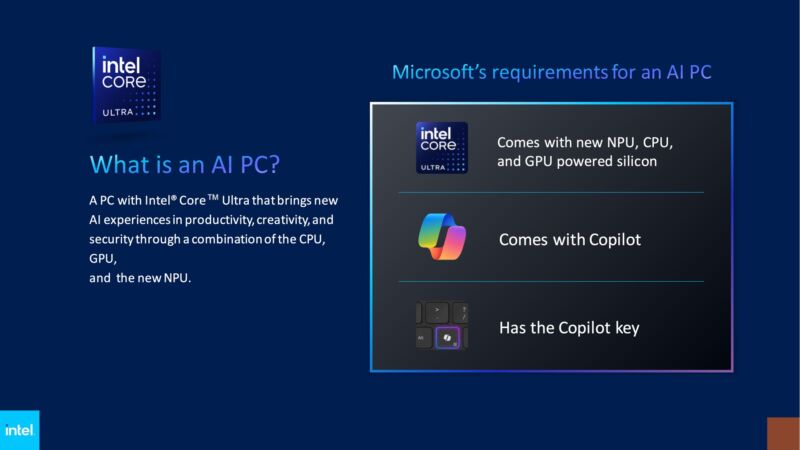
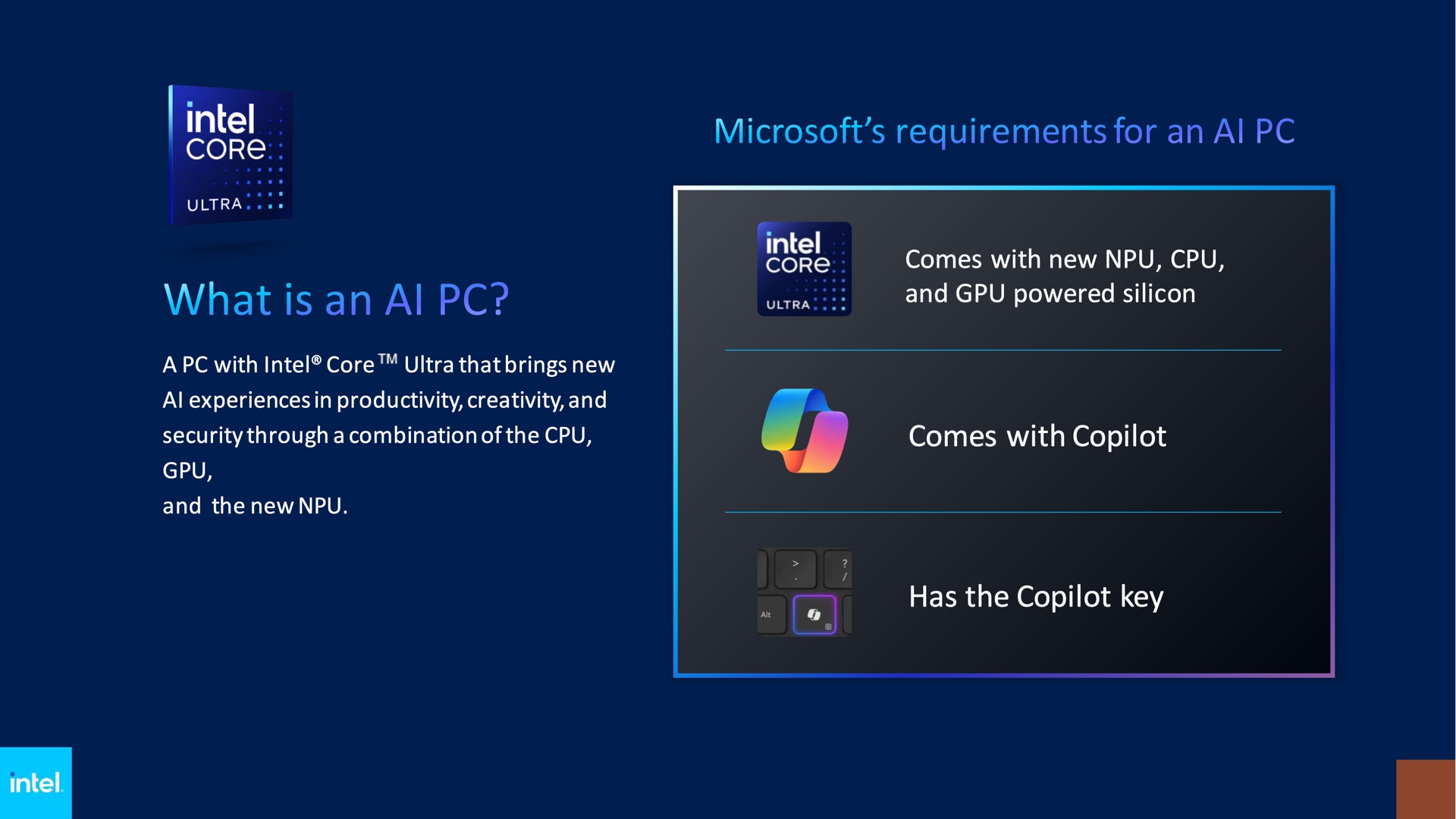
The basic requirements for an AI PC, at least when it's running Windows.
Enlarge / The basic requirements for an AI PC, at least when it’s running Windows.

Microsoft said in January that 2024 would be the year of the “AI PC,” and we know that AI PCs will include a few hardware components that most Windows systems currently do not include—namely, a built-in neural processing unit (NPU) and Microsoft’s new Copilot key for keyboards. But so far we haven’t heard a whole lot about what a so-called AI PC will actually do for users.

Microsoft and Intel are starting to talk about a few details as part of an announcement from Intel about a new AI PC developer program that will encourage software developers to leverage local hardware to build AI features into their apps.

The main news comes from Tom’s Hardware, confirming that AI PCs would be able to run “more elements of Copilot,” Microsoft’s AI chatbot assistant, “locally on the client.” Currently, Copilot relies on server-side processing even for small requests, introducing lag that is tolerable if you’re making a broad request for information but less so if all you want to do is change a setting or get basic answers. Running generative AI models locally could also improve user privacy, making it possible to take advantage of AI-infused software without automatically sending information to a company that will use it for further model training.

Right now, Windows doesn’t use local NPUs for much, since most current PCs don’t have them. The Surface Studio webcam features can use NPUs for power-efficient video effects and background replacement, but as of this writing that’s pretty much it. Apple’s and Google’s operating systems both use NPUs for a wider swatch of image and audio processing features, including facial recognition and object recognition, OCR, live transcription and translation, and more.

Intel also said that Microsoft would require NPUs in “next-gen AI PCs” to hit speeds of 40 trillion operations per second (TOPS) to meet its requirements. Intel, AMD, Qualcomm, and others sometimes use TOPS as a high-level performance metric when comparing their NPUs; Intel’s Meteor Lake laptop chips can run 10 TOPS, while AMD’s Ryzen 7040 and 8040 laptop chips hit 10 TOPS and 16 TOPS, respectively.

Unfortunately for Intel, the first company to put out an NPU suitable for powering Copilot locally may come from Qualcomm. The company’s upcoming Snapdragon X processors, long seen as the Windows ecosystem’s answer to Apple’s M-series Mac chips, promise up to 45 TOPS. Rumors suggest that Microsoft will shift the consumer version of its Surface tablet to Qualcomm’s chips after a few years of offering both Intel and Qualcomm options; Microsoft announced a Surface Pro update with Intel’s Meteor Lake chips last week but is only selling it to businesses.

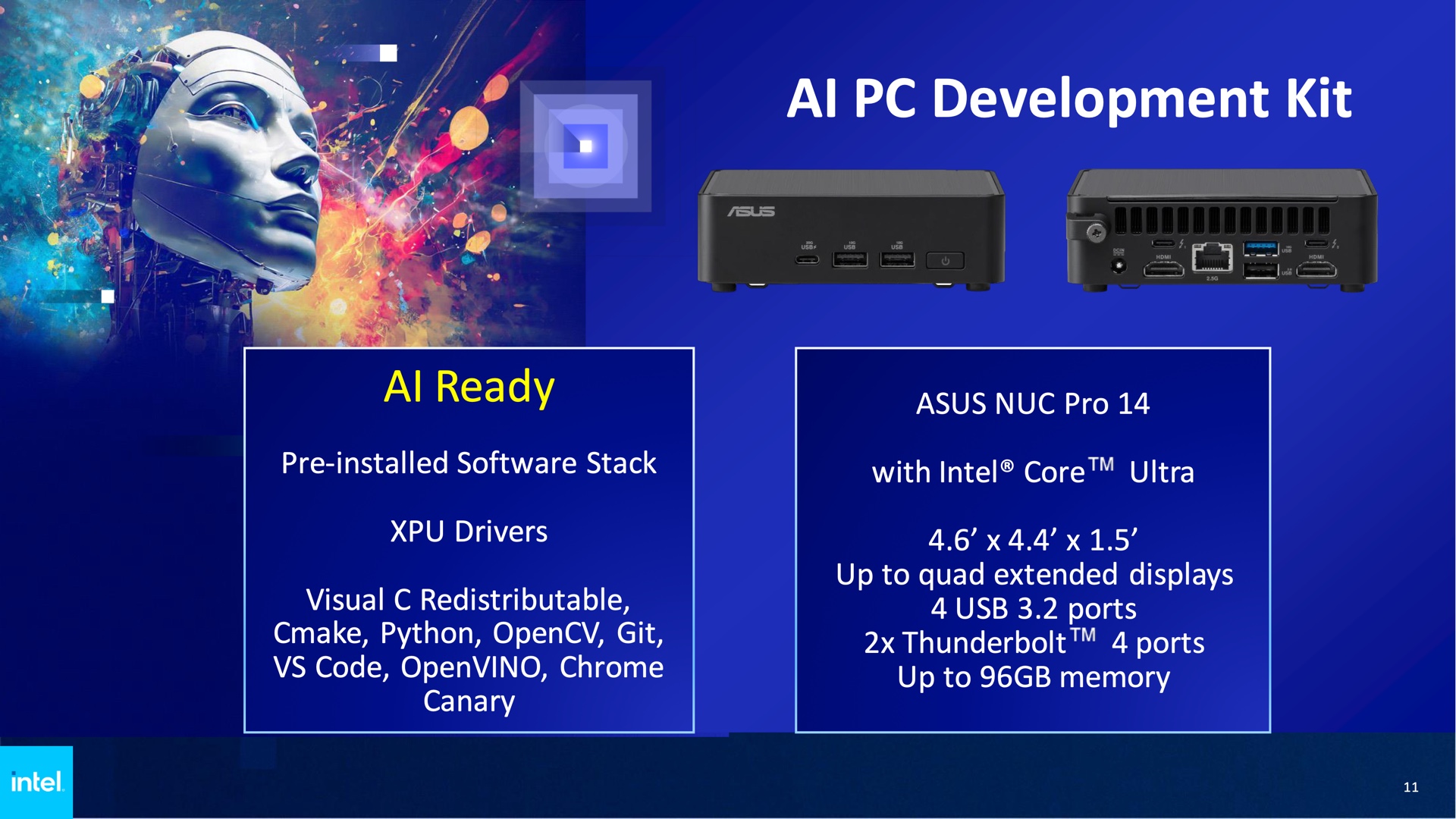
Asus and Intel are offering a NUC with a Meteor Lake CPU and its built-in NPU as an AI development platform.
Enlarge / Asus and Intel are offering a NUC with a Meteor Lake CPU and its built-in NPU as an AI development platform.

All of that said, TOPS are just one simplified performance metric. As when using FLOPS to compare graphics performance, it’s imprecise and won’t capture variations in how each NPU handles different tasks. And the Arm version of Windows still has software and hardware compatibility issues that could continue to hold it back.

As part of its developer program, Intel is also offering an “AI PC development kit” centered on an Asus NUC Pro 14, a mini PC built around Intel’s Meteor Lake silicon. Intel formally stopped making its NUC mini PCs last year, passing the brand and all of its designs off to Asus. Asus is also handling all remaining warranty service and software support for older NUCs designed and sold by Intel. The NUC Pro 14 is one of the first new NUCs announced since the transition, along with the ROG NUC mini gaming PC.

https://arstechnica.com/?p=2012793


WWDC 2024 starts on June 10 with announcements about iOS 18 and beyond

A colorful logo that says
Enlarge / The logo for WWDC24.

Apple has announced dates for this year’s Worldwide Developers Conference (WWDC). WWDC24 will run from June 10 through June 14 at the company’s Cupertino, California, headquarters, but everything will be streamed online.

Apple posted about the event with the following generic copy:

Join us online for the biggest developer event of the year. Be there for the unveiling of the latest Apple platforms, technologies, and tools. Learn how to create and elevate your apps and games. Engage with Apple designers and engineers and connect with the worldwide developer community. All online and at no cost.

As always, the conference will kick off with a keynote presentation on the first day, which is Monday, June 10. You can be sure Apple will use that event to at least announce the key features of its next round of annual software updates for iOS, iPadOS, macOS, watchOS, visionOS, and tvOS.

We could also see new hardware—it doesn’t happen every year, but it has of late. We don’t yet know exactly what that hardware might be, though.

Much of the speculation among analysts and commentators concerns Apple’s first move into generative AI. There have been reports that Apple may work with a partner like Google to include a chatbot in its operating system, that it has been considering designing its own AI tools, or that it could offer an AI App Store, giving users a choice between many chatbots.

Whatever the case, Apple is playing catch-up with some of its competitors in generative AI and large language models even though it has been using other applications of AI across its products for a couple of years now. The company’s leadership will probably talk about it during the keynote.

After the keynote, Apple usually hosts a “Platforms State of the Union” talk that delves deeper into its upcoming software updates, followed by hours of developer-focused sessions detailing how to take advantage of newly planned features in third-party apps.

https://arstechnica.com/?p=2012651


Meet Dan Harlacher: VP of Products at ON1 & Passionate Photographer | Discover ON1 Photo RAW 2024

Fellow Photographers,

I want to introduce myself. I’m Dan Harlacher, the VP of Products at ON1. You may recognize me from some ON1 announcement videos if you have been with us for a few years. My role at ON1 is guiding the design and development of ON1 Photo RAW and the rest of the photo editing software product line. I’ve been with ON1 since the beginning, eighteen years now. Only a few people in technology get to work most of their careers for the same company these days. For me, ON1 is more than my employer or company; it’s my team and family. Many of the original team members are still with us, and we have grown up and raised our kids together. It’s a fantastic place to work because of our passion for photography.  

I started photography in middle school, shooting film on a Canon FTb. I was the photo editor for my high school newspaper and yearbook. I went to college, quickly changed my major to photography, and started assisting a well-known commercial photographer to build my skills. In college, I was an early adopter of digital photography and was the first student to use ink prints for assignments. Remember, this was in 1996. After college, I started my portrait and wedding studio with a friend. However, the call for digital photography pulled me to the big city, where I integrated systems and trained professional photographers transitioning from film to digital in the early 2000s. Then, on a chance meeting on an airline flight, I made the move into software product management, and well, here I am. 

When it comes to photography, I have shot just about everything: Portraits, weddings, boudoir, pets, babies, special events, racing, airshows, sports, commercials, and even a live nuclear reactor core while standing on top of it. However, when it comes to what I love, it has always been landscapes and fine art. Photography is a great excuse for a hike, and I will take it whenever possible. 

What I love the most about my job is that I can combine my love and deep knowledge of all things photography with my problem-solving skills. I know first-hand where photographers struggle in post-processing. I know and use every tool out there, and it’s part of my job to understand the competition. Even though I have access to every app under the sun, I use Photo RAW daily for my photography. That’s as it should be; I designed it for photographers like me, so I know it can do everything I need well. If you have ever heard the old expression “eat your own dog food,” I firmly believe in using what you make. Sure, it isn’t perfect; no app is, but there are dedicated people like me listening to users like you to make it faster and better all the time. 

If you haven’t heard of ON1 or Photo RAW 2024, please give it a try. You can use it for a full 30 days without limitation, and it won’t watermark your photos in trial mode. We have made it a ton faster, and I know even more dramatic improvements are coming soon. The new user interface is much cleaner and easier to use. The new Brilliance AI is my new starting point whenever I open a photo to edit it. It gets me 90% done just by turning it on. I spend that last 10% using Super Select AI to fine-tune and mask the subject matter and apply the new on-trend presets with today’s styles.  

As the guy who designs it, we have some fantastic stuff up our sleeves that we are already working on. We will continue on our usability, performance, and stability mission and bring you new and improved features in the coming months and years. I hope to see you in the ON1 community soon! We have a ton of free training on using our apps, just like our friends here at KelbyOne. We appreciate your support and trust. 

https://layersmagazine.com/meet-dan-harlacher-vp-of-products-at-on1-passionate-photographer-discover-on1-photo-raw-2024.html


Antibodies against anything? AI tool adapted to make them

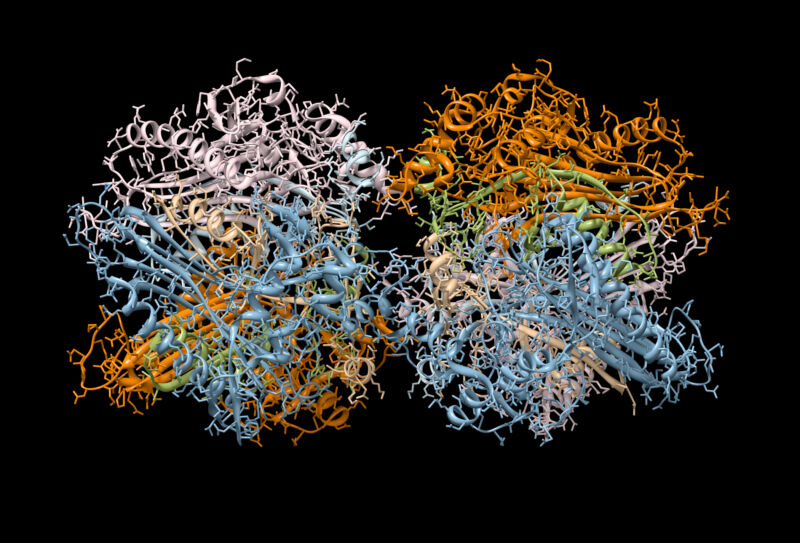
A ribbon-based string that represents the structure of the backbone of a protein.

Antibodies are incredibly useful. Lots of recently developed drugs rely on antibodies that bind to and block the activity of specific proteins. They’re also great research tools, allowing us to identify proteins within cells, purify both proteins and cells, and so on. Therapeutic antibodies have provided our first defenses against emerging viruses like Ebola and SARS-CoV-2.

But making antibodies can be a serious pain, because it involves getting animals to make antibodies for us. You need to purify the protein you want the antibodies to stick to, inject it into an animal, and get the animal to produce antibodies as part of an immune response. From there, you either purify the antibodies, or to purify the cells that produce them. It’s time-consuming, doesn’t always work, and sometimes produces antibodies with properties that you’re not looking for.

But thanks to developments in AI-based protein predictions, all that hassle might become unnecessary. A recently developed diffusion model for protein structures has been adapted to antibody production and has successfully designed antibodies against flu virus proteins.

Making the antibody of your choice

Humans (and many other mammals) make antibodies that are four-protein complexes composed of two heavy and two light proteins. Both heavy and light proteins have constant regions, which are the same or similar among all antibodies produced. They also both have a variable region, which is unique to every antibody. It’s the variable region that’s responsible for recognizing proteins in viruses and other pathogens. Some other mammals, like camels, skip the light proteins and have antibodies that are simply a pair of heavy proteins (which still recognize pathogens via the variable regions of the heavy proteins).

The body doesn’t know what proteins it will eventually need to recognize. So, it simply makes a lot of antibody-producing cells, each with a unique combination of heavy and light variable regions. When any of these cells run into the protein their antibodies recognize, they start dividing and produce a lot of the needed antibody. It takes time for these cells to mature and additional time to purify them. Plus, there’s no guarantee that the specific combination of variable regions will be the optimal one for recognizing a protein.

The only way to avoid the hassle and uncertainty of getting an animal to generate antibodies for us is to figure out how to design antibodies that will recognize what we want. And that just hasn’t been possible. We don’t understand enough about how proteins fold up into a three-dimensional configuration to design one that will adopt a shape of our choice—one that wraps around a specific target.

We still don’t really understand enough to do that intentionally. But in recent years, we’ve trained AI software to take a string of amino acids and accurately predict the three-dimensional structure that this protein would adopt. And, more recently, people have figured out how to merge these with diffusion models to create software that can design proteins that will adopt a specified configuration.

It turns out that this approach can be adopted for designing antibodies.

https://arstechnica.com/?p=2011766


GPT-5 might arrive this summer as a “materially better” update to ChatGPT

A glowing OpenAI logo on a blue background.

When OpenAI launched its GPT-4 AI model a year ago, it created a wave of immense hype and existential panic from its ability to imitate human communication and composition. Since then, the biggest question in AI has remained the same: When is GPT-5 coming out? During interviews and media appearances around the world, OpenAI CEO Sam Altman frequently gets asked this question, and he usually gives a coy or evasive answer, sometimes coupled with promises of amazing things to come.

According to a new report from Business Insider, OpenAI is expected to release GPT-5, an improved version of the AI language model that powers ChatGPT, sometime in mid-2024—and likely during the summer. Two anonymous sources familiar with the company have revealed that some enterprise customers have recently received demos of GPT-5 and related enhancements to ChatGPT.

One CEO who recently saw a version of GPT-5 described it as “really good” and “materially better,” with OpenAI demonstrating the new model using use cases and data unique to his company. The CEO also hinted at other unreleased capabilities of the model, such as the ability to launch AI agents being developed by OpenAI to perform tasks automatically.

We asked OpenAI representatives about GPT-5’s release date and the Business Insider report. They responded that they had no particular comment, but they included a snippet of a transcript from Altman’s recent appearance on the Lex Fridman podcast.

Lex Fridman(01:06:13) So when is GPT-5 coming out again?
Sam Altman(01:06:15) I don’t know. That’s the honest answer.
Lex Fridman(01:06:18) Oh, that’s the honest answer. Blink twice if it’s this year.
Sam Altman(01:06:30) We will release an amazing new model this year. I don’t know what we’ll call it.
Lex Fridman(01:06:36) So that goes to the question of, what’s the way we release this thing?
Sam Altman(01:06:41) We’ll release in the coming months many different things. I think that’d be very cool. I think before we talk about a GPT-5-like model called that, or not called that, or a little bit worse or a little bit better than what you’d expect from a GPT-5, I think we have a lot of other important things to release first.

In this conversation, Altman seems to imply that the company is prepared to launch a major AI model this year, but whether it will be called “GPT-5” or be considered a major upgrade to GPT-4 Turbo (or perhaps an incremental update like GPT-4.5) is up in the air.

Like its predecessor, GPT-5 (or whatever it will be called) is expected to be a multimodal large language model (LLM) that can accept text or encoded visual input (called a “prompt”). And like GPT-4, GPT-5 will be a next-token prediction model, which means that it will output its best estimate of the most likely next token (a fragment of a word) in a sequence, which allows for tasks such as completing a sentence or writing code. When configured in a specific way, GPT models can power conversational chatbot applications like ChatGPT.

OpenAI launched GPT-4 in March 2023 as an upgrade to its most major predecessor, GPT-3, which emerged in 2020 (with GPT-3.5 arriving in late 2022). Last November, OpenAI released GPT-4 Turbo, which lowered inference (running) costs of OpenAI’s best AI model dramatically but has been plagued with accusations of “laziness” where the model sometimes refuses to answer prompts or complete coding projects as requested. OpenAI has attempted to fix the laziness issue several times.

LLMs like those developed by OpenAI are trained on massive datasets scraped from the Internet and licensed from media companies, enabling them to respond to user prompts in a human-like manner. However, the quality of the information provided by the model can vary depending on the training data used, and also based on the model’s tendency to confabulate information. If GPT-5 can improve generalization (its ability to perform novel tasks) while also reducing what are commonly called “hallucinations” in the industry, it will likely represent a notable advancement for the firm.

According to the report, OpenAI is still training GPT-5, and after that is complete, the model will undergo internal safety testing and further “red teaming” to identify and address any issues before its public release. The release date could be delayed depending on the duration of the safety testing process.

Of course, the sources in the report could be mistaken, and GPT-5 could launch later for reasons aside from testing. So, consider this a strong rumor, but this is the first time we’ve seen a potential release date for GPT-5 from a reputable source. Also, we now know that GPT-5 is reportedly complete enough to undergo testing, which means its major training run is likely complete. Further refinements will likely follow.

https://arstechnica.com/?p=2011612


Intelligenza Artificiale, ora è ufficiale: la vigilanza in Italia ad AgID e ACN

Ora è ufficiale: la funzione di vigilanza e controllo dell’intelligenza artificiale in Italia andrà all’AgID e per le competenze che riguardano la cybersecurity all’ACN. Questa decisione era nell’aria, ma ora è stata annunciata pubblicamente dal Sottosegretario all’Innovazione Alessio Butti, che già nei giorni scorsi aveva anticipato che la competenza sull’AI non sarebbe comunque finita in mano ad una autorità indipendente, escludendo di fatto Agcom e Agcm.

In una intervista al Sole 24 Ore, Butti ha precisato che “una Authority indipendente”, come invece suggerito dalla Ue, “potrebbe mancare della competenza tecnica specifica e dell’integrazione con il sistema digitale nazionale che Agid e Acn già possiedono ed esercitano”.

“La scelta è di affidare ad Agenzia per l’Italia digitale e Agenzia per la cybersicurezza nazionale i compiti di vigilanza e controllo sull’intelligenza artificiale: rispecchia una visione strategica incentrata sull’efficacia e l’efficienza nella governance dell’Ia. Queste agenzie, con il loro focus specifico sul digitale e sulla cybersicurezza, offrono competenze tecniche e operazionali complementari e altamente specializzate, essenziali per affrontare le sfide poste dall’Ia in ambito di cittadinanza, industria, sicurezza, protezione dei dati e su tutto la difesa e l’interesse nazionale”.

Scialdone (Euroconsumers): ‘Bene che si inizi a fare chiarezza su questo punto’

“Bene che si inizi a fare chiarezza su questo punto. Potrebbe essere l’occasione per ridefinire le competenze di Agid e rilanciarne la struttura e le ambizioni. Bisogna essere consapevoli che il soggetto designato dovrà operare una importante opera di raccordo con le autorità settoriali (in particolare, Concorrenza, Data Protection, Comunicazioni), essendo l’AI una materia trasversale”, ha detto Marco Scialdone, Head Litigation and Academic Outreach di Euroconsumers che da tempo auspicava una decsione da parte del Governo.

Leggi anche: DSA e AI Act, Scialdone (Euroconsumers): ‘Il Governo scelga subito l’Authority responsabile dell’enforcement’

Butti ha poi risposto ad una domanda sulla cessione di Pago Pa senza gara a Poligrafico e Poste, bocciata dall’Antitrust: “L’Antitrust ha sottolineato le problematiche relative a questo passaggio. Le sue osservazioni sono ora al vaglio del Mef, che fornirà le risposte necessarie. La logica dietro a questa scelta”, ha spiegato Butti, è quella di “cercare di sfruttare al meglio le sinergie tra le competenze tecniche e l’ampia rete territoriale di Poligrafico e Poste Italiane”.

Inifne, la nascita di It Wallet: “Sarà possibile accedervi sia con Spid che con Cie”, a alcuni servizi “ritenuti più critici, come la patente e gli altri del Wallet pubblico, per i quali sarà necessario garantire un livello di sicurezza maggiore, saranno tuttavia accessibili solo con la Cie”.

https://www.key4biz.it/intelligenza-artificiale-ora-e-ufficiale-la-vigilanza-in-italia-ad-agid-e-acn/484086/