OpenAI and Common Sense Media partner to protect teens from AI harms and misuse
On Monday, OpenAI announced a partnership with the nonprofit Common Sense Media to create AI guidelines and educational materials targeted at parents, educators, and teens. It includes the curation of family-friendly GPTs in OpenAI’s GPT store. The collaboration aims to address concerns about the impacts of AI on children and teenagers.
Known for its reviews of films and TV shows aimed at parents seeking appropriate media for their kids to watch, Common Sense Media recently branched out into AI and has been reviewing AI assistants on its site.
“AI isn’t going anywhere, so it’s important that we help kids understand how to use it responsibly,” Common Sense Media wrote on X. “That’s why we’ve partnered with @OpenAI to help teens and families safely harness the potential of AI.”
For his part, Altman offered a canned statement in the press release, saying, “AI offers incredible benefits for families and teens, and our partnership with Common Sense will further strengthen our safety work, ensuring that families and teens can use our tools with confidence.”
The announcement feels slightly non-specific in the official news release, with Steyer offering, “Our guides and curation will be designed to educate families and educators about safe, responsible use of ChatGPT, so that we can collectively avoid any unintended consequences of this emerging technology.”
The partnership seems aimed mostly at bringing a patina of family-friendliness to OpenAI’s GPT store, with the most solid reveal being the aforementioned fact that Common Sense media will help with the “curation of family-friendly GPTs in the GPT Store based on Common Sense ratings and standards.”
Common Sense AI reviews
As mentioned above, Common Sense Media began reviewing AI assistants on its site late last year. This puts Common Sense Media in an interesting position with potential conflicts of interest regarding the new partnership with OpenAI. However, it doesn’t seem to be offering any favoritism to OpenAI so far.
For example, Common Sense Media’s review of ChatGPT calls the AI assistant “A powerful, at times risky chatbot for people 13+ that is best used for creativity, not facts.” It labels ChatGPT as being suitable for ages 13 and up (which is in OpenAI’s Terms of Service) and gives the OpenAI assistant three out of five stars. ChatGPT also scores a 48 percent privacy rating (which is oddly shown as 55 percent on another page that goes into privacy details). The review we cited was last updated on October 13, 2023, as of this writing.
For reference, Google Bard gets a three-star overall rating and a 75 percent privacy rating in its Common Sense Media review. Stable Diffusion, the image synthesis model, nets a one-star rating with the description, “Powerful image generator can unleash creativity, but is wildly unsafe and perpetuates harm.” OpenAI’s DALL-E gets two stars and a 48 percent privacy rating.
The information that Common Sense Media includes about each AI model appears relatively accurate and detailed (and the organization cited an Ars Technica article as a reference in one explanation), so they feel fair, even in the face of the OpenAI partnership. Given the low scores, it seems that most AI models aren’t off to a great start, but that may change. It’s still early days in generative AI.
https://arstechnica.com/?p=1999788
Following lawsuit, rep admits “AI” George Carlin was human-written
Enlarge/ A promotional image cited in the lawsuit uses Carlin’s name and image to promote the Dudsey podcast and special.
The estate of George Carlin has filed a federal lawsuit against the comedy podcast Dudesy for an hour-long comedy special sold as an AI-generated impression of the late comedian. But a representative for one of the podcast hosts behind the special now admits that it was actually written by a human.
In the lawsuit, filed by Carlin manager Jerold Hamza in a California district court, the Carlin estate points out that the special, “George Carlin: I’m Glad I’m Dead,” (which was set to “private” on YouTube shortly after the lawsuit was filed) presents itself as being created by an AI trained on decades worth of Carlin’s material. That training would, by definition, involve making “unauthorized copies” of “Carlin’s original, copyrighted routines” without permission in order “to fabricate a semblance of Carlin’s voice and generate a Carlin stand-up comedy routine,” according to the lawsuit.
“Defendants’ AI-generated ‘George Carlin Special’ is not a creative work,” the lawsuit reads, in part. “It is a piece of computer-generated click-bait which detracts from the value of Carlin’s comedic works and harms his reputation. It is a casual theft of a great American artist’s work.”
Enlarge/ The original YouTube thumbnail for Dudesy’s Carlin special shows an AI-generated comedian sporting Carlin’s signature grey ponytail look.
The Dudesy special is presented as an “impression” of Carlin that the AI generated by “listening” to Carlin’s existing material “in the exact same way a human impressionist would.” But the lawsuit takes direct issue with this analogy, arguing that an AI model is just an “output generated by a technological process that is an unlawful appropriation of Carlin’s identity, which also damages the value of Carlin’s real work and his legacy.”
The use of copyrighted material in AI training models is one of the most contentious and unsettled areas of law in the AI field at the moment. Just this month, media organizations testified before Congress to argue against AI makers’ claims that training on news content was legal under a “fair use” exemption.
“It’s a fictional podcast character”
Despite the presentation as an AI creation, there was a good deal of evidence that the Dudesy podcast and the special itself were not actually written by an AI, as Ars laid out in detail this week. And in the wake of this lawsuit, a representative for Dudesy host Will Sasso admitted as much to The New York Times.
“It’s a fictional podcast character created by two human beings, Will Sasso and Chad Kultgen,” spokeswoman Danielle Del told the newspaper. “The YouTube video ‘I’m Glad I’m Dead’ was completely written by Chad Kultgen.”
Regardless of that admission, Carlin estate lawyer Josh Schiller told the Times that the lawsuit would move forward. “We don’t know what they’re saying to be true,” he said. “What we will know is that they will be deposed. They will produce documents, and there will be evidence that shows one way or another how the show was created.”
Names and likenesses
A human writing a stand-up special that was merely inspired by Carlin’s work would likely not be subject to the same kind of potential copyright claims as the makers of an AI explicitly trained on that work. But even a fully human-written special would be guilty of unauthorized use of Carlin’s name and likeness for promotional purposes, according to the lawsuit.
“Defendants always presented the Dudesy Special as an AI-generated George Carlin comedy special, where George Carlin was ‘resurrected’ with the use of modern technology,” the lawsuit argues. “In short, Defendants sought to capitalize on the name, reputation, and likeness of George Carlin in creating, promoting, and distributing the Dudesy Special and using generated images of Carlin, Carlin’s voice, and images designed to evoke Carlin’s presence on a stage.”
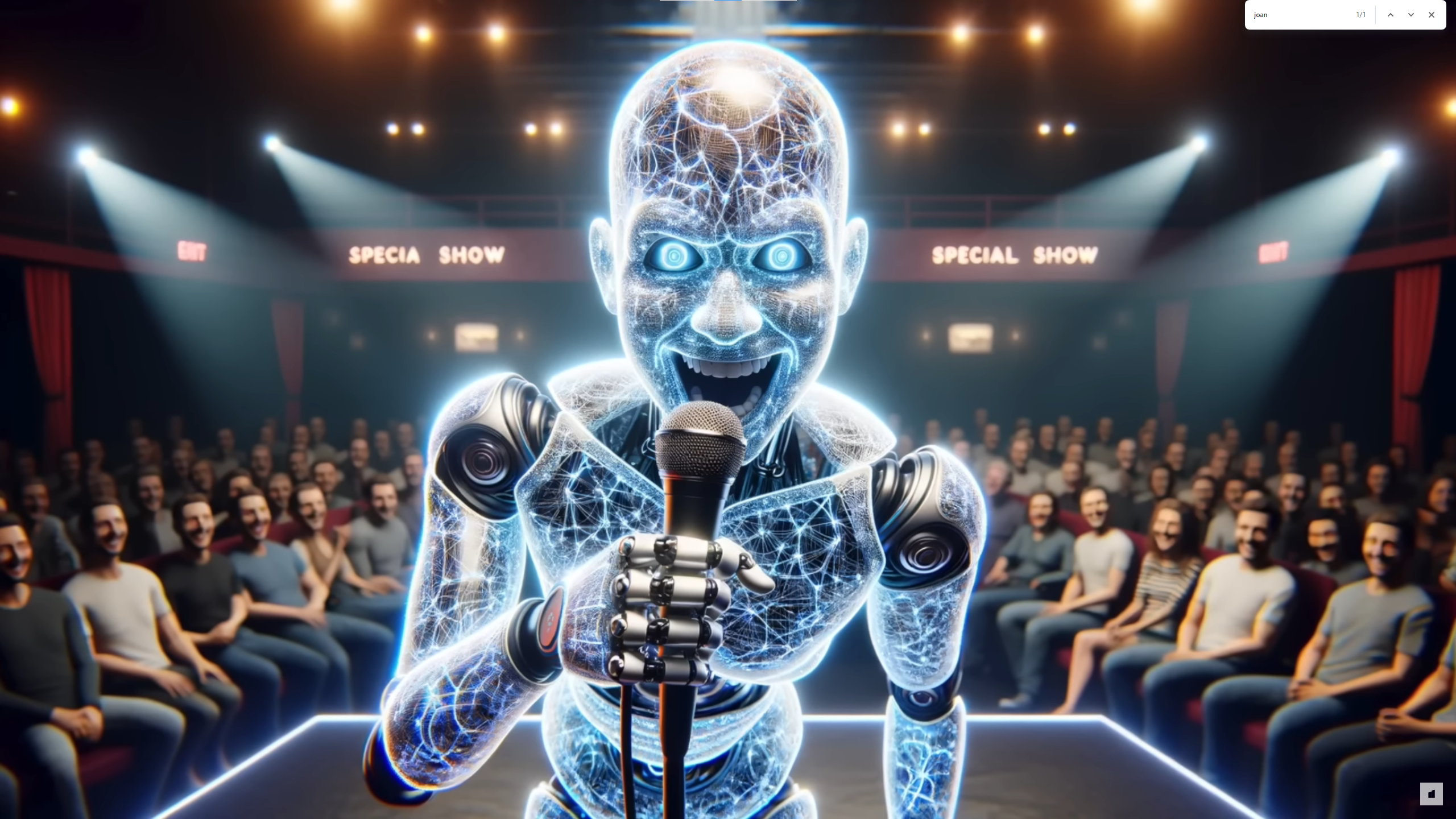
Enlarge/ A Dudesy-generated image representing AI’s impending replacement of human stand-up comedy.
While the special doesn’t present images or video of Carlin (AI-generated or not), the YouTube thumbnail for the video shows an AI-generated image of a comedian with Carlin’s signature gray ponytail looking out over an audience. The lawsuit also cites numerous social media posts where Carlin’s name and image are used to promote the special or the Dudesy podcast.
That creates an “association” between the Dudesy podcast and Carlin that is “harmful to Carlin’s reputation, his legacy, and to the value of his real work,” according to the lawsuit. “Worse, if not curtailed now, future AI models may incorrectly associate the Dudesy Special with Carlin, ultimately folding Defendants’ knockoff version in with Carlin’s actual creative output.”
Anticipating potential free speech defenses, the lawsuit argues that the special “has no comedic or creative value absent its self-proclaimed connection with George Carlin” and that it doesn’t “satirize him as a performer or offer an independent critique of society.”
Kelly Carlin, the late comedian’s daughter, told The Daily Beast earlier this month that she was talking to lawyers about potential legal action. “It’s not his material. It’s not his voice,” she said at the time. “So they need to take the name off because it is not George Carlin.”
“The ‘George Carlin’ in that video is not the beautiful human who defined his generation and raised me with love,” Kelly Carlin wrote in a statement obtained by Variety. “It is a poorly executed facsimile cobbled together by unscrupulous individuals to capitalize on the extraordinary goodwill my father established with his adoring fanbase.”
The lawsuit asks a court to force Dudesy to “remove, take down, and destroy any video or audio copies… of the ‘George Carlin Special,’ wherever they may be located,” as well as pay punitive damages.
Update: Added information about a spokesperson admitting the special was human-written.
https://arstechnica.com/?p=1999215
Google’s latest AI video generator can render cute animals in implausible situations
Enlarge/ Still images of AI-generated video examples provided by Google for its Lumiere video synthesis model.
On Tuesday, Google announced Lumiere, an AI video generator that it calls “a space-time diffusion model for realistic video generation” in the accompanying preprint paper. But let’s not kid ourselves: It does a great job at creating videos of cute animals in ridiculous scenarios, such as using roller skates, driving a car, or playing a piano. Sure, it can do more, but it is perhaps the most advanced text-to-animal AI video generator yet demonstrated.
According to Google, Lumiere utilizes unique architecture to generate a video’s entire temporal duration in one go. Or, as the company put it, “We introduce a Space-Time U-Net architecture that generates the entire temporal duration of the video at once, through a single pass in the model. This is in contrast to existing video models which synthesize distant keyframes followed by temporal super-resolution—an approach that inherently makes global temporal consistency difficult to achieve.”
In layperson terms, Google’s tech is designed to handle both the space (where things are in the video) and time (how things move and change throughout the video) aspects simultaneously. So, instead of making a video by putting together many small parts or frames, it can create the entire video, from start to finish, in one smooth process.
[embedded content]
The official promotional video accompanying the paper “Lumiere: A Space-Time Diffusion Model for Video Generation,” released by Google.
Lumiere can also do plenty of party tricks, which are laid out quite well with examples on Google’s demo page. For example, it can perform text-to-video generation (turning a written prompt into a video), convert still images into videos, generate videos in specific styles using a reference image, apply consistent video editing using text-based prompts, create cinemagraphs by animating specific regions of an image, and offer video inpainting capabilities (for example, it can change the type of dress a person is wearing).
In the Lumiere research paper, the Google researchers state that the AI model outputs five-second long 1024×1024 pixel videos, which they describe as “low-resolution.” Despite those limitations, the researchers performed a user study and claim that Lumiere’s outputs were preferred over existing AI video synthesis models.
As for training data, Google doesn’t say where it got the videos they fed into Lumiere, writing, “We train our T2V [text to video] model on a dataset containing 30M videos along with their text caption. [sic] The videos are 80 frames long at 16 fps (5 seconds). The base model is trained at 128×128.”
Enlarge/ A block diagram showing components of the Lumiere AI model, provided by Google.
AI-generated video is still in a primitive state, but it’s been progressing in quality over the past two years. In October 2022, we covered Google’s first publicly unveiled image synthesis model, Imagen Video. It could generate short 1280×768 video clips from a written prompt at 24 frames per second, but the results weren’t always coherent. Before that, Meta debuted its AI video generator, Make-A-Video. In June of last year, Runway’s Gen2 video synthesis model enabled the creation of two-second video clips from text prompts, fueling the creation of surrealistic parody commercials. And in November, we covered Stable Video Diffusion, which can generate short clips from still images.
AI companies often demonstrate video generators with cute animals because generating coherent, non-deformed humans is currently difficult—especially since we, as humans (you are human, right?), are adept at noticing any flaws in human bodies or how they move. Just look at AI-generated Will Smith eating spaghetti.
Judging by Google’s examples (and not having used it ourselves), Lumiere appears to surpass these other AI video generation models. But since Google tends to keep its AI research models close to its chest, we’re not sure when, if ever, the public may have a chance to try it for themselves.
As always, whenever we see text-to-video synthesis models getting more capable, we can’t help but think of the future implications for our Internet-connected society, which is centered around sharing media artifacts—and the general presumption that “realistic” video typically represents real objects in real situations captured by a camera. Future video synthesis tools more capable than Lumiere will make deceptive deepfakes trivially easy to create.
To that end, in the “Societal Impact” section of the Lumiere paper, the researchers write, “Our primary goal in this work is to enable novice users to generate visual content in an creative and flexible way. [sic] However, there is a risk of misuse for creating fake or harmful content with our technology, and we believe that it is crucial to develop and apply tools for detecting biases and malicious use cases in order to ensure a safe and fair use.”
https://arstechnica.com/?p=1998725
Intelligenza Artificiale, Agcom avvia un gruppo di lavoro
“Il Consiglio di Agcom ha deciso oggi di dotarsi di un gruppo di consulenti esperti sul tema della intelligenza artificiale. Il team è coordinato dal prof. Andrea Renda”. Lo ha scritto il commissario Antonello Giacomelli in un post su Linkedin.
“Già componente dell’EU High Level Expert Group on Artificial Intelligence e membro dell’advisory group on Economic and Societal Impacts of Research (ESIR) per la Commissione Europea, Renda rappresenta una figura di primissimo piano a livello internazionale e riferimento consolidato delle istituzioni comunitarie e globali.
Del gruppo fanno parte anche la professoressa Maddalena Rabitti, il professor Andrea Simoncini, il professor Giuseppe Cassano, il professor Giovanni Boccia Artieri e il professor Mauro Giusto”.
“Con l’approvazione dell’AI ACT presto le autorità di regolazione e i governi nazionali saranno chiamati ad applicare il regolamento europeo sull’intelligenza artificiale, il primo impianto normativo al mondo a disciplinare una tecnologia così pervasiva. La decisione di oggi mette Agcom in condizione di affrontare al più alto livello l’impatto dell’intelligenza artificiale sui temi di propria competenza”.
A “robot” should be chemical, not steel, argues man who coined the word
In 1921, Czech playwright Karel Čapek and his brother Josef invented the word “robot” in a sci-fi play called R.U.R. (short for Rossum’s Universal Robots). As Even Ackerman in IEEE Spectrum points out, Čapek wasn’t happy about how the term’s meaning evolved to denote mechanical entities, straying from his original concept of artificial human-like beings based on chemistry.
In a newly translated column called “The Author of the Robots Defends Himself,” published in Lidové Noviny on June 9, 1935, Čapek expresses his frustration about how his original vision for robots was being subverted. His arguments still apply to both modern robotics and AI. In this column, he referred to himself in the third-person:
For his robots were not mechanisms. They were not made of sheet metal and cogwheels. They were not a celebration of mechanical engineering. If the author was thinking of any of the marvels of the human spirit during their creation, it was not of technology, but of science. With outright horror, he refuses any responsibility for the thought that machines could take the place of people, or that anything like life, love, or rebellion could ever awaken in their cogwheels. He would regard this somber vision as an unforgivable overvaluation of mechanics or as a severe insult to life.
This recently resurfaced article comes courtesy of a new English translation of Čapek’s play called R.U.R. and the Vision of Artificial Life accompanied by 20 essays on robotics, philosophy, politics, and AI. The editor, Jitka Čejková, a professor at the Chemical Robotics Laboratory in Prague, aligns her research with Čapek’s original vision. She explores “chemical robots”—microparticles resembling living cells—which she calls “liquid robots.”
Enlarge/ “An assistant of inventor Captain Richards works on the robot the Captain has invented, which speaks, answers questions, shakes hands, tells the time and sits down when it’s told to.” – September 1928
In Čapek’s 1935 column, he clarifies that his robots were not intended to be mechanical marvels, but organic products of modern chemistry, akin to living matter. Čapek emphasizes that he did not want to glorify mechanical systems but to explore the potential of science, particularly chemistry. He refutes the idea that machines could replace humans or develop emotions and consciousness.
The author of the robots would regard it as an act of scientific bad taste if he had brought something to life with brass cogwheels or created life in the test tube; the way he imagined it, he created only a new foundation for life, which began to behave like living matter, and which could therefore have become a vehicle of life—but a life which remains an unimaginable and incomprehensible mystery. This life will reach its fulfillment only when (with the aid of considerable inaccuracy and mysticism) the robots acquire souls. From which it is evident that the author did not invent his robots with the technological hubris of a mechanical engineer, but with the metaphysical humility of a spiritualist.
The reason for the transition from chemical to mechanical in the public perception of robots isn’t entirely clear (though Čapek does mention a Russian film which went the mechanical route and was likely influential). The early 20th century was a period of rapid industrialization and technological advancement that saw the emergence of complex machinery and electronic automation, which probably influenced the public and scientific community’s perception of autonomous beings, leading them to associate the idea of robots with mechanical and electronic devices rather than chemical creations.
The 1935 piece is full of interesting quotes (you can read the whole thing in IEEE Spectrum or here), and we’ve grabbed a few highlights below that you can conveniently share with your robot-loving friends to blow their minds:
“He pronounces that his robots were created quite differently—that is, by a chemical path”
“He has learned, without any great pleasure, that genuine steel robots have started to appear”
“Well then, the author cannot be blamed for what might be called the worldwide humbug over the robots.”
“The world needed mechanical robots, for it believes in machines more than it believes in life; it is fascinated more by the marvels of technology than by the miracle of life.”
So it seems, over 100 years later, that we’ve gotten it wrong all along. Čapek’s vision, rooted in chemical synthesis and the philosophical mysteries of life, offers a different narrative from the predominant mechanical and electronic interpretation of robots we know today. But judging from what Čapek wrote, it sounds like he would be firmly against AI takeover scenarios. In fact, Čapek, who died in 1938, probably would think they would be impossible.
https://arstechnica.com/?p=1998255
Tech trend di Engineering, le sfide del 2024 tra business e AI. Scarica il report
Quali sono le sfide principali del tech per il 2024? Engineering fa le carte alla industry con un’indagine condotta sui suoi business leader con particolare attenzione al ruolo dell’Intelligenza Artificiale. Tre domande uguali per tutti, ma declinate per mercati (Sanità, Finance, Government, Smart Cities, Energy…..) e Tech trend (AI, Cloud, Realtà Aumentata…).
Parola d’ordine sostenibilità. E’ questa la premessa fondamentale per lo sviluppo di nuove soluzioni di business. La pensa così Maximo Ibarra, Ceo e General Manager di Engineering: “Le sfide principali del 2024 gravitano attorno al ruolo sempre più centrale dell’Intelligenza Artificiale, declinata anche nella forma di IA Generativa. Questa
tecnologia rappresenta un vero e proprio copilota, in grado di amplificare le nostre capacità e di supportarci nelle strategie aziendali, nelle decisioni politiche e nel realizzare soluzioni e progetti con cui raggiungere importanti obiettivi ambientali, sociali e di governance”.
L’impatto crescente dell’Intelligenza Artificiale su tutte le nostre attività si porta dietro due sfide. “La prima è tecnologica e consiste nel riuscire a integrare l’AI con altre tecnologie abilitanti comeCloud, Digital Twin, Extended Reality (XR) eCybersecurity, quest’ultima sempre più strategica per la sicurezza di individui, imprese e interi Paesi”.
“La seconda sfida è di gestione: è infatti indispensabile creare sinergie sempre più strette tra i diversistakeholder, privati e pubblici, che operano nell’ecosistema in cui viviamo”, aggiunge Ibarra.
“L’AI ci aiuta a migliorare e ad aumentare le nostre capacità in settori chiave come l’informazione, lasanità, l’industria, l’energia, la lotta al cambiamentoclimatico e la prevenzione di eventi catastrofali. L’integrazione con altre tecnologie, come IoT e Blockchain, può favorire modelli di business sostenibili sia da un punto di vista ambientale che etico, ottimizzando l’utilizzo delle risorse e migliorandone tracciabilità e trasparenza, oppure raccogliendo, gestendo e analizzando enormi quantità di dati”, dice ancora il Ceo di Engineering.
Tra l’altro, Engineering sfrutta l’AI anche in ottica di taglio delle emissioni. “Abbiamo realizzato un piano ESG che, anche attraverso l’uso dell’AI, è finalizzato a ridurre le emissioni deinostri Data Center, aumentare l’uso di energia dafonti rinnovabili, integrare gli obiettivi di sostenibilitànei nostri piani di business”.
Sfida PNRR per l’E-Health
La principale sfida per il mercato dell’e-Health in Italia è avviare i cantieri del PNRR.
“Penso all’implementazione della Telemedicina, sia dal punto di vista della Piattaforma Nazionale diTelemedicina (PNT) che attraverso applicativi verticali regionali, ma anche alla Piattaforma di Intelligenza Artificiale per potenziare e supportare l’assistenzasanitaria primaria, fino ad arrivare alla digitalizzazione dei DEA di I e II livello”, dice Antonio Delli Gatti, Executive Director Healthcare Division Engineering.
Smart Government fra software governativi, Cloud PA e identità digitale
L’implementazione del Pnrr nel 2024 è la sfida principale anche in ambito di PA digitale. “Investimenti fondamentali per assicurare un valore aggiunto nelle infrastrutture strategiche e facilitare la transizione digitale – dice Dario Buttitta, Executive Vice President Public Sector & Healthcare Engineering –L’introduzione dell’Intelligenza Artificiale nella governance pubblica, così come negli altri ambiti, poi, è indiscutibilmente un elemento chiave su cui concentrarsi, ovviamente utilizzata in modo etico e responsabile. Una gestione agile dei servizi pubblici, infatti, sostenuta dall’AI, contribuisce a snellire le procedure e soprattutto rendere più efficaci le risposte ai cittadini, potenziando la cittadinanza digitale. La terza sfida è legata a due temi di estrema attualità, vale a dire la gestione delle emergenze e lasicurezza nazionale”.
Augmented city: AI su misura di città
Un altro ambito di grande sviluppo potenziale è l’applicazione dell’Intelligenza Artificiale nella gestione delle città, in particolare tramite i digital twin. “È necessario per i Comuni capire l’impatto che può avere sul modo di lavorare e sui processi e le sue declinazioni, anche sotto il profilo dell’etica e della sicurezza dei cittadini – dice Stefano Capitani, Executive Vice President & Municipia CEO Engineering – Le PA locali, quindi, devono comprendere le potenzialità e le applicazioni concrete anche di questa tecnologia. Questo ci porta alla seconda sfida, legata alla continua e rapida evoluzione delle tecnologie in generale, che diventano sempre più delle commodities. Il settore pubblico può sfruttare questa evoluzione traendone vantaggio e, in quest’ottica, la collaborazione con il privato diventa cruciale per guidare e applicare questa trasformazione, cogliendone le opportunità e i benefici per l’Ente stesso e i cittadini”.
Digital Finance
Altri ambiti di sviluppo tecnologico sono la Digital Finance, con il Cloud al centro dello sviluppo tecnologico di Banche e Assicurazioni.
Digital industry
La smart energy and Utilities
Si legge nel report: “L’ormai costante turbolenza geopolitica, che sta rapidamente trasformando la nostra realtà con ripercussioni su qualunque comparto economico, non può che influenzare fortemente anche il settore Energy & Utilities. L’instabilità influisce sull’accessibilità alle risorse primarie, generando una pressione crescente sui costi e sulle tariffe finali. Una pressione che va mitigata, ad esempio attraverso una maggiore efficacia nella gestione degli asset strategici, con un approccio che non si limiti alla manutenzione ordinaria ma che sia sempre di più orientato alla valorizzazione degli investimenti”.
Smart Agriculture
A seguire, l’analisi si concentra sulla smart agriculture, “Grazie all’Earth Observation Data, alla sensoristica in campo e alle Geospatial Advanced Analytics, si lavora con dati localizzati per migliorare l’efficienza del sistema irriguo, riducendo le perdite nella rete e ottimizzando l’uso dell’acqua in agricoltura”, si legge.
Smart Transportation
La transizione ecologica e la decarbonizzazione sono due delle sfide fondamentali per il futuro della società e del pianeta e il settore delle infrastrutture e dei trasporti (strade, ferrovie, porti, aeroporti) ha un ruolo chiave in questo processo, in quanto responsabile di una quota significativa delle emissioni di gas serra e di altri impatti ambientali.
Digital Media & Communication
“Il mercato Telco in Italia negli ultimi 10 anni ha perso circa 11 miliardi di euro di ricavi per due effetti contrastanti: da un lato l’aumento dei costi di produzione e degli investimenti e dall’altro la riduzione continua dei prezzi dei servizi specialmente per ilcomparto consumer”, dice Nello Nuzzi, Telco & Media BU Director Engineering.
La crescita continua dei volumi di traffico principalmente dovuta ai servizi digitali delle Technology Companies, quali Apple, Google, Amazon, Netflix, sia sulla rete mobile che sulla rete fissa, sta generando un incremento dei costi di gestione e degli investimenti per gli operatori. Nel 2024 continua la necessità di investire per l’evoluzione della rete mobile 5G, ancora non implementata in tecnologia stand-alone, e lo sviluppo dell’infrastruttura di rete broadband fissa, con un peso sulle revenues di circa il 25-30% contro una percentuale del 10-15% per gli operatori del comparto Energy & Utilities. In aggiunta l’incremento del costo dell’energia ha avuto un impatto molto negativo sui risultati degli ultimi anni. Di contro i prezzi dei servizi continuano a scendere per effetto di
una forte competizione del mercato (5 operatori mobili sul mercato) ed una forte pressione normativa. In Italia i prezzi sono inferiori a tutti quelli degli altri paesi. In questo contesto le linee di azione e di sfida per gli operatori sono sostanzialmente tre:
AI & Advanced Analytics
Il 2024 sarà cruciale per le organizzazioni nell’adozione di AI e analisi dati, con rapida evoluzione che apre nuovi orizzonti e presenta sfide complesse. In questo contesto in continua trasformazione è essenziale trovare un equilibrio tra l’innovazione necessaria e la responsabilità che ne deriva. Emergono due pilastri fondamentali: la gestione dei rischi associati all’AI e la promozione di buone pratiche nel suo utilizzo. Affinché l’AI diventi un motore di successo per le organizzazioni è imperativo affrontare sfide come dati inaccurati, la mancanza di maturità nelle capacità di gestione dei dati e le difficoltà nell’integrazione di dati provenienti da fonti diverse.
Cloud
Nel 2024, quattro sfide dinamiche emergono nel contesto del cloud computing, rispondendo alle crescenti esigenze aziendali. In primo luogo, la sicurezza dei dati assume un ruolo prioritario, con l’aumento delle minacce cibernetiche che richiede approcci avanzati per proteggere le informazioni sensibili nell’ambiente cloud. Allo stesso tempo, l’ottimizzazione dei costi rappresenta
un aspetto critico, richiedendo strategie efficienti per gestire e ridurre i costi dell’infrastruttura cloud, senza compromettere gli elevati standard di servizio. Un’altra sfida rilevante è data dalla continua evoluzione delle tecnologie cloud, spinta dalla crescente adozione di nuove piattaforme e offerte “as-a-service”, specialmente nei servizi di AI.
Cybersecurity
Nel complesso panorama delle minacce digitali il 2024 si prospetta come un ambiente sfidante e ricco di opportunità per la sicurezza informatica. L’Artificial Intelligence e il Machine Learning rivestono un ruolo chiave, trasformandosi da concetti teorici
a strumenti pratici che rivoluzionano settori grazie a algoritmi avanzati e maggiore potenza di calcolo. Tuttavia, l’evoluzione dell’AI ha dato ai criminali informatici nuovi strumenti per attacchi sofisticati, come la generazione di e-mail di phishing convincenti.
L’espansione del lavoro remoto, combinata con l’incremento dell’IoT e la diffusione del 5G, crea perimetri di difesa più fluidi e introduce nuove minacce cyber. Nonostante la crescita della forza lavoro nella sicurezza informatica, la carenza globale di professionisti rappresenta ancora una sfida significativa. La domanda in continua crescita e la scarsità di personale qualificato potrebbero presto compromettere la capacità di proteggere le infrastrutture critiche, quindi, nel 2024 diventano essenziali la comprensione delle vulnerabilità e la capacità di anticipare gli impatti.
Digital Experience
Le aspettative degli utenti di poter accedere a fonti di conoscenza ed esperienza praticamente illimitate, interagendo con sistemi sempre più complessi in grado di conversare, esprimersi e “pensare” come un essere umano, oltre che di assumerne l’aspetto. Parallelamente, si rafforza l’importanza di unire i mondi fisici e virtuali, plasmando una realtà unificata che li integri e armonizzi senza soluzione di continuità, al fine di massimizzare l’accesso alle informazioni, semplificare e potenziare i modelli di interazione, offrendo un’esperienza più coinvolgente ed immersiva. Questa evoluzione è caratterizzata da una crescente attenzione all’inclusività, sottolineata dalla necessità di integrare tecnologie che garantiscono l’accesso a servizi essenziali per ogni individuo, tenendo conto delle specifiche capacità fisiche o cognitive. Si tratta di un livello avanzato di personalizzazione dell’esperienza che abbraccia le modalità di rappresentazione, i modelli di interazione e si estende fino alla dimensione della percezione.
Sam Altman cerca di raccogliere miliardi per una rete di impianti di chip AI
Il Ceo di OpenAI CEO Sam Altman sta cercando nuovi fondi per avviare una nuova rete di impianti per la produzione di semiconduttori. Lo ha reso noto Bloomberg, ripresa poi dal Financial Times, secondo cui Altman ha avuto colloqui con diversi potenziali investitori anche mediorientali nella speranza di raccogliere i miliardi necessari per realizzare le fabbriche di chip necessarie per il business dell’AI.
Secondo il rapporto, il progetto comporterebbe la collaborazione con i principali produttori di chip e la rete di fabbriche avrebbe una portata globale.
La produzione di chip è costosa. Richiedono anche ingenti quantità di risorse naturali, oltre ai miliardi di dollari di finanziamenti. I costi sono aumentati nel corso degli anni con l’avanzamento della tecnologia per realizzare chip utilizzati nelle applicazioni di intelligenza artificiale.
G42, con sede ad Abu Dhabi, e il gruppo giapponese SoftBank, sono tra le aziende che hanno avuto colloqui con il capo di OpenAI, ma i colloqui sono ancora all’inizio e un elenco completo dei partner e dei finanziatori coinvolti non è stato stabilito, secondo Bloomberg.
I colloqui con G42, con cui il produttore di ChatGPT ha collaborato nell’ottobre dello scorso anno, si erano concentrati da soli sulla raccolta di 8-10 miliardi di dollari, anche se lo stato attuale delle discussioni non è chiaro, secondo il rapporto.
Intel, il produttore di chip taiwanese Taiwan Semiconductor Manufacturing Co., Samsung Electronics sono potenziali partner per OpenAI.
Altman è tornato a OpenAI a novembre dopo una cacciata a sorpresa che aveva scosso l’industria tecnologica.
Il rapporto di Bloomberg afferma che aveva lavorato duramente sul progetto dei chip fino a quando non fu temporaneamente estromesso e al suo ritorno, riaccese gli sforzi.
WordPad out; 80Gbps USB support and other Win 11 features in testing this month
Windows 11’s big feature update in September included a long list of minor changes, plus the Copilot AI assistant; that update was followed by Windows 11 23H2 in late October, which reset the operating system’s timeline for technical support and security updates but didn’t add much else in and of itself. But Windows development never stops these days, and this month’s Insider Preview builds have already shown us a few things that could end up in the stable version of the operating system in the next couple of months.
One major addition, which rolled out to Dev Channel builds on January 11 and Beta Channel builds today, is support for 80Gbps USB 4 ports. These speeds are part of the USB4 Version 2.0 spec—named with the USB-IF’s typical flair for clarity and consistency—that was published in 2022. Full 80Gbps speeds are still rare and will be for the foreseeable future, but Microsoft says that they’ll be included the Razer Blade 18 and a handful of other PCs with Intel’s 14th-generation HX-series laptop processors. We’d expect the new speeds to proliferate slowly and mostly in high-end systems over the next few months and years.
Another addition to that January 11 Dev Channel build is a change in how the Copilot generative AI assistant works. Normally, Copilot is launched by the user manually, either by clicking the icon on the taskbar, hitting the Win+C key combo, or (in some new PCs) by using the dedicated Copilot button on the keyboard. In recent Dev Channel builds, the Copilot window will open automatically on certain PCs as soon as you log into Windows, becoming part of your default desktop unless you turn it off in Settings.
The Copilot panel will only open by default on screens that meet minimum size and resolution requirements, things that Windows already detects and takes into account when setting your PC’s default zoom and showing available Snap Layouts, among other things. Microsoft says it’s testing the feature on screens that are 27 inches or larger with 1,920 or more horizontal pixels (for most screens, this means a minimum resolution of 1080p). For PCs without Copilot, including those that haven’t been signed into a Microsoft account, the feature will continue to be absent.
Enlarge/ The “richer weather experience on the Lock screen,” seen in the bottom-center of this screenshot.
Other additions to the Dev Channel builds this month include easy Snipping Tool editing for Android screenshots from phones that have been paired to your PC, custom user-created voice commands, the ability to share URLs directly to services like WhatsApp and Gmail from the Windows share window, a new Weather widget for the Windows lock screen, and app install notifications from the Microsoft store.
Microsoft hasn’t publicized any of the changes it has made to its Canary channel builds since January 4—this is typical since it changes the fastest, and the tested features are the most likely to be removed or significantly tweaked before being released to the public. Most of the significant additions from that announcement have since made it out to the other channels, but there are a couple of things worth noting. First, there’s a new Energy Saver taskbar icon for desktop PCs without batteries, making it easier to tell when the feature is on without creating confusion. And the venerable WordPad app, originally marked for deletion in September, has also been removed from these builds and can’t be reinstalled.
Microsoft doesn’t publish Windows feature updates on an exact cadence beyond its commitment to deliver one with a new version number once per year in the fall. Last year’s first major batch of Windows 11 additions rolled out at the end of February, so a late winter or early spring launch window for the next batch of features could make sense.
https://arstechnica.com/?p=1997547
Meta prevede di acquistare 350mila GPU Nvidia per costruire un’IA generale
L’amministratore delegato di Meta Platforms, Mark Zuckerberg, ha rivelato che la sua azienda sta pianificando di acquistare circa 350mila unità di elaborazione grafica H100 di fascia alta da Nvidia per fornire la potenza di calcolo necessaria a portare avanti i propri obiettivi in una nuova area dell’intelligenza artificiale.
L’azienda sta cercando di diventare leader nel settore dell’intelligenza artificiale generale, o AGI, che è una potenziale intelligenza artificiale avanzata in grado di eguagliare l’intelligenza umana ed eseguire una vasta gamma di compiti diversi.
Le prospettive dell’AGI, AI generale
Zuckerberg ha detto in un video di Instagram Reels pubblicato ieri che l’AGI potrebbe finalmente essere in grado di alimentare un’ampia gamma di servizi e dispositivi all’avanguardia, inclusi assistenti digitali più avanzati, occhiali per realtà aumentata e altro ancora. L’obiettivo dell’azienda è quello di costruire “i migliori assistenti IA, IA per creatori, IA per le aziende e altro ancora”, ha detto Zuckerberg, aggiungendo che per farlo saranno necessari progressi in ogni area dell’IA.
Per arrivarci, Meta dovrà fare un investimento significativo nella sua infrastruttura informatica AI, da qui i suoi piani per acquisire montagne di potenti GPU H100 da Nvidia. Il chip H100 è il chip più avanzato mai realizzato da Nvidia e si dice che sia particolarmente abile nell’addestrare i modelli linguistici di grandi dimensioni che alimentano l’intelligenza artificiale generativa come ChatGPT.
“Stiamo costruendo una quantità assolutamente enorme di infrastrutture per supportare tutto questo”, ha detto Zuckerberg. “Entro la fine dell’anno, avremo circa 350mila Nvidia H100, o circa 600mila equivalenti H100 di calcolo se si includono altre GPU”.
Investimento miliardario
È un numero sconcertante, anche a causa dell’enorme spesa richiesta per acquistare tutto quel silicio. Anche se il Ceo non ha detto quanto l’azienda intende spendere per le sue GPU, è probabile che si tratti di una cifra sconcertante. Inoltre, è improbabile che Meta ne abbia accumulati così tanti finora, poiché l’H100 è stato messo in vendita solo alla fine del 2022 ed è stato in fornitura limitata.
Le stime degli analisti di Raymond James dicono che Nvidia vende l’H100 per un prezzo compreso tra 25mila e 30mila dollari, mentre su eBay possono raggiungere più di 40mila dollari. Anche se Meta otterrà sicuramente del credito per gli acquisti in blocco, è probabile che spenderà comunque oltre 9 miliardi di dollari sulle GPU.
Zuckerberg ha detto che le 350mila GPU H100 verranno aggiunte a un’infrastruttura che conterrà anche circa 600mila equivalenti H100, il che potrebbe significare che la società sta anche acquistando in massa chip rivali come il nuovo acceleratore AI Instinct M1300X di Advanced Micro Devices (AMD).
Priorità all’AI
Nvidia e i suoi azionisti saranno senza dubbio lieti di conoscere i piani di investimento nelle GPU di Meta, ma è meno chiaro cosa significhi realmente l’annuncio di Zuckerberg per la sua stessa azienda, ha detto a SiliconANGLE Charles King, un analista di Pund-IT. Ha sottolineato che non è passato molto tempo da quando Zuckerberg proclamava il metaverso come la prossima grande novità, investendo miliardi di dollari in quello che, almeno per ora, deve essere visto come uno sforzo fallito.
“L’intelligenza artificiale ha sicuramente più supporto nella tecnologia e in altri settori rispetto a quanto abbia mai avuto il metaverso”, ha aggiunto King. “Tuttavia, a questo punto, gli acquisti di GPU di Meta sono più indicativi della sua ricchezza relativa che del potenziale successo dei suoi piani”.
Zuckerberg: ‘AI più grande area di investimento nel 2024’
“In termini di priorità di investimento, l’intelligenza artificiale sarà la nostra più grande area di investimento nel 2024, sia in termini di risorse ingegneristiche che informatiche”, ha detto Zuckerberg in una teleconferenza con gli analisti.
Nel suo post su Instagram, Zuckerberg ha rivelato che le GPU di Meta sono già utilizzate con buoni risultati nell’addestramento di Llama 3, che è un’alternativa open source ai modelli ChatGPT di OpenAI. Tuttavia, la società sta adottando un approccio diverso rispetto al suo rivale e prevede di rendere open source il modello Llama 3, proprio come ha fatto con il suo predecessore, Llama 2.
“Questa tecnologia è così importante e le opportunità sono così grandi che dovremmo renderla open source e renderla disponibile il più ampiamente possibile”, ha insistito Zuckerberg.
6G e AI pronte e rivoluzionare le decisioni in tempo reale nell’industria
La connettività altamente potenziata delle reti 6G semplificherà e migliorerà il coordinamento fra diversi dispositivo basati sull’AI. Questo salto tecnologico migliorerà in modo sostanziale l’affidabilità e l’efficienza in un ampio spettro di applicazioni.
La fusione fra 6G e AI aprirà la strada a grandi cambiamenti in diverse industry
L’AI generativa potrà fornire capacità di edge computing aumentate dal 6G, consentendo di portare i processi decisionali più vicini all’edge. Una condizione cruciale per applicazioni che richiedono risposte rapide per l’utilizzo di robot mobili autonomi (ARM), droni intelligenti, dispositivi IoT.
Un connubio fra 6G e AI consentirà di rendere più efficienti e affidabili applicazioni di agricoltura smart, manifattura avanzata, energia, sanità. Sarà possibile creare applicazioni customizzate e personalizzate, che consentiranno ai produttori di rispondere in tempi più stretti alle mutevoli richieste dei clienti. La convergenza fra 6G e AI permetterà di trasformare il modo in cui simulazioni e gemelli digitali agiscono e di amplificare le modalità di interazione e collaborazione virtuale basata su AR e VR e di ridefinire in breve il modo di interagire fra uomo e macchina.
Cosa serve all’AI
Ma l’AI, come tutte le tecnologie, per funzionare ha bisogno di dati di alta qualità, chiarezza dei processi decisionali, correttezza, sicurezza, e supervisione umana. Anche se crea grandi opportunità, con l’AI si aprono molte domande in tema di pregiudizi, sicurezza, privacy e fiducia.
Serve quindi un approccio responsabile a questa nuova tecnologia, che riguardi anche le sfide etiche dell’AI che toccano le persone e il pianeta, il contesto economico, i dati sia in fase in input che di output. In base a questi parametri sarà quindi possibile valutare il livello di rischio dei singoli progetti.
AI Act nella Ue
Nel contempo, il quadro normativo internazionale per l’AI sta prendendo forma, con l’approvazione della normativa Ue AI Act nel 2023 e diversi stati americani che hanno introdotto delle leggi ad hoc.
Sarà fondamentale, in ambito normativo, ridurre al minimo il ritardo delle norme rispetto allo sviluppo tecnologico. In questo senso, parola d’ordine flessibilità e capacità di adattamento.
Supply chian e compliance
E ancora, soddisfare la natura complessa dello sviluppo e dell’utilizzo dell’intelligenza artificiale che ha una supply chain lunga e complessa, che può cambiare a seconda delle diverse categorie di utenza finale.
In terzo luogo, sarà importante puntare sull’armonizzazione regolatoria a livello globale. Una eccessiva mole di diverse normative a macchio di leopardo potrebbe creare problemi ai business internazionali. I costi di compliance rischiano di schizzare alle stelle, rendendo le applicazioni AI non percorribili.
In quarto luogo, sarà importante evitare il rischio di discriminazione per i business più piccoli.
Questioni normative troppo complesse di pari passo con i pregiudizio dell’algoritmo, minacce alla sicurezza e trasparenza obbligatoria nei modelli a scatola nera richiedono tecnologia avanzata e capacità specialistiche ben definite rischiano di penalizzare i piccoli business.