Rabbit R1, l’assistente tascabile basato su AI è la vera star al CES di Las Vegas (video)
Un assistente tascabile che utilizza le app dell’utente e risolve piccoli compiti senza cellulare, con una tecnologia che ricorda altri assistenti virtuali come Siri e Alexa, è una delle stelle del CES 2024 di Las Vegas, la principale kermesse globale dell’hitech di largo consumo.
L’intelligenza artificiale è il momento clou dell’edizione di quest’anno del mega evento sull’innovazione che si svolgerà questa settimana negli Stati Uniti. E il Rabbit R1 è un esempio calzante.
[embedded content]
Dispositivo AI touchscreen
Rabbit ha presentato allo show il dispositivo portatile di intelligenza artificiale touchscreen, che funziona come un walkie-talkie e ha funzionalità di fotocamera.
L’R1 è pubblicizzato come un dispositivo che fa ciò che può fare un’app: organizzare una riunione, chiamare un’auto o modificare la data di un volo.
Per fare ciò, l’utente preme un pulsante sul lato dell’R1, che ha le dimensioni di una carta di credito, e dice ciò di cui ha bisogno tramite walkie-talkie.
Ha un sistema operativo interno, Rabbit OS, e il cosiddetto LAM (Largen Action Model), un sistema che fa eseguire le applicazioni all’intelligenza artificiale.
Basta app sullo smartphone
Secondo gli espositori il sistema operativo interno elimina la necessità di scaricare e utilizzare diverse app sullo smartphone.
Il dispositivo arancione ha due microfoni, un pulsante di scorrimento, un pulsante push-to-talk e una fotocamera rotante.
La piccola fotocamera viene utilizzata per scansionare gli oggetti intorno al dispositivo, così puoi filmare il cibo nel frigorifero e chiedere all’R1 di darti suggerimenti per ricette, ad esempio.
Un computer semplificato
“La nostra missione è creare il computer più semplice possibile, qualcosa di così intuitivo che non sia necessario imparare a usarlo”, dice Jesse Lyu, CEO di Rabbit, alla presentazione del prodotto. “Non vogliamo che l’R1 sostituisca il tuo iPhone, è solo un dispositivo di diversa generazione.”
I dati memorizzati sull’R1 possono essere cancellati in qualsiasi momento, e la modalità di ascolto non è sempre attiva, il microfono non registra a meno che non venga premuto il pulsante laterale.
L’R1 costa 199 dollari ed è disponibile per il preordine sul sito ufficiale dell’azienda.
La Commissione Ue accelera con le consultazioni su IA e metaverso. Scarica il documento
La Commissione Ue ha appena avviato una doppia consultazione pubblica, per valutare il panorama competitivo dei nascenti mercati del metaverso e dell’intelligenza artificiale generativa.
La vicepresidente della Commissione Ue Margrethe Vestager, titolare della Concorrenza, ha chiesto il contributo si tutti per valutare il livello di concorrenza in ambito AI generativa e metaverso. La consultazione è aperta fino all’11 marzo (scarica il documento in PDF).
Accordi fra Big Tech e sviluppatori AI sotto la lente
La Commissione sta inoltre valutando gli accordi che sono stati siglati fra Big Tech e sviluppatori di AI generativa per valutare l’impatto sulle dinamiche di mercato. Sta inoltre verificando se l’investimento di 1 miliardo di euro da parte di Microsoft nello sviluppatore OpenAI di ChatGPT è idoneo alla revisione ai sensi delle normative UE sulle fusioni.
Secondo la Commissione, lo scorso anno gli investimenti in capitale di rischio nell’intelligenza artificiale nell’UE hanno pesato per oltre 7,2 miliardi di euro, mentre le dimensioni del mercato europeo del metaverso – o mercato dei “mondi virtuali”, come lo chiama l’Ue – hanno superato gli 11 miliardi di euro.
L’Ue prevede che questi mercati cresceranno in modo esponenziale nei prossimi anni e probabilmente avranno un impatto significativo sul modo in cui le imprese competono.
Mondi virtuali sviluppo rapido
“I mondi virtuali e l’intelligenza artificiale generativa si stanno sviluppando rapidamente. È fondamentale che questi nuovi mercati rimangano competitivi e che nulla ostacoli la crescita delle aziende e la fornitura dei prodotti migliori e più innovativi ai consumatori”, ha affermato Vestager. “Invitiamo aziende ed esperti a parlarci di eventuali problemi di concorrenza che potrebbero percepire in questi settori, monitorando allo stesso tempo da vicino le partnership sull’intelligenza artificiale per garantire che non distorcano indebitamente le dinamiche del mercato”.
Partendo dall’intelligenza artificiale, alcuni dei più grandi nomi del settore tecnologico stanno ancora lottando per la posizionarsi. Fino all’anno scorso Google e IBM erano visti come i favoriti, finché non è apparso OpenAI. Anche Amazon entra in azione, con il suo chatbot Amazon Q.
Apple resta a guardare come vanno le cose per gli altri.
Il mercato
Nel frattempo, le società tecnologiche, di telecomunicazioni e di venture capital di tutto il mondo si stanno riversando nel mercato dell’intelligenza artificiale, rivolgendo il denaro a tutto ciò che potrebbe dare loro un vantaggio.
Il mercato sta ancora prendendo forma. Potrebbe ancora esserci il rischio che si formi una bolla, che, una volta inevitabilmente scoppiata, potrebbe portare a uno scossone.
Sul fronte del metaverso, la situazione è alquanto diversa. L’entusiasmo iniziale è evaporato, quando si è capito che non tutti vogliono spendere i loro soldi su un visore VR e trascorrere il loro tempo libero limitato chiacchierando con avatar in Roblox.
La divisione metaverso di Meta ha perso 46,5 miliardi di dollari dal 2019.
L’attenzione sul metaverso si è spostata dai mondi interamente virtuali alla realtà mista o aumentata, una versione diluita che fonde il fisico con il virtuale.
Apple spera di assumere un ruolo di primo piano in questa evoluzione con il suo visore Vision Pro, presentate come un computer spaziale che fonde perfettamente contenuti digitali con spazi fisici.
OpenAI’s GPT Store lets ChatGPT users discover popular user-made chatbot roles
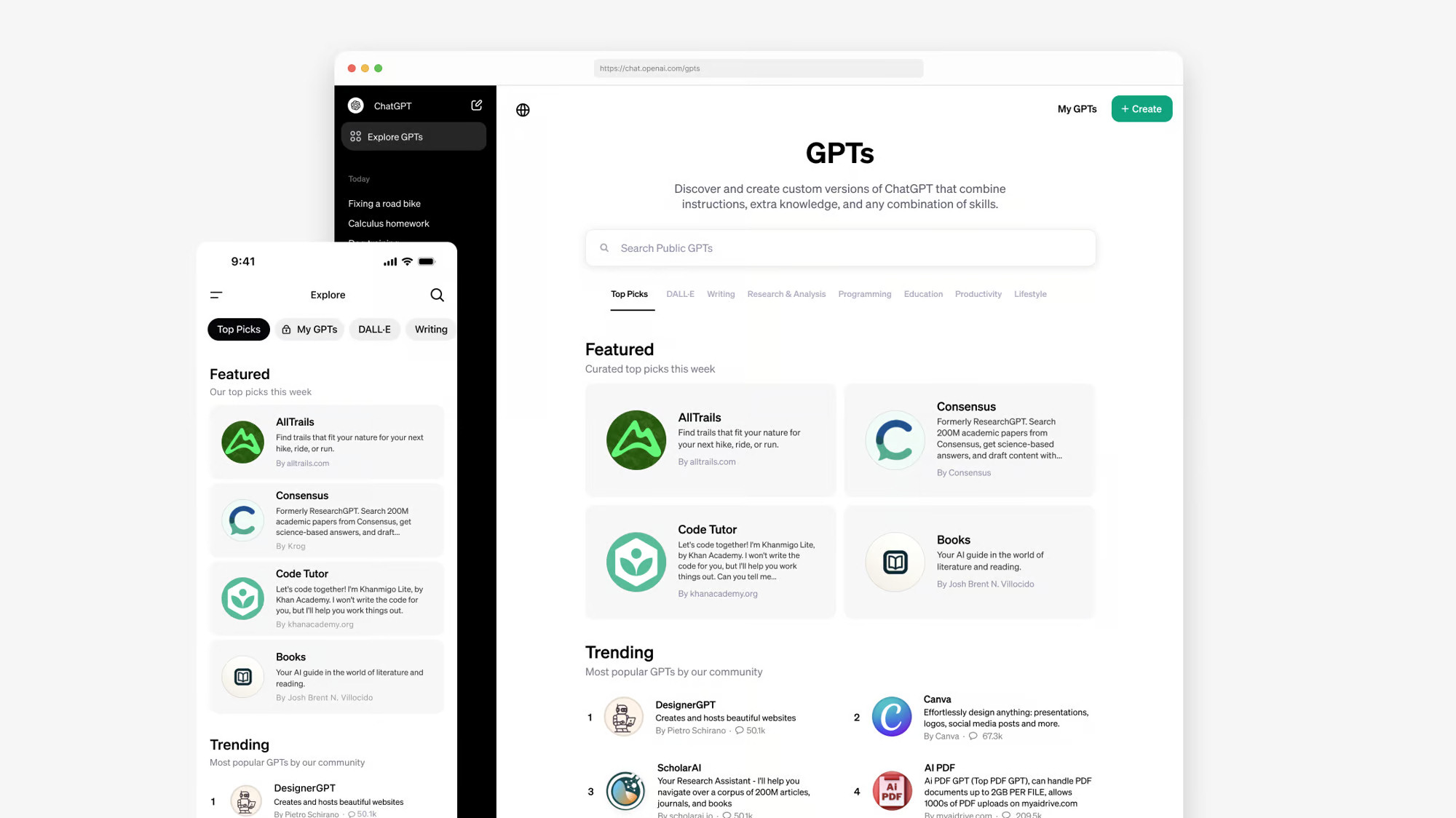
On Wednesday, OpenAI announced the launch of its GPT Store—a way for ChatGPT users to share and discover custom chatbot roles called “GPTs”—and ChatGPT Team, a collaborative ChatGPT workspace and subscription plan. OpenAI bills the new store as a way to “help you find useful and popular custom versions of ChatGPT” for members of Plus, Team, or Enterprise subscriptions.
“It’s been two months since we announced GPTs, and users have already created over 3 million custom versions of ChatGPT,” writes OpenAI in its promotional blog. “Many builders have shared their GPTs for others to use. Today, we’re starting to roll out the GPT Store to ChatGPT Plus, Team and Enterprise users so you can find useful and popular GPTs.”
OpenAI launched GPTs on November 6, 2023, as part of its DevDay event. Each GPT includes custom instructions and/or access to custom data or external APIs that can potentially make a custom GPT personality more useful than the vanilla ChatGPT-4 model. Before the GPT Store launch, paying ChatGPT users could create and share custom GPTs with others (by setting the GPT public and sharing a link to the GPT), but there was no central repository for browsing and discovering user-designed GPTs on the OpenAI website.
According to OpenAI, the ChatGPT Store will feature new GPTs every week, and the company shared a list a group of six notable early GPTs that are available now: AllTrails for finding hiking trails, Consensus for searching 200 million academic papers, Code Tutor for learning coding with Khan Academy, Canva for designing presentations, Books for discovering reading material, and CK-12 Flexi for learning math and science.
Enlarge/ A screenshot of the OpenAI GPT Store provided by OpenAI.
ChatGPT members can include their own GPTs in the GPT Store by setting them to be accessible to “Everyone” and then verifying a builder profile in ChatGPT settings. OpenAI plans to review GPTs to ensure they meet their policies and brand guidelines. GPTs that violate the rules can also be reported by users.
As promised by CEO Sam Altman during DevDay, OpenAI plans to share revenue with GPT creators. Unlike a smartphone app store, it appears that users will not sell their GPTs in the GPT Store, but instead, OpenAI will pay developers “based on user engagement with their GPTs.” The revenue program will launch in the first quarter of 2024, and OpenAI will provide more details on the criteria for receiving payments later.
“ChatGPT Team” is for teams who use ChatGPT
Also on Monday, OpenAI announced the cleverly named ChatGPT Team, a new group-based ChatGPT membership program akin to ChatGPT Enterprise, which the company launched last August. Unlike Enterprise, which is for large companies and does not have publicly listed prices, ChatGPT Team is a plan for “teams of all sizes” and costs US $25 a month per user (when billed annually) or US $30 a month per user (when billed monthly). By comparison, ChatGPT Plus costs $20 per month.
So what does ChatGPT Team offer above the usual ChatGPT Plus subscription? According to OpenAI, it “provides a secure, collaborative workspace to get the most out of ChatGPT at work.” Unlike Plus, OpenAI says it will not train AI models based on ChatGPT Team business data or conversations. It features an admin console for team management and the ability to share custom GPTs with your team. Like Plus, it also includes access to GPT-4 with the 32K context window, DALL-E 3, GPT-4 with Vision, Browsing, and Advanced Data Analysis—all with higher message caps.
Why would you want to use ChatGPT at work? OpenAI says it can help you generate better code, craft emails, analyze data, and more. Your mileage may vary, of course. As usual, our standard Ars warning about AI language models applies: “Bring your own data” for analysis, don’t rely on ChatGPT as a factual resource, and don’t rely on its outputs in ways you cannot personally confirm. OpenAI has provided more details about ChatGPT Team on its website.
https://arstechnica.com/?p=1994230
OpenAI says it’s “impossible” to create useful AI models without copyrighted material
ChatGPT developer OpenAI recently acknowledged the necessity of using copyrighted material in the development of AI tools like ChatGPT, The Telegraph reports, saying they would be “impossible” without it. The statement came as part of a submission to the UK’s House of Lords communications and digital select committee inquiry into large language models.
AI models like ChatGPT and the image generator DALL-E gain their abilities from training sessions fed, in part, by large quantities of content scraped from the public Internet without the permission of rights holders (In the case of OpenAI, some of the training content is licensed, however). This sort of free-for-all scraping is part of a longstanding tradition in academic machine learning research, but because deep learning AI models went commercial recently, the practice has come under intense scrutiny.
“Because copyright today covers virtually every sort of human expression—including blogposts, photographs, forum posts, scraps of software code, and government documents—it would be impossible to train today’s leading AI models without using copyrighted materials,” wrote OpenAI in the House of Lords submission.
Further, OpenAI writes that limiting training data to public domain books and drawings “created more than a century ago” would not provide AI systems that “meet the needs of today’s citizens.”
This statement follows a lawsuit filed last month by The New York Times against OpenAI and Microsoft, a significant investor in OpenAI, for allegedly using the newspaper’s content unlawfully in their products. OpenAI responded to the lawsuit on its website on Monday, claiming that the suit lacks merit and affirming its support for journalism and partnerships with news organizations.
OpenAI’s defense largely rests on the legal principle of fair use, which permits limited use of copyrighted content without the owner’s permission under specific circumstances. The company asserts that copyright law does not prohibit the training of AI models with such material.
“Training AI models using publicly available internet materials is fair use, as supported by long-standing and widely accepted precedents,” OpenAI wrote in its Monday blog post.”We view this principle as fair to creators, necessary for innovators, and critical for US competitiveness.”
This is not the first time OpenAI has claimed fair use regarding its AI training data. In August, we reported on a similar situation in which OpenAI defended its use of publicly available materials as fair use in response to a copyright lawsuit involving comedian Sarah Silverman.
OpenAI claimed that the authors in that lawsuit “misconceive[d] the scope of copyright, failing to take into account the limitations and exceptions (including fair use) that properly leave room for innovations like the large language models now at the forefront of artificial intelligence.”
https://arstechnica.com/?p=1994591
Regulators aren’t convinced that Microsoft and OpenAI operate independently
European Union regulators are concerned that Microsoft may be covertly controlling OpenAI as its biggest investor.
On Tuesday, the European Commission (EC) announced that it is currently “checking whether Microsoft’s investment in OpenAI might be reviewable under the EU Merger Regulation.”
The EC’s executive vice president in charge of competition policy, Margrethe Vestager, said in the announcement that rapidly advancing AI technologies are “disruptive” and have “great potential,” but to protect EU markets, a forward-looking analysis scrutinizing antitrust risks has become necessary.
Hoping to thwart predictable anticompetitive risks, the EC has called for public comments. Regulators are particularly keen to hear from policy experts, academics, and industry and consumer organizations who can identify “potential competition issues” stemming from tech companies partnering to develop generative AI and virtual world/metaverse systems.
The EC worries that partnerships like Microsoft and OpenAI could “result in entrenched market positions and potential harmful competition behavior that is difficult to address afterwards.” That’s why Vestager said that these partnerships needed to be “closely” monitored now—”to ensure they do not unduly distort market dynamics.”
Microsoft has denied having control over OpenAI.
A Microsoft spokesperson told Ars that, rather than stifling competition, since 2019, the tech giant has “forged a partnership with OpenAI that has fostered more AI innovation and competition, while preserving independence for both companies.”
But ever since Sam Altman was bizarrely ousted by OpenAI’s board, then quickly reappointed as OpenAI’s CEO—joining Microsoft for the brief time in between—regulators have begun questioning whether recent governance changes mean that Microsoft’s got more control over OpenAI than the companies have publicly stated.
OpenAI did not immediately respond to Ars’ request to comment. Last year, OpenAI confirmed that “it remained independent and operates competitively,” CNBC reported.
Beyond the EU, the UK’s Competition and Markets Authority (CMA) and reportedly the US Federal Trade Commission have also launched investigations into Microsoft’s OpenAI investments. On January 3, the CMA ended its comments period, but it’s currently unclear whether significant competition issues were raised that could trigger a full-fledged CMA probe.
A CMA spokesperson declined Ars’ request to comment on the substance of comments received or to verify how many comments were received.
Antitrust legal experts told Reuters that authorities should act quickly to prevent “critical emerging technology” like generative AI from being “monopolized,” noting that before launching a probe, the CMA will need to find evidence showing that Microsoft’s influence over OpenAI materially changed after Altman’s reappointment.
The EC is also investigating partnerships beyond Microsoft and OpenAI, questioning whether agreements “between large digital market players and generative AI developers and providers” may impact EU market dynamics.
Microsoft observing OpenAI board meetings
In total, Microsoft has pumped $13 billion into OpenAI, CNBC reported, which has a somewhat opaque corporate structure. OpenAI’s parent company, Reuters reported in December, is a nonprofit, which is “a type of entity rarely subject to antitrust scrutiny.” But in 2019, as Microsoft started investing billions into the AI company, OpenAI also “set up a for-profit subsidiary, in which Microsoft owns a 49 percent stake,” an insider source told Reuters. On Tuesday, a nonprofit consumer rights group, the Public Citizen, called for California Attorney General Robert Bonta to “investigate whether OpenAI should retain its non-profit status.”
A Microsoft spokesperson told Reuters that the source’s information was inaccurate, reiterating that the terms of Microsoft’s agreement with OpenAI are confidential. Microsoft has maintained that while it is entitled to OpenAI’s profits, it does not own “any portion” of OpenAI.
After OpenAI’s drama with Altman ended with an overhaul of OpenAI’s board, Microsoft appeared to increase its involvement with OpenAI by receiving a non-voting observer role on the board. That’s what likely triggered lawmaker’s initial concerns that Microsoft “may be exerting control over OpenAI,” CNBC reported.
The EC’s announcement comes days after Microsoft confirmed that Dee Templeton would serve as the observer on OpenAI’s board, initially reported by Bloomberg.
Templeton has spent 25 years working for Microsoft and is currently vice president for technology and research partnerships and operations. According to Bloomberg, she has already attended OpenAI board meetings.
Microsoft’s spokesperson told Ars that adding a board observer was the only recent change in the company’s involvement in OpenAI. An OpenAI spokesperson told CNBC that Microsoft’s board observer has no “governing authority or control over OpenAI’s operations.”
By appointing Templeton as a board observer, Microsoft may simply be seeking to avoid any further surprises that could affect its investment in OpenAI, but the CMA has suggested that Microsoft’s involvement in the board may have created “a relevant merger situation” that could shake up competition in the UK if not appropriately regulated.
https://arstechnica.com/?p=1994697
Magic: The Gathering maker admits it used AI-generated art despite standing ban
The promo image in question, seen in its original context.
Magic: The Gathering (MtG) maker Wizards of the Coast (WotC) has apologized after admitting it made a “mistake” in publishing a promotional image that included artwork at least partially generated using artificial intelligence tools. The admission comes despite a WotC policy barring the use of AI in its art, and the controversy has already caused at least one MtG artist to publicly announce that he is “done” with the company.
The promo image in question was posted in a now-deleted (but still archived) social media post last Thursday, showing five new “retro frame” versions of lands from the upcoming Ravnica Remastered set in a nondescript steampunk-style laboratory. While the image looks unobjectionable at first glance, careful viewers soon zoomed in on specific and incongruous background details in the lab that showed telltale errors common to some AI image generators. (The human authorship of the art on the cards themselves, it should be noted, has not yet come under question.)
The suggestion that AI art tools were used in a promo image is particularly sensitive for Wizards of the Coast, which has relied on hundreds of human artists to generate tens of thousands of iconic images for its Magic cards and its Dungeons & Dragons (D&D) products over the years. Last August, when a longtime D&D artist was found to be using AI tools for commissioned pieces, WotC said that it was “updating our artist guidelines to make clear that artists must refrain from using AI art generation as part of their art creation process for developing D&D art.”
In December, amid a wave of company layoffs that included many human art directors, WotC publicly reaffirmed its “internal guidance” that “we require artists, writers, and creatives contributing to the Magic TCG to refrain from using AI generative tools to create final Magic products.”
As accusations of AI use in the creation of the promo image grew throughout the day, WotC posted multiple defenses on Thursday (such as this archived, now-deleted post) insisting that the art in question “was created by humans and not AI.” But given the evidence, the situation was too much for veteran MtG artist Dave Rapoza, who has created art for dozens of Magic cards going back years.
“And just like that, poof, I’m done working for Wizards of the Coast,” Rapoza wrote on social media on Saturday. “You can’t say you stand against this then blatantly use AI to promote your products… If you’re gonna stand for something you better make sure you’re actually paying attention, don’t be lazy, don’t lie.”
Whoopsy-daisy
Well, we made a mistake earlier when we said that a marketing image we posted was not created using AI. Read on for more. (1/5)
By Sunday afternoon, WotC had backtracked on its initial claims, saying on social media that it “made a mistake earlier when we said that a marketing image we posted was not created using AI.” In the same thread, WotC explained that the art, which it says was provided by an outside vendor, included “some AI components that are now popping up in industry standard tools like Photoshop… even if a human did the work to create the overall image.”
In an accompanying statement on its website, WotC thanked the “diligent community” that noticed the issue and said it was “rethinking our process of how we work with vendors for our marketing creative… We can’t promise to be perfect in such a fast-evolving space, especially with generative AI becoming standard in tools such as Photoshop, but our aim is to always come down on the side of human-made art and artists.”
Rapoza said in a follow-up message Sunday evening that he was “not going to return for work” with the company even after hearing WotC’s explanation. “Let’s see how this all pans out over time,” he wrote. “My hope is they stick to their word but everyone seems to be heading that direction so I’ll hang for awhile.”
But for others, WotC’s handling of the controversy highlights just how difficult it can be to maintain an outright ban on AI-generated art, even for companies that, like WotC, say they want to work with human artists.
“My stance is that the larger the entity and the more AI develops, it’s going to get harder and harder to spot,” freelance MtG artist Jason Rainville wrote on social media. “It’s going to squeak through, especially [with] the amount of freelancers and vendors out of house.”
https://arstechnica.com/?p=1994427
AI, le aziende cinesi guardano in patria per la fornitura di chips
Il primo beneficiario dei tentativi americani di impedire i progressi cinesi nel campo dell’intelligenza artificiale sembra essere Huawei. E’ quanto emerge da un articolo delWall Street Journal, secondo cui il bando di forniture made in usa alla Cina (in questo caso di chips targati Nvidia) andrà a tutto vantaggio dei produttori cinesi.
AI fronte di battaglia fra Usa e Cina
L’anno scorso l’Intelligenza Artificiale ha rappresentato uno dei primi fronti di scontro fra Usa e Cina. Su molti aspetti dell’AI la Cina è già davanti agli Usa, anche se resta dipendente dalla fornitura da parte della statunitense Nvidia per quanto concerne i super chip necessari per lo sviluppo della tecnologia.
Non a caso il divieto di fornire questi chips alle aziende cinesi rappresenta un vantaggio competitivo importante per gli Stati Uniti, che per questo motivo hanno ridimensionato le forniture di chips made in Usa verso la Cina.
Si guarda in patria
Secondo il Wall Street Journal, le aziende cinesi hanno fatto di necessità virtù e nell’ultimo anno hanno cominciato a guardare più intensamente in patria, acquistando in grandi quantitativi il nuovo chip Ascend 910B prodotto da Huawei che di fatto sopperisce al bando dei migliori prodotti di Nvidia.
La società di analisi TrendForce ha recentemente pubblicato una nota di ricerca sul chip Ascend 910B, ipotizzando che sia prodotto dalla principale fonderia cinese SMIC. Sono ancora un paio di generazioni indietro rispetto a ciò di cui sono capaci TSMC e Samsung, ma sono già abbastanza avanzati.
Sanzioni Usa un boomerang?
L’articolo del WSJ conclude che questa è l’inevitabile conseguenza delle sanzioni statunitensi. La Cina ha investito risorse nel settore nazionale dei semiconduttori da quando gli Stati Uniti hanno avviato le ostilità tecnologiche e, anche se è improbabile che riuscirà mai a raggiungere completamente la taiwanese TSMC, potrebbe fare abbastanza per rimanere competitiva.
Huawei, ovviamente, è stata particolarmente colpita dalle sanzioni statunitensi negli ultimi anni. Sarebbe una grossa rivalsa se l’azienda si potesse rilanciare grazie alla produzione di chip AI per i giganti della tecnologia cinese come Alibaba, Tencent e Baidu, così come tutti i tipi di chip per i propri smartphone.
Android users could soon replace Google Assistant with ChatGPT
Aurich Lawson | Getty Images
Hey Android users, are you tired of Google’s neglect of Google Assistant? Well, one of Google’s biggest rivals, OpenAI’s ChatGPT, is apparently coming for the premium phone space occupied by Google’s voice assistant. Mishaal Rahman at Android Authority found that the ChatGPT app is working on support for Android’s voice assistant APIs and a system-wide overlay UI. If the company rolls out this feature, users could set the ChatGPT app as the system-wide assistant app, allowing it to pop up anywhere in Android and respond to user questions. ChatGPT started as a text-only generative AI but received voice and image input capabilities in September.
Usually, it’s the Google Assistant with system-wide availability in Android, but that’s not special home cooking from Google—it all happens via public APIs that technically any app can plug into. You can only have one app enabled as the system-wide “Default Assistant App,” and beyond the initial setting, the user always has to change it manually. The assistant APIs are designed to be powerful, keeping some parts of the app running 24/7 no matter where you are. Being the default Assistant app enables launching the app via the power button or a gesture, and the assist app can read the current screen text and images for processing.
If some Android manufacturer signed a deal with ChatGPT and included it as a bundled system application, ChatGPT could even use an always-on voice hotword, where saying something like “Hey, ChatGPT” would launch the app even when the screen is off. System apps get more permissions than normal apps, though, and an always-on hotword is locked behind these system app permissions, so ChatGPT would need to sign a distribution deal with some Android manufacturer. Given the red-hot popularity of ChatGPT, though, I’m sure a few would sign up if it were offered.
Rahman found that ChatGPT version 1.2023.352, released last month, included a new activity named “com.openai.voice.assistant.AssistantActivity.” He managed to turn on the normally disabled feature that revealed ChatGPT’s new overlay API. This is the usual semi-transparent spinning orb UI that voice assistants use, although Rahman couldn’t get it to respond to a voice command just yet. This is all half-broken and under development, so it might never see a final release, but companies usually release the features they’re working on.
Of course, the problem with any of these third-party voice assistant apps as a Google Assistant replacement is that they don’t run a serious app ecosystem. As with Bixby and Alexa, there are no good apps to host your notes, reminders, calendar entries, shopping list items, or any other input-based functions you might want to do. As a replacement for Google Search, though, where you ask it a question and get an answer, it would probably be a decent alternative.
Google has neglected Google Assistant for years, but with the rise of generative AI, it’s working on revamping Assistant with some Google Bard smarts. It’s also reportedly working on a different assistant, “Pixie,” which would apparently launch with the Pixel 9, but that will be near the end of 2024.
https://arstechnica.com/?p=1993933
How much detail is too much? Midjourney v6 attempts to find out
Enlarge/ An AI-generated image of a “Beautiful queen of the universe looking at the camera in sci-fi armor, snow and particles flowing, fire in the background” created using alpha Midjourney v6.
Midjourney
In December, just before Christmas, Midjourney launched an alpha version of its latest image synthesis model, Midjourney v6. Over winter break, Midjourney fans put the new AI model through its paces, with the results shared on social media. So far, fans have noted much more detail than v5.2 (the current default) and a different approach to prompting. Version 6 can also handle generating text in a rudimentary way, but it’s far from perfect.
“It’s definitely a crazy update, both in good and less good ways,” artist Julie Wieland, who frequently shares her Midjourney creations online, told Ars. “The details and scenery are INSANE, the downside (for now) are that the generations are very high contrast and overly saturated (imo). Plus you need to kind of re-adapt and rethink your prompts, working with new structures and now less is kind of more in terms of prompting.”
At the same time, critics of the service still bristle about Midjourney training its models using human-made artwork scraped from the web and obtained without permission—a controversial practice common among AI model trainers we have coveredindetail in the past. We’ve also covered the challenges artists might face in the future from these technologies elsewhere.
Too much detail?
With AI-generated detail ramping up dramatically between major Midjourney versions, one could wonder if there is ever such as thing as “too much detail” in an AI-generated image. Midjourney v6 seems to be testing that very question, creating many images that sometimes seem more detailed than reality in an unrealistic way, although that can be modified with careful prompting.
An AI-generated image of a nurse in the 1960s created using alpha Midjourney v6.
Midjourney
An AI-generated image of an astronaut created using alpha Midjourney v6.
Midjourney
An AI-generated image of a “juicy flaming cheeseburger” created using alpha Midjourney v6.
Midjourney
An AI-generated image of “a handsome Asian man” created using alpha Midjourney v6.
Midjourney
An AI-generated image of an “Apple II” sitting on a desk in the 1980s created using alpha Midjourney v6.
Midjourney
An AI-generated image of a “photo of a cat in a car holding a can of beer” created using alpha Midjourney v6.
Midjourney
An AI-generated image of a forest path created using alpha Midjourney v6.
Midjourney
An AI-generated image of a woman among flowers created using alpha Midjourney v6.
Midjourney
An AI-generated image of “a plate of delicious pickles” created using alpha Midjourney v6.
Midjourney
An AI-generated image of a barbarian beside a TV set that says “Ars Technica” on it created using alpha Midjourney v6.
Midjourney
An AI-generated image of “Abraham Lincoln holding a sign that says Ars Technica” created using alpha Midjourney v6.
Midjourney
An AI-generated image of Mickey Mouse holding a machine gun created using alpha Midjourney v6.
Midjourney
In our testing of version 6 (which can currently be invoked with the “–v 6.0” argument at the end of a prompt), we noticed times when the new model appeared to produce worse results than v5.2, but Midjourney veterans like Wieland tell Ars that those differences are largely due to the different way that v6.0 interprets prompts. That is something Midjourney is continuously updating over time. “Old prompts sometimes work a bit better than the day they released it,” Wieland told us.
https://arstechnica.com/?p=1993424
All Science journals will now do an AI-powered check for image fraud
Aurich Lawson
On Thursday, the research publisher Science announced that all of its journals will begin using commercial software that automates the process of detecting improperly manipulated images. The move comes many years into our awareness that the transition to digital data and publishing has made it comically easy to commit research fraud by altering images.
While the move is a significant first step, it’s important to recognize the software’s limitations. While it will catch some of the most egregious cases of image manipulation, enterprising fraudsters can easily avoid being caught if they know how the software operates. Which, unfortunately, we feel compelled to describe (and, to be fair, the company that has developed the software does so on its website).
Fantastic fraud and how to catch it
Much of the image-based fraud we’ve seen arises from a dilemma faced by many scientists: It’s not a problem to run experiments, but the data they generate often isn’t the data you want. Maybe only the controls work, or maybe the experiments produce data that is indistinguishable from controls. For the unethical, this doesn’t pose a problem since nobody other than you knows what images come from which samples. It’s relatively simple to present images of real data as something they’re not.
To make this concrete, we can look at data from a procedure called a western blot, which uses antibodies to identify specific proteins from a complex mixture that has been separated according to protein size. Typical western blot data looks like the image at right, with the darkness of the bands representing proteins that are present at different levels in different conditions.
A western blot like this, with lots of individual images removed from their original context, makes it easy to commit research fraud.
Note that the bands are relatively featureless and are cropped out of larger images of the raw data, divorcing them from their original context. It’s possible to take bands from one experiment and splice them into an image of a different experiment entirely, fraudulently generating “evidence” where none exists. Similar things can be done with graphs, photographs of cells, and so on.
Since data is hard to come by and fraudsters are often lazy, in many cases, the original and fraudulent images are both derived from data used for the same paper. To hide their tracks, unethical researchers will often rotate, magnify, crop, or change the brightness/contrast of images and use them more than once in the same paper.
Not everyone is quite that lazy. But this image recycling is remarkably common and perhaps the most frustrating form of research fraud. All the evidence is in the paper, and it is usually easy to see once it’s pointed out. But it can be remarkably difficult to spot in the first place.
That “spot in the first place” challenge is why Science is turning to a service called Proofig to make it easier to spot problems.