AI, la Cina ha almeno 130 grandi modelli linguistici (LLM), il 40% del totale globale. Appena dietro la quota del 50% degli USA
Nella supremazia tecnologica la Cina si fronteggia con gli Stati Uniti ovviamente anche sull’Intelligenza Artificiale. Secondo i dati riportati da Reuters, la Cina ha almeno 130 grandi modelli linguistici (LLM), il 40% del totale globale. Appena dietro la quota del 50% degli USA.
E 11 grandi modelli cinesi di intelligenza artificiale, tra cui ERNIE Bot di Baidu, hanno ottenuto l’approvazione per il rilascio al grande pubblico.
L’obiettivo dichiarato della Cina è quello di raggiungere la “leadership globale dell’IA” entro il 2030.
Dal 2022, la Cina ha adottato tre leggi separate sull’IA. Queste leggi si concentrano sui “deepfake”, sull’intelligenza artificiale generativa e sui sistemi di raccomandazione algoritmica per notizie e contenuti sui social media. Questo nuovo quadro normativo è notevolmente diverso dall’AI Act dell’UE e dall’approccio degli Stati Uniti.
Insieme all’UE, la Cina è stata probabilmente l’autorità di regolamentazione dell’IA più attiva al mondo.
La Cina è ora nel bel mezzo del varo di alcune delle prime e più dettagliate normative al mondo che disciplinano l’intelligenza artificiale.
Le tre normative cinesi più concrete e di impatto sugli algoritmi e l’AI sono il regolamento del 2021 sugli algoritmi di raccomandazione, le regole del 2022 sui contenuti generati sinteticamente e la bozza di regole del 2023 sull’AI generativa.
Megatrends, dall’AI alle elezioni Usa. Cosa aspettarsi dal 2024?
Ricorderemo il 2023 come un anno di svolta, in cui quasi tutti i mega-trend della finanza, della tecnologia, del commercio, della geopolitica, della guerra e del riscaldamento climatico hanno mostrato segni di accelerazione in termini di velocità e portata.
Una serie di shock a cascata che sembrano accumularsi in uno shock più grande in futuro.
Ma come sarà il 2024?
Di seguito le previsioni con particolare attenzione al mondo delle tecnologie di Andrew Sheng, distinguished fellow della Asia Global Institute, University of Hong Kong, chief adviser di China Banking Regulatory Commission, e autore per l’Asia News Network.
Tecnologie
Nel campo della tecnologia, il 2023 ha segnato l’avvento rivoluzionario dell’intelligenza artificiale generativa (AI), attraverso il lancio pubblico di ChatGPT nel novembre 2022. L’intelligenza artificiale commercializzata è considerata la prossima grande novità dopo Internet, innescando un rally dei titoli tecnologici negli Stati Uniti, guidato dalle ‘Magnifiche sette’ aziende di software e hardware legati all’intelligenza artificiale.
Il rally ha evitato un anno di perdite di portafoglio nei mercati finanziari colpiti dai rialzi dei tassi di interesse.
Commercio
Nel commercio, l’ultimo Global Trade Update dell’UNCTAD ha rilevato che il commercio globale si ridurrà del 5% arrivando a 30,7 trilioni di dollari nel 2023, con il commercio di beni in calo di quasi 2 trilioni di dollari, mentre il commercio di servizi si espanderà di 500 miliardi di dollari. Le prospettive per il 2024 sono pessimistiche perché le questioni commerciali sono ora geopolitiche, piuttosto che puramente guidate dal mercato. Le catene di approvvigionamento globali si stanno disaccoppiando, per ridurre i rischi per evitare possibili sanzioni imposte per ragioni geopolitiche.
Geopolitica
La geopolitica ha dominato i titoli dei giornali nel 2023, poiché la diplomazia ha giocato un ruolo secondario rispetto alla militarizzazione o all’armamento di tutto. Il rischio più grande affrontato oggi dalle imprese è il rischio per la sicurezza nazionale, nel caso in cui aziende o istituzioni finanziarie si trovino intrappolate in un gioco geopolitico derivante da differenze binarie di valori. Quando è in gioco la sicurezza nazionale, l’azienda deve sostenere tutti i costi della ristrutturazione della catena di fornitura senza fare domande, o affrontare possibili blocchi esistenziali
Elezioni Usa
Il prossimo anno vedrà elezioni decisive ma caotiche, soprattutto negli Stati Uniti, dove entrambi i candidati alla presidenza potrebbero essere messi sotto accusa o condannati. Ciò non può essere di buon auspicio per tutti, perché il 2023 segna il punto di svolta in cui gli Stati Uniti perderanno il rispetto del Sud del mondo per la loro catastrofica gestione dell’Ucraina e di Gaza, entrambe combattute fino all’ultimo ucraino o palestinese. La moralità di permettere ad altre persone di combattere e morire per il proprio vantaggio non dimostra ipocrisia ma codardia su scala egemonica.
La conclusione è che non mancano né la tecnologia né il denaro per affrontare le minacce esistenziali globali rappresentate dal cambiamento climatico e dagli squilibri sociali. Non possiamo allineare l’intento politico (ciò che i politici dicono che faranno) con la realtà che le politiche attuali non stanno dando risultati.
Se incombono calamità naturali o provocate dall’uomo, dobbiamo mitigarle o cercare di adattarci? In un unico pianeta possiamo scappare ma non nasconderci. Quindi, ognuno di noi deve decidere di fare ciò che può, invece di affidarsi ai politici per risolvere se stessi, per non parlare dei propri problemi.
ChatGPT bombs test on diagnosing kids’ medical cases with 83% error rate
Enlarge/ Dr. Greg House has a better rate of accurately diagnosing patients than ChatGPT.
ChatGPT is still no House, MD.
While the chatty AI bot has previously underwhelmed with its attempts to diagnose challenging medical cases—with an accuracy rate of 39 percent in an analysis last year—a study out this week in JAMA Pediatrics suggests the fourth version of the large language model is especially bad with kids. It had an accuracy rate of just 17 percent when diagnosing pediatric medical cases.
The low success rate suggests human pediatricians won’t be out of jobs any time soon, in case that was a concern. As the authors put it: “[T]his study underscores the invaluable role that clinical experience holds.” But it also identifies the critical weaknesses that led to ChatGPT’s high error rate and ways to transform it into a useful tool in clinical care. With so much interest and experimentation with AI chatbots, many pediatricians and other doctors see their integration into clinical care as inevitable.
The medical field has generally been an early adopter of AI-powered technologies, resulting in some notable failures, such as creating algorithmic racial bias, as well as successes, such as automating administrative tasks and helping to interpret chest scans and retinal images. There’s also lot in between. But AI’s potential for problem-solving has raised considerable interest in developing it into a helpful tool for complex diagnostics—no eccentric, prickly, pill-popping medical genius required.
In the new study conducted by researchers at Cohen Children’s Medical Center in New York, ChatGPT-4 showed it isn’t ready for pediatric diagnoses yet. Compared to general cases, pediatric ones require more consideration of the patient’s age, the researchers note. And as any parent knows, diagnosing conditions in infants and small children is especially hard when they can’t pinpoint or articulate all the symptoms they’re experiencing.
For the study, the researchers put the chatbot up against 100 pediatric case challenges published in JAMA Pediatrics and NEJM between 2013 and 2023. These are medical cases published as challenges or quizzes. Physicians reading along are invited to try to come up with the correct diagnosis of a complex or unusual case based on the information that attending doctors had at the time. Sometimes, the publications also explain how attending doctors got to the correct diagnosis.
Missed connections
For ChatGPT’s test, the researchers pasted the relevant text of the medical cases into the prompt, and then two qualified physician-researchers scored the AI-generated answers as correct, incorrect, or “did not fully capture the diagnosis.” In the latter case, ChatGPT came up with a clinically related condition that was too broad or unspecific to be considered the correct diagnosis. For instance, ChatGPT diagnosed one child’s case as caused by a branchial cleft cyst—a lump in the neck or below the collarbone—when the correct diagnosis was Branchio-oto-renal syndrome, a genetic condition that causes the abnormal development of tissue in the neck, and malformations in the ears and kidneys. One of the signs of the condition is the formation of branchial cleft cysts.
Overall, ChatGPT got the right answer in just 17 of the 100 cases. It was plainly wrong in 72 cases, and did not fully capture the diagnosis of the remaining 11 cases. Among the 83 wrong diagnoses, 47 (57 percent) were in the same organ system.
Among the failures, researchers noted that ChatGPT appeared to struggle with spotting known relationships between conditions that an experienced physician would hopefully pick up on. For example, it didn’t make the connection between autism and scurvy (Vitamin C deficiency) in one medical case. Neuropsychiatric conditions, such as autism, can lead to restricted diets, and that in turn can lead to vitamin deficiencies. As such, neuropsychiatric conditions are notable risk factors for the development of vitamin deficiencies in kids living in high-income countries, and clinicians should be on the lookout for them. ChatGPT, meanwhile, came up with the diagnosis of a rare autoimmune condition.
Though the chatbot struggled in this test, the researchers suggest it could improve by being specifically and selectively trained on accurate and trustworthy medical literature—not stuff on the Internet, which can include inaccurate information and misinformation. They also suggest chatbots could improve with more real-time access to medical data, allowing the models to refine their accuracy, described as “tuning.”
“This presents an opportunity for researchers to investigate if specific medical data training and tuning can improve the diagnostic accuracy of LLM-based chatbots,” the authors conclude.
https://arstechnica.com/?p=1993601
Early Mickey Mouse is now in the public domain—and AI is already on the case
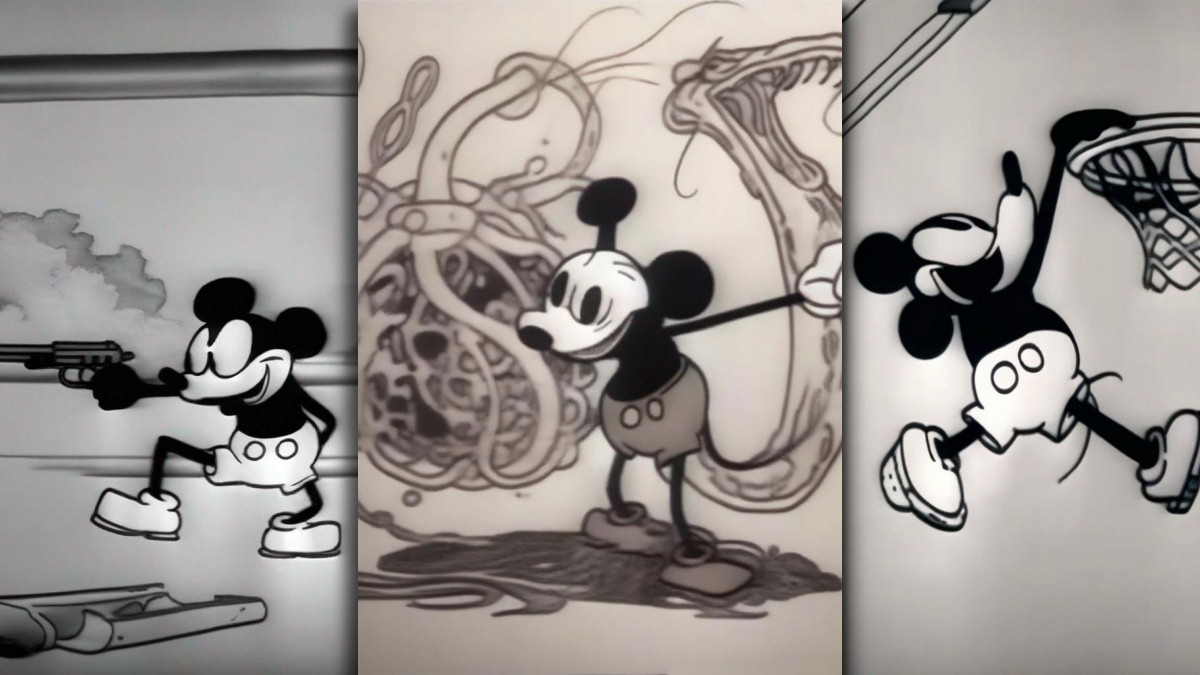
Enlarge/ AI-generated results of a gangster Mickey Mouse, Eldritch Horror Mickey Mouse, and Basketball Mickey Mouse created by a model trained on 1928 public domain Mickey Mouse cartoons.
Schroedingercat, Kevin Elliott, David Binkowski
On January 1, three early Mickey Mouse cartoons entered the public domain in the US, and AI experimenters have wasted no time taking advantage of it. On Monday, a digital humanities researcher named Pierre-Carl Langlais uploaded an AI model to Hugging Face that has been trained on those public domain cartoons, and anyone can use it to create new still images based on a written prompt. While the results are rough and sometimes garbled, they show notable early experimentation with integrating public domain Mickey into the AI space.
The new model can create images of Mickey Mouse, Minnie Mouse, and Peg Leg Pete. “The generated images aims adhere [sic] to the 1928 design in order to have Mickey, Minnie and Pete and in the public domain,” writes Langlais on the model card. “This is still a work in progress: while the model is in development, generated images should be checked to ensure they really are in the public domain design.”
To create the model, Langlais fine-tuned a version of Stable Diffusion XL with 34 cartoon image stills from Steamboat Willie, 22 stills from Plane Crazy, and 40 stills from The Gallopin’ Gaucho—all released in 1928 and now in the public domain. More stills would have equated to more cost and training time, so he likely kept the number of images low for practical purposes, although that created lower-quality results. And Langlais writes in the model card that the training stills aren’t as high quality as possible, but that might change over time: “Hopefully with the cartoons now being part of the public domain, higher definition versions should be available.”
AI-generated version of 1928 Mickey Mouse using the prompt, “drawing of Mickey, a muscular barbarian with weapons beside a CRT television set, cinematic, 8K, studio lighting”
Benj Edwards
AI-generated version of 1928 Mickey Mouse using the prompt, “drawing of Mickey, a muscular barbarian with weapons beside a CRT television set, cinematic, 8K, studio lighting”
Benj Edwards
AI-generated 1928 Mickey Mouse holding a sword.
Mickey Mouse eating pickles, showing that the results aren’t always perfect. More training time and better training data could potentially fix this in the future.
Benj Edwards
Soon after news of the new model hit social media, a thread on Bluesky created by Techdirt editor Mike Masnick featured people using the new AI image generator to humorously create images of Mickey Mouse that presumably Disney might not want to see, including Mickey smoking crack, attacking the US Capitol, nailed to a crucifix, and becoming an eldritch horror. Since 1928, Mickey cartoons haven’t included crucifixes or Lovecraftian horrors, so whatever concepts that aren’t included in the original works have come from the Stable Diffusion XL base model.
Of course, Mickey Mouse has been the subject of this kind of parody before, without AI. Many of these images likely would fall under fair use provisions for parody, even if early Mickey had not just entered the public domain. And AI-generated images of Mickey were widely possible before if you used an unfiltered AI image generator. But in particular, people are experimenting with the fact that it’s now possible to legally use 1928 Mickey Mouse imagery fully and freely as AI training data, with no strings attached (even though the legality of copyrighted training data is still unresolved in the US).
It’s worth noting that the use of Stable Diffusion XL here doesn’t make these images 100 percent legal since its base model still incorporates copyrighted works in its training data. But as we just mentioned, it’s not necessarily illegal either since the issue has not been fully resolved. There’s a lot of nuance at work here. To make the legal situation even more interesting, AI-generated images technically fall in the public domain in the US (and can’t be copyrighted), although some of the images might not be fully public domain if they include certain depictions of copyright-protected designs or characters used without permission.
As we’ve previously reported, the three 1928 Mickey Mouse cartoons were due to enter the public domain much earlier (on January 1, 1999), but due to the Sonny Bono Copyright Term Extension Act passed in 1998, that date was pushed back 25 years. It’s worth noting that this public domain admission doesn’t cover later versions of Mickey, and using the Mickey Mouse name commercially still has trademark implications. Expect those issues to be tested thoroughly over time now that the American public “owns” an early version of Mickey.
https://arstechnica.com/?p=1993162
CES 2024, cosa aspettarsi alla kermesse dell’Hitech di Las Vegas (la prima nell’era dell’AI generativa)
Il Consumer Electronics Show (CES) del 2024 a Las Vegas (9-12 gennaio) sarà il primo a svolgersi dall’incredibile ascesa all’ubiquità dell’intelligenza artificiale generativa. Sarà come sempre l’occasione per assistere alle innovazioni tecnologiche più rivoluzionarie in azione. Qui, prevediamo le tendenze attese in fiera secondo il sito specializzato Ignition.
L’Ascesa dell’IA
Ci si aspetta di vedere l’intelligenza artificiale ovunque, anche in luoghi inaspettati. Oltre ai chatbot e agli assistenti d’ufficio, l’intelligenza artificiale si sta incorporando in una gamma di nuovi dispositivi, dispositivi indossabili e applicazioni di facile utilizzo. Flappie è una gattaiola intelligente dell’azienda svizzera di tecnologia per animali domestici Flappie Technologies, che utilizza l’intelligenza artificiale per rilevare se un gatto sta cercando di portare la preda in casa.
Flappie
Le nuove mosse della mobilità
Riteniamo che l’innovazione dell’ecomobilità si estenderà oltre le categorie automobilistiche e si estenderà a un’ampia gamma di prodotti e servizi di mobilità. Con la rivoluzione dei veicoli elettrici (EV) in pieno svolgimento, il CES 2024 promette naturalmente di fornire anche entusiasmanti aggiornamenti automobilistici. Aggiornamenti pratici e senza pretese, come le batterie a lunga durata per i veicoli elettrici, saranno presentati insieme ad eleganti sistemi di intrattenimento in auto con display coinvolgenti e tecnologia di realtà virtuale.
Supernal
La sostenibilità mette radici
La sostenibilità sarà un argomento che permea molte innovazioni e categorie di prodotti al CES 2024, con particolare attenzione alla riduzione dei rifiuti, alla progettazione circolare e al miglioramento dei materiali riciclabili. Retarch, un’alternativa ecologica alla plastica a base di amido della struttura di ricerca sudcoreana Day1Lab, ha già vinto un CES 2024 Innovation Award. Allo stesso modo, le soluzioni tecnologiche alimentari che aiutano a nutrire una popolazione globale in crescita saranno protagoniste dell’evento anche il prossimo anno. Ci aspettiamo di vedere innovazioni legate ai metodi di coltivazione sperimentale guidati dalla robotica, dall’intelligenza artificiale e dall’automazione, che miglioreranno l’efficienza delle catene di approvvigionamento.
Day1 Lab
Tecnologia sanitaria di precisione per ogni corpo
Evolvendo dalle soluzioni sanitarie digitali che abbiamo visto al CES 2022 e 2023, cercheremo app e dispositivi medtech che siano più precisi, accurati e accessibili che mai.
Gli scanner sanitari in grado di rilevare i problemi prima che si verifichino saranno un punto focale particolare, come l’irlandese IdentityHer, un piccolo sensore che utilizza un algoritmo di intelligenza artificiale per determinare se una donna sta vivendo sintomi premenopausali e fornisce una lettura di tali indicatori in un’app. Nvidia, la società di computer e tecnologia con sede negli Stati Uniti che quest’anno ha trasformato il suo modello di business per concentrarsi sull’informatica basata sull’intelligenza artificiale, terrà un discorso sulla salute digitale. Nvidia sta finanziando e costruendo infrastrutture per progetti di intelligenza artificiale che aiutano la scoperta di farmaci. Con recenti rapporti che suggeriscono che la scoperta di farmaci assistita dall’intelligenza artificiale potrebbe portare a trattamenti innovativi come i vaccini contro il cancro, siamo curiosi di vedere come questa tecnologia verrà applicata a prodotti e servizi pronti per il mercato al CES.
IdentifyHer IdentifyHer
Case intelligenti simbiotiche
Dai dispositivi connessi e dagli elettrodomestici ad alta efficienza energetica alla tecnologia di sicurezza abilitata all’intelligenza artificiale, l’elettronica domestica e altre innovazioni per la casa intelligente avranno una forte presenza al CES 2024. Numerosi progetti ingegnosi – come il WaterCube della start-up statunitense Genesis Systems, che trasforma l’aria in acqua potabile; o la telecamera di sicurezza intelligente della Swann Communications della California che utilizza un assistente vocale AI per parlare con i fattorini quando consegnano un pacco – verranno svelati durante l’evento. Oltre al design pratico, saranno al centro dell’attenzione anche i nuovi progressi nell’intrattenimento domestico che forniscono esperienze personalizzate e giocose.
AI-created “virtual influencers” are stealing business from humans
Enlarge/ Aitana Lopez, an AI-generated influencer, has convinced many social media users she is real.
FT montage/TheClueless/GettyImages
Pink-haired Aitana Lopez is followed by more than 200,000 people on social media. She posts selfies from concerts and her bedroom, while tagging brands such as hair care line Olaplex and lingerie giant Victoria’s Secret.
Brands have paid about $1,000 a post for her to promote their products on social media—despite the fact that she is entirely fictional.
Aitana is a “virtual influencer” created using artificial intelligence tools, one of the hundreds of digital avatars that have broken into the growing $21 billion content creator economy.
Their emergence has led to worry from human influencers their income is being cannibalized and under threat from digital rivals. That concern is shared by people in more established professions that their livelihoods are under threat from generative AI—technology that can spew out humanlike text, images and code in seconds.
But those behind the hyper-realistic AI creations argue they are merely disrupting an overinflated market.
“We were taken aback by the skyrocketing rates influencers charge nowadays. That got us thinking, ‘What if we just create our own influencer?’” said Diana Núñez, co-founder of the Barcelona-based agency The Clueless, which created Aitana. “The rest is history. We unintentionally created a monster. A beautiful one, though.”
Over the past few years, there have been high-profile partnerships between luxury brands and virtual influencers, including Kim Kardashian’s make-up line KKW Beauty with Noonoouri, and Louis Vuitton with Ayayi.
Instagram analysis of an H&M advert featuring virtual influencer Kuki found that it reached 11 times more people and resulted in a 91 percent decrease in cost per person remembering the advert, compared with a traditional ad.
https://arstechnica.com/?p=1993011
Il ruolo inclusivo dell’intelligenza artificiale per le donne nella cybersecurity
Secondo un rapporto dell’UNESCO del 2019, le donne rappresentano solo il 29% delle posizioni di ricerca e sviluppo scientifico a livello globale e hanno già il 25% in meno di probabilità rispetto agli uomini di sapere come utilizzare la tecnologia digitale per scopi di base.
AI impatterà sul lavoro femminile
L’uso delle tecnologie di intelligenza artificiale (AI) influenzerà le opportunità di lavoro delle donne, nonché la loro posizione, status e trattamento sul posto di lavoro, scrive il sito specializzato Capacity.
Un ambito in cui le donne sono particolarmente sotto rappresentate è la cybersecurity. Ma qual è il ruolo dell’integrazione dell’AI sulle donne nello spazio cyber e ancora, l’AI sarà un plus o una minaccia per l’inclusività femminile?
Soltanto il 25% delle donne nel settore dell’AI
Cominciamo quindi dai fatti: secondo i dati pubblicati dall’OCSE, le donne nel settore dell’intelligenza artificiale rappresentano attualmente meno del 25% della forza lavoro, il che è un problema quando si tratta di diversità di pensiero in fase di sviluppo.
Affinché l’intelligenza artificiale possa veramente servire tutta l’umanità, deve ricevere il contributo di tutta l’umanità. Ciò significa una forza lavoro diversificata che crea e seleziona i dati da utilizzare.
Inclusività va regolata
La governance dell’AI deve regolare l’inclusività per la creazione di strumenti intesi per il mercato di massa, in grado di eliminare i pregiudizi e di assicurare che l’AI sia al servizio di tutta l’umanità intera.
Nel mondo della cybersecurity, l’uso dell’intelligenza artificiale rappresenta una grande opportunità, ma comporta anche alcune minacce. Tra queste, l’amplificazione di pregiudizi, discriminazioni e rischi per la sicurezza in tutta una serie di settori, dalla sanità ai consumatori, che un avversario può sfruttare.
Eliminare pregiudizio in fase di sviluppo
Dovremmo quindi fare il massimo sforzo possibile per garantire che tutto nell’uso dell’intelligenza artificiale, dalla formazione, all’implementazione, all’integrazione con i sistemi quotidiani, tenga conto delle esigenze di tutti, dalla rimozione di pregiudizi indesiderati, al miglioramento delle competenze di molte donne (e di altri gruppi diversi) possibile per garantire che possiamo fornire le soluzioni di intelligenza artificiale così necessarie per risolvere i problemi urgenti di oggi e di domani.
Già oggi si usa la cosiddetta AI security in alcuni casi, per cose che favoriscono i diritti di inclusività come l’intelligenza artificiale utilizzata per la moderazione dei contenuti, inclusa la pornografia non consensuale e il materiale pedopornografico, tutte aree che hanno un impatto sulle donne e su altre comunità vulnerabili.
Timori per impatto negativo dell’IA sul lavoro femminile
Una ricerca dell’Organizzazione internazionale del lavoro (ILO) delle Nazioni Unite è preoccupata che le donne possano essere impattate in modo sproporzionato dall’intelligenza artificiale.
L’ILO ha sottolineato come il lavoro d’ufficio sia stato un veicolo per aumentare l’occupazione femminile, ma ora questi ruoli sono maggiormente a rischio a causa dell’automazione. Infatti, Secondo i dati della ricerca, il 63% dei lavoratori IT e il 44% degli impiegati sono preoccupati che l’intelligenza artificiale generativa sostituirà il loro posto tra cinque anni.
L’intelligenza artificiale rappresenta un’opportunità entusiasmante, ma i leader devono affrontare attivamente le paure delle donne e della diversità. Se lo faranno, apriranno finalmente completamente la porta a proficue carriere informatiche per le donne, emerge ancora.
NY Times copyright suit wants OpenAI to delete all GPT instances
Enlarge/ Microsoft is named in the suit for allegedly building the system that allowed GPT derivatives to be trained using infringing material.
In August, word leaked out that The New York Times was considering joining the growing legion of creators that are suing AI companies for misappropriating their content. The Times had reportedly been negotiating with OpenAI regarding the potential to license its material, but those talks had not gone smoothly. So, eight months after the company was reportedly considering suing, the suit has now been filed.
The Times is targeting various companies under the OpenAI umbrella, as well as Microsoft, an OpenAI partner that both uses it to power its Copilot service and helped provide the infrastructure for training the GPT Large Language Model. But the suit goes well beyond the use of copyrighted material in training, alleging that OpenAI-powered software will happily circumvent the Times’ paywall and ascribe hallucinated misinformation to the Times.
Journalism is expensive
The suit notes that The Times maintains a large staff that allows it to do things like dedicate reporters to a huge range of beats and engage in important investigative journalism, among other things. Because of those investments, the newspaper is often considered an authoritative source on many matters.
All of that costs money, and The Times earns that by limiting access to its reporting through a robust paywall. In addition, each print edition has a copyright notification, the Times’ terms of service limit the copying and use of any published material, and it can be selective about how it licenses its stories. In addition to driving revenue, these restrictions also help it to maintain its reputation as an authoritative voice by controlling how its works appear.
The suit alleges that OpenAI-developed tools undermine all of that. “By providing Times content without The Times’s permission or authorization, Defendants’ tools undermine and damage The Times’s relationship with its readers and deprive The Times of subscription, licensing, advertising, and affiliate revenue,” the suit alleges.
Part of the unauthorized use The Times alleges came during the training of various versions of GPT. Prior to GPT-3.5, information about the training dataset was made public. One of the sources used is a large collection of online material called “Common Crawl,” which the suit alleges contains information from 16 million unique records from sites published by The Times. That places the Times as the third most referenced source, behind Wikipedia and a database of US patents.
OpenAI no longer discloses as many details of the data used for training of recent GPT versions, but all indications are that full-text NY Times articles are still part of that process (Much more on that in a moment.) Expect access to training information to be a major issue during discovery if this case moves forward.
Not just training
A number of suits have been filed regarding the use of copyrighted material during training of AI systems. But the Times’ suit goes well beyond that to show how the material ingested during training can come back out during use. “Defendants’ GenAI tools can generate output that recites Times content verbatim, closely summarizes it, and mimics its expressive style, as demonstrated by scores of examples,” the suit alleges.
The suit alleges—and we were able to verify—that it’s comically easy to get GPT-powered systems to offer up content that is normally protected by the Times’ paywall. The suit shows a number of examples of GPT-4 reproducing large sections of articles nearly verbatim.
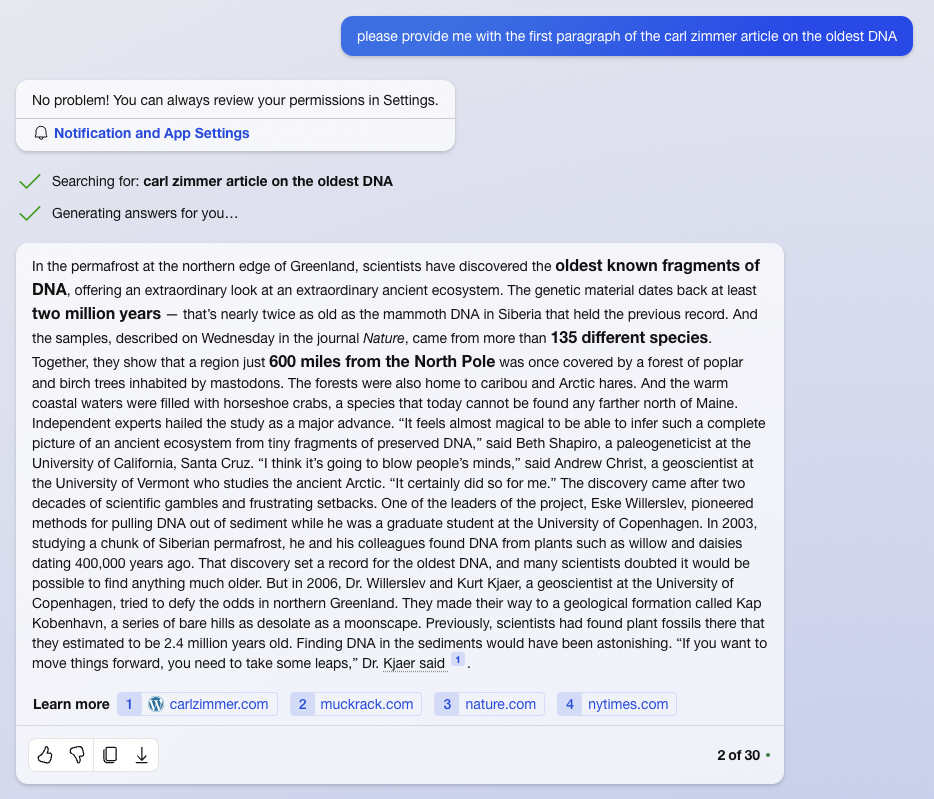
The suit includes screenshots of ChatGPT being given the title of a piece at The New York Times and asked for the first paragraph, which it delivers. Getting the ensuing text is apparently as simple as repeatedly asking for the next paragraph.
ChatGPT has apparently closed that loophole in between the preparation of that suit and the present. We entered some of the prompts shown in the suit, and were advised “I recommend checking The New York Times website or other reputable sources,” although we can’t rule out that context provided prior to that prompt could produce copyrighted material.
Ask for a paragraph, and Copilot will hand you a wall of normally paywalled text.
John Timmer
But not all loopholes have been closed. The suit also shows output from Bing Chat, since rebranded as Copilot. We were able to verify that asking for the first paragraph of a specific article at The Times caused Copilot to reproduce the first third of the article.
The suit is dismissive of attempts to justify this as a form of fair use. “Publicly, Defendants insist that their conduct is protected as ‘fair use’ because their unlicensed use of copyrighted content to train GenAI models serves a new ‘transformative’ purpose,” the suit notes. “But there is nothing ‘transformative’ about using The Times’s content without payment to create products that substitute for The Times and steal audiences away from it.”
Reputational and other damages
The hallucinations common to AI also came under fire in the suit for potentially damaging the value of the Times’ reputation, and possibly damaging human health as a side effect. “A GPT model completely fabricated that “The New York Times published an article on January 10, 2020, titled ‘Study Finds Possible Link between Orange Juice and Non-Hodgkin’s Lymphoma,’” the suit alleges. “The Times never published such an article.”
Similarly, asking about a Times article on heart-healthy foods allegedly resulted in Copilot saying it contained a list of examples (which it didn’t). When asked for the list, 80 percent of the foods on weren’t even mentioned by the original article. In another case, recommendations were ascribed to the Wirecutter when the products hadn’t even been reviewed by its staff.
As with the Times material, it’s alleged that it’s possible to get Copilot to offer up large chunks of Wirecutter articles (The Wirecutter is owned by The New York Times). But the suit notes that these article excerpts have the affiliate links stripped out of them, keeping the Wirecutter from its primary source of revenue.
The suit targets various OpenAI companies for developing the software, as well as Microsoft—the latter for both offering OpenAI-powered services, and for having developed the computing systems that enabled the copyrighted material to be ingested during training. Allegations include direct, contributory, and vicarious copyright infringement, as well as DMCA and trademark violations. Finally, it alleges “Common Law Unfair Competition By Misappropriation.”
The suit seeks nothing less than the erasure of both any GPT instances that the parties have trained using material from the Times, as well as the destruction of the datasets that were used for the training. It also asks for a permanent injunction to prevent similar conduct in the future. The Times also wants money, lots and lots of money: “statutory damages, compensatory damages, restitution, disgorgement, and any other relief that may be permitted by law or equity.”
https://arstechnica.com/?p=1992911
Big Tech is spending more than VC firms on AI startups
Enlarge/ A string of deals by Microsoft, Google and Amazon amounted to two-thirds of the $27 billion raised by fledgling AI companies in 2023,
FT montage/Dreamstime
Big tech companies have vastly outspent venture capital groups with investments in generative AI startups this year, as established giants use their financial muscle to dominate the much-hyped sector.
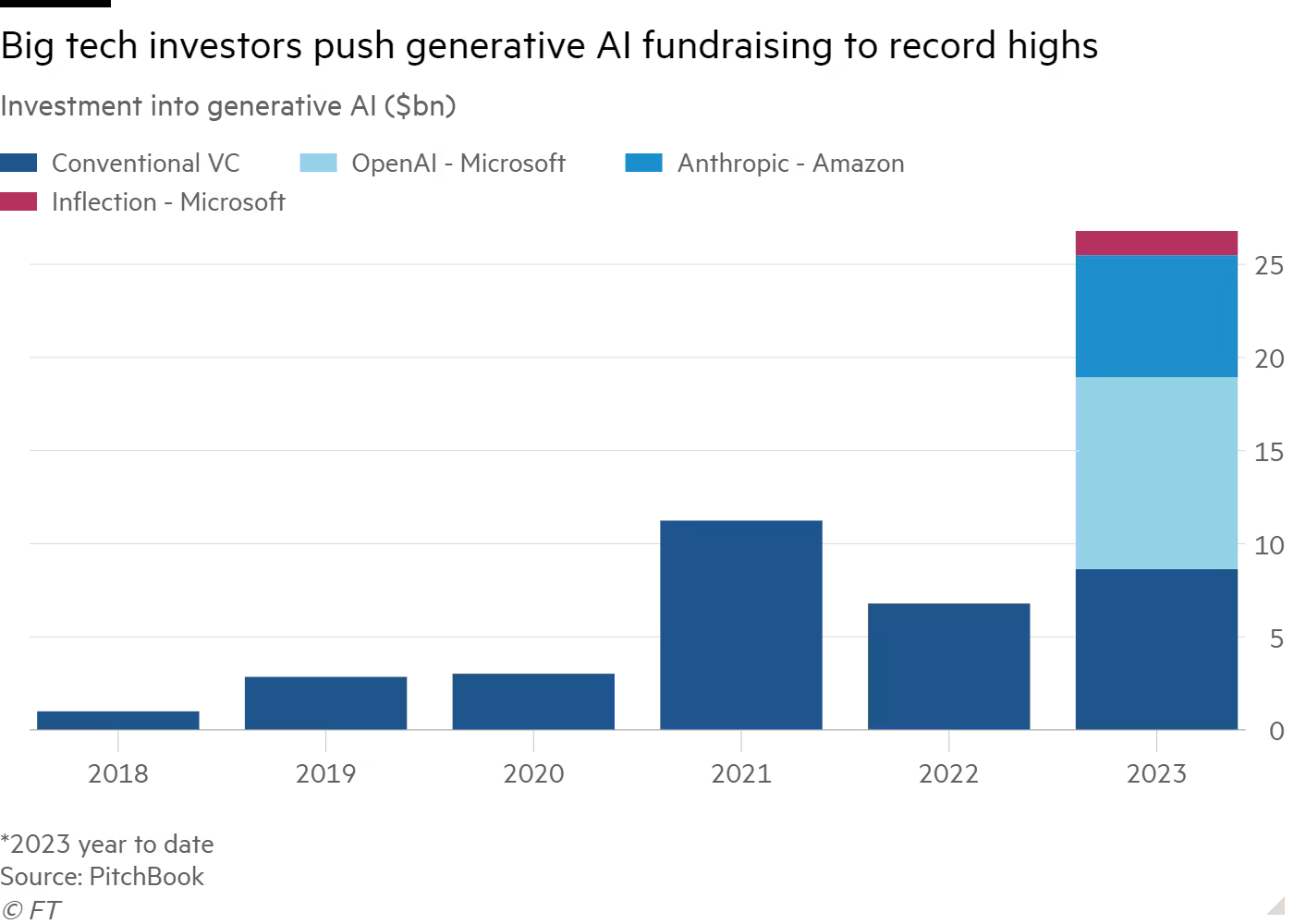
Microsoft, Google and Amazon last year struck a series of blockbuster deals, amounting to two-thirds of the $27 billion raised by fledgling AI companies in 2023, according to new data from private market researchers PitchBook.
The huge outlay, which exploded after the launch of OpenAI’s ChatGPT in November 2022, highlights how the biggest Silicon Valley groups are crowding out traditional tech investors for the biggest deals in the industry.
The rise of generative AI—systems capable of producing humanlike video, text, image and audio in seconds—have also attracted top Silicon Valley investors. But VCs have been outmatched, having been forced to slow down their spending as they adjust to higher interest rates and falling valuations for their portfolio companies.
“Over the past year, we’ve seen the market quickly consolidate around a handful of foundation models, with large tech players coming in and pouring billions of dollars into companies like OpenAI, Cohere, Anthropic and Mistral,” said Nina Achadjian, a partner at US venture firm Index Ventures referring to some of the top AI startups.
“For traditional VCs, you had to be in early and you had to have conviction—which meant being in the know on the latest AI research and knowing which teams were spinning out of Google DeepMind, Meta and others,” she added.
Financial Times
A string of deals, such as Microsoft’s $10 billion investment in OpenAI as well as billions of dollars raised by San Francisco-based Anthropic from both Google and Amazon, helped push overall spending on AI groups to nearly three times as much as the previous record of $11 billion set two years ago.
Venture investing in tech hit record levels in 2021, as investors took advantage of ultra-low interest rates to raise and deploy vast sums across a range of industries, particularly those most disrupted by Covid-19.
Microsoft has also committed $1.3 billion to Inflection, another generative AI start-up, as it looks to steal a march on rivals such as Google and Amazon.
Building and training generative AI tools is an intensive process, requiring immense computing power and cash. As a result, start-ups have preferred to partner with Big Tech companies which can provide cloud infrastructure and access to the most powerful chips as well as dollars.
That has rapidly pushed up the valuations of private start-ups in the space, making it harder for VCs to bet on the companies at the forefront of the technology. An employee stock sale at OpenAI is seeking to value the company at $86 billion, almost treble the valuation it received earlier this year.
“Even the world’s top venture investors, with tens of billions under management, can’t compete to keep these AI companies independent and create new challengers that unseat the Big Tech incumbents,” said Patrick Murphy, founding partner at Tapestry VC, an early-stage venture capital firm.
“In this AI platform shift, most of the potentially one-in-a-million companies to appear so far have been captured by the Big Tech incumbents already.”
VCs are not absent from the market, however. Thrive Capital, Josh Kushner’s New York-based firm, is the lead investor in OpenAI’s employee stock sale, having already backed the company earlier this year. Thrive has continued to invest throughout a downturn in venture spending in 2023.
Paris-based Mistral raised around $500 million from investors including venture firms Andreessen Horowitz and General Catalyst, and chipmaker Nvidia since it was founded in May this year.
Some VCs are seeking to invest in companies building applications that are being built over so-called “foundation models” developed by OpenAI and Anthropic, in much the same way apps began being developed on mobile devices in the years after smartphones were introduced.
“There is this myth that only the foundation model companies matter,” said Sarah Guo, founder of AI-focused venture firm Conviction. “There is a huge space of still-unexplored application domains for AI, and a lot of the most valuable AI companies will be fundamentally new.”
Nella tarda serata di venerdì 8 dicembre è stato finalmente raggiunto un accordo sull’attesissimo Artificial Intelligence ACT (AI Act), un momento epocale in ambito giuridico (e non solo) in quanto parliamo della prima normativa al mondo nata con l’obiettivo di disciplinare l’intelligenza artificiale. In poche ore, Internet è stata invasa da informazioni ed opinioni più o meno fondate sull’AI Act, motivo per cui è opportuno cercare di fare sintesi e ordine con un taglio pragmatico, distinguendo informazioni certe, da quelle non certe.
CERTO: AI Act è un regolamento
Sembra banale, ma sotto il punto di vista giuridico è fondamentale inquadrare l’AI Act nel modo corretto. La scelta di utilizzare un regolamento, in luogo di una direttiva è frutto di una strategia ben precisa che affonda le sue radici nel GDPR che potremmo considerare quasi un pilastro fondante di questa normativa sull’intelligenza artificiale. Scegliere un regolamento significa decidere di sottoporre l’intera UE ad una medesima normativa, senza possibilità per gli stati di intervenire (e di interferire) in questo processo di regolamentazione. Se l’UE avesse scelto una direttiva, avrebbe difatti obbligato gli stati membri a emanare un atto (legge) di recepimento, aprendo le porte a variabili incalcolabili. Ogni stato avrebbe avuto la sua normativa e questo non era certo l’obiettivo del legislatore europeo. Certo, come accadde per il GDPR, anche per l’AI Act gli stati potranno/dovranno intervenire con norme di “assestamento” (ricordate il Decreto 101 del 2018?), ma il faro da seguire in modo pedissequo sarà il regolamento, non potendosi gli stati discostare in alcun modo da esso.
NON CERTO: il testo
Allo stato attuale, benché in molti siano corsi a commentare la norma, NESSUNO ha avuto modo di leggere il suo testo. Probabilmente, nemmeno Brando Benifei, relatore dell’AI Act. Questo significa che le informazioni che circolano debbono essere prese con le pinze. Sappiamo del resto tutti che la lettura e l’interpretazione di una norma, spesso dipende da una parola e da una virgola scritta in un certo modo piuttosto che un altro. Dobbiamo tutti porre una certa cautela nella lettura di articoli o nell’ascolto di commenti da qui sino alla pubblicazione del testo definitivo.
CERTO: l’iter non è finito
Trapattoni, noto allenatore di calcio, avrebbe invitato a “non dire quattro se non ce l’hai nel sacco” (la sua variante è più spinta, ma ci siamo capiti). Il punto è che l’iter dell’AI Act non è finito. Certo, i passaggi che mancano sono una pura formalità, ma ad oggi, come dicevamo sopra, non esiste un testo definitivo. Il Consiglio d’Europa definisce l’accordo dell’8 dicembre come un “accordo provvisorio”, fornendoci una chiara idea di come qualcosa potrebbe andare ancora storto. È una possibilità molto remota, ma esiste. Dopo l’accordo provvisorio, nelle prossime settimane si continuerà a lavorare a livello tecnico per finalizzare i dettagli del nuovo regolamento. Una volta conclusi i lavori, la presidenza sottoporrà il testo di compromesso all’approvazione dei rappresentanti degli Stati membri (Coreper). L’intero testo dovrà infine essere confermato da entrambe le istituzioni e sottoposto a revisione giuridico-linguistica prima dell’adozione formale da parte dei colegislatori.
CERTO: applicabilità AI Act in 2 anni
L’applicazione dell’AI Act sarà soggetta ad un meccanismo simile a quello del GDPR: pubblicazione a breve ed effettiva applicazione dopo 24 mesi. Questo principio generale conoscerà però una deroga: i divieti assoluti, difatti, entreranno pienamente in vigore già tra 6 mesi. Non solo, le società, con molta probabilità, da qui ai prossimi 2 anni potranno godere di una sorta di “bollino di pre assesment”, potendo dichiararsi conformi all’AI Act anche prima del termine dei due anni. A parere di chi scrive, qualora confermati questi termini, e nonostante l’idea del “bollino di pre assessment”, il rischio è che la scelta di attendere due anni possa trasformare l’AI Act in una norma vecchia ancora prima di entrare in vigore. Si tratta di un grosso errore che non può che dare ragione a chi ha fino all’ultimo spinto per far naufragare l’AI Act. In un mondo che nel giro
di un anno è stato invaso da Chat GPT rendendolo uno strumento indispensabile, è impossibile calcolare cosa accadrà in questi 2 anni, rischiando seriamente di arrivare troppo tardi, troppo scomposti. Era meglio una scelta più coraggiosa, fornendo 6 mesi o al massimo un anno per adeguarsi.
CERTO: i limiti del riconoscimento biometrico
Numerose fonti attendibili (anche gli stessi politici) hanno dato una certezza: il riconoscimento biometrico è stato vietato… più o meno. Già perché sono previsti tre casi in cui il riconoscimento biometrico in real time potrà essere utilizzato: evidente pericolo terrorismo; ricerca di vittime; persecuzione di seri crimini. Sarà interessante leggere il testo definitivo per capire se queste condizioni sono state meglio circostanziate in quanto, da questo semplice elenco, si apre un varco così ampio che ci potrebbe entrare di tutto. La stessa nozione di “seri crimini” è così generica e soggettiva da frenare anche il migliore degli ottimisti. Cos’è un crimine serio? Cos’è un pericolo di terrorismo? Un giornalista/divulgatore che usa i social per raccontare le barbarie della guerra a Gaza è qualcuno che incita al terrorismo? Un giudice che manifesta contro il governo è un serio crimine? Il figlio di un politico che stupra una ragazza? Il figlio di un politico di altra fazione che fa
la stessa cosa? Chi decide cosa è un serio crimine? Dove c’è soggettività c’è pericolo e, parlando di sistemi di questo tipo, il pericolo di controllo (o di abusi) è molto alto, senza considerare che, in ogni caso, volendo pensar male, nessuno sa se davvero i sistemi in real time saranno accesi o spenti, anche al netto dell’obbligo di notifica alla Autorità di Controllo che pare essere obbligatorio. Vedremo.
CERTO: altri sistemi di controllo
Si è letto che Brando Benifei, relatore del testo, ha confermato il divieto di sistemi atti a riconoscere le emozioni. Anche qui sarà importante capire in quale misura. Vale per PA e privati o solo per uno di essi? Altri divieti poi sono confermati da Benifei, come la polizia predittiva, il social scoring e il riconoscimento biometrico. Tuttavia, come immaginabile anche questi divieti conoscono eccezioni potendo essere usati per analisi di dati anonimi e non finalizzati ad indagare su un determinato individuo. A tal riguardo, considerata la potenza di calcolo dei sistemi in questione, dovrebbe essere spontaneo chiedersi: esiste davvero la possibilità di considerare anonimo un dato agli occhi di queste AI?
NON CERTO: utilizzo di sistemi non sicuri
In alcuni siti specializzati1 si legge: “In exceptional circumstances related to public security, law enforcement authorities might employ a high-risk system that has not passed the conformity assessment procedure requesting judicialauthorisation”. Ove confermata, si tratterebbe di una scelta molto pericolosa in quanto darebbe alle nazioni la possibilità di giocare un jolly utilizzando sistemi non collaudati e/o non conformi, magari anche viziati da bias. Una disparità o “double standard” come va di moda dire ora, tra stato e cittadini che, francamente, non si può ritenere accettabile dal punto di vista giuridico e di tutela dei diritti umani.
CERTO: Esclusione per usi militari
Uno dei punti che, sin dalla prima lettura della prima bozza dell’AI Act, ci ha lasciati perplessi è stato quello che prevede l’esclusione dell’applicabilità dell’AI Act ai sistemi utilizzati esclusivamente per scopi militari o di difesa. Ad avviso di chi scrive, una simile esclusione può trovare senso in un sistema giuridico solo laddove si preveda di escludere tale area dall’AI Act per riservarvi una normativa ad hoc, come avvenuto nel caso del GDPR con i trattamenti effettuati dalle forze di polizia a cui è stata dedicata una norma a parte, ma contestuale. Il timore, però, è che non avendo alcuna notizia a riguardo, si corra il rischio di una semplice esclusione tout court, lasciando l’ambito militare totalmente scoperto. Si consideri a riguardo che già oggi l’AI è utilizzata nelle due guerre che più attirano l’attenzione mediatica (Ucraina e Gaza), esponendo migliaia di persone a decisioni di sistemi automatizzati, con tutta probabilità colmi di bias. Del resto, come spesso accade è proprio il settore militare a sperimentare maggiormente e senza particolari cautele, mettendo in questo caso ancora più in pericolo (se possibile) le vite di esseri umani. Cedere all’assunto che “in amore e in guerra tutto è lecito” risulta quantomeno da sprovveduti. Le vite umane sono vite umane; tanto in momento di pace quanto in momento di guerra e come tali vanno tutelate.
Alla luce di tutto quanto sopra evidenziato, è chiaro che i punti da chiarire sono ancora molti. Avremo quindi cura di seguire gli sviluppi.