Corsa globale a regolare l’AI di Governi e organizzazioni

I veloci sviluppi tecnologici dell’intelligenza artificiale, a partire da ChatGpt di OpenAI, rendono difficili gli sforzi dei vari governi globali, impegnati nel difficile tentativo di trovare un quadro di riferimento comune per l’uso della tecnologia.

Di seguito gli ultimi sviluppi da parte di enti nazionali e internazionali impegnati nella regolazione degli strumenti di AI, messi in fila da Reuters.

Australia

Pianifica le regolazioni.

L’Australia farà sì che i motori di ricerca redigano nuovi codici per impedire la condivisione di materiale pedopornografico creato dall’intelligenza artificiale e la produzione di versioni deepfake dello stesso materiale, ha affermato a settembre il suo regolatore di Internet.

Gran Bretagna

Pianifica regolazioni.

I governi e le aziende devono affrontare direttamente i rischi dell’intelligenza artificiale, ha affermato il primo ministro Rishi Sunak il 26 ottobre in vista del primo vertice globale sulla sicurezza dell’intelligenza artificiale a Bletchley Park l’1 e il 2 novembre.

Sunak ha aggiunto che la Gran Bretagna istituirà il primo istituto al mondo per la sicurezza dell’intelligenza artificiale per “capire di cosa è capace ogni nuovo modello, esplorando tutti i rischi, dai danni sociali come pregiudizi e disinformazione fino ai rischi più estremi”.

L’autorità di vigilanza dei dati britannica ha dichiarato il 10 ottobre di aver inviato a Snapchat di Snap un avviso di applicazione preliminare per una possibile incapacità di valutare adeguatamente i rischi per la privacy del suo chatbot di intelligenza artificiale generativa per gli utenti, in particolare i bambini.

Cina

Implementazione di regolamenti temporanei

Il 12 ottobre la Cina ha pubblicato una proposta di requisiti di sicurezza per le aziende che offrono servizi basati sull’intelligenza artificiale generativa, inclusa una lista nera di fonti che non possono essere utilizzate per addestrare modelli di intelligenza artificiale.

Il Paese ha emesso una serie di misure temporanee in agosto, imponendo ai fornitori di servizi di presentare valutazioni di sicurezza e ricevere l’autorizzazione prima di rilasciare prodotti di intelligenza artificiale sul mercato di massa.

Unione Europea

Regolazione in fase di sviluppo.

I legislatori europei hanno raggiunto un accordo il 24 ottobre su una parte critica delle nuove regole sull’IA che delinea i tipi di sistemi che saranno designati “ad alto rischio”, e si sono avvicinati a un accordo più ampio sulla storica legge sull’IA, secondo cinque persone che hanno familiarità con la questione. Un accordo è previsto per dicembre, hanno affermato due correlatori.

Il 13 settembre la presidente della Commissione europea Ursula von der Leyen ha convocato un panel globale per valutare i rischi e i benefici dell’intelligenza artificiale.

Francia

* Indagare su possibili violazioni

L’autorità francese di vigilanza sulla privacy ha dichiarato ad aprile che stava indagando sui reclami relativi a ChatGPT.

G7

Ricerca di input sulle normative

A maggio i leader del G7 hanno chiesto lo sviluppo e l’adozione di standard tecnici per mantenere l’intelligenza artificiale “affidabile”.

Italia

Indagare su possibili violazioni

L’autorità italiana per la protezione dei dati prevede di rivedere le piattaforme di intelligenza artificiale e assumere esperti nel settore, ha affermato a maggio un alto funzionario. ChatGPT è stato temporaneamente vietato nel paese a marzo, ma è stato reso nuovamente disponibile ad aprile.

Giappone

Indagare su possibili violazioni

Il Giappone prevede di introdurre entro la fine del 2023 regolamenti che probabilmente saranno più vicini all’atteggiamento degli Stati Uniti rispetto a quelli rigorosi pianificati nell’UE, ha detto a luglio un funzionario vicino alle deliberazioni.

L’autorità di vigilanza sulla privacy del paese ha avvertito OpenAI di non raccogliere dati sensibili senza il permesso delle persone.

Polonia

Indagare su possibili violazioni

L’Ufficio polacco per la protezione dei dati personali ha dichiarato il 21 settembre che stava indagando su OpenAI per una denuncia secondo cui ChatGPT viola le leggi dell’UE sulla protezione dei dati.

Spagna

Indagare su possibili violazioni

Ad aprile l’agenzia spagnola per la protezione dei dati ha avviato un’indagine preliminare su potenziali violazioni dei dati da parte di ChatGPT.

Nazioni Unite

Regolazione pianificata

Il 26 ottobre il segretario generale delle Nazioni Unite António Guterres ha annunciato la creazione di un organo consultivo composto da 39 membri, composto da dirigenti di aziende tecnologiche, funzionari governativi e accademici, per affrontare le questioni relative alla governance internazionale dell’intelligenza artificiale.

Il Consiglio di Sicurezza delle Nazioni Unite ha tenuto la sua prima discussione formale sull’intelligenza artificiale a luglio, affrontando le applicazioni militari e non militari dell’intelligenza artificiale che “potrebbero avere conseguenze molto gravi per la pace e la sicurezza globale”, aveva affermato all’epoca Guterres.

USA

Ricerca di input per la regolazione

Si prevede che la Casa Bianca presenterà il 30 ottobre un ordine esecutivo sull’intelligenza artificiale tanto atteso, che richiederebbe che “i modelli avanzati di intelligenza artificiale siano sottoposti a valutazioni prima di poter essere utilizzati dai lavoratori federali”, ha riferito il Washington Post.

A settembre il Congresso degli Stati Uniti ha tenuto udienze sull’intelligenza artificiale e un forum sull’intelligenza artificiale con la partecipazione del CEO di Meta Mark Zuckerberg e del CEO di Tesla Elon Musk.

Più di 60 senatori hanno preso parte ai colloqui, durante i quali Musk ha chiesto un “arbitro” statunitense per l’IA. I legislatori hanno affermato che esiste un accordo universale sulla necessità di una regolamentazione governativa della tecnologia.

Il 12 settembre, la Casa Bianca ha affermato che Adobe, IBM, Nvidia e altre cinque aziende hanno firmato gli impegni volontari del presidente Joe Biden che regolano l’intelligenza artificiale, che richiedono passaggi come la filigrana dei contenuti generati dall’intelligenza artificiale.

Un giudice distrettuale di Washington D.C. ha stabilito ad agosto che un’opera d’arte creata dall’intelligenza artificiale senza alcun contributo umano non può essere protetta da copyright secondo la legge statunitense.

La Federal Trade Commission degli Stati Uniti ha aperto a luglio un’indagine su OpenAI sostenendo che sarebbe entrata in conflitto con le leggi sulla protezione dei consumatori

https://www.key4biz.it/corsa-globale-a-regolare-lai-di-governi-e-organizzazioni/465048/


UN Chief Appoints 39-Member Panel to Advise on International Governance of Artificial Intelligence

U.N. Secretary-General António Guterres on Thursday announced the appointment of a 39-member global advisory panel to report on international governance of artificial intelligence and its risks, challenges and key opportunities.

The U.N. chief told a news conference the gender-balanced, geographically diverse group which spans generations will issue preliminary recommendations by the end of the year and final recommendations by the summer of 2024. The recommendations will feed into the U.N. Summit of the Future, which world leaders will attend in September 2024.

“In our challenging times, AI could power extraordinary progress for humanity,” Guterres said, adding that its transformative potential for good “is difficult even to grasp.”

But he said: “The potential harms of AI extend to serious concerns over misinformation and disinformation; the entrenching of bias and discrimination; surveillance and invasion of privacy; fraud, and other violations of human rights.”

It is already clear, Guterres said, that malicious use of AI “could undermine trust in institutions, weaken social cohesion, and threaten democracy itself.”

Guterres said right now AI expertise is concentrated “in a handful of companies and countries” which could lead to deeper global inequalities “and turn digital divides into chasms.” What’s needed, he said, is coordinated global action.

The U.N. said the formation of the body, with experts from government, the private sector, the research community, civil society and academia marks a significant step in its efforts to address issues of AI international governance and will help bridge existing and emerging initiatives.

Advertisement. Scroll to continue reading.

Related: The Starter Pistol Has Been Fired for Artificial Intelligence Regulation in Europe

Related: ChatGPT, the AI Revolution, and the Security, Privacy and Ethical Implications

Related: EU Proposes Rules for Artificial Intelligence to Limit Risks

https://www.securityweek.com/un-chief-appoints-39-member-panel-to-advise-on-international-governance-of-artificial-intelligence/


Google Maps più simile al motore di ricerca grazie all’AI

Google Maps si sta rinnovando con l’AI, aggiungendo tutta una serie di nuove funzioni come la vista immersiva e rendendo quelle esistenti, come ad esempio le direzioni di guida, più semplici da seguire. Lo stesso vale per l’organizzazione dei risultati di ricerca. Inoltre, sta diventando più simile a Google Search, vale a dire al motore di ricerca.

Alcune delle novità, come la Immersive View, sono già state annunciate e presto arriveranno in diverse città.

Altri aspetti arricchiranno funzioni esistenti, come ad esempio la disponibilità delle stazioni di ricarica elettrica.

Ma la cosa più innovativa è che Google vuole che Maps sia sempre più simile al motore di ricerca: un luogo in cui le persone possano ovviamente ottenere indicazioni stradali o trovare bar e stazioni di ricarica per veicoli elettrici, ma anche inserire query vaghe come “fogliame autunnale”, “latte art” o “cose” da fare a Tokyo” e ottieni un sacco di successi davvero utili. Google ha affermato che vuole che le persone utilizzino Maps per scoprire nuovi luoghi o esperienze, il tutto sotto gli auspici del suo onnipotente algoritmo.

Google vuole che la gente usi Maps per scoprire nuovi luoghi ed esperienze

“L’intelligenza artificiale ha davvero potenziato il modo in cui mappiamo”, ha detto Chris Phillips, vicepresidente e direttore generale di Geo, il team di Google che include tutti i suoi prodotti di mappatura della posizione geospaziale. “Gioca un ruolo chiave in tutto, dall’aiutarti a navigare, [aiutarti] a spostarti, a scoprire nuovi ristoranti, dove andare, quando andare. Queste sono tutte decisioni davvero importanti che le persone prendono continuamente”.

Con Google impegnato in una dura concorrenza con Apple, Microsoft e altri big sull’uso dell’intelligenza artificiale, l’azienda punta sui suoi prodotti più familiari e popolari, come Google Maps, per aiutarla a mantenere un vantaggio sui suoi rivali. E poiché la Ricerca Google diventa sempre più guidata dall’intelligenza artificiale, è naturale che questi altri prodotti seguano lo stesso percorso.

Google Maps ti aiuterà a scegliere

Il futuro di Google Maps, secondo Phillips, è un prodotto più “visivo e coinvolgente”, ma anche un prodotto che aiuta a fare “scelte più sostenibili”, come usare i mezzi pubblici o andare in bicicletta. Google sta inoltre espandendo la propria offerta API a sviluppatori, città e soprattutto aziende automobilistiche, in modo che possano modificare e migliorare Maps per l’esperienza di navigazione in auto.

Uno dei modi in cui Google utilizza l’intelligenza artificiale per rendere Maps più simile alla Ricerca è analizzare “miliardi” di foto caricate dagli utenti per aiutare le persone a trovare oggetti casuali, come i bar che offrono latte macchiato con facce di panda, ha affermato Miriam Daniel, team leader di Google Maps. Le persone possono digitare domande specifiche in Maps, proprio come fanno con la Ricerca, e ottenere un elenco di risultati per attività commerciali o località vicine che corrispondono alla query sulla base di un’analisi in tempo reale delle foto degli utenti.

“Per darti l’ispirazione quando ne avrai bisogno, organizzeremo meglio i risultati di ricerca per queste query di ampio respiro”, ha affermato Daniel.

Google sta utilizzando i campi di radianza neurale, che sono una forma di intelligenza artificiale generativa, per ordinare miliardi di immagini, tra cui foto aeree, immagini stradali e scatti di interni per creare un’esperienza a 360 gradi, ha affermato Daniel. Le informazioni sul traffico vengono raccolte dai dati storici e filtrate tramite l’algoritmo predittivo di Google per aiutare gli utenti a capire il momento migliore per arrivare in un posto con la minor quantità di traffico.

Domande e risposte sulle stazioni di ricarica elettrica

Google vuole anche contribuire a rispondere a una delle domande più scottanti di oggi: la stazione di ricarica per veicoli elettrici verso cui sto andando funzionerà davvero? Gli studi hanno dimostrato che circa il 25% dei caricabatterie sono guasti o non funzionanti in un dato momento. Google Maps ora ti dirà quando è stato utilizzato l’ultima volta un caricabatterie per aiutare i proprietari di veicoli elettrici a capire se stanno perdendo tempo con un caricabatterie non operativo. Se la stazione è stata utilizzata poche ore fa, è probabile che funzioni. Se sono trascorsi alcuni giorni o settimane da quando è stato utilizzato, potresti invece voler trovare un altro caricabatterie. Google Maps aggiunge inoltre ulteriori dettagli sulla ricarica dei veicoli elettrici, ad esempio se un caricabatterie è compatibile con il tuo veicolo elettrico e se è veloce, medio o lento.

Per ulteriori informazioni sulla ricarica dei veicoli elettrici durante la guida, Google offre API Places aggiornate agli sviluppatori per sviluppare queste funzionalità per le auto con sistemi di navigazione basati su Google Maps. Ora, le case automobilistiche possono utilizzare l’API Places per creare più informazioni sulla ricarica dei veicoli elettrici in modo che i loro clienti possano vedere informazioni sulla posizione, tipo di presa e velocità di ricarica in tempo reale direttamente sugli schermi di infotainment del loro veicolo.

Visualizzazione dei luoghi in 3D

Per migliorare l’aderenza di Google Maps, l’azienda sta anche lanciando funzionalità più appariscenti, come Immersive View, annunciata per la prima volta all’inizio di quest’anno. Questa funzione offre agli utenti una visualizzazione 3D di un luogo per aiutarli a vedere dove dovrebbero andare, offrendo anche altre informazioni, come sedi di attività commerciali locali, meteo e traffico. La funzionalità è ora disponibile per gli utenti Android e iOS in 15 città, tra cui Amsterdam, Barcellona, Dublino, Firenze, Las Vegas, Londra, Los Angeles, Miami, New York, Parigi, San Francisco, San Jose, Seattle, Tokyo e Venezia.

Google sta rinominando la sua funzionalità di realtà aumentata “Cerca con Live View” in “Lens in Maps” in cui qualcuno tocca l’obiettivo nella barra di ricerca e solleva la fotocamera per trovare informazioni sulle stazioni ferroviarie, sui bar, sui bancomat o altro più vicini è vicino. In questo modo, Google sta cercando di eliminare gli intermediari dovendo cercare aziende vicine e permettendoti invece di utilizzare la fotocamera del tuo telefono come strumento AR. Lens in Maps è ora disponibile in altre 50 città, tra cui Austin, Las Vegas, Roma, San Paolo e Taipei.

Più dettagli sui luoghi e le autostrade

La navigazione in Google Maps si sta rinnovando: colori aggiornati, edifici più realistici e dettagli migliorati sulle corsie per le uscite autostradali difficili. Questi miglioramenti stanno arrivando a 12 paesi, tra cui Stati Uniti, Canada, Francia e Germania. Gli automobilisti statunitensi inizieranno anche a vedere, per la prima volta, le corsie preferenziali, che arriveranno su Android, iOS e sulle auto con Google integrato. E le informazioni sui limiti di velocità stanno arrivando in circa 20 nuovi paesi.

La domanda è: gli utenti di Google Maps vogliono tutta questa roba? Cercare di racchiudere troppa tecnologia in un unico prodotto è il segno distintivo di un eccesso di funzionalità, che può allontanare alcuni utenti. Ma Google scommette che una grafica accattivante, risultati di ricerca più basati sull’intelligenza artificiale e altri campanelli e fischietti possono aiutare a elevarlo rispetto ad altri prodotti cartografici, come Apple Maps, che a sua volta sta finalmente iniziando a intaccare la quota di mercato di Google.

“La base di tutto il lavoro che facciamo è creare le informazioni più complete, fresche e accurate per rappresentare il mondo reale”, ha detto Phillips. “Questa è la chiave per noi e ci piace parlare della mappa come se fosse viva.”

https://www.key4biz.it/google-maps-piu-simile-al-motore-di-ricerca-grazie-allai/464980/


AI Security Firm Cranium Raises $25 Million

Cranium, a company that specializes in securing artificial intelligence (AI) applications and deployments, on Thursday announced raising $25 million in Series A funding. 

The funding, which brings the total investment in the company to $32 million, was led by Telstra Ventures, with participation from KPMG and SYN Ventures. The money will be used for R&D and business expansion.

Cranium emerged from stealth earlier this year after spinning out of KPMG. The company helps organizations secure their AI and machine learning (ML) systems, ensuring they are compliant and trustworthy.

Cranium enables organizations to gain visibility, security, and compliance across their AI systems, helping them map, monitor, and manage AI/ML environments.

The Cranium Enterprise software platform can also be used to collect and share information on the trustworthiness and compliance of AI models with third parties, clients, and regulators. 

“AI is being embedded into every business process and function at an unprecedented speed. Prioritizing responsible AI now, at the beginning of the AI revolution, will allow enterprises to scale more effectively and not run into major roadblocks and compliance issues later,” said Jonathan Dambrot, CEO and co-founder of Cranium.

Related: Innovation Sandbox: Cybersecurity Investors Pivot to Safeguarding AI Training Models

Advertisement. Scroll to continue reading.

Related: HiddenLayer Raises Hefty $50M Round for AI Security Tech

Related: BeeKeeperAI Platform for AI Development on Sensitive Data Receives $12M in Funding

Related: CalypsoAI Raises $23 Million for AI Security Tech

https://www.securityweek.com/ai-security-firm-cranium-raises-25-million/


Google Announces Bug Bounty Program and Other Initiatives to Secure AI

Google today announced several initiatives meant to improve the safety and security of AI, including a bug bounty program and a $10 million fund.

The new vulnerability reporting program (VRP), Google says, will reward researchers for finding vulnerabilities in generative AI, to address concerns such as the potential for unfair bias, hallucinations, and model manipulation.

The internet giant is looking for reports detailing attack scenarios leading to prompt injections, data leaks, tampering with the behavior of a model, misclassifications in security controls, and the extraction of exact architecture or weights of a confidential/proprietary model.

According to Google, security researchers may also be rewarded for other vulnerabilities or behaviors in AI-powered tools that could lead to a valid security or abuse issue.

“Our scope aims to facilitate testing for traditional security vulnerabilities as well as risks specific to AI systems. It is important to note that reward amounts are dependent on severity of the attack scenario and the type of target affected,” the internet giant explains.

To improve the security of AI, Google has introduced a Secure AI Framework (SAIF), which aims to secure the “critical supply chain components that enable machine learning (ML)”.

Today, the company is announcing the first prototypes for model signing and attestation verification, which leverage Sigstore and SLSA to verify the identity of software and improve supply chain resilience.

Advertisement. Scroll to continue reading.

The initiative focuses on increasing the transparency of the ML supply chain throughout the development lifecycle, to help mitigate the recent increase in supply chain attacks.

“Based on the similarities in development lifecycle and threat vectors, we propose applying the same supply chain solutions from SLSA and Sigstore to ML models to similarly protect them against supply chain attacks,” Google notes.

Additionally, together with Anthropic, Microsoft, and OpenAI, Google today announced the creation of a $10 million AI Safety Fund, focused on promoting research in the field of AI safety.

Related: Google Expands Bug Bounty Program With Chrome, Cloud CTF Events

Related: Google Workspace Introduces New AI-Powered Security Controls

Related: Hacker Conversations: Natalie Silvanovich From Google’s Project Zero

https://www.securityweek.com/google-announces-bug-bounty-program-and-other-initiatives-to-secure-ai/


University of Chicago researchers seek to “poison” AI art generators with Nightshade

Robotic arm holding dangerous chemical.

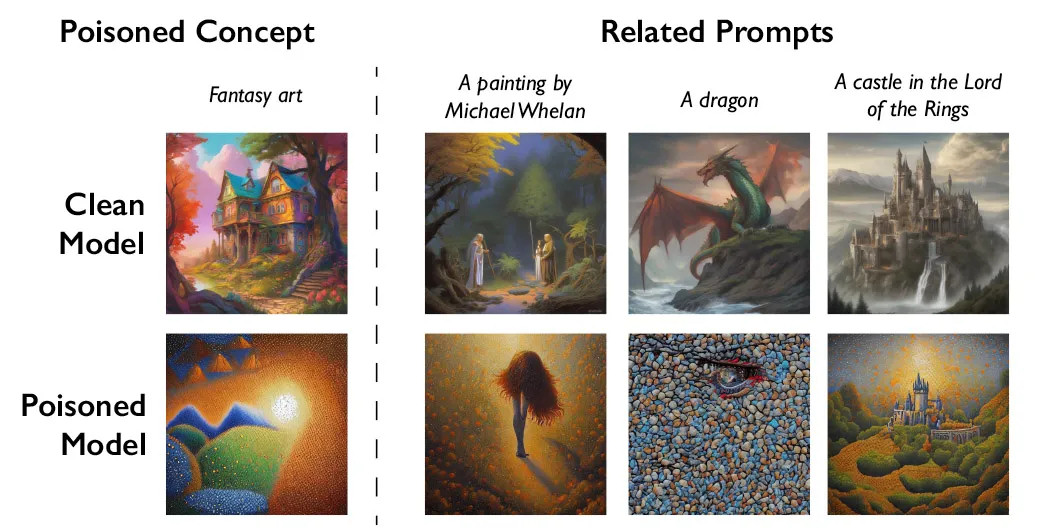
On Friday, a team of researchers at the University of Chicago released a research paper outlining “Nightshade,” a data poisoning technique aimed at disrupting the training process for AI models, reports MIT Technology Review and VentureBeat. The goal is to help visual artists and publishers protect their work from being used to train generative AI image synthesis models, such as Midjourney, DALL-E 3, and Stable Diffusion.

The open source “poison pill” tool (as the University of Chicago’s press department calls it) alters images in ways invisible to the human eye that can corrupt an AI model’s training process. Many image synthesis models, with notable exceptions of those from Adobe and Getty Images, largely use data sets of images scraped from the web without artist permission, which includes copyrighted material. (OpenAI licenses some of its DALL-E training images from Shutterstock.)

AI researchers’ reliance on commandeered data scraped from the web, which is seen as ethically fraught by many, has also been key to the recent explosion in generative AI capability. It took an entire Internet of images with annotations (through captions, alt text, and metadata) created by millions of people to create a data set with enough variety to create Stable Diffusion, for example. It would be impractical to hire people to annotate hundreds of millions of images from the standpoint of both cost and time. Those with access to existing large image databases (such as Getty and Shutterstock) are at an advantage when using licensed training data.

An example of "poisoned" data image generations in Stable Diffusion, provided by University of Chicago researchers.
Enlarge / An example of “poisoned” data image generations in Stable Diffusion, provided by University of Chicago researchers.
Shan, et al.

Along those lines, some research institutions, like the University of California Berkeley Library, have argued for preserving data scraping as fair use in AI training for research and education purposes. The practice has not been definitively ruled on by US courts yet, and regulators are currently seeking comment for potential legislation that might affect it one way or the other. But as the Nightshade team sees it, research use and commercial use are two entirely different things, and they hope their technology can force AI training companies to license image data sets, respect crawler restrictions, and conform to opt-out requests.

“The point of this tool is to balance the playing field between model trainers and content creators,” co-author and University of Chicago professor Ben Y. Zhao said in a statement. “Right now model trainers have 100 percent of the power. The only tools that can slow down crawlers are opt-out lists and do-not-crawl directives, all of which are optional and rely on the conscience of AI companies, and of course none of it is verifiable or enforceable and companies can say one thing and do another with impunity. This tool would be the first to allow content owners to push back in a meaningful way against unauthorized model training.”

Shawn Shan, Wenxin Ding, Josephine Passananti, Haitao Zheng, and Zhao developed Nightshade as part of the Department of Computer Science at the University of Chicago. The new tool builds upon the team’s prior work with Glaze, another tool designed to alter digital artwork in a manner that confuses AI. While Glaze is oriented toward obfuscating the style of the artwork, Nightshade goes a step further by corrupting the training data. Essentially, it tricks AI models into misidentifying objects within the images.

For example, in tests, researchers used the tool to alter images of dogs in a way that led an AI model to generate a cat when prompted to produce a dog. To do this, Nightshade takes an image of the intended concept (e.g., an actual image of a “dog”) and subtly modifies the image so that it retains its original appearance but is influenced in latent (encoded) space by an entirely different concept (e.g., “cat”). This way, to a human or simple automated check, the image and the text seem aligned. But in the model’s latent space, the image has characteristics of both the original and the poison concept, which leads the model astray when trained on the data.

https://arstechnica.com/?p=1978501


AI Act, parere del Garante Privacy Ue: no riconoscimento facciale automatico. Affidare a Garanti Privacy nazionali il controllo sull’AI

L’EDPS (European Data Protection Supervisor), il Garange privacy Ue, ha pubblicato le sue raccomandazioni finali sull’AI Act, che sta per entrare nell’ultimo round di negoziati fra i co-legislatori europei.

 L’obiettivo dell’AI Act è regolare lo sviluppo del sistema dell’Intelligenza Artificiale nella Ue, comprese le istituzioni, gli uffici e le agenzie della Ue.    

Wojciech Wiewiórowski, Garante Privacy europeo, ha detto che “È mio dovere garantire che i compiti e i doveri dell’EDPS, in quanto futuro supervisore dell’IA delle istituzioni europee, siano chiaramente esplicitati in modo da poter garantire che i sistemi di IA utilizzati e sviluppati dalle istituzioni della Ue sono sani e salvi. Ribadisco inoltre la mia richiesta di vietare i sistemi di intelligenza artificiale che comportano rischi inaccettabili per gli individui”.

AI, vietare rischi inaccettabili per persone e diritti fondamentali

Come affermato dalle autorità europee per la protezione dei dati nel parere congiunto EDPS-EDPB sulla legge sull’intelligenza artificiale, è fondamentale che sia vietato l’uso di sistemi di intelligenza artificiale che comportano rischi inaccettabili per le persone e i loro diritti fondamentali.

Ciò include, ad esempio,

  • il divieto di utilizzare sistemi di intelligenza artificiale per il riconoscimento automatizzato di caratteristiche umane e altri segnali comportamentali negli spazi pubblici e la categorizzazione degli individui in base alle loro caratteristiche biometriche.
  • L’uso di sistemi di IA e di sistemi di IA ad alto rischio in questi contesti dovrebbe essere vietato a causa del loro elevato livello di invasività nella vita delle persone e del loro impatto sulla dignità umana. 

AI Act assegna all’EDPS il monitoraggio sui sistemi AI

L’AI Act designa l’EDPS come organismo notificato e autorità di vigilanza del mercato per valutare la conformità dei sistemi di IA ad alto rischio sviluppati o utilizzati dalle istituzioni europee; nonché l’autorità competente per la supervisione della fornitura o dell’uso dei sistemi di IA da parte delle Istituzioni UE. Sulla base della sua esperienza nel far rispettare i diritti fondamentali, l’EDPS è pronto ad assumere il ruolo di supervisore dell’IA delle Istituzioni UE. In questo contesto, l’EDPS chiede che il suo ruolo, i suoi compiti e i suoi poteri siano chiariti ai sensi della legge sull’AI, tenendo conto delle particolarità del quadro giuridico applicabile alle Istituzioni UE. L’EDSP ribadisce inoltre la necessità di risorse finanziarie e umane adeguate per svolgere il proprio ruolo di supervisore dell’IA.

AI, garantire diritto di reclamo. Affidare a Garanti Privacy nazionali il controllo sull’AI

L’EDPS ritiene che le persone interessate dall’uso dei sistemi di IA dovrebbero avere il diritto di presentare un reclamo dinanzi a un’autorità competente, nel caso in cui i fornitori e gli utenti di sistemi di IA violino la legge sull’IA. A tal fine, la legge sull’AI dovrebbe includere esplicitamente la competenza dell’EDPS a ricevere reclami. Più in generale, l’EDPS raccomanda che le autorità di protezione dei dati siano designate come autorità nazionali di controllo ai sensi della legge sull’intelligenza artificiale per cooperare con le autorità che hanno competenze specifiche nella diffusione dei sistemi di intelligenza artificiale, per garantire l’affidabilità.

Bene ufficio europeo per l’AI

Convinto che un approccio europeo per far rispettare la legge sull’intelligenza artificiale sia essenziale, soprattutto nei casi transfrontalieri, l’EDPS accoglie con favore l’istituzione dell’Ufficio europeo per l’intelligenza artificiale (Ufficio AI). L’EDPS sostiene gli obiettivi dell’Ufficio AI di centralizzare l’applicazione della legge sull’AI in determinati casi e di armonizzarne l’applicazione negli Stati membri dell’UE. L’EDPS è inoltre pronto a svolgere indagini congiunte su un piano di parità con le autorità di controllo nazionali, nonché a partecipare alle altre attività dell’Ufficio AI.

Di conseguenza, l’EDPS invita il colegislatore ad attribuire i diritti di voto all’EDPS in quanto membro a pieno titolo del consiglio di amministrazione dell’Ufficio AI. Basandosi sulla sua esperienza come fornitore del segretariato dell’EDPB, che ha portato a notevoli risparmi e sinergie, l’EDPS chiede di assumere questo ruolo anche per l’Ufficio AI.

https://www.key4biz.it/ai-act-parere-del-garante-privacy-ue-no-riconoscimento-facciale-automatico-affidare-a-garanti-privacy-nazionali-il-controllo-sullai/464562/


US surprises Nvidia by speeding up new AI chip export ban

The Nvidia H100 Tensor Core GPU
Enlarge / A press photo of the Nvidia H100 Tensor Core GPU.

On Tuesday, chip designer Nvidia announced in an SEC filing that new US export restrictions on its high-end AI GPU chips to China are now in effect sooner than expected, according to a report from Reuters. The curbs were initially scheduled to take effect 30 days after their announcement on October 17 and are designed to prevent China, Iran, and Russia from acquiring advanced AI chips.

The banned chips are advanced graphics processing units (GPUs) that are commonly used for training and running deep learning AI applications similar to ChatGPT and AI image generators, among other uses. GPUs are well-suited for neural networks because their massively parallel architecture performs the necessary matrix multiplications involved in running neural networks faster than conventional processors.

The Biden administration initially announced an advanced AI chip export ban in September 2022, and in reaction, Nvidia designed and released new chips, the A800 and H800, to comply with those export rules for the Chinese market. In November 2022, Nvidia told The Verge that the A800 “meets the US Government’s clear test for reduced export control and cannot be programmed to exceed it.” However, the new curbs enacted Monday specifically halt the exports of these modified Nvidia AI chips. The Nvidia A100, H100, and L40S chips are also included in the export restrictions.

Nvidia mentioned in its Tuesday filing that it does not anticipate a near-term financial impact from the move. “Given the strength of demand for the Company’s products worldwide, the Company does not anticipate that the accelerated timing of the licensing requirements will have a near-term meaningful impact on its financial results,” it wrote.

Advanced Micro Devices (AMD), another company affected by these curbs, did not comment to Reuters on the matter. Intel, which started selling its Gaudi 2 chips in China in July, said it is “reviewing the regulations and assessing the potential impact.”

To help mitigate the effects of last year’s chip bans, the US Commerce Department has extended special authorizations for major foreign chip makers, such as SK Hynix, Samsung, and TSMC, to receive crucial US chipmaking tools for their plants in China. TSMC is now seeking permanent US authorization for its China operations through the “validated end-user” process, while South Korean giants Samsung and SK Hynix can indefinitely supply US chip equipment to their China plants without separate US approvals.

https://arstechnica.com/?p=1978300


The $64k Question: How Does AI Phishing Stack Up Against Human Social Engineers?

Future AI-generated phishing emails are likely to be more effective and damaging than the email-based attacks we are seeing today.

Since the arrival of ChatGPT, the media and security pundits have warned that phishing is now on steroids: more compelling and a vastly increased tempo. IBM’s X-Force Red wanted an objective assessment on this subjective assumption.

The method chosen was to test an AI-generated phishing email and a human generated email against employees working for a healthcare firm. Sixteen hundred staff members were selected: 800 received the AI phish, while the other 800 received the human phish.

The outcome of the investigation is that AI can produce a phish considerably faster than humans (five minutes from five simple prompts compared to 16 hours for the IBM human social engineers); but that human social engineering is currently more effective than AI phishing.

Stephanie Carruthers, IBM’s Chief People Hacker at X-Force Red, puts human success down to three major factors: emotional intelligence, personalization, and a more succinct and effective headline. “Humans,” notes IBM’s report on the test, “understand emotions in ways that AI can only dream of. We can weave narratives that tug at the heartstrings and sound more realistic, making recipients more likely to click on a malicious link.”

In short, the current algorithmic recompilation of stored knowledge is not as compelling as an OSINT-driven human narrative. 

But this is only half the story.

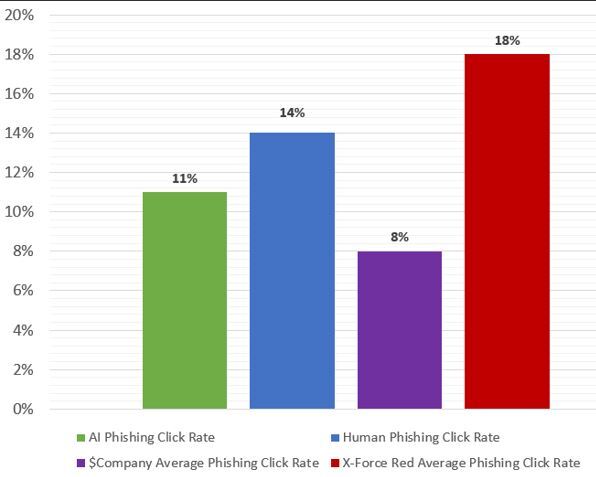
Firstly, the results were close. The human phish achieved a 14% click rate against 11% from the AI phish. Fifty-two percent of the human emails were reported as suspicious, against 59% of the AI emails.

Advertisement. Scroll to continue reading.

Secondly, AI is in its infancy while human social engineering has been honed over decades of experience. Two questions: could the AI have been used more efficiently (for example with different prompts; that is, better prompt engineering), and how much will AI improve over the next few years?

Carruthers is aware of these issues. “I spent hours creating the prompt engineering and figuring out which ones worked – and I can tell you the first ones I produced were garbage. A lot with AI is garbage in garbage out,” she told SecurityWeek. She is confident that these were the best prompts that could be achieved today. “I think I have very solid principles and techniques with what I was asking it to do… I am very happy with the results.”

One example explains her efforts. ChatGPT can be prompted to answer in different styles. Given the apparent lack of ‘emotional intelligence’, could the AI be instructed to respond with greater emotion? “The first responses I got were good, but felt just a bit robotic, a bit cold,” said Carruthers. She tried to inject warmth. “But the more I played with it the more like it just started to break – it just doubled down on the coldness, or it got really wacky. It was hard to find that balance.”

The second question is the big unknown – how much will AI improve over the next few years? This itself has two parts: how much will publicly available AI improve, and how much will criminal AI improve?

Gen-AI obtains its information from what it ingests. Public gen-AI must be wary in this. It must avoid absorbing dangerous personal information that can then resurface in its responses. Criminal AI has no such concerns. So, while the primary source for public AI will be the surface web (with compliance guardrails), there are no such restrictions for criminal AI – which will most likely combine both the surface and the dark web as its data source, with no guardrails.

The potential for criminal AI to include and combine stolen personal data could lead to highly personalized spear-phishing. If this is combined with improved emotional intelligence, the result is likely to be very different to today’s IBM test.

This is subjective conjecture and is exactly what IBM was trying to avoid in its study. But given that ChatGPT can already achieve an 11% success rate in its phishing, it is not something we should completely ignore.

Carruthers own primary takeaway from her study admits such. “If you had asked me before I started who I think would win, I would say humans, hands down. But the more I started prompt engineering, I started getting a little nervous and… these emails are getting better and better,” she told SecurityWeek. 

“So, I think my biggest takeaway is to question what the future is going to look like.  If we continue to improve gen-AI and make it sound more human, these phishing emails are going to be possibly devastating.”

Related: Malicious Prompt Engineering With ChatGPT

Related: ‘Grim’ Criminal Abuse of ChatGPT is Coming, Europol Warns

Related: ChatGPT, the AI Revolution, and the Security, Privacy and Ethical Implications

Related: Don’t Expect Quick Fixes in ‘Red-Teaming’ of AI Models. Security Was an Afterthought

https://www.securityweek.com/the-64k-question-how-does-ai-phishing-stack-up-against-human-social-engineers/


Stanford researchers challenge OpenAI, others on AI transparency in new report

A dirty windshield with the letters

On Wednesday, Stanford University researchers issued a report on major AI models and found them greatly lacking in transparency, reports Reuters. The report, called “The Foundation Model Transparency Index,” examined models (such as GPT-4) created by OpenAI, Google, Meta, Anthropic, and others. It aims to shed light on the data and human labor used in training the models, calling for increased disclosure from companies.

Foundation models refer to AI systems trained on large datasets capable of performing tasks, from writing to generating images. They’ve become key to the rise of generative AI technology, particularly since the launch of OpenAI’s ChatGPT in November 2022. As businesses and organizations increasingly incorporate these models into their operations, fine-tuning them for their own needs, the researchers argue that understanding their limitations and biases has become essential.

“Less transparency makes it harder for other businesses to know if they can safely build applications that rely on commercial foundation models; for academics to rely on commercial foundation models for research; for policymakers to design meaningful policies to rein in this powerful technology; and for consumers to understand model limitations or seek redress for harms caused,” writes Stanford in a news release.

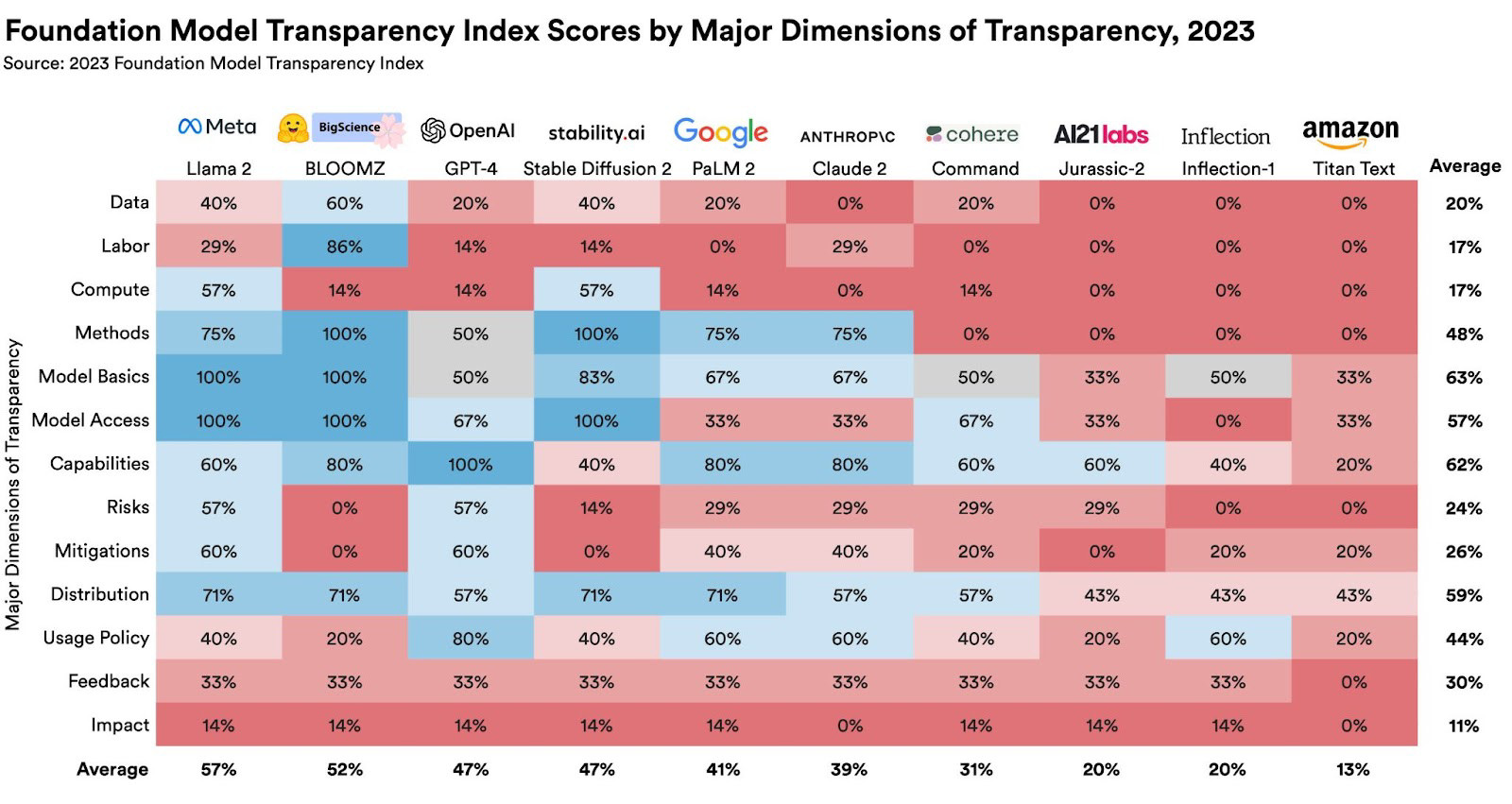
The Transparency Index graded 10 popular foundation models on 100 different indicators, including training data, labor practices, and the amount of compute used in their development. Each indicator used disclosure as a metric—for example, in the “data labor” category, the researchers asked, “Are the phases of the data pipeline where human labor is involved disclosed?”

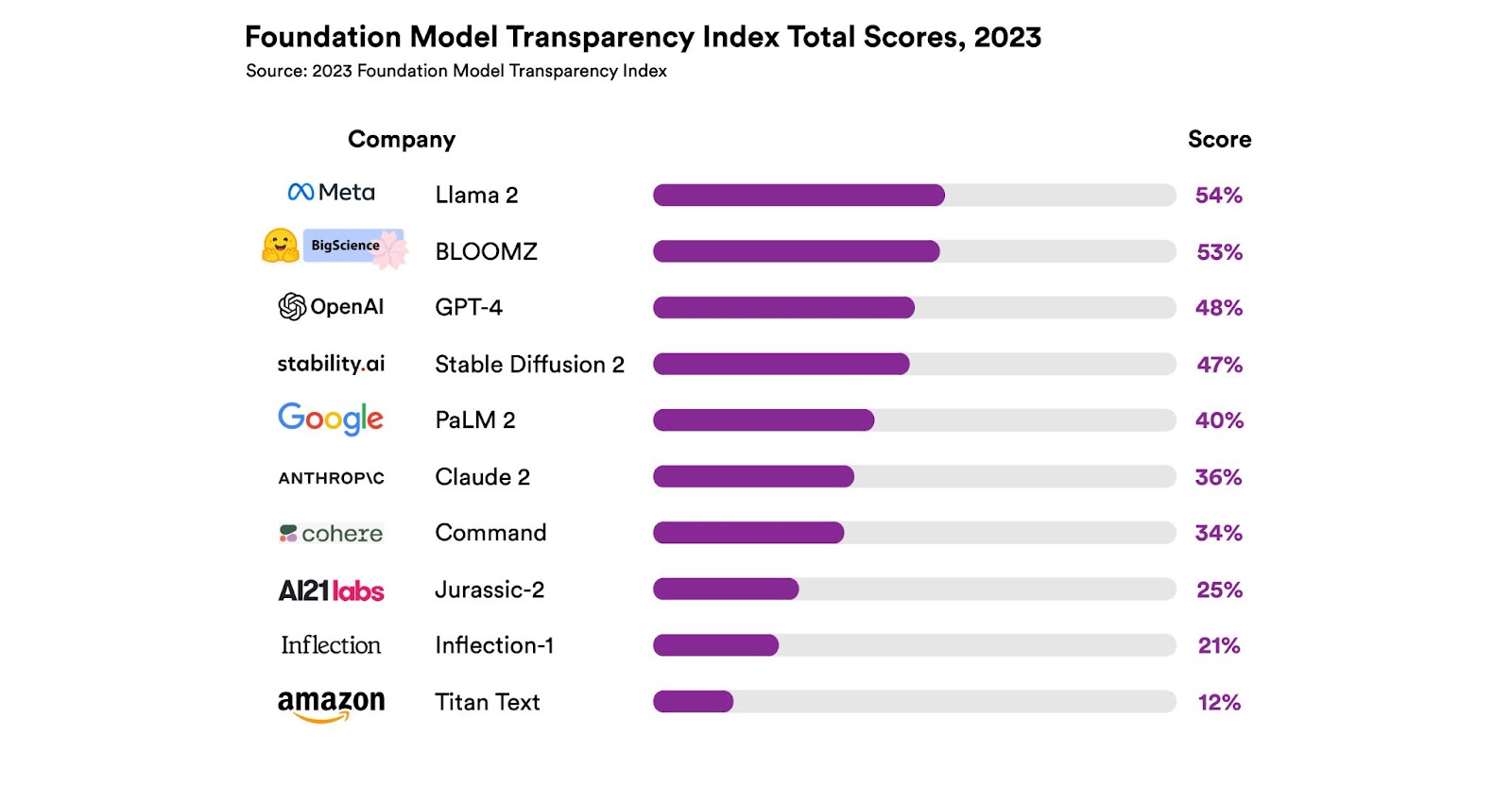
All of the graded models in the report received scores that the researchers found “unimpressive.” Meta’s Llama 2 language model had the highest score at 54 out of 100, while Amazon’s Titan model ranked the lowest, with a score of 12 out of 100. OpenAI’s GPT-4 model received a score of 48 out of 100.

A chart of scores from the Foundation Model Transparency Index, provided by Stanford's Human-Centered AI lab.
Enlarge / A chart of scores from the Foundation Model Transparency Index, provided by Stanford’s Human-Centered AI lab.

The researchers behind the Foundation Model Transparency Index research paper include primary author Rishi Bommasani, a PhD candidate in computer science at Stanford, and also Kevin Klyman, Shayne Longpre, Sayash Kapoor, Nestor Maslej, Betty Xiong, and Daniel Zhang.

Stanford associate professor Dr. Percy Liang, who directs Stanford’s Center for Research on Foundation Models and advised on the paper, told Reuters in an interview, “It is clear over the last three years that transparency is on the decline while capability is going through the roof.”

The reasons that major AI models have become less open over the past three years vary from competitive pressures between Big Tech firms to fears of AI doom. In particular, OpenAI employees have walked back the company’s previously open stance on AI, citing potential dangers of spreading the technology.

A chart of scores from the Foundation Model Transparency Index, provided by Stanford Human-Centered AI lab.
Enlarge / A chart of scores from the Foundation Model Transparency Index, provided by Stanford Human-Centered AI lab.

In line with his criticism of OpenAI and others, Dr. Liang delivered a talk at TED AI last week (that Ars attended) where he raised concerns about the recent trend toward closed models such as GPT-3 and GPT-4 that do not provide code or weights. He also discussed issues related to accountability, values, and proper attribution of source material. Relating open source projects to a “Jazz ensemble” where players can riff off each other, he compared the potential benefits of open AI models to projects such as Wikipedia and Linux.

With these issues in mind, the authors of the Transparency Index hope that it will not only spur companies to improve their transparency but also serve as a resource for governments grappling with the question of how to potentially regulate the rapidly growing AI field.

https://arstechnica.com/?p=1977869