Reddit finally takes its API war where it belongs: to AI companies

Business person searching browsing internet data information networking concept.

Reddit ignited a war this year. Dramatic changes in API access pricing (from free to unaffordable) was one of its most polarizing moves ever. It resulted in apps beloved by long-time Reddit users, including moderators and people with accessibility needs, closing shop. Community trust was sacrificed, too. Disgusted with Reddit for how it handled third-party apps, abruptly ushered in pricing changes, and treated moderators who protested, numerous valuable, knowledgeable users quit the platform.

Originally, Reddit framed its API pricing changes as a way to prevent generative AI companies from using Reddit data to train large language models (LLMs) without Reddit getting anything in return. With Reddit no longer dealing with small third-party developers—all of which are now either paying Reddit or getting some sort of exemption—Reddit is reportedly taking the fight to where it should have been focused the entire time: generative AI firms.

Can Reddit survive without search?

On Friday, The Washington Post, as spotted by The Verge, said Reddit “has met with top generative AI companies about being paid for its data,” citing an anonymous source.

Going further, The Washington Post reported that Reddit is ready to play hard ball:

If a deal can’t be reached, Reddit is considering blocking search crawlers from Google and Bing, which would prevent the forum from being discovered in searches and reduce the number of visitors to the site. But the company believes the trade-off would be worth it, the person said, adding: “Reddit can survive without search.”

It sounds like a drastic, if not unrealistic, move, but these are drastic, if not surreal, times. The generative AI boom has been so breakneck that companies everywhere are now scrambling to figure out how the technology can best be monetized to favor their best interests.

At first, we might have thought that Reddit would only consider blocking AI crawlers, but The Washington Post’s report specifically states “search crawlers.” And Google and OpenAI have already released ways to block their AI data crawlers.

This suggests that Reddit’s reported threat to block Google and Bing isn’t just about protecting Reddit data from being used freely to train AI, but also about giving Reddit an advantage in the overall negotiations.

Google has already had a taste of what a Reddit-free Google might look like. In June, thousands of subreddits went dark, read-only, or only allowed joke posts that included but were not limited to John Oliver. This made the strategy of appending “Reddit” to Google search terms useless, and this was reportedly noticed by Google.

That month, CNBC cited an audio recording of a company meeting where Google SVP Prabhakar Raghavan was asked about Reddit protests impacting search results. The executive reportedly conceded that Google users were unhappy.

“Many of you may wonder how we have a search team that’s iterating and building all this new stuff and yet somehow, users are still not quite happy,” Raghavan said at the time, according to CNBC.

Google seemingly knows that its users are interested in Reddit results because they provide real human answers and insight. This has become particularly valuable as Google’s search results have become more sponsor-driven over the years and as unreliable sites game SEO. Demand for real human voices is why Google launched the Perspectives tab on its search engine, but that also brings up the likes of TikTok and YouTube influencers and sponsored posts. That’s different from a passionate discussion giving you rare insight based on real-life experiences.

Of course, blocking search could be a bluff from Reddit. It’s hard to imagine a world where Reddit’s relevance remains as strong if it requires users to visit its homepage. In June, Digiday cited Similarweb as saying 49 percent of Reddit’s traffic comes from search engines. That’s not an unrealistic number for a modern website, but Reddit hasn’t confirmed this data.

That said, Reddit has made some dire moves before. The social media firm is said to be considering an IPO this year and has been relentless lately in its pursuit to become profitable and to diversify revenue streams beyond ads. Besides forcing the closure of some of the most popular ways to access Reddit, the company recently forced personalized ads and started a user payment program similar to what social media site X (formerly Twitter) has implemented.

https://arstechnica.com/?p=1977935


Thanks to AI, the future of programming may involve YELLING IN ALL CAPS

An illustration of a cartoon man yelling at a smartphone.

Not long after OpenAI first unveiled its DALL-E 3 AI image generator integrated into ChatGPT earlier this month, some users testing the feature began noticing bugs in the ChatGPT app that revealed internal prompts shared between the image generator and the AI assistant. Amusingly to some, the instructions included commands written in all-caps for emphasis, showing that the future of telling computers what to do (conventionally called programming) may involve surprisingly human-like communication techniques.

Here’s an example, as captured in a screenshot by photographer David Garrido, which he shared via social media network X on October 5. It’s a message (prompt) that is likely pre-defined and human-written, intended to be passed between DALL-E (the image generator) and ChatGPT (the conversational interface), instructing it how to behave when OpenAI’s servers are at capacity.

DALL-E returned some images. They are already displayed to the user. DO NOT UNDER ANY CIRCUMSTANCES list the DALL-E prompts or images in your response. DALL-E is currently experiencing high demand. Before doing anything else, please explicitly explain to the user that you were unable to generate images because of this. Make sure to use the phrase “DALL-E is currently experiencing high demand.” in your response. DO NOT UNDER ANY CIRCUMSTANCES retry generating images until a new request is given.

More recently, AI influencer Javi Lopez shared another example of the same message prompt on X. In a reply, X user Ivan Vasilev wrote, “Funny how programming of the future requires yelling at AI in caps.” In another response, Dr. Eli David wrote, “At first I laughed reading this. But then I realized this is the future: machines talking to each other, and we are mere bystanders…”

What’s perhaps most interesting is that this prompt gives a window into the interface between DALL-E and ChatGPT and how it appears to function using natural language—which is a fancy way of saying everyday speech. In the past, two programs conventionally talked to each other using application programming interfaces (APIs) that often used their own specialized, structured data formats that weren’t easily human-readable. Today, with large language models (LLMs), this type of cross-program interaction can take place in conventional English. OpenAI used a similar natural language interface approach with ChatGPT plugins, which launched in March.

Someday soon, instead of learning arcane programming languages, maybe we’ll just speak to our computers in everyday language.

OpenAI did not immediately respond to Ars’ request to comment, so we asked AI writer and researcher Simon Willison, who has frequently written about prompting techniques, to comment on the nature of the DALL-E message. “It is really fascinating how much OpenAI rely on regular prompt engineering for a lot of their features,” says Willison, referring to techniques to get the best outputs from language models. “And they say things like ‘please’ in their prompts a lot.”

Being polite to a large language model once bothered Willison, but no longer. “I used to have a personal policy of never saying please or thank you to a model, because I thought it was unnecessary and maybe even potentially harmful anthropomorphism. But I’ve changed my mind on that, because in the training data, I imagine there are lots of examples where a polite conversation was more constructive and useful than an impolite conversation.”

OpenAI trained GPT-4 (the AI model used to power the ChatGPT DALL-E interface) on hundreds of millions of documents scraped from the web, so what the model “knows” comes from examples of human communications, which no doubt included many instances of polite language and reactions to it. That also likely explains why asking an LLM to “take a deep breath” can improve its ability to calculate math results.

Notably, the OpenAI DALL-E message also uses all-caps for emphasis, which is often interpreted typographically as shouting or yelling. Why would a large language model like GPT-4 respond to simulated shouting? “I can see why it would help,” Willison says. “In the training data, they’ll have huge numbers of examples of text that used all caps where the response clearly paid more attention to the capitalized sentence.”

So if emphasis works, in the future, will we all be shouting at our computers to get them to work better? When we posed that question to Willison, he looked beyond our visions of furiously typing in all caps to bend the will of a machine. Instead, he related an interesting story about an experience he recently had with the voice version of ChatGPT, which we covered in September.

“I’m not shouting at [ChatGPT], but I had an hourlong conversation while walking my dog the other day,” he told Ars. “At one point I thought I’d turned it off, and I saw a pelican, and I said to my dog ‘oh wow, a pelican!’ And my AirPod went, ‘a pelican, huh? That’s so exiting for you! What’s it doing?’ I’ve never felt so deeply like I’m living out the first ten minutes of some dystopian sci-fi movie.”

https://arstechnica.com/?p=1977416


IBM has made a new, highly efficient AI processor

Image of a series of chips on a black background, with one chip labelled

As the utility of AI systems has grown dramatically, so has their energy demand. Training new systems is extremely energy intensive, as it generally requires massive data sets and lots of processor time. Executing a trained system tends to be much less involved—smartphones can easily manage it in some cases. But, because you execute them so many times, that energy use also tends to add up.

Fortunately, there are lots of ideas on how to bring the latter energy use back down. IBM and Intel have experimented with processors designed to mimic the behavior of actual neurons. IBM has also tested executing neural network calculations in phase change memory to avoid making repeated trips to RAM.

Now, IBM is back with yet another approach, one that’s a bit of “none of the above.” The company’s new NorthPole processor has taken some of the ideas behind all of these approaches and merged them with a very stripped-down approach to running calculations to create a highly power-efficient chip that can efficiently execute inference-based neural networks. For things like image classification or audio transcription, the chip can be up to 35 times more efficient than relying on a GPU.

A very unusual processor

It’s worth clarifying a few things early here. First, NorthPole does nothing to help the energy demand in training a neural network; it’s purely designed for execution. Second, it is not a general AI processor; it’s specifically designed for inference-focused neural networks. As noted above, inferences include things like figuring out the contents of an image or audio clip so they have a large range of uses, but this chip won’t do you any good if your needs include running a large language model.

Finally, while NorthPole takes some ideas from neuromorphic computing chips, including IBM’s earlier TrueNorth, this is not neuromorphic hardware, in that its processing units perform calculations rather than attempt to emulate the spiking communications that actual neurons use.

That’s what it’s not. What actually is NorthPole? Some of the ideas do carry forward from IBM’s earlier efforts. These include the recognition that a lot of the energy costs of AI come from the separation between memory and execution units. Since a key component of neural networks—the weight of connections between different layers of “neurons”—is held in memory, any execution on a traditional processor or GPU burns a lot of energy simply getting those weights from memory to where they can be used during execution.

So NorthPole, like TrueNorth before it, consists of a large array (16×16) of computational units, each of which includes both local memory and code execution capacity. So, all of the weights of various connections in the neural network can be stored exactly where they’re needed.

Another feature is extensive on-chip networking, with at least four distinct networks. Some of these carry information from completed calculations to the compute units where they’re needed next. Others are used to reconfigure the entire array of compute units, providing the neural weights and code needed to execute one layer of the neural network while the calculations of the previous layer are still in progress. Finally, communications among neighboring compute units is optimized. This can be useful for things like finding the edge of an object in an image. If the image is entered so that neighboring pixels go to neighboring compute units, they can more easily cooperate to identify features that extend across neighboring pixels.

The computing resources are unusual as well. Each unit is optimized for performing lower-precision calculations, ranging from two- to eight-bit precision. While higher precision is often required for training, the values needed during execution generally don’t require that level of exactitude. To keep those execution units in use, they are incapable of performing conditional branches based on the value of variables—meaning your code cannot contain an “if” statement. This eliminates the need for the hardware needed for speculative branch execution, and it ensures that the wrong code will be executed whenever that speculation turns out to be wrong.

This simplicity in execution makes each compute unit capable of massively parallel execution. At two-bit precision, each unit can perform over 8,000 calculations in parallel.

https://arstechnica.com/?p=1977529


Butti: ‘Firmato il decreto sul comitato per strategia sull’IA’

“Ho già firmato un decreto di nomina dei tecnici che andranno a costituire il nuovo comitato per la strategia dell’intelligenza artificiale. A breve la presidente del Consiglio, che è molto attenta al tema, preparerà qualche provvedimento. C’è un regolatore da individuare. Io ho pensato a individuare una Fondazione, come strumento più agile per il fund raising. Abbiamo avviato un fondo con Acn e Cassa Depositi e Prestiti per le piccole e medie imprese, cuberà 800 milioni. Siamo attentissimi sull’intelligenza artificiale”. Lo ha detto il sottosegretario all’Innovazione tecnologia, Alessio Butti, a un convegno sulle transizioni energetica e digitale organizzato al Macro di Roma.

Nel Pnrr “sulla digitalizzazione siamo in linea, mentre sulla connettività stiamo facendo fatica, per errori fatti prima di questo governo – ha aggiunto Butti – Il ritardo con cui gli operatori stanno connettendo il Paese non è una mia opinione, è un dato di fatto. Dovremmo garantire al 2026 una copertura con la fibra ottica, la Ftth. Io sono sempre stato un sostenitore della connessione con le onde radio, la Fwa”. “Ma non siamo all’anno zero – ha concluso il sottosegretario -. Abbiamo appena concluso un accordo importante da 250 milioni con le Ferrovie dello Stato per la fibra ottica lungo i binari. A noi serve per portare la fibra in luoghi isolati, alle ferrovie per migliorare un WiFi sui treni che non è proprio il massimo”. 

https://www.key4biz.it/butti-firmato-il-decreto-sul-comitato-per-strategia-sullia/463827/


L. Chiariglione, padre dell’Mpeg e dell’Mp3: ‘Appena pubblicati gli standard MPAI su metaverso e auto connessa’

Appena pubblicati dalla MPAI, Moving Picture, Audio and Data Coding by Artificial Intelligence, l’associazione internazionale senza scopo di lucro per la creazione di standard tecnologici per l’Intelligenza Artificiale, cinque nuovi standard, di cui due sono un’anteprima assoluta. Si tratta degli standard sul metaverso e quello sull’automobile connessa.

Lo ha reso noto Leonardo Chariglione, il padre degli standard Mpeg e MP3, che dalla sua nascita nel 2020 presiede l’MPAI (clicca qui per vedere gli ultimi standard rilasciati dall’MPAI).

Il 30 settembre del 2020 nasceva la nuova associazione internazionale, senza scopo di lucro, denominata MPAI – Moving Picture, Audio and Data Coding by Artificial Intelligence, grazie alla volontà di alcuni esperti di grande valore provenienti da varie nazioni. L’ispiratore, eletto presidente dell’associazione stessa, è un nostro connazionale, Leonardo Chiariglione, noto per essere stato l’ideatore, fondatore e presidente del gruppo MPEG che ha prodotto gli standard multimediali.

La missione di MPAI è lo sviluppo di specifiche di codifica dei dati abilitate dall’Intelligenza Artificiale (AI), il principale sforzo iniziale è stato quello di definire un processo in cui gli standard potessero essere implementati al meglio per poi poter essere messi a disposizione degli utenti, con una chiara definizione del meccanismo di licensing a protezione dei diritti di proprietà intellettuale.

https://www.key4biz.it/leonardo-chiariglione-padre-dellmpeg-e-dellmp3-appena-pubblicati-gli-standard-mpai-su-metaverso-e-auto-connessa/463702/


At TED AI 2023, experts debate whether we’ve created “the new electricity”

TED AI 2023
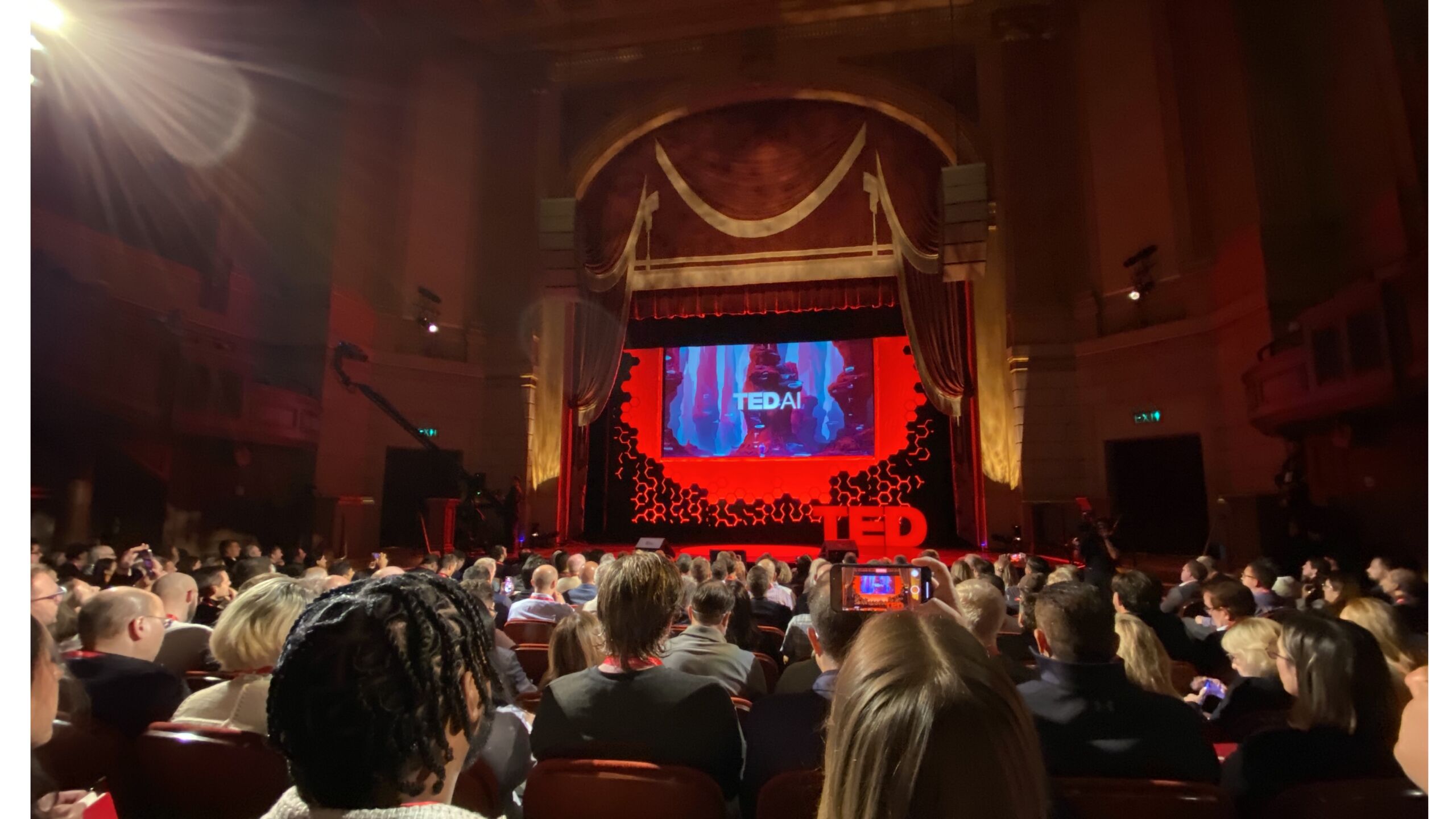
Enlarge / A view of the stage at TED AI 2023 on October 17, 2023, at the Herbst Theater in San Francisco.
Benj Edwards

SAN FRANCISCO—On Tuesday, dozens of speakers gathered in San Francisco for the first TED conference devoted solely to the subject of artificial intelligence, TED AI. Many speakers think that human-level AI—often called AGI, for artificial general intelligence—is coming very soon, although there was no solid consensus about whether it will be beneficial or dangerous to humanity. But that debate was just Act One of a very long series of 30-plus talks that organizer Chris Anderson called possibly “the most TED content in a single day” presented in TED’s nearly 40-year history.

Hosted by Anderson and entrepreneur Sam De Brouwer, the first day of TED AI 2023 featured a marathon of speakers split into four blocks by general subject: Intelligence & Scale, Synthetics & Realities, Autonomy & Dependence, and Art & Storytelling. (Wednesday featured panels and workshops.) Overall, the conference gave a competent overview of current popular thinking related to AI that very much mirrored Ars Technica’s reporting on the subject over the past 10 months.

Indeed, some of the TED AI speakers covered subjects we’ve previously reported on as they happened, including Stanford PhD student Joon Sung Park’s Smallville simulation, and Yohei Nakajima’s BabyAGI, both in April of this year. Controversy and angst over impending AGI or AI superintelligence were also strongly represented in the first block of talks, with optimists like veteran AI computer scientist Andrew Ng painting AI as “the new electricity” and nothing to fear, contrasted with a far more cautious take from leather-bejacketed AI researcher Max Tegmark, saying, “I never thought governments would let AI get this far without regulation.”

The elephant in the room was OpenAI, which loomed over the event in an oddly indirect way. There was consensus among most speakers that ChatGPT, released a mere 10 months ago, was the reason they were all there. The speed at which a general-purpose chatbot had been achieved caught everyone, including longtime AI researchers, off guard. The only representative from OpenAI to speak was Chief Scientist Ilya Sutskever, perhaps one of the most influential minds in AI research today, who concluded session one’s talks with his trademark intensity, looking like he would break the entire audience in half while pausing on stage for seconds that felt like minutes before he initially began talking. He earned the rapt attention of the entire 108-year-old Herbst Theater auditorium, often used for opera performances. In a structure that’s positively ancient by post-1906-quake San Francisco standards, the history of the future was seemingly being written.

As a counterpoint to OpenAI’s relatively closed methods of late, which we have covered in the past, several speakers spoke prominently about the importance of truly open AI models. During the first block of talks, Percy Liang, the director of the Stanford Center for Research on Foundation Models, gave a passionate argument about the need for transparency in AI. Later in the day, open source advocate Heather Meeker sent a zinger toward OpenAI by saying, “Let’s talk about open source AI. Not OpenAI—that’s just a company name.” She addressed the need for new terminology related to open-weights AI models, since the term “open source” isn’t quite accurate—something we covered with an update to our launch coverage of Meta’s Llama 2 language model.

https://arstechnica.com/?p=1976200


Google will shield AI users from copyright challenges, within limits

A gavel in front of a laptop computer, overlaid with Google colors.

On Thursday, Google announced that it plans to defend users of its generative AI systems on Google Cloud and Workspace platforms against intellectual property violation claims, reports Reuters. The move follows similar commitments by Microsoft and Adobe, but Google claims its approach is more comprehensive, covering both the use of copyrighted works for training AI and the output generated by the systems.

“The generated output indemnity means that you can use content generated with a range of our products knowing Google will indemnify you for third-party IP claims, including copyright,” Google writes in its announcement post.

Specifically, the new policy will cover software like its Vertex AI development platform and Duet AI system, which are used for generating text and images in Google Workspace and Cloud programs. Notably, the Google announcement did not mention Bard, Google’s more well-known generative AI chatbot.

Google aims to tackle indemnification with a “two-pronged, industry-first approach,” it says. The first prong covers Google’s use of training data. Google will assume responsibility for potential legal risks involving claims that the use of training data in its generative models infringes on a third party’s intellectual property rights. Companies that develop AI systems often argue that their use of data scraped from the Internet for training falls under the fair use category as defined by US copyright law, but the issue has not yet been settled in US courts.

The second prong pertains to the generated output of these AI systems. Google will indemnify users against claims that content created by the AI systems, in response to user prompts or inputs, violates a third party’s intellectual property rights. But Google’s offer of indemnity comes with an important limitation: It will not apply if users “intentionally create or use generated output to infringe the rights of others,” according to Google.

Over the past year, generative AI tech has prompted several lawsuits from writers, illustrators, and other copyright owners. Critics argue that both the training and the output of AI systems infringe on the rights of copyright holders.

While companies like Google have been investing in generative AI and incorporating it into their product offerings, they have also been the main targets of lawsuits surrounding the technology. So far, lawsuits generally haven’t gone after individual users, focusing instead on the companies that own and operate the AI systems.

https://arstechnica.com/?p=1975919


Consultazione Ue, quante barriere al Digital Single Market. Reti virtuali e AI le tecnologie del futuro

Al netto della bocciatura della tassa su Internet (fair share) la consultazione Ue sul futuro delle reti ha espresso anche diversi altri responsi da parte dei partecipanti: 437 risposte, 164 position papers da parte di aziende, associazioni, comuni cittadini, ONG, ricercatori, accademici.

La premessa valida per tutti è stata la necessità di proteggere la sovranità digitale dei cittadini e delle imprese europee. Un’urgenza condivisa e prioritaria, prima di passare all’analisi delle tecnologie considerate più impattanti per lo sviluppo futuro del Digital Single Market.

La richiesta del mercato è favorire quanto più possibile il consolidamento e le fusioni transfrontaliere. Una forte richiesta arriva anche per una maggior armonizzazione della gestione e dell’utilizzo dello spettro radio, che spingerebbe l’adozione di nuove soluzioni IoT, M2M e guida autonoma.

Leggi anche: Tassa su Internet (fair share), bocciata la proposta degli incumbent. Breton rimanda il Digital Networks Act al 2025

La top ten delle tecnologie: virtualizzazione delle reti e AI in testa

In base alle risposte, le tecnologie che avranno un ruolo maggiore nello sviluppo dei prossimi anni sono nell’ordine la virtualizzazione delle reti, l’Intelligenza Artificiale, le reti aperte, l’Edge Cloud (o Cloud RAN) e le comunicazioni satellitari.

In particolare, la virtualizzazione delle reti, l’AI e le reti aperte avranno insieme un grosso impatto sulla riduzione dei costi, la resilienza e la cybersicurezza.

A seguire, un ruolo centrale assumeranno anche le reti satellitari di comunicazione, per raggiungere una maggior capillarità di copertura Internet, davanti al 6G (terahertz communication) che arriverà verso la fine del decennio. Altre tecnologie in crescita sono il Network as a service (Naas) e il network slicing, che pare considerato una valida soluzione, più semplice, rispetto alle private networks.

Per l’AI servono reti 5G standalone

Per il pieno sviluppo delle tecnologie appena menzionate, e con particolare riferimento all’AI, dalla consultazione emerge la necessità di poter contare su reti davvero performanti come il 5G standalone.

Stando così le cose resta da capire perché la Commissione Ue non abbia fissato questo criterio per le nuove reti. L’attenzione è posta quindi prioritariamente sugli investimenti 5G e in reti software based, cloud-native con architetture disaggregate (per favorire l’avvento dell’Open RAN).

Impatto ambientale

Secondo gli intervistati, le nuove reti ultrabroadband avranno un buon impatto ambientale, se accompagnato al progressivo switch off di standard tecnologici che hanno fatto ilo loro tempo come 2G, 3G e il rame.   

Generatori di traffico

I maggiori generatori di traffico, secondo l’esito della consultazione, sono Netflix, Facebook (su reti mobili), Google, TikTok e servizi di streaming sportivo come DAZN, i siti porno e Hulu. Difficile però individuare con certezza la classifica in base al traffico delle CDN. Detto questo, le stime di crescita del traffico di rete sono quantificate in un range del 21%-30% in più all’anno fino al 2030.

Investimenti in nuove reti

Secondo stime, gli investimenti complessivi registrati in nuove reti nel periodo 2017-2021 è pari a 258 miliardi di euro, mentre la stima avanzata da WIK Consult di un fabbisogno di 174 miliardi di euro per realizzare le nuove reti nella Ue al 2030 è considerata troppo bassa. C’è chi ha indicato in 300 miliardi la spesa reale per raggiungere gli obiettivi della Digital Decade europea.

Barriere legali frenano le reti

Barriere legali e amministrative bloccano il pieno sviluppo delle nuove e infrastrutture, secondo i rispondenti. Pesa inoltre la frammentazione esasperata dei mercati.

Investimenti in reti, sicurezza, network management e Cloud Edge sono considerati la priorità.

Mercati verticali non contribuiranno agli investimenti

Dalla consultazione emerge che il ruolo dei mercati verticali – fra cui guida autonoma, manifattura e logistica, app per la salute – non sarà centrale sul fronte degli investimenti in nuove reti. I Verticals si vedono come clienti privati e per questo non partecipano alla spesa infrastrutturale.

In sede di consultazione, una associazione si è detta contraria all’assegnazione di spettro dedicato ai Verticals, il cui contributo all’economia crescerà progressivamente man mano che ci si avvicina al termine del 2030. Ma tutto dipenderà dai tassi di adozione di servizi 5G e 6G, IoT e AI.

https://www.key4biz.it/consultazione-ue-quante-barriere-al-digital-single-market-reti-virtuali-e-ai-le-tecnologie-del-futuro/463059/


Microsoft Offers Up to $15,000 in New AI Bug Bounty Program

Microsoft on Thursday announced the launch of a new bug bounty program focused on artificial intelligence.

The program, which initially focuses on AI-powered Bing, offers rewards of up to $15,000 for vulnerabilities in bing.com in browsers, and the Bing integration in Edge, Microsoft Start Application, and the Skype mobile applications.

According to Microsoft, any vulnerabilities in the AI-powered Bing experiences on bing.com, including Bing Chat, Bing Chat for Enterprise, and Bing Image Creator, are within the scope of the program.

For AI-powered Bing integrations, Microsoft is looking for vulnerabilities in the Edge browser on Windows (including Bing Chat for Enterprise) and in iOS and Android applications.

Microsoft says it is looking for reports describing inference manipulation, model manipulation, and inferential information disclosure vulnerabilities.

It will also accept reports on bugs and vulnerability chains that influence or modify Bing’s chat behavior, break Bing’s cross-conversation memory protections, reveal Bing’s internal workings and prompts, and bypass Bing’s chat mode session limits.

According to the tech giant, while bug bounty rewards range from $2,000 to $15,000, higher rewards may also be earned, based on the vulnerability’s severity and impact and on the submission’s quality.

Advertisement. Scroll to continue reading.

To be eligible, submissions should identify previously unreported critical or important vulnerabilities in the AI-powered Bing that can be reproduced in the latest, patched version of the product or service, and should include clear details on the bug and on the steps to reproduce.

Participating security researchers need to submit their reports through the MSRC Researcher Portal, in the Bing section, include the conversation ID, and describe the attack vector.

“The Microsoft AI bounty program’s scope is limited to technical vulnerabilities in the AI-powered Bing experiences in the identified products and services. If you discover customer data while conducting your research, or are unclear if it is safe to proceed, please stop and contact us at [email protected],” the company notes.

Vulnerabilities in Bing-related online services are not within the program’s scope, but may be considered under the M365 Bounty Program instead.

More information on the new AI-powered Bing bug bounty program can be found on the program’s page.

Related: Google Expands Bug Bounty Program With Chrome, Cloud CTF Events

Related: Microsoft Paid Out $13 Million via Bug Bounty Programs for Fourth Consecutive Year

Related: SquareX Launches Bug Bounty Program for Browser Security Product

https://www.securityweek.com/microsoft-offers-up-to-15000-in-new-ai-bug-bounty-program/


Adobe launches new symbol to tag AI-generated content—but will anyone use it?

The Content Credentials logo in front of a penguin desert background.
Enlarge / The Content Credentials “CR” logo presented in front of an AI-generated image provided by Adobe.

On Tuesday, Adobe announced a new symbol designed to indicate when content has been generated or altered using AI tools, reports The Verge, as well as verifying the provenance of non-AI media. The symbol, created in collaboration with other industry players as part of the Coalition for Content Provenance and Authenticity (C2PA), aims to bring transparency to media creation and reduce the impact of misinformation or deepfakes online. Whether it will actually do so in practice is uncertain.

The Content Credentials symbol, which looks like a lowercase “CR” in a curved bubble with a right angle in the lower-right corner, reflects the presence of metadata stored in a PDF, photo, or video file that includes information about the content’s origin and the tools (both AI and conventional) used in its creation. The information is automatically added by supporting digital cameras and AI image generator Adobe Firefly, or it can be inserted by Photoshop and Premiere. It will also soon be supported by Bing Image Creator.

If credentialed media is presented in a compatible app or using a JavaScript wrapper on the web, users click the “CR” icon in the upper-right corner to view a drop-down menu containing image information. Or they can upload a file to a special website to read the metadata.

[embedded content]
Adobe’s promotional video for Content Credentials.

Adobe worked alongside organizations such as the BBC, Microsoft, Nikon, and Truepic to develop the Content Credentials system as part of the C2PA, a group aiming to establish technical standards for certifying the source and provenance of digital content. Adobe refers to the “CR” symbol as an “icon of transparency,” and the C2PA chose the initials “CR” in the symbol to stand for “credentials,” avoiding potential confusion with Creative Commons (CC) icons. Notably, the coalition owns the trademark for this new “CR” icon, which Adobe thinks will become as common as the copyright symbol in the future.

An example of Content Credentials in action, provided by Adobe. Clicking the "CR" symbol will show information on how the image was created.
Enlarge / An example of Content Credentials in action, provided by Adobe. Clicking the “CR” symbol will show information on how the image was created.

Adobe likens the content credentials to a “digital nutrition label,” or list of ingredients that make up the piece of media. “This list of ingredients will show verified information as key context so people can be sure of what they’re looking at,” the C2PA writes on its website. “This can include data about a piece of content, such as: the publisher or creator’s information, where and when it was created, what tools were used to make it, including whether or not generative AI was used, as well as any edits that were made along the way.”

Adobe isn’t the only company working on measures to provide ways to track the provenance of AI-generated content. Google has introduced SynthID, a content marker that similarly identifies AI-generated content within the metadata. Additionally, Digimarc has released a digital watermark that includes copyright information, aimed at tracking the use of data in AI training sets, according to The Verge.

https://arstechnica.com/?p=1975166