Italia Digitale, Butti: ‘Stiamo lavorando ad una nuova strategia quinquennale per l’Intelligenza Artificiale’
Digitale: Butti, ‘Aiuteremo le Pmi, una strategia quinquennale sull’ intelligenza artificiale’
“Le aziende italiane dell’Ict hanno perfettamente ragione”’ a lamentare la concorrenza di quelle estere. Lo ha detto il sottosegretario di Stato alla presidenza del Consiglio con delega all’Innovazione Alessio Butti a margine del convegno promosso a Lecce da Links Management and Technology sulla filiera digitale italiana.
“Fino a un anno, un anno e mezzo fa c’era l’abitudine ad essere sostanzialmente supini rispetto all’impostazione delle grandi e potenti realtà tecnologiche. Abbiamo cominciato noi a parlare di sovranità digitale e qualcuno ha inarcato il sopracciglio perché non eravamo convincenti sotto questo punto di vista. Poi è arrivata la Von der Leyen che in alcuni suoi interventi ha cominciato a citare tutto ciò che riguarda la sovranità digitale e allora è stata sdoganata l’espressione. Noi dobbiamo fare in modo che all’interno di questo concetto rientrino pienamente le nostre piccole e medie imprese”.
”Per esempio, non possiamo più solo usare l’intelligenza artificiale,noi dobbiamo fare l’intelligenza artificiale”, sottolinea Butti. “Abbiamo una rete di Pmi che va aiutata, curata, coltivata e portata a un livello importante. Stiamo dialogando molto con l’Europa. Sull’intelligenza artificiale stiamo predisponendo una nuova strategia, io sto nominando un pool di esperti che dovrà elaborare una strategia almeno quinquennale sulla quale poter lavorare. Siamo al fianco della piccola e media impresa perché l’Italia in questo ha un’eccellenza, come ce l’ha nella rete universitaria. Lì si fa la ricerca e il governo intende sostenere questa ricerca”.
PA, Butti ‘Entro l’anno il position paper sul codice semplificazione amministrazione digitale’
“A oggi l’amministrazione digitale complica la vita dei cittadini. Ma a luglio e agosto abbiamo avviato la semplificazione del codice dell’amministrazione digitale. Entro la fine dell’anno offriremo al governo per le valutazioni successive un position paper. Questo ci porterà a un secondo passo, non meno importante: il Codice unico per l’innovazione digitale. Abbiamo bisogno che ogni anno insieme alla concorrenza si discuta in sede di Parlamento e di governo anche della innovazione digitale”, ha detto Butti.
Fondo Innovazione, Butti ‘Entro fine anno il regolamento per il fondo. Cdp ha skill per gestire investimenti’
“Cdp è importantissima e ha la struttura e le skill per gestire gli investimenti diretti. Stanno preparando il regolamento, assieme al mio Dipartimento, per il Fondo sull’innovazione. Credo che entro la fine dell’anno il Fondo avrà chiarito la sua funzione e sarà pronto il regolamento”. Lo ha detto ad Adnkronos il sottosegretario Butti.
“Io mi sono inventato il Fondo per l’innovazione mettendo immediatamente a bordo anche l’Agenzia per la cybersicurezza nazionale per tutti i temi che riguardano la cybersecurity, e poi Cassa depositi e prestiti”, spiega Butti. ”Cdp, infatti, è fondamentale perché ha una struttura dedicata esclusivamente alle start up che è Venture capital. Sono bastate due riunioni per entrare immediatamente in sintonia. Abbiamo messo tutti quanti una fee, e attraverso i moltiplicatori del mercato siamo in grado di avere oggi una disponibilità di 850 milioni-un miliardo di euro. Sono fondamentali per andare a premiare le start up che già si stanno impegnando sul tema dell’innovazione, dell’intelligenza artificiale, della cybersecurity”.
Tlc: Butti ‘Punto a 5G stand-alone, ma su fibra ottica abbiamo ritardo certificato’
“Stiamo connettendo le strutture sanitarie, stiamo connettendo le scuole e non a caso li cito, perchésono i due driver su cui insisterò moltissimo. Perché se no è inutile parlare di fascicolo sanitario elettronico, di sanità digitale, è inutile parlare di telechirurgia, di telemedicina se noi non connettiamo e digitalizziamo il Paese. Lo stesso vale per le scuole. Siamo tutti d’accordo che occorre un nuovo tipo di formazione per inostri ragazzi”. Oltre a questi due settori, ”c’è l’industria 4.0, che è fondamentale. Io vorrei mettere a disposizione un 5G stand-alone, cioè in grado di reggere tecnologicamente, perché gli artigiani che vogliono stampare in 3D hanno bisogno di un 5G pieno. Oggi non c’è”. Ha aggiunto Butti.
“La creatività italiana che noi abbiamo ereditato ha promosso il 4,5G. Una cosa assolutamente ridicola. Noi dobbiamo dotare il Paese di un 5G stand-alone. Pertanto serve la fibra, e sulla questione della fibra ottica abbiamo un ritardo certificato”.
Governo, Butti, ‘promosso a pieni voti su economia, lavoro, estero, Pnrr’
“Valutando l’eredità difficile ricevuta dal governo Meloni nel contesto internazionale, in quello economico e
in quello sociale, credo debba essere certamente promosso in questo primo anno. Sul fronte dell’economia basta considerare il valore della Borsa un anno fa e quello di oggi per capire che c’è stato un incredibile balzo in avanti. Per quanto riguarda l’occupazione non c’è mai stata un’Italia così occupata, quindi vuol dire che il lavoro del governo Meloni è certamente proficuo”, ha aggiunto Butti.
“A livello internazionale – aggiunge – il presidente del Consiglio sta facendo un grandissimo lavoro, che è indispensabile non solo per la gestione dell’immigrazione ma anche perché occorre che l’Italia diventi centrale non solo nel Mediterraneo ma anche nel mondo, per tutto quello che, venendo alle mie competenze, noi possiamo fare in materia di innovazione tecnologica, di intelligenza artificiale, sucui la premier insiste molto”.
Butti evidenzia poi come “il lavoro che sta svolgendo il ministro Fitto sia di straordinaria qualità. Nella cabina di regia di oggi si discute già della quinta rata del Pnrr. I pessimisti davano per persasia la terza che la quarta rata. Valutando l’eredità difficile ricevuta dal governo Meloni nel contesto internazionale, in quello economico e in quello sociale, credo debba essere certamente promossoin questo primo anno”.
ChatGPT update enables its AI to “see, hear, and speak,“ according to OpenAI
On Monday, OpenAI announced a significant update to ChatGPT that enables its GPT-3.5 and GPT-4 AI models to analyze images and react to them as part of a text conversation. Also, the ChatGPT mobile app will add speech synthesis options that, when paired with its existing speech recognition features, will enable fully verbal conversations with the AI assistant, OpenAI says.
OpenAI is planning to roll out these features in ChatGPT to Plus and Enterprise subscribers “over the next two weeks.” It also notes that speech synthesis is coming to iOS and Android only, and image recognition will be available on both the web interface and the mobile apps.
OpenAI says the new image recognition feature in ChatGPT lets users upload one or more images for conversation, using either the GPT-3.5 or GPT-4 models. In its promotional blog post, the company claims the feature can be used for a variety of everyday applications: from figuring out what’s for dinner by taking pictures of the fridge and pantry, to troubleshooting why your grill won’t start. It also says that users can use their device’s touch screen to circle parts of the image that they would like ChatGPT to concentrate on.
A shot taken from an OpenAI promotional video where ChatGPT analyzes user photos to help adjust a bike seat.
A shot taken from an OpenAI promotional video where ChatGPT analyzes user photos to help adjust a bike seat.
A shot taken from an OpenAI promotional video where ChatGPT analyzes user photos to help adjust a bike seat.
On its site, OpenAI provides a promotional video that illustrates a hypothetical exchange with ChatGPT where a user asks how to raise a bicycle seat, providing photos as well as an instruction manual and an image of the user’s toolbox. ChatGPT reacts and advises the user how to complete the process. We have not tested this feature ourselves, so its real-world effectiveness is unknown.
So how does it work? OpenAI has not released technical details of how GPT-4 or its multimodal version, GPT-4V, operate under the hood, but based on known AI research from others (including OpenAI partner Microsoft), multimodal AI models typically transform text and images into a shared encoding space, which enables them to process various types of data through the same neural network. OpenAI may use CLIP to bridge the gap between visual and text data in a way that aligns image and text representations in the same latent space, a kind of vectorized web of data relationships. That technique could allow ChatGPT to make contextual deductions across text and images, though this is speculative on our part.
Meanwhile in audio land, ChatGPT’s new voice synthesis feature reportedly allows for back-and-forth spoken conversation with ChatGPT, driven by what OpenAI calls a “new text-to-speech model,” although text-to-speech has been solved for a long time. Once the feature rolls out, the company says that users can engage the feature by opting in to voice conversations in the app’s settings and then selecting from five different synthetic voices with names like “Juniper,” “Sky,” “Cove,” “Ember,” and “Breeze.” OpenAI says these voices have been crafted in collaboration with professional voice actors.
OpenAI’s Whisper, an open source speech recognition system we covered in September of last year, will continue to handle the transcription of user speech input. Whisper has been integrated with the ChatGPT iOS app since it launched in May. OpenAI released the similarly capable ChatGPT Android app in July.
https://arstechnica.com/?p=1970737
How to Save Time with AI Social Media Content Creation
Ogilvy’s Creative Director, David Raichman, called AI “a force multiplier for creative expression,” and I couldn’t agree more. I remember the countless times I’d be staring at the blinking cursor, waiting for inspiration to strike, only to be met by a nagging voice of doubt. That’s probably because the brain filters out many ideas before they can reach our conscious thoughts. It is at these times AI steps in, rescuing me from the creative rut.
Diving into the world of AI was initially out of sheer curiosity, but in the past year, it has transformed how I work. AI tools have helped me add a dynamic touch to my content, from writing captivating social posts to creating or editing eye-catching images. It has also helped me double my social media content production.
In this piece, I’m sharing a select few AI tools that I’ve found quite useful, and surely you will too.
How to save time in social media content creation with AI
Whether you’re a content creator, a marketer, or a business owner, the pressure to consistently deliver engaging content on social can be overwhelming. AI content creation tools can help you here, especially when saving time in social media post creation. These tools leverage artificial intelligence (AI) and natural language processing (NLP) technologies to assist in creating, optimizing, and managing content for various social media platforms.
Here are some ways AI helps you save time in social media content creation:
Suggest content ideas and even generate text, reducing the time spent brainstorming and writing
Create and enhance visuals for social posts, eliminating the need for extensive manual editing
Suggest trending and relevant hashtags and emojis
Translate content into multiple languages, expanding your reach to global audiences
Extend the life of valuable posts through content repurposing
Analyze engagement metrics, providing actionable insights to refine your content strategy
Monitor competitors’ social media activities and provide insights into their strategies
Schedule and automate posts to go live at optimal times, without manual intervention
Designed to be your creative assistants, AI tools can inspire social post ideas and automate content generation, taking care of everything from writing text and recommending hashtags to image creation.
Some AI tools can also help with social listening, competitor analysis, content personalization, and other repetitive tasks involved in social media marketing. They can save you hours of effort, giving you more time to focus on other aspects of social media management — strategizing and building meaningful connections with your audience.
The 15 Best AI Social Media Content Creation Tools
There are many different types of AI social media content creation tools out there, each designed to help content creators with specific tasks. Here, I’ve sorted these AI tools into five distinct categories:
1. Automated social media caption or text generation
Words can be incredibly powerful. They allow you to tell a story, share experiences, and connect with your audience on a deeper level. But if you find yourself wracking your brains for hours trying to come up with the right words for your social media post, you might be spending more time on it than you should.
AI writing tools can automatically generate captions, headlines, and other text-based content for your social posts within seconds. The tools analyze your input, which may include audience information and brand preferences, to craft contextually relevant content that will resonate with your target audience.
Whether you need to promote a new product, share industry insights, or simply want to connect with your audience, automated text generation can save valuable time while keeping your social media game strong. Here are three AI tools to help you here:
Buffer’s AI Assistant – Endless post variations, content repurposing, and more
Buffer’s AI Assistant can whip up new posts, repurpose old ones, and even spark new ideas for creating click-worthy social posts for any platform at any scale. You only need to give it a few words, and the AI tool will generate relevant content for you within seconds. I find it quite useful for quick ideation, especially when I’m stuck in a creative rut.
👉 Key Features:
Personalized social media posts and ideas: Generates viral social media content ideas personalized to your niche and target audience. The AI assistant can also create personalized posts for different social media channels and audiences, capitalizing on the latest trends.
Brand consistency: Allows you to define the tone and style of social media posts, ensuring a consistent brand voice across channels.
Content translation: Translates your social posts into different languages.
Content repurposing: Turns your long-form content into bite-sized social media posts, and repurposes those posts for other social media channels. The AI assistant can extract key points and concepts to allow for faster and more efficient content repurposing.
Audience engagement: Analyzes audience’s comments and inquiries and gives you quick AI-generated responses to enhance social media engagement.
Test social posts: The AI assistant can generate endless post variations for you to experiment with and run A/B tests to determine the most effective approach.
Supports multiple platforms: Generates content for various social media platforms like Twitter, TikTok, Instagram, Facebook, Pinterest, and more.
Social media scheduling: Streamline social media content publishing with calendar and preset publishing schedules.
🤔 Why go for it? Buffer AI Assistant can help you overcome creativity fatigue and make social media content creation faster and more efficient.
Narrato AI Content Genie – Social media (and blog) content on auto-pilot
Narrato AI Content Genie is your personal content marketer that auto-generates social and blog content every week. This tool takes your website URL and themes as input and serves 20 to 25 pieces of social media and blog content weekly to choose from. You can also easily edit and publish these from Narrato.
Narrato’s other AI social media content generator tools include custom social media content generation templates (social posts from URLs, themes, notes, and more), a memes generator, a Twitter thread generator, a social profile content generator, an AI image generator, and a royalty-free images and GIFs search and download tool.
👉 Key Features:
AI Content Genie: Generates fresh social posts (+ blog posts) on autopilot every week, complete with AI-generated content, hashtags, emojis, and images/GIFs. Chosen posts can be edited and scheduled/published directly from the platform. This was particularly helpful for me when working solo, as the tool served as my content strategist, creator, and social media manager – all rolled up into one.
15+ AI writing templates for social media content: Generates LinkedIn posts, Facebook and Instagram posts, and Twitter threads in various formats. You can also generate posts around a specific theme/occasion/quotes. It also offers templates for social media poll creation and meme idea generation. You can even generate video scripts for Reels and Tiktok.
Customization and quality enhancement: All social content generation tools come with customization options where you can input your social media channel, tone of voice, length of the social post, and other parameters. Besides content generation, some AI writing templates and in-line AI options assist with content improvement, simplification, paraphrasing, and turning paragraphs into bullets, etc.
AI Image Generator: Generates unique images for social posts in a variety of styles using text prompts.
AI Chat: Generates creative ideas for social posts based on your custom prompts. Can be used for calendar planning, strategizing, storytelling ideas, and more.
Multi-platform support: Generates relevant content for Facebook, Instagram, LinkedIn, and Twitter, customizing and tailoring the content for each platform.
Social media planning and scheduling: Offers a built-in social media calendar for planning and organizing social posts. Content can be scheduled/published to some social media platforms or CMS, or through Zapier connecting to industry-standard social schedulers like Buffer, etc.
🤔 Why go for it? Narrato AI Content Genie and social media content generator is an all-in-one solution for social media content planning, creation, and publishing, offering everything you need under one roof. It also helps with content planning, SEO, and creation for blogs, web copy, emails, and more, with 100+ AI templates and a host of other powerful tools.
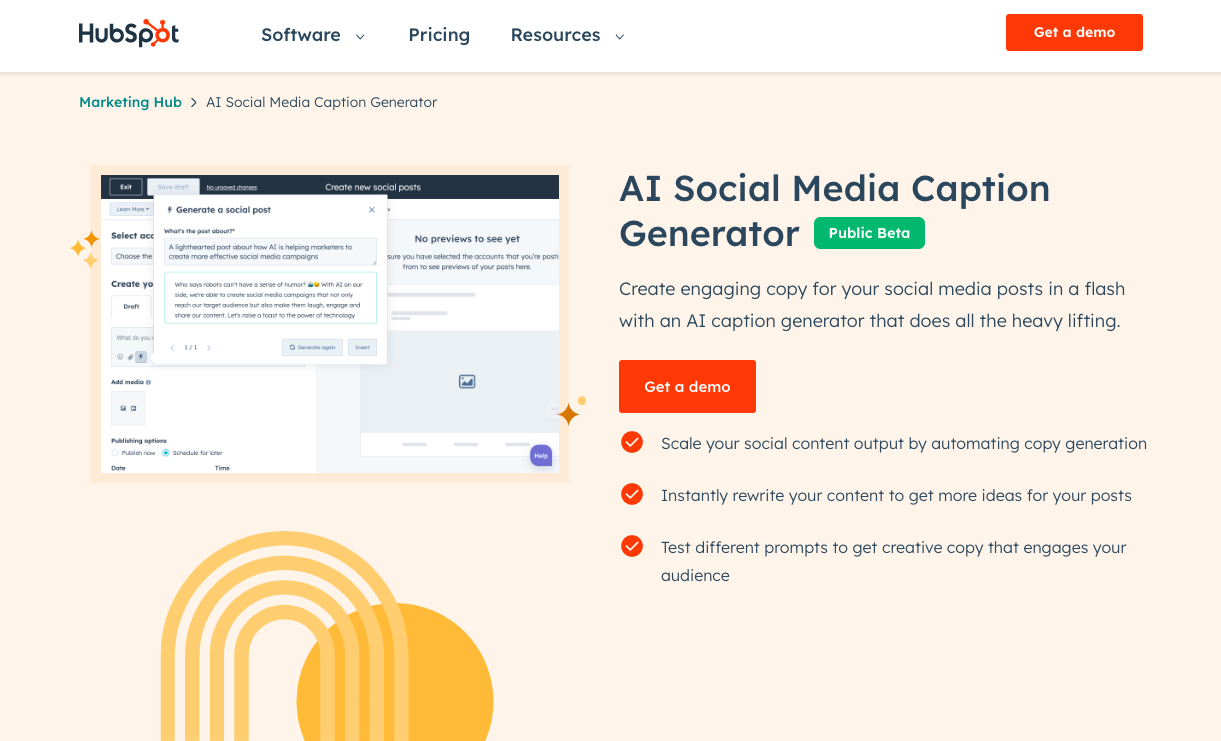
HubSpot AI Social Media Caption Generator – Get catchy social media captions instantly
HubSpot’s AI Social Media Caption Generator is another useful AI-powered content generation tool that has helped me create catchy social media captions. It’s great for when you need quick captions to go with your visuals. Simply provide a short post description, a few details about your audience, and the desired tone, and you’ll get your social media copy.
👉 Key Features:
Personalized captions: Generates social media captions that align with your brand personality and appeal to your audience. Test out multiple prompts to create multiple variations of copy.
Automated social copy generation: Repurposes basic social post copy into trivia, polls, and question-based captions to enhance engagement.
Supports multiple social media channels: Creates engaging captions for Instagram, Twitter, Facebook, and LinkedIn.
Built-in reporting: Create, publish, and track social posts from Hubspot’s dashboard. Plus, you can identify your top-performing content, analyze audience trends, and optimize your posting times.
🤔 Why go for it? HubSpot AI Social Media Caption Generator can be a good choice if you’re looking for quick social media captions, but it doesn’t come with many customization options.
2. AI-powered social listening
When you’re creating social media content, think in terms of striking up a conversation, not broadcasting your message. Content that is helpful to your audience and addresses their pain points and preferences will always be more engaging. So, it becomes important to analyze all the conversations, mentions, and trends on social media and track how your audience engages with social media content. That’s where AI social listening tools come in.
These AI tools can give you the inside scoop on audience sentiment, helping you build a social media content creation strategy that hits the bullseye. Around 16 percent of organizations around the world are already using AI for sentiment analysis.
Some AI tools that can help you with social listening are:
Buffer’s Engagement Features – Decode audience sentiment in conversations
With Buffer’s engagement features, it’s easy to track all your audience interactions and find opportunities for engagement. This tool also offers a unique feature that gives you smart alerts on audience sentiment using machine learning.
👉 Key Features:
Manage conversations: Displays past 30 posts (with up to 2,000 comments per post) from your connected social media account. It indicates which posts have unanswered comments, and checks for new comments every five seconds. You can use hotkeys and smart emojis for quick replies, and there’s also an easy option to dismiss any comments that don’t need replying.
Labels and sentiments: This AI-powered feature prioritizes your comments to show you what is most relevant to your business. It displays three types of labels on posts – Questions (query-based comments), Order (comments discussing order/shipment status), and Negativity (comments that have a negative sentiment).
Intuitive dashboard: Displays all your posts on a social media channel in a grid layout that mirrors the Instagram feed, making it easier to navigate through posts and find important comments.
🤔 Why go for it? Buffer’s engagement features are not only fantastic for social listening, but they can also be incredibly useful for uncovering new opportunities to boost engagement.
Buffer’s Analytics Features- Find out what works on social
Buffer’s analytics featuresuse AI to gather metrics from all your connected accounts, giving valuable insights into your audience reach and engagement across different social media channels. What sets this tool apart is its ability to collect metrics on content, regardless of the tool used for posting.
👉 Key Features:
Intuitive analytics dashboard: Monitors and generates reports for Instagram, Facebook, Twitter, and LinkedIn. Gives you an overview of your audience demographics, key engagement metrics, and the performance of social posts across different channels.
Individual posts’ performance: Besides giving you a high-level overview of your average performance on any channel, Buffer Analyze can also tell you about the performance of individual posts.
Answers: Get answers to the most pressing questions – What is the best time to post? What is the best type of post? What is the best posting frequency?
Customizable reports with daily updates: Build customizable reports tracking specific metrics, and set up your reports to get daily updates. Option to export reports as PDFs, and charts in image format.
🤔 Why go for it? Buffer Analyze can deliver invaluable insights and actionable suggestions for data-driven social media success.
Mentionlytics – Monitor conversations in real-time
Keep an eye on social mentions across popular social media platforms and the web, and get all the valuable insights you need. Mentionlytics is an AI-powered social listening tool that analyzes online conversations using advanced algorithms and big data analysis. It can help you stay on top of important stats like audience sentiment, engagement, reach, share of voice, and follower growth.
👉 Key Features:
Social media monitoring: Monitors brand mentions, specific hashtags, or any other phrases related to your brand on all major channels, including Facebook, Twitter, LinkedIn, Instagram, and more.
Web monitoring: Monitors brand mentions across blogs, news sites, forums, and other online sources.
Sentiment analysis: Helps in gauging audience sentiment, and gives you an overview of positive or negative reactions towards your brand.
Report builder: Drag-and-drop report builder allows you to customize your reports with actionable data, graphs, and more.
Identify influencers: Find the top influencers in your niche to leverage them for influencer marketing.
SIA: Mentionlytics’ Social Intelligent Assistant (SIA) serves up practical and tailored brand advice just for you.
🤔 Why go for it? If you need personalized brand insights across both social media and the web, then consider trying out Mentionlytics AI-powered social listening tool.
Meltwater – Capture every brand mention across social
Meltwater is an all-in-one social intelligence solution that comes with a comprehensive suite of tools for social listening and analytics, media monitoring, trend tracking, sentiment analysis, influencer identification, and more. It can gather data from various online channels, including popular social media platforms like YouTube, Pinterest, Twitch, Reddit, WeChat, Douyin, and Twitter.
👉 Key Features:
Media Intelligence: Highlights hidden insights about your market and brand, helping you build your voice of share.
Social Listening: No data caps or limits on social listening. Gives you historical brand data from a 15-month rolling archive.
Sentiment Analysis: Uses smart algorithms to analyze the sentiment behind all your online content, including your social media posts and articles.
Trend Tracking: Helps you keep up with the latest trends and topics in your industry so you can adjust your marketing strategies based on what’s relevant to your brand.
Real-time Alerts: Stay informed about important mentions, trends, or events with customizable alerts.
Reporting and analytics: Create custom reports that show all the important social media insights, charts, and metrics. Also comes with an automated regular reporting feature.
🤔 Why go for it? Meltwater is a comprehensive social intelligence solution that could be a good choice for unrestricted social listening across various online platforms, including some niche social media channels.
3. AI-powered competitor analysis
To level up your social media content creation game, it’s crucial to keep tabs on what your competitors are up to. AI-powered competitor analysis can help you pinpoint their weaknesses, strengths, and chances for growth, which you can then leverage to your advantage.
If you’re looking for some AI-powered tools to analyze your competitors’ social media strategies, content performance, and audience engagement, we’ve got three excellent suggestions to get you started –
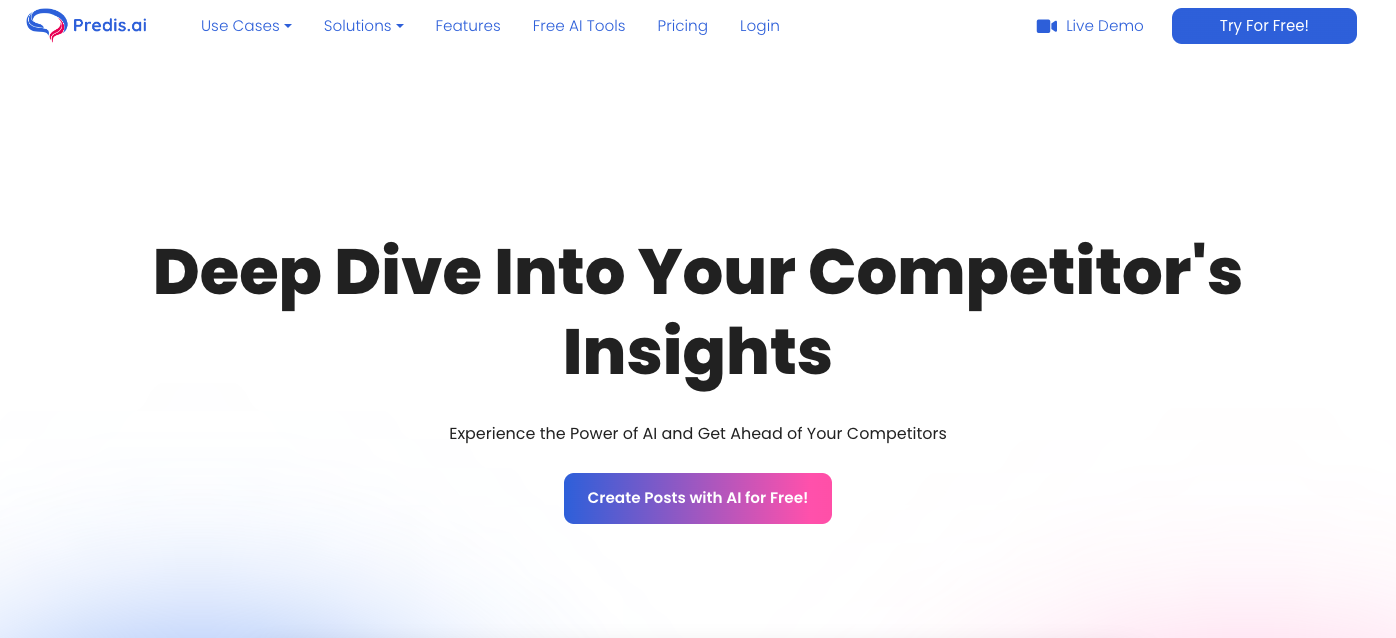
Predis.ai – Granular analysis of best and worst-performing competitor content on social
Predis.ai is an AI-powered social media marketing platform that can help you figure out what type of content is most effective for your audience by decoding your competition’s marketing strategy. It currently offers competitor analysis for Facebook and Instagram, with support for more platforms like LinkedIn, Twitter, TikTok, Pinterest, and YouTube on the way.
👉 Key Features:
Granular competitive analysis: Analyze your competitor’s social media content to see which posts are hitting the mark and which ones are falling short. It can also help you understand their content distribution patterns. This valuable info can help you gauge if your upcoming campaign ideas are on the right track. Plus, you get an overview of all the important metrics, like average likes/comments, number of followers, engagement rates, etc.
Hashtag analysis: Reveals the hashtag sets that the competitors are using in their social posts.
Reports: Generate reports with useful insights on competitor behavior and industry trends to develop actionable social media strategies.
🤔 Why go for it? Predis.ai can help you gain an edge over your competitors through granular-level social media competitive analysis, in which you get to learn about their social media marketing successes as well as failures.
Rival IQ – Deep competitor analytics to make better social media content decisions
Stay ahead in the game and make informed decisions about your social media content strategy with Rival IQ. This competitor analytics tool can help you uncover your competitors’ strengths and weaknesses with comprehensive benchmarking data. With this tool, you get a complete picture of your brand’s performance on social.
👉 Key Features:
Always-on competitive benchmarks: Understand your social media metrics better by putting them into a comparative context.
Competitive social media analytics: See where your competitors are focusing their efforts with always-on social post monitoring. Gives you an option to compare your social performance against specific competitors or all competitors in the industry.
Custom dashboards: Fully customizable dashboard templates make evaluating your social performance against competitors a breeze.
Boosted post detection: Uses machine learning to figure out if a rival has boosted a Facebook post. This way, you’ll be able to jump into action or replicate their strategy quickly.
🤔 Why go for it? If you’re a business or marketer interested in analyzing competitor social media posts in bulk, then Rival IQ could be a great tool for you.
Unmetric – Competitive benchmarking to improve your social strategy
Unmetric is a competitive benchmarking tool that uses AI to monitor and track your competitors’ and top brands’ social media activities. It can provide relevant insights about their social media strategies, from the type of content they’re creating to the hashtags being used, helping you step up your own social game.
👉 Key Features:
Competitive benchmarking: Track your performance, identify patterns, and assess the effectiveness of your social strategy. Keep an eye on your competitors to gain insights from their successes, mistakes, and innovations.
Competitive intelligence: Uncover what’s currently striking a chord with social media audiences by filtering your competitor’s organic and paid content based on engagement.
Automated reporting: Generate reports with your social KPIs for any social media channel or time frame.
Creative content ideas: Find inspiration for your social media content, and gain insights from over 100,000 brands on trending keywords, topics, events, and holidays.
Supports all major social networks: Offers social media analytics for all important social media platforms, like Facebook, Instagram, Twitter, and YouTube.
🤔 Why go for it? Unmetric could be a useful AI-based competitor analysis tool for making real-time decisions by comparing, benchmarking, and analyzing your social performance.
4. AI-generated visuals
Images and videos are crucial in social media content. In fact, they’re way more engaging than plain text posts on pretty much every internet platform. On LinkedIn, posts with images get 98 percent more comments, while on Twitter, including visual content makes tweets three times more likely to attract engagement.
But it’s not enough to just slap on any old image. Quality visual content is key. That’s where AI comes in. With AI algorithms, you can create stunning visuals like images, infographics, and even branded videos tailored to your brand’s style. AI-powered image and video editing tools might offer features like automatic background removal, image retouching, and even generating visuals based on text descriptions. So, save yourself some time and try out these three AI-powered tools for visual generation –
Canva – Create social media graphics with ease
Canva is a popular graphic design tool that helps content creators and marketing teams create beautiful visual content in seconds. With over 100 templates and social media layouts, you can create eye-catching designs for Facebook, Twitter, Pinterest, Instagram, and Google+. And now, they’ve added a slew of AI features to their platform to make graphic designing even simpler and more efficient.
👉 Key Features:
100+ social media layouts: Hundreds of professionally designed social media layouts for every social media platform, from TikTok to Twitter.
600k+ pre-designed templates: Customizable templates for a variety of social media posts.
Magic Design: AI tool that turns a text prompt into a custom social media post design.
Text-to-Image: Creates unique AI-generated images to add to your social posts
Magic Write: Generates text for the social media post graphic (or the social post copy)
Magic Edit and Magic Eraser: Allows for one-click image editing where you can modify, add, and replace elements from images, and remove any unwanted elements.
Magic Resizer: One-click image resizing tool makes it easier to create designs suitable for different platforms.
Drag-and-drop editor: Easy-to-use editor with a content library offering 100M+ graphics, photos, videos, fonts, and audio.
🤔 Why go for it? Canva is an intuitive tool that lets you experiment with graphic designing at your own pace. The best part is that it doesn’t involve a steep learning curve, allowing everyone to create social media graphics quickly and efficiently.
Let’s Enhance – AI-powered image enhancement
Let’s Enhance uses advanced AI technology to upscale and boost the resolution of your images. With its powerful Super Resolution machine learning algorithm, the tool maintains the finest details in images, removing any pixelation or blur, to give you high-quality images for your social media content.
👉 Key Features:
Image Upscaling: Enhances image resolution by up to 16 times without compromising quality.
Image Enhancement: Improves image quality by fixing pixelation, blur, lighting, and colors, and getting rid of any visual artifacts.
Facial and text Sharpening: Helps in enhancing the finer details in text and faces within images.
AI Art Generator: Transform your words into stunning high-resolution images, allowing you to create one-of-a-kind AI art for your social posts.
🤔 Why go for it? Let’s Enhance is an easy-to-use AI tool that could help you improve the quality of your visual content with minimal effort.
Pictory – Create AI-generated videos for social
Pictory is an AI tool transforming video creation for social media by helping users create engaging videos from text. It also offers the option to edit existing videos using text, making it way easier to repurpose content for different platforms and for different audiences.
👉 Key Features:
Script-to-Video: Converts scripts into videos, complete with visuals, transitions, and AI-powered voiceovers.
Article-to-Video: Transforms written content (articles and blog posts) into videos for sharing on social.
Edit videos using text: Allows text-based editing of existing videos and makes it easier to create short video clips.
Visuals-to-Video: Creates custom videos using uploaded media files (videos and photos).
AI Voiceover: Offers a variety of AI-powered voice options to add voiceovers to videos, and comes with a voice sync option that automatically syncs text with voiceover.
Customizable templates: Offers a selection of templates for various themes and styles, simplifying video creation.
Highlights: Automatically identifies and highlights key points in videos. Useful for creating summaries or extracting important clips from longer videos.
Stock media library: Provides a large library of stock videos and images.
🤔 Why go for it? Pictory offers a comprehensive video marketing toolkit packed with beautiful AI features to simplify video content creation for social.
5. AI meme generation
What’s in a meme? A lot, I’d say. Memes have a way of bringing people together through humor. They’re way more popular than your regular social media graphics. An NYU study found that memes get 60 percent more organic engagement than regular posts.
Given the increasing popularity of meme marketing, it’s no surprise that technology has jumped on the bandwagon. There are many AI tools to curate and create memes tailored to current trends and user preferences. I’ve found these three to be pretty useful –
Supermeme.ai – Turn text into memes
Supermeme is an AI tool that merges OpenAI’s GPT-3 with a cool collection of handpicked images and GIFs to create shareable memes, with witty captions and appropriate meme templates. Whether you’re looking to turn text into memes or GIFs, or want themed memes for a specific occasion, this tool offers numerous features for meme generation.
👉 Key Features:
Text-to-meme: Gives you a bunch of memes to use from simple text prompts.
AI GIF memes: Creates hilarious GIF memes by matching thousands of GIFs with the perfect captions to fit your text prompt.
Themed memes: Generates relevant memes on any topic provided.
Custom memes: Upload your image and turn it into a custom meme using AI.
1,000+ meme templates: Offers thousands of specially curated meme templates that are professionally usable and come without any watermarks.
Minimalistic meme editor: Makes it easier to add and modify text, adjust font size, and make necessary tweaks in memes.
Multi-language supports: Creates memes in over 110 different languages.
Custom watermark: Option to add custom watermarks to brand your AI-generated memes.
🤔 Why go for it? Supermeme could be a great tool for creating customized memes quickly and effortlessly.
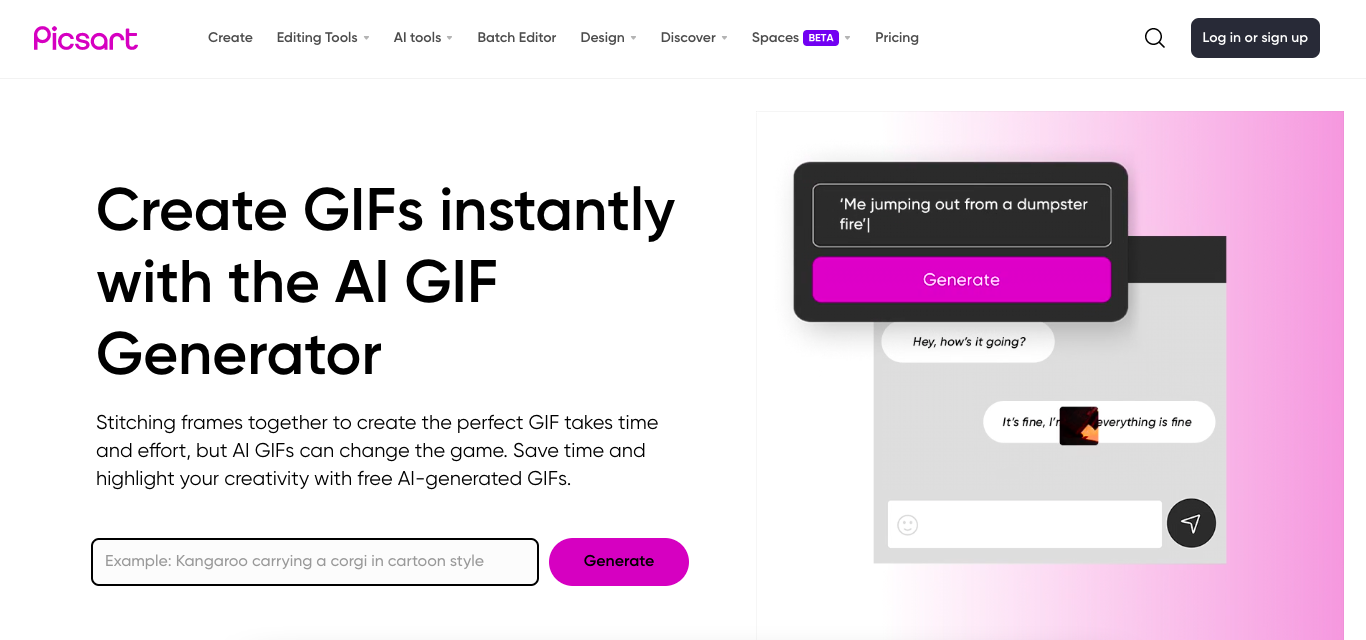
Picsart – Generate high-quality GIFs with AI
Picsart’s AI GIF Generator is a recent addition to the AI-powered image editing tool. This is not your basic tool that combines AI-generated captions with pre-made GIFs to create memes. Instead, it creates entirely new GIFs using text prompts.
👉 Key Features:
Text-to-GIF: Uses AI to create unique GIFs by stitching together frames based on your text prompts. Fine-tune the AI-generated GIFs using thumbs-up and thumbs-down options.
GIF style options: Wide variety of moods, styles, and art options to cater to different creative preferences.
AI art generator, AI image generator, and AI video generator, with many other features for image editing.
🤔 Why go for it? Picsart could help you create GIF memes that are uniquely yours.
Kapwing AI Meme Generator – Create relatable, AI-generated memes
Kapwing’s Meme Maker is another AI tool that helps in creating hilarious memes effortlessly. I’ve used this tool to whip up images, GIFs, and video memes quickly. It offers a vast collection of meme templates to choose from and allows you to import your own content to create memes.
👉 Key Features:
AI meme generator: Generates six variations of memes using your text input. Offers the option to change caption and add animation, text, or even music.
Memes from images and videos: Choose from image and video meme templates, or upload your own image/video files to convert them into memes on Kapwing’s editor.
Huge meme template library: Provides a large library of meme templates on various classic and trending topics. Also offers blank templates to allow for more customization.
AI image generator, AI video generator, and a bunch of other AI tools.🤔 Why go for it? Kapwing’s meme generator offers both AI-generated memes and the ability to create custom ones from scratch.
Wrapping Up
Time is precious, and AI can help you maximize every second of it! Take it from me, I used to spend hours on end crafting the perfect social media post. But once I dipped my toes into the world of AI-powered social media content creation? Game changer. 🙌
Since I started using AI for social media content creation, I’ve seen two major positive changes –
It has drastically improved the quality of my content
It is helping me maintain a consistent posting schedule
So, if you’re looking to make your marketing life easier too, check out these 15 amazing AI tools I’ve listed here, and see which ones work best for you. Honestly, you’ll wonder why you didn’t hop on board sooner – I know I did!
Isarele introduce la nuova variante del carro Merkava, il “Barak”, con tanto di AI
Le Forze di Difesa Israeliane (IDF) hanno svelato la loro nuova variante di prossima generazione del loro venerabile carro armato principale “Merkava” (MBT).
Sviluppato negli ultimi cinque anni congiuntamente dal Ministero della Difesa israeliano e dall’IDF, Gerusalemme ha annunciato che questo carro armato è cruciale per il futuro della nazione. I miglioramenti rispetto alle varianti precedenti includono le tecnologie più recenti, come sensori, intelligenza artificiale, reti e sistemi di protezione attiva, anziché fare affidamento su progressi strutturali.
“La nuova era inaugurata dal carro armato ‘Barak’ è un passo avanti straordinario ed un’espressione delle capacità tecnologiche che migliorano continuamente e assicurano il vantaggio qualitativo dell’IDF, sia in difesa che in attacco”, ha affermato il ministro della Difesa israeliano Yoav Gallant in un discorso dichiarazione martedì. “L’assorbimento del nuovo carro armato rappresenta un’enorme opportunità per migliorare l’efficacia operativa in preparazione della prossima campagna e un moltiplicatore di forza per l’IDF, la fanteria e il corpo corazzato”, ha spiegato il comandante della 401a brigata corazzata, il colonnello Benny Aharon.
Il 401°, sotto il Comando Sud di Israele, è una delle tre unità corazzate che compongono il corpo corazzato israeliano e riceverà il carro armato. Si prevede che il “Barak” sostituirà tutti i carri armati “Merkava 4” esistenti nella 401a Brigata entro la fine del 2025.
Il “Barak” riceverà anche il casco “IronVision”, sviluppato da Elbit Systems, che viene ora schierato insieme al ‘Barak’. Il casco sarà integrato con sensori all’esterno del carro armato per conferire al comandante una visione periferica simile a quella di un pilota da caccia, consentendogli di “vedere” oltre il carro armato attraverso telecamere e sensori.
Elmo Ironvision
Secondo Elbit, questo sistema fornirà al “Barak” capacità di elaborazione delle immagini per assistere i sensori del serbatoio nell’ordinamento dei dati e nel riconoscimento degli oggetti. L’autista, l’artigliere o il comandante possono quindi utilizzare gli schermi situati all’interno del serbatoio per indagare ed eliminare potenziali minacce. Il controller della pistola funziona come un joystick o come la levetta di controllo di volo del pilota. Inoltre, il carro armato è dotato del “Trophy Active Protection System” di Rafael.
Il “Barak” è inoltre dotato di touch screen e di un archivio di applicazioni operative per assistere l’equipaggio nelle missioni. Inoltre, può trasferire informazioni in tempo reale tra diversi rami militari.
Israele ha iniziato a pianificare il nuovo carro armato nel 2015 per far fronte alle esigenze operative emergenti. A quel tempo, i carri armati israeliani venivano utilizzati principalmente a Gaza, in particolare in contesti urbani, contro minacce non tradizionali, come militanti equipaggiati con granate lanciarazzi (RPG). La progettazione del serbatoio è stata finalizzata nel 2016 e il processo di sviluppo è iniziato nel 2018. Il serbatoio è ora pronto per l’impiego dopo le prove tecnologiche nel 2020 e nel 2021.
Arriverà molto presto in servizio
Il ministero non ha fornito dettagli sul numero di unità ordinate, sui tempi di dispiegamento o sul loro costo. Tuttavia, hanno menzionato che il prezzo è paragonabile al Merkava 4M (circa 3,5 milioni di dollari). La produzione del nuovo serbatoio è iniziata il mese scorso. Recentemente, una compagnia del Battaglione 52 del Corpo Corazzato ha ricevuto il suo primo “Barak”.
Grazie al nostro canale Telegram potete rimanere aggiornati sulla pubblicazione di nuovi articoli di Scenari Economici.
Opinion: The Copyright Office is making a mistake on AI-generated art
Two weeks ago, the US Copyright Office refused to register a copyright for Théâtre D’opéra Spatial, an AI-generated image that got widespread media attention last year after it won an art competition. It’s at least the third time the Copyright Office has ruled that AI-generated art cannot be copyrighted.
The Copyright Office first ruled on this issue in 2019. Artist Stephen Thaler tried to register an image that he said had been created entirely by a computer program. The Copyright Office rejected the application because copyright protection is only available for works created by human beings—not supernatural beings (like the Holy Spirit), not animals (like this now-famous monkey), and not computer programs.
The ruling raised an important question: Was the issue just that Thaler should have listed himself, rather than his AI system, as the image’s creator? Or is AI-generated art categorically excluded from copyright protection?
In recent months, the Copyright Office has endorsed this second view. In February, it canceled the registration of a comic book called Zarya of the Dawn that contained AI-generated images. Then on September 5, the office rejected the copyright for Théâtre D’opéra Spatial, holding that it “was not the product of human authorship” because it had been created by the AI software Midjourney.
I don’t think these more recent decisions are going to age well.
“The copyright office’s position follows fairly logically from what they’ve staked out,” Cornell University copyright scholar James Grimmelmann told me. “And that follows fairly logically from existing copyright doctrine or theory.”
At the same time, Grimmelmann said, “I don’t see this approach being scalable. It seems like a quagmire.”
Lessons from photography
In the 1880s, courts were deciding how copyright law should handle the then-new technology of photography. Some people argued that photographs shouldn’t receive copyright protection at all. Copyright is supposed to cover creative works, and a camera just mechanically captures images of whatever it’s pointed at.
A photographer named Napoleon Sarony took a photo of Oscar Wilde and later sued a company that republished it without permission. The case went all the way to the US Supreme Court, which ruled in 1884.
The nation’s highest court acknowledged that “ordinary” photographs may not merit copyright protection because they may be a “mere mechanical reproduction” of some scene.
By contrast, the court said the Wilde photograph reflected Sarony’s “original mental conception,” which he had brought to life by “posing Oscar Wilde in front of the camera, selecting and arranging the costume, draperies, and other various accessories in said photograph, arranging the subject so as to present graceful outlines, arranging and disposing the light and shade, suggesting and evoking the desired expression.”
So even though a mechanical process captured the image, it nevertheless reflected creative choices by the photographer, and therefore deserved copyright protection.
This ruling is still good law today, and the Copyright Office cited it in its February ruling rescinding copyright protection for Zarya of the Dawn. But there are two different ways to read this century-old precedent. And in my view, the Copyright Office picked the wrong reading.
The Copyright Office concluded that using AI to generate art was a “merely mechanical” process with “no place for novelty, invention, or originality”—and hence not worthy of copyright protection. But I don’t think this makes sense given how copyright law has treated photographs over the last 130 years.
After all, if you read the Sarony ruling literally, it suggests that many photographs shouldn’t get copyright protection. Landscape photographers, for example, don’t decide the position of the sun, the shape of clouds, or the color of trees. Yet landscape photos can be copyrighted.
Or consider the time an Associated Press photographer, Mannie Garcia, snapped a photo of then-Sen. Barack Obama listening to George Clooney during a 2006 panel discussion. Two years later, artist Shepard Fairey used Garcia’s photo as the basis for an illustration called “Obama Hope” that was ubiquitous during the 2008 presidential campaign.
When the AP learned Fairey had based his work on an AP photo, it demanded compensation. Fairey sued the AP, asking for a ruling that he had not infringed the photo. The lawsuit argued that Fairey’s use of the photo was allowed under copyright’s fair use doctrine.
But notably, Fairey didn’t argue that the photograph wasn’t eligible for copyright at all—probably because that argument would have been laughed out of court. Everyone agrees that a photograph like Garcia’s is eligible for copyright—even though Garcia did not pose Obama in front of the camera, select or arrange Obama’s clothes, set up the background or lighting, or suggest what expressions Obama should make.
Garcia just recognized a compelling shot of Obama and captured a high-quality image. And under US copyright law, that’s enough creativity to merit copyright protection.
Photographers “choose where to point the camera, when to snap the image, and how to adjust a bunch of camera settings,” Grimmelmann told me. “We settled into the idea that a photographer owns the copyright in the resulting photograph.”
https://arstechnica.com/?p=1969880
AI-generated books force Amazon to cap e-book publications to 3 per day
On Monday, Amazon introduced a new policy that limits Kindle authors from self-publishing more than three books per day on its platform, reports The Guardian. The rule comes as Amazon works to curb abuses of its publication system from an influx of AI-generated books.
Amazon revealed the new limitations in a post on its Kindle Direct Publishing (KDP) forum. KDP allows self-published authors to list their works on the Amazon website. While the official announcement did not state a limit number, an Amazon representative told The Guardian about the three-book limit, which can be adjusted “if needed.” Previously, there had been no limit on the number of books that authors could list daily.
Since the launch of ChatGPT, an AI assistant that can compose text in almost any style, some news outlets have reported a marked increase in AI-authored books, including some that seek to fool others by using established author names. Despite the anecdotal observations, Amazon is keeping its cool about the scale of the AI-generated book issue for now. “While we have not seen a spike in our publishing numbers,” they write, “in order to help protect against abuse, we are lowering the volume limits we have in place on new title creations.”
The news comes on the heels of another rule from Amazon announced in early September that requires authors to inform the company if their material is AI-generated. Amazon added new sections to its Content Guidelines defining what counts as “AI-generated” (if AI is used to create content) and “AI-assisted” (if AI is used to edit or correct content).
AI-generated books are not banned from Amazon completely, but the company’s guidelines say, “We require you to inform us of AI-generated content (text, images, or translations) when you publish a new book or make edits to and republish an existing book through KDP.”
The Guardian notes that these changes follow some high-profile incidents where books suspected to be AI-generated were removed from Amazon’s site. In particular, books about mushroom foraging (that potentially contained dangerous advice) and travel books were reportedly AI-generated and subsequently taken down.
Some industry experts are skeptical about the effectiveness of the new rules. The Guardian quotes Dr. Miriam Johnson, a senior lecturer in publishing at Oxford Brookes University, as saying that the three-book limit would probably not be a “gamechanger for managing the influx of AI-written content” because those flooding Amazon with AI-generated books will likely find workarounds.
Presumably, the three-per-day book limit will not affect self-published authors who do not use AI tools to write books, unless they typically publish all of their books they’ve been writing for months or years on the same day. “Very few publishers will be impacted by this change,” Amazon says.
Still, Amazon is acting out of an abundance of caution rather than a state of panic. “We are actively monitoring the rapid evolution of generative AI and the impact it is having on reading, writing, and publishing,” the company writes, “and we remain committed to providing the best possible shopping, reading, and publishing experience for our authors and customers.”
https://arstechnica.com/?p=1970174
Agcom si sta candidando anche al ruolo di autorità supervisore dell’AI?
Dopo la recente nomina a coordinatore dei servizi digitali, come responsabile dell’enforcement dei nuovi regolamenti digitali, a partire dal Digital Services Act, l’Agcom punta anche all’Intelligenza Artificiale. E’ quanto emerge dalle dichiarazioni del presidente dell’autorità Giacomo Lasorella, durante l’evento congiunto Agcom/Italian Chapter dell’Iic dal titolo “Pluralismo e diritto d’autore al tempo dell’intelligenza artificiale”, che oggi ha fatto riferimento alla necessità di regolare l’uso corretto dell’IA in diversi ambiti, lanciando l’Autorità come supervisore anche di questo capitolo tecnologico.
Ruolo digital services coordinator rafforza Agcom anche su IA
Questi “sono temi comuni alle riflessioni di tutte l’autorità europee. C’è grande attenzione all’evoluzione dell’AI in questi settori, perché sono le sfide del futuro”. Il prossimo passaggio fondamentale “è l’attuazione del Digital Services act, destinato a diventare totalmente attuabile dal febbraio 2024” e nell’AI Act “si segue l’impostazione del Dsa”.
Ci sarà “la necessità di approfondire anche attraverso la regolazione dell’intelligenza artificiale un dialogo costante tra i portatori di interessi di mercato e istituzionali”. La recentissima designazione di Agcom come digital services coordinator “consentirà all’Italia di avvalersi di un’autorità nazionale per lavorare in sinergia con tutti gli altri soggetti e Autorità e avviare una regolazione organica di questo elemento. Sicuramente è un primo passo verso la regolazione dell’Ai”. Agcom “farà di tutto per essere all’altezza dei nuovi compiti”.
L’intelligenza artificiale “è destinata a trasformare in modo sempre più profondo il mondo dell’informazione e l’industria creativa”. Nel settore audiovisivo “gli algoritmi comportano una serie di rischi e opportunità. La nuova regolamentazione dell’Ai richiederà alle autorità competenti un delicato ruolo di composizione degli interessi in gioco. Il problema è adattare la tutela autoriale alle opere dell’ingegno non umano o non del tutto umano, in quanto creazione originale prodotta dalle macchine”. Lo ha detto il presidente di Agcom Giacomo Lasorella in apertura dell’evento congiunto Agcom/Iic “Pluralismo e diritto d’autore al tempo dell’intelligenza artificiale” in corso a Roma.
Su AI Act necessaria composizione da parte delle Autorità di diversi interessi in gioco
“L’Artificial Intelligence Act (Aia) europeo costituisce il primo regolamento al mondo sull’intelligenza artificiale e segue il modello seguito anche per il Digital Service Act (Dsa). Rappresenta un’interessante novità dal punto di vista normativo perché lascia alle grandi piattaforme, ai motori di ricerca e ai vari soggetti regolati l’onere di analizzare il rischio e di autoregolarsi e nel contempo prevede delle Autorità che controllino questo processo. La nuova regolazione sull’intelligenza artificiale richiederà alle autorità competenti un delicato ruolo di composizione dei vari interessi in gioco. C’è grande attenzione per l’evoluzione dell’intelligenza artificiale nei settori dell’audiovisivo e della comunicazione, e il passaggio fondamentale sarà sicuramente proprio l’attuazione del Dsa, destinata a diventare veramente applicabile a partire dal febbraio 2024”.
Opere generate daIl’IA non assimilabili a quelle dell’ingegno umano
“E’ da mettere in dubbio l’assimilabilità delle opere generate dall’IA a quelle dell’ingegno, in quanto manca il requisito fondamentale dell’autorialità umana e della creazione intellettuale” sottolinea. E’ necessario “valutare caso per caso il livello dell’elemento umano e di autonomia dell’IA nel generare il risultato, capire se si è in presenza di ‘AI assisted output’ o ‘AI generated output’”. Del resto “è anche importante, come è stato detto in una risoluzione del Parlamento Europeo incoraggiare investimenti in queste forme di creazione”. C’è poi il “problema dell’utilizzo delle opere tutelate – aggiunge – delle istanze degli autori che chiedono un regime di equo compenso e di previa autorizzazione”.
IA crea deep fake ma è in grado anche di combatterli
C’è inoltre il problema “di quali siano i soggetti a cui riconoscere diritti o imputare responsabilità”. Allargando l’orizzonte “al sistema dei media audiovisivi e dell’informazione online, si pongono necessità di protezione dai rischi. Ad esempio l’IA può essere utilizzata per creare deep fake, contenuti falsi, ma è proprio l’intelligenza artificiale che riesce a contrastare questo fenomeno”. Bisogna regolamentare “con intelligenza ed equilibrio”.
C’è anche “il grande tema del pluralismo dei media”. Nella regolazione“di tutti questi aspetti a cominciare dal Digital Services Act e l’Ai Act, l’Europa è all’avanguardia anche se per ora sono solo procedure”. Finora, “al di là dell’attuazione delle grandi direttive di settore, abbiamo agito prevalentemente con strumenti di autoregolamentazione e coregolamentazione”.
OpenAI’s new AI image generator pushes the limits in detail and prompt fidelity
On Wednesday, OpenAI announced DALL-E 3, the latest version of its AI image synthesis model that features full integration with ChatGPT. DALL-E 3 renders images by closely following complex descriptions and handling in-image text generation (such as labels and signs), which challenged earlier models. Currently in research preview, it will be available to ChatGPT Plus and Enterprise customers in early October.
Like its predecessor, DALLE-3 is a text-to-image generator that creates novel images based on written descriptions called prompts. Although OpenAI released no technical details about DALL-E 3, the AI model at the heart of previous versions of DALL-E was trained on millions of images created by human artists and photographers, some of them licensed from stock websites like Shutterstock. It’s likely DALL-E 3 follows this same formula, but with new training techniques and more computational training time.
Judging by the samples provided by OpenAI on its promotional blog, DALL-E 3 appears to be a radically more capable image synthesis model than anything else available in terms of following prompts. While OpenAI’s examples have been cherry-picked for their effectiveness, they appear to follow the prompt instructions faithfully and convincingly render objects with minimal deformations. Compared to DALL-E 2, OpenAI says that DALL-E 3 refines small details like hands more effectively, creating engaging images by default with “no hacks or prompt engineering required.”
A DALL-E 3 image provided by OpenAI with the prompt: “An illustration of an avocado sitting in a therapist’s chair, saying ‘I just feel so empty inside’ with a pit-sized hole in its center. The therapist, a spoon, scribbles notes.”
A DALL-E 3 image provided by OpenAI with the prompt: “A vast landscape made entirely of various meats spreads out before the viewer. tender, succulent hills of roast beef, chicken drumstick trees, bacon rivers, and ham boulders create a surreal, yet appetizing scene. the sky is adorned with pepperoni sun and salami clouds.”
A DALL-E 3 image provided by OpenAI with the prompt: “A minimap diorama of a cafe adorned with indoor plants. Wooden beams crisscross above, and a cold brew station stands out with tiny bottles and glasses.”
A DALL-E 3 image provided by OpenAI with the prompt: “Close-up photograph of a hermit crab nestled in wet sand, with sea foam nearby and the details of its shell and texture of the sand accentuated.”
A DALL-E 3 image provided by OpenAI with the prompt: “A paper craft art depicting a girl giving her cat a gentle hug. Both sit amidst potted plants, with the cat purring contentedly while the girl smiles. The scene is adorned with handcrafted paper flowers and leaves.”
A DALL-E 3 image provided by OpenAI with the prompt: “Pixel art scene of Coit Tower standing tall on Telegraph Hill, with a panoramic view of the city below and birds flying around.”
A DALL-E 3 image provided by OpenAI with the prompt: “Tiny potato kings wearing majestic crowns, sitting on thrones, overseeing their vast potato kingdom filled with potato subjects and potato castles.”
A DALL-E 3 image provided by OpenAI with the prompt: “An illustration of a human heart made of translucent glass, standing on a pedestal amidst a stormy sea. Rays of sunlight pierce the clouds, illuminating the heart, revealing a tiny universe within. The quote ‘Find the universe within you’ is etched in bold letters across the horizon.”
A DALL-E 3 image provided by OpenAI with the prompt: “A middle-aged woman of Asian descent, her dark hair streaked with silver, appears fractured and splintered, intricately embedded within a sea of broken porcelain. The porcelain glistens with splatter paint patterns in a harmonious blend of glossy and matte blues, greens, oranges, and reds, capturing her dance in a surreal juxtaposition of movement and stillness. Her skin tone, a light hue like the porcelain, adds an almost mystical quality to her form.”
In comparison, Midjourney, a competing AI image synthesis model from another vendor, renders photorealistic details well, but it still requires a great deal of counter-intuitive tinkering with prompts to gain any control over the image output.
DALL-E 3 also appears to handle text within images in a way that its predecessor couldn’t (some competing models like Stable Diffusion XL and DeepFloyd are getting better at it). For example, a prompt that included the words, “An illustration of an avocado sitting in a therapist’s chair, saying ‘I feel so empty inside’ with a pit-sized hole in its center,” created a cartoon avocado with the character quote perfectly encapsulated in a speech bubble.
Notably, OpenAI says that DALL-E 3 has been “built natively” on ChatGPT and will arrive as an integrated feature of ChatGPT Plus, allowing conversational refinements to images in a way that will use the AI assistant as a brainstorming partner. It also means that ChatGPT will be able to generate images based on the context of the current conversation, which may lead to novel new capabilities. Microsoft’s Bing Chat AI assistant, also built on technology from OpenAI, has been able to generate images in conversation since March.
https://arstechnica.com/?p=1969719
Telling AI model to “take a deep breath” causes math scores to soar in study
Google DeepMind researchers recently developed a technique to improve math ability in AI language models like ChatGPT by using other AI models to improve prompting—the written instructions that tell the AI model what to do. It found that using human-style encouragement improved math skills dramatically, in line with earlier results.
In a paper called “Large Language Models as Optimizers” listed this month on arXiv, DeepMind scientists introduced Optimization by PROmpting (OPRO), a method to improve the performance of large language models (LLMs) such as OpenAI’s ChatGPT and Google’s PaLM 2. This new approach sidesteps the limitations of traditional math-based optimizers by using natural language to guide LLMs in problem-solving. “Natural language” is a fancy way of saying everyday human speech.
“Instead of formally defining the optimization problem and deriving the update step with a programmed solver,” the researchers write, “we describe the optimization problem in natural language, then instruct the LLM to iteratively generate new solutions based on the problem description and the previously found solutions.”
Typically, in machine learning, techniques using algorithms such as derivative-based optimizers act as a guide for improving an AI model’s performance. Imagine a model’s performance as a curve on a graph: The goal is to find the lowest point on this curve because that’s where the model makes the fewest mistakes. By using the slope of the curve to make adjustments, the optimizer helps the model get closer and closer to that ideal low point, making it more accurate and efficient at whatever task it’s designed to do.
Rather than relying on formal mathematical definitions to perform this task, OPRO uses “meta-prompts” described in natural language to set the stage for the optimization process. The LLM then generates candidate solutions based on the problem’s description and previous solutions, and it tests them by assigning each a quality score.
In OPRO, two large language models play different roles: a scorer LLM evaluates the objective function such as accuracy, while an optimizer LLM generates new solutions based on past results and a natural language description. Different pairings of scorer and optimizer LLMs are evaluated, including models like PaLM 2 and GPT variants. OPRO can optimize prompts for the scorer LLM by having the optimizer iteratively generate higher-scoring prompts. These scores help the system identify the best solutions, which are then added back into the ‘meta-prompt’ for the next round of optimization.
“Take a deep breath and work on this step by step”
Perhaps the most intriguing part of the DeepMind study is the impact of specific phrases on the output. Phrases like “let’s think step by step” prompted each AI model to produce more accurate results when tested against math problem data sets. (This technique became widely known in May 2022 thanks to a now-famous paper titled “Large Language Models are Zero-Shot Reasoners.”)
Consider a simple word problem, such as, “Beth bakes four two-dozen batches of cookies in a week. If these cookies are shared among 16 people equally, how many cookies does each person consume?” The 2022 paper discovered that instead of just feeding a chatbot a word problem like this by itself, you’d instead prefix it with “Let’s think step by step” and then paste in the problem. The accuracy of the AI model’s results almost always improves, and it works well with ChatGPT.
Interestingly, in this latest study, DeepMind researchers found “Take a deep breath and work on this problem step by step” as the most effective prompt when used with Google’s PaLM 2 language model. The phrase achieved the top accuracy score of 80.2 percent in tests against GSM8K, which is a data set of grade-school math word problems. In comparison, PaLM 2, without any special prompting, scored only 34 percent accuracy on GSM8K, and the classic “Let’s think step by step” prompt scored 71.8 percent accuracy.
So why does this work? Obviously, large language models can’t take a deep breath because they don’t have lungs or bodies. They don’t think and reason like humans, either. What “reasoning” they do (and “reasoning” is a contentious term among some, though it is readily used as a term of art in AI) is borrowed from a massive data set of language phrases scraped from books and the web. That includes things like Q&A forums, which include many examples of “let’s take a deep breath” or “think step by step” before showing more carefully reasoned solutions. Those phrases may help the LLM tap into better answers or produce better examples of reasoning or solving problems from the data set it absorbed into its neural network weights.
Even though working out the best ways to give LLMs human-like encouragement is slightly puzzling to us, that’s not a problem for OPRO because the technique utilizes large language models to discover these more effective prompting phrases. DeepMind researchers think that the biggest win for OPRO is its ability to sift through many possible prompts to find the one that gives the best results for a specific problem. This could allow people to produce far more useful or accurate results from LLMs in the future.
https://arstechnica.com/?p=1969012
Google’s AI protein folder IDs structure where none seemingly existed
For most proteins, structure is function. The complex three-dimensional shapes that proteins adopt create folds and pockets that can accomplish the remarkably improbable: driving chemical reactions that would otherwise never happen or binding to a single chemical inside the complex environment of a cell. Protein structure is so important that there’s an entire discipline, along with several well-developed approaches, to figuring out what a protein looks like when it’s all folded up into its active state.
But that’s only most proteins. Scientists have also found a growing catalog of intrinsically disordered proteins. Rather than having a set structure, intrinsically disordered proteins seem to have entire sections that can flap around in the breeze of Brownian motion and, yet, were critical to the protein’s structure. People haven’t been sure whether these proteins temporarily adopted a specific structure to work or the disorder was critical for function.
Now, a new paper describes a case where two intrinsically disordered proteins induce specific structures in each other when they interact. And Google’s new AlphaFold AI software was critical to figuring out that structure.
Chasing disorder
Most studies of protein structures identify the positions of amino acids with a fairly high degree of certainty. However, many proteins had regions where these studies produced the equivalent of a blur, suggesting that part of the protein was in constant motion in the environment. A number of additional proteins also resisted structural studies entirely.
For many years, these were considered oddities that had little to do with each other. Eventually, people came around to the idea that this seemingly disordered state was not an experimental artifact but, rather, represented the protein’s actual behavior—and, in some cases, was essential to their function. The idea of intrinsically disordered proteins was a key conceptual breakthrough.
Since then, researchers have identified a number of ways these things function. In some cases, they can form a specific structure when interacting with a separate molecule. In others, they allow the formation of different structures depending on which molecule they’re interacting with. In still others, proteins seem to remain disordered even when functionally active. Figuring out which is the case for a given intrinsically disordered protein can be a serious challenge.
But that’s the challenge a group of researchers in Hefei, China, decided to tackle. They were interested in a protein called protein 4.1G, which, through its interactions with a protein called NuMA, is essential for cell division. The regions of both NuMA and protein 4.1G that mediate this interaction have been identified, and they’re both intrinsically disordered.
So how do you figure out what the proteins are doing?