China keeps buying hobbled Nvidia cards to train its AI models

The Nvidia H100 Tensor Core GPU
Enlarge / A press photo of the Nvidia H100 Tensor Core GPU.

The US acted aggressively last year to limit China’s ability to develop artificial intelligence for military purposes, blocking the sale there of the most advanced US chips used to train AI systems.

Big advances in the chips used to develop generative AI have meant that the latest US technology on sale in China is more powerful than anything available before. That is despite the fact that the chips have been deliberately hobbled for the Chinese market to limit their capabilities, making them less effective than products available elsewhere in the world.

The result has been soaring Chinese orders for the latest advanced US processors. China’s leading Internet companies have placed orders for $5 billion worth of chips from Nvidia, whose graphical processing units have become the workhorse for training large AI models.

The impact of soaring global demand for Nvidia’s products is likely to underpin the chipmaker’s second-quarter financial results due to be announced on Wednesday.

Besides reflecting demand for improved chips to train the Internet companies’ latest large language models, the rush has also been prompted by worries that the US might tighten its export controls further, making even these limited products unavailable in the future.

However, Bill Dally, Nvidia’s chief scientist, suggested that the US export controls would have greater impact in the future.

“As training requirements [for the most advanced AI systems] continue to double every six to 12 months,” the gap between chips sold in China and those available in the rest of the world “will grow quickly,” he said.

Capping processing speeds

Last year’s US export controls on chips were part of a package that included preventing Chinese customers from buying the equipment needed to make advanced chips.

Washington set a cap on the maximum processing speed of chips that could be sold in China, as well as the rate at which the chips can transfer data—a critical factor when it comes to training large AI models, a data-intensive job that requires connecting large numbers of chips together.

Nvidia responded by cutting the data transfer rate on its A100 processors, at the time its top-of-the-line GPUs, creating a new product for China called the A800 that satisfied the export controls.

This year, it has followed with data transfer limits on its H100, a new and far more powerful processor that was specially designed to train large language models, creating a version called the H800 for the Chinese market.

The chipmaker has not disclosed the technical capabilities of the made-for-China processors, but computer makers have been open about the details. Lenovo, for instance, advertises servers containing H800 chips that it says are identical in every way to H100s sold elsewhere in the world, except that they have a transfer rate of only 400 gigabytes per second.

That is below the 600GB/s limit the US has set for chip exports to China. By comparison, Nvidia has said its H100, which it began shipping to customers earlier this year, has a transfer rate of 900GB/s.

The lower transfer rate in China means that users of the chips there face longer training times for their AI systems than Nvidia’s customers elsewhere in the world—an important limitation as the models have grown in size.

The longer training times raise costs since chips will need to consume more power, one of the biggest expenses with large models.

However, even with these limits, the H800 chips on sale in China are more powerful than anything available anywhere else before this year, leading to the huge demand.

The H800 chips are five times faster than the A100 chips that had been Nvidia’s most powerful GPUs, according to Patrick Moorhead, a US chip analyst at Moor Insights & Strategy.

That means that Chinese Internet companies that trained their AI models using top-of-the-line chips bought before the US export controls can still expect big improvements by buying the latest semiconductors, he said.

“It appears the US government wants to not shut down China’s AI effort, but make it harder,” said Moorhead.

Cost-benefit

Many Chinese tech companies are still at the stage of pre-training large language models, which burns a lot of performance from individual GPU chips and demands a high degree of data transfer capability.

Only Nvidia’s chips can provide the efficiency needed for pre-training, say Chinese AI engineers. The individual chip performance of the 800 series, despite the weakened transfer speeds, is still ahead of others on the market.

“Nvidia’s GPUs may seem expensive but are, in fact, the most cost-effective option,” said one AI engineer at a leading Chinese Internet company.

Other GPU vendors quoted lower prices with more timely service, the engineer said, but the company judged that the training and development costs would rack up and that it would have the extra burden of uncertainty.

Nvidia’s offering includes the software ecosystem, with its computing platform Compute Unified Device Architecture, or Cuda, that it set up in 2006 and that has become part of the AI infrastructure.

Industry analysts believe that Chinese companies may soon face limitations in the speed of interconnections between the 800-series chips. This could hinder their ability to deal with the increasing amount of data required for AI training, and they will be hampered as they delve deeper into researching and developing large language models.

Charlie Chai, a Shanghai-based analyst at 86Research, compared the situation with building many factories with congested motorways between them. Even companies that can accommodate the weakened chips might face problems within the next two or three years, he added.

© 2023 The Financial Times Ltd. All rights reserved. Please do not copy and paste FT articles and redistribute by email or post to the web.

https://arstechnica.com/?p=1962036


US judge: Art created solely by artificial intelligence cannot be copyrighted

AI-generated image looks like a painting of a train track running through a tunnel overgrown with flowers.
Enlarge / AI-generated art titled, “A Recent Entrance to Paradise.” The image cannot be copyrighted, a judge ruled.

Art generated entirely by artificial intelligence cannot be copyrighted because “human authorship is an essential part of a valid copyright claim,” a federal judge ruled on Friday.

The US Copyright Office previously rejected plaintiff Stephen Thaler’s application for a copyright because the work lacked human authorship, and he challenged the decision in US District Court for the District of Columbia. Thaler and the Copyright Office both moved for summary judgment in motions that “present the sole issue of whether a work generated entirely by an artificial system absent human involvement should be eligible for copyright,” Judge Beryl Howell’s memorandum opinion issued Friday noted.

Howell denied Thaler’s motion for summary judgment, granted the Copyright Office’s motion, and ordered that the case be closed.

Thaler sought a copyright for an image titled, “A Recent Entrance to Paradise,” which was produced by a computer program that he developed, the ruling said. In his application for a copyright, he identified the author as the Creativity Machine, the name of his software.

Image “created by a computer algorithm”

Thaler’s application “explained the work had been ‘autonomously created by a computer algorithm running on a machine,’ but that plaintiff sought to claim the copyright of the ‘computer-generated work’ himself ‘as a work-for-hire to the owner of the Creativity Machine,'” Howell wrote. “The Copyright Office denied the application on the basis that the work ‘lack[ed] the human authorship necessary to support a copyright claim,’ noting that copyright law only extends to works created by human beings.”

The denial was in August 2019. Howell petitioned the Copyright Office again, saying that AI should be “acknowledge[d]… as an author where it otherwise meets authorship criteria, with any copyright ownership vesting in the AI’s owner.” The Copyright Office again refused to register the work in 2020 and 2022.

“Because copyright law is limited to ‘original intellectual conceptions of the author,’ the Office will refuse to register a claim if it determines that a human being did not create the work,” the second refusal letter in March 2020 said.

Thaler last year lost a different case over whether AI software can be the registered inventor on a patent. US patent law requires inventors to be human, a federal appeals court ruled in the August 2022 ruling against Thaler.

Plaintiff “put cart before the horse”

In the Friday ruling on copyright of an AI-generated image, Judge Howell wrote that Thaler attempted “to complicate the issues presented by devoting a substantial portion of his briefing to the viability of various legal theories under which a copyright in the computer’s work would transfer to him, as the computer’s owner; for example, by operation of common law property principles or the work-for-hire doctrine.” But these arguments “put the cart before the horse” because they only address “to whom a valid copyright should have been registered,” not whether a copyright can be granted for a work generated without human involvement, Howell wrote.

“United States copyright law protects only works of human creation,” Howell wrote.

Thaler “correctly observes” that “copyright law has proven malleable enough to cover works created with or involving technologies developed long after traditional media of writings memorialized on paper,” the ruling said. The US Copyright Act of 1976 says that copyright attaches to “original works of authorship fixed in any tangible medium of expression, now known or later developed… either directly or with the aid of a machine or device.”

“Underlying that adaptability, however, has been a consistent understanding that human creativity is the sine qua non at the core of copyrightability, even as that human creativity is channeled through new tools or into new media,” Howell wrote.

Thaler pointed out that the Copyright Act does not define the word “author.” But Howell wrote that the law’s “‘authorship’ requirement as presumptively being human rests on centuries of settled understanding.”

https://arstechnica.com/?p=1962023


IA generativa, tanto rumore per nulla. Non incide ancora in modo rilevante sulla spesa IT

Secondo stime di Gartner, la spesa IT globale crescerà del 4,3% nel 2023, ma nonostante tutto il rumore intorno all’IA generativa,  per il momento non sta spostando molto il livello degli investimenti.

Nel 2023 la spesa complessiva in prodotti e servizi UIT raggiungerà quota 4mila e settecento miliardi di dollari (4,7 trillion $) trainata da un non trascurabile balzo del 14,5% della spesa complessiva in software. Lo prevede Gartner, secondo cui l’impatto dell’IA generativa di cui tanto si parla per ora non si sente sul fronte della spesa tecnologica. In futuro, secondo la società di analisi, l’IA sarà per così dire incorporata dai diversi business esistenti.

Sfruttare l’IA in servizi già esistenti

In altre parole, per l’IA generativa il modo migliore per avere successo è attraverso il software, l’hardware e i servizi che le organizzazioni già usano e che hanno già in casa.  

Sostiene Gartner che “Ogni anno vengono aggiunte nuove funzionalità a prodotti e servizi tecnologici come componenti aggiuntivi o aggiornamenti. La maggior parte delle aziende incorporerà l’IA generativa in modo lento e controllato attraverso l’aggiornamento degli strumenti già integrati nei budget IT. Quando si tratta di IA quest’anno, le organizzazioni possono prosperare senza avere l’IA in produzione, ma non possono essere prive di una storia e di una strategia”.

Aumento del software

L’aumento nel segmento del software è in parte dovuto alle organizzazioni che cercano di riallocare la spesa verso applicazioni e piattaforme che supportano guadagni di efficienza, come le applicazioni di pianificazione delle risorse aziendali (ERP) e di gestione delle relazioni con i clienti (CRM), sostiene Gartner.

Questo perché mentre i CIO “continuano a perdere la concorrenza per i talenti IT”, stanno acquistando tecnologia che consente l’automazione e l’efficienza per raggiungere la crescita con meno dipendenti umani.

Spesa in device in flessione

Nel frattempo, la spesa per i dispositivi dovrebbe diminuire dell’8,6% nel 2023 a causa dell’impatto dell’inflazione sugli acquisti dei consumatori.

“Il segmento dei dispositivi sta vivendo uno dei peggiori anni di crescita mai registrati”, aggiunge Gartner. “Anche se l’inflazione si attenua leggermente in alcune regioni, i fattori macroeconomici stanno ancora influenzando negativamente la spesa discrezionale e allungando i cicli di aggiornamento dei dispositivi. La spesa per i dispositivi non dovrebbe tornare ai livelli del 2021 almeno fino al 2026″.

L’IA per sopperire alla mancanza di personale umano

Il punto chiave sembra essere che invece di creare un segmento completamente nuovo, i dipartimenti IT e altrove devono riallocare i fondi per rimanere aggiornati con gli strumenti più recenti, l’IA generativa sarà incorporata nelle aree che hanno già sui libri contabili a bilancio.

L’altra cosa interessante da notare è che mentre si parla spesso di automazione o intelligenza artificiale che si intromette e dissolve i posti di lavoro delle persone, il punto sottolineato nel rapporto Gartner sembra essere che la spesa in queste aree è una risposta per colmare le lacune in cui non hanno o non possono mettere in campo il talento umano.

https://www.key4biz.it/ia-generativa-tanto-rumore-per-nulla-non-incide-ancora-in-modo-rilevante-sulla-spesa-it/454472/


Microsoft AI suggests food bank as a “cannot miss” tourist spot in Canada

A photo of the Ottawa Food Bank warehouse.
Enlarge / A photo of the Ottawa Food Bank warehouse.
Ottawa Food Bank

Late last week, MSN.com’s Microsoft Travel section posted an AI-generated article about the “cannot miss” attractions of Ottawa that includes the Ottawa Food Bank, a real charitable organization that feeds struggling families. In its recommendation text, Microsoft’s AI model wrote, “Consider going into it on an empty stomach.”

Titled, “Headed to Ottawa? Here’s what you shouldn’t miss!,” (archive here) the article extols the virtues of the Canadian city and recommends attending the Winterlude festival (which only takes place in February), visiting an Ottawa Senators game, and skating in “The World’s Largest Naturallyfrozen Ice Rink” (sic).

As the No. 3 destination on the list, Microsoft Travel suggests visiting the Ottawa Food Bank, likely drawn from a summary found online but capped with an unfortunate turn of phrase.

The organization has been collecting, purchasing, producing, and delivering food to needy people and families in the Ottawa area since 1984. We observe how hunger impacts men, women, and children on a daily basis, and how it may be a barrier to achievement. People who come to us have jobs and families to support, as well as expenses to pay. Life is already difficult enough. Consider going into it on an empty stomach.

That last line is an example of the kind of empty platitude (or embarrassing mistaken summary) one can easily find in AI-generated writing, inserted thoughtlessly because the AI model behind the article cannot understand the context of what it is doing.

The article is credited to “Microsoft Travel,” and it is likely the product of a large language model (LLM), a type of AI model trained on a vast scrape of text found on the Internet. Microsoft partner OpenAI made waves with LLMs called GPT-3 in 2020 and GPT-4 in 2023, both of which can imitate human writing styles but have frequently been used for unsuitable tasks, according to critics.

Since the announcement of deep investments and collaborations with ChatGPT-maker OpenAI in January and the emergence of Bing Chat the month after, Microsoft has been experimenting with integrating AI-generated content into its online publications and services, such as adding AI-generated stories to Bing Search and including AI-generated App review summaries on the Microsoft Store. “Microsoft Travel” appears to be another production use of generative AI technology.

First noticed by tech author Paris Marx on Bluesky, the post on the Ottawa Food Bank began to gain traction on social media late Thursday. In response to Marx’s post, frequent LLM critic Emily Bender noted, “I can’t find anything on that page that marks it overtly as AI-generated. Seems like a major failing on two of their ‘Responsible AI’ principles.”

Bender also pointed toward Microsoft policies; one is “Transparency,” and reads, “How might people misunderstand, misuse, or incorrectly estimate the capabilities of the system?” and the other is “Accountability,” which states, “How can we create oversight so that humans can be accountable and in control?”

Judging by the Ottawa article’s content, it’s more than likely that a human was not responsible for writing the article and that no one fully reviewed its content before publication either, which means that Microsoft is publishing AI-generated content on the Internet with little-to-no oversight.

Microsoft was not immediately available for comment by press time.

https://arstechnica.com/?p=1961606


Report: Potential NYT lawsuit could force OpenAI to wipe ChatGPT and start over

An illustration of a cartoon worker wiping a hard drive.
Benj Edwards / Getty Images

Weeks after The New York Times updated its terms of service (TOS) to prohibit AI companies from scraping its articles and images to train AI models, it appears that the Times may be preparing to sue OpenAI. The result, experts speculate, could be devastating to OpenAI, including the destruction of ChatGPT’s dataset and fines up to $150,000 per infringing piece of content.

NPR spoke to two people “with direct knowledge” who confirmed that the Times’ lawyers were mulling whether a lawsuit might be necessary “to protect the intellectual property rights” of the Times’ reporting.

Neither OpenAI nor the Times immediately responded to Ars’ request to comment.

If the Times were to follow through and sue ChatGPT-maker OpenAI, NPR suggested that the lawsuit could become “the most high-profile” legal battle yet over copyright protection since ChatGPT’s explosively popular launch. This speculation comes a month after Sarah Silverman joined other popular authors suing OpenAI over similar concerns, seeking to protect the copyright of their books.

Of course, ChatGPT isn’t the only generative AI tool drawing legal challenges over copyright claims. In April, experts told Ars that image-generator Stable Diffusion could be a “legal earthquake” due to copyright concerns.

But OpenAI seems to be a prime target for early lawsuits, and NPR reported that OpenAI risks a federal judge ordering ChatGPT’s entire data set to be completely rebuilt—if the Times successfully proves the company copied its content illegally and the court restricts OpenAI training models to only include explicitly authorized data. OpenAI could face huge fines for each piece of infringing content, dealing OpenAI a massive financial blow just months after The Washington Post reported that ChatGPT has begun shedding users, “shaking faith in AI revolution.” Beyond that, a legal victory could trigger an avalanche of similar claims from other rights holders.

Unlike authors who appear most concerned about retaining the option to remove their books from OpenAI’s training models, the Times has other concerns about AI tools like ChatGPT. NPR reported that a “top concern” is that ChatGPT could use The Times’ content to become a “competitor” by “creating text that answers questions based on the original reporting and writing of the paper’s staff.”

As of this month, the Times’ TOS prohibits any use of its content for “the development of any software program, including, but not limited to, training a machine learning or artificial intelligence (AI) system.”

Now it seems clear that this update provides the Times with an extra layer of protection as NPR reports that the media outlet is seemingly reconsidering a licensing deal with OpenAI. That licensing deal would have ensured that OpenAI paid for NYT content used to train its models. According to NPR, meetings between OpenAI and the Times have become “contentious,” making the deal appear increasingly unlikely as the Times seemingly weighs whether any licensing deal would be worth participating in, as the resulting product could become its fiercest competitor.

To defend its AI training models, OpenAI would likely have to claim “fair use” of all the web content the company sucked up to train tools like ChatGPT. In the potential New York Times case, that would mean proving that copying the Times’ content to craft ChatGPT responses would not compete with the Times.

Experts told NPR that would be challenging for OpenAI because unlike Google Books—which won a federal copyright challenge in 2015 because its excerpts of books did not create a “significant market substitute” for the actual books—ChatGPT could actually replace for some web users the Times’ website as a source of its reporting.

The Times’ lawyers appear to think this is a real risk, and NPR reported that, in June, NYT leaders issued a memo to staff that seems like an early warning of that risk. In the memo, the Times’ chief product officer, Alex Hardiman, and deputy managing editor Sam Dolnick said a top “fear” for the company was “protecting our rights” against generative AI tools.

“How do we ensure that companies that use generative AI respect our intellectual property, brands, reader relationships, and investments?” the memo asked, echoing a question being raised in newsrooms that are beginning to weigh the benefits and risks of generative AI.

Last month, the Associated Press became one of the first news organizations to strike a licensing deal with OpenAI, but the terms of the deal were not disclosed. Today, AP reported that it had joined other news organizations in developing standards for the use of AI in newsrooms, acknowledging that many “news organizations are concerned about their material being used by AI companies without permission or payment.”

In April, the News Media Alliance published AI principles, seeking to defend publishers’ intellectual property by insisting that generative AI “developers and deployers must negotiate with publishers for the right to use” publishers’ content for AI training, AI tools surfacing information, and AI tools synthesizing information.

Ars could not immediately reach the News Media Alliance for comment on the potential impact of the NYT case.

https://arstechnica.com/?p=1961547


An Iowa school district is using ChatGPT to decide which books to ban

A book wrapped in chains.
Getty Images

In response to recently enacted state legislation in Iowa, administrators are removing banned books from Mason City school libraries, and officials are using ChatGPT to help them pick the books, according to The Gazette and Popular Science.

The new law behind the ban, signed by Governor Kim Reynolds, is part of a wave of educational reforms that Republican lawmakers believe are necessary to protect students from exposure to damaging and obscene materials. Specifically, Senate File 496 mandates that every book available to students in school libraries be “age appropriate” and devoid of any “descriptions or visual depictions of a sex act,” per Iowa Code 702.17.

But banning books is hard work, according to administrators, so they need to rely on machine intelligence to get it done within the three-month window mandated by the law. “It is simply not feasible to read every book and filter for these new requirements,” said Bridgette Exman, the assistant superintendent of the school district, in a statement quoted by The Gazette. “Therefore, we are using what we believe is a defensible process to identify books that should be removed from collections at the start of the 23-24 school year.”

The district shared its methodology: “Lists of commonly challenged books were compiled from several sources to create a master list of books that should be reviewed. The books on this master list were filtered for challenges related to sexual content. Each of these texts was reviewed using AI software to determine if it contains a depiction of a sex act. Based on this review, there are 19 texts that will be removed from our 7-12 school library collections and stored in the Administrative Center while we await further guidance or clarity. We also will have teachers review classroom library collections.”

Unfit for this purpose

In the wake of ChatGPT’s release, it has been increasingly common to see the AI assistant stretched beyond its capabilities—and to read about its inaccurate outputs being accepted by humans due to automation bias, which is the tendency to place undue trust in machine decision-making. In this case, that bias is doubly convenient for administrators because they can pass responsibility for the decisions to the AI model. However, the machine is not equipped to make these kinds of decisions.

Large language models, such as those that power ChatGPT, are not oracles of infinite wisdom, and they make poor factual references. They are prone to confabulate information when it is not in their training data. Even when the data is present, their judgment should not serve as a substitute for a human—especially concerning matters of law, safety, or public health.

“This is the perfect example of a prompt to ChatGPT which is almost certain to produce convincing but utterly unreliable results,” Simon Willison, an AI researcher who often writes about large language models, told Ars. “The question of whether a book contains a description of depiction of a sex act can only be accurately answered by a model that has seen the full text of the book. But OpenAI won’t tell us what ChatGPT has been trained on, so we have no way of knowing if it’s seen the contents of the book in question or not.”

It’s highly unlikely that ChatGPT’s training data includes the entire text of each book under question, though the data may include references to discussions about the book’s content—if the book is famous enough—but that’s not an accurate source of information either.

“We can guess at how it might be able to answer the question, based on the swathes of the Internet that ChatGPT has seen,” Willison said. “But that lack of transparency leaves us working in the dark. Could it be confused by Internet fan fiction relating to the characters in the book? How about misleading reviews written online by people with a grudge against the author?”

Indeed, ChatGPT has proven to be unsuitable for this task even through cursory tests by others. Upon questioning ChatGPT about the books on the potential ban list, Popular Science found uneven results and some that did not apparently match the bans put in place.

Even if officials were to hypothetically feed the text of each book into the version of ChatGPT with the longest context window, the 32K token model (tokens are chunks of words), it would not likely be able to consider the entire text of most books at once, though it may be able to process it in chunks. Even if it did, one should not trust the result as reliable without verifying it—which would require a human to read the book anyway.

“There’s something ironic about people in charge of education not knowing enough to critically determine which books are good or bad to include in curriculum, only to outsource the decision to a system that can’t understand books and can’t critically think at all,” Dr. Margaret Mitchell, chief ethicist scientist at Hugging Face, told Ars.

https://arstechnica.com/?p=1961316


The New York Times prohibits AI vendors from devouring its content

An android man looking through a hole in a newspaper.
Benj Edwards / Getty Images

In early August, The New York Times updated its terms of service (TOS) to prohibit scraping its articles and images for AI training, reports Adweek. The move comes at a time when tech companies have continued to monetize AI language apps such as ChatGPT and Google Bard, which gained their capabilities through massive unauthorized scrapes of Internet data.

The new terms prohibit the use of Times content—which includes articles, videos, images, and metadata—for training any AI model without express written permission. In Section 2.1 of the TOS, the NYT says that its content is for the reader’s “personal, non-commercial use” and that non-commercial use does not include “the development of any software program, including, but not limited to, training a machine learning or artificial intelligence (AI) system.”

Further down, in section 4.1, the terms say that without NYT’s prior written consent, no one may “use the Content for the development of any software program, including, but not limited to, training a machine learning or artificial intelligence (AI) system.”

NYT also outlines the consequences for ignoring the restrictions: “Engaging in a prohibited use of the Services may result in civil, criminal, and/or administrative penalties, fines, or sanctions against the user and those assisting the user.”

As threatening as that sounds, restrictive terms of use have not previously stopped the wholesale gobble of the Internet into machine learning data sets. Every large language model available today—including OpenAI’s GPT-4, Anthropic’s Claude 2, Meta’s Llama 2, and Google’s PaLM 2—has been trained on large data sets of materials scraped from the Internet. Using a process called unsupervised learning, the web data was fed into neural networks, allowing AI models to gain a conceptual sense of language by analyzing the relationships between words.

The controversial nature of using scraped data to train AI models, which has not been fully resolved in US courts, has led to at least one lawsuit that accuses OpenAI of plagiarism due to the practice. Last week, the Associated Press and several other news organizations published an open letter saying that “a legal framework must be developed to protect the content that powers AI applications,” among other concerns.

OpenAI likely anticipates continued legal challenges ahead and has begun making moves that may be designed to get ahead of some of this criticism. For example, OpenAI recently detailed a method that websites could use to block its AI-training web crawler using robots.txt. This led to several sites and authors publicly stating they would block the crawler.

For now, what has already been scraped is baked into GPT-4, including New York Times content. We may have to wait until GPT-5 to see whether OpenAI or other AI vendors respect content owners’ wishes to be left out. If not, new AI lawsuits—or regulations—may be on the horizon.

https://arstechnica.com/?p=1960621


Sites scramble to block ChatGPT web crawler after instructions emerge

A woman hiding behind a cloud.

Without announcement, OpenAI recently added details about its web crawler, GPTBot, to its online documentation site. GPTBot is the name of the user agent that the company uses to retrieve webpages to train the AI models behind ChatGPT, such as GPT-4. Earlier this week, some sites quickly announced their intention to block GPTBot’s access to their content.

In the new documentation, OpenAI says that webpages crawled with GPTBot “may potentially be used to improve future models,” and that allowing GPTBot to access your site “can help AI models become more accurate and improve their general capabilities and safety.”

OpenAI claims it has implemented filters ensuring that sources behind paywalls, those collecting personally identifiable information, or any content violating OpenAI’s policies will not be accessed by GPTBot.

News of being able to potentially block OpenAI’s training scrapes (if they honor them) comes too late to affect ChatGPT or GPT-4’s current training data, which was scraped without announcement years ago. OpenAI collected the data ending in September 2021, which is the current “knowledge” cutoff for OpenAI’s language models.

It’s worth noting that the new instructions may not prevent web-browsing versions of ChatGPT or ChatGPT plugins from accessing current websites to relay up-to-date information to the user. That point was not spelled out in the documentation, and we reached out to OpenAI for clarification.

The answer lies with robots.txt

According to OpenAI’s documentation, GPTBot will be identifiable by the user agent token “GPTBot,” with its full string being “Mozilla/5.0 AppleWebKit/537.36 (KHTML, like Gecko; compatible; GPTBot/1.0; +https://openai.com/gptbot)”.

The OpenAI docs also give instructions about how to block GPTBot from crawling websites using the industry-standard robots.txt file, which is a text file that sits at the root directory of a website and instructs web crawlers (such as those used by search engines) not to index the site.

It’s as easy as adding these two lines to a site’s robots.txt file:

User-agent: GPTBot
Disallow: /

OpenAI also says that admins can restrict GPTBot from certain parts of the site in robots.txt with different tokens:

User-agent: GPTBot
Allow: /directory-1/
Disallow: /directory-2/

Additionally, OpenAI has provided the specific IP address blocks from which the GPTBot will be operating, which could be blocked by firewalls as well.

Despite this option, blocking GPTBot will not guarantee that a site’s data does not end up training all AI models of the future. Aside from issues of scrapers ignoring robots.txt files, there are other large data sets of scraped websites (such as The Pile) that are not affiliated with OpenAI. These data sets are commonly used to train open source (or source-available) LLMs such as Meta’s Llama 2.

Some sites react with haste

While wildly successful from a tech point of view, ChatGPT has also been controversial by how it scraped copyrighted data without permission and concentrated that value into a commercial product that circumvents the typical online publication model. OpenAI has been accused of (and sued for) plagiarism along these lines.

Accordingly, it’s not surprising to see some people react to the news of being able to potentially block their content from future GPT models with a kind of pent-up relish. For example, on Tuesday, VentureBeat noted that The Verge, Substack writer Casey Newton, and Neil Clarke of Clarkesworld, all said they would block GPTBot soon after news of the bot broke.

But for large website operators, the choice to block large language model (LLM) crawlers isn’t as easy as it may seem. Making some LLMs blind to certain website data will leave gaps of knowledge that could serve some sites very well (such as sites that don’t want to lose visitors if ChatGPT supplies their information for them), but it may also hurt others. For example, blocking content from future AI models could decrease a site’s or a brand’s cultural footprint if AI chatbots become a primary user interface in the future. As a thought experiment, imagine an online business declaring that it didn’t want its website indexed by Google in the year 2002—a self-defeating move when that was the most popular on-ramp for finding information online.

It’s still early in the generative AI game, and no matter which way technology goes—or which individual sites attempt to opt out of AI model training—at least OpenAI is providing the option.

https://arstechnica.com/?p=1960108


Zoom updates terms of service to clarify that it won’t use your calls to train AI

Zoom updates terms of service to clarify that it won’t use your calls to train AI

Earlier this week, videoconferencing company Zoom made headlines for a recent terms of service update that implied that its customers’ video calls could be used to train AI models. Those terms said that “service generated data” and “customer content” could be used “for the purpose of product and service development,” such as “machine learning or artificial intelligence (including for the purposes of training or tuning of algorithms and models.”

Zoom Chief Product Officer Smita Hashim attempted to clarify in a blog post that “[Zoom does] not use audio, video, or chat content for training our models without customer consent,” that Zoom customers own data like meeting recordings and invitations, and that “service generated data” referred to telemetry and diagnostic data and not the actual content of customers’ calls.

Perhaps sensing that a blog post written separately from the terms of service was inadequate, Zoom today updated both the terms of service and Hashim’s blog post, and each now contains the same statement in bolded text:

Zoom does not use any of your audio, video, chat, screen sharing, attachments or other communications-like Customer Content (such as poll results, whiteboard and reactions) to train Zoom or third-party artificial intelligence models.

According to Hashim’s updated blog post, this doesn’t reflect a policy change, but it was done “based on customer feedback” to make Zoom’s policies “easier to understand.”

The new blog post also makes it clear that “enterprises and customers in regulated verticals like education and healthcare” often have their terms of service written and updated separately from the public ones that cover “online customers” (that is, individual end-users who use Zoom independently of a large organization). These organizations often have their own strict data privacy requirements for both business and legal reasons, and they would need different terms of service to ensure that those requirements were being met.

Following this year’s explosion of high-profile generative AI projects, multiple services have made changes to either prevent data from being used to train AI models or to specify what data can be used and when. Reddit and the site once known as Twitter have limited third-party API access to their platforms out of concern that human-generated data was being used for AI training (at least, that’s part of the official explanation); Twitter also blamed AI for recent changes to the number of tweets users could view in a single day. Several groups of artists have also sued companies like OpenAI, alleging that AI models trained on their words and images are “industrial-strength plagiarists” that are “powered entirely by [artists’] hard work.”

https://arstechnica.com/?p=1960446


Using AI to find antibodies is fast and produces unimagined molecules

Workers in a lab
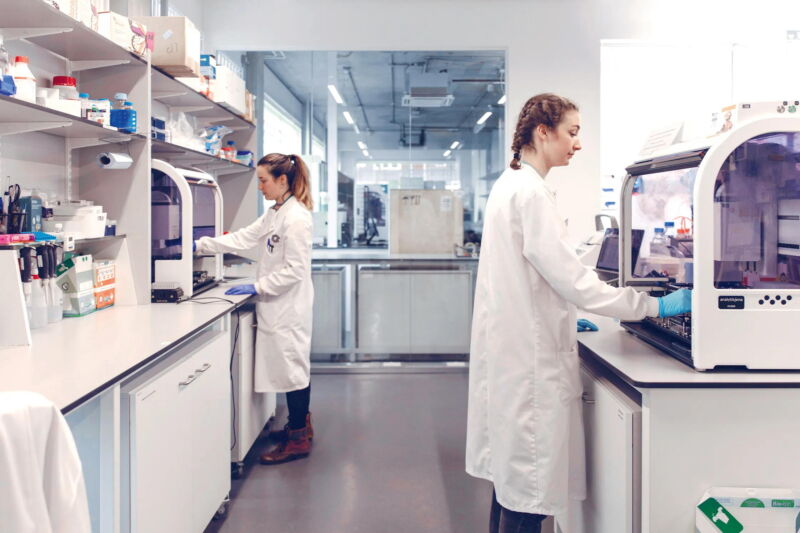
Enlarge / Researchers use CyBio FeliX workstations to extract and purify DNA samples for testing

At an old biscuit factory in South London, giant mixers and industrial ovens have been replaced by robotic arms, incubators, and DNA sequencing machines. James Field and his company LabGenius aren’t making sweet treats; they’re cooking up a revolutionary, AI-powered approach to engineering new medical antibodies.

In nature, antibodies are the body’s response to disease and serve as the immune system’s front-line troops. They’re strands of protein that are specially shaped to stick to foreign invaders so that they can be flushed from the system. Since the 1980s, pharmaceutical companies have been making synthetic antibodies to treat diseases like cancer, and to reduce the chance of transplanted organs being rejected.

But designing these antibodies is a slow process for humans—protein designers must wade through the millions of potential combinations of amino acids to find the ones that will fold together in exactly the right way, and then test them all experimentally, tweaking some variables to improve some characteristics of the treatment while hoping that doesn’t make it worse in other ways. “If you want to create a new therapeutic antibody, somewhere in this infinite space of potential molecules sits the molecule you want to find,” says Field, the founder and CEO of LabGenius.

He started the company in 2012 when, while studying for a PhD in synthetic biology at Imperial College London, he saw the costs of DNA sequencing, computation, and robotics all coming down. LabGenius makes use of all three to largely automate the antibody discovery process. At the lab in Bermondsey, a machine learning algorithm designs antibodies to target specific diseases, and then automated robotic systems build and grow them in the lab, run tests, and feed the data back into the algorithm, all with limited human supervision. There are rooms for culturing diseased cells, growing antibodies, and sequencing their DNA: Technicians in lab coats prepare samples and tap away at computers as machines whir in the background.

Human scientists start by identifying a search space of potential antibodies for tackling a particular disease: They need proteins that can differentiate between healthy and diseased cells, stick to the diseased cells, and then recruit an immune cell to finish the job. But these proteins could sit anywhere in the infinite search space of potential options. LabGenius has developed a machine learning model that can explore that space much more quickly and effectively. “The only input you give the system as a human is, here’s an example of a healthy cell, here’s an example of a diseased cell,” says Field. “And then you let the system explore the different [antibody] designs that can differentiate between them.”

The model selects more than 700 initial options from across a search space of 100,000 potential antibodies, and then automatically designs, builds, and tests them, with the aim of finding potentially fruitful areas to investigate in more depth. Think of choosing the perfect car from a field of thousands: You might start by choosing a broad color, and then filter from there into specific shades.

The tests are almost fully automated, with an array of high-end equipment involved in preparing samples and running them through the various stages of the testing process: Antibodies are grown based on their genetic sequence and then put to the test on biological assays—samples of the diseased tissue that they’ve been designed to tackle. Humans oversee the process, but their job is largely to move samples from one machine to the next.

“When you have the experimental results from that first set of 700 molecules, that information gets fed back to the model and is used to refine the model’s understanding of the space,” says Field. In other words, the algorithm begins to build a picture of how different antibody designs change the effectiveness of treatment—with each subsequent round of antibody designs, it gets better, carefully balancing exploitation of potentially fruitful designs with exploration of new areas.

“A challenge with conventional protein engineering is, as soon as you find something that works a bit, you tend to make a very large number of very small tweaks to that molecule to see if you can further refine it,” Field says. Those tweaks may improve one property—how easily the antibody can be made at scale, for instance—but have a disastrous effect on the many other attributes required, such as selectivity, toxicity, potency, and more. The conventional approach means you may be barking up the wrong tree, or missing the wood for the trees—endlessly optimizing something that works a little bit, when there may be far better options in a completely different part of the map.

You’re also constrained by the number of tests you can run, or the number of “shots on goal,” as Field puts it. This means human protein-engineers tend to look for things they know will work. “As a result of that, you get all of these heuristics or rules of thumb that human protein-engineers do to try and find the safe spaces,” Field says. “But as a consequence of that you quickly get the accumulation of dogma.”

The LabGenius approach yields unexpected solutions that humans may not have thought of, and finds them more quickly: It takes just six weeks from setting up a problem to finishing the first batch, all directed by machine learning models. LabGenius has raised $28 million from the likes of Atomico and Kindred, and is beginning to partner with pharmaceutical companies, offering its services like a consultancy. Field says the automated approach could be rolled out to other forms of drug discovery too, turning the long, “artisanal” process of drug discovery into something more streamlined.

Ultimately, Field says, it’s a recipe for better care: antibody treatments that are more effective, or have fewer side effects than existing ones designed by humans. “You find molecules that you would never have found using conventional methods,” he says. “They’re very distinct and often counterintuitive to designs that you as a human would come up with—which should enable us to find molecules with better properties, which ultimately translates into better outcomes for patients.”

This article appears in the September/October 2023 edition of WIRED UK magazine.

This story originally appeared on wired.com.

https://arstechnica.com/?p=1960034