Author discovers AI-generated counterfeit books written in her name on Amazon
Getty Images
Upon searching Amazon and Goodreads, author Jane Friedman recently discovered a half-dozen listings of fraudulent books using her name, likely filled with either junk or AI-generated content. Both Amazon and Goodreads resisted removing the faux titles until the author’s complaints went viral on social media.
In a blog post titled “I Would Rather See My Books Get Pirated Than This (Or: Why Goodreads and Amazon Are Becoming Dumpster Fires),” published on Monday, Friedman detailed her struggle with the counterfeit books.
“Whoever’s doing this is obviously preying on writers who trust my name and think I’ve actually written these books,” she wrote. “I have not. Most likely they’ve been generated by AI.”
It’s a rising problem in a world where scammers game Amazon’s algorithm to make a quick buck on fraudulent sales. In February, Reuters did a profile on authors using ChatGPT to write e-books, selling them through Amazon. In June, Vice reported on an influx of dozens of AI-generated books full of nonsense that took over Kindle bestseller lists.
Enlarge/ A screenshot showing books falsely attributed to Jane Friedman on Goodreads.
Jane Friedman
Friedman, who reports on the book publishing industry and has authored 10 books, is worried that AI-generated fake books listed in her name will impact her reputation. “A reasonable person might think I control what books are shown on my Goodreads profile, or that I approve them, or at the very least I could have them easily removed. Not so.”
It’s not easy to take the falsely attributed books down. On Goodreads, the process requires authors to reach out to volunteer “librarians” and join specific groups and post in comment threads to request the removal of illegitimate books. Even then, there are no guarantees that the offending titles will be taken down promptly. Friedman reports that Goodreads removed the offending titles from her official author profile hours after her blog post went live.
When she reached out to Amazon for assistance in removing the titles from her author profile, Amazon asked for “trademark registration numbers” relating to her claim and, upon learning that she did not have a trademark for her name, closed the case without removing the books from sale. Although the fraudulent titles were eventually removed from Amazon after the story blew up, Friedman’s experience sheds light on the complex process authors must navigate to protect their name and work online.
Part of a wider problem
Friedman isn’t alone in this struggle. On the social media network X (formerly Twitter), author Jane Ward said she recently discovered 29 titles on Goodreads that incorrectly listed her name as the author. Another author, Sarah Rose, tweeted, “People keep telling me they bought my newest book—that has my name on it but I didn’t write—some scammer using the ‘find more by this author’ algorithm. My publisher was unable to make it stop and I sort of gave up.”
Numerous other replies on Friedman’s posts about the topic suggest that author impersonation by scammy sellers has become a common occurrence on both Goodreads and Amazon, frustrating many authors.
In a world where generative AI could potentially flood our communication channels with noise—low-quality, automated creative output in unlimited quantity—open selling platforms such as Amazon haven’t caught up with how to deal with the problem yet. And generative AI isn’t even needed to fill the fraudulent books with content. On X, historian Dean Grodzins wrote, “I once bought what Amazon indicated was a paperback edition of George Saunders’s Swim in the Pond in the Rain. Turns out the real paperback had not yet come out; this one had the cover of Saunders’s book but content unrelated, taken off a website, about economic policy.”
Regardless of what the fake books are filled with, the larger question is how Amazon and Goodreads, two major sites that reach hundreds of millions of customers, plan to safeguard both authors and customers against fraud and misattribution.
“We desperately need guardrails on this landslide of misattribution and misinformation,” wrote Friedman in her blog post. “Amazon and Goodreads, I beg you to create a way to verify authorship, or for authors to easily block fraudulent books credited to them. Do it now, do it quickly.”
https://arstechnica.com/?p=1959662
La AI renderà disoccupate le emule della Ferragni
La AI rischia di creare una classe inattesa di disoccupati: le influencer dei social media che, emule della Ferragni, pensano che sia sufficiente una bella faccina, un aspetto apprezzabile e una marea di banalità mainstream per farsi notare, magari fingendo uno stile di vita lussuoso per attrarre qualche ricco sponsor.
La proliferazione social media influence poco vestie generati dall’intelligenza artificiale è un campanello d’allarme per chi pensavva di fare carriera in questo settore.
Facciamo qualche esempio:
Milla Sofia si presenta come una bella ragazza finlandese, confessando però di essere generata dalla AI
It’s #colabfriday nite and the band is back together! Mae West said, “Good girls go to Heaven. Bad girls go everywhere.” So, where are we going?#detention Want to relive the best part of High School? Join us as we put the fun in dysfunctional! pic.twitter.com/JdSVaKzI4M
Tutte queste ragazze AI sono bellissime, rispondo perfettamente ai canoni estetici dei potenziali clienti, non si fanno problemi a fare trni estenuanti, possono viaggiare a costi bassissimi e praticamente in modo istantaneo, e sono sempre perfette per qualsiasi occasione o qualsiasi abito. Possono perfino avere un carattere, fornito dalla AI o da chi le manofra. Tra l’altro giocano in squadra, senza nessuna invidia, ciascuna rinviando ad un’altra…
Tra l’altro queste che abbiamo selezionato confessano di essere generate dalla AI. Quante non saranno così sincere ?
A questo punto le varie starlette e influencer che futuro avranno contro questa concorrenzza?
Grazie al nostro canale Telegram potete rimanere aggiornati sulla pubblicazione di nuovi articoli di Scenari Economici.
Hear Elvis sing Baby Got Back using AI—and learn how it was made
Getty Images / Benj Edwards
Recently, a number of viral music videos from a YouTube channel called There I Ruined It have included AI-generated voices of famous musical artists singing lyrics from surprising songs. One recent example imagines Elvis singing lyrics to Sir Mix-a-Lot’s Baby Got Back. Another features a faux Johnny Cash singing the lyrics to Aqua’s Barbie Girl.
(The original Elvis video has since been taken down from YouTube due to a copyright claim from Universal Music Group, but thanks to the magic of the Internet, you can hear it anyway.)
[embedded content]
An excerpt copy of the “Elvis Sings Baby Got Back” video.
Obviously, since Elvis has been dead for 46 years (and Cash for 20), neither man could have actually sung the songs themselves. That’s where AI comes in. But as we’ll see, although generative AI can be amazing, there’s still a lot of human talent and effort involved in crafting these musical mash-ups.
To figure out how There I Ruined It does its magic, we first reached out to the channel’s creator, musician Dustin Ballard. Ballard’s response was low in detail, but he laid out the basic workflow. He uses an AI model called so-vits-svc to transform his own vocals he records into those of other artists. “It’s currently not a very user-friendly process (and the training itself is even more difficult),” he told Ars Technica in an email, “but basically once you have the trained model (based on a large sample of clean audio references), then you can upload your own vocal track, and it replaces it with the voice that you’ve modeled. You then put that into your mix and build the song around it.”
But let’s back up a second: What does “so-vits-svc” mean? The name originates from a series of open source technologies being chained together. The “so” part comes from “SoftVC” (VC for “voice conversion”), which breaks source audio (a singer’s voice) into key parts that can be encoded and learned by a neural network. The “VITS” part is an acronym for “Variational Inference with adversarial learning for end-to-end Text-to-Speech,” coined in this 2021 paper. VITS takes knowledge of the trained vocal model and generates the converted voice output. And “SVC” means “singing voice conversion”—converting one singing voice to another—as opposed to converting someone’s speaking voice.
The recent There I Ruined It songs primarily use AI in one regard: The AI model relies on Ballard’s vocal performance, but it changes the timbre of his voice to that of someone else, similar to how Respeecher’s voice-to-voice technology can transform one actor’s performance of Darth Vader into James Earl Jones’ voice. The rest of the song comes from Ballard’s arrangement in a conventional music app.
A complicated process—at the moment
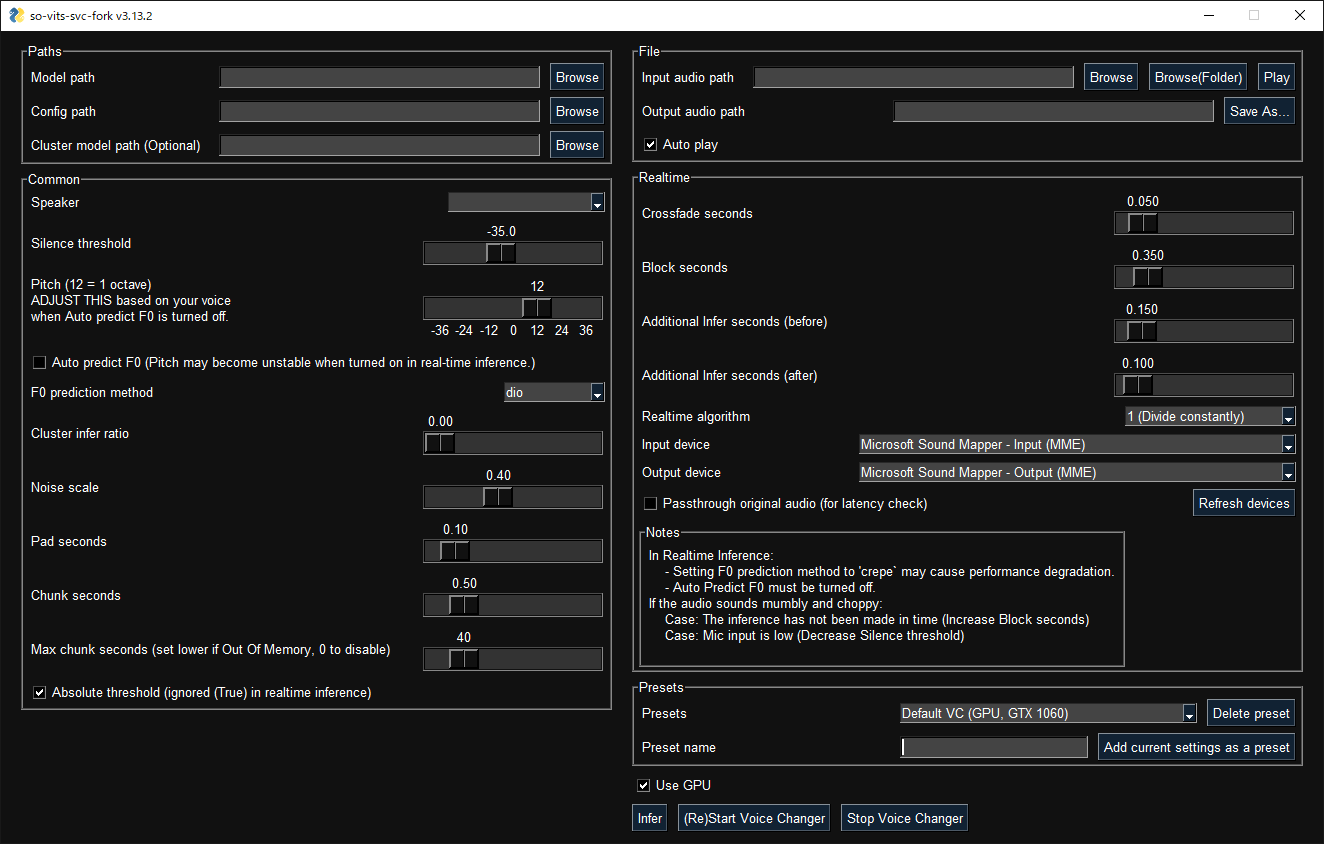
Enlarge/ The GUI interface for a fork of so-vits-svc.
Michael van Voorst
To get more insight into the musical voice-cloning process with so-vits-svc-fork (an altered version of the original so-vits-svc), we tracked down Michael van Voorst, the creator of the Elvis voice AI model that Ballard used in his Baby Got Back video. He walked us through the steps necessary to create an AI mash-up.
“In order to create an accurate replica of a voice, you start off with creating a data set of clean vocal audio samples from the person you are building a voice model of,” said van Voorst. “The audio samples need to be of studio quality for the best results. If they are of lower quality, it will reflect back into the vocal model.”
In the case of Elvis, van Voorst used vocal tracks from the singer’s famous Aloha From Hawaii concert in 1973 as the foundational material to train the voice model. After careful manual screening, van Voorst extracted 36 minutes of high-quality audio, which he then divided into 10-second chunks for correct processing. “I listened carefully for any interference, like band or audience noise, and removed it from my data set,” he said. Also, he tried to capture a wide variety of vocal expressions: “The quality of the model improves with more and varied samples.”
https://arstechnica.com/?p=1950200
IA, in che modo ha cambiato il panorama delle aziende
Nell’ultimo anno, abbiamo assistito a passi da gigante nello sviluppo dell’IA e a enormi cambiamenti nella percezione pubblica di questa tecnologia. Chatbot come ChatGPT di OpenAI e LLM come GPT-4 hanno dimostrato notevoli capacità di comunicare fluentemente e di esprimersi al livello più alto o vicino a una vasta gamma di valutazioni cognitive. Le aziende che sono parte integrante dell’ecosistema AI (come Nvidia) hanno visto aumentare le loro capitalizzazioni di mercato. Parlare di una corsa agli armamenti dell’IA tra giganti della tecnologia come Google e Microsoft non è fuori luogo. Di seguito le considerazioni di Mark Sherman, managing partner di Telstra Ventures.
Ansia crescente
Nonostante tutta l’eccitazione che circonda l’IA, non è mancata una crescente ansia: dalle preoccupazioni per la soppressione o il cambiamento di posti di lavoro, la diffusione della disinformazione e degli attacchi informatici basati sull’intelligenza artificiale fino ai timori di rischi esistenziali. Sebbene sia essenziale testare e implementare l’IA in modo responsabile, è improbabile che vedremo cambiamenti normativi significativi entro il prossimo anno (che amplieranno il divario tra leader e follower sul campo). I grandi leader dell’IA ricchi di dati vedranno probabilmente enormi benefici mentre i concorrenti che rimangono indietro sulla tecnologia – o le aziende che forniscono prodotti e servizi minacciati dall’IA – rischiano di perdere valore sostanziale.
Ci saranno vincitori e vinti nella corsa all’IA, ma i pessimisti dell’IA stanno scontando la creatività e la produttività che la tecnologia scatenerà. Sì, le perdite di posti di lavoro sono inevitabili, ma lo sono anche i guadagni di posti di lavoro. Le aziende di maggior successo non combatteranno la marea del cambiamento: capiranno come prendere parte a una delle più grandi rivoluzioni tecnologiche a cui abbiamo mai assistito.
L’innovazione contrasterà la dislocazione
Non c’è dubbio che l’intelligenza artificiale sostituirà molti ruoli che esistono oggi: addetti all’inserimento dati, creatori di contenuti, paralegali, agenti del servizio clienti e milioni di altri lavoratori potrebbero scoprire che le loro carriere stanno per prendere una svolta inaspettata. Accenture prevede che il 40% di tutte le ore lavorative sarà influenzato dai soli LLM, poiché “le attività linguistiche rappresentano il 62% del tempo totale di lavoro dei dipendenti”. Il rapporto sul futuro dell’occupazione 2023 del World Economic Forum prevede che la percentuale di attività svolte dalle macchine passerà dal 34% al 43% entro il 2027.
Nuove abilità per nuovi lavori
Detto questo, è sempre saggio scommettere sulla creatività e sulla resilienza umana. Man mano che alcuni ruoli diventano ridondanti, aumenterà la domanda di auditor ed esperti di etica AI, ingegneri, analisti della sicurezza delle informazioni e così via. Ci sarà anche una crescente domanda di risorse educative incentrate sull’IA. PwC riferisce che ben il 74% dei lavoratori si dice “pronto ad apprendere una nuova abilità o a riqualificarsi completamente per mantenersi occupabile” – un segnale incoraggiante che i dipendenti riconoscono l’importanza di adattarsi alle nuove realtà tecnologiche ed economiche. Forse è per questo che il 73% dei lavoratori americani crede che la tecnologia migliorerà le loro prospettive di lavoro.
Le aziende dovrebbero trarre vantaggio da questi sentimenti concentrandosi sulla mobilità dei talenti e sullo sviluppo professionale, che contemporaneamente prepareranno la loro forza lavoro per l’era dell’IA e miglioreranno la fidelizzazione in un mercato del lavoro ostinatamente stretto. Oltre alla formazione interna, stiamo assistendo all’emergere di servizi educativi di terze parti incentrati su intelligenza artificiale, scienza dei dati, sicurezza informatica e molti altri argomenti lungimiranti, una tendenza che probabilmente prenderà slancio nei prossimi anni. Tra tutti i terribili titoli sulle perdite di posti di lavoro alimentate dall’IA, è importante ricordare quanto possano essere adattabili gli esseri umani.
La gestione del rischio AI sarà una priorità fondamentale
Oltre agli shock economici che saranno causati dall’IA, la tecnologia pone molti altri pericoli che le aziende e i consumatori dovranno tenere in considerazione nei prossimi anni. Gli attacchi informatici basati sull’intelligenza artificiale, i problemi di parzialità e trasparenza, la violazione del copyright e la produzione su larga scala di informazioni inesatte sono tutti rischi che stanno diventando sempre più urgenti. I modi in cui gestiamo questi rischi avranno implicazioni radicali per l’implementazione e l’adozione dell’IA nei prossimi anni.
Nuovi rischi informatici
Assumi il ruolo potenziale dell’IA negli attacchi informatici. Secondo il Data Breach Invetigations Report 2023 di Verizon, quasi tre quarti delle violazioni dei dati coinvolgono un elemento umano, motivo per cui i criminali informatici spesso si affidano ad attacchi di ingegneria sociale come il phishing. Gli LLM sono in grado di produrre quantità illimitate di testo coerente e convincente in un istante, il che potrebbe fornire ai criminali informatici un potente strumento per aumentare gli attacchi di phishing (questi attacchi dipendono dal convincere le vittime a fare clic su contenuti dannosi con testo dal suono realistico). Check Point Research ha già identificato “tentativi da parte di criminali informatici russi di aggirare le restrizioni di OpenAI”.
Le aziende aumenteranno i loro investimenti in sicurezza informatica per tenere il passo con questi sviluppi e probabilmente vedremo importanti attacchi informatici abilitati all’IA nel prossimo futuro. Sarà necessario aggiornare gli approcci alla formazione in materia di cybersicurezza per tenere conto della minaccia rappresentata dall’IA. I tentativi di phishing, ad esempio, saranno più difficili da individuare perché i criminali informatici utilizzeranno gli LLM per produrre testo convincente (e meno pieno di errori). Le aziende nella posizione migliore per avere successo durante la rivoluzione dell’IA sono quelle che stanno considerando i rischi ora e che stanno aggiornando i loro protocolli di conformità, le politiche delle risorse umane e le piattaforme di sicurezza informatica per tenere conto dei pericoli dell’IA sfruttando i suoi benefici.
ChatGPT è cresciuta fino a 100 milioni di utenti attivi mensili in soli due mesi, il che lo rende l’applicazione consumer in più rapida crescita di tutti i tempi. Mentre le grandi aziende tecnologiche con accesso a enormi quantità di dati e menti leader nel settore avranno significativi vantaggi per la prima mossa, molte startup svilupperanno implementazioni innovative per l’IA nel prossimo futuro. L’impatto economico dell’IA andrà ben oltre lo sviluppo della tecnologia stessa.
Ad esempio, la fusione di intelligenza artificiale e robotica – così come le nuove collaborazioni tra ingegneri meccanici, elettrici e software – ridurrà drasticamente i tempi del ciclo di innovazione, i tassi di errore e i costi. Nel corso del prossimo anno, la disruption guidata dall’IA prenderà rapidamente slancio: la forza lavoro cambierà, ci saranno drastiche fluttuazioni della quota di mercato e delle valutazioni e i lenti utilizzatori dell’IA perderanno rapidamente trazione. Ci saranno anche molte false partenze – mentre alcune aziende genereranno rendimenti sbalorditivi, altre cadranno in hype mal indirizzato e si imbatteranno in vicoli ciechi. Le startup di maggior successo troveranno un modo per capitalizzare gli effetti di rete relativi all’acquisizione dei dati e alle partnership con i primi mover.
È impossibile sapere esattamente come sarà il panorama aziendale mentre l’IA migliora e prolifera rapidamente. Ma una cosa è certa: le aziende lungimiranti hanno ragione a concentrarsi sull’IA ora: devono soltanto essere consapevoli dei rischi insieme ai potenziali benefici.
Meta releases open source AI audio tools, AudioCraft
On Wednesday, Meta announced it is open-sourcing AudioCraft, a suite of generative AI tools for creating music and audio from text prompts. With the tools, content creators can input simple text descriptions to generate complex audio landscapes, compose melodies, or even simulate entire virtual orchestras.
AudioCraft consists of three core components: AudioGen, a tool for generating various audio effects and soundscapes; MusicGen, which can create musical compositions and melodies from descriptions; and EnCodec, a neural network-based audio compression codec.
In particular, Meta says that EnCodec, which we first covered in November, has recently been improved and allows for “higher quality music generation with fewer artifacts.” Also, AudioGen can create audio sound effects like a dog barking, a car horn honking, or footsteps on a wooden floor. And MusicGen can whip up songs of various genres from scratch, based on descriptions like “Pop dance track with catchy melodies, tropical percussions, and upbeat rhythms, perfect for the beach.”
Meta has provided several audio samples on its website for evaluation. The results seem in line with their state-of-the-art labeling, but arguably they aren’t quite high quality enough to replace professionally produced commercial audio effects or music.
Meta notes that while generative AI models centered around text and still pictures have received lots of attention (and are relatively easy for people to experiment with online), development in generative audio tools has lagged behind. “There’s some work out there, but it’s highly complicated and not very open, so people aren’t able to readily play with it,” they write. But they hope that AudioCraft’s release under the MIT License will contribute to the broader community by providing accessible tools for audio and musical experimentation.
“The models are available for research purposes and to further people’s understanding of the technology. We’re excited to give researchers and practitioners access so they can train their own models with their own datasets for the first time and help advance the state of the art,” Meta said.
Meta isn’t the first company to experiment with AI-powered audio and music generators. Among some of the more notable recent attempts, OpenAI debuted its Jukebox in 2020, Google debuted MusicLM in January, and last December, an independent research team created a text-to-music generation platform called Riffusion using a Stable Diffusion base.
None of these generative audio projects have attracted as much attention as image synthesis models, but that doesn’t mean the process of developing them isn’t any less complicated, as Meta notes on its website:
Generating high-fidelity audio of any kind requires modeling complex signals and patterns at varying scales. Music is arguably the most challenging type of audio to generate because it’s composed of local and long-range patterns, from a suite of notes to a global musical structure with multiple instruments. Generating coherent music with AI has often been addressed through the use of symbolic representations like MIDI or piano rolls. However, these approaches are unable to fully grasp the expressive nuances and stylistic elements found in music. More recent advances leverage self-supervised audio representation learning and a number of hierarchical or cascaded models to generate music, feeding the raw audio into a complex system in order to capture long-range structures in the signal while generating quality audio. But we knew that more could be done in this field.
Amid controversy over undisclosed and potentially unethical training material used to create image synthesis models such as Stable Diffusion, DALL-E, and Midjourney, it’s notable that Meta says that MusicGen was trained on “20,000 hours of music owned by Meta or licensed specifically for this purpose.” On its surface, that seems like a move in a more ethical direction that may please some critics of generative AI.
It will be interesting to see how open source developers choose to integrate these Meta audio models in their work. It may result in some interesting and easy-to-use generative audio tools in the near future. For now, the more code-savvy among us can find model weights and code for the three AudioCraft tools on GitHub.
https://arstechnica.com/?p=1958362
The Google Assistant is getting a big reboot around generative AI
Axios has more details about Google’s plan to reboot the Google Assistant into something based around generative AI. As was previously reported, the Google Assistant team is getting reorganized around Google’s new LLM (large language model) ChatGPT-clone, Google Bard. Axios was given a copy of an email to employees explaining their new marching orders and says that “dozens” of people are being laid off out of the “thousands” that work on the Google Assistant.
The email, written by Google VP Peeyush Ranjan and Director of Product Duke Dukellis, tells the team to “explore what a supercharged Assistant, powered by the latest LLM technology, would look like.” The two execs say they’ve “heard people’s strong desire for assistive, conversational technology that can improve their lives.”
It’s hard to make heads or tails of Google’s jargon-filled internal communications, but it sounds like a lot of changes are happening. Whatever the “Services and Surface teams” are in the Google Assistant are being merged, while the mobile team will now “operate separately” from that group (it sounds like this is all client app work?). The “NLP” (we’re assuming that’s “Natural Language Processing”) team is getting new leadership, while a “Speech” team “will continue supporting Assistant and other products.”
For now, the email says: “We remain deeply committed to Assistant and we are optimistic about its bright future ahead.” “Deeply committed” is usually not where you want to be in Google doublespeak land. Google Stadia VP Phil Harrison said Google was “deeply committed to gaming” after shutting down Stadia and then he left the company a few months later. Google AI lead Jeff Deen said the company was “deeply committed” to AI Ethics after firing researcher Timnit Gebru, and today members of the ethics team say they were shut out of high-priority launches like Google Bard. Google PR just recently said the company was “deeply committed to Waze’s unique brand” on the same day it stripped the division of independent company status and merged it with Google Maps.
Google Assistant’s version of “deeply committed” has so far involved stopping all hardware releases, with the last Assistant device launching 2.5 years ago in March 2021. The Pixel Tablet sure looks like it started life as a Google Assistant smart display, thanks to it looking identical to a Nest Hub, but never actually made it to market as a new device in that lineup. The Fuchsia OS team had been taking over Google Assistant smart display software, but 9to5Google reports that work on doing the same for speakers has stopped. Google also reportedly told employees it will “invest less” in the Google Assistant on third-party devices, including cars. Whatever the Google Assistant pivot ends up being, it looks like a big pivot.
What does the “Google Assistant” mean to you?
It’s unclear exactly how a language model would help a voice assistant. A language model is for generating large blocks of text, while a voice assistant is about listening to voice commands, understanding them, and then performing some kind of action. The primarycomplaintabouttheGoogle Assistant is that voice recognition seemingly gets worse with every passing day, with replies taking longer and exhibiting more bugs, as core features like voice authentication and multi-user support quietly disappear. A language model is about text, and mixing up ChatGPT and a voice assistant wouldn’t help one bit with the core voice-to-text input. The Assistant is actually fine when it comes to processing correctly recognized voice commands; it’s just a question of getting the voice part right.
I’m sure everyone uses a voice assistant differently, but I generally ask it to do something, and I want that task done quickly and quietly—turn off the lights, set a timer, remind me to do something, add a thing to my shipping list, that sort of thing. In the rare case I ask it an open-ended “Google Search” question, the short infobox responses are great. The idea of a voice assistant that replies by reading paragraphs and paragraphs of generated text in the usual stilted robot voice sounds annoying. The idea of this being a long, “conversational” interaction is definitely not how I’ve used the Assistant in the past. Theoretically, a language model could help with parsing the intent of strangely worded commands, but today that’s not a real problem with most voice assistants. If you plainly say what you want, they can understand and perform the task pretty well.
I think the core problem here is that Google Assistant doesn’t make any money, so something has to change. The hardware is sold at cost, and with no ads or subscriptions, the Assistant generates no revenue, while the cloud processing costs just keep piling up. Google and Amazon’s Alexa started this voice assistant war and are now in the same boat: products that were loss leaders years ago never discovered a revenue path and have run out of runway. Seven-ish years ago, both products were created when voice assistants were the hot new thing, and now that AI language models are the hot new thing, pivoting buys them more time as loss leaders to hope to someday find a revenue stream.
That’s actually still the billion-dollar question: How will a voice assistant make money? How does adding a language model help it make money? It might help that one of the authors of the letter, Dukellis, only joined the Assistant team in November 2022 and, before that, spent six years as the director of product management for Google’s publisher-facing ad products.
https://arstechnica.com/?p=1958080
Meta plans AI-powered chatbots to boost social media numbers
Benj Edwards / Getty Images
Meta is reportedly developing a range of AI-powered chatbots with different personalities, a move aimed at increasing user engagement on social platforms such as Facebook and Instagram, according to the Financial Times and The Verge. The chatbots, called “personas” by Meta staff, will mimic human-like conversations and might take on various character forms, such as Abraham Lincoln or a surfer-like travel adviser.
The move to introduce chatbots to Meta platforms comes amid growing competition from social media platforms like TikTok and a rising interest in AI technology. Meta has also made big investments into generative AI recently, including the release of a new large language model, Llama 2, which could power its upcoming chatbots.
During a recent earnings call, Meta CEO Mark Zuckerberg mentioned that the company envisions AI agents acting as assistants and coaches, facilitating interactions between users, businesses, and creators. He also hinted at the development of AI agents for customer service and an internal AI-powered productivity assistant for staff.
“You can imagine lots of ways that AI can help people connect and express themselves in our apps, creative tools that make it easier and more fun to share content, agents that act as assistants, coaches or help you interact with businesses and creators and more,” he said.
However, the Financial Times says that some experts are voicing concerns over the plans. Ravit Dotan, an AI ethics adviser and co-founder of the Collaborative AI Responsibility Lab at the University of Pittsburgh, warns that interactions with chatbots might pose a personal privacy hazard for users.
“Once users interact with a chatbot, it really exposes much more of their data to the company, so that the company can do anything they want with that data,” she told the outlet.
Privacy aside, concerns about social media addiction have also been common among critics of Facebook in the past, and introducing engaging simulated people into social networks may make it harder for some people to stop using them—although that might be exactly the point.
Meta isn’t the first social media company to experiment with AI-powered chatbots. In February, Snap announced a “My AI” chatbot designed to serve as an amusing conversationalist and possibly an adviser for trip or product recommendations, despite admissions about its propensity to confabulate inaccurate or potentially dangerous information. And beyond social media, chatbots on sites like Character.AI have proven popular among some people as a form of entertainment.
Despite these risks, Meta thinks that its artificial personas could provide a fun and interactive element on its platforms, besides functioning as a search tool and offering recommendations. The company plans to roll them out as early as September.
https://arstechnica.com/?p=1958059
GPT-3 aces tests of reasoning by analogy
Large language models are a class of AI algorithm that relies on a high number computational nodes and an equally large number of connections among them. They can be trained to perform a variety of functions—protein folding, anyone?—but they’re mostly recognized for their capabilities with human languages.
LLMs trained to simply predict the next word that will appear in text can produce human-sounding conversations and essays, although with some worrying accuracy issues. The systems have demonstrated a variety of behaviors that appear to go well beyond the simple language capabilities they were trained to handle.
We can apparently add analogies to the list of items that LLMs have inadvertently mastered. A team from University of California, Los Angeles has tested the GPT-3 LLM using questions that should be familiar to any Americans that have spent time on standardized tests like the SAT. In all but one variant of these questions, GPT-3 outperformed undergrads who presumably had mastered these tests just a few years earlier. The researchers suggest that this indicates that LLMs can master reasoning by analogy.
Different kinds of reasoning
The UCLA team, Taylor Webb, Keith Holyoak, and Hongjing Lu, relied on a large collection of ways that past research has tested humans’ ability to reason via analogy. The classic form of this is the completion of a comparison—think “cold is to ice as hot is to ____”—where you have to select the best completion from a set of options.
Related tests involve figuring out the rules behind transformations of a series of letters. So, for example, if the series a b c d is transformed to a b c e, then the rule is to replace the last letter of the series with its alphabetical successor. The participant’s understanding of the rule is tested by asking them to use the rule to transform a different set of letters. Similar tests with numbers can involve complex rules, such as “only even numbers in order, but can be ascending or descending.”
On all of these tests, GPT-3 consistently outperformed undergrads, although the margins varied depending on the specific test involved. The researchers also found that the software could develop rules based on a series of numbers, and then apply them to a different domain, such as descriptions of temperatures like “warm” and “chilly.” They conclude that “these results suggest that GPT-3 has developed an abstract notion of successorship that can be flexibly generalized between different domains.”
But there were also some odd glitches. The software didn’t consistently recognize when it was being presented with these problems, displaying a large error rate unless given a prompt to supply an answer or when the question was phrased as a sentence, rather than sets of values.
https://arstechnica.com/?p=1957885
Arizona law school embraces ChatGPT use in student applications
Benj Edwards / Arizona State University
On Friday, Arizona State University’s Sandra Day O’Connor College of Law announced that prospective students would be allowed to use AI tools, such as OpenAI’s ChatGPT, to assist in preparing their applications, according to a report by Reuters.
This decision comes a week after the University of Michigan Law School notably decided to ban such AI tools, highlighting the diverse policies different universities are adopting related to AI’s role in student applications.
Arizona State’s law school says that applicants who use AI tools must clearly disclose that fact, and they must also ensure that the submitted information is accurate. This parallels the school’s existing requirement for applicants to certify if they have used a professional consultant to help with their application.
The law school’s dean, Stacy Leeds, stated that the new policy acknowledges the increasing use of AI tools among lawyers and law students. Leeds emphasized that students cannot use AI to generate false information, adding that they still need to “communicate their own life.”
Released in November, ChatGPT is an AI assistant application that can perform analysis and also compose text in different styles, depending on what the user requests. Its appearance, followed by similar tools from other vendors, sparked an existential crisis among some educators who worry that students will use it to complete assignments without learning the material.
Some university professors, such as Ethan Mollick of Wharton School in Pennsylvania, have taken a more open approach, recognizing that the use of tools like ChatGPT among some students is inevitable. Mollick’s policy states that students must be able to vouch for the accuracy of their work, no matter how it was composed. Also, students must disclose their use of AI tools to the professor.
Leeds believes that generative AI, widely available to applicants regardless of their economic situation, can potentially level the playing field for those who might not be able to afford to hire a professional consultant—some of which charge hundreds of thousands of dollars in fees.
Despite the new policy, Reuters reports that officially sanctioned ChatGPT use at the Arizona State law school is limited to applications for now. The school is still formulating regulations for AI usage within coursework and the classroom. Soon, ASU plans to provide educational videos to guide prospective students about acceptable uses and potential pitfalls of AI.
https://arstechnica.com/?p=1957764
10 Examples of How Content Creators and Teams Are Using AI
Artificial intelligence tools have become more accessible to non-technical users – even if they don’t always recognize it. If you’ve ever checked your work with Grammarly or recorded a meeting with Otter, you’ve used AI. However, more people are paying attention to the AI tools that make up their kits and how they use them.
Thanks to the speedy advances in AI technology (ChatGPT anyone?), creating content’s easier than ever. There are also more conflicting views about the topic of AI-generated content and where to place limits. One Buffer community member said, “I’ve been apprehensive about AI because it isn’t necessarily original because of what it’s referencing (at least with art).”
Anyone creating content must consider where and how AI will influence their processes. Some questions you’ll need to be able to, at the very least, answer are: Will you use AI to generate content? Or edit it? How will you assure your audience that your content and ideas are original?
To help make the process a bit easier, we put together a list of examples from different creators and content teams about their policies regarding using AI in content creation.
How content teams approach using AI for content development
AI has been a double-edged sword for many content and creative teams. On the one hand, over 55 percent of Bynder’s clients said they are using AI to automate time-consuming tasks to boost productivity. Conversely, a report showed that AI was a major reason for over 4,000 layoffs in May 2023.
There are varying perspectives on using AI, from those who reject it entirely to those actively exploring it. Here are some of them.
CNET shares transparent insights into how AI is used in its content
CNET uses AI to write its articles but emphasizes that they don’t publish AI-generated content without having it reviewed and edited by humans before posting – even more since an incident with its content.
A report found that of 77 AI-written articles, 41 contained errors. The team paused using the AI tool to build better editorial processes and has committed to refining it to suit their editorial standards and needs.
The tech publication now updates an AI Policy page detailing how they’re using AI. They even have an in-house AI engine called RAMP (Responsible AI Machine Partner) to assist in their content creation. They’re also more transparent about which articles feature AI-generated content.
Verblio
As a marketplace to connect writers with clients, Verblio had to set stricter rules than most regarding AI use in content to ensure quality. Their writer policy and guidelines regarding AI-generated content explicitly state that they don’t accept AI-generated content.
They also explained their multi-stage screening process to ensure that no AI-generated content is submitted to a client, as no AI tool can pass the high-quality standards Verblio requires of all of its writers.
One Generation
One Generation SEO, a content agency, sets clear boundaries regarding AI use in content with a dedicated “AI content policy” page. The agency emphasizes that AI-generated content will never be directly “copied and pasted” onto a site without undergoing human editorial review.
In the policy, they state that they experiment with AI to create:
Guides and tutorials
Informational and support content
Short, supportive copy for metadata (titles, descriptions) and social posts
They also shared that they don’t use AI for
Niche or expert-level content
Articles to be written from personal experience or original research
Content about proprietary processes or terms a company has invented
Thought leadership content
Finally, according to their policy, every piece of AI-generated content has to undergo a strict editorial process, including plagiarism checks, writing quality edits, fact-checking, brand alignment, and conversion optimization.
Doist
As part of Doist’s Content & SEO, Naomi Liddell shared AI doesn’t produce great results for writing. She specifically mentioned their Todoist newsletter, which takes a personal storytelling approach that AI can’t replicate. So while the Marketing team doesn’t have formal guidelines, Naomi keeps AI out of writing, sticking to keep the warmth and honesty that comes from her.
However, she highlighted that AI has been beneficial in repurposing content – specifically converting evergreen articles to video. She mentioned that it has saved her time, and the resulting scripts are “excellent springboards that require minimal editing.”
Buffer
We like AI here at Buffer and have even incorporated it into Buffer to help our audience improve their content creation process. However, we also understand that it’s limited and not a replacement for quality content or the people that make it.
Here are the four statements that cover 90 percent of how we think about using AI in content.
AI assists but doesn’t replace
AI never writes complete drafts or paragraphs without being edited by a human
AI content is always reviewed for accuracy
We don’t believe AI can replace creative work in any sense
Buffer Content Team’s AI Policy
For a deeper dive into how our Content Team uses AI, check out this article, where we outline our history with AI tools, our approach to AI in content, tangible ways we’ve been using AI, and more!
How creators are using AI for content development
You might think that creators would be hesitant about AI. After all, much of the narrative around AI, especially in the news, is about how it’s here to replace people. However, 94.5 percent of creators said they use AI mainly to edit content and create text and captions for accessibility, according to Influencer Marketing Factory report.
Most assumptions about AI (and its applications) are that it can take over the creation process, from generating ideas to distribution. This conflicts with how creators are actually using it – to work more efficiently.
Chris Bailey uses AI to support his writing, not replace it
The author and multi-platform creator is one of the few creators with a fully transparent explanation of where AI fits into their creative process. Chris published a blog post explaining his perspective on AI: “In short, my goal is for AI to support my writing (and other work), not replace it.”
In this policy, he outlines how exactly he uses (and doesn’t use AI). Here’s an overview of how he currently uses AI in his process:
To organize data and large amounts of information
To find starting points for research
To identify blind spots and biases
To spark new ideas
He also outlined which tasks he doesn’t use AI for:
Drafting written content
Preparing for speaking engagements
Connecting ideas in innovative ways
The post adds that the policy is a work in progress and will change over time. Still, this clear explanation will help build trust with his audience that they receive content from his authentic perspective.
Colin and Samir encourage the use of AI to speed up post-production
Samir Chaudry of the popular duo behind The Colin and Samir Showtold NBC that he’s encouraging all his team members to use AI in their day-to-day. He said tools like Descript, AutoPod, and Midjourney have improved the team’s post-production process, leaving them more time to create.
However, Samir also mentioned that he understands people may be uncomfortable adopting AI, especially with so little regulation. He shared an optimistic prediction that AI will encourage human interaction, saying, “[In a few years] when a lot of stuff [has been] altered or generated by AI, we will value human perspectives in a way that we maybe have lost touch with.”
Tejas Hullur generates images for his newsletter
TikToker Tejas Hullur is a prominent creator with over 600,000 followers and has seamlessly integrated AI into his content creation process, particularly for his newsletter, “Out West Chronicles.”
Tejas and his co-writers use DALL-E, an AI image generation tool, to create header images for the newsletter, and as he told Insider, it’s less about speed and more about keeping consistent branding.
Alasdair Mann (@Alementary) uses AI to enhance information and create video hooks
When struggling to gather specific information, Alasdair Mann (or @Alementary as he’s known on YouTube) turns to AI for assistance. For instance, while working on a story about Dennis Tito, the first space tourist, he sought AI’s insights into potential challenges Tito might have faced. Between the AI-generated suggestions and his independent research, he was able to craft a more compelling narrative.
[embedded content]
He also uses AI to create hooks – the first sentence you write or the first few things you say to capture your audience’s attention. As he told Insider, he prompts the AI with a content brief explaining his video and his idea for a hook. The AI tool then offers alternative suggestions, which he creatively combines or edits to align with his unique style. Working with AI like that allows him to expand his ideas while keeping his voice authentic.
Jen Glantz uses AI to save time across her creative process
Jen Glantz, a solopreneur balancing business and motherhood, has seamlessly integrated ChatGPT into her content creation process. In an article for Insider she states that she uses AI for:
Keyword research to boost website traffic
Viral content ideas, like this Instagram Reel that hit over 6 million views
Creating and sending pitches to potential brand partners
Keep an eye on competitors and market positioning
Improving how she communicates with customers
Jen’s use of AI gives her a lot more time back in her day to spend with her family, enhances her content, and improves her business operations.
Develop a simple set of guidelines to communicate your stance on AI and content
While there are valid concerns about AI replacing human jobs, the current trend shows that creators and businesses use AI to enhance and optimize their processes, not replace them.
Across our examples, there’s a strong emphasis on the human touch, storytelling, and unique perspectives, which AI cannot replicate. However, AI can be valuable for editing, research, and automation, making the content creation process more efficient.
Wherever you use AI in your creative process, make sure you communicate it or at least have an answer for your audience, who still want original and authentic content from your perspective.