Study claims ChatGPT is losing capability, but some experts aren’t convinced

A shaky toy robot on a multicolor background.
Benj Edwards / Getty Images

On Tuesday, researchers from Stanford University and University of California, Berkeley released a research paper that purports to show changes in GPT-4‘s outputs over time. The paper fuels a common-but-unproven belief that the AI language model has grown worse at coding and compositional tasks over the past few months. Some experts aren’t convinced by the results, but they say that the lack of certainty points to a larger problem with how OpenAI handles its model releases.

In a study titled “How Is ChatGPT’s Behavior Changing over Time?” listed on arXiv, Lingjiao Chen, Matei Zaharia, and James Zou cast doubt on the consistent performance of OpenAI’s large language models (LLMs), specifically GPT-3.5 and GPT-4. Using API access, they tested the March and June 2023 versions of these models on tasks like math problem-solving, answering sensitive questions, code generation, and visual reasoning. Most notably, GPT-4’s ability to identify prime numbers reportedly plunged dramatically from an accuracy of 97.6 percent in March to just 2.4 percent in June. Strangely, GPT-3.5 showed improved performance in the same period.

Performance of the March 2023 and June 2023 versions of GPT-4 and GPT-3.5 on four tasks, taken from "How Is ChatGPT’s Behavior Changing over Time?"
Enlarge / Performance of the March 2023 and June 2023 versions of GPT-4 and GPT-3.5 on four tasks, taken from “How Is ChatGPT’s Behavior Changing over Time?”
Chen/Zaharia/Zou

This study comes on the heels of people frequently complaining that GPT-4 has subjectively declined in performance over the past few months. Popular theories about why include OpenAI “distilling” models to reduce their computational overhead in a quest to speed up the output and save GPU resources, fine-tuning (additional training) to reduce harmful outputs that may have unintended effects, and a smattering of unsupported conspiracy theories such as OpenAI reducing GPT-4’s coding capabilities so more people will pay for GitHub Copilot.

Meanwhile, OpenAI has consistently denied any claims that GPT-4 has decreased in capability. As recently as last Thursday, OpenAI VP of Product Peter Welinder tweeted, “No, we haven’t made GPT-4 dumber. Quite the opposite: we make each new version smarter than the previous one. Current hypothesis: When you use it more heavily, you start noticing issues you didn’t see before.”

While this new study may appear like a smoking gun to prove the hunches of the GPT-4 critics, others say not so fast. Princeton computer science professor Arvind Narayanan thinks that its findings don’t conclusively prove a decline in GPT-4’s performance and are potentially consistent with fine-tuning adjustments made by OpenAI. For example, in terms of measuring code generation capabilities, he criticized the study for evaluating the immediacy of the code’s ability to be executed rather than its correctness.

“The change they report is that the newer GPT-4 adds non-code text to its output. They don’t evaluate the correctness of the code (strange),” he tweeted. “They merely check if the code is directly executable. So the newer model’s attempt to be more helpful counted against it.”

https://arstechnica.com/?p=1954989


Report: OpenAI holding back GPT-4 image features on fears of privacy issues

A woman being facially recognized by AI.
Witthaya Prasongsin (Getty Images)

OpenAI has been testing its multimodal version of GPT-4 with image-recognition support prior to a planned wide release. However, public access is being curtailed due to concerns about its ability to potentially recognize specific individuals, according to a New York Times report on Tuesday.

When OpenAI announced GPT-4 earlier this year, the company highlighted the AI model’s multimodal capabilities. This meant that the model could not only process and generate text but also analyze and interpret images, opening up a new dimension of interaction with the AI model.

Following the announcement, OpenAI took its image-processing abilities a step further in collaboration with a startup called Be My Eyes, which is developing an app to describe images to blind users, helping them interpret their surroundings and interact with the world more independently.

The New York Times report highlights the experiences of Jonathan Mosen, a blind user of Be My Eyes from New Zealand. Mosen has enjoyed using the app to identify items in a hotel room, like shampoo dispensers, and to accurately interpret images on social media. However, Mosen expressed disappointment when the app recently stopped providing facial information, displaying a message that faces had been obscured for privacy reasons.

Sandhini Agarwal, an OpenAI policy researcher, confirmed to the Times that privacy issues are why the organization has curtailed GPT-4’s facial recognition abilities. OpenAI’s system is currently capable of identifying public figures, such as those with a Wikipedia page, but OpenAI is concerned that the feature could potentially infringe upon privacy laws in regions like Illinois and Europe, where the use of biometric information requires explicit consent from citizens.

Further, OpenAI expressed worry that Be My Eyes could misinterpret or misrepresent aspects of individuals’ faces, like gender or emotional state, leading to inappropriate or harmful results. OpenAI aims to navigate these and other safety concerns before GPT-4’s image analysis capabilities become widely accessible. Agarwal told the Times, “We very much want this to be a two-way conversation with the public. If what we hear is like, ‘We actually don’t want any of it,’ that’s something we’re very on board with.”

Despite these precautions, there have also been instances of GPT-4 confabulating or making false identifications, underscoring the challenge of making a useful tool that won’t give blind users inaccurate information.

Meanwhile, Microsoft, a major investor in OpenAI, is testing a limited rollout of the visual analysis tool in its AI-powered Bing chatbot, which is based on GPT-4 technology. Bing Chat has recently been seen on Twitter solving CAPTCHA tests designed to screen out bots, which may also delay the wider release of Bing’s image-processing features.

Google also recently introduced image analysis features into its Bard chatbot, which allows users to upload pictures for recognition or processing by Bard. In our tests of the feature, it could solve word-based CAPTCHAs, although not perfectly every time. Already, some services such as Roblox use very difficult CAPTCHAs, likely to keep ahead of similar improvements in computer vision.

This kind of AI-powered computer vision may come to everyone’s devices sooner or later, but it’s also clear that companies will need to work out the complications before we can see wide releases with minimal ethical impact.

https://arstechnica.com/?p=1954677


Meta launches Llama 2, an open source AI model that allows commercial applications

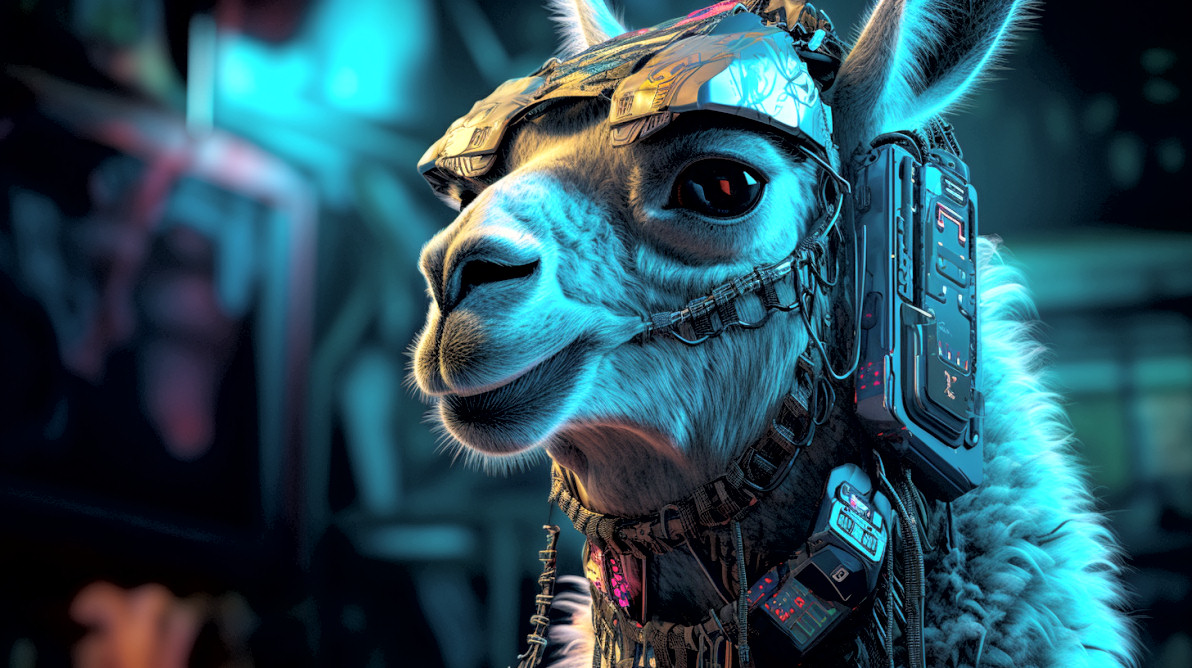
An AI-generated image of a cybernetic llama.
Enlarge / An AI-generated image of a cybernetic llama.
Midjourney

On Tuesday, Meta announced Llama 2, a new open source family of AI language models notable for its commercial license, which means the models can be integrated into commercial products, unlike its predecessor. They range in size from 7 to 70 billion parameters and reportedly “outperform open source chat models on most benchmarks we tested,” according to Meta.

“This is going to change the landscape of the LLM market,” tweeted Chief AI Scientist Yann LeCun. “Llama-v2 is available on Microsoft Azure and will be available on AWS, Hugging Face, and other providers.”

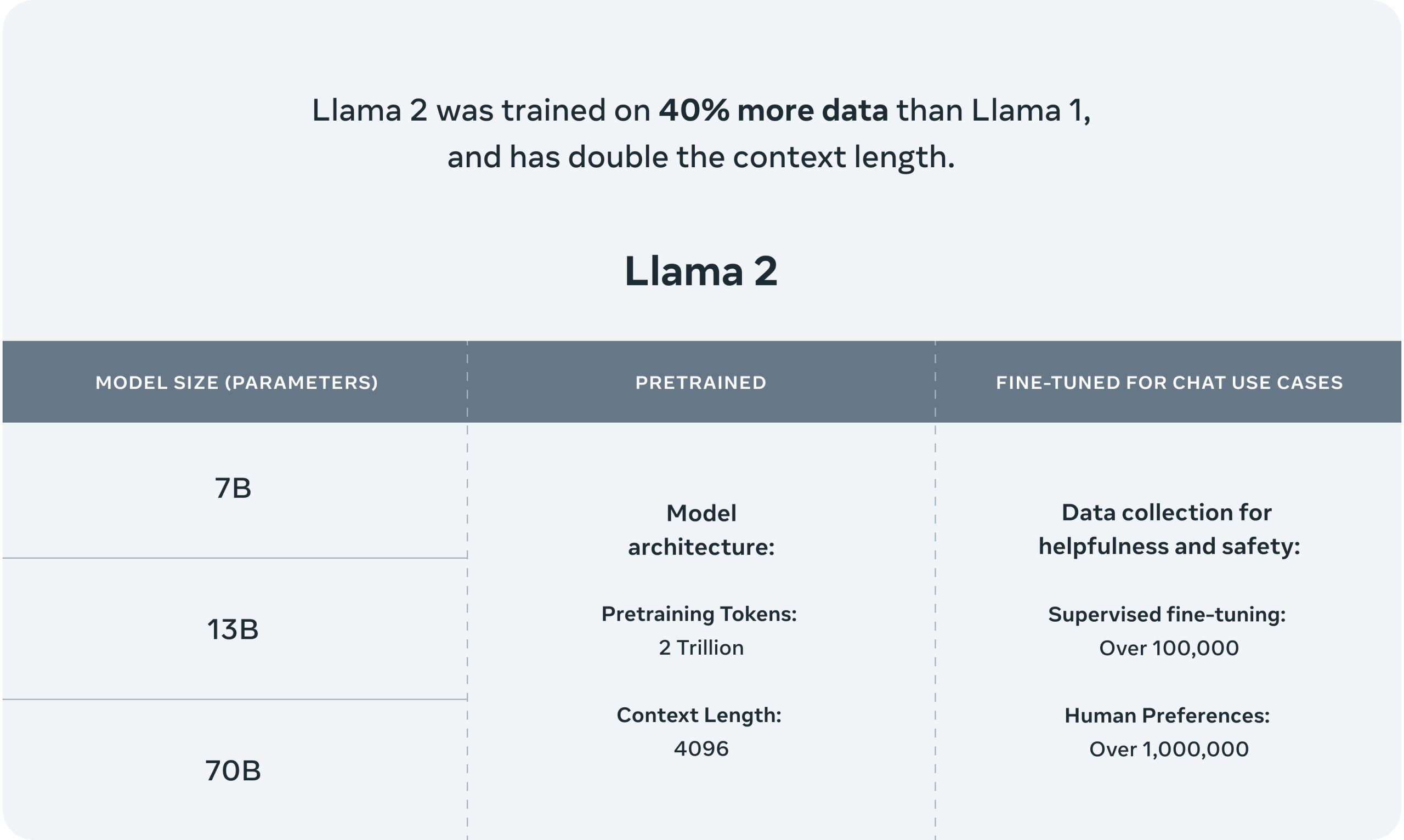
According to Meta, its Llama 2 “pretrained” models (the bare-bones models) are trained on 2 trillion tokens and have a context window of 4,096 tokens (fragments of words). The context window determines the length of the content the model can process at once. Meta also says that the Llama 2 fine-tuned models, developed for chat applications similar to ChatGPT, have been trained on “over 1 million human annotations.”

While it can’t match OpenAI’s GPT-4 in performance, Llama 2 apparently fares well for an open source model. According to Jim Fan, senior AI scientist at Nvidia, “70B is close to GPT-3.5 on reasoning tasks, but there is a significant gap on coding benchmarks. It’s on par or better than PaLM-540B on most benchmarks, but still far behind GPT-4 and PaLM-2-L.” More details on Llama 2’s performance, benchmarks, and construction can be found in a research paper released by Meta on Tuesday.

Llama 2 information from Meta.
Enlarge / Llama 2 information from Meta.

In February, Meta released the precursor of Llama 2, LLaMA, as open source with a non-commercial license. Officially only available to academics with certain credentials, someone soon leaked LLaMA’s weights (files containing the parameter values of the trained neural networks) to torrent sites, and they spread widely in the AI community. Soon, fine-tuned variations of LLaMA, such as Alpaca, sprang up, providing the seed of a fast-growing underground LLM development scene.

Llama 2 brings this activity more fully out into the open with its allowance for commercial use, although potential licensees with “greater than 700 million monthly active users in the preceding calendar month” must request special permission from Meta to use it, potentially precluding its free use by giants the size of Amazon or Google.

The power and peril of open source AI

While open source AI models have proven popular with hobbyists and people seeking uncensored chatbots, they have also proven controversial. Meta is notable for standing alone among the tech giants in supporting major open source foundation models, while those in the closed-source corner include OpenAI, Microsoft, and Google.

Critics say that open source AI models carry potential risks, such as misuse in synthetic biology or in generating spam or disinformation. It’s easy to imagine Llama 2 filling some of these roles, although such uses violate Meta’s terms of service. Currently, if someone performs restricted acts with OpenAI’s ChatGPT API, access can be revoked. But with open source software, once the weights are released, there is no taking them back.

However, proponents of open source AI often argue that open source AI models encourage transparency (in terms of the training data used to make them), foster economic competition (not limiting the technology to giant companies), encourage free speech (no censorship), and democratize access to AI (without paywall restrictions).

Perhaps getting ahead of potential criticism for its open source release, Meta also published a short “Statement of Support for Meta’s Open Approach to Today’s AI” that reads, “We support an open innovation approach to AI. Responsible and open innovation gives us all a stake in the AI development process, bringing visibility, scrutiny and trust to these technologies. Opening today’s Llama models will let everyone benefit from this technology.”

As of Tuesday afternoon, the statement has been signed by a list of executives and educators such as Drew Houston (CEO of Dropbox), Matt Bornstein (Partner at Andreessen Horowitz), Julien Chaumond (CTO of Hugging Face), Lex Fridman (research scientist at MIT), and Paul Graham (Founding Partner of Y Combinator).

Although Llama 2 is open source, Meta did not disclose the source of the training data used in creating the Llama 2 models, which Mozilla Senior Fellow of Trustworthy AI Abeba Birhane pointed out on Twitter. Lack of training data transparency is still a sticking point for some LLM critics because the training data that teaches these LLMs what they “know” often comes from an unauthorized scrape of the Internet with little regard for privacy or commercial impact. Meta says it “made an effort to remove data from certain sites known to contain a high volume of personal information about private individuals” in the Llama 2 research paper, but it did not list what those sites are.

Currently, anyone can request access to download Llama 2 by filling out a form on Meta’s website. Ars Technica submitted a request for the download and received a download link about an hour later, suggesting that the list may be manually screened.

https://arstechnica.com/?p=1954747


Fran Drescher: “We are all going to be in jeopardy of being replaced by machines”

Fran Drescher: “We are all going to be in jeopardy of being replaced by machines”
Getty Images

On Thursday, members of the SAG-AFTRA actors’ union (and its president, actor Fran Drescher) announced their decision to go on strike in solidarity with the WGA strike that has been ongoing since May. One of the central issues raised in this conflict is the threat of using artificial intelligence models to replace human labor, a concern echoed in the writers’ strike.

As reported by The Verge and Reuters, The Screen Actors Guild – American Federation of Television and Radio Artists (SAG-AFTRA) is particularly concerned about the use of AI to create digital likenesses of actors without ongoing consent or appropriate compensation. These digital replicas, powered by advancements in computer graphics techniques and machine learning, are becoming increasingly lifelike, creating new challenges and ethical considerations for the film and television industry. SAG-AFTRA represents over 160,000 film and television actors.

During a press conference on Thursday, SAG-AFTRA President Fran Drescher, best known as the star of the 1990s sitcom The Nanny, underscored the union’s concerns, warning of a future where AI-powered digital doubles might replace human actors. As she put it, “If we don’t stand tall right now, we are all going to be in trouble. We are all going to be in jeopardy of being replaced by machines.”

In contrast, the Alliance of Motion Picture and Television Producers (AMPTP), which represents major studios including Walt Disney and Netflix, has proposed measures that they say protect actors’ digital likenesses. According to the AMPTP, these protections include securing an actor’s consent to create and use a digital likeness or to digitally alter their performance. The proposal also states that the use of digital replicas would be restricted to the specific motion picture for which the actor is employed, and any additional use would require that actor’s consent and further negotiation.

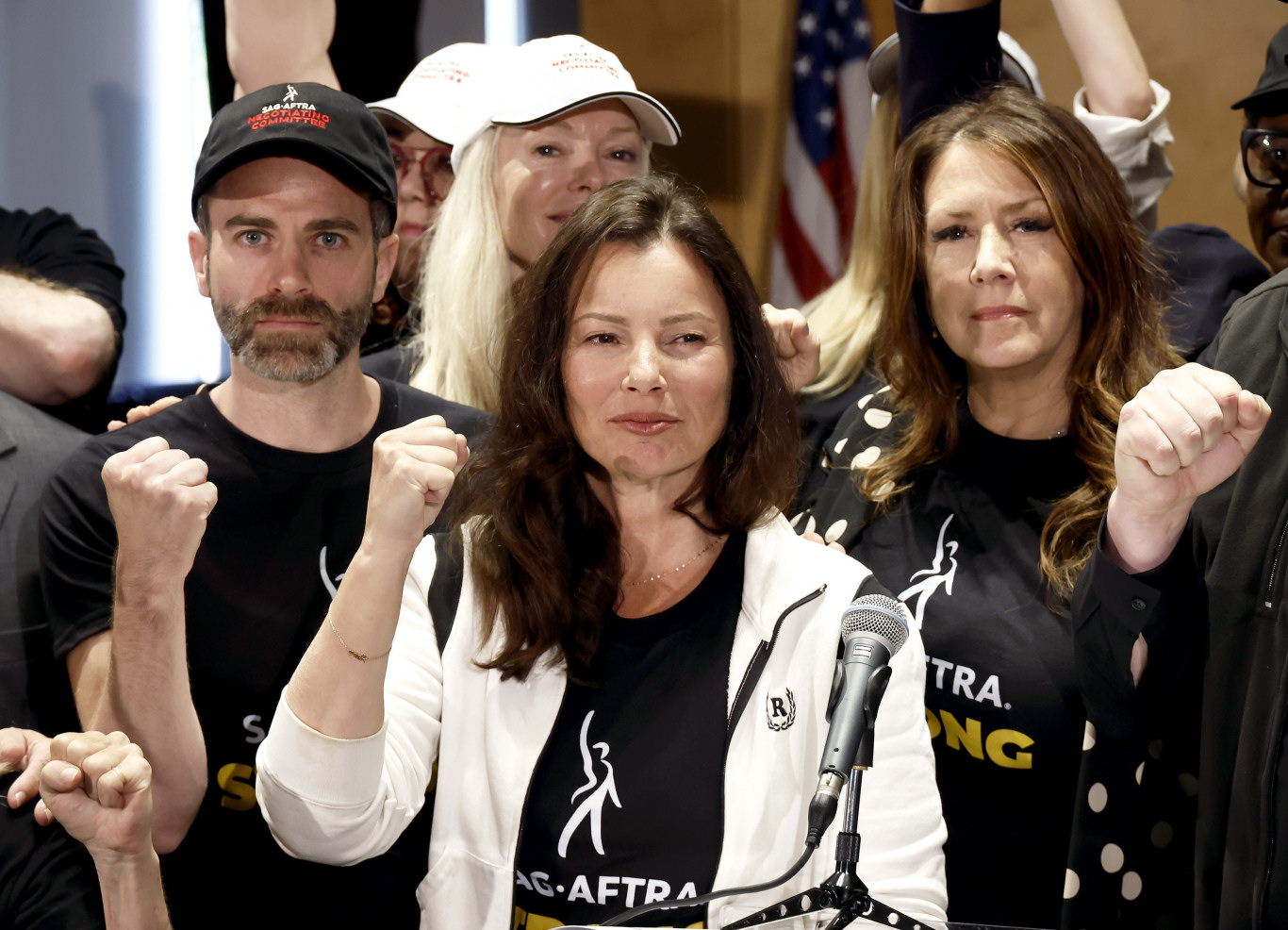
(L-R) Ben Whitehair, Frances Fisher, SAG President Fran Drescher, Joely Fisher, and SAG-AFTRA members are seen as SAG-AFTRA National Board holds a press conference for a vote on recommendation to call a strike regarding the TV/Theatrical contract at SAG-AFTRA on July 13, 2023.
Enlarge / (L-R) Ben Whitehair, Frances Fisher, SAG President Fran Drescher, Joely Fisher, and SAG-AFTRA members are seen as SAG-AFTRA National Board holds a press conference for a vote on recommendation to call a strike regarding the TV/Theatrical contract at SAG-AFTRA on July 13, 2023.
Frazer Harrison/Getty Images

However, SAG-AFTRA disputes this interpretation of the AMPTP’s proposal. SAG-AFTRA chief negotiator Duncan Crabtree-Ireland voiced his concerns during a press conference in Los Angeles. As cited in The Verge, he responded to the proposal, saying, “They propose that our background performers should be able to be scanned, get paid for one day’s pay, and their company should own that scan of their image, their likeness, and should be able to use it for the rest of eternity.”

Like John Henry versus the steam drill, the disagreement between SAG-AFTRA and the Hollywood studios reflects a growing discomfort among those in creative fields about the rise of generative AI models, which typically absorb human creations and use machine-learning techniques to replicate them in novel ways—and potentially doing so in unlimited quantity without compensating the humans that initially “inspired” the machines.

With the rapid evolution of generative AI technology, concerns about its ethical use are not limited to the acting profession; they extend to other creative fields as well, such as artists and musicians. As a proxy battle in a larger war of human creatives versus those who would potentially replace them with AI models, the resolution of these Hollywood negotiations could set substantial precedents for AI use in the entertainment industry.

https://arstechnica.com/?p=1953928


Sky, provocazione fake news: ricrea l’ex presidente Kennedy con l’IA e lo intervista sull’Ucraina (video)

“Se fossi ancora in vita e Presidente degli Stati Uniti, sarei disposto a intraprendere negoziati con il Presidente Putin per cercare una soluzione pacifica alla situazione in Ucraina”.  Così ha risposto, a una domanda sulla possibile soluzione al conflitto in corso, l’ex presidente americano John Fitzgerald Kennedy, ricreato tramite intelligenza artificiale e intervistato da Sarah Varetto, EVP Communications, Inclusion & Bigger Picture di Sky.

Link alla clip dell’intervista al presidente Kennedy versione IA

Si tratta di una provocazione che Sky ha voluto lanciare per riflettere sul tema delle fake news e dei rischi crescenti che le nuove tecnologie e in particolare l’Intelligenza artificiale generativa, possono presentare per la nostra società, ma anche delle opportunità di crescita e sviluppo che queste tecnologie possono offrire.

L’intervista integrale al deepfake di Kennedy sarà trasmessa all’interno della trasmissione “Trappole virtuali e libertà digitale” condotta da Sarah Varetto, EVP Communications, Inclusion & Bigger Picture di Sky, in onda sabato 15 luglio alle 18.30 e in replica domenica 16 luglio alle 21 su Sky TG24.

Al dibattito hanno partecipato il direttore di Sky TG24, Giuseppe De Bellis e l’imprenditore e autore multimediale Roberto Carraro, l’imprenditrice Laura Sposato e il Sottosegretario di Stato al Ministero dell’Istruzione e del Merito, Paola Frassinetti.

“La sfida della nostra epoca è quella lanciata dal mondo digitale che attraverso algoritmi e nuove tecnologie può mettere a dura prova la democrazia e creare grandi disuguaglianze sociali. Comprendere e padroneggiare la tecnologia è fondamentale per affrontare i cambiamenti che la contemporaneità ci impone. Con Sky Up, il programma di Sky creato per combattere il divario digitale, vogliamo dare il nostro contributo per promuovere la digital equity, mettendo a disposizione di chi è più svantaggiato strumenti e competenze che diano alle persone possibilità di crescita e realizzazione personale e professionale” ha dichiarato Sarah Varetto, EVP Communications, Inclusion & Bigger Picture di Sky Italia.

Sul fronte dell’informazione Sky TG24 vuole essere un punto di riferimento per l’approfondimento sull’Intelligenza artificiale, con una programmazione dedicata che ha come obiettivo quello di aiutare il pubblico a capire non solo cos’è l’intelligenza artificiale e quali siano i suoi campi di applicazione, ma anche di affrontare i temi etici e filosofici che questa tecnologia sta ponendo al genere umano.

L’immagine di Kennedy è stata creata dagli autori digitali Roberto e Gualtiero Carraro, che con la loro società, Carraro LAB, sviluppano piattaforme, tecnologie e contenuti innovativi nei settori più avanzati dei nuovi media.

“Abbiamo creato per finalità dimostrative quello che possiamo ribattezzare John Fake Kennedy.  Si tratta di una figura generata dall’intelligenza artificiale.  Il suo aspetto è stato creato della tecnologia deep fake, le sue risposte sono state ottenute tramite Chat GPT. Oggi, con delle semplici app, è sempre più facile costruire immagini di questo tipo”, ha dichiarato Roberto Carraro. “Grazie al rapido sviluppo di queste tecnologie ci si attende una fase di forte inquinamento informativo. Nel breve periodo ci saranno una serie di episodi di distorsione del mondo dell’infosfera che creeranno grande confusione”.

Link alla clip dell’intervista al presidente Kennedy versione IA

https://www.key4biz.it/sky-provocazione-fake-news-ricrea-lex-presidente-kennedy-con-lia-e-lo-intervista-sullucraina/453761/


Why AI detectors think the US Constitution was written by AI

An AI generated image of James Madison writing the U.S. Constitution using AI.
Enlarge / An AI-generated image of James Madison writing the US Constitution using AI.
Midjourney / Benj Edwards

If you feed America’s most important legal document—the US Constitution—into a tool designed to detect text written by AI models like ChatGPT, it will tell you that the document was almost certainly written by AI. But unless James Madison was a time traveler, that can’t be the case. Why do AI writing detection tools give false positives? We spoke to several experts—and the creator of AI writing detector GPTZero—to find out.

Among news stories of overzealous professors flunking an entire class due to the suspicion of AI writing tool use and kids falsely accused of using ChatGPT, generative AI has education in a tizzy. Some think it represents an existential crisis. Teachers relying on educational methods developed over the past century have been scrambling for ways to keep the status quo—the tradition of relying on the essay as a tool to gauge student mastery of a topic.

As tempting as it is to rely on AI tools to detect AI-generated writing, evidence so far has shown that they are not reliable. Due to false positives, AI writing detectors such as GPTZero, ZeroGPT, and OpenAI’s Text Classifier cannot be trusted to detect text composed by large language models (LLMs) like ChatGPT.

If you feed GPTZero a section of the US Constitution, it says the text is “likely to be written entirely by AI.” Several times over the past six months, screenshots of other AI detectors showing similar results have gone viral on social media, inspiring confusion and plenty of jokes about the founding fathers being robots. It turns out the same thing happens with selections from The Bible, which also show up as being AI-generated.

To explain why these tools make such obvious mistakes (and otherwise often return false positives), we first need to understand how they work.

Understanding the concepts behind AI detection

Different AI writing detectors use slightly different methods of detection but with a similar premise: There’s an AI model that has been trained on a large body of text (consisting of millions of writing examples) and a set of surmised rules that determine whether the writing is more likely to be human- or AI-generated.

For example, at the heart of GPTZero is a neural network trained on “a large, diverse corpus of human-written and AI-generated text, with a focus on English prose,” according to the service’s FAQ. Next, the system uses properties like “perplexity” and burstiness” to evaluate the text and make its classification.

Bonnie Jacobs / Getty Images

In machine learning, perplexity is a measurement of how much a piece of text deviates from what an AI model has learned during its training. As Dr. Margaret Mitchell of AI company Hugging Face told Ars, “Perplexity is a function of ‘how surprising is this language based on what I’ve seen?'”

So the thinking behind measuring perplexity is that when they’re writing text, AI models like ChatGPT will naturally reach for what they know best, which comes from their training data. The closer the output is to the training data, the lower the perplexity rating. Humans are much more chaotic writers—or at least that’s the theory—but humans can write with low perplexity, too, especially when imitating a formal style used in law or certain types of academic writing. Also, many of the phrases we use are surprisingly common.

Let’s say we’re guessing the next word in the phrase “I’d like a cup of _____.” Most people would fill in the blank with “water,” “coffee,” or “tea.” A language model trained on a lot of English text would do the same because those phrases occur frequently in English writing. The perplexity of any of those three results would be quite low because the prediction is fairly certain.

https://arstechnica.com/?p=1932658


New ChatGPT rival, Claude 2, launches for open beta testing

Anthropic Claude 2 logo

On Tuesday, Anthropic introduced Claude 2, a large language model (LLM) similar to ChatGPT that can craft code, analyze text, and write compositions. Unlike the original version of Claude launched in March, users can try Claude 2 for free on a new beta website. It’s also available as a commercial API for developers.

Anthropic says that Claude is designed to simulate a conversation with a helpful colleague or personal assistant and that the new version addresses feedback from users of the previous model: “We have heard from our users that Claude is easy to converse with, clearly explains its thinking, is less likely to produce harmful outputs, and has a longer memory.”

Anthropic claims that Claude 2 demonstrates advancements in three key areas: coding, math, and reasoning. “Our latest model scored 76.5% on the multiple choice section of the Bar exam, up from 73.0% with Claude 1.3,” they write. “When compared to college students applying to graduate school, Claude 2 scores above the 90th percentile on the GRE reading and writing exams, and similarly to the median applicant on quantitative reasoning.”

One of the major enhancements of Claude 2 is its expanded input and output length. As we’ve previously covered, Anthropic has been experimenting with processing prompts of up to 100,000 tokens (fragments of words), which allows the AI model to analyze long documents such as technical guides or entire books. This increased length also applies to its outputs, allowing the creation of longer documents as well.

In terms of coding capabilities, Claude 2 demonstrated a reported increase in proficiency. Its score on the Codex HumanEval, a Python programming test, rose from 56 percent to 71.2 percent. Similarly, on GSM8k, a test comprising grade-school math problems, it improved from 85.2 to 88 percent.

One of the primary focuses for Anthropic has been to make its language model less likely to generate “harmful” or “offensive” outputs when presented with certain prompts, although measuring those qualities is highly subjective and difficult. According to an internal red-teaming evaluation, “Claude 2 was 2x better at giving harmless responses compared to Claude 1.3.”

Claude 2 is now available for general use in the US and UK  for individual users and businesses via its API. Anthropic reports that companies like Jasper, an AI writing platform, and Sourcegraph, a code navigation tool, have begun incorporating Claude 2 into their operations.

It’s important to note that while AI models like Claude 2 can analyze long and complex works, Anthropic is still aware of its limitations. After all, language models occasionally make things up out of thin air. Our advice is to not use them as factual references but allow them to process data that you provide—if you are already familiar with the subject matter and can validate the results.

“AI assistants are most useful in everyday situations, like serving to summarize or organize information,” Anthropic writes, “and should not be used where physical or mental health and well-being are involved.”

https://arstechnica.com/?p=1952822


OpenAI launches GPT-4 API for everyone

OpenAI launches GPT-4 API for everyone

On Thursday, OpenAI announced that all paying API customers now have access to the GPT-4 API. It also introduced updates to chat-based models, announced a shift from the Completions API to the Chat Completions API, and outlined plans for deprecation of older models.

Generally considered its most powerful API product, the GPT-4 API first launched in March but has been under closed testing until now. As an API, developers can use a special interface to integrate OpenAI’s large language model (LLM) into their own products for uses such as summarization, coding assistance, analysis, and composition. The model runs remotely on OpenAI’s servers and provides output to other apps over the Internet.

OpenAI says the GPT-4 API with 8K context is accessible to existing developers who have a successful payment history, with plans to open access to new developers by the end of July. And in a move to distance itself from older GPT-3-style models, OpenAI has also opted to begin retiring “Completions API” models in favor of newer Chat Completions API models. Since its March launch, OpenAI says that its Chat Completions API models now account for 97 percent of OpenAI’s API GPT usage.

This deprecation plan involves retiring models that are part of the Completions API in six months. Starting January 4, 2024, these older models, which simply complete a prompt instead of engaging in a chat-like dialog, will be replaced with newer versions, and developers using some of these models will be required to upgrade their integration manually. For now, the older models will remain available but will be labeled as “legacy” products. Here’s a partial list of models that will be deprecated:

  • ada
  • babbage
  • curie
  • davinci
  • davinci-instruct-beta
  • curie-instruct-beta
  • text-ada-001
  • text-babbage-001
  • text-curie-001
  • text-davinci-001
  • text-davinci-002
  • text-davinci-003

OpenAI will provide drop-in replacements for these older models. For example, OpenAI recommends that users of the text-davinci-003 model switch to the gpt-3.5-turbo-instruct model instead. Similarly, the ada-002, babbage-002, curie-002, and davinci-002 models will replace earlier versions of each. Applications using some of these GPT-3 models (such as ada, babbage, curie, davinci) will “automatically be upgraded to the new models listed above on January 4, 2024,” according to OpenAI.

OpenAI also announced that “based on the stability and readiness of these models for production-scale use,” it is also making APIs for Whisper, DALL-E, and GPT-3.5 Turbo “generally available.” And the company expects to continue fine-tuning the models throughout the year.

Developers can find more details in OpenAI’s blog post for the announcement.

https://arstechnica.com/?p=1952557


Sarah Silverman sues OpenAI, Meta for being “industrial-strength plagiarists”

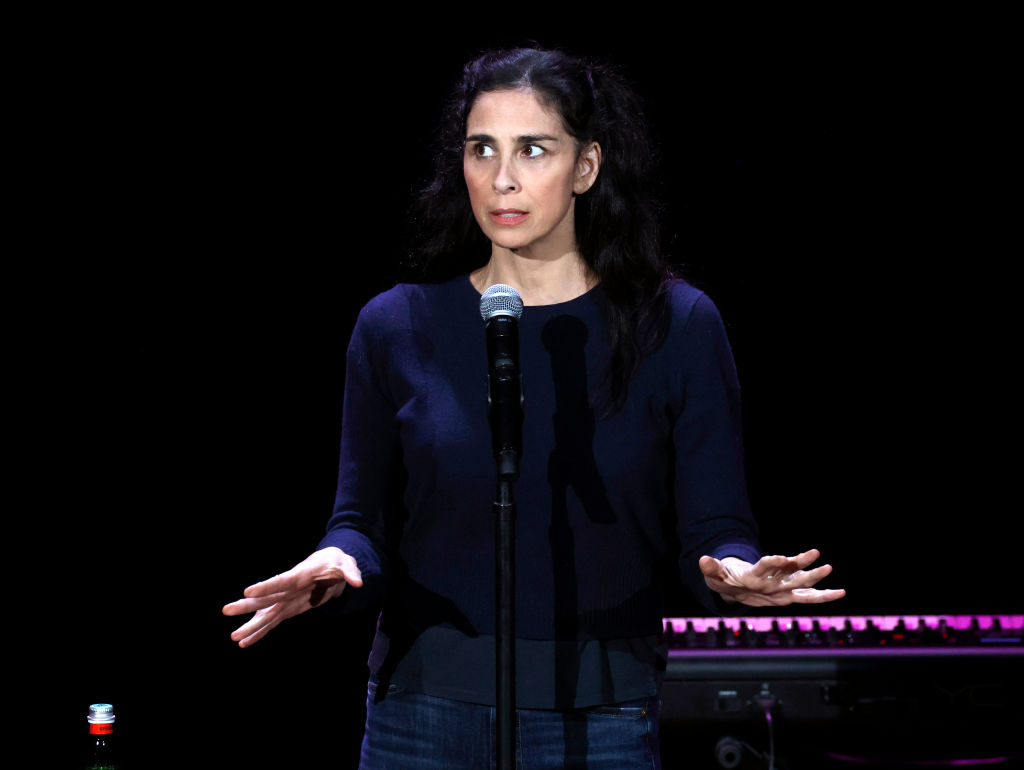
Comedian and author Sarah Silverman.
Enlarge / Comedian and author Sarah Silverman.

On Friday, the Joseph Saveri Law Firm filed US federal class-action lawsuits on behalf of Sarah Silverman and other authors against OpenAI and Meta, accusing the companies of illegally using copyrighted material to train AI language models such as ChatGPT and LLaMA.

Other authors represented include Christopher Golden and Richard Kadrey, and an earlier class-action lawsuit filed by the same firm on June 28 included authors Paul Tremblay and Mona Awad. Each lawsuit alleges violations of the Digital Millennium Copyright Act, unfair competition laws, and negligence.

The Joseph Saveri Law Firm is no stranger to press-friendly legal action against generative AI. In November 2022, the same firm filed suit over GitHub Copilot for alleged copyright violations. In January 2023, the same legal group repeated that formula with a class-action lawsuit against Stability AI, Midjourney, and DeviantArt over AI image generators. The GitHub lawsuit is currently on path to trial, according to lawyer Matthew Butterick. Procedural maneuvering in the Stable Diffusion lawsuit is still underway with no clear outcome yet.

In a press release last month, the law firm described ChatGPT and LLaMA as “industrial-strength plagiarists that violate the rights of book authors.” Authors and publishers have been reaching out to the law firm since March 2023, lawyers Joseph Saveri and Butterick wrote, because authors “are concerned” about these AI tools’ “uncanny ability to generate text similar to that found in copyrighted textual materials, including thousands of books.”

The most recent lawsuits from Silverman, Golden, and Kadrey were filed in a US district court in San Francisco. Authors have demanded jury trials in each case and are seeking permanent injunctive relief that could force Meta and OpenAI to make changes to their AI tools.

Meta declined Ars’ request to comment. OpenAI did not immediately respond to Ars’ request to comment.

A spokesperson for the Saveri Law Firm sent Ars a statement, saying, “If this alleged behavior is allowed to continue, these models will eventually replace the authors whose stolen works power these AI products with whom they are competing. This novel suit represents a larger fight for preserving ownership rights for all artists and other creators.”

Accused of using “flagrantly illegal” data sets

Neither Meta nor OpenAI has fully disclosed what’s in the data sets used to train LLaMA and ChatGPT. But lawyers for authors suing say they have deduced the likely data sources from clues in statements and papers released by the companies or related researchers. Authors have accused both OpenAI and Meta of using training data sets that contained copyrighted materials distributed without authors’ or publishers’ consent, including by downloading works from some of the largest e-book pirate sites.

In the OpenAI lawsuit, authors alleged that based on OpenAI disclosures, ChatGPT appeared to have been trained on 294,000 books allegedly downloaded from “notorious ‘shadow library’ websites like Library Genesis (aka LibGen), Z-Library (aka Bok), Sci-Hub, and Bibliotik.” Meta has disclosed that LLaMA was trained on part of a data set called ThePile, which the other lawsuit alleged includes “all of Bibliotik,” and amounts to 196,640 books.

On top of allegedly accessing copyrighted works through shadow libraries, OpenAI is also accused of using a “controversial data set” called BookCorpus.

BookCorpus, the OpenAI lawsuit said, “was assembled in 2015 by a team of AI researchers for the purpose of training language models.” This research team allegedly “copied the books from a website called Smashwords that hosts self-published novels, that are available to readers at no cost.” These novels, however, are still under copyright and allegedly “were copied into the BookCorpus data set without consent, credit, or compensation to the authors.”

Ars could not immediately reach the BookCorpus researchers or Smashwords for comment. [Update: Dan Wood, COO of Draft2Digital—which acquired Smashwords in March 2022—told Ars that the Smashwords  “store site lists close to 800,000 titles for sale,” with “about 100,000” currently priced at free.

“Typically, the free book will be the first of a series,” Wood said. “Some authors will keep these titles free indefinitely, and some will run limited promotions where they offer the book for free. From what we understand of the BookCorpus data set, approximately 7,185 unique titles that were priced free at the time were scraped without the knowledge or permission of Smashwords or its authors.” It wasn’t until March 2023 when Draft2Digital “first became aware of the scraped books being used for commercial purposes and redistributed, which is a clear violation of Smashwords’ terms of service,” Wood said.

“Every author, whether they have an internationally recognizable name or have just published their first book, deserve to have their copyright protected,” Wood told Ars. “They also should have the confidence that the publishing service they entrust their work with will protect it. To that end, we are working diligently with our lawyers to fully understand the issues—including who took the data and where it was distributed—and to devise a strategy to ensure our authors’ rights are enforced. We are watching the current cases being brought against OpenAI and Meta very closely.”]

https://arstechnica.com/?p=1952424


Generative AI in games will create a copyright crisis

Generative AI in games will create a copyright crisis

AI Dungeon, a text-based fantasy simulation that runs on OpenAI’s GPT-3, has been churning out weird tales since May 2019. Reminiscent of early text adventure games like Colossal Cave Adventure, you get to choose from a roster of formulaic settings—fantasy, mystery, apocalyptic, cyberpunk, zombies—before picking a character class and name, and generating a story.

Here was mine: “You are Mr. Magoo, a survivor trying to survive in a post-apocalyptic world by scavenging among the ruins of what is left. You have a backpack and a canteen. You haven’t eaten in two days, so you’re desperately searching for food.” So began Magoo’s 300-ish-word tale of woe in which, “driven half-mad” by starvation, he happens upon “a man dressed in white.” (Jesus? Gordon Ramsay?) Offering him a greeting kiss, Magoo is stabbed in the neck.

As lame as this story is, it hints at a knotty copyright issue the games industry is only just beginning to unravel. I’ve created a story using my imagination—but to do that I’ve used an AI helper. So who wrote the tale? And who gets paid for the work?  

AI Dungeon was created by Nick Walton, a former researcher at a deep learning lab at Brigham Young University in Utah who is now the CEO of Latitude, a company that bills itself as “the future of AI-generated games.” AI Dungeon is certainly not a mainstream title, though it has still attracted millions of players. As Magoo’s tale shows, the player propels the story with action, dialog, and descriptions; AI Dungeon reacts with text, like a dungeon master—or a kind of fantasy improv.

In several years of experimentation with the tool, people have generated far more compelling D&D-esque narratives than mine, as well as videos like “I broke the AI in AI Dungeon with my horrible writing.” It’s also conjured controversy, notably when users began prompting it to make sexually explicit content involving children. And as AI Dungeon—and tools like it—evolve, they will raise more difficult questions about authorship, ownership, and copyright.

Many games give you toolsets to create worlds. Classic series like Halo or Age of Empires include sophisticated mapmakers; Minecraft precipitated an open-ended, imaginative form of gameplay that The Legend of Zelda: Tears of the Kingdom’s Fuse and Ultrahand capabilities draw clear inspiration from; others, like Dreams or Roblox, are less games than platforms for players to make more games.

Historically, claims of ownership to in-game creations or user-generated creations (IGCs or UGCs) have been rendered moot by “take it or leave it” end-user license agreements—the dreaded EULAs that nobody reads. Generally, this means players surrender any ownership of their creations by switching on the game. (Minecraft is a rare exception here. Its EULA has long afforded players ownership of their IGCs, with relatively few community freakouts.)

AI adds new complexities. Laws in both the US and the UK stipulate that, when it comes to copyright, only humans can claim authorship. So for a game like AI Dungeon, where the platform allows a player to, essentially, “write” a narrative with the help of a chatbot, claims of ownership can get murky: Who owns the output? The company that developed the AI, or the user?

There’s a big discussion nowadays, with prompt engineering in particular, about the extent to which you as a player imprint your personality and your free and creative choices,” says Alina Trapova, a law professor at University College London who specializes in AI and copyright and has authored several papers on AI Dungeon’s copyright problems. Right now, this gray area is circumvented with an EULA. AI Dungeon’s is particularly vague. It states that users can use content they create “pretty much however they want.” When I emailed Latitude to ask whether I could turn my Mr. Magoo nightmare into a play, book, or film, the support line quickly responded, “Yes, you have complete ownership of any content you created using AI Dungeon.”

https://arstechnica.com/?p=1951703