Biden Discusses Risks and Promises of Artificial Intelligence With Tech Leaders in San Francisco

President Joe Biden convened a group of technology leaders on Tuesday to debate what he called the “risks and enormous promises” of artificial intelligence.

The Biden administration is seeking to figure out how to regulate the emergent field of AI, looking for ways to nurture its potential for economic growth and national security and protect against its potential dangers.

“We’ll see more technological change in the next 10 years that we saw in the last 50 years,” Biden said as the meeting with eight technology experts from academia and advocacy groups kicked off.

“AI is already driving that change,” Biden said.

The sudden emergence of AI chatbot ChatGPT and other tools has jumpstarted investment in the sector. AI tools are able to craft human-like text, music, images and computer code. This form of automation could increase the productivity of workers, but experts warn of numerous risks.

The technology could be used to replace workers, causing layoffs. It’s already being deployed in false images and videos, becoming a vehicle of disinformation that could undermine democratic elections. Governments, as well as the European Union, have said they are determined to regulate and put brakes on AI before it is too late.

Biden said social media has already shown the harm technology can do “without the right safeguards in place.”

Advertisement. Scroll to continue reading.

In May, Biden’s administration brought together tech CEOs at the White House to discuss these issues, with the Democratic president telling them, “What you’re doing has enormous potential and enormous danger.”

White House chief of staff Jeff Zients’ office is developing a set of actions the federal government can take over the coming weeks regarding AI, according to the White House. Top officials are meeting two to three times each week on this issue, in addition to the daily work of federal agencies. The administration wants commitments from private companies to address the possible risks from AI.

Biden is meeting Tuesday at the Fairmont hotel in San Francisco with Tristan Harris, executive director of the Center for Human Technology; Jim Steyer, the CEO of Common Sense Media; and Joy Buolamwin, founder of the Algorithmic Justice League, among others. California Gov. Gavin Newsom was also in attendance.

Biden is also in the San Francisco area to raise money for this 2024 reelection campaign. At his first fundraiser of the night, Biden spoke about what he saw as freedoms under siege, particularly for the LGBTQ community and with the overturning of abortion protections by the U.S. Supreme Court. And as president, it’s his job to help safeguard the right to choose.

“I think the American people need to have the confidence that we’re going to do what we say we’re going to do,” he said.

Related: Cyber Insights 2023 | Artificial Intelligence

Related: White House Unveils Artificial Intelligence ‘Bill of Rights’

Related: Bias in Artificial Intelligence: Can AI be Trusted?

https://www.securityweek.com/biden-discusses-risks-and-promises-of-artificial-intelligence-with-tech-leaders-in-san-francisco/


Purely AI-generated songs declared ineligible for Grammy Awards

Tin robots dance in a stock photo.
Getty Images

Amid increasing use of generative AI in music, the Recording Academy has updated its rules for the 66th annual Grammy Awards regarding the role of AI in considered works, Reuters reports. To be eligible for an award, a song must have meaningful human authorship. Purely algorithmically generated music cannot win a Grammy.

According to the 66th Grammy Awards Rules & Guidelines booklet, works generated solely by AI are not eligible for the awards. However, the Academy does not completely exclude AI’s potential role in the creation process. Works that incorporate elements of “AI-generated material” are eligible if they meet two key criteria, and we’ll quote the booklet itself:

  • “The human-authored components of the work must be meaningful and more than ‘de minimis.'” (The booklet defines “de minimis” as “lacking significance or importance, or so minor as to merit disregard.”)
  • “These human-authored components must be relevant to the category in which the work is entered. For instance, if the work is submitted in a songwriting category, there should be significant human authorship involved in the music and/or lyrics. Similarly, for a performance category, the human performance element should be significant.”

The rules also state that if a piece of work incorporates material generated by AI, the individuals or teams who programmed or operated the AI to generate that material cannot be considered for a Grammy award based on that contribution. In other words, if a song uses AI to generate a melody, lyrics, or any other element, the people who created or utilized the AI do not get credit for Grammy consideration for that specific AI-generated part. The credit and potential for nomination or award receipt go to the human elements that significantly contribute to the song.

AI in music can take different forms. Over the past year, we’ve seen increasing progress in AI models that can create complete audio compositions from scratch based on text descriptions, such as Riffusion, MusicLM from Google, and the more recently announced MusicGen from Meta. Under these rules, songs created using those tools (or others like them) alone would not be eligible for receiving a Grammy award—assuming they were good enough.

On the other hand, we’ve also reported about The Beatles using AI to remaster songs and potentially pull out vocals from a demo tape for use in a “final” Beatles track. In those cases, since the AI would be limited to processing the audio rather than generating a composition or performance from scratch, we’d guess the resulting songs or albums would still be eligible for Grammy consideration in most categories.

Somewhere in between lies the use of generative AI tools such as vocal generators in songs. In those cases, the AI “vocalist” could not win an award in a category that awards vocal performances, but if the song still contained substantial human creative elements, the song could potentially win in a different category that considers human contributions to the song, even with an AI vocal track.

Here is the full list of the new AI rules, listed in a new section called “Generative AI”:

The GRAMMY Award recognizes creative excellence. Only human creators are eligible to be submitted for consideration for, nominated for, or win a GRAMMY Award. A work that contains no human authorship is not eligible in any Categories. A work that features elements of A.I. material (i.e., material generated by the use of artificial intelligence technology) is eligible in applicable Categories; however: (1) the human authorship component of the work submitted must be meaningful and more than de minimis; (2) such human authorship component must be relevant to the Category in which such work is entered (e.g., if the work is submitted in a songwriting Category, there must be meaningful and more than de minimis human authorship in respect of the music and/or lyrics; if the work is submitted in a performance Category, there must be meaningful and more than de minimis human authorship in respect of the performance); and (3) the author(s) of any A.I. material incorporated into the work are not eligible to be nominees or GRAMMY recipients insofar as their contribution to the portion of the work that consists of such A.I material is concerned. De minimis is defined as lacking significance or importance; so minor as to merit disregard.

As AI continues to emerge as a creative but controversial tool in the arts, the Grammy rule introduction serves as a notable statement about the importance of human creativity in the music industry. Although generative AI may someday have the capacity to create impressive compositions, the Grammy stage remains largely reserved for human artists—for the time being.

And while artificial intelligence-powered rock stars need not apply, an “Al” as in “Alfred” star made a joke about the new rules on Twitter.

A tweet from Weird Al Yankovic about the new AI Grammy rules.
Enlarge / A tweet from Weird Al Yankovic about the new AI Grammy rules.

The 66th annual Grammy Awards will take place in 2024.

https://arstechnica.com/?p=1948932


Thousands of realistic but fake AI child sex images found online, report says

Thousands of realistic but fake AI child sex images found online, report says

Child safety experts are growing increasingly powerless to stop thousands of “AI-generated child sex images” from being easily and rapidly created, then shared across dark web pedophile forums, The Washington Post reported.

This “explosion” of “disturbingly” realistic images could help normalize child sexual exploitation, lure more children into harm’s way, and make it harder for law enforcement to find actual children being harmed, experts told the Post.

Finding victims depicted in child sexual abuse materials is already a “needle in a haystack problem,” Rebecca Portnoff, the director of data science at the nonprofit child-safety group Thorn, told the Post. Now, law enforcement will be further delayed in investigations by efforts to determine if materials are real or not.

Harmful AI materials can also re-victimize anyone whose images of past abuse are used to train AI models to generate fake images.

“Children’s images, including the content of known victims, are being repurposed for this really evil output,” Portnoff said.

Normally, content of known victims can be blocked by child safety tools that hash reported images and detect when they are reshared to block uploads on online platforms. But that technology only works to detect previously reported images, not newly AI-generated images. Both law enforcement and child-safety experts report these AI images are increasingly being popularized on dark web pedophile forums, with many Internet users “wrongly” viewing this content as a legally gray alternative to trading illegal child sexual abuse materials (CSAM).

“Roughly 80 percent of respondents” to a poll posted in a dark web forum with 3,000 members said that “they had used or intended to use AI tools to create child sexual abuse images,” ActiveFence, which builds trust and safety tools for online platforms and streaming sites, reported in May.

While some users creating AI images and even some legal analysts believe this content is potentially not illegal because no real children are harmed, some United States Justice Department officials told the Post that AI images sexualizing minors still violate federal child-protection laws. There seems to be no precedent, however, as officials could not cite a single prior case resulting in federal charges, the Post reported.

As authorities become more aware of the growing problem, the public is being warned to change online behaviors to prevent victimization. Earlier this month, the FBI issued an alert, “warning the public of malicious actors creating synthetic content (commonly referred to as ‘deepfakes’) by manipulating benign photographs or videos to target victims,” including reports of “minor children and non-consenting adults, whose photos or videos were altered into explicit content.”

These images aren’t just spreading on the dark web, either, but on “social media, public forums, or pornographic websites,” the FBI warned. The agency blamed recent technology advancements for the surge in malicious deepfakes because AI tools like Stable Diffusion, Midjourney, and DALL-E can be used to generate realistic images based on simple text prompts. These advancements are “continuously improving the quality, customizability, and accessibility of artificial intelligence (AI)-enabled content creation,” the FBI warned.

https://arstechnica.com/?p=1948977


How Buffer’s Content Team Uses AI

There’s been much ado about AI lately, especially since ChatGPT was released to the public in November 2022. Since then, we’ve seen an influx of thoughts and tools around the topic and the use of AI.

We like AI here at Buffer – we’ve even launched an AI Assistant to help our audience create content better and faster. However, we understand its limitations, especially when it comes to creation, better than most. We also understand the (valid) concerns that many creatives and marketers have about the impact of AI on the quality of content.

So even though we use AI in our processes on Buffer’s Content team (there are only three of us, and it helps us work more efficiently), we wanted to clarify exactly how and where we use AI in our work.

Our history with AI

We’ve been playing around with different AI tools for several months, and it shows in our content archive from the past year.

The first article from Buffer about AI went live in May 2022 to answer the question, “Should you be using AI for content creation?” Reflecting on this article is interesting because our stance then and now is the same – let it handle the small stuff, so you can better handle the big, creative work.

Our interest in AI has only grown since then, as ChatGPT went public, we published several articles mentioning AI on the blog, and we launched an AI Assistant.

Spending time with the different tools powered by AI has allowed us to define our boundaries better. As a result, we already have unwritten rules around AI in content. However, a pattern emerged in two recent events that prompted us to ask ourselves: how do we let people know our stance on AI?

The first was our latest (now closed) hiring run for a Content Writer. This article goes into more detail, but a surprising amount of applications were completed using AI. Our understanding of the typical AI-generated content helped us identify these applications, but it was prevalent enough to highlight.

The second event is ongoing – our recently launched Guest Post Program. The idea of the program is to open up the Buffer blog to knowledge stories from creators and small business owners. We want skilled writing that feels personal and leaves our audience feeling like they’ve learned something valuable. But, again, many pitches that come through are AI-generated with little to no editing. They all followed the same structure we’ve recognised from AI-generated answers, especially those created in ChatGPT.

Despite the speculation that AI is a ticking time bomb for people in creative industries, we beg to differ. No tool can replace the human mind and its capacity to create art that connects deeply. Also, it’s worth remembering that AI is just an extensive language-learning model. It makes inferences from what you tell it and its limited bank of information to perform what several people have called “spicy autocomplete”. It’s a tool – only as good as the person who wields it.

So, yes, we had to take the time to clarify our stance because while it’s great, it’s not replacing any of us any time soon.

Our approach to AI in content

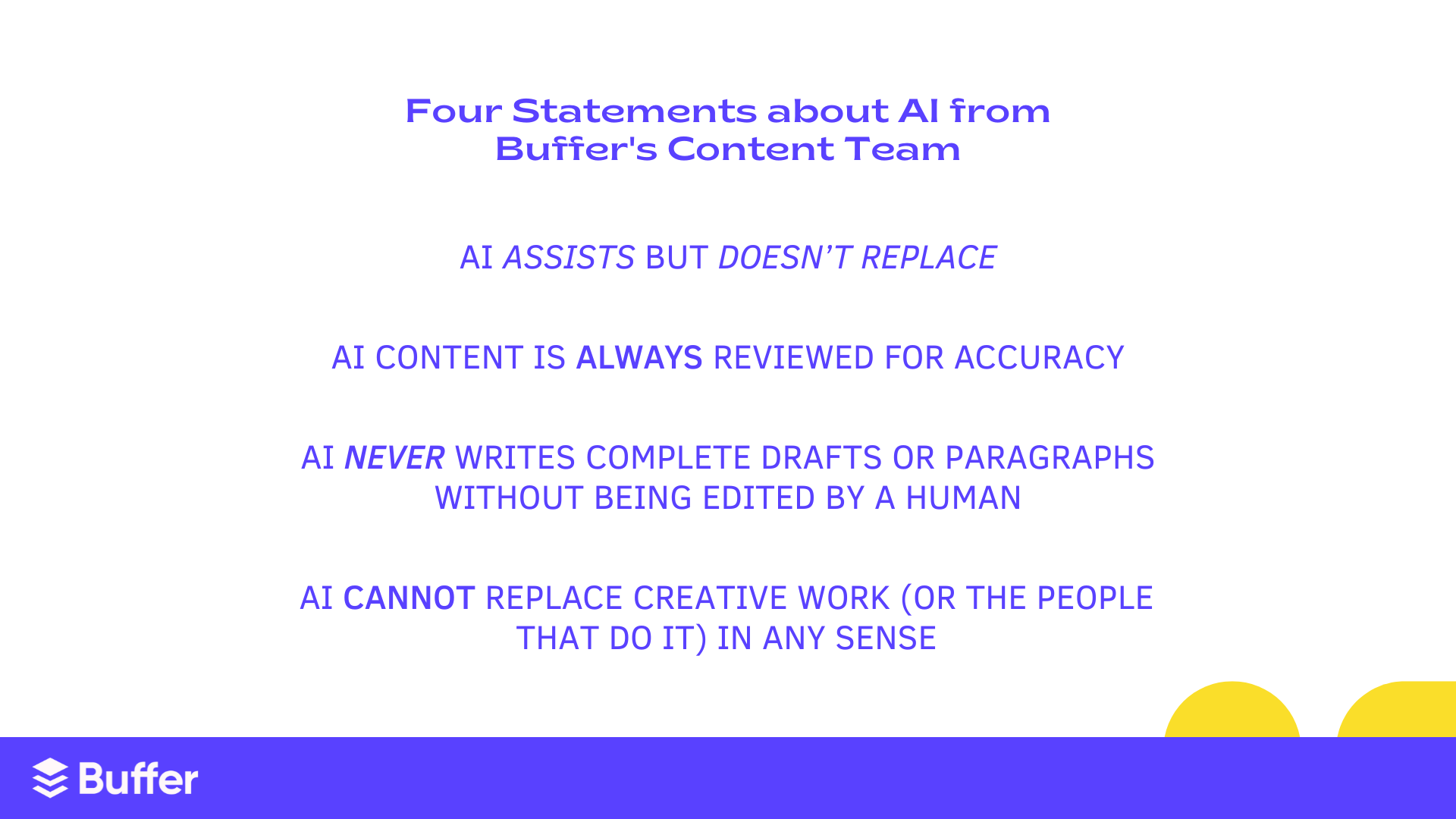
Here are the four statements that cover 90 percent of how we think about using AI in content.

  • AI assists but doesn’t replace
  • AI never writes complete drafts or paragraphs without being edited by a human
  • AI content is always reviewed for accuracy
  • We don’t believe AI can replace creative work in any sense
ai in content

The Content team’s experience with AI

Buffer’s Content team comprises three people who manage the team’s blogs, social media, PR, and other content and communication-related needs. The size of our team versus our responsibilities often means we must turn down certain projects and opportunities. We need to prioritize, but at the end of the day, content and social are top priorities for our team, so they can’t be put aside.

Adopting AI tools has allowed us to free up more time to explore these opportunities and collaborate with other teams more effectively. For example, the first edits are done with Grammarly instead of one of us to catch the most visible errors in grammar and punctuation. This allows us to focus on deeper-level structure, voice, and tone editing. I use Otter a lot to record interviews. It joins my Zoom calls and makes rough notes – meaning I don’t have to start listening and transcribing from scratch. It even gives a summary of each call.

Outside of AI-heavy tools, some of our other resources have AI incorporated into them like

  • Threads, which we use for internal communication
  • Notion, which we use for knowledge management
  • Canva, for designing social media posts and blog graphics
  • and even Buffer.

AI’s an inevitable part of our process, and while we could choose not to use these tools, we’d all be less effective for it.

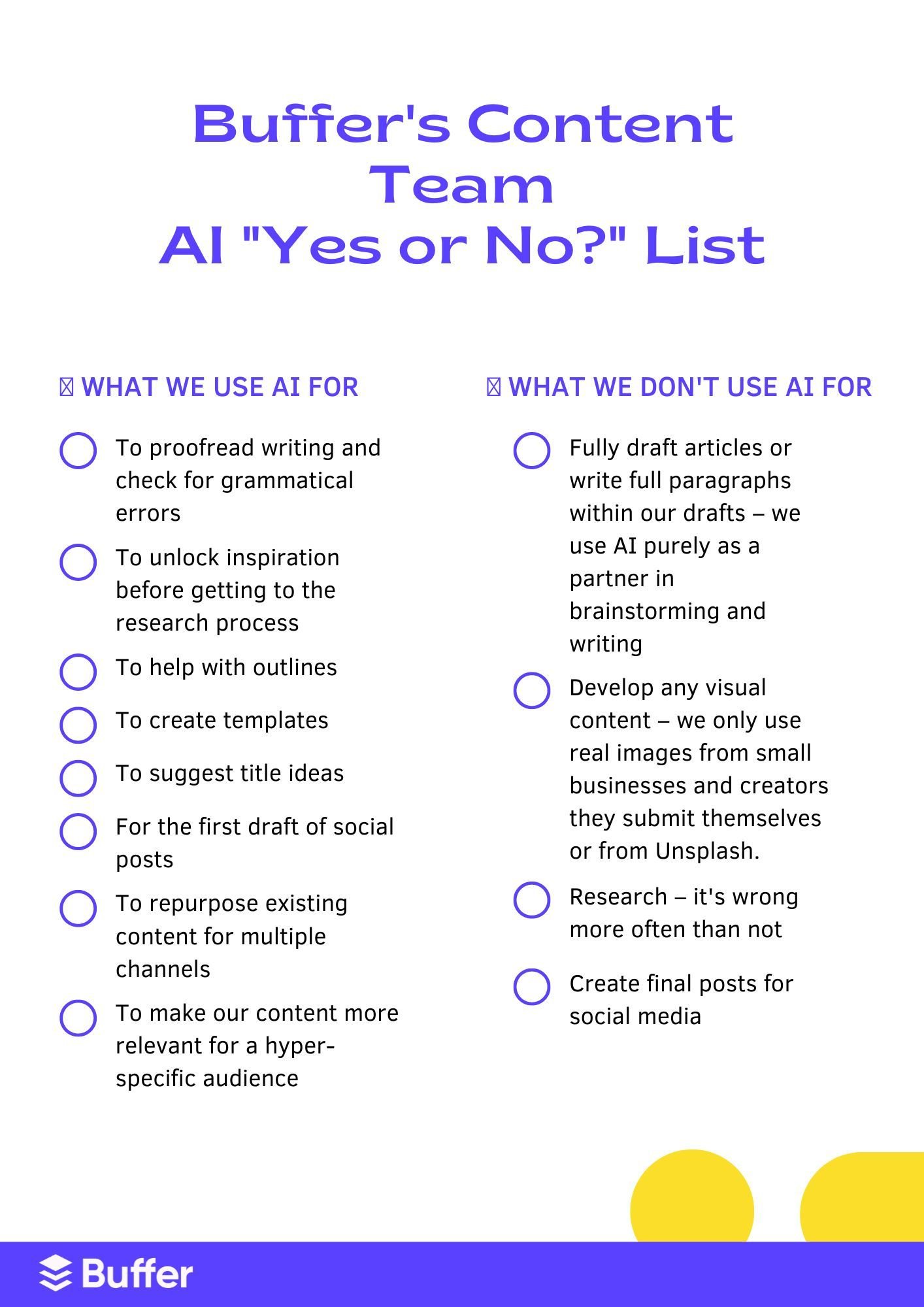
What we use AI for

We use AI for important, time-consuming tasks that a nonhuman can do.

  • To proofread writing and check for grammatical errors
  • To unlock inspiration before getting to the research process
  • To help with outlines
  • For creating templates
  • For coming up with interview questions
  • For suggesting title ideas
  • For the first draft of social posts
  • To repurpose existing content for multiple channels
  • To make our content more relevant for a hyper-specific audience

What we’re not using AI for

We do not and will never use AI to

  • Research because it’s wrong more often than not
  • Fully draft articles or write full paragraphs within our drafts – we use AI purely as a partner in brainstorming and writing
  • Create final posts for social media
  • Develop any visual content – we only use real images from small businesses and creators they submit themselves or from Unsplash.
how we use ai for content

Real ways we’ve been using AI

The Content and broader Marketing teams view AI as a partner – and we have projects as proof. For a little more of the practical side of how we approach AI, here are some of the public ways we’ve been using it.

The social posts experiment

Our social media manager, Mitra, shared the results of her experiment of writing social posts with AI.

Mitra highlighted that AI didn’t make a difference in the performance of the content and even used words that she would never use. However, Mitra gave the idea an A-plus for creating captions on days without inspiration.

Lunch and learn

I presented a lunch and learn on AI for the broad Marketing team at Buffer, sharing how I’ve been using it in my work.

Social media glossary

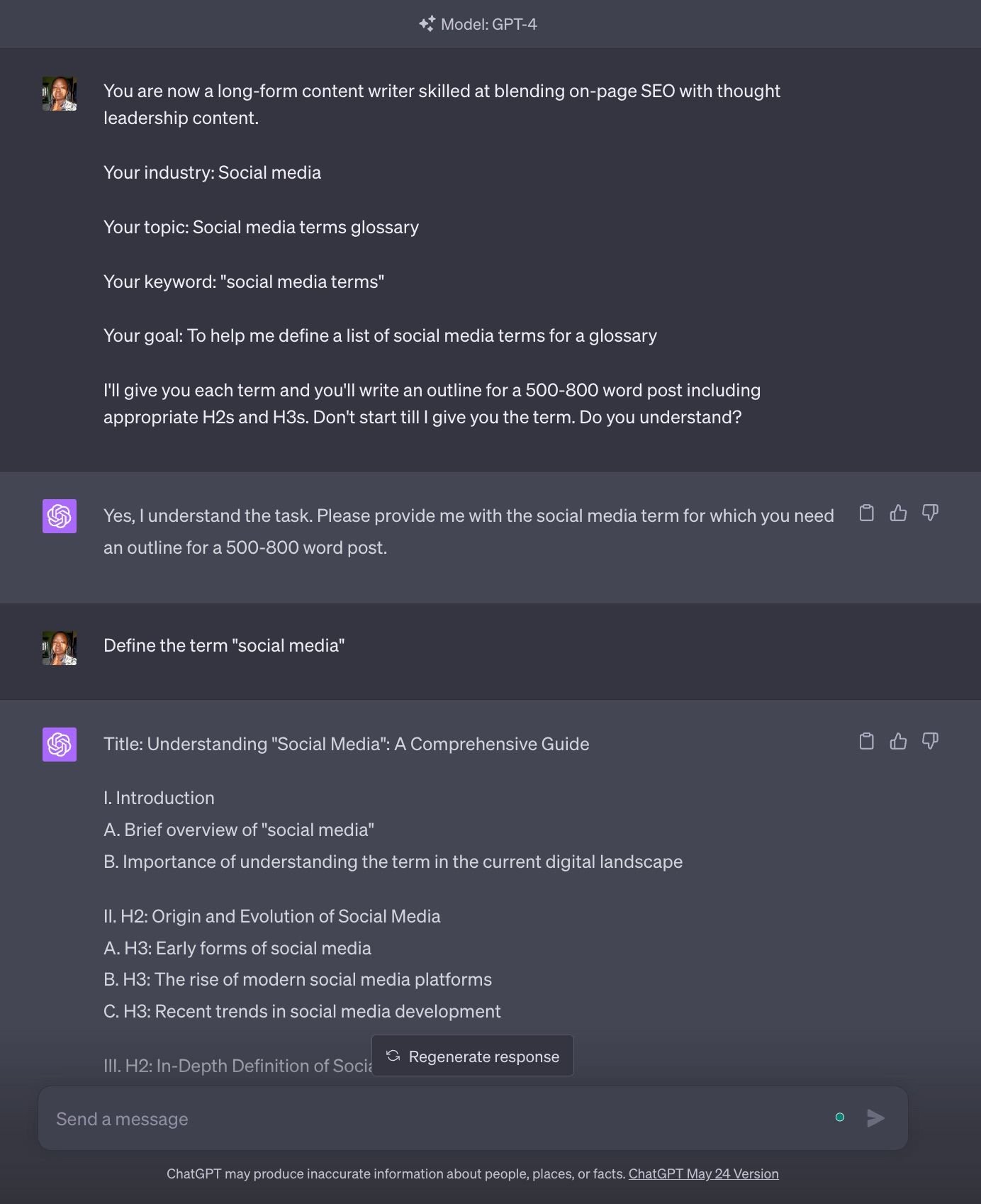
We recently launched a Social Media Glossary that resulted from months of hard work and cross-functional collaboration on the Marketing team.

It might have taken us longer to complete, but using AI cut the time we spent figuring out what to write under each term and how to write it in half. We developed a prompt that helped us fill out the basic outline of each term within our Glossary that we used as the foundation for each word.

We also considered the impact of AI-only content on the performance of the page and its effectiveness for the reader. So, we spent a lot of time editing and adding additional resources to increase the value searchers would get from spending time on each page.

Localizing the entire Buffer website

We’ve been working on a project to localize the Buffer website to other languages, starting with Spanish – and AI has helped us realize most of it.

Of course, we’re using a human translator to double-check our work, but we were able to do the bulk of the initial translation thanks to AI.

What’s next for AI on Buffer’s Content team

Where do we go from here? To be honest, not much else is going to change for us. Mostly we’ll keep trying new tools and implementing them when they make sense. We’ve been using AI tools in our process for months, and it’s helped us do our work better and better.

In sharing this we hope to help content teams and content creators who are thinking about defining the place AI has or should have in their creative process. Let us know how it goes!

https://buffer.com/resources/how-we-use-ai-in-content/


EU votes to ban AI in biometric surveillance, require disclosure from AI systems

The EU flag in front of an AI-generated background.
Enlarge / The EU flag in front of an AI-generated background.
EU / Stable Diffusion

On Wednesday, European Union officials voted to implement stricter proposed regulations concerning AI, according to Reuters. The updated draft of the “AI Act” law includes a ban on the use of AI in biometric surveillance and requires systems like OpenAI’s ChatGPT to reveal when content has been generated by AI. While the draft is still non-binding, it gives a strong indication of how EU regulators are thinking about AI.

The new changes to the European Commission’s proposed law—which have not yet been finalized—intend to shield EU citizens from potential threats linked to machine learning technology.

The changes come amid the proliferation of generative AI systems that imitate human conversational abilities, such as OpenAI’s ChatGPT and GPT-4, which have triggered controversial calls for action among AI scientists and industry executives regarding potential societal risks. However, the EU’s proposed AI Act is over 2 years old, so it isn’t just a knee-jerk response to AI hype. It includes provisions that guard against other types of AI harm that are more grounded in the here and now than a hypothetical AI takeover.

“While Big Tech companies are sounding the alarm over their own creations, Europe has gone ahead and proposed a concrete response to the risks AI is starting to pose,” said Brando Benifei, who is co-rapporteur of the bill. (A co-rapporteur is similar to a co-sponsor of a bill in the US Congress, sharing responsibility with another person for drafting and guiding proposed legislation through the legislative process.)

The new draft of the AI Act includes a provision that would ban companies from scraping biometric data (such as user photos) from social media for facial recognition training purposes. News of firms like Clearview AI using this practice to create facial recognition systems drew severe criticism from privacy advocates in 2020. However, Reuters reports that this rule might be a source of contention with some EU countries who oppose a blanket ban on AI in biometric surveillance.

The new EU draft also imposes disclosure and transparency measures on generative AI. Image synthesis services like Midjourney would be required to disclose AI-generated content to help people identify synthesized images. The bill would also require that generative AI companies provide summaries of copyrighted material scraped and utilized in the training of each system. While the publishing industry backs this proposal, according to The New York Times, tech developers argue against its technical feasibility.

Additionally, creators of generative AI systems would be required to implement safeguards to prevent the generation of illegal content, and companies working on “high-risk applications” must assess their potential impact on fundamental rights and the environment. The current draft of the EU law designates AI systems that could influence voters and elections as “high-risk.” It also classifies systems used by social media platforms with over 45 million users under the same category, thus encompassing platforms like Meta and Twitter.

According to Reuters, Microsoft and IBM applaud the new rules proposed by EU lawmakers, though they hope for further refinement of the proposed legislation. “We believe that AI requires legislative guardrails, alignment efforts at an international level, and meaningful voluntary actions by companies that develop and deploy AI,” a spokesperson for Microsoft told the news service.

However, despite growing calls for AI regulation, some companies like Meta have downplayed the potential threats of machine learning systems. At a conference in Paris on Wednesday, Meta Chief AI Scientist Yann LeCun said, “AI is intrinsically good because the effect of AI is to make people smarter.”

Also, some critics think the alarm over the existential risk from AI systems is overblown and only serves to aid companies like Microsoft and OpenAI achieve regulatory capture—using their clout and influence to shape regulations to their advantage. Especially concerning potential US-based AI regulation, critics argue that allowing tech giants to write the rules could harm smaller firms and stifle competition.

The European Commission first introduced the AI Act draft rules in April 2021, and some have criticized the slow pace of regulations on the global stage, but with the technology changing so quickly, it’s difficult to keep up. EU industry chief Thierry Breton emphasized the need for swift action rather than delaying progress. “AI raises a lot of questions—socially, ethically, economically,” he said. “But now is not the time to hit any ‘pause button.’ On the contrary, it is about acting fast and taking responsibility.”

Experts say that after considerable debate over the new rules among EU member nations, a final version of the AI Act isn’t expected until later this year.

https://arstechnica.com/?p=1948103


How Europe is Leading the World in the Push to Regulate AI

Lawmakers in Europe signed off Wednesday on the world’s first set of comprehensive rules for artificial intelligence, clearing a key hurdle as authorities across the globe race to rein in AI.

The European Parliament vote is one of the last steps before the rules become law, which could act as a model for other places working on similar regulations.

A yearslong effort by Brussels to draw up guardrails for AI has taken on more urgency as rapid advances in chatbots like ChatGPT show the benefits the emerging technology can bring — and the new perils it poses.

Here’s a look at the EU’s Artificial Intelligence Act:

How do the Rules Work?

The measure, first proposed in 2021, will govern any product or service that uses an artificial intelligence system. The act will classify AI systems according to four levels of risk, from minimal to unacceptable.

Riskier applications, such as for hiring or tech targeted to children, will face tougher requirements, including being more transparent and using accurate data.

Advertisement. Scroll to continue reading.

It will be up to the EU’s 27 member states to enforce the rules. Regulators could force companies to withdraw their apps from the market.

In extreme cases, violations could draw fines of up to 40 million euros ($43 million) or 7% of a company’s annual global revenue, which in the case of tech companies like Google and Microsoft could amount to billions.

What are the risks?

One of the EU’s main goals is to guard against any AI threats to health and safety and protect fundamental rights and values.

That means some AI uses are an absolute no-no, such as “social scoring” systems that judge people based on their behavior.

Also forbidden is AI that exploits vulnerable people, including children, or uses subliminal manipulation that can result in harm, for example, an interactive talking toy that encourages dangerous behavior.

Predictive policing tools, which crunch data to forecast who will commit crimes, is also out.

Lawmakers beefed up the original proposal from the European Commission, the EU’s executive branch, by widening the ban on real-time remote facial recognition and biometric identification in public. The technology scans passers-by and uses AI to match their faces or other physical traits to a database.

A contentious amendment to allow law enforcement exceptions such as finding missing children or preventing terrorist threats did not pass.

AI systems used in categories like employment and education, which would affect the course of a person’s life, face tough requirements such as being transparent with users and taking steps to assess and reduce risks of bias from algorithms.

Most AI systems, such as video games or spam filters, fall into the low- or no-risk category, the commission says.

What about ChatGPT?

The original measure barely mentioned chatbots, mainly by requiring them to be labeled so users know they’re interacting with a machine. Negotiators later added provisions to cover general purpose AI like ChatGPT after it exploded in popularity, subjecting that technology to some of the same requirements as high-risk systems.

One key addition is a requirement to thoroughly document any copyright material used to teach AI systems how to generate text, images, video and music that resemble human work.

That would let content creators know if their blog posts, digital books, scientific articles or songs have been used to train algorithms that power systems like ChatGPT. Then they could decide whether their work has been copied and seek redress.

Why are the EU rules so important?

The European Union isn’t a big player in cutting-edge AI development. That role is taken by the U.S. and China. But Brussels often plays a trend-setting role with regulations that tend to become de facto global standards and has become a pioneer in efforts to target the power of large tech companies.

The sheer size of the EU’s single market, with 450 million consumers, makes it easier for companies to comply than develop different products for different regions, experts say.

But it’s not just a crackdown. By laying down common rules for AI, Brussels is also trying to develop the market by instilling confidence among users.

“The fact this is regulation that can be enforced and companies will be held liable is significant” because other places like the United States, Singapore and Britain have merely offered “guidance and recommendations,” said Kris Shrishak, a technologist and senior fellow at the Irish Council for Civil Liberties.

“Other countries might want to adapt and copy” the EU rules, he said.

Businesses and industry groups warn that Europe needs to strike the right balance.

“The EU is set to become a leader in regulating artificial intelligence, but whether it will lead on AI innovation still remains to be seen,” said Boniface de Champris, a policy manager for the Computer and Communications Industry Association, a lobbying group for tech companies.

“Europe’s new AI rules need to effectively address clearly defined risks, while leaving enough flexibility for developers to deliver useful AI applications to the benefit of all Europeans,” he said.

Sam Altman, CEO of ChatGPT maker OpenAI, has voiced support for some guardrails on AI and signed on with other tech executives to a warning about the risks it poses to humankind. But he also has said it’s “a mistake to go put heavy regulation on the field right now.”

Others are playing catch up on AI rules. Britain, which left the EU in 2020, is jockeying for a position in AI leadership. Prime Minister Rishi Sunak plans to host a world summit on AI safety this fall.

“I want to make the U.K. not just the intellectual home but the geographical home of global AI safety regulation,” Sunak said at a tech conference this week.

What’s Next?

It could be years before the rules fully take effect. The next step is three-way negotiations involving member countries, the Parliament and the European Commission, possibly facing more changes as they try to agree on the wording.

Final approval is expected by the end of this year, followed by a grace period for companies and organizations to adapt, often around two years.

Brando Benifei, an Italian member of the European Parliament who is co-leading its work on the AI Act, said they would push for quicker adoption of the rules for fast-evolving technologies like generative AI.

To fill the gap before the legislation takes effect, Europe and the U.S. are drawing up a voluntary code of conduct that officials promised at the end of May would be drafted within weeks and could be expanded to other “like-minded countries.”

Related: ChatGPT, the AI Revolution, and the Security, Privacy and Ethical Implications

Related: Cyber Insights 2023 | Artificial Intelligence

Related: White House Unveils Artificial Intelligence ‘Bill of Rights’

Related: Bias in Artificial Intelligence: Can AI be Trusted?

Related: The Starter Pistol Has Been Fired for Artificial Intelligence Regulation in Europe

https://www.securityweek.com/how-europe-is-leading-the-world-in-the-push-to-regulate-ai/


Report: Microsoft launched Bing chatbot despite OpenAI warning it wasn’t ready

Report: Microsoft launched Bing chatbot despite OpenAI warning it wasn’t ready

Tension and confusion have made the partnership between Microsoft and OpenAI “awkward,” people familiar with the matter revealed in a Wall Street Journal report today.

Not only has this tension and confusion extended to Microsoft’s internal AI team—which apparently is dealing with budget cuts and limited access to OpenAI technology—but sources said it also clouded Microsoft’s controversial rollout of AI-powered Bing search last February. At that time, Bing was found to be vulnerable to prompt injection attacks revealing company secrets and providing sometimes inaccurate and truly unhinged responses to user prompts.

According to WSJ, OpenAI warned Microsoft “about the perils of rushing to integrate OpenAI’s technology without training it more” and “suggested Microsoft move slower on integrating its AI technology with Bing.” A top concern for OpenAI was that Bing’s chatbot, Sydney, might give inaccurate or unhinged responses, but this early warning seemingly was easily ignored by Microsoft.

In a Wired interview published today, Microsoft CEO Satya Nadella suggested that any hiccups with Sydney at first were just part of Microsoft’s plan for training the chatbot to respond to real-world prompts that couldn’t be tested in a lab.

“We did not launch Sydney with GPT-4 the first day I saw it, because we had to do a lot of work to build a safety harness,” Nadella told Wired. “But we also knew we couldn’t do all the alignment in the lab. To align an AI model with the world, you have to align it in the world and not in some simulation.”

So that’s partly why Microsoft rushed ahead anyway, but sources told WSJ that the rush was also partly due to Microsoft executives who had “misgivings about the timing of ChatGPT’s launch last fall.”

Because OpenAI started ChatGPT’s public testing while Microsoft was still working on integrating OpenAI tech into Bing, tension seemingly spiked between the partners, who also stood as rivals in an AI race to capture the world’s attention.

As ChatGPT’s success grew, some Microsoft employees raised concerns that ChatGPT was stealing Bing’s “thunder,” WSJ reported. Others sensibly posited that Microsoft could learn valuable lessons ahead of Bing’s rollout from ChatGPT’s early public testing. While Microsoft watched its partner grow ever more popular by the minute, it’s easy to see why the company placed more urgency on AI-powered Bing’s release. Public interest in the technology was there, and Microsoft wanted to be a bigger part of the conversation.

Of course, ChatGPT ultimately won the AI race, instantly attracting the fastest-growing user base in history. Meanwhile, “the new Bing,” released a month later, “has yet to come close to the breakout success of ChatGPT,” WSJ reported. Citing data from analytics firm YipitData, WSJ reported that ChatGPT “has nearly double the average number of daily search sessions as Bing search does.” YipitData reported that ChatGPT has reached 200 million monthly users, while Bing hit 100 million daily active users in March.

ChatGPT and Bing were later criticized for launching chatbots guilty of making up stuff, lying, and other issues that many users didn’t expect to encounter. OpenAI is still looking for ways to limit chatbots’ so-called “hallucinations,” CNBC reported in May. In February, Microsoft had to update Bing to limit long conversations until the company could find a better solution. Even after working on the issue for months, though, The Verge reported that—while Bing may respond with fewer unhinged outbursts during long conversations—”it still often gets things wrong.”

Nadella told Wired that Microsoft has found “very practical stuff that reduces hallucination” and that seemingly serves as a stopgap until the technology improves and new solutions emerge.

Nadella also said that sometimes “hallucinations” are desirable, though, and any solutions to limit “hallucinations” should be mindful that users should maintain the option to use AI chatbots for creative purposes, too.

OpenAI did not immediately respond to Ars’ request to comment. A Microsoft spokesperson told Ars that another reason why the company launched the new Bing preview was to respond to half of all standard web searches that typically go unanswered. Microsoft is also continually seeking to improve the authority and credibility of the web results that underpin their chat mode response, the spokesperson said, and stands prepared to quickly fix unanticipated issues that arise.

“Our approach is to make AI tools available to people responsibly with guardrails in place so we can get feedback, continue to learn, and quickly improve these tools, as we have done with Bing,” Microsoft’s spokesperson told Ars.

https://arstechnica.com/?p=1947867


8 ways Google Lens can help make your life easier8 ways Google Lens can help make your life easierSenior Director, Product Management, Google Search

If you can see it, you can search it. That’s the simple idea behind Lens, our visual search tool available in the Google app (Android and iOS). With Lens, you can search what you see with your camera, take a picture or a screenshot, or long press an image you see while browsing, and get a range of visual results to explore.

As the saying goes, a picture is worth a thousand words, and it seems that many people agree: Every month we see more than 12 billion visual searches on Lens.

Haven’t tried Lens yet? If you need some motivation, here are our favorite ways that Lens can make your life a bit easier.

1. Learn about the things you see as you go about your day

If you see a cool building or landmark that you don’t recognize, Lens can tell you what you’re looking at and provide links to learn more. Similarly, whether on the road or in your own backyard, it’s not uncommon to discover plants and animals that you can’t quite clock or describe perfectly with words. Lens helps you search what you see and learn all about it — like whether that beautiful plant can grow indoors.

2. Search for skin conditions

Describing an odd mole or rash on your skin can be hard to do with words alone. Fortunately, there’s a new way Lens can help, with the ability to search skin conditions that are visually similar to what you see on your skin. Just take a picture or upload a photo through Lens, and you’ll find visual matches to inform your search. This feature also works if you’re not sure how to describe something else on your body, like a bump on your lip, a line on your nails or hair loss on your head.


AI, ok dell’Europarlamento alle nuove regole. Dibattito solo all’inizio, tempi più stretti per ChatGPT?

Via libera dall’Eurocamera all’AiAct, il testo che racchiude le nuove regole Ue per l’Intelligenza artificiale. L’aula di Strasburgo ha approvato con 499 voti a favore 28 contrari e 93 astenuti la prima regolamentazione al mondo pensata per imprimere alle tecnologie come ChatGpt il rispetto delle leggi Ue e dei valori fondamentali e per combattere la discriminazione digitale e prevenire la disinformazione e l’utilizzo dei ‘deep fakes’. Il voto apre la strada ai triloghi con i Paesi membri e la Commissione Ue. I tempi saranno più stretti, con una sorta di corsia preferenziale, per ChatGPT: Bruxelles sta valutando di anticipare l’applicazione del Regolamento nei primi mesi del 2024 soltanto per ChatGpt e simili.

Europarlamento, divieto totale di riconoscimento facciale

L’europarlamento sostiene il divieto totale di utilizzo di tecnologie di riconoscimento biometrico ad intelligenza artificiale in tempo reale nei luoghi pubblici. È stato bocciato l’emendamento del Partito popolare europeo (Ppe) che chiedeva di inserire nell’AIAct alcune eccezioni per permettere l’uso di telecamere riconoscimento facciale nelle strade e ai confine dell’Ue per motivi di sicurezza nazionale o nei casi di minori scomparsi. Anche la Commissione Ue (in particolare la commissaria alla Concorrenza Margrethe Vestager) vorrebbe alcune eccezioni in casi estremi, ad esempio in caso di terrorismo o di rapimento di un minore. Ma ci sarà tempo per un dibattito che si preannuncia molto interessante. Il primo negoziato è previsto già per questa sera.

Leggi anche: AI Act, Benifei: “Ok a Regolamento inizi 2024. Valutiamo come poi applicarlo subito a ChatGPT e simili”

Democrazia Futura. La primavera dell’intelligenza artificiale e la bozza di regolamento europeo AI Act

IA, 350 leader del settore: “Senza controllo rischiamo l’estinzione”

Secondo il 59% degli italiani l’IA deve essere regolamentata

IA: Parlamento Ue vieta riconoscimento facciale in luoghi pubblici

L’europarlamento sostiene il divieto totale di utilizzo di tecnologie di riconoscimento biometrico ad intelligenza artificiale in tempo reale nei luoghi pubblici. E’ stato bocciato l’emendamento del Ppe che chiedeva di inserire nell’AiAct, il testo che racchiude le nuove regole Ue per l’Intelligenza artificiale, alcune eccezioni per permettere l’uso di telecamere riconoscimento facciale nelle strade e ai confine dell’Ue per motivi di sicurezza nazionale o nei casi di minori scomparsi.

Vietato il social scoring

Le norme seguono un approccio basato sul rischio e stabiliscono obblighi per fornitori e operatori dei sistemi di IA a seconda del livello di rischio che può generare. Saranno quindi vietati i sistemi di IA che presentano un livello di rischio inaccettabile per la sicurezza delle persone, come quelli utilizzati per il punteggio sociale (classificare le persone in base al loro comportamento sociale o alle loro caratteristiche personali, come avviene invece in Cina).

Vietato il riconoscimento delle emozioni

I deputati, rispetto al testo iniziale, hanno ampliato l’elenco per includere divieti sugli usi intrusivi e discriminatori dell’IA, come: l’uso di sistemi di identificazione biometrica remota “in tempo reale” e “a posteriori” in spazi accessibili al pubblico; i sistemi di categorizzazione biometrica basati su caratteristiche sensibili (ad esempio genere, razza, etnia, cittadinanza, religione, orientamento politico); i sistemi di polizia predittiva (basati su profilazione, ubicazione o comportamenti criminali passati); i sistemi di riconoscimento delle emozioni utilizzati dalle forze dell’ordine, nella gestione delle frontiere, nel luogo di lavoro e negli istituti d’istruzione; e l’estrazione non mirata di dati biometrici da Internet o da filmati di telecamere a circuito chiuso per creare database di riconoscimento facciale (in violazione dei diritti umani e del diritto alla privacy).

Vietati sistemi di influenza politica

Il testo approvato dal Parlamento europeo prevede che la classificazione delle applicazioni ad alto rischio includa anche i sistemi di IA che comportano danni significativi per la salute, la sicurezza, i diritti fondamentali delle persone o l’ambiente. Sono stati aggiunti alla lista ad alto rischio i sistemi di intelligenza artificiale utilizzati per influenzare gli elettori e l’esito delle elezioni e i sistemi di raccomandazione utilizzati dalle piattaforme di social media (con oltre 45 milioni di utenti).

Per Chat GPT obbligo di trasparenza

I sistemi di IA generativa che si basano su tali modelli, quali ChatGPT, secondo il testo, dovrebbero rispettare i requisiti di trasparenza (dichiarando che il contenuto è stato generato dall’IA), aiutando anche a distinguere le cosiddette immagini deep-fake e da quelle reali, e fornire salvaguardie per evitare la generazione di contenuti illegali. Dovrebbero inoltre essere pubblicate le sintesi dettagliate dei dati protetti dal diritto d’autore utilizzati per l’addestramento.

Dovrebbero essere rese pubbliche anche sintesi dettagliate dei dati protetti da copyright che sono stati utilizzati. Per promuovere l’innovazione dell’Ia e sostenere le piccole e medie imprese, i deputati hanno aggiunto esenzioni per le attività di ricerca e i componenti dell’Ia forniti con licenze open source, a codice sorgente aperto. La nuova legge promuove i cosiddetti sandbox normativi, o ambienti di vita reale, istituiti dalle autorità pubbliche per testare l’intelligenza artificiale prima che venga implementata.

Infine, i deputati vogliono rafforzare il diritto dei cittadini di presentare reclami sui sistemi di Ia e ricevere spiegazioni delle decisioni basate su sistemi di Ia ad alto rischio che incidono in modo significativo sui loro diritti fondamentali. I deputati hanno anche riformato il ruolo dell’Ufficio dell’Ue, che avrebbe il compito di monitorare l’attuazione del regolamento sull’Intelligenza Artificiale. Ora inizieranno i negoziati interistituzionali con il Consiglio per dare forma definitiva alla legge, nelle intenzioni entro fine anno.

Ai: Vestager, noi per riconoscimento facciale contro terrorismo

“Quando abbiamo sviluppato la proposta” di regolamento europeo sull’intelligenza artificiale “il nostro approccio era quello di vietare come principio l’uso dell’identificazione biometrica in tempo reale negli spazi pubblici. Ma con alcune eccezioni molto attente, per esempio se la polizia sta cercando un bambino o se c’è un’emergenza terrorismo con persone in fuga da trovare”. Lo ha dichiarato la vice presidente della Commissione europea, Margrethe Vestager, dopo il voto al Parlamento europeo che ha bocciato tutte le possibilità di riconoscimento facciale in tempo reale in spazi pubblici. “Il Parlamento ha un’opinione diversa mentre il Consiglio e’ in linea con la posizione della Commissione. Ora dipendera’ dai negoziato dove si trovera’ il punto di incontro nelle prossime settimane e nei prossimi mesi”, ha aggiunto Vestager.

‘Agire in fretta‘

“L’intelligenza artificiale solleva molte domande: dal punto di vista sociale, etico ed economico. (…) Si tratta di agire rapidamente e assumersi la responsabilità”, ha affermato il commissario al mercato interno Thierry Breton. Ma il regolamento non entrerà in vigore prima del 2026, nel migliore dei casi. Ritenendo che ci fosse urgenza, Thierry Breton e Margrethe Vestager hanno annunciato la loro intenzione di ottenere impegni volontari dalle aziende il più rapidamente possibile.

Di grande complessità tecnica, i sistemi di intelligenza artificiale affascinano quanto preoccupano. Mentre possono salvare vite scavalcando le diagnosi mediche, vengono anche sfruttate da regimi autoritari per esercitare una sorveglianza di massa sui cittadini.

https://www.key4biz.it/ai-ok-delleuroparlamento-al-regolamento-riconoscimento-facciale-vietato-ma-il-dibattito-e-solo-allinizio/449845/


Introducing new AI-powered ad solutions to drive demandIntroducing new AI-powered ad solutions to drive demandVP & GM in Google Ads (Search Ads & Ads on Google Experiences)

Google AI powers so much of what people love about YouTube: content recommendations, accessibility, user experience and more. As we shared at Google Marketing Live, it also powers the ads solutions that help you run your business.

Today we’re announcing two new Google AI-powered campaigns, Demand Gen and Video View campaigns. They make it easier to connect with consumers and drive demand from the mid-funnel, all the way to purchase. Research already shows that 87% of consumers say YouTube helps them make purchase decisions faster. These ad solutions use relevant, immersive creatives to drive action and conversions in the moments that matter.