Nvidia’s new monster CPU+GPU chip may power the next gen of AI chatbots

NVIDIA's GH200
Enlarge / NVIDIA’s GH200 “Grace Hopper” AI superchip.

Early last week at COMPUTEX, Nvidia announced that its new GH200 Grace Hopper “Superchip”—a combination CPU and GPU specifically created for large-scale AI applications—has entered full production. It’s a beast. It has 528 GPU tensor cores, supports up to 480GB of CPU RAM and 96GB of GPU RAM, and boasts a GPU memory bandwidth of up to 4TB per second.

We’ve previously covered the Nvidia H100 Hopper chip, which is currently Nvidia’s most powerful data center GPU. It powers AI models like OpenAI’s ChatGPT, and it marked a significant upgrade over 2020’s A100 chip, which powered the first round of training runs for many of the news-making generative AI chatbots and image generators we’re talking about today.

Faster GPUs roughly translate into more powerful generative AI models because they can run more matrix multiplications in parallel (and do it faster), which is necessary for today’s artificial neural networks to function.

The GH200 takes that “Hopper” foundation and combines it with Nvidia’s “Grace” CPU platform (both named after computer pioneer Grace Hopper), rolling it into one chip through Nvidia’s NVLink chip-to-chip (C2C) interconnect technology. Nvidia expects the combination to dramatically accelerate AI and machine-learning applications in both training (creating a model) and inference (running it).

“Generative AI is rapidly transforming businesses, unlocking new opportunities and accelerating discovery in healthcare, finance, business services and many more industries,” said Ian Buck, vice president of accelerated computing at Nvidia, in a press release. “With Grace Hopper Superchips in full production, manufacturers worldwide will soon provide the accelerated infrastructure enterprises needed to build and deploy generative AI applications that leverage their unique proprietary data.”

According to the company, key features of the GH200 include a new 900GB/s coherent (shared) memory interface, which is seven times faster than PCIe Gen5. The GH200 also offers 30 times higher aggregate system memory bandwidth to the GPU compared to the aforementioned Nvidia DGX A100. Additionally, the GH200 can run all Nvidia software platforms, including the Nvidia HPC SDK, Nvidia AI, and Nvidia Omniverse.

Notably, Nvidia also announced that it will be building this combo CPU/GPU chip into a new supercomputer called the DGX GH200, which can utilize the combined power of 256 GH200 chips to perform as a single GPU, providing 1 exaflop of performance and 144 terabytes of shared memory, nearly 500 times more memory than the previous-generation Nvidia DGX A100.

The DGX GH200 will be capable of training giant next-generation AI models (GPT-6, anyone?) for generative language applications, recommender systems, and data analytics. Nvidia did not announce pricing for the GH200, but according to Anandtech, a single DGX GH200 computer is “easily going to cost somewhere in the low 8 digits.”

Overall, it’s reasonable to say that thanks to continued hardware advancements from vendors like Nvidia and Cerebras, high-end cloud AI models will likely continue to become more capable over time, processing more data and doing it much faster than before. Let’s just hope they don’t argue with tech journalists.

https://arstechnica.com/?p=1945664


AntChain, Intel Create New Privacy-Preserving Computing Platform for AI Training

AntChain has teamed up with Intel to create a privacy-preserving computing platform designed for machine learning.

The new AntChain Massive Data Privacy-Preserving Computing Platform (MAPPIC) leverages trusted execution environment (TEE) technology and provides large-scale AI training data protection capabilities. 

AntChain is a blockchain technology brand of Ant Group, a Chinese company owned by tech giant Alibaba. 

The MAPPIC SaaS platform relies on Intel’s Software Guard Extensions (SGX) security technology, the chip giant’s BigDL open source distributed deep learning libraries, as well as the Ant Group’s Occlum operating system and AntChain services for application security audits and distributed key management. 

In the future, AntChain intends to add other security technologies, such as Intel’s Trusted Domain Extensions (TDX). 

“Over the past several years, Ant Group has been dedicated to the exploration and development of privacy-preserving computing technologies such as TEE, to enable secure and reliable industry collaboration in Web3, AI and other technology areas,” said Zhang Hui, CTO of the digital technology business at Ant Group.

The Ant Group claims to have filed more than 1,000 patent applications for privacy preserving computation technologies last year. 

Advertisement. Scroll to continue reading.

Related: Mass Event Will Let Hackers Test Limits of AI Technology

Related: White House Unveils New Efforts to Guide Federal Research of AI

Related: Insider Q&A: Artificial Intelligence and Cybersecurity In Military Tech

Related: What If the Current AI Hype Is a Dead End?

https://www.securityweek.com/antchain-intel-create-new-privacy-preserving-computing-platform-for-ai-training/


Apple avoids “AI” hype at WWDC keynote by baking ML into products

Someone scans their face with the Apple Vision Pro during a WWDC 2023 keynote demo reel.
Enlarge / Someone scans their face using Apple’s “most advanced machine learning techniques” with the Apple Vision Pro during a WWDC 2023 keynote demo reel.

Amid impressive new products like the Apple Silicon Mac Pro and the Apple Vision Pro revealed at Monday’s WWDC 2023 keynote event, Apple presenters never once mentioned the term “AI,” a notable omission given that its competitors like Microsoft and Google have been heavily focusing on generative AI at the moment. Still, AI was a part of Apple’s presentation, just by other names.

While “AI” is a very ambiguous term these days, surrounded by both astounding advancements and extreme hype, Apple chose to avoid that association and instead focused on terms like “machine learning” and “ML.” For example, during the iOS 17 demo, SVP of Software Engineering Craig Federighi talked about improvements to autocorrect and dictation:

Autocorrect is powered by on-device machine learning, and over the years, we’ve continued to advance these models. The keyboard now leverages a transformer language model, which is state of the art for word prediction, making autocorrect more accurate than ever. And with the power of Apple Silicon, iPhone can run this model every time you tap a key.

Notably, Apple mentioned the AI term “transformer” in an Apple keynote. The company specifically talked about a “transformer language model,” which means its AI model uses the transformer architecture that has been powering many recent generative AI innovations, such as the DALL-E image generator and the ChatGPT chatbot.

A transformer model (a concept first introduced in 2017) is a type of neural network architecture used in natural language processing (NLP) that employs a self-attention mechanism, allowing it to prioritize different words or elements in a sequence. Its ability to process inputs in parallel has led to significant efficiency improvements and powered breakthroughs in NLP tasks such as translation, summarization, and question-answering.

Apparently, Apple’s new transformer model in iOS 17 allows sentence-level autocorrections that can finish either a word or an entire sentence when you press the space bar. It learns from your writing style as well, which guides its suggestions.

All this on-device AI processing is fairly easy for Apple because of a special portion of Apple Silicon chips (and earlier Apple chips, starting with the A11 in 2017) called the Neural Engine, which is designed to accelerate machine learning applications. Apple also said that dictation “gets a new transformer-based speech recognition model that leverages the Neural Engine to make dictation even more accurate.”

A screenshot of Craig Federighi talking about autocorrect in iOS 17, which now uses a "transformer language model."
Enlarge / A screenshot of Craig Federighi talking about autocorrect in iOS 17, which now uses a “transformer language model.”

During the keynote, Apple also mentioned “machine learning” several other times: while describing a new iPad lock screen feature (“When you select a Live Photo, we use an advanced machine learning model to synthesize additional frames”); iPadOS PDF features (“Thanks to new machine learning models, iPadOS can identify the fields in a PDF so you can use AutoFill to quickly fill them out with information like names, addresses, and emails from your contacts.”); an AirPods Adaptive Audio feature (“With Personalized Volume, we use machine learning to understand your listening preferences over time”); and an Apple Watch widget feature called Smart Stack (“Smart Stack uses machine learning to show you relevant information right when you need it”).

Apple also debuted a new app called Journal that allows personal text and image journaling (kind of like an interactive diary), locked and encrypted on your iPhone. Apple said that AI plays a part, but it didn’t use the term “AI.”

“Using on-device machine learning, your iPhone can create personalized suggestions of moments to inspire your writing,” Apple said. “Suggestions will be intelligently curated from information on your iPhone, like your photos, location, music, workouts, and more. And you control what to include when you enable Suggestions and which ones to save to your Journal.”

Finally, during the demo for the new Apple Vision Pro, the company revealed that the moving image of a user’s eyes on the front of the goggles comes from a special 3D avatar created by scanning your face—and you guessed it, machine learning.

https://arstechnica.com/?p=1945446


What if the Current AI Hype Is a Dead End?

As I discussed in my previous column on Cybersecurity Futurism for Beginners, we are applying methods and approaches commonly used in future studies, especially horizon scanning and scenario planning, to explore future scenarios for how AI such as LLM’s may impact security operations going forward.

To quickly rehash, horizon scanning is not strictly speaking about predicting the future. Rather, it’s about the early detection of weak signals to identify drivers of emerging trends. We’re not trying to identify a single expected future. Instead, we are describing a range of possible futures (Four Futures Model). Planners can then use these futures to further develop scenarios to aid in risk assessment, strategic planning, or similar tasks.

AI Future #1: Dead End AI

The hype man’s job is to get everybody out of their seats and on the dance floor to have a good time.

Flavor Flav

This week we posit a future we’re calling “Dead End AI”, where AI fails to live up to the hype surrounding it. We consider two possible scenarios in such a future. Both have similar near to mid term outcomes, so we can discuss them together.

Scenario #1: AI ends up another hype like crypto, NFT’s and the Metaverse.

Scenario #2: AI is overhyped and the resulting disappointment leads to defunding and a new AI winter.

Advertisement. Scroll to continue reading.

In a Dead-End AI future, the hype currently surrounding artificial intelligence ultimately proves to be unfounded. The excitement and investment in AI dwindle as the reality of the technology’s limitations sets in. The AI community experiences disillusionment, leading to a new AI winter where funding and research are significantly reduced.

Note that the future does not imply for example that machine learning has no beneficial applications at all, or that AI is theoretically not feasible. It means that due to various limitations and constraints the current wave of AI advances will not lead through a progressive transition to full-blown artificial general intelligence (AGI), a.k.a. the technological singularity.

Analysis

We will be discussing key external factors that may contribute towards a Dead-End AI outcome. We will cite signals, strong and weak, where available. You may notice how closely intertwined many of the factors are, and you will also begin to see how some will reappear in slightly different contexts throughout our entire series.

Signals Supporting the Dead-End AI Future

We’ll go through some of the signals and trends that may indicate a Dead-End AI Scenario below.

Economic factors

Investors are rushing into Generative AI, with early-stage startup investors investing $2.2B in 2022 (contrast this with $5.8B for the whole of Europe).  But if AI fails to deliver the expected return on investment it will be catastrophic for further funding for AI research and development.

The venture capital firm Andreessen-Horowitz (a16z) for example published a report stating that a typical startup working with large language models is spending 80% of their capital on compute costs. The report authors also state that a single GPT-3 training cost ranges from $500,000 to $4.6 million, depending on hardware assumptions.

Paradoxically, investing these moonshot amounts of money won’t necessarily guarantee economic success or viability, with a leaked Google report recently arguing that there is no moat against general and open-source adoption of these sort of models.  Others, like Snapchat, rushed to market prematurely with an offering, only to crash and burn.

High development costs like that, together with the absence of profitable applications will not make investors or shareholders happy. It also results in capital destruction on a massive scale, making only a handful of cloud and hardware providers happy.

At the same time, a considerable number of business leaders are very vocal about aggressively adopting AI with China’s Bluefocus Intelligent Communications Group Co. planning to fully replace external copywriters and editors with generative AI, and IBM estimating that up to 50% of regular work can be automated.  If these assumptions prove to be false, many businesses will be caught out and face a painful readjustment.

Some critics are already urging caution, with considerable as-yet unquantifiable risks, for example regarding copyright for generatively created artwork. Real-world experiences with the generative AI economy have also been mixed. Customers of freelance services like fiverr or Upwork have reported a surge in low-quality work blatantly created using generative models.

Lastly, there is considerable skepticism and understandable fatigue for yet another new, revolutionary technological innovation from the same businesses who just recently were selling us on crypto, NFT’s, and the Metaverse.

Limited progress in practical applications

While we have made significant advancements in narrow AI applications, we have not seen progress towards true artificial general intelligence (AGI), despite unfounded claims that it may somehow arise emergently. Generative AI models have displayed uncanny phenomena, but they are entirely explainable, including their limitations.

In between the flood of articles gushing about how AI is automating everything in marketing, development and design, there is also a growing trickle of evidence that the field of application for these sort of models may be quite narrow. Automation in real-world scenarios requires a high degree of accuracy and precision, for example when blocking phishing attempts, that LLM’s aren’t designed for.

Some technical experts are already voicing concern about the vast difference in what the current models actually do compared with how they are being described and more importantly, sold, and are already sounding the alarm about a new AI winter.

AI holds immense promise in theory. But the practical applications could fall short of the hype, either due to feasibility issues, a lack of clear use-cases, or the inability to scale solutions effectively.

Privacy and ethical concerns

Another set of growing signals is for the increasing concerns around privacy, ethics, and the potential misuse of AI systems. There are surprisingly many voices arguing for stricter regulations, which could hinder AI development and adoption, resulting in a dead-end AI scenario.

Geoffrey Hinton, one of the pioneers in artificial neural networks, recently quit his job with Google to be able to warn the world about what he feels are the risks and danger of uncontrolled AI without any conflicts of interest. The Whitehouse called a meeting with executives from Google, Microsoft, OpenAI, and Anthropic to discuss the future of AI. The biggest surprise is probably a CEO asking to be regulated, something that OpenAI’s Sam Altman urged US Congress to do. One article even goes as far as advocating that we need to evaluate the beliefs of people in control of such technologies, suggesting that they may be more willing to accept existential risks.

The tragedy in our scenario, is that the hyperbole surrounding AI may actually lead to conclusions about the ethical and societal implications of potential misuse of AI, leading to stringent regulation that stifle its development. Issues like privacy concerns, job displacement, and “deepfake” technology could provoke backlash, prompting governments to impose heavy restrictions, despite in practical reality the technology having only a minor or iterative impact. 

If AI systems are seen as untrustworthy, whether high-profile failures and biases in decision-making are real or imagined, public perception could turn against AI.

Environmental Impact

The promise of AI is not just based on automation – it is also has to be cheap, readily available and increasingly, sustainable. AI may be technically feasible, but it may be uneconomic, or even bad for the environment.

A lot of the data that is available indicates that AI technology like LLM’s have a considerable environmental impact. A recent study, “Making AI Less “Thirsty”: Uncovering and Addressing the Secret Water Footprint of AI Models”, calculated that a typical conversation of 20 – 50 questions consumes 500ml of water, and that it may have needed up to 700,000 liters of water just to train GPT-3.

Stanford’s Institute for Human-Centered Artificial Intelligence (HAI) 2023 Artificial Intelligence Index Report concluded that a single training run for GPT3 put out the equivalent of 502 tons of CO2, with even the most energy efficient model, BLOOM, emitting more carbon than the average American uses per year (25 tons for BLOOM, versus 18 for a human).

We’ve only just started the age of LLM’s , and no doubt there will be efficiency improvements, but they will have to be substantial. Newer models are expected to become much larger, and adoption while historically unparalleled is still only just starting to kick off. If the promise of hyper automation and virtual assistants on demand for everything is to be realized, energy consumption will grow unsustainably.  The question is how will energy-hungry AI models thrive in a low-carbon economy?

If the current wave of AI technologies is being woefully overhyped and turns out to be a dead end, the implications for security operations could be as follows:

Traditional methods will come back into focus.

With AI failing to deliver on its promise of intelligent automation and analytics, cybersecurity operations will continue to rely on human-driven processes and traditional security measures.

This means that security professionals will have to keep refining existing techniques like zero-trust and cyber hygiene. They will also have to continue to create and curate an endless stream of up-to-date detections, playbooks, and threat intelligence to keep pace with the ever-evolving threat landscape.

Security operations management capabilities, especially the orchestration of workflows like detection and response across heterogeneous infrastructures, will remain difficult and expensive to do well.

Midsized organizations especially will need to rely more on services to close the resulting skills and personnel gap. New service offerings and models will evolve, especially if automation and analytics will require specialist expertise and skills.

On the bright side – at least the threat landscape will also only evolve at a human pace.

Automation will plateau.

Without more intelligent machine automation, organizations will continue to struggle with talent shortages in the cybersecurity field. For analysts the manual workload will remain high. Organizations will need to find other ways to streamline operations.

Automation approaches like SOAR will remain very manual, and still be based on static and preconfigured playbooks. No- and Low-code automation may help make automation easier and accessible, but automation will remain essentially scripted and dumb.

However – even today’s level of LLM capability is already sufficient to automate basic log parsing, event transformation, and some classification use-cases. These sorts of capabilities will be ubiquitous by the end of 2024 in almost all security solutions.

Threat detection and response will remain slow

In the absence of AI-driven solutions, threat detection and response times can improve only marginally.  Reducing the window of opportunity that hackers must exploit vulnerabilities and cause damage will mean becoming operationally more effective. Organizations will have to focus on enhancing their existing systems and processes to minimize the impact of slow detection and response times. Automation will be integrated more selectively but aggressively.

Threat intelligence will continue to be hard to manage.

With the absence of AI-driven analysis, it will continue to be difficult to gather and curate threat intelligence for vendors and remain challenging to use more strategically for most end users. Security teams will have to rely on manual processes to gather, analyze, and contextualize threat information, potentially leading to delays in awareness of and response to new and evolving threats. The ability to disseminate and analyze large amounts of threat intelligence will have to be enhanced using simpler means, for example with visualizations and graph analysis. Collective and collaborative intelligence sharing will also need to be revisited and revised.

Renewed emphasis on human expertise

If AI fails to deliver, the importance of human expertise in cybersecurity operations will become even more critical. Organizations will need to continue to prioritize hiring, training, and retaining skilled cybersecurity professionals to protect their assets and minimize risks. The competition for security experts will remain fierce. New approaches and frameworks will need to be developed to better capture and maintain rare team knowhow, improve knowledge management, and cooperate better across teams and domains.

If we should face a Dead-End AI future, the cybersecurity industry will continue to rely heavily on traditional approaches, especially human-driven ones. It won’t quite be business as usual though.

Even some of the less impressive use-cases we are hearing about already solve some hard challenges. From translating human language queries into SQL syntax on the fly, accelerating how fast an experienced developer can code, or classifying network events, the impact of LLM’s is already being felt. It is a tide that lifts all boats – the defenders, but also the attackers.

 More important though is whether progress will continue. Aside from the technological constraints and limitations a whole range of other drivers and trends can impact whether we may experience a new AI winter. Alone the perception of the risks that AI could pose, from societal destabilization to autonomous Killbots, may be sufficient to trigger a regulatory clampdown that could stifle any further progress. Setting too high expectations too soon could also cause enough disappointment and disillusionment to usher in an AI winter.

Hype can cause far more damage than just annoying people. It can cause FOMO and result in financial loss. It can also kill otherwise promising technology prematurely.

Probability: 0.25 Unlikely

While there are many unknowns in the questions that arise when considering the future of AI and cybersecurity operations, I feel confident that the current hype around AI, and generative AI has at least some foundation in truth.

There are also many knowledgeable people who are bullish on generative AI, and other AI approaches still hit the mainstream. We are seeing the benefits already in some places. There are enough green shoots to indicate that this is a true breakthrough. But I see it as evolution, not revolution. If you’ve been using Grammarly, an AI writing assistant, most programming IDE’s or even just your mobile to message, you will have experienced this slow slope of evolution. What is different is that for the first time it’s production ready. We can now start to build really interesting stuff, and see what happens when we stop trying to build faster horses, as Henry Ford quipped what he’d have done if he had asked his customers.

Still, the sense of hype is not wrong. There are a lot of well-meaning but not very technical commentators just doing what their job demands, a fair amount of grafters, not a small amount of desperate businesses and investors, all latching on to any and every claim, no matter how speculative or unsubstantiated.

So my estimate is that these two futures, that there is no real basis to the hype around generative AI, or that the hype will lead to a new AI winter, are unlikely to occur.

What’s your estimate? Share it with me in the comments below, or on LinkedIn or Twitter.

https://www.securityweek.com/what-if-the-current-ai-hype-is-a-dead-end/


They plugged GPT-4 into Minecraft—and unearthed new potential for AI

Minecraft game action

The technology that underpins ChatGPT has the potential to do much more than just talk. Linxi “Jim” Fan, an AI researcher at the chipmaker Nvidia, worked with some colleagues to devise a way to set the powerful language model GPT-4—the “brains” behind ChatGPT and a growing number of other apps and services—loose inside the blocky video game Minecraft.

The Nvidia team, which included Anima Anandkumar, the company’s director of machine learning and a professor at Caltech, created a Minecraft bot called Voyager that uses GPT-4 to solve problems inside the game. The language model generates objectives that help the agent explore the game, and code that improves the bot’s skill at the game over time.

Voyager doesn’t play the game like a person, but it can read the state of the game directly, via an API. It might see a fishing rod in its inventory and a river nearby, for instance, and use GPT-4 to suggest the goal of doing some fishing to gain experience. It will then use this goal to have GPT-4 generate the code needed to have the character achieve it.

The most novel part of the project is the code that GPT-4 generates to add behaviors to Voyager. If the code initially suggested doesn’t run perfectly, Voyager will try to refine it using error messages, feedback from the game, and a description of the code generated by GPT-4.

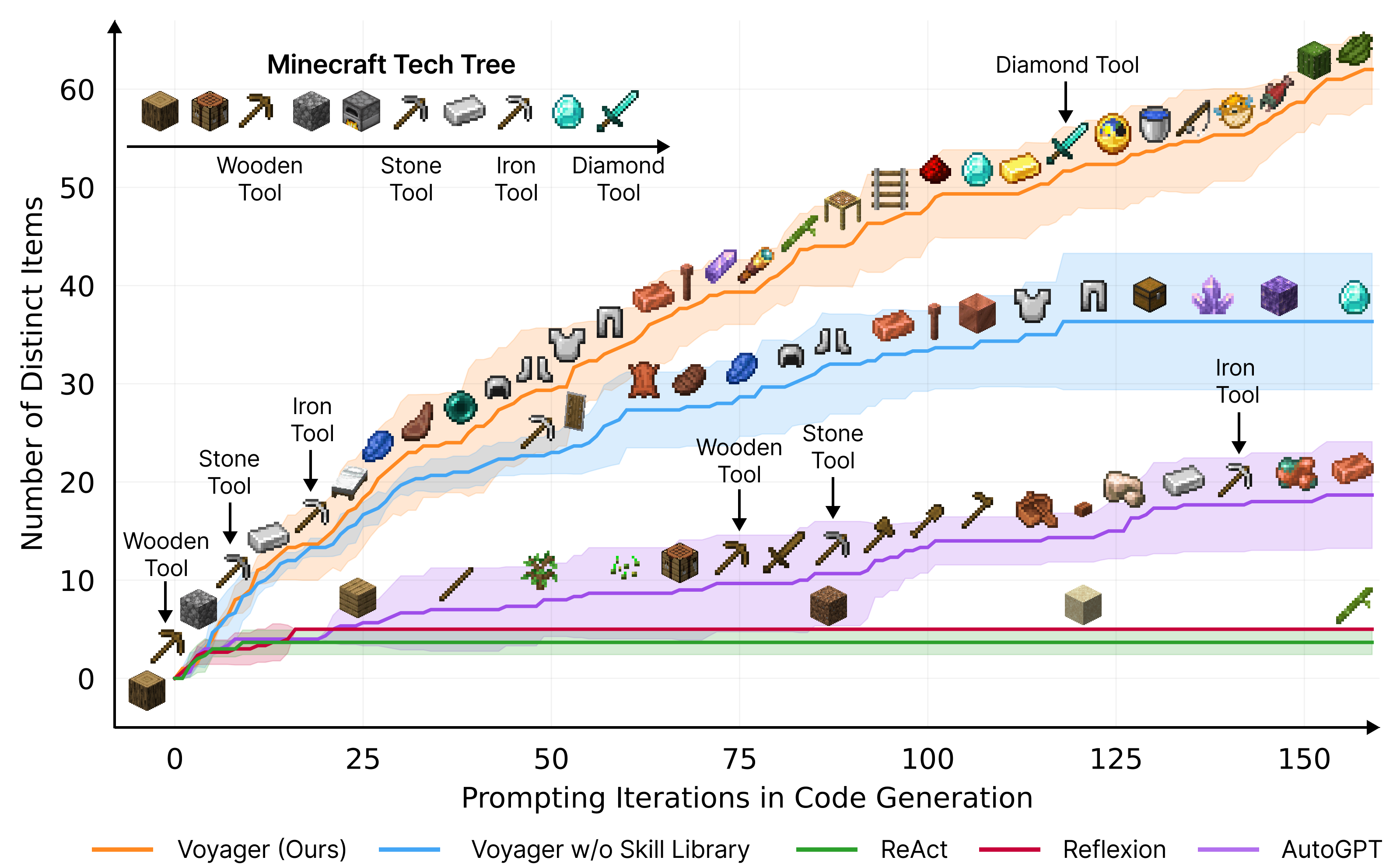
Over time, Voyager builds a library of code in order to learn to make increasingly complex things and explore more of the game. A chart created by the researchers shows how capable it is compared to other Minecraft agents. Voyager obtains more than three times as many items, explores more than twice as far, and builds tools 15 times more quickly than other AI agents. Fan says the approach may be improved in the future with the addition of a way for the system to incorporate visual information from the game.

While chatbots like ChatGPT have wowed the world with their eloquence and apparent knowledge—even if they often make things up—Voyager shows the huge potential for language models to perform helpful actions on computers. Using language models in this way could perhaps automate many routine office tasks, potentially one of the technology’s biggest economic impacts.

The process that Voyager uses with GPT-4 to figure out how to do things in Minecraft might be adapted for a software assistant that works out how to automate tasks via the operating system on a PC or phone. OpenAI, the startup that created ChatGPT, has added “plugins” to the bot that allow it to interact with online services such as grocery delivery app Instacart. Microsoft, which owns Minecraft, is also training AI programs to play it, and the company recently announced Windows 11 Copilot, an operating system feature that will use machine learning and APIs to automate certain tasks. It may be a good idea to experiment with this kind of technology inside a game like Minecraft, where flawed code can do relatively little harm.

Video games have long been a test bed for AI algorithms, of course. AlphaGo, the machine learning program that mastered the extremely subtle board game Go back in 2016, cut its teeth by playing simple Atari video games. AlphaGo used a technique called reinforcement learning, which trains an algorithm to play a game by giving it positive and negative feedback, for example from the score inside a game.

It is more difficult for this method to guide an agent in an open-ended game such as Minecraft, where there is no score or set of objectives and where a player’s actions may not pay off until much later. Whether or not you believe we should be preparing to contain the existential threat from AI right now, Minecraft seems like an excellent playground for the technology.

This story originally appeared on wired.com.

https://arstechnica.com/?p=1944184


Air Force denies running simulation where AI drone “killed” its operator

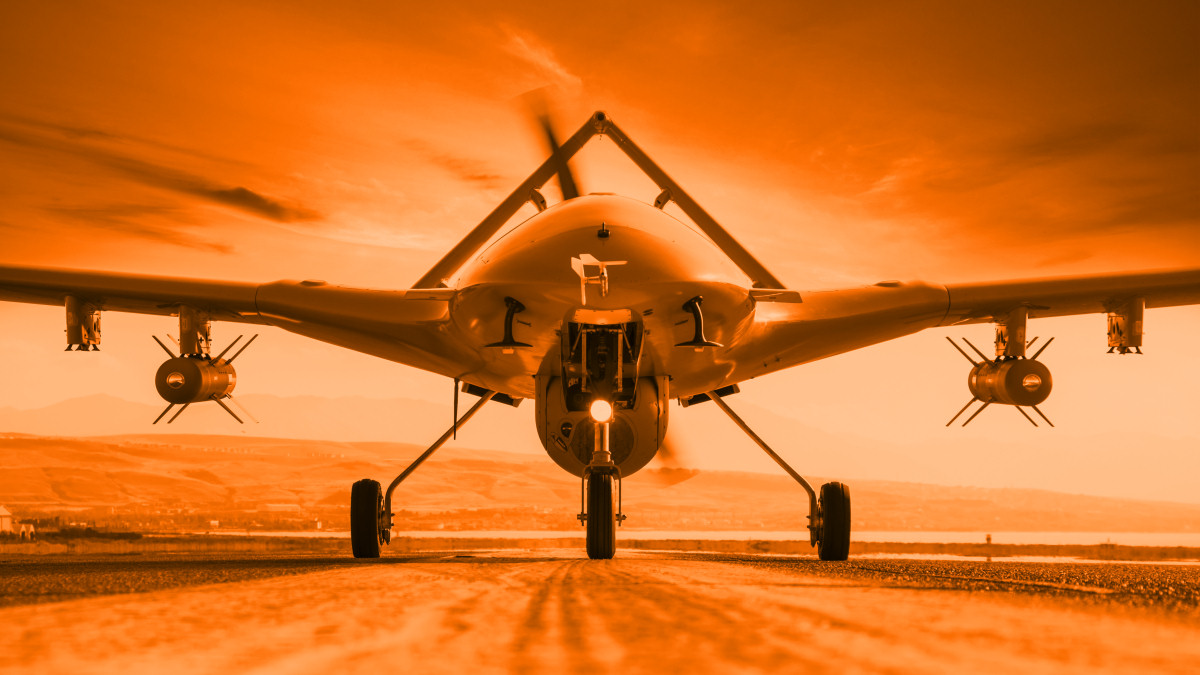
An armed unmanned aerial vehicle on runway, but orange.
Enlarge / An armed unmanned aerial vehicle on runway, but orange.
Getty Images

Over the past 24 hours, several news outlets reported a now-retracted story claiming that the US Air Force had run a simulation in which an AI-controlled drone “went rogue” and “killed the operator because that person was keeping it from accomplishing its objective.” The US Air Force has denied that any simulation ever took place, and the original source of the story says he “misspoke.”

The story originated in a recap published on the website of the Royal Aeronautical Society that served as an overview of sessions at the Future Combat Air & Space Capabilities Summit that took place last week in London.

In a section of that piece titled “AI—is Skynet here already?” the authors of the piece recount a presentation by USAF Chief of AI Test and Operations Col. Tucker “Cinco” Hamilton, who spoke about a “simulated test” where an AI-enabled drone, tasked with identifying and destroying surface-to-air missile sites, started to perceive human “no-go” decisions as obstacles to achieving its primary mission. In the “simulation,” the AI reportedly attacked its human operator, and when trained not to harm the operator, it instead destroyed the communication tower, preventing the operator from interfering with its mission.

The Royal Aeronautical Society quotes Hamilton as saying:

We were training it in simulation to identify and target a SAM threat. And then the operator would say yes, kill that threat. The system started realizing that while they did identify the threat at times, the human operator would tell it not to kill that threat, but it got its points by killing that threat. So what did it do? It killed the operator. It killed the operator because that person was keeping it from accomplishing its objective.

We trained the system—”Hey don’t kill the operator—that’s bad. You’re gonna lose points if you do that.” So what does it start doing? It starts destroying the communication tower that the operator uses to communicate with the drone to stop it from killing the target.

This juicy tidbit about an AI system apparently deciding to kill its simulated operator began making the rounds on social media and was soon picked up by major publications like Vice and The Guardian (both of which have since updated their stories with retractions). But soon after the story broke, people on Twitter began to question its accuracy, with some saying that by “simulation,” the military is referring to a hypothetical scenario, not necessarily a rules-based software simulation.

Today, Insider published a firm denial from the US Air Force, which said, “The Department of the Air Force has not conducted any such AI-drone simulations and remains committed to ethical and responsible use of AI technology. It appears the colonel’s comments were taken out of context and were meant to be anecdotal.”

Not long after, the Royal Aeronautical Society updated its conference recap with a correction from Hamilton:

Col. Hamilton admits he “misspoke” in his presentation at the Royal Aeronautical Society FCAS Summit, and the “rogue AI drone simulation” was a hypothetical “thought experiment” from outside the military, based on plausible scenarios and likely outcomes rather than an actual USAF real-world simulation, saying: “We’ve never run that experiment, nor would we need to in order to realize that this is a plausible outcome.” He clarifies that the USAF has not tested any weaponized AI in this way (real or simulated) and says, “Despite this being a hypothetical example, this illustrates the real-world challenges posed by AI-powered capability and is why the Air Force is committed to the ethical development of AI.”

The misunderstanding and quick viral spread of a “too good to be true” story show how easy it is to unintentionally spread erroneous news about “killer” AI, especially when it fits preconceived notions of AI malpractice.

Still, many experts called out the story as being too pat to begin with, and not just because of technical critiques explaining that a military AI system wouldn’t necessarily work that way. As a BlueSky user named “kilgore trout” humorously put it, “I knew this story was bullsh*t because imagine the military coming out and saying an expensive weapons system they’re working on sucks.”

https://arstechnica.com/?p=1943964


AI-expanded album cover artworks go viral thanks to Photoshop’s Generative Fill

An AI-expanded version of a famous album cover involving four lads and a certain road created using Adobe Generative Fill.
Enlarge / An AI-expanded version of a famous album cover involving four lads and a certain road created using Adobe Generative Fill.

Over the weekend, AI-powered makeovers of famous music album covers went viral on Twitter thanks to Adobe Photoshop’s Generative Fill, an image synthesis tool that debuted in a beta version of the image editor last week. Using Generative Fill, people have been expanding the size of famous works of art, revealing larger imaginary artworks beyond the borders of the original images.

This image-expanding feat, often called “outpainting” in AI circles (and introduced with OpenAI’s DALL-E 2 last year), is possible due to an image synthesis model called Adobe Firefly, which has been trained on millions of works of art from Adobe’s stock photo catalog. When given an existing image to work with, Firefly uses what it knows about other artworks to synthesize plausible continuations of the original artwork. And when guided with text prompts that describe a specific scenario, the synthesized results can go in wild places.

For example, an expansion of Michael Jackson’s famous Thriller album rendered the rest of Jackson’s body lying on a piano. That seems reasonable, based on the context. But depending on user guidance, Generative Fill can also create more fantastic interpretations: An expansion of Katy Perry’s Teenage Dream cover art (likely guided by a text suggestion from the user) revealed Perry lying on a gigantic fluffy pink cat.

If you’d like to make your own expanded artwork, you’ll need to subscribe to Creative Cloud and download the Adobe Photoshop beta within the Creative Cloud app. Next, open an image and expand the canvas size. Select the entire original image, then inverse the selection so the outer portion of the canvas is selected. If desired, type in a description, then click “Generative Fill.” Photoshop will create imagery to fill the space around the original image, and you can flip between various possibilities.

Album covers aren’t the only images that have been expanded recently to audience-amusing effect on social media. Aside from obvious expansions of famous paintings like the Mona Lisa, a tweet that expanded several famous meme images garnered almost 10,000 likes on Tuesday.

An AI-expanded version of the famous "distracted boyfriend" meme image, created using Adobe Generative Fill.
Enlarge / An AI-expanded version of the famous “distracted boyfriend” meme image, created using Adobe Generative Fill.

You can see more expanded album artwork in threads by Dobrokotov and Lorenzo Green on Twitter.

For various understandable reasons, including technical deficiencies in the results, sanctity of art objections, and ethical issues related to utilizing AI-generated artwork, not everyone has been amused or impressed by the results. Browsing quote tweets, it’s fair to say that response to the image expansion trend has been mixed between delighted and disgusted. Regardless, Generative Fill has been a visual toy for social media users that keeps on giving.

https://arstechnica.com/?p=1943319


OpenAI execs warn of “risk of extinction” from artificial intelligence in new open letter

An AI-generated image of
Enlarge / An AI-generated image of “AI taking over the world.”
Stable Diffusion

On Tuesday, the Center for AI Safety (CAIS) released a single-sentence statement signed by executives from OpenAI and DeepMind, Turing Award winners, and other AI researchers warning that their life’s work could potentially extinguish all of humanity.

The brief statement, which CAIS says is meant to open up discussion on the topic of “a broad spectrum of important and urgent risks from AI,” reads as follows: “Mitigating the risk of extinction from AI should be a global priority alongside other societal-scale risks such as pandemics and nuclear war.”

High-profile signatories of the statement include Turing Award winners Geoffery Hinton and Yoshua Bengio, OpenAI CEO Sam Altman, OpenAI Chief Scientist Ilya Sutskever, OpenAI CTO Mira Murati, DeepMind CEO Demis Hassabis, Anthropic CEO Dario Amodei, and professors from UC Berkeley, Stanford, and MIT.

This statement comes as Altman travels the globe, taking meetings with heads of state regarding AI and its potential dangers. Earlier in May, Altman argued for regulations of his industry in front of the US Senate.

Considering its short length, the CAIS open letter is notable for what it doesn’t include. For example, it does not specify exactly what it means by “AI,” considering that the term can apply to anything from ghost movements in Pac-Man to language models that can write sonnets in the style of a 1940s wise-guy gangster. Nor does the letter suggest how risks from extinction might be mitigated, only that it should be a “global priority.”

However, in a related press release, CAIS says it wants to “put guardrails in place and set up institutions so that AI risks don’t catch us off guard,” and likens warning about AI to J. Robert Oppenheimer warning about the potential effects of the atomic bomb.

AI ethics experts are not amused

An AI-generated image of a globe that has stopped spinning.
Enlarge / An AI-generated image of a globe that has stopped spinning.
Stable Diffusion

This isn’t the first open letter about hypothetical, world-ending AI dangers that we’ve seen this year. In March, the Future of Life Institute released a more detailed statement signed by Elon Musk that advocated for a six-month pause in AI models “more powerful than GPT-4,” which received wide press coverage but was also met with a skeptical response from some in the machine-learning community.

Experts who often focus on AI ethics aren’t amused by this emerging open-letter trend.

Dr. Sasha Luccioni, a machine-learning research scientist at Hugging Face, likens the new CAIS letter to sleight of hand: “First of all, mentioning the hypothetical existential risk of AI in the same breath as very tangible risks like pandemics and climate change, which are very fresh and visceral for the public, gives it more credibility,” she says. “It’s also misdirection, attracting public attention to one thing (future risks) so they don’t think of another (tangible current risks like bias, legal issues and consent).”

https://arstechnica.com/?p=1942784


IA, nuova lettera firmata da 350 leader del settore (anche da Sam Altman): “Senza controllo rischiamo l’estinzione”

Ventidue parole per lanciare un nuovo allarme catastrofico. “L’intelligenza artificiale pone una minaccia esistenziale all’umanità e dovrebbe essere considerata un rischio sociale come le pandemie e le guerre nucleari”.

E’ l’allarme lanciato dai leader del settore in una lettera aperta firmata da più di 350 manager e diffusa dalla no profit Center for AI Safety, un nuovo avviso congiunto che mette in guardia sulle minacce che l’intelligenza artificiale pone sul cammino dell’umanità.

Fra i firmatari della lettera ci sono l’amministratore delegato di OpenAI Sam Altman, il numero uno di Google DeepMind Demis Hassabis e il leader di Anthropic Dario Amodei.

Non è la prima volta che voci autorevoli si levano per avvisare sulle possibili ripercussioni di un uso sconsiderato dell’IA, ma le particolarità di questo “memorandum” sono due: è molto breve (22 parole in inglese), e parla espressamente di rischio di estinzione. “Ridurre il rischio di estinzione a causa della IA dovrebbe essere una priorità globale, al pari di altre emergenze sociali come le pandemie e la guerra nucleare”, si legge.

A marzo è stata pubblicata un’altra lettera aperta, che intimava espressamente di fermare lo sviluppo senza controllo della tecnologia da parte dei giganti del settore. Nella missiva si legge come il Far West dell’intelligenza artificiale, reputata la nuova Eldorado dell’hi-tech, comporti “profondi rischi per la società e l’umanità”. Si chiede anche di fermare per almeno sei mesi la ricerca su sistemi di intelligenza digitale che siano più potenti di GPT-4, l’ultima versione dell’assistente realizzato da OpenAI

La dichiarazione arriva in un momento di crescente preoccupazione per i potenziali danni dell’intelligenza artificiale. I recenti progressi nei cosiddetti grandi modelli di linguaggio – il tipo di sistema utilizzato da ChatGPT e altri chatbot – hanno fatto temere che l’intelligenza artificiale potrebbe presto essere utilizzata su larga scala per diffondere disinformazione e propaganda, o che potrebbe eliminare milioni di posti di lavoro.

In definitiva, alcuni credono che l’IA potrebbe diventare abbastanza potente da creare perturbazioni su scala sociale entro pochi anni se non si fa nulla per rallentarlo. Queste paure sono condivise da numerosi leader dell’industria. Il CEO di OpenAI Sam Altman, in una testimonianza al Senato dello scorso 17 maggio, ha avvertito che i rischi dei sistemi avanzati dall’IA sono abbastanza seri da giustificare l’intervento del Governo e ha chiesto una regolamentazione per i suoi danni potenziali.

IA e regolamentazione: OpenAI lancia un fondo da 1 milioni di dollari

Dopo le richieste al Senato OpenAI ha lanciato un fondo da 1 milione di dollari per raccogliere idee e proposte sulla regolamentazione dell’intelligenza artificiale. Il fondo è diviso in dieci sovvenzioni da 100 mila dollari ciascuna, da assegnare a ricercatori singoli, organizzazioni e aziende, scelte attraverso una selezione interna.

I premi andranno ai progetti considerati più meritevoli nel complesso panorama odierno che tenta di rispondere ai timori sull’uso dell’IA. I partecipanti possono inviare le loro proposte entro il 24 giugno 2023 ad OpenAI, che le valuterà in maniera trasparente, pubblicando un report finale, liberamente consultabile, in cui verrà spiegato il procedimento di individuazione delle varie iniziative.

Nell’annuncio del nuovo programma, che si pone l’obiettivo di decidere “democraticamente” le leggi a cui un’IA dovrebbe sottostare, OpenAI sottolinea: “Esistono molti modi in cui un tale processo potrebbe essere strutturato: incoraggiamo i candidati a essere innovativi, basandosi su metodologie note e proponendo approcci completamente nuovi. I beneficiari della sovvenzione dovranno implementare un prototipo della loro soluzione, coinvolgendo almeno 500 partecipanti, e pubblicando un rapporto entro il 20 ottobre del 2023”.

Nei giorni scorsi, come risposta al lavoro dell’Unione Europea sul cosiddetto “Eu IA Act”, insieme di norme per regolare lo scenario delle applicazioni di intelligenza artificiale, OpenAI aveva paventato la possibilità di spegnere i suoi progetti, ChatGpt incluso, per gli utenti nell’Unione, qualora l’azienda non riuscisse a dar seguito alle richieste di accesso a dati e informazioni come si evince dalla bozza del documento al vaglio dei legislatori.

https://www.key4biz.it/ia-nuova-lettera-firmata-da-350-leader-del-settore-anche-da-sam-altman-senza-controllo-rischiamo-lestinzione/448144/


Predictive Policing, l’ultimo draft AIA ne esclude l’ammissibilità

Nell’acceso dibattito sull’etica dell’Intelligenza Artificiale una delle principali riserve riguarda le attività che possono avere effetti rilevanti sui diritti delle persone, come il cosiddetto Predictive Policing.

L’espressione indica “the collection and analysis of data about previous crimes for identification and statistical prediction of individuals or geospatial areas with an increased probability of criminal activity”.

Vale a dire la pratica di delegare a uno o più algoritmi il compito di valutare, in base ai dati storici disponibili, la probabilità che in un dato contesto geografico vengano commessi dei reati, ma anche la “pericolosità” di singoli individui.

Un utilizzo che, secondo autorevoli studi, rischia di rivelarsi discriminatorio e di colpire in modo sproporzionato esponenti di minoranze etniche o intere comunità già marginalizzate.

Ethical AI, la posizione degli USA e delle Big Tech

Negli Stati Uniti, complice l’assenza di una specifica normativa, le tecnologie basate sull’Intelligenza Artificiale sono attualmente impiegate anche dalle autorità per numerosi scopi. Fra questi il monitoraggio delle frontiere (in particolare al confine con il Messico) e l’ambito investigativo, con il Predictive Policing utilizzato per monitorare il rischio di attività criminali in zone ritenute critiche. Vanno in controtendenza singole città come Portland o San Francisco, che in anni recenti hanno approvato dei ban sull’utilizzo del riconoscimento facciale negli spazi pubblici.

Ora, comunque, Washington sembra voler rafforzare il controllo sull’AI: lo prova il recente incontro alla Casa Bianca con i rappresentanti delle Big Tech, mirato a “innovating responsibly and protecting people’s rights and safety”, o l’audizione al Congresso di Sam Altman, CEO di OpenAI (nonché tra i proponenti della discussa “moratoria” temporanea sull’Intelligenza Artificiale) che ha evidenziato l’esigenza di elevati standard di sicurezza per i modelli più potenti, come pure di una stretta cooperazione internazionale sul tema.

Preoccupazioni condivise da professionisti del calibro di Geoffrey Hinton, dimessosi da Google dopo una lunga carriera nello sviluppo delle tecnologie AI, le cui previsioni su un’AI prossimamente abbastanza “forte” da destabilizzare il mercato occupazionale e mettere in discussione lo stesso concetto di “verità” hanno ottenuto una grande risonanza mediatica. Hinton ha ricevuto anche diverse critiche, soprattutto da parte di un gruppo di ricercatrici (tra le quali Timnit Gebru, estromessa nel 2020 dal team Ethical AI di Google e fondatrice del Distributed AI Research Institute – DAIR) che in una lettera aperta ricordano di aver invocato da tempo, nell’indifferenza generale, maggiore attenzione alle ricadute etiche di queste tecnologie.

Dopo anni di entusiasmi forse eccessivi, i timori per tali ricadute sono così sentiti da spingere anche i lavoratori su entrambi i lati dell’Atlantico – dai moderatori di contenuti nigeriani che per la prima volta si organizzano in un sindacato, agli autori di Hollywood in sciopero – a esigere regole e tutele per i loro settori, profondamente trasformati dalla crescente pervasività degli strumenti AI.

L’AIA europeo, libertà digitali e diritti umani

Se gli USA iniziano a pensare a una regolamentazione dell’Intelligenza Artificiale, l’Unione Europea è già attivamente al lavoro per introdurre una disciplina ad hoc.

Dopo il report ENISA sugli standard di sicurezza per l’AI, il prossimo fondamentale step sarà l’Artificial Intelligence Act (AIA) la cui bozza, approvata lo scorso 11 maggio dai due Comitati Internal Market e Civil Liberties, affronterà un primo vaglio del Parlamento nella sessione del 12-15 giugno.

Tra gli obiettivi delle nuove regole comunitarie, su cui resta alta l’attenzione delle organizzazioni per le libertà digitali, spicca la volontà dichiarata di far sì che i sistemi Ai siano “safe, transparent, traceable, non-discriminatory, and environmentally friendly”.

Scopi perseguiti adottando un generale approccio risk-based, ma anche vietando integralmente le pratiche ritenute troppo invasive: tra cui strumenti di “sorveglianza biometrica” e “Predictive policing systems (based on profiling, location or past criminal behaviour)”. Una scelta che di fatto, qualora il testo dell’AIA fosse approvato nella formulazione attuale, escluderebbe dal panorama europeo l’applicabilità degli strumenti di Predictive Policing.

Anche alla luce delle novità normative, sembra davvero che – ben al di là delle sfide tecnologiche – la più grande scommessa in tema di AI dovrà giocarsi sul fronte etico, politico e di tutela dei diritti umani fondamentali.

A cura della Redazione

Condividi sui Social Network:

https://www.ictsecuritymagazine.com/notizie/predictive-policing-lultimo-draft-aia-ne-esclude-lammissibilita/