AI writing assistants can cause biased thinking in their users

AI ethics or AI Law concept. Developing AI codes of ethics. Compliance, regulation, standard , business policy and responsibility for guarding against unintended bias in machine learning algorithms.
Parradee Kietsirikul

Anyone who has had to go back and retype a word on their smartphone because autocorrect chose the wrong one has had some kind of experience writing with AI. Failure to make these corrections can allow AI to say things we didn’t intend. But is it also possible for AI writing assistants to change what we want to say?

This is what Maurice Jakesch, a doctoral student of information science at Cornell University, wanted to find out. He created his own AI writing assistant based on GPT-3, one that would automatically come up with suggestions for filling in sentences—but there was a catch. Subjects using the assistant were supposed to answer, “Is social media good for society?” The assistant, however, was programmed to offer biased suggestions for how to answer that question.

Assisting with bias

AI can be biased despite not being alive. Although these programs can only “think” to the degree that human brains figure out how to program them, their creators may end up embedding personal biases in the software. Alternatively, if trained on a data set with limited or biased representation, the final product may display biases.

Where an AI goes from there can be problematic. On a large scale, it can help perpetuate a society’s existing biases. On an individual level, it has the potential to influence people through latent persuasion, meaning the person may not be aware that they are being influenced by automated systems. Latent persuasion by AI programs has already been found to influence people’s opinions online. It can even have an impact on behavior in real life.

After seeing previous studies that suggested automated AI responses can have a significant influence, Jakesch set out to look into how extensive this influence can be. In a study recently presented at the 2023 CHI Conference on Human Factors in Computing Systems, he suggested that AI systems such as GPT-3 might have developed biases during their training and that this can impact the opinions of a writer, whether or not the writer realizes it.

“The lack of awareness of the models’ influence supports the idea that the model’s influence was not only through conscious processing of new information but also through the subconscious and intuitive processes,” he said in the study.

Past research has shown that the influence of an AI’s recommendations depends on people’s perception of that program. If they think it is trustworthy, they are more likely to go along with what it suggests, and the likelihood of taking advice from AIs like this only increases if uncertainty makes it more difficult to form an opinion. Jakesch developed a social media platform similar to Reddit and an AI writing assistant that was closer to the AI behind Google Smart Compose or Microsoft Outlook than it was to autocorrect. Both Smart Compose and Outlook generate automatic suggestions on how to continue or complete a sentence. While this assistant didn’t write the essay itself, it acted as a co-writer that suggested letters and phrases. Accepting a suggestion only required a click.

For some, the AI assistant was geared to suggest words that would ultimately result in positive responses. For others, it was biased against social media and pushed negative responses. (There was also a control group that did not use the AI at all.) It turned out that anyone who received AI assistance was twice as likely to go with the bias built into the AI, even if their initial opinion had been different. People who kept seeing techno-optimist language pop up on their screens were more likely to say that social media benefits society, while subjects who saw techno-pessimist language were more likely to argue the opposite.

https://arstechnica.com/?p=1942533


Among AI dangers, deepfakes worry Microsoft president most

An AI-generated image of a
Enlarge / An AI-generated image of a “wall of fake images.”
Stable Diffusion

On Thursday, Microsoft President Brad Smith announced that his biggest apprehension about AI revolves around the growing concern for deepfakes and synthetic media designed to deceive, Reuters reports.

Smith made his remarks while revealing his “blueprint for public governance of AI” in a speech at Planet World, a language arts museum in Washington, DC. His concerns come when talk of AI regulations is increasingly common, sparked largely by the popularity of OpenAI’s ChatGPT and a political tour by OpenAI CEO Sam Altman.

Smith expressed his desire for urgency in formulating ways to differentiate between genuine photos or videos and those created by AI when they might be used for illicit purposes, especially in enabling society-destabilizing disinformation.

“We’re going have to address the issues around deepfakes. We’re going to have to address in particular what we worry about most foreign cyber influence operations, the kinds of activities that are already taking place by the Russian government, the Chinese, the Iranians,” Smith said, according to Reuters. “We need to take steps to protect against the alteration of legitimate content with an intent to deceive or defraud people through the use of AI.”

Smith also pushed for the introduction of licensing for critical forms of AI, arguing that these licenses should carry obligations to protect against threats to security, whether physical, cybersecurity, or national. “We will need a new generation of export controls, at least the evolution of the export controls we have, to ensure that these models are not stolen or not used in ways that would violate the country’s export control requirements,” he said.

Last week, Altman appeared at the US Senate and voiced his concerns about AI, saying that the nascent industry needs to be regulated. Altman, whose company OpenAI is backed by Microsoft, argued for global cooperation on AI and incentives for safety compliance.

In his speech Thursday, Smith echoed these sentiments and insisted that people must be held accountable for the problems caused by AI. He urged for safety measures to be put on AI systems controlling critical infrastructure, like the electric grid and water supply, to ensure human oversight.

In an effort to maintain transparency around AI technologies, Smith urged that developers should develop a “know your customer”-style system to keep a close eye on how AI technologies are used and inform the public about content created by AI, making it easier to identify fabricated content. Along these lines, companies such as Adobe, Google, and Microsoft are all working on ways to watermark or otherwise label AI-generated content.

Deepfakes have been a subject of research at Microsoft for years now. In September, Microsoft’s Chief Scientific Officer Eric Horvitz penned a research paper about the dangers of both interactive deepfakes and the creation of synthetic histories, subjects also covered in a 2020 article in FastCompany by this author, which also mentioned earlier efforts from Microsoft at detecting deepfakes.

Meanwhile, Microsoft is simultaneously pushing to include text– and image-based generative AI technology into its products, including Office and Windows. Its rough launch of an unconditioned and undertested Bing chatbot (based on a version of GPT-4) in February spurred deeply emotional reactions from its users. It also reignited latent fears that world-dominating superintelligence may be just around the corner, a reaction that some critics claim is part of a conscious marketing campaign from AI vendors.

So the question remains: What does it mean when companies like Microsoft are selling the very product that they are warning us about?

https://arstechnica.com/?p=1942347


3 new ways generative AI can help you search3 new ways generative AI can help you searchProduct LeadEngineering Lead

Today, we’re starting to open up access to Search Labs, a new program to access early experiments from Google. If you’ve already signed up for the waitlist at labs.google.com/search, you’ll be notified by email when you can start testing Labs experiments, like SGE (Search Generative Experience), Code Tips and Add to Sheets in the U.S. And if you want to opt-in to these experiments, simply tap the Labs icon in the latest version of the Google app (Android and iOS) or on Chrome desktop to sign up. You can also visit the Labs site to check your waitlist status.

Once you’re in, the new generative AI powered Search experience will help you take some of the work out of searching, so you can understand a topic faster, uncover new viewpoints and insights and get things done more easily. So instead of asking a series of questions and piecing together that information yourself, Search now can do some of that heavy lifting for you.


The lightning onset of AI—what suddenly changed? An Ars Frontiers 2023 recap

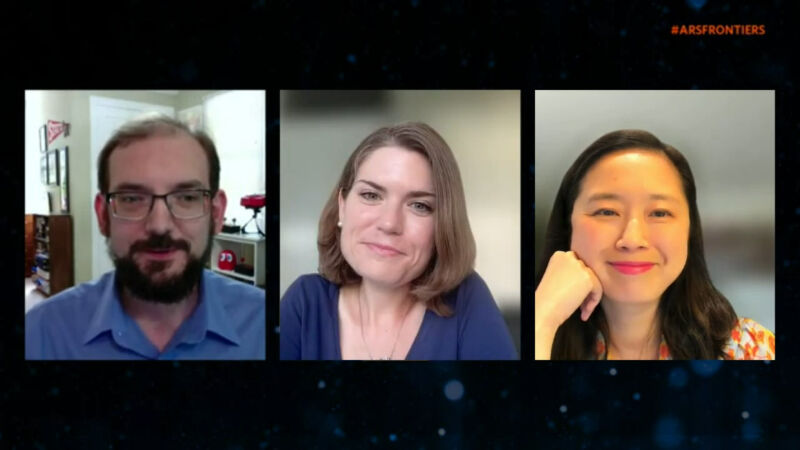
Benj Edwards (L) moderated a panel featuring Paige Bailey (C), Haiyan Zhang (R) for the Ars Frontiers 2023 session titled
Enlarge / On May 22, Benj Edwards (left) moderated a panel featuring Paige Bailey (center), Haiyan Zhang (right) for the Ars Frontiers 2023 session titled, “The Lightning Onset of AI — What Suddenly Changed?”
Ars Technica

On Monday, Ars Technica hosted our Ars Frontiers virtual conference. In our fifth panel, we covered “The Lightning Onset of AI—What Suddenly Changed?” The panel featured a conversation with Paige Bailey, lead product manager for Generative Models at Google DeepMind, and Haiyan Zhang, general manager of Gaming AI at Xbox, moderated by Ars Technica’s AI reporter, Benj Edwards.

The panel originally streamed live, and you can now watch a recording of the entire event on YouTube. The “Lightning AI” part introduction begins at the 2:26:05 mark in the broadcast.

[embedded content]
Ars Frontiers 2023 livestream recording.

With “AI” being a nebulous term, meaning different things in different contexts, we began the discussion by considering the definition of AI and what it means to the panelists. Bailey said, “I like to think of AI as helping derive patterns from data and use it to predict insights … it’s not anything more than just deriving insights from data and using it to make predictions and to make even more useful information.”

Zhang agreed, but from a video game angle, she also views AI as an evolving creative force. To her, AI is not just about analyzing, pattern-finding, and classifying data; it is also developing capabilities in creative language, image generation, and coding. Zhang believes this transformative power of AI can elevate and inspire human creativity, especially in video games, which she considers the apex of artistic expression.

Next, we dove into the main question of the panel: What has changed that’s led to this new era of AI? Is it all just hype, perhaps based on the high visibility of ChatGPT, or have there been some major tech breakthroughs that brought us this new wave?

Paige Bailey of Google during her Ars Frontiers 2023 panel on AI.
Enlarge / Paige Bailey of Google during her Ars Frontiers 2023 panel on AI.
Ars Technica

Zhang pointed to the developments in AI techniques and the vast amounts of data now available for training: “We’ve seen breakthroughs in the model architecture for transformer models, as well as the recursive autoencoder models, and also the availability of large sets of data to then train these models and couple that with thirdly, the availability of hardware such as GPUs, MPUs to be able to really take the models to take the data and to be able to train them in new capabilities of compute.”

Bailey echoed these sentiments, adding a notable mention of open-source contributions, “We also have this vibrant community of open source tinkerers that are open sourcing models, models like LLaMA, fine-tuning them with very high-quality instruction tuning and RLHF datasets.”

When asked to elaborate on the significance of open source collaborations in accelerating AI advancements, Bailey mentioned the widespread use of open-source training models like PyTorch, Jax, and TensorFlow. She also affirmed the importance of sharing best practices, stating, “I certainly do think that this machine learning community is only in existence because people are sharing their ideas, their insights, and their code.”

When asked about Google’s plans for open source models, Bailey pointed to existing Google Research resources on GitHub and emphasized their partnership with Hugging Face, an online AI community. “I don’t want to give away anything that might be coming down the pipe,” she said.

Generative AI on game consoles, AI risks

Haiyan Zhang of Microsoft during her Ars Frontiers 2023 panel on AI.
Enlarge / Haiyan Zhang of Microsoft during her Ars Frontiers 2023 panel on AI.
Ars Technica

As part of a conversation about advances in AI hardware, we asked Zhang how long it would be before generative AI models could run locally on consoles. She said she was excited about the prospect and noted that a dual cloud-client configuration may come first: “I do think it will be a combination of working on the AI to be inferencing in the cloud and working in collaboration with local inference for us to bring to life the best player experiences.”

Bailey pointed to the progress of shrinking Meta’s LLaMA language model to run on mobile devices, hinting that a similar path forward might open up the possibility of running AI models on game consoles as well: “I would love to have a hyper-personalized large language model running on a mobile device, or running on my own game console, that can perhaps make a boss that is particularly gnarly for me to beat, but that might be easier for somebody else to beat.”

To follow up, we asked if a generative AI model runs locally on a smartphone, will that cut Google out of the equation? “I do think that there’s probably space for a variety of options,” said Bailey. “I think there should be options available for all of these things to coexist meaningfully.”

In discussing the social risks from AI systems, such as misinformation and deepfakes, both panelists said their respective companies were committed to responsible and ethical AI use. “At Google, we care very deeply about making sure that the models that we produce are responsible and behave as ethically as possible. And we actually incorporate our responsible AI team from day zero, whenever we train models from curating our data, making sure that the right pre-training mix is created,” Bailey explained.

Despite her earlier enthusiasm for open source and locally run AI models, Baily mentioned that API-based AI models that only run in the cloud might be safer overall: “I do think that there is significant risk for models to be misused in the hands of people that might not necessarily understand or be mindful of the risk. And that’s also part of the reason why sometimes it helps to prefer APIs as opposed to open source models.”

Like Bailey, Zhang also discussed Microsoft’s corporate approach to responsible AI, but she also remarked about gaming-specific ethics challenges, such as making sure that AI features are inclusive and accessible.

https://arstechnica.com/?p=1941696


White House Unveils New Efforts to Guide Federal Research of AI

The White House on Tuesday announced new efforts to guide federally backed research on artificial intelligence as the Biden administration looks to get a firmer grip on understanding the risks and opportunities of the rapidly evolving technology.

Among the moves unveiled by the administration was a tweak to the United States’ strategic plan on artificial intelligence research, which was last updated in 2019, to add greater emphasis on international collaboration with allies.

White House officials on Tuesday were also hosting a listening session with workers on their firsthand experiences with employers’ use of automated technologies for surveillance, monitoring, evaluation, and management. And the U.S. Department of Education’s Office of Educational Technology issued a report focused on the risks and opportunities related to AI in education.

“The report recognizes that AI can enable new forms of interaction between educators and students, help educators address variability in learning, increase feedback loops, and support educators,” the White House said in a statement. “It also underscores the risks associated with AI — including algorithmic bias — and the importance of trust, safety, and appropriate guardrails.”

The U.S. government and private sector in recent months have begun more publicly weighing the possibilities and perils of artificial intelligence.

Tools like the popular AI chatbot ChatGPT have sparked a surge of commercial investment in other AI tools that can write convincingly human-like text and churn out new images, music and computer code. The ease with which AI technology can be used to mimic humans has also propelled governments around the world to consider how it could take away jobs, trick people and spread disinformation.

Last week, Senate Majority Leader Chuck Schumer said Congress “must move quickly” to regulate artificial intelligence. He has also convened a bipartisan group of senators to work on legislation.

Advertisement. Scroll to continue reading.

The latest efforts by the administration come after Vice President Kamala Harris met earlier this month with the heads of Google, Microsoft, ChatGPT-creator OpenAI and Anthropic. The administration also previously announced an investment of $140 million to establish seven new AI research institutes.

The White House Office of Science and Technology Policy on Tuesday also issued a new request for public input on national priorities “for mitigating AI risks, protecting individuals’ rights and safety, and harnessing AI to improve lives.”

Related: ChatGPT’s Chief Testifies Before Congress, Calls for New Agency to Regulate Artificial Intelligence

Related: White House Unveils Artificial Intelligence ‘Bill of Rights’

Related: In Global Rush to Regulate AI, Europe Set to Be Trailblazer

https://www.securityweek.com/white-house-unveils-new-efforts-to-guide-federal-research-of-ai/


Fake Pentagon “explosion” photo sows confusion on Twitter

A fake AI-generated image of an
Enlarge / A fake AI-generated image of an “explosion” near the Pentagon that went viral on Twitter.

On Monday, a tweeted AI-generated image suggesting a large explosion at the Pentagon led to brief confusion, which included a reported small drop in the stock market. It originated from a verified Twitter account named “Bloomberg Feed,” unaffiliated with the well-known Bloomberg media company, and was quickly exposed as a hoax. However, before it was debunked, large accounts such as Russia Today had already spread the misinformation,  The Washington Post reported.

The fake image depicted a large plume of black smoke alongside a building vaguely reminiscent of the Pentagon with the tweet “Large Explosion near The Pentagon Complex in Washington D.C. — Inital Report.” Upon closer inspection, local authorities confirmed that the image was not an accurate representation of the Pentagon. Also, with blurry fence bars and building columns, it looks like a fairly sloppy AI-generated image created by a model like Stable Diffusion.

Before Twitter suspended the false Bloomberg account, it had tweeted 224,000 times and reached fewer than 1,000 followers, according to the Post, but it’s unclear who ran it or the motives behind sharing the false image. In addition to Bloomberg Feed, other accounts that shared the false report include “Walter Bloomberg” and “Breaking Market News,” both unaffiliated with the real Bloomberg organization.

This incident underlines the potential threats AI-generated images may present in the realm of hastily shared social media—and a paid verification system on Twitter. In March, fake images of Donald Trump’s arrest created with Midjourney reached a wide audience. While clearly marked as fake, they sparked fears of mistaking them for real photos due to their realism. That same month, AI-generated images of Pope Francis in a white coat fooled many who saw them on social media.

A screenshot of the "Bloomberg Feed" tweet about the reported explosion near the Pentagon that was later confirmed to be fake.
Enlarge / A screenshot of the “Bloomberg Feed” tweet about the reported explosion near the Pentagon that was later confirmed to be fake.

The pope in puffy coats is one thing, but when someone features a government subject like the headquarters of the United States Department of Defense in a fake tweet, the consequences could potentially be more severe. Aside from general confusion on Twitter, the deceptive tweet may have affected the stock market. The Washington Post says that the Dow Jones Industrial Index dropped 85 points in four minutes after the tweet spread but rebounded quickly.

Much of the confusion over the false tweet may have been made possible by changes at Twitter under its new owner, Elon Musk. Musk fired content moderation teams shortly after his takeover and largely automated the account verification process, transitioning it to a system where anyone can pay to have a blue check mark. Critics argue that practice makes the platform more susceptible to misinformation.

While authorities easily picked out the explosion photo as a fake due to inaccuracies, the presence of image synthesis models like Midjourney and Stable Diffusion means it no longer takes artistic skill to create convincing fakes, lowering the barriers to entry and opening the door to potentially automated misinformation machines. The ease of creating fakes, coupled with the viral nature of a platform like Twitter, means that false information can spread faster than it can be fact-checked.

But in this case, the image did not need to be high quality to make an impact. Sam Gregory, the executive director of the human rights organization Witness, pointed out to The Washington Post that when people want to believe, they let down their guard and fail to look into the veracity of the information before sharing it. He described the false Pentagon image as a “shallow fake” (as opposed to a more convincing “deepfake“).

“The way people are exposed to these shallow fakes, it doesn’t require something to look exactly like something else for it to get attention,” he said. “People will readily take and share things that don’t look exactly right but feel right.”

https://arstechnica.com/?p=1941475


Adobe Photoshop’s new “Generative Fill” AI tool lets you manipulate photos with text

An example of a 1983 file photo of the Apple Lisa computer that has been significantly enhanced by Generative Fill in the Adobe Photoshop beta.
Enlarge / An example of a 1983 file photo of the Apple Lisa computer that has been significantly enhanced by the new “Generative Fill” AI tool in the Adobe Photoshop beta.
Apple / Benj Edwards / Adobe

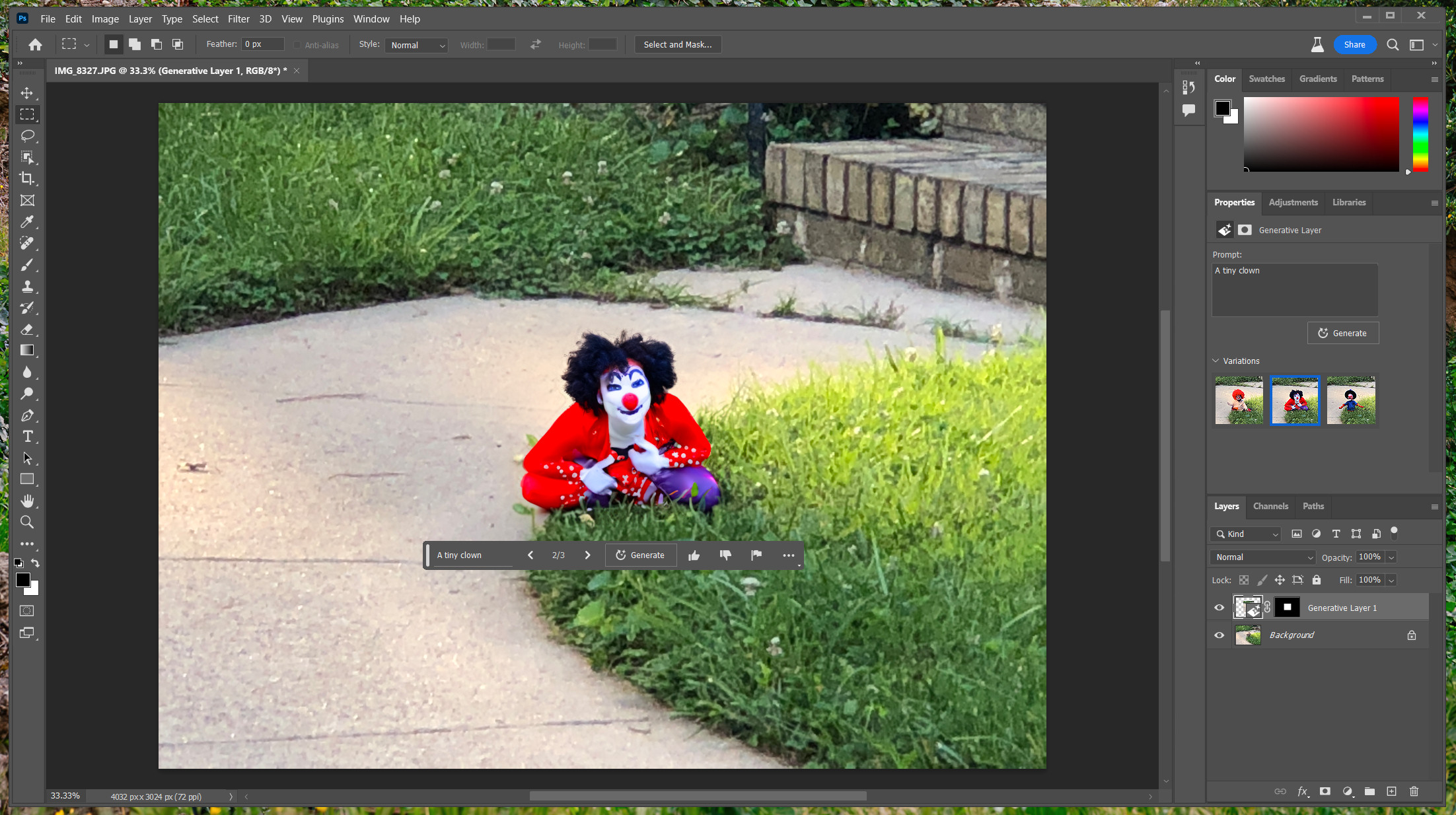
On Tuesday, Adobe added a new tool to its Photoshop beta called “Generative Fill,” which uses cloud-based image synthesis to fill selected areas of an image with new AI-generated content based on a text description. Powered by Adobe Firefly, Generative Fill works similarly to a technique called “inpainting” used in DALL-E and Stable Diffusion releases since last year.

At the core of Generative Fill is Adobe Firefly, which is Adobe’s custom image-synthesis model. As a deep learning AI model, Firefly has been trained on millions of images in Adobe’s stock library to associate certain imagery with text descriptions of them. Now part of Photoshop, people can type in what they want to see (i.e., “a clown on a computer monitor”), and Firefly will synthesize several options for the user to choose from. Generative Fill uses a well-known AI technique called “inpainting” to create a context-aware generation that can seamlessly blend synthesized imagery into an existing image.

To use Generative Fill, users select an area of an existing image they want to modify. After selecting it, a “Contextual Task Bar” pops up that allows users to type in a description of what they want to see generated in the selected area. Photoshop sends this data to Adobe’s servers for processing, then returns results in the app. After generating, the user has the option to select between several options of generations or to create more options to browse through.

When used, the Generative Fill tool creates a new “Generative Layer,” allowing for non-destructive alterations of image content, such as additions, extensions, or removals, driven by these text prompts. It automatically adjusts to the perspective, lighting, and style of the selected image.

Generative Fill isn’t the only AI-powered feature added to the Photoshop beta. Firefly has also enabled Photoshop to remove parts of an image entirely, erase objects from a scene, or extend the dimensions of an image by generating new content that surrounds the existing image, an AI technique known as “outpainting.”

These features have been available in OpenAI’s DALL-E 2 image generator and editor since August of last year (and in various homebrew releases of Stable Diffusion since around the same time), so Adobe is just now catching up to adding them to its flagship image editor. Admittedly, it’s a fast turnaround for a company that might have a huge liability target painted on its back when it comes to issues of harmful or socially stigmatized content generation, utilizing artists’ images for training data, and powering propaganda or disinformation.

An example of the complete Generative Fill interface in the Adobe Photoshop beta.
Enlarge / An example of the complete Generative Fill interface in the Adobe Photoshop beta.
Benj Edwards

Along those lines, Adobe not only blocks certain copyrighted, violent, and sexual keywords from generating but also relies on terms of use that restrict people from generating “abusive, illegal, or confidential” content.

Also, with Generative Fill’s ability to easily warp the apparent media reality of a photo (admittedly, something Photoshop has been doing since its inception), Adobe is doubling down on its Content Authenticity Initiative, which uses Content Credentials to add metadata to generated files that help track their provenance.

Generative Fill in the Photoshop beta app is currently available to all Creative Cloud members with a Photoshop subscription or trial through the “Beta apps” section of the Creative Cloud app. It is not yet available for commercial use, not accessible to individuals under 18, not available in China, and currently supports English-only text prompts. Adobe plans to make Generative Fill available to all Photoshop customers by the end of the year so that anyone can make yard clowns with ease.

If you aren’t a Creative Cloud subscriber, you can also try Generative Fill for free on the Adobe Firefly website with an Adobe login through a web-based tool. Adobe recently removed the waitlist from its Firefly beta.

https://arstechnica.com/?p=1941261


Built-in ChatGPT-driven Copilot will transform Windows 11 starting in June

Windows Copilot is an AI-assisted feature coming to Windows 11 preview builds starting in June.
Enlarge / Windows Copilot is an AI-assisted feature coming to Windows 11 preview builds starting in June.

A couple of months ago, Microsoft added generative AI features to Windows 11 in the form of a taskbar-mounted version of the Bing chatbot. Starting this summer, the company will be going even further, adding a new ChatGPT-driven Copilot feature that can be used alongside your other Windows apps. The company announced the change at its Build developer conference alongside another new batch of Windows 11 updates due later this year. Windows Copilot will be available to Windows Insiders starting in June.

Like the Microsoft 365 Copilot, Windows Copilot is a separate window that opens up along the right side of your screen and assists with various tasks based on what you ask it to do. A Microsoft demo video shows Copilot changing Windows settings, rearranging windows with Snap Layouts, summarizing and rewriting documents that were dragged into it, and opening apps like Spotify, Adobe Express, and Teams. Copilot is launched with a dedicated button on the taskbar.

“Once open, the Windows Copilot side bar stays consistent across your apps, programs and windows, always available to act as your personal assistant. It makes every user a power user, helping you take action, customize your settings, and seamlessly connect across your favorite apps,” wrote Microsoft Chief Product Officer Panos Panay.

Microsoft didn’t talk about the privacy and security considerations of Windows Copilot—whether users can expect the contents of their documents to be kept private, what processing is happening locally on your device versus on Microsoft’s servers, and whether chat history and contextual information will be saved between sessions or even synced between computers. We’ll presumably learn more about this as the feature gets closer to launching.

Whatever you think of Microsoft’s relentless push into AI this year, it has been fascinating to watch Windows 11 evolve from “Windows 10 but nicer looking” to an OS with baked-in AI features in the space of a year. In the days of Windows 7 and Windows 8, it took Microsoft much longer to shift gears and respond to new developments. Whether that’s a good thing depends on your perspective—millions of Windows 11 users will be offered generative AI assistance whether they want it or not—but it’s a very different approach to Windows than the one Microsoft used a decade ago.

Other new Windows 11 features

The Microsoft Store's AI Hub.
The Microsoft Store’s AI Hub.

Copilot is the flagship feature of this batch of Windows 11 updates, but it’s not the only way Microsoft has found to insert AI into Windows 11. The Microsoft Store will get a new “AI Hub” section, a top-level navigation option alongside the buttons for apps, movies and TV, and gaming categories. The AI Hub will offer generative AI apps for text, images, and more, and the store will also be able to create AI-generated summaries of all the reviews on a given app. These features are coming “soon.”

A few features are arriving even sooner than soon. Among the features that Microsoft VP Aaron Woodman says will be launching “tomorrow” is a new setting to enable and disable presence-sensing features, in addition to related features like wake-on-approach; a new shield icon that will appear over your Wi-Fi icon in the taskbar when you’re “connected to a recognized VPN”; live audio captions for 10 additional languages; and a tweaked design for the Widgets area. At some point in the future, Windows devices with compatible hardware will also gain support for Bluetooth Low-Energy Audio.

Since Build is a developer conference, there were also features announced specifically for developers. Dev Home is a new app that facilitates quick setup for new development PCs, providing the ability to sign into GitHub, automatically clone repositories, install apps, monitor system performance, and set up ReFS-based “Dev Drives” on local storage that “improve performance for key developer workloads.”

What we still haven’t heard much about is the Windows 11 23H2 update, which should theoretically be the operating system’s next major yearly feature update. By this time last year, the foundation of the Windows 11 22H2 update was finished and available to Windows Insiders for testing, but all of the current Windows Insider builds are still using 22H2 version numbering.

Microsoft has de-emphasized these yearly updates over Windows 11’s lifecycle, shifting instead to releasing a steady drip of features that come out whenever they’re ready. It may be that the 23H2 update is even smaller in scale than the 22H2 update was, and it may have less development lead time. The company could also change its update strategy again and move away from these yearly version changes; Microsoft has already announced the end of yearly feature updates for Windows 10.

Listing image by Microsoft

https://arstechnica.com/?p=1941293


A. Ghiglia (Garante Privacy): “A breve un’indagine conoscitiva sull’IA generativa”

“Abbiamo in programma di avviare una indagine conoscitiva ad ampio raggio delle applicazioni di IA generativa e di apprendimento automatico disponibili online, perché vogliamo capire se questi nuovi strumenti si stiano rendendo conformi alla normativa sulla protezione dei dati, e se necessario faremo partire nuove istruttorie”.

Lo ha annunciato ieri a Reuters Agostino Ghiglia, uno dei quattro membri del collegio del Garante per la Protezione dei Dati Personali. L’autorità punta dunque ad avviare un’indagine conoscitiva ad ampio spettro su altre piattaforme d’intelligenza artificiale che potrebbero dare origine a nuove istruttorie e provvedimenti restrittivi dopo il blocco temporaneo di ChatGPT.

Il componente ha annunciato inoltre che a breve l’autorità lancerà un bando per arruolare tre esperti di intelligenza artificiale che aiuteranno il Garante nel proprio lavoro. “Stiamo cercando tre consulenti esperti di intelligenza artificiale perché siamo consapevoli che questi strumenti si evolvono molto rapidamente e abbiamo bisogno di esperti con un background tecnologico affinché ci aiutino nella nostra attività di protezione dei dati”, ha affermato Ghiglia.

Il Garante Privacy prima autorità al mondo a bloccare ChatGPT

Lo scorso marzo il Garante ha temporaneamente bloccato l’uso di ChatGPT, il chatbot di OpenAI, avviando un’indagine sulla presunta violazione delle norme sulla privacy da parte dell’applicazione.

Secondo l’Autorità, ChatGPT non rispettava alcune norme del GDPR, in particolare di quelle che tutelano i minorenni e concedono agli individui il diritto di opporsi all’uso dei propri dati personali e di chiederne l’eliminazione.

Dopo l’intervento del Garante, OpenAI ha apportato modifiche al suo chatbot perché ritornasse conforme alla normativa. Una riapertura con riserva, in attesa che un nuovo sistema di age verification affidabile venga messo a punto nelle prossime settimane. Ad ogni modo, un prima fase di aggiustamenti da parte della piattaforma si è chiusa entro il 30 aprile, mentre la seconda fase è fissata entro il 30 settembre. Per allora, quindi, anche il tema della age verification sarà affrontato. Nel frattempo basterà autocertificare la maggiore età con un semplice click.

IA: servono regole, ma ci vorrà ancora tempo

Il successo di ChatGPT ha spinto le Big Tech, da Alphabet a Meta, a promuovere le proprie versioni, e i legislatori e i governi di tutto il mondo stanno discutendo nuove leggi in materia, la cui attuazione potrebbe richiedere anni. Al momento le autorità di regolamentazione si stanno affidando alle leggi esistenti per tenere sotto controllo una tecnologia che potrebbe stravolgere il modo di operare di società e le imprese.

L’Unione Europea è intanto a lavoro nel mettere in atto una legislazione storica e la prima al mondo sul governare l’intelligenza artificiale. Con specifici casi in cui vietare l’IA. L’11 maggio è stato dato il via libera – con 84 voti a favore, 7 contrari e 12 astensioni – dalle commissioni per il Mercato interno (Libe) e Giustizia (Libe) del Parlamento Ue al mandato negoziale sul regolamento sull’Intelligenza artificiale, il cosiddetto Artificial Intelligence Act, proposto dalla Commissione Ue ad aprile 2021. Prima che possano iniziare i negoziati con il Consiglio Ue sulla forma finale della legge, il mandato negoziale deve ora essere approvato dall’intero Parlamento, con il voto previsto durante la sessione del 12-15 giugno. Mentre l’approvazione finale del Regolamento è prevista per i primi mesi del 2024, ma la sua piena applicazione in tutti gli Stati dell’Ue richiederà tempo.

[embedded content]

https://www.key4biz.it/a-ghiglia-garante-privacy-a-breve-unindagine-conoscitiva-sullia-generativa/447190/


When it comes to advanced math, ChatGPT is no star student

Image of a student standing before a whiteboard filled with equations.

While learning high-level mathematics is no easy feat, teaching math concepts can often be just as tricky. That may be why many teachers are turning to ChatGPT for help. According to a recent Forbes article, 51 percent of teachers surveyed stated that they had used ChatGPT to help teach, with 10 percent using it daily. ChatGPT can help relay technical information in more basic terms, but it may not always provide the correct solution, especially for upper-level math.

An international team of researchers tested what the software could manage by providing the generative AI program with challenging graduate-level mathematics questions. While ChatGPT failed on a significant number of them, its correct answers suggested that it could be useful for math researchers and teachers as a type of specialized search engine.

Portraying ChatGPT’s math muscles

The media tends to portray ChatGPT’s mathematical intelligence as either brilliant or incompetent. “Only the extremes have been emphasized,” explained Frieder Simon, a University of Oxford PhD candidate and the study’s lead author. For example, ChatGPT aced Psychology Today’s Verbal-Linguistic Intelligence IQ Test, scoring 147 points, but failed miserably on Accounting Today’s CPA exam. “There’s a middle [road] for some use cases; ChatGPT is performing pretty well [for some students and educators], but for others, not so much,” Simon elaborated.

At the testing level of high school and undergraduate math classes, ChatGPT performs well, ranking in the 89th percentile for the SAT math test. It even received a B on technology expert Scott Aaronson’s quantum computing final exam.

But different tests may be needed to reveal the limits of ChatGPT’s capabilities. “One thing media have focused on is ChatGPT’s ability to pass various popular standardized tests,” stated Leah Henrickson, a professor of digital media at the University of Leeds. “These are tests that students spend literally years preparing for. We’re often led to believe that these tests evaluate our intelligence, but more often than not, they evaluate our ability to recall facts. ChatGPT can pass these tests because it can recall facts that it has picked up in its training.”

Simon and his research team proposed a unique set of upper-level math questions to assess whether ChatGPT also had test-taking and problem-solving skills. “[Previous studies looked at] if the output has been correct or incorrect,” Simon added. “And we wanted to go beyond this and have implemented a much more fine-grained methodology where we can really assess how ChatGPT fails, if it does fail, and in what way it fails.” To create a more complex testing system, the researchers compiled prompts from several fields into a larger problem set they called GHOSTS.

https://arstechnica.com/?p=1940663