AI gains “values” with Anthropic’s new Constitutional AI chatbot approach

Anthropic's Constitutional AI logo on a glowing orange background.
Enlarge / Anthropic’s Constitutional AI logo on a glowing orange background.
Anthropic / Benj Edwards

On Tuesday, AI startup Anthropic detailed the specific principles of its “Constitutional AI” training approach that provides its Claude chatbot with explicit “values.” It aims to address concerns about transparency, safety, and decision-making in AI systems without relying on human feedback to rate responses.

Claude is an AI chatbot similar to OpenAI’s ChatGPT that Anthropic released in March.

“We’ve trained language models to be better at responding to adversarial questions, without becoming obtuse and saying very little,” Anthropic wrote in a tweet announcing the paper. “We do this by conditioning them with a simple set of behavioral principles via a technique called Constitutional AI.”

Keeping AI models on the rails

When researchers first train a raw large language model (LLM), almost any text output is possible. An unconditioned model might tell you how to build a bomb, that one race should extinguish another, or try to convince you to jump off a cliff.

Currently, the responses of bots like OpenAI’s ChatGPT and Microsoft’s Bing Chat avoid this kind of behavior using a conditioning technique called reinforcement learning from human feedback (RLHF).

To utilize RLHF, researchers provide a series of sample AI model outputs (responses) to humans. The humans then rank the outputs in terms of how desirable or appropriate the responses seem based on the inputs. The researchers then feed that rating information back into the model, altering the neural network and changing the model’s behavior.

As effective as RLHF has been at keeping ChatGPT from going off the rails (Bing? Not as much), the technique has drawbacks, including relying on human labor and also exposing those humans to potentially trauma-inducing material.

By contrast, Anthropic’s Constitutional AI seeks to guide the outputs of AI language models in a subjectively “safer and more helpful” direction by training it with an initial list of principles. “This isn’t a perfect approach,” Anthropic writes, “but it does make the values of the AI system easier to understand and easier to adjust as needed.”

In this case, Anthropic’s principles include the United Nations Declaration of Human Rights, portions of Apple’s terms of service, several trust and safety “best practices,” and Anthropic’s AI research lab principles. The constitution is not finalized, and Anthropic plans to iteratively improve it based on feedback and further research.

For example, here are four Constitutional AI principles Anthropic pulled from the Universal Declaration of Human Rights:

  • Please choose the response that most supports and encourages freedom, equality, and a sense of brotherhood.
  • Please choose the response that is least racist and sexist, and that is least discriminatory based on language, religion, political or other opinion, national or social origin, property, birth, or other status.
  • Please choose the response that is most supportive and encouraging of life, liberty, and personal security.
  • Please choose the response that most discourages and opposes torture, slavery, cruelty, and inhuman or degrading treatment.

Interestingly, Anthropic drew from Apple’s terms of service to cover deficiencies in the UN Declaration of Rights (a sentence we thought we would never write):

“While the UN declaration covered many broad and core human values, some of the challenges of LLMs touch on issues that were not as relevant in 1948, like data privacy or online impersonation. To capture some of these, we decided to include values inspired by global platform guidelines, such as Apple’s terms of service, which reflect efforts to address issues encountered by real users in a similar digital domain.”

Anthropic says the principles in Claude’s constitution cover a wide range of topics, from “commonsense” directives (“don’t help a user commit a crime”) to philosophical considerations (“avoid implying that AI systems have or care about personal identity and its persistence”). The company has published the complete list on its website.
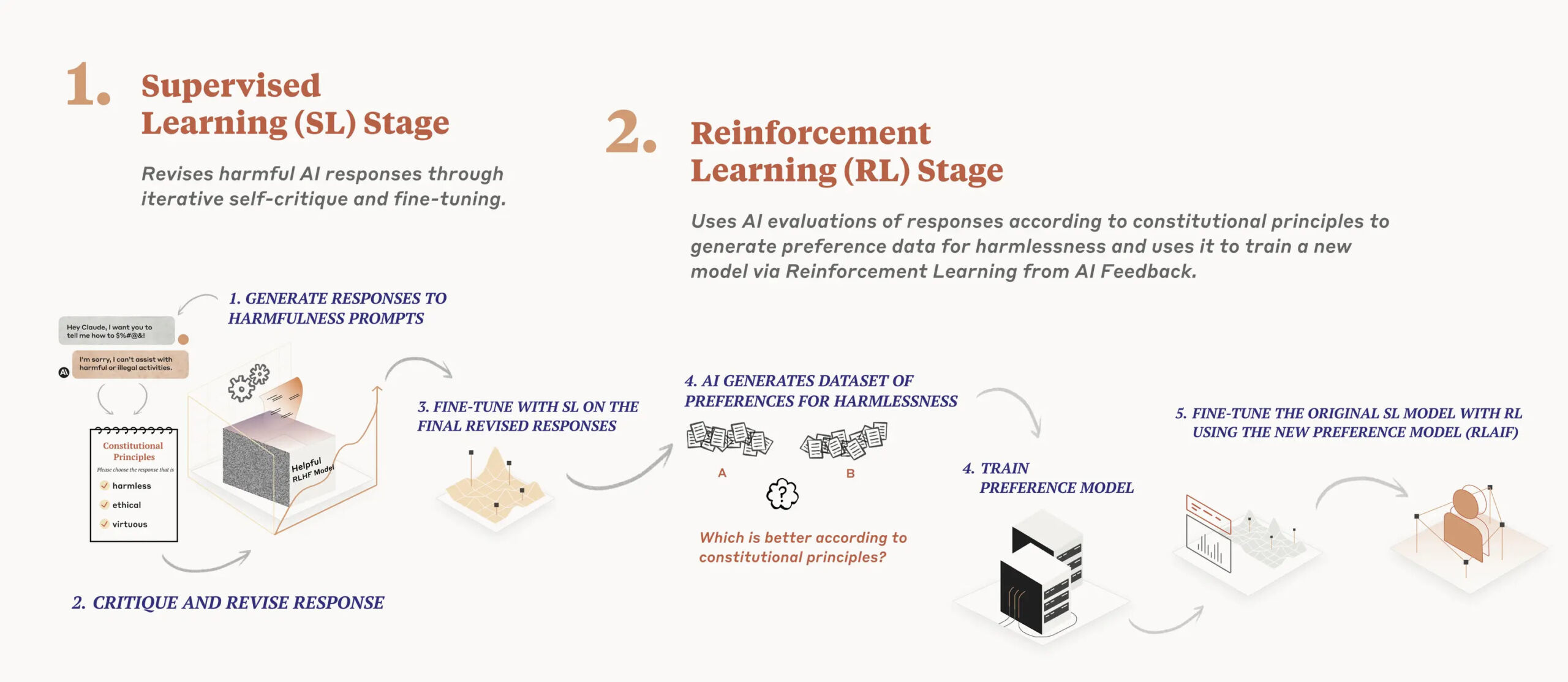
A diagram of Anthropic's "Constitutional AI" training process.
Enlarge / A diagram of Anthropic’s “Constitutional AI” training process.

Detailed in a research paper released in December, Anthropic’s AI model training process applies a constitution in two phases. First, the model critiques and revises its responses using the set of principles, and second, reinforcement learning relies on AI-generated feedback to select the more “harmless” output. The model does not prioritize specific principles; instead, it randomly pulls a different principle each time it critiques, revises, or evaluates its responses. “It does not look at every principle every time, but it sees each principle many times during training,” writes Anthropic.

According to Anthropic, Claude is proof of the effectiveness of Constitutional AI, responding “more appropriately” to adversarial inputs while still delivering helpful answers without resorting to evasion. (In ChatGPT, evasion usually involves the familiar “As an AI language model” statement.)

https://arstechnica.com/?p=1937794


La voce di tuo nipote clonata dall’IA ti chiede i soldi. Occhio alla nuova truffa telefonica per anziani

Si chiama deepkake della voce ed è l’ultima ondata di truffe generate dall’Intelligenza artificiale. Ne scrivono già molto in diversi paesi, fra cui il Canada ma anche la Svezia, dove persone anziane sono state raggirate da voci telefoniche del tutto identiche a quelle di nipoti e figli. Voci che dall’altro capo del telefono chiedevano con urgenza ingenti somme di denaro, anche 3mila dollari, magari per uscire di prigione o per altre questioni urgenti. E così i nonni premurosi hanno sganciato i soldi, per poi rendersi conto che si trattava di una voce finta, prodotta dall’intelligenza artificiale per imitare in tutto e per tutto quella dei più stretti parenti.  

Nuova ondata di deep fake vocali

Ne ha scritto recentemente Il Washington Post, mettendo in guardia il pubblico da questa nuova ondata di deep fake, usata per raggiare le persone più disparate, più di tutti persone anziane.

Fingere che qualche membro della famiglia abbia un problema funziona bene con quel target di persone.

Lo rende noto la FTC (Federal Trade Commission) secondo cui nel 2022 sono state più di 36mila le segnalazioni di truffe o quanto meno tentativi di truffa avvenuti in questo modo  

Nuova generazione IA

Con la nuova generazione di motori AI, in grado di imitare qualunque tipo di voce umana con l’allenamento, le cose stanno peggiorando e Microsoft ha da poco presentato VAL-E. Di male in peggio, considerato che le voci clonate dall’IA fanno esattamente quello che fanno i truffatori veri: imitano la voce di qualcuno di cui ti fidi. Un bambino, un parente, un amico. Poi convincono la vittima designata a mandargli dei soldi ad un indirizzo prestabilito, adducendo gravi problemi inventando gravi problemi di ogni tipo.

Le voci contraffatte, tra l’altro, non devono nemmeno essere prese dall’originale in modo volontario. Basta un video caricato su Youtube, un podcast o un pezzetto di video su TikTok, Instagram o Facebook per creare una voce falsa ma identica all’originale.  

Il consiglio è di farsi venire qualche dubbio quando qualche parente ti chiede urgentemente dei soldi e nel caso chiamalo subito per verificare che sia davvero lui a domandarteli.  

https://www.key4biz.it/la-voce-di-tuo-nipote-clonata-dallia-ti-chiede-i-soldi-occhio-alla-nuova-truffa-telefonica-per-anziani/445457/


Spotify ejects thousands of AI-made songs in purge of fake streams

Spotify on a phone with headphones

Spotify has removed tens of thousands of songs from artificial intelligence music start-up Boomy, ramping up policing of its platform amid complaints of fraud and clutter across streaming services.

In recent months the music industry has been confronting the rise of AI-generated songs and, more broadly, the growing number of tracks inundating streaming platforms daily.

Spotify, the largest audio streaming business, recently took down about 7 percent of the tracks that had been uploaded by Boomy, the equivalent of “tens of thousands” of songs, according to a person familiar with the matter.

Recording giant Universal Music had flagged to all the main streaming platforms that it saw suspicious streaming activity on Boomy tracks, according to another person close to the situation.

The Boomy songs were removed because of suspected “artificial streaming”—online bots posing as human listeners to inflate the audience numbers for certain songs.

AI has made this type of activity easier because it allows someone to instantly generate many music tracks, which can then be uploaded online and streamed.

Boomy, which was launched two years ago, allows users to choose various styles or descriptors, such as “rap beats” or “rainy nights,” to create a machine-generated track. Users can then release the music to streaming services, where they will generate royalty payments. California-based Boomy says its users have created more than 14 million songs.

Spotify confirmed it had removed some Boomy content. “Artificial streaming is a longstanding, industry-wide issue that Spotify is working to stamp out across our service,” the company said.

“We are always encouraged when we see our partners exercise vigilance around the monitoring or activity on their platforms,” said Michael Nash, Universal’s chief digital officer.

The crackdown comes as music industry power broker Lucian Grainge has spent the past few months speaking out about the proliferation of songs on platforms such as Spotify, where 100,000 new tracks are being added each day, and growing manipulation of the system.

Grainge, Universal’s chief executive, told investors last week that “the recent explosive development in generative AI will, if left unchecked, both increase the flood of unwanted content on platforms and create rights issues with respect to existing copyright law.”

While the use of artificial intelligence to create songs is not new, the issue has escalated to the forefront of conversations in the music industry in the past few months. The streaming boom has given rise to an array of services offering artists the chance to buy their way to success. A Google search for “buy Spotify streams” yields millions of results, with sites such as “spotistar.com” offering 1,000 Spotify plays for $6.

The Financial Times reported last month that Universal sent a letter to streaming services asking them to crack down on the use of generative AI on their platforms. That same week, a song that used AI to mimic Drake and The Weeknd’s voices went viral on streaming platforms.

Spotify’s chief executive, Daniel Ek, last week told analysts, “I don’t think I’ve ever seen anything like it in technology,” regarding how fast AI technology was progressing.

Boomy at the weekend resumed submitting new tracks to Spotify. The two sides are negotiating over reinstating the rest of Boomy’s catalog. The company said: “Boomy is categorically against any type of manipulation or artificial streaming. We are working with industry partners to address this issue.”

© 2023 The Financial Times Ltd. All rights reserved. Not to be redistributed, copied, or modified in any way.

https://arstechnica.com/?p=1937660


Una chance per l’Europa nell’IA: l’open source sta battendo i giganti della rete

Siamo nani sulle spalle dei giganti, il noto aforismo di Bernardo da Chartres, il grande bibliofilo del XIII secolo che controllando tutti i manoscritti che circolavano in Europa attraverso la sua copisteria, era ben sicuro che sulle sue spalle non sarebbe salito nessuno e avrebbe potuto continuare a dominare il mercato delle idee in tutto il vecchio Sacro Romano Impero.

Oggi, invece, i nani cominciano a correre ben più velocemente dei giganti che arrancano. Se ne è accorto perfino Google, il gigante digitale che controlla il 70 % dei sistemi di ricerca automatico nel pianeta oltre che il 40 % delle pubblicità personalizzate.

L’IA preoccupa Google

In un resoconto dell’agenzia Bloomberg si rivela che da qualche giorno lo stato maggiore di Mountain View, la sede del gruppo Alphabet, proprietario del motore di ricerca più grande del mondo, è molto preoccupato sul fronte dell’intelligenza artificiale. La causa delle angustie non è la popolarità di ChatGPT, che sta oscurando e trasformando la stessa idea di ricerche online, quanto un fenomeno che rischia di sgretolare il potere delle grandi piattaforme digitali. Così lo spiega Luke Sernau, un ingegnere del vertice di Google nel resoconto di una riunione interna intercettata proprio da Bloomberg “scritto. “Ma la scomoda verità è che non siamo nella posizione per vincere questa corsa agli armamenti e nemmeno OpenAI. Mentre litigavamo, una terza fazione ha tranquillamente consumato il nostro pranzo. Sto parlando, ovviamente, delll’open source”.

Secondo gli osservatori più accreditati, proprio la struttura e la logica dei sistemi di intelligenza artificiale basati sul cosiddetto Pre-Trained, addestramento preventivo, rende difficile e costoso per un apparato proprietario gestire internamente tutte le fasi della progettazione, formattazione, formazione e collaudo di un tale sistema. Mentre la potenza di una rete con milioni di tecnici e di partner che concorrono a parlare e dialogare con il dispositivo intelligente permetterebbe con grande agilità organizzativa e convenienza economica la messa in funzione di sistemi affidabili.

Open source e pluralità di applicazioni specializzate

La considerazione ovviamente non vale solo per Google ma riguarda la stessa OpenAI, proprietaria di ChatGPT, e il gruppo Facebook che sta elaborando un proprio sistema.

La preoccupata constatazione dell’ingegner Sernau non riguarda solo la capacità dell’open source di addestrare più convenientemente i sistemi di intelligenza artificiale, ma anche la struttura e la natura di questi modelli. Infatti, proprio un accesso generalizzato e differenziato , da parte di molti operatori, dei quali ognuno è in grado di dare un certo imprinting al complesso tecnologico intelligente porta ad una segmentazione dei meccanismi. Avremo, spiega il tecnico di Google intercettato da Bloomberg, sempre più una pluralità di applicazioni, ognuna specializzata su un tema, un problema, una comunità o una categoria, rompendo quella forma generalista e monopolista che veniva intravvista con i primi nuovi sistemi sperimentali. E per questo, aggiunge Sernau “La nostra migliore speranza è imparare e collaborare con ciò che gli altri stanno facendo al di fuori di Google”.

Gli sviluppatori di tecnologia open source non sono proprietari e rilasciano il proprio lavoro affinché chiunque possa utilizzarlo, migliorarlo o adattarlo come meglio crede. Esempi storici di lavoro open source includono il sistema operativo Linux e LibreOffice, un’alternativa a Microsoft Office.

Tecnologia di libertà

L’ingegnere  citato  ha affermato che gli sviluppatori di intelligenza artificiale open source ci stavano “già lambendo”, citando esempi che includono strumenti basati su un modello di linguaggio di grandi dimensioni sviluppato da Meta di Mark Zuckerberg, che è stato reso disponibile dalla società su un “non commerciale” e caso per caso base a febbraio ma è trapelato online poco dopo.

L’elemento che ha reso possibile questa socializzazione dell’innovazione, per molti esperti, sta nella decisione di Facebook di rendere accessibile il proprio sistema linguistico LLaMA che interfaccia il linguaggio naturale gestendo le infinite formule semantiche. Da quel momento tutto cambia e si innesta la magia della miniaturizzazione che rende l’informatica, come diceva Adriano Olivetti, una tecnologia di libertà. Infatti, si spiega proprio con il decentramento dell’accesso a LLaMA si produce un fenomeno per cui “la barriera all’ingresso per lavorare sui modelli di intelligenza artificiale è scesa dalla produzione totale di un’importante organizzazione di ricerca a una persona, una serata e un robusto laptop“.

Un cambio di scena radicale che in poche settimane trasforma completamente lo scenario che sembrava irrimediabilmente destinato ad un duopolio gestito da pochissimi proprietari. A questo punto vanno riviste le considerazione sulle famose cautele che gli stessi vertici dei gruppi che sviluppano intelligenza artificiale, da Elon Musk al CEO di Google Sundar Pichai, hanno fatto circolare. A chi parlavano i proprietari delle grande piattaforme private quando chiedevano di rallentare la  ricerca e di regolamentare il sistema tecnologico? Forse chiedevano alle istituzioni di frenare questa straordinaria corsa che sta portando, ancora una volta, la rete a rompere compatibilità e gerarchia, rendendo più articolato il mercato e più trasparenti i prodotti?

La partita dell’Europa

Su questo snodo l’Europa potrebbe giocare realmente la sua partita. Invece di inseguire meccanicamente una impossibile competizione con i giganti americani e cinesi, il Vecchio Continente potrebbe diventare il vero partner dell’open source globale, dando spazio e codificando modelli ed esperienze, a partire dai propri apparati sanitari e universitari, per far crescere queste esperienze e fornire massa critica alle sperimentazioni più interessanti.

Si torna così alle origini del digitale, quando nei primi anni ’60 si giocò la partita del free soft che venne sonoramente persa proprio per la totale assenza dell’Europa che non riuscì a cogliere quell’opportunità che veniva dalle lotte delle comunità californiane. Ora il tram ripassa dal nostro capolinea: l’intelligenza artificiale come fenomeno sociale ci propone una straordinaria idea di aggregazione e di contaminazione del mercato. Chi risponde?

https://www.key4biz.it/una-chance-per-leuropa-nellia-lopen-source-sta-battendo-i-giganti-della-rete/445328/


After 18 months, GitHub’s big code search overhaul is generally available

GitHub has announced the general availability of a ground-up rework of its code search that has been in development for years.

The changes include substantial new functionality that is significantly more aware of context. The company says its new code search is “about twice as fast” as the old code search and that it “understands code, putting the most relevant results first.”

That’s on top of redesigned search and code view interfaces. The new search interface offers suggestions and completions and categorizes and formats the results more intelligently.

Within the code view, you can easily see references in a side panel, more or less matching what you’d be able to do in Visual Studio when it comes to looking up and navigating to references. Substring queries, regular expressions, and symbol search are also supported.

GitHub published a guide to syntax, including but not limited to the usual stuff like leveraging boolean operations in queries or performing an exact search with quotation marks. There are also more specific features, like limiting your search to a specific repository, language, path, or organization.

This overhaul was first made available as a technology preview with a waitlist in December 2021. Those who opted in and were offered the new search spent a long time using it alongside the old code search as a separate tool.

If you want to go way deeper in understanding it, you can check out the GitHub engineering blog’s February 2023 post detailing exactly how it works, which technologies were used to build it, and so on.

The changes are meant to improve productivity for software developers—for example, the new search could be much more efficient for finding specific vulnerabilities in a large codebase.

As noted, the change has been in the works for a while, but GitHub is positioning it as part of a larger initiative to bring more intelligence to the platform. The other most notable bullet point in that initiative is the enrichening and expansion of the AI coding tool Copilot leveraging generative AI.

Listing image by GitHub

https://arstechnica.com/?p=1937544


President Biden meets with AI CEOs at the White House amid ethical criticism

US President Joe Biden and Vice President Kamala Harris meet the 'Investing in America Cabinet.'
Enlarge / US President Joe Biden and Vice President Kamala Harris meet the ‘Investing in America Cabinet’ to discuss the Investing in America agenda in the Roosevelt Room of the White House in Washington, DC, on May 5.

On Thursday, President Joe Biden held a meeting at the White House with CEOs of leading AI companies, including Google, Microsoft, OpenAI, and Anthropic, emphasizing the importance of ensuring the safety of AI products before deployment. During the meeting, Biden urged the executives to address the risks that AI poses. But some AI experts criticized the exclusion of ethics researchers who have warned of AI’s dangers for years.

Over the past few months, generative AI models such as ChatGPT have quickly gained popularity and rallied intense tech hype, driving companies to develop similar products at a rapid pace.

However, concerns have been growing about potential privacy issues, employment bias, and the potential for using them to create misinformation campaigns. According to the White House, the administration called for greater transparency, safety evaluations, and protection against malicious attacks during a “frank and constructive discussion” with the executives.

The meeting’s most high-profile attendees included Google’s Sundar Pichai, Microsoft’s Satya Nadella, OpenAI’s Sam Altman, and Anthropic’s Dario Amodei.

Vice President Kamala Harris chaired the meeting, and in a video of Biden “dropping by” posted on Twitter, the president said, “I just came by to say thanks. What you’re doing has enormous potential—and enormous danger. I know you understand that. And I hope you can educate us as to what you think is most needed to protect society as well as to the advancement. This is really, really important.”

Last fall, the Biden administration released a set of guidelines called the “AI Bill of Rights” that aims to protect Americans from the detrimental effects of automated systems, including bias, discrimination, and privacy issues.

AI ethics researchers respond

While Biden’s invitation showed executive interest in a hot policy topic, critics of the invitee companies’ ethical track records were not impressed by the meeting, with many questioning the choice of inviting people to the meeting who, they argue, represent companies that have created the issues with AI that the White House seeks to address.

On Twitter, AI researcher Dr. Timnit Gebru wrote, “It seems like we spend half our time talking to various legislators and agencies and STILL we have this shit. A room full of the dudes who gave us the issues & fired us for talking about the risks, being called on by the damn president to ‘protect people’s rights.'”

In 2020, Google fired Gebru following a dispute over a research paper she co-authored that highlighted potential risks and biases in large-scale language models. The incident sparked debate within the AI research community about Google’s commitment to AI ethics.

Similarly, University of Oxford AI ethics researcher Elizabeth Renieris tweeted, “Unfortunately, and with all due respect POTUS, these are not the people who can tell us what is “most needed to protect society” when it comes to #AI.”

The criticism mirrors the common divide between what is often termed “AI safety” (a loose movement concerned primarily with hypothetical existential risk from AI, openly associated with OpenAI employees) and “AI ethics” (a group of researchers concerned largely about misapplications and impacts of current AI systems, including bias and misinformation).

Along these lines, author Dr. Brandeis Marshall suggested organizing a “counter-meeting” to the White House meeting that would include Hugging Face, the Distributed AI Research Institute, the UCLA Center of Critical Internet Inquiry, and the Algorithmic Justice League.

Also on Thursday, the White House announced a $140 million investment to launch seven AI research institutes through the National Science Foundation. Additionally, Anthropic, Google, Hugging Face, Nvidia, OpenAI, and Stability AI, will participate in public evaluations of their AI systems at DEF CON 31.

After the White House meeting, Harris released a statement saying, “The private sector has an ethical, moral, and legal responsibility to ensure the safety and security of their products. And every company must comply with existing laws to protect the American people. I look forward to the follow through and follow up in the weeks to come.”

https://arstechnica.com/?p=1937052


Snoop Dogg on AI risk: “Sh–, what the f—?”

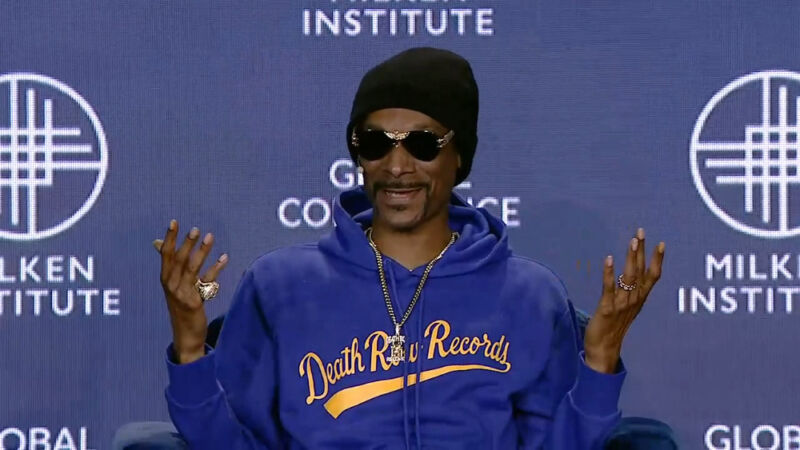
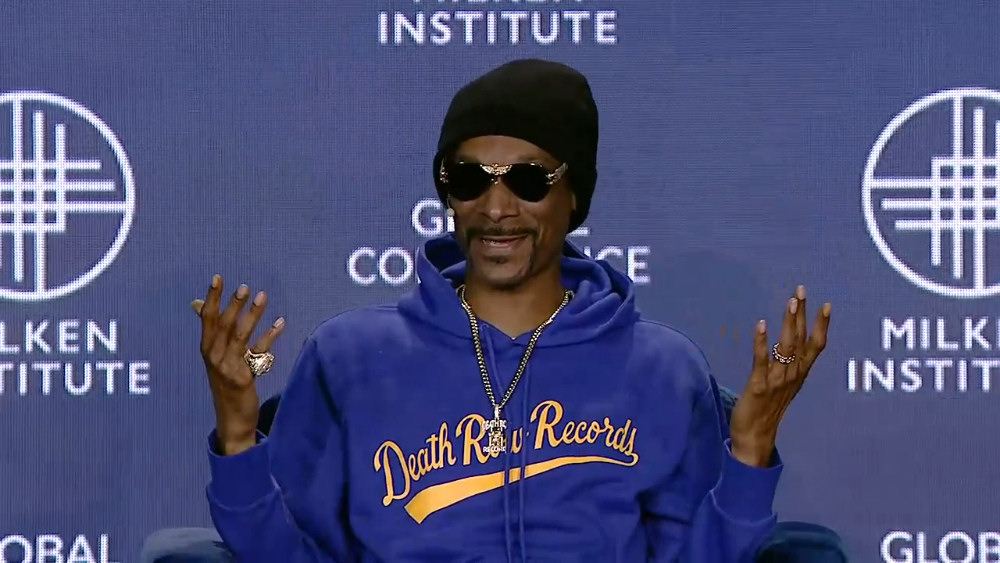
Snoop Dogg talking about AI at the 2023 Milken Institute Global Conference on May 3, 2023.
Enlarge / Snoop Dogg talking about AI at the 2023 Milken Institute Global Conference on May 3, 2023.
Milken Institute

On Wednesday, celebrated multi-platinum recording artist Snoop Dogg took part in a panel at the Milken Institute’s 2023 Global Conference in Beverly Hills, California. After fielding a question by Variety editor Shirley Halperin about AI in relation to the 2023 WGA writers’ strike, Snoop expressed his bemused feelings on AI in a genuinely funny exchange, resulting in convivial laughter from the audience.

During his response, Snoop described how conversing with a large language model (such as ChatGPT or Bing Chat) reminds him of sci-fi movies he watched as a kid. Showing that he keeps up with current events, Snoop also referenced Geoffery Hinton, who resigned this week from Google so he could speak of the dangers of AI without conflicts of interest:

Well I got a motherf*cking AI right now that they did made for me. This n***** could talk to me. I’m like, man this thing can hold a real conversation? Like real for real? Like it’s blowing my mind because I watched movies on this as a kid years ago. When I see this sh*t I’m like what is going on? And I heard the dude, the old dude that created AI saying, “This is not safe, ‘cause the AIs got their own minds, and these motherf*ckers gonna start doing their own sh*t. I’m like, are we in a f*cking movie right now, or what? The f*ck man? So do I need to invest in AI so I can have one with me? Or like, do y’all know? Shit, what the f*ck?” I’m lost, I don’t know.

Snoop’s confusion over today’s AI systems reflects what may be a common sentiment among people who are trying to understand and follow the latest developments in generative AI, which have unfolded rapidly over the past year. His unguarded observations on AI are notable coming from a highly respected multi-award-winning musical artist and entrepreneur.

The Milken Institute is a nonprofit, nonpartisan economic think tank that is focused on “accelerating measurable progress on the path to a meaningful life.” Every year, the Institute hosts the Milken Institute Global Conference. In 2023, according to its website, the conference convened “the best minds in the world to tackle its most urgent challenges and realize its most exciting opportunities.”

During the same Snoop Dogg panel, which took place with music label CEO Larry Jackson of Gamma Records, Snoop also expressed solidarity with striking members of the WGA. And he took umbrage over what he sees as the lack of fair compensation for artists through music streaming services: “Can somebody explain to me how you can get a billion streams and not get a million dollars? That sh*t don’t make sense to me.”

You can watch the full Snoop Dogg panel on the Milken Institute website.

https://arstechnica.com/?p=1936767


Microsoft Expands AI Access to Public

Microsoft on Thursday expanded public access to its generative artificial intelligence programs, despite fears that tech firms are rushing ahead too quickly with potentially dangerous technology.

The AI-enhanced features of the company’s Bing search engine and Edge internet browser are now open for anyone to use, Yusuf Mehdi, corporate vice president, said in a blog post.

“This means that it will now be easier than ever for everyone to try the new Bing and Edge by simply signing into Bing with your Microsoft Account,” Mehdi said.

The services have been enhanced with the ability to work with images as well as text, and Microsoft intends to add video to the mix, according to the executive.

A Bing “Image Creator” was recently integrated into its AI chatbot’s repertoire, allowing it to generate visual, as well as written, content, Mehdi said.

“We are expanding Image Creator to all languages in Bing,” he added. “So now you can create images in your native language.” Risks from AI include its potential uses for fraud, with voice clones, deep-fake videos and convincing written messages.

A range of experts in March urged a pause in the development of powerful AI systems to allow time to make sure they are safe.

Advertisement. Scroll to continue reading.

Their open letter, signed by more than 1,000 people, including billionaire Elon Musk and Apple cofounder Steve Wozniak, was prompted by generative AI technology from Microsoft-backed firm OpenAI.

“AI systems with human-competitive intelligence can pose profound risks to society and humanity,” the letter read.

“Powerful AI systems should be developed only once we are confident that their effects will be positive and their risks will be manageable,” it said.

A prominent computer scientist often dubbed “the godfather of artificial intelligence” recently quit his job at Google to speak out about the dangers of the technology.

Geoffrey Hinton said at an MIT forum on Wednesday that it makes sense to halt the development of AI. But he added that the idea is naive given the intense competition between countries and companies involved in the sector.

Hinton, who created some of the technology underlying AI systems, maintained that the existential threat from AI is “serious and close.”

In the three months since AI-powered Bing and Edge were unveiled, more than a half a billion chats have taken place, according to Mehdi.

Microsoft has so far seen people make more than 200 million images with Bing creator software, Mehdi said. “We believe innovating and learning in the open is part of a responsible approach,” he added.

“Our teams continue to work to address issues such as misinformation and disinformation, content blocking, data safety and preventing the promotion of harmful or discriminatory content in line with our AI principles.”

Related: Microsoft Puts ChatGPT to Work on Automating Cybersecurity

Related: ChatGPT Integrated Into Cybersecurity Products as Industry Tests Its Capabilities

https://www.securityweek.com/microsoft-expands-ai-access-to-public/


Harris to Meet With CEOs About Artificial Intelligence Risks

Vice President Kamala Harris will meet on Thursday with the CEOs of four major companies developing artificial intelligence as the Biden administration rolls out a set of initiatives meant to ensure the rapidly evolving technology improves lives without putting people’s rights and safety at risk.

The Democratic administration plans to announce an investment of $140 million to establish seven new AI research institutes, administration officials told reporters in previewing the effort.

In addition, the White House Office of Management and Budget is expected to issue guidance in the next few months on how federal agencies can use AI tools. There will also be an independent commitment by top AI developers to participate in a public evaluation of their systems in August at the Las Vegas hacker convention DEF CON.

Harris and administration officials on Thursday plan to discuss the risks they see in current AI development with the CEOs of Alphabet, Anthropic, Microsoft and OpenAI. The government leaders’ message to the companies is that they have a role to play in reducing the risks and that they can work together with the government.

President Joe Biden noted last month that AI can help to address disease and climate change but also could harm national security and disrupt the economy in destabilizing ways.

The release of the ChatGPT chatbot this year has led to increased debate about AI and the government’s role with the technology. Because AI can generate human-like writing and fake images, there are ethical and societal concerns.

OpenAI, which developed ChatGPT, has been secretive about the data its AI systems have been trained upon. That makes it hard for those outside the company to understand why ChatGPT is producing biased or false answers to requests or to address concerns about whether it’s stealing from copyrighted works.

Advertisement. Scroll to continue reading.

Companies worried about being liable for something in their training data might also not have incentives to properly track it, said Margaret Mitchell, chief ethics scientist at AI startup Hugging Face.

“I think it might not be possible for OpenAI to actually detail all of its training data at a level of detail that would be really useful in terms of some of the concerns around consent and privacy and licensing,” Mitchell said in an interview Tuesday. “From what I know of tech culture, that just isn’t done.”

Theoretically, at least, some kind of disclosure law could force AI providers to open up their systems to more third-party scrutiny. But with AI systems being built atop previous models, it won’t be easy for companies to provide greater transparency after the fact.

“I think it’s really going to be up to the governments to decide whether this means that you have to trash all the work you’ve done or not,” Mitchell said. “Of course, I kind of imagine that at least in the U.S., the decisions will lean towards the corporations and be supportive of the fact that it’s already been done. It would have such massive ramifications if all these companies had to essentially trash all of this work and start over.”

https://www.securityweek.com/harris-to-meet-with-ceos-about-artificial-intelligence-risks/


“We must regulate AI,” FTC Chair Khan says

Lina M. Khan testifies during a Senate Commerce, Science, and Transportation Committee nomination hearing on April 21, 2021 in Washington, DC.
Enlarge / FTC Chair Lina M. Khan testifies during a Senate Commerce, Science, and Transportation Committee nomination hearing on April 21, 2021, in Washington, DC.
Graeme Jennings/Getty Images

On Wednesday, Federal Trade Commission (FTC) Chair Lina Khan pledged to use existing laws to regulate AI in a New York Times op-ed, “We Must Regulate A.I. Here’s How.” In the piece, she warns of AI risks such as market dominance by large tech firms, collusion, and the potential for increased fraud and privacy violations.

In the op-ed, Khan cites the rise of the “Web 2.0” era in the mid-2000s as a cautionary tale for AI’s expansion, saying that the growth of tech companies led to invasive surveillance and loss of privacy. Khan feels that public officials must now ensure history doesn’t repeat itself with AI, but without unduly restricting innovation.

“As these technologies evolve,” she wrote, “we are committed to doing our part to uphold America’s longstanding tradition of maintaining the open, fair and competitive markets that have underpinned both breakthrough innovations and our nation’s economic success—without tolerating business models or practices involving the mass exploitation of their users.”

Khan’s op-ed comes when rising hype and anxiety about generative AI like ChatGPT has begun to dominate the tech world. Increasing use of the nebulous term “AI” in commerce has led the FTC to post clarifying statements about how it plans to deal with these new technologies (and potentially misleading claims about them) on its website.

In line with those previous statements, Khan made a point of noting that AI represents nothing special in the eyes of the law. “Although these tools are novel, they are not exempt from existing rules,” she wrote, “and the FTC will vigorously enforce the laws we are charged with administering, even in this new market.”

Furthermore, Khan’s plans for AI go beyond the popular AI chatbots of generative AI, extending to other forms of automation and algorithmic decision-making. She mentions at least four key areas of concern:

  • Ensuring fair competition: Preventing large tech firms from exploiting their market dominance and using collusion to stifle innovation and smaller competitors in the AI landscape.
  • Strengthening consumer protection: Safeguarding users from deceptive and fraudulent practices enabled by AI, such as phishing scams, deepfake videos, and voice cloning.
  • Promoting data privacy: Monitoring AI systems to ensure they adhere to data protection laws and prevent exploitative data collection or usage, protecting users’ personal information.
  • Combating discriminatory practices: Ensuring AI systems don’t perpetuate or amplify biases and discrimination, which can lead to unfair treatment in areas like employment, housing, or access to essential services.

Some of these elements have previously been laid out in the Biden administration’s “AI Bill of Rights” guidelines published in October. Those guidelines do not explicitly have the force of law behind them, but the FTC has the latitude to interpret existing laws to apply to AI. “The FTC is well equipped with legal jurisdiction to handle the issues brought to the fore by the rapidly developing A.I. sector,” Khan said.

Looking ahead, Khan asks: Can the United States continue to foster world-leading technology without accepting “race-to-the-bottom business models” and “monopolistic control” that locks out higher-quality products. Her answer? “Yes—if we make the right policy choices.”

https://arstechnica.com/?p=1936486