AI vs. Hollywood: Writers battle “plagiarism machines” in union talks

An AI-generated image of
Enlarge / An AI-generated image of “an office copy machine in front of a hollywood-style explosion.”
Midjourney

The Writers Guild of America (WGA) is seeking to restrict the use of generative AI in writing film and TV scripts as part of an ongoing strike, reports Reuters. The concerns come at a time when anxiety over the economic impact of tech like ChatGPT looms large in the minds of many.

The WGA strike is the first in 15 years, and it’s taking place over issues beyond just AI. But in particular, Reuters reports that WGA writers have two main concerns about automation in writing, quoting screenwriter John August, who is part of the WGA negotiating committee: They don’t want their material to be used as training data for AI systems, and they don’t want to be tasked with fixing AI-generated “sloppy first drafts.”

An excerpt of the WGA's position on AI, as posted by novelist Hari Kunzru and several others on Twitter. MBA stands for "Minimum Basic Agreement," the name of the union's collective bargaining agreement.
Enlarge / An excerpt of the WGA’s position on AI, as posted by novelist Hari Kunzru and several others on Twitter. MBA stands for “Minimum Basic Agreement,” the name of the union’s collective bargaining agreement.

That’s because writers who are hired to polish first drafts get paid at a lower rate, and WGA writers are fighting to make sure that a ChatGPT-generated first draft would not be counted as “literary material” or “source material,” which are terms defined in their contract.

On Twitter, screenwriter C. Robert Cargill expressed similar concerns, writing, “The immediate fear of AI isn’t that us writers will have our work replaced by artificially generated content. It’s that we will be underpaid to rewrite that trash into something we could have done better from the start. This is what the WGA is opposing and the studios want.”

Additionally, the WGA argues that existing scripts should not be used to train AI systems, to avoid potential IP theft. WGA chief negotiator Ellen Stutzman said some members have referred to AI as “plagiarism machines.”

While accusations of plagiarism in the training of AI models like ChatGPT still haven’t been settled in courts, the models absorb millions of documents scraped from the Internet without permission from content creators. By recombining statistical “knowledge” about those works in new ways, large language models (LLMs) can create novel material.

So far, Hollywood studios have rejected the WGA’s proposals, instead offering to discuss new technologies annually. As the strike is still underway, the outcome of these negotiations remains uncertain, but it’s a notable sign of the growing pains of integrating new technology like generative AI into an existing creative field.

https://arstechnica.com/?p=1936380


AI’s chaotic rollout in big US hospitals detailed in anonymous quotes

AI’s chaotic rollout in big US hospitals detailed in anonymous quotes
Aurich Lawson | Getty Images

When it comes to artificial intelligence, the hype, hope, and foreboding are suddenly everywhere. But the turbulent tech has long caused waves in health care: from IBM Watson’s failed foray into health care (and the long-held hope that AI tools may one day beat doctors at detecting cancer on medical images) to the realized problems of algorithmic racial biases.

But, behind the public fray of fanfare and failures, there’s a chaotic reality of rollouts that has largely gone untold. For years, health care systems and hospitals have grappled with inefficient and, in some cases, doomed attempts to adopt AI tools, according to a new study led by researchers at Duke University. The study, posted online as a pre-print, pulls back the curtain on these messy implementations while also mining for lessons learned. Amid the eye-opening revelations from 89 professionals involved in the rollouts at 11 health care organizations—including Duke Health, Mayo Clinic, and Kaiser Permanente—the authors assemble a practical framework that health systems can follow as they try to roll out new AI tools.

And new AI tools keep coming. Just last week, a study in JAMA Internal Medicine found that ChatGPT (version 3.5) decisively bested doctors at providing high-quality, empathetic answers to medical questions people posted on the subreddit r/AskDocs. The superior responses—as subjectively judged by a panel of three physicians with relevant medical expertise—suggest an AI chatbot such as ChatGPT could one day help doctors tackle the growing burden of responding to medical messages sent through online patient portals.

This is no small feat. The rise of patient messages is linked to high rates of physician burnout. According to the study authors, an effective AI chat tool could not only reduce this exhausting burden—offering relief to doctors and freeing them to direct their efforts elsewhere—but it could also reduce unnecessary office visits, boost patient adherence and compliance with medical guidance, and improve patient health outcomes overall. Moreover, better messaging responsiveness could improve patient equity by providing more online support for patients who are less likely to schedule appointments, such as those with mobility issues, work limitations, or fears of medical bills.

AI in reality

That all sounds great—like much of the promise of AI tools for health care. But there are some big limitations and caveats to the study that makes the real potential for this application harder than it seems. For starters, the types of questions that people ask on a Reddit forum are not necessarily representative of the ones they would ask a doctor they know and (hopefully) trust. And the quality and types of answers volunteer physicians offer to random people on the Internet may not match those they give their own patients, with whom they have an established relationship.

But, even if the core results of the study held up in real doctor-patient interactions through real patient portal message systems, there are many other steps to take before a chatbot could reach its lofty goals, according to the revelations from the Duke-led preprint study.

To save time, the AI tool must be well-integrated into a health system’s clinical applications and each doctor’s established workflow. Clinicians would likely need reliable, potentially around-the-clock technical support in case of glitches. And doctors would need to establish a balance of trust in the tool—a balance such that they don’t blindly pass along AI-generated responses to patients without review but know they won’t need to spend so much time editing responses that it nullifies the tool’s usefulness.

And after managing all of that, a health system would have to establish an evidence base that the tool is working as hoped in their particular health system. That means they’d have to develop systems and metrics to follow outcomes, like physicians’ time management and patient equity, adherence, and health outcomes.

These are heavy asks in an already complicated and cumbersome health system. As the researchers of the preprint note in their introduction:

Drawing on the Swiss Cheese Model of Pandemic Defense, every layer of the healthcare AI ecosystem currently contains large holes that make the broad diffusion of poorly performing products inevitable.

The study identified an eight-point framework based on steps in an implementation when decisions are made, whether it’s from an executive, an IT leader, or a front-line clinician. The process involves: 1) identifying and prioritizing a problem; 2) identifying how AI could potentially help; 3) developing ways to assess an AI’s outcomes and successes; 4) figuring out how to integrate it into existing workflows; 5) validating the safety, efficacy, and equity of AI in the health care system before clinical use; 6) rolling out the AI tool with communication, training, and trust building; 7) monitoring; and 8) updating or decommissioning the tool as time goes on.

https://arstechnica.com/?p=1936159


AI-generated beer commercial contains joyful monstrosities, goes viral

A still image from
Enlarge / A still image from “Synthetic Summer,” an AI-generated beer commercial.
Privateisland.tv

While many fear a future where AI-generated media becomes indistinguishable from traditional media, destroying society and/or civilization in the process, we aren’t quite there yet. Exhibit A comes in the form of a surreal AI-generated beer commercial that went viral over the weekend.

Titled “Synthetic Summer,” the 30-second video first appeared on Instagram about a week ago, created by Helen Power and Chris Boyle of a London-based production company called Privateisland.tv. The pair were not available for comment before this story was published, but judging by the look of the video, it appears they likely created it using Runway’s new Gen-2 AI model, which can create short video clips based on written prompts similar to how Stable Diffusion can create still images.

In the video, set to a raucous crowd backing track and Smash Mouth’s “All Star,” we see simulacra of people partying at a stereotypical American backyard barbecue, occasionally physically merging with impressionistic beer vessels. Women laugh, jaws flaring. Beer glasses turn into beer cans. Flaming grills achieve columnar fire tornado status and arc across the yard. It’s a vision of surrealistic hell that is at once familiar and impressively alien.

Why is it so weird? Currently, AI video generators are still primitive. As their creators train the models, they’re working from a much smaller set of source material than still image AI synthesis models, and the models are dramatically more computationally expensive to run. The impressionistic view of beer commercials likely comes from absorbing the essence of real beer commercials in Gen-2’s data set. Runway has not disclosed the data set used to train Gen-2, but in the paper for Gen-1 (an earlier model), it cited “an internal dataset of 240M images and a custom dataset of 6.4M video clips.”

We’ve experimented with Gen-2 (which is currently in a closed testing phase), and generating even weirdly alien clips like these still require human persistence, running through and discarding many generations to get even an OK result. Even then, the resulting clip is only a few seconds long. In the case of Synthetic Summer, Privateisland.tv generated the clips, selected the best ones, and pieced the segments together in a sequence, adding music and sound effects.

But wait, beer isn’t the only product being fictionally advertised by AI for memetic purposes. On April 24, someone called “Pizza Later” tweeted a largely AI-generated video for a fictional restaurant called “Pepperoni Hug Spot” that includes distorted video clips of people eating pizza generated by Runway’s Gen-2. In addition, its creator reportedly generated the script with GPT-4, used Midjourney for still images, and a voice-over by Eleven Labs. They pieced it all together using Adobe After Effects.

Both these human-initiated and human-assembled pieces show that generative AI still has a long way to go before it has autonomously bedazzled the masses with society-altering memes. People are still behind the wheel of these alien works, and from that, we can potentially take some semblance of comfort. Maybe.

Still, neither video can match the purity and majesty of AI-generated Will Smith eating spaghetti, which will forever live in our hearts as our first AI-generated video meme nightmare.

https://arstechnica.com/?p=1936137


AI plus MRI yields the ability to recognize what the mind is hearing

Colored image of a cross section of the skull and brain.

We have various ways of seeing what the brain is up to, from low-resolution electrodes that track waves of activity that ripple across the brain, to implanted electrodes that can follow the activity of individual cells. Combined with a detailed knowledge of which regions of the brain are involved in specific processes, we’ve been able to do remarkable things, such as using functional MRI (fMRI) to determine what letter a person was looking at or an implant to control a robotic arm.

But today, researchers announced a new bit of mind reading that’s impressive in its scope. By combining fMRI brain imaging with a system that’s somewhat like the predictive text of cell phones, they’ve worked out the gist of the sentences a person is hearing in near real time. While the system doesn’t get the exact words right and makes a fair number of mistakes, it’s also flexible enough that it can reconstruct an imaginary monologue that goes on entirely within someone’s head.

Making functional MRI functional

Functional MRI is a way of seeing what parts of the brain have been active. By tuning the sensitivity of the imaging to pick up differences in the flow of blood, it’s possible to identify areas within the brain that are replenishing their energy after having processed some information. It has been extremely useful for understanding how the brain operates, but it also has some significant limitations.

To start, the person whose brain is being imaged has to be stuffed inside an MRI tube for it to work, so it’s not useful for any real-world applications. In addition, the spatial resolution is somewhat limited, so activities that involve only a small number of cells can be difficult to resolve. Finally, the response to activity that fMRI picks up is somewhat delayed; it starts picking up a couple of seconds after the neural activity, builds to a peak, and doesn’t fade out until a full 10 seconds after the neurons were active.

This delay makes tracking a continuous activity—reading a few paragraphs, for example—very tricky because some areas that are activated by one word may partly overlap both physically and temporally with the ones that are activated by ensuing words.

The researchers behind the new work (a small team at the University of Texas at Austin) decided to skip identifying individual words and focused on developing a system that could identify a sequence of words. And they developed an astonishing data set to train the recognition system: Three individuals spent 16 hours sitting in MRI tubes while text was read to them.

What are you listening to?

The system works by constantly updating a list of candidate phrases, that are consistent with the brain activity registered by the fMRI. The computerized portion of things was based on a generative neural network language model that had been trained on the English language, which narrowed down the word combinations that it needed to consider. (It keeps the system from evaluating the possibility of users hearing “aimless hyena mauve” or something equally nonsensical.)

That still leaves a huge range of valid English phrases that the system needs to consider. To handle this in near real time, the researchers turned to something called a beam search algorithm. As the neural response to a spoken word is processed, the system creates a list of high-scoring potential matches. As the next word’s response is added, it converts these to scored lists of two-word combinations that are both good matches for the neural signals and make sense given its training in the English language. As each new response comes in from the fMRI, it continues refining these lists until it has scores for entire phrases.

By managing these as lists rather than a single answer, the system avoids throwing out a good match if it misidentifies a single word. And, by limiting things to common English usage, the system avoids getting bogged down by tracking nonsense phrases.

https://arstechnica.com/?p=1935842


Stone-hearted researchers gleefully push over adorable soccer-playing robots

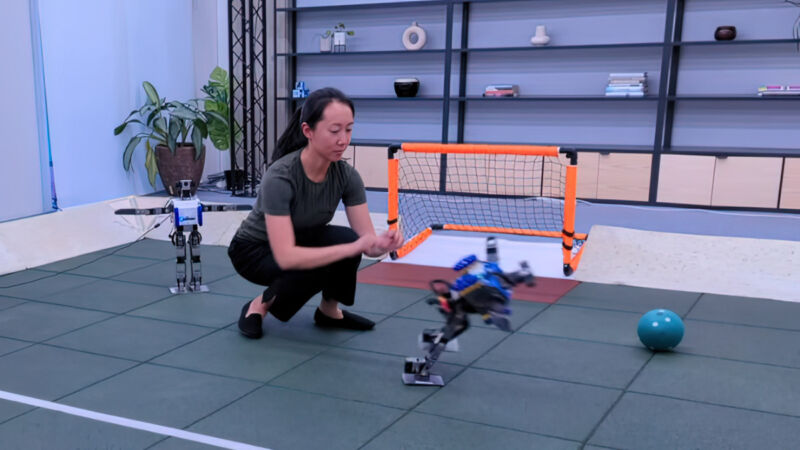
In a still from a DeepMind demo video, a researcher pushes a small humanoid robot to the ground.
Enlarge / In a still from a DeepMind demo video, a researcher pushes a small humanoid robot to the ground.

On Wednesday, researchers from DeepMind released a paper ostensibly about using deep reinforcement learning to train miniature humanoid robots in complex movement skills and strategic understanding, resulting in efficient performance in a simulated one-on-one soccer game.

But few paid attention to the details because to accompany the paper, the researchers also released a 27-second video showing one experimenter repeatedly pushing a tiny humanoid robot to the ground as it attempts to score. Despite the interference (which no doubt violates the rules of soccer), the tiny robot manages to punt the ball into the goal anyway, marking a small but notable victory for underdogs everywhere.

[embedded content]
DeepMind’s “Robustness to pushes” demonstration video.

On the demo website for “Learning Agile Soccer Skills for a Bipedal Robot with Deep Reinforcement Learning,” the researchers frame the merciless toppling of the robots as a key part of a “robustness to pushes” evaluation, writing, “Although the robots are inherently fragile, minor hardware modifications together with basic regularization of the behavior during training lead to safe and effective movements while still being able to perform in a dynamic and agile way.”

Reading between the technical jargon, machine learning experts will undoubtedly glean a technical breakthrough somewhere in there. But like us, people on social media instead focused on the obvious: Can’t they leave those cute little guys alone?

  • “Feel kinda bad for these little dudes,” tweeted Kenneth Cassel. “Just let him play soccer in peace.”
  • “It’s hard not to anthropomorphize. My brain says, STOP BEING MEAN! Lol,” said John Weller.
  • “Stop abusing the little dude,” tweeted Amr Awadallah.

Viewer reaction reminds us of the famous Boston Dynamics demo videos where robots repeatedly get pushed over by sticks, tripped, and thwarted in various ways. All in the name of testing, of course.

[embedded content]
Boston Dynamics pushed over lots of robots to test them about seven years ago.

So back to DeepMind, and we’ll be serious for a second. What’s behind the little robot’s ability to keep getting up on its relentless drive to score? The researchers used deep reinforcement learning, a type of AI, to train the humanoid robots to play a one-on-one soccer game. They first trained the skills in isolation, then composed them to the match setting. (Other demonstration videos on the paper’s demo site show the performance of two tiny metal humanoids playing soccer.)

“The resulting policy exhibits robust and dynamic movement skills such as rapid fall recovery, walking, turning, kicking and more; and transitions between them in a smooth, stable, and efficient manner—well beyond what is intuitively expected from the robot,” the researchers write. “The agents also developed a basic strategic understanding of the game, and learned, for instance, to anticipate ball movements and to block opponent shots.”

It’s impressive work, but one cannot help to think that if someday, hypothetically, a machine intelligence becomes embodied and aware enough to start looking back and understanding its history, maybe it’s unwise to topple the little guys with such glee. Or, as someone on Twitter put it, “It’s all fun and games until the robot starts pushing back.”

https://arstechnica.com/?p=1935756


Warning of AI’s danger, pioneer Geoffrey Hinton quits Google to speak freely

Geoffrey Hinton in 2019.
Enlarge / Geoffrey Hinton, chief scientific adviser at the Vector Institute, speaks during The International Economic Forum of the Americas (IEFA) Toronto Global Forum in Toronto, Ontario, Canada, on Thursday, Sept. 5, 2019.
Getty Images / Benj Edwards

According to The New York Times, AI pioneer Dr. Geoffrey Hinton has resigned from Google so he can “speak freely” about potential risks posed by AI. Hinton, who helped create some of the fundamental technology behind today’s generative AI systems, fears that the tech industry’s drive to develop AI products could result in dangerous consequences—from misinformation to job loss or even a threat to humanity.

“Look at how it was five years ago and how it is now,” the Times quoted Hinton as saying. “Take the difference and propagate it forwards. That’s scary.”

Hinton’s résumé in artificial intelligence extends back to 1972, and his accomplishments have influenced current practices in generative AI. In 1987, Hinton, David Rumelhart, and Ronald J. Williams popularized backpropagation, a key technique for training neural networks that is used in today’s generative AI models. In 2012, Hinton, Alex Krizhevsky, and Ilya Sutskever created AlexNet, which is commonly hailed as a breakthrough in machine vision and deep learning, and it arguably kickstarted our current era of generative AI. In 2018, Hinton won the Turing Award, which some call the “Nobel Prize of Computing,” along with Yoshua Bengio and Yann LeCun.

Hinton joined Google in 2013 after Google acquired Hinton’s company, DNNresearch. His departure a decade later marks a notable moment for the tech industry as it simultaneously hypes and forewarns about the potential impact of increasingly sophisticated automation systems. For instance, the release of OpenAI’s GPT-4 in March led a group of tech researchers to sign an open letter calling for a six-month moratorium on developing new AI systems “more powerful” than GPT-4. However, some notable critics think that such fears are overblown or misplaced.

Hinton did not sign that open letter, but he believes that intense competition between tech giants like Google and Microsoft could lead to a global AI race that can only be stopped through international regulation. He emphasizes collaboration between leading scientists to prevent AI from becoming uncontrollable.

“I don’t think [researchers] should scale this up more until they have understood whether they can control it,” he told the Times.

Hinton is also worried about a proliferation of false information in photos, videos, and text, making it difficult for people to discern what is true. He also fears that AI could upend the job market, initially complementing human workers but eventually replacing them in roles like paralegals, personal assistants, and translators who handle routine tasks.

Hinton’s long-term worry is that future AI systems could threaten humanity as they learn unexpected behavior from vast amounts of data. “The idea that this stuff could actually get smarter than people—a few people believed that,” he told the Times. “But most people thought it was way off. And I thought it was way off. I thought it was 30 to 50 years or even longer away. Obviously, I no longer think that.”

Hinton’s warnings feel notable because, at one point, he was one of the field’s biggest proponents. In a 2015 Toronto Star profile, Hinton expressed enthusiasm for the future of AI and said, “I don’t think I’ll ever retire.” But today, the Times says that Hinton’s worry about the future of AI has driven him to partially regret his life’s work. “I console myself with the normal excuse: If I hadn’t done it, somebody else would have,” he said.

Some critics have cast a skeptical eye on Hinton’s resignation and regrets. In response to The New York Times piece, Dr. Sasha Luccioni of Hugging Face tweeted, “People are referring to this to mean: look, AI is becoming so dangerous, even its pioneers are quitting. I see it as: The people who have caused the problem are now jumping ship.”

On Monday, Hinton clarified his motivations for leaving Google. He wrote in a tweet: “In the NYT today, Cade Metz implies that I left Google so that I could criticize Google. Actually, I left so that I could talk about the dangers of AI without considering how this impacts Google. Google has acted very responsibly.”

https://arstechnica.com/?p=1935563


ChatGPT ora dà la voce al cane robot di Boston Dynamics. Non iniziate ad essere un po’ inquieti?

Un team di programmatori ha dotato il cane robot di Boston Dynamics, Spot, della ChatGPT di OpenAI e della modulazione vocale Text-to-Speech di Google in un video virale. Santiago Valdarrama, ingegnere specializzato nell’apprendimento automatico, ha twittato su Twitter il successo dell’integrazione, che consente al robot di rispondere in tempo reale alle domande sulle sue missioni, aumentando notevolmente l’efficienza della ricerca dei dati.

“Ora possiamo chiedere ai robot informazioni sulle missioni passate e future e ottenere una risposta in tempo reale”, ha detto Valdarrama in un thread di tweet che inizia con il popolare video, che finora ha superato il milione di visualizzazioni. “ChatGPT interpreta la domanda, analizza i file e formula la risposta”.

Per integrare chatGPT con il robot è stato però necessario programmare alcune procedure specifiche di interpretazione.  Con la nuova integrazione, Spot può fornire feedback utili e prendere ordini dal team, fornendo loro le informazioni pertinenti di cui hanno bisogno, secondo l’ingegnere.

Se da un lato l’uso dell’IA nella robotica ha portato a importanti progressi e scoperte, dall’altro ha suscitato preoccupazioni per la potenziale perdita di posti di lavoro umani. Per contrastare questo fenomeno, in numerosi Paesi si stanno sviluppando normative. I robot sono accusati di rubare idee e lavoro agli umani, ed ora arriva anche l’integrazione di chatGPT in un robot utilizzabile per fare la guardia. Potenzialmente, applicando queste estensioni, è possibile far evolvere tutti i robot, che risponderanno tramite una singola AI centralizzata. Cosa può andare male dando tutto il potere ad un unico ente informatico?

Joe Russo, il co-regista di Avengers Endgame, ha parlato di recente delle possibilità dell’intelligenza artificiale nella cinematografia, visto l’aumento del suo utilizzo in numerosi settori. “Vengono fuori domande su ciò che queste NON dovrebbero fare e sui modi per evitare di percorrere una strada che porterebbe a usi non etici?”, ha chiesto un utente di Twitter all’ingegnere del software. “Stiamo limitando ChatGPT a rispondere alle domande da un contesto che generiamo noi, quindi non c’è modo di ottenere altro testo”, ha risposto Valdarrama. “ChatGPT non può controllare il robot. È solo una conversazione”, ha aggiunto, ma quanto tempo passerà perché diventi controllo?

Sebbene l’aggiunta di ChatGPT a Spot possa sembrare un passo verso la rivolta dei robot, l’intenzione di incorporare i chatbot nei robot è sempre stata quella. Microsoft, che ha appena annunciato una partnership multimiliardaria con OpenAI, ha pubblicato a febbraio un documento che definisce le linee guida per l’integrazione ChatGPT-robot.

Tuttavia, l’incorporazione dell’intelligenza artificiale nella robotica deve essere valutata con attenzione per evitare controversie, come dimostra la reazione negativa a un video di un cane robot imitativo di Boston Dynamics che sparava con un fucile mitragliatore l’anno scorso.


Telegram

Telegram
Grazie al nostro canale Telegram potete rimanere aggiornati sulla pubblicazione di nuovi articoli di Scenari Economici.

⇒ Iscrivetevi subito ⇐


MindsMinds

https://scenarieconomici.it/chatgpt-ora-da-la-voce-al-cane-robot-di-boston-dynamics-non-iniziate-ad-essere-un-po-inquieti/


Report describes Apple’s “organizational dysfunction” and “lack of ambition” in AI

A Siri logo in an iOS interface near the iPhone's dock
Enlarge / Siri, Apple’s sort-of-AI assistant, pops up in iOS.
Samuel Axon

A new behind-the-scenes report in The Information details Apple’s struggles to keep up with AI features and innovation amid the rise of large language models (LLMs) that drive groundbreaking tools like ChatGPT.

The article focuses on the efforts by the company’s AI chief since 2018, John Giannandrea, to bring order to a fragmented AI group and make Apple more competitive with companies like Google, from which Giannandrea defected.

In some ways, The Information’s piece is a roundup or a confirmation of what we already know—like Apple employees’ frustrations with the limitations of Siri’s underlying technology, which had been previously reported—but it calls on new sources to add additional context and depth to the narrative.

For example, it reveals that the team that has been working on Apple’s long-in-development mixed reality headset was so frustrated with Siri that it considered developing a completely separate, alternative voice control method for the headset.

But it goes beyond just recounting neutral details; rather, it lays all that information out in a structured case to argue that Apple is ill-prepared to compete in the fast-moving field of AI.

Think different, indeed

As Google restructures itself to pour efforts into products like Bard and Microsoft injects ChatGPT and related AI features into a wide variety of products from Bing to Word to GitHub, Apple’s recent approach to AI has been different; it has focused almost exclusively on practical applications in features for the iPhone. The emphasis is on using machine learning to improve palm detection on the iPad, give iPhone users more neat photo editing tricks, and improve suggestions in Apple’s content-oriented apps, among other similar things.

That’s a different tack than the ambitious, blue sky experimentation and innovation you see at companies like OpenAI, Microsoft, or Google. Apple has been comparatively conservative, seeking to use AI and machine learning as a tool to improve the user experience, not to truly reinvent how much of anything is done or disrupt existing industries.

In fact, The Information’s sources offer up numerous examples of senior Apple leadership putting the brakes on (or at least reining in) aggressive efforts within the company’s AI group for fear of seeing products like Siri present the same kinds of embarrassing factual errors or unhinged behavior that ChatGPT and its ilk have done. In other words, Apple isn’t keen on tolerating what many working in AI research and product development call “hallucinations.”

For example, Siri’s responses are not generative—they’re human-written and human-curated. Apple leadership has been hesitant to allow Siri developers to push the voice assistant toward detailed back-and-forth conversations like you see in the latest LLM-driven chatbots. Those are seen as more attention-grabbing than usefulness, and Apple is worried about being responsible for bad answers. https://arstechnica.com/?p=1935453


Nuke-launching AI would be illegal under proposed US law

An AI-generated image of a nuclear mushroom cloud.
Enlarge / An AI-generated image of a nuclear mushroom cloud.
Midjourney

On Wednesday, US Senator Edward Markey (D-Mass.) and Representatives Ted Lieu (D-Calif.), Don Beyer (D-Va.), and Ken Buck (R-Colo.) announced bipartisan legislation that seeks to prevent an artificial intelligence system from making nuclear launch decisions. The Block Nuclear Launch by Autonomous Artificial Intelligence Act would prohibit the use of federal funds for launching any nuclear weapon by an automated system without “meaningful human control.”

“As we live in an increasingly digital age, we need to ensure that humans hold the power alone to command, control, and launch nuclear weapons—not robots,” Markey said in a news release. “That is why I am proud to introduce the Block Nuclear Launch by Autonomous Artificial Intelligence Act. We need to keep humans in the loop on making life or death decisions to use deadly force, especially for our most dangerous weapons.”

The new bill builds on existing US Department of Defense policy, which states that in all cases, “the United States will maintain a human ‘in the loop’ for all actions critical to informing and executing decisions by the President to initiate and terminate nuclear weapon employment.”

The new bill aims to codify the Defense Department principle into law, and it also follows the recommendation of the National Security Commission on Artificial Intelligence, which called for the US to affirm its policy that only human beings can authorize the employment of nuclear weapons.

“While US military use of AI can be appropriate for enhancing national security purposes, use of AI for deploying nuclear weapons without a human chain of command and control is reckless, dangerous, and should be prohibited,” Buck said in a statement. “I am proud to co-sponsor this legislation to ensure that human beings, not machines, have the final say over the most critical and sensitive military decisions.”

The new bill comes as anxiety grows over the future potential of rapidly advancing (and sometimes poorly understood and overhyped) generative AI technology, which prompted a group of researchers to call for a pause in the development of systems “more powerful” than GPT-4 in March.

While GPT-4 isn’t feared to launch a nuclear strike, a group of AI researchers that evaluate the capabilities of today’s most popular large language models for OpenAI fear that more advanced future AI systems may be a threat to human civilization. Some of that fear has transferred to the broader populace, despite worries over existential threats from AI remaining controversial in the broader machine learning community.

Hot topics in technology aside, the new bill is also part of a larger plan from Markey and Lieu for avoiding nuclear escalation. The pair also recently reintroduced a bill that would prohibit any US president from launching a nuclear strike without prior authorization from Congress. The overall goal, according to the congressmen, is to reduce the risk of “nuclear Armageddon” and hinder nuclear proliferation.

Cosponsors of the Block Nuclear Launch by Autonomous Artificial Intelligence Act in the Senate include Bernie Sanders (I-Vt.) and Elizabeth Warren (D-Mass.).

https://arstechnica.com/?p=1935261


Garante Privacy Ue, trovare un approccio comune su ChatGPT. L’IA Usa rischia un altro caso Cambridge Analytica

“Abbiamo deciso in qualità di comitato europeo per la protezione dei dati di creare una task force” su ChatGPT “principalmente per armonizzare l’approccio. In questo caso tutte le autorità (nazionali) di protezione dei dati sono competenti” in linea con il principio dello sportello unico previsto dal regolamento europeo per la protezione dei dati personali (Gdpr). Lo ha detto il garante Ue per la privacy, Wojciech Wiewiórowski, in conferenza stampa, rispondendo a una domanda sul blocco temporaneo di ChatGPT deciso dall’autorità italiana per la protezione dei dati. “OpenIA, che ha introdotto ChatGPT nel mercato, non ha sede in Ue, per questo il Garante può prendere questa decisione e ci sono anche indagini in corso in altri paesi”, ha aggiunto Wiewiórowski, sottolineando tuttavia la necessità di “un approccio comune tra le autorità di vigilanza” sull’impatto di questo modello di Ia generativa sulla protezione dei dati.

Il Garante privacy Ue mette in guardia le compagnie di AI americane: rischiano uno scenario d’inferno

Il Garante Privacy Ue mette in guardia le aziende americane del settore AI sotto inchiesta in Europa per presunte violazioni del GDPR.

In una recente intervista alla MIT Technology Review Wiewiòrowski ha detto che che il rapido ritmo di sviluppo nello spazio dell’IA significa che le autorità di regolamentazione della protezione dei dati dovrebbero essere preparate per un altro scandalo, invocando la situazione di Cambridge Analytica come riferimento.

I commenti di Wiewiórowski arrivano dopo una settimana tumultuosa per il principale gruppo di intelligenza artificiale OpenAI, creatore della popolarissima suite di prodotti e servizi GPT. La suite di servizi GPT dell’azienda è stata completamente vietata in Italia in attesa di ulteriori informazioni sulla sua intenzione e capacità di conformarsi al GDPR, con azioni simili in corso in Irlanda, Francia e Germania.

Secondo il Garante dell’Unione Europea, OpenAI si trova attualmente l’incudine europeo e il martello negli Stati Uniti, legalmente parlando. Mentre i regolatori dell’UE cercano di reprimere, i legislatori statunitensi potrebbero considerare la prescrizione europea come un possibile modello da replicare. Ha detto Wiewiórowski nell’intervista al MIT Technology Review:

“L’approccio europeo è connesso allo scopo per cui si utilizzano i dati. Quindi, quando cambi lo scopo per cui vengono utilizzati i dati, e soprattutto se lo fai contro le informazioni che fornisci alle persone, stai violando la legge.

In base a questa premessa, ad esempio, OpenAI potrebbe trovarsi incapace di implementare e utilizzare modelli come GPT-3.5 e GPT-4 a causa del modo in cui sono progettati e addestrati. La legge GDPR richiede che i cittadini dell’UE abbiano la possibilità di rinunciare alla raccolta dei dati e, nel caso in cui un sistema emetta dati errati, di correggere tali errori”.

Tuttavia, alcuni esperti ritengono che sarà quasi impossibile per gli sviluppatori mettere GPT e simili modelli di linguaggi di grandi dimensioni (LLM) in linea con il GDPR. Uno dei motivi è che i dati su cui vengono addestrati sono spesso confusi, rendendo così i singoli dati inseparabili l’uno dall’altro.

La valutazione di Wiewiórowski, secondo l’articolo di Technology Review, è che questo rappresenta un danno per aziende come OpenAI che si sarebbe affrettata a partire senza un piano pubblico per affrontare problemi di privacy come quelli regolati dal GDPR.

OpenAI deve affrontare varie inchieste ufficiali in Europa con scadenze che si avvicinano – 30 aprile in Italia, 11 giugno in Germania – e non è chiaro come la società intenda affrontare le preoccupazioni sulla privacy dei regolatori.

Ancora una volta nel mezzo ci sono coloro che utilizzano prodotti e servizi basati sull’API GPT e altri LLM che, in questo momento, non possono essere sicuri per quanto tempo ancora quei modelli saranno legalmente disponibili.

Un divieto assoluto ai sensi del GDPR potrebbe avere conseguenze devastanti per gli europei che utilizzano gli LLM per alimentare le proprie attività e i propri progetti individuali, in particolare nel mercato fintech, dove gli scambi di criptovalute, gli analisti e i trader hanno abbracciato la nuova tecnologia.

E, negli Stati Uniti, dove hanno sede molte delle società di criptovaluta e blockchain più dominanti, un divieto simile potrebbe essere un duro colpo per il settore finanziario.

Fino al 25 aprile, gli analisti della società di servizi finanziari JPMorgan Chase affermavano che almeno la metà dei guadagni dell’indice S&P 500 di quest’anno sono stati guidati da ChatGPT.

Se gli Stati Uniti assumessero il ruolo europeo e istituissero regolamenti sulla privacy in linea con il GDPR, sia il mercato tradizionale che quello delle criptovalute potrebbero subire enormi interruzioni.

https://www.key4biz.it/garante-privacy-ue-trovare-un-approccio-comune-su-chatgpt-lia-usa-rischia-un-altro-caso-cambridge-analytica/444363/