Reputazione del brand, il web non dimentica. Scarica il report di Volocom

La reputazione online di un brand è un asset portante delle aziende. E’ per questo che va protetta, anche perché il web non perdona e i commenti negativi sono un marchio che non si può cancellare. Lo sa bene Volocom, il leader italiano della News Intelligence. “Oggi la reputazione è sfuggevole e poco controllabile. Non bisogna scordarsi che il digitale non dimentica. Le recensioni, i commenti o i post, positivi o negativi che siano, rimangono come un marchio indelebile sull’immagine del brand”: così Federico Luperi, Direttore Marketing e News Intelligence di Volocom, rimarca l’importanza della reputazione nella società contemporanea, nella quale persone e marchi sono costantemente sotto la lente di ingrandimento non solo della stampa e del web ma anche e soprattutto dei social media.

Come misurare la reputazione

Per comprendere come si può misurare e migliorare la reputazione, Volocom, azienda informatica fondata nel 2001, presenta il secondo numero della serie “Quaderni” dedicato a questo tema: costruire e tutelare la propria reputazione è una sfida cruciale, e diventa quindi fondamentale monitorare quotidianamente le notizie e le informazioni che riguardano un brand per costruire una strategia vincente.

Proprio per questo, Volocom mette a disposizione dei propri clienti strumenti e metodologie in grado di analizzare come e quanto si parla di un argomento o di un brand su tutti i canali di comunicazione. I report possono concentrarsi sull’analisi di un fenomeno complesso attraverso lo studio delle diverse sfaccettature presentate sui media e sui social network, esaminando nel dettaglio la sua evoluzione temporale. Ciò permette di comprendere e considerare l’impatto di un argomento all’interno della comunità mediatica.

L’IA non basta

“È bene ricordare che sebbene l’intelligenza artificiale sia di grandissimo aiuto nel monitoraggio della reputazione, solo l’analisi critica di un analista può fornire le risposte giuste”, sottolinea Lucrezia Maggio, Services & Communication Director di Volocom.

Per maggiori informazioni e per scaricare la versione digitale del Quaderno sulla reputazione è possibile scaricare il documento qui.

https://www.key4biz.it/reputazione-del-brand-il-web-non-dimentica-scarica-il-report-di-volocom/444228/


Innovation Sandbox: Cybersecurity Investors Pivot to Safeguarding AI Training Models

News Analysis: If the winner of the RSA Innovation Sandbox says anything about the future of innovation and hype in cybersecurity, brace yourselves for a cottage industry of startups promising to protect AI machine learning models behind enterprise products. 

At the annual RSA Conference shindig in San Francisco this week, a tiny Texas company called HiddenLayer won the ‘Most Innovative Startup’ prize for its technology that promises to monitor algorithms for adversarial ML attack techniques.

The HiddenLayer win signals an interesting shift in the startup ecosystem as venture capitalists pivot from hyping AI/ML security tools to investing in new companies to protect the code flowing in and out of AI training sets.

HiddenLayer’s pitch is a future that includes MLMDR (machine learning detection and response) platforms that monitor the inputs and outputs of your machine learning algorithms for anomalous activity consistent with adversarial ML attack techniques. The company emerged from stealth in July 2022 with $6 million in funding. 

What does winning the RSA Innovation Sandbox mean?

The RSA Innovation Sandbox, whether you take it seriously or not, provides a massive soapbox for investors and entrepreneurs to pitch security wares, boost sales pipelines and validate new approaches to market categories.

Now in its 18th year, the top 10 Sandbox finalists have collectively seen over 75 acquisitions and raised more than $12.5 billion in investments since its inception. Previous winners include recognizable names like Imperva, Phantom, SECURITI.ai, Apiiro and Talon Cyber Security.

In previous years, the Sandbox finalists and pitches provided signs of investors rushing to fund startups in emerging categories like Data Security Posture Management (DSPM), API security, software supply chain security and intelligent identity and access management.

Now that HiddenLayer has captured the spotlight, look for a mad scramble to incubate and launch startups promising to protect the machine learning models and training sets behind tools like ChatGPT and other popular generative AI chatbots.

Consulting giant KPMG has already spun out a venture-backed startup building technology to secure AI (artificial intelligence) applications and deployments as organizations look to a future where AI models — and the data flowing through them — need to be secured.

KPMG’s Cranium says it is working on “an end-to-end AI security and trust platform” capable of mapping AI pipelines, validating security, and monitoring for adversarial threats.

Big tech vendors Microsoft and Google have also started competing in the AI/ML space with Redmond first out of the gate with Microsoft Security Copilot, a ChatGPT-powered security analysis tool to automate incident response and threat hunting tasks.

Anti-malware vendor SentinelOne has followed suit with its own AI-powered threat hunting platform and Google’s VirusTotal subsidiary rolled out a major generative AI feature upgrade.

In addition to security use cases for AI chatbots, the dramatic adoption of generative AI technology is sure to spur innovation among vendors helping with coming compliance and regulatory mandates.

Investors are seeing signs of revenue everywhere and the results of this year’s RSA Innovation Sandbox, a contest that includes VCs as judges, present a clear sign of what’s to come in cybersecurity innovation.

Related: RSA Conference 2023 Announcements: Day 1, Day 2, Day 3

Related: Microsoft Puts ChatGPT to Work on Automating Cybersecurity

Related: KPMG Tackles AI Security With Cranium Spinout

Related: ChatGPT Integrated Into Security Products as Industry Tests Capabilities

https://www.securityweek.com/innovation-sandbox-cybersecurity-investors-pivot-to-safeguarding-ai-training-models/


Cybersecurity Futurism for Beginners

“Prediction is very difficult, especially if it’s about the future!” – Niels Bohr, Physicist, Nobel Prize Laureate

A frequent topic I am asked about is what the future of the SOC looks like. At first glance, this seems like a simple question – but scratch beneath the surface and it’s actually really complex. Cybersecurity does not exist in its own little pocket universe. Instead, what happens in security operations is driven mainly by external factors – the economy and macro-economics, internal, external and geopolitics, social and cultural trends, fashions, and of course, natural disasters like pandemics. There is no future of the SOC independent of the Future. So if you want to talk about the future of security operations, you really have to make a whole series of predictions and assumptions about the world in general .That’s what makes futurism and trend analysis so difficult. Good futurology synthesises trends from all and any relevant domains and fields into a coherent whole.

It doesn’t help that humans are incredibly bad at predicting the future, especially when trying to understand complex issues. We can even empirically study how bad we are at predicting, with definitions for a range of fun and scary cognitive fallacies, like the optimism or recency biases, not to mention the Duning-Kruger effect. Worst of all – even being aware of these pitfalls doesn’t necessarily help prevent succumbing to them.

Case in point, how will Artificial Intelligence develop in the near term, and how will this impact us as security planners and practitioners?

As I write this, Microsoft just announced their Cybersecurity Copilot, a personal AI assistant for security analysts, with industry analysts cautiously declaring that “AI Finally Does More Than Enhance Detection”.

The FT put out an article (paywall) saying that generative AI will affect over 300M jobs in developing economies. A collection of over 1,100 scientists, tech experts, and business leaders including Elon Musk, are publicly calling for a global 6-month pause to consider the “profound risks of AI to society and humanity”

Other commentators like Corey Doctorow, the blogger, journalist, and science fiction author, are already calling generative AI the new “crypto-bubble”.

And by the time you read this, I am sure further developments will have occurred, to drive the conversation forward.

Biases and Black Swans

The examples above represent just a small sample of the  viewpoints currently being expressed in the public debate around generative AI. What is remarkable is how widely they diverse in their assumptions and conclusions. We can roughly group them into three vastly different predictions for the future of generative AI.

Prediction #1: Microsoft and Forrester – Generative AI is production-ready and the impact will be evolutionary rather than revolutionary, at least when applying ChatGPT to incident response.

Prediction #2: Financial Times, Elon Musk, and Co – Generative AI progress is on the slope of massive acceleration that will disrupt work and life for millions of people.

Prediction #3: Corey Doctorow – Generative AI is overhyped and will only have marginal impact, if any.

How can three groups of people, all with highly relevant and applicable backgrounds, knowledge and experience in technology, come to such widely divergent conclusions?  More importantly, if they can’t agree, how can we decide which future is more likely?

Of course, we can try and assign probabilities to each assertion, maybe  based on considerations such as how well informed or knowledgeable the individuals or organizations making these predictions are, or how successful they have been at predicting events in the past. But without truly objective criteria and measures, we will likely just follow our own set of biases.

Most people will fall back on the recency bias – “last year AI didn’t work, so next year AI won’t work.” As a method this will actually seem to work out well for a while. Until it does not. As Mike Tyson put it, “Everyone has a plan until they get punched in the mouth.” To use a recent real-world example familiar to everyone, when the pandemic hit, many organizations had a multi-year cloud security and remote working transformation program that suddenly had to be ready now. 

So far, we’ve stuck to the easy stuff – the known-knowns and known-unknowns. These are theoretically in the realm of being predictable – but then there are what Nicolas Taleb calls the unknown-unknowns, which despite all FUD-based cybersecurity marketing to the contrary, are by definition unknowable and unpredictable. These fall into the same bucket as stochastic processes, where randomness and  complexity mean that while you can measure the current state of a system, you can’t predict the next state.

But as we’re learning, there is a deeper body of knowledge and theory around forecasting, trend analysis, futurism, futurology, horizon scanning, or however you want to call it. Much of it revolves around the limits of knowing and knowledge, and approaches to deal with uncertainty.

Futures, not Future

However hard it is to try and predict the future, we still have to try, or we can’t plan. But plan we must, whether you’re leading a country, a company, a charity or a commune. That’s the real reason why futurism exists as a field of study and practice. To make planning for the future less guesswork, futurists and other strategic planners have developed a set of tools to help model future developments, and more importantly, to derive something actionable from them. We’re going to be working with two of these in particular:

Horizon scanning is a systematic process used to identify and analyze emerging trends, opportunities, threats, and potential disruptions that could affect an organization, industry, or society in the future. The main goal of horizon scanning is to supply early warning signs of change and to inform strategic planning and decision-making, allowing organizations to prepare for and adapt to future developments proactively.

Scenario planning or scenario method is a strategic planning technique used to explore and prepare for possible future events and uncertainties. It involves developing multiple plausible future scenarios based on key driving forces and trends, and then analysing the potential impacts of these scenarios on an organization, industry, or system. The main goal of the scenario method is to help decision-makers better understand the risks and opportunities associated with different future outcomes and make more informed strategic choices.

Scanning the horizon for scenarios to analyze

The scenarios we are going to analyze will be based on near-term horizon scanning. Rather than trying to predict a single certain future, we are going to model a variety of alternative future scenarios, all with the same initial starting point – Now.  None of our futures are likely to play out exactly the way we anticipate them, but combined across all of them,  we should get at least a few things right. This will allow us to be better prepared, and make informed decisions.

AI on the Horizon

We’re going to imagine a variety of different futures  throughout this series, but all of them will be extrapolated from current trends, with different uncertain assumptions defining the scenarios.

With all of the hype and hustle on the topic of generative AI, we’re going to look at some future AI scenarios first.

We can now go back to our original three predictions on how generative AI will impact society in the near term, and also infer a few further ones:

Dead End AI

  • AI ends up another hype like crypto, NFT’s and the Metaverse.
  • AI is overhyped and the resulting disappointment leads to defunding and a new AI winter.

Slow AI

  • AI plateaus and stays on our current level
  • AI iteratively improves on an evolutionary, not revolutionary path

Controlled AI

  • AI progresses rapidly, but is globally rigidly controlled and regulated
  • AI progresses rapidly, but is only available to a few great powers

Runaway AI

  • A new AI revolution, as disruptive as the agricultural or industrial revolution
  • Endgame, Imminent Artificial general Intelligence and the Technological Singularity

We will be imagining all of these scenarios over the next months in a series of articles. For today though, we will quickly discuss the Endgame Scenario – Artificial General Intelligence (AGI) resulting in the Technological Singularity (Kurzweil). We can’t  make any predictions about it. By definition, and the reason that the term singularity was chosen in the first place, is that its impact will be so momentous that it will cause unforeseeable changes to human civilization. We hit a prediction event horizon.

What is remarkable to note is that we’ve hit a point where reliable prediction becomes exceedingly difficult beyond even short time horizons way before full-blown AGI. It may be the case that the requirement for machine intelligence to be massively disruptive may be far more modest than we thought.

It is worth noting that AI is just one of the many scenario factors that will be relevant for the future of security operations. There are many other interesting and plausible scenario, like what would security look like in a future where low power consumption, durability and repairability are major factors? What about a world where energy becomes freely available? These and many other factors converge with AI, even acting as inhibitors and catalysts. Some futures are also bright. Let’s explore those too.

https://www.securityweek.com/cybersecurity-futurism-for-beginners/


ChatGPT now allows disabling chat history, declining training, and exporting data

An AI-generated abstract colorful artwork.
OpenAI / Stable Diffusion

On Tuesday, OpenAI announced new controls for ChatGPT users that allow them to turn off chat history, simultaneously opting out of providing that conversation history as data for training AI models. Also, users can now export chat history for local storage.

The new controls, which rolled out to all ChatGPT users today, can be found in ChatGPT settings. Conversations that begin with the chat history disabled won’t be used to train and improve the ChatGPT model, nor will they appear in the history sidebar. OpenAI will retain the conversations internally for 30 days and review them “only when needed to monitor for abuse” before permanently deleting them.

However, users who wish to opt out of providing data to OpenAI for training will lose the conversation history feature. It’s unclear why users cannot use conversation history while simultaneously opting out of model training.

Previously, ChatGPT kept track of conversations and used the conversation data to fine-tune its AI models. Users could periodically clear their chat history on demand, but any conversation could still be used for fine-tuning. That posed a significant privacy issue, especially for sensitive data that might be shared by corporate employees, lawyers, or doctors using ChatGPT.

A screenshot of ChatGPT settings that shows the "Chat History & Training" option.
Enlarge / A screenshot of ChatGPT settings that shows the “Chat History & Training” option.
Benj Edwards / Ars Technica

ChatGPT’s conversation history got OpenAI in hot water in March due to a bug that temporarily exposed some ChatGPT users’ chat histories to other people. That event attracted regulatory interest in Italy that has not yet been resolved. The new privacy-related ChatGPT features are likely related to the resolution process.

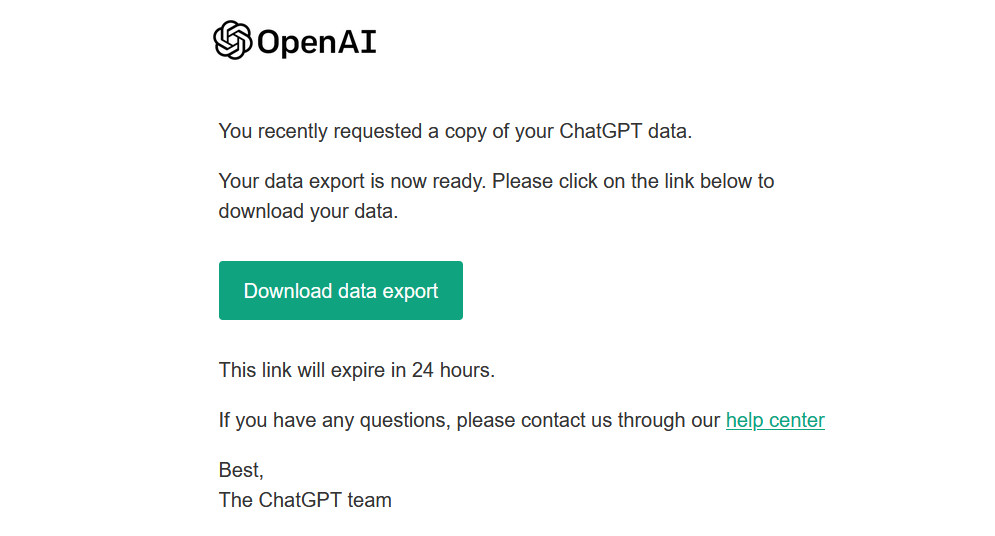
Also on Tuesday, OpenAI introduced a new “export” option in ChatGPT settings that allows users to export their ChatGPT data to files that can be stored locally on a PC. We tried the export option in ChatGPT Settings (click “Show” beside “Data Controls”) and received an email containing a link to a compressed HTML file and several JSON files that contained our stored conversation history with ChatGPT. The history only extended back to the last time we cleared the conversation history.

A screenshot of an email from OpenAI providing a link to exported ChatGPT conversation history.
Enlarge / A screenshot of an email from OpenAI providing a link to exported ChatGPT conversation history.
Benj Edwards / Ars Technica

For professionals and enterprises that “need more control over their data,” OpenAI also announced that it is working on a new “ChatGPT Business” subscription that will opt users out of model training by default, according to OpenAI’s Data Controls FAQ. OpenAI says the release date for ChatGPT Business will occur “in the coming months.”

https://arstechnica.com/?p=1934271


GOP releases AI-generated ad to fearmonger over Biden’s reelection bid

Screenshot from RNC's "Beat Biden" ad.
Enlarge / Screenshot from RNC’s “Beat Biden” ad.

Shortly after US President Joe Biden announced his 2024 presidential run—asking Americans to re-elect him so he can “finish the job!”—the Republican National Committee (RNC) responded with a AI-generated video. The 30-second RNC ad urged voters to “Beat Biden,” or else suffer disastrous consequences that the RNC suggests would likely come to pass if Americans voted to re-elect “the weakest president we’ve ever had.”

The RNC video opens with a fake news announcer calling the 2024 presidency for Biden. On the screen flashes a dark, AI-generated image of Biden and Vice President Kamala Harris, smiling and waving in front of a sea of American flags. From there, a series of AI-generated scenes show the faked future that the RNC imagines that this election result would bring, depicting banks closing, China invading Taiwan, San Francisco crime skyrocketing, and 80,000 “illegals” overwhelming the border.

[embedded content]
RNC’s “Beat Biden” ad.

“Who’s in charge here?” the RNC’s video asks. “It feels like the train is coming off the tracks.” The video then concludes with an image of Biden bent over his desk, appearing worried as he faces down the RNC’s slogan, “Beat Biden.”

Along with sharing the video, RNC Chairwoman Ronna McDaniel issued a statement claiming Biden is “so out-of-touch” for thinking that “he deserves another four years” after “creating crisis after crisis.”

“If voters let Biden ‘finish the job,’ inflation will continue to skyrocket, crime rates will rise, more fentanyl will cross our open borders, children will continue to be left behind, and American families will be worse off,” McDaniel said, her statement in sync with the AI video’s claims and designed to appeal to “Make America Great Again” (MAGA) fans.

Meanwhile, on Truth Social, Donald Trump continued his 2024 campaign by reminding his audience that “in the polls,” he claims to be “beating Biden everywhere, by a lot.” (Against other Republican candidates, Trump has a lead, as seen in a recent NBC News poll among Republican primary voters that weighs heavily in his favor, as well as this recent Wall Street Journal poll. However, The New York Times reported today that polls measuring Trump’s chances against Biden remain highly competitive but currently show Biden narrowly ahead.)

In his official statement on Biden’s re-election announcement, Trump also appeals to his MAGA fans. Like the RNC video, he criticizes Biden for doing more damage than the worst five American presidents in history put together. He warns that “banks are failing” and the “border has been abolished.” He also suggests that voting out Biden would “prevent World War III from happening.”

The RNC’s “Beat Biden” video had nearly 27,000 views on YouTube, as of this writing. Several YouTube commenters cracked jokes about the RNC’s historic use of AI image generators, with some suggesting that the RNC needed to use AI because their arguments against Biden aren’t based in reality. On Twitter, “Pod Save America” co-host Dan Pfeiffer similarly criticized the video, saying that the RNC’s response “suggests that they still haven’t figured out an argument against Biden that makes sense to anyone outside of the MAGA media bubble.”

The RNC didn’t immediately respond to Ars’ request to comment.

https://arstechnica.com/?p=1934254


L’IA potrebbe davvero causare una catastrofe di livello nucleare?

Secondo un sondaggio condotto dall’Institute for Human-Centered AI della Stanford University, il 36% dei ricercatori ritiene che l’IA potrebbe causare una “catastrofe a livello nucleare”. Grande.

L’indagine è stata condotta nel quadro del report annuale dell’istituto per il suo annuale AI index, che di fatto rappresenta la bibbia sullo stato dell’arte dell’industria.

E se da un lato il report indica un interesse crescente della politica per l’IA, non passa certamente inosservato quel 36% di ricercatori che considera l’IA una potenziale minaccia a livello nucleare.

Se può consolare, c’è da dire che recentemente un utilizzatore stava tentando di crearsi da solo un sistema di IA battezzato ChaosGPT allo scopo di distruggere l’umanità. Non è andato molto lontano, però è indicativo.

Più modi

Quella cifra del 36% arriva con un avvertimento importante. Si riferisce solo al processo decisionale dell’IA – come in un’IA che fa una scelta da sola che alla fine provoca una catastrofe – e non all’abuso umano dell’IA, una minaccia crescente che il rapporto ha affrontato separatamente in seguito.

“Secondo il database AIAAIC… il numero di incidenti e controversie sull’IA è aumentato di 26 volte dal 2012”, si legge nel rapporto. “Alcuni incidenti degni di nota nel 2022 includevano un video deepfake della resa del presidente ucraino Volodymyr Zelenskyy e le prigioni statunitensi che utilizzavano la tecnologia di monitoraggio delle chiamate sui loro detenuti”.

“Questa crescita è la prova sia di un maggiore utilizzo delle tecnologie di intelligenza artificiale sia della consapevolezza delle possibilità di uso improprio”, hanno scritto i ricercatori.

In altre parole: ci sono altri modi in cui l’IA può e sta causando danni, se non per sua stessa proverbiale mano.

Nonostante queste preoccupazioni, secondo il rapporto, solo il 41% dei ricercatori sull’elaborazione del linguaggio naturale (PNL) pensava che l’intelligenza artificiale dovesse essere regolamentata.

Allaccia le cinture

Il sondaggio serve come uno sguardo affascinante nella mente collettiva del settore dell’intelligenza artificiale, che nel complesso sembra avere una certa ambivalenza sul futuro della tecnologia. Solo il 57 percento dei ricercatori, ad esempio, pensa che i “recenti progressi della ricerca” stiano aprendo la strada all’intelligenza artificiale generale.

Gli intervistati avevano un notevole punto di accordo: il 73% dei ricercatori “ritiene che l’intelligenza artificiale potrebbe presto portare a un cambiamento sociale rivoluzionario”.

Quindi, se stiamo andando verso una catastrofe a livello nucleare, o qualcosa di completamente diverso, potresti voler allacciare le cinture.

https://www.key4biz.it/lia-potrebbe-davvero-causare-una-catastrofe-di-livello-nucleare/443393/


Reddit will start charging AI models learning from its extremely human archives

Reddit mascot in front of silhouetted phone
Enlarge / Reddit, a site that is chock-full of humans being every kind of human possible, will start charging larger businesses that want to train their Large Language Model AIs on its data.
Getty Images

If you’re a business training a large language model (LLM) AI and want it to learn from the u/420NarutoConspiracy subreddit, you’ll soon have to pay for that.

Steve Huffman, founder and CEO of social news and discussion aggregator Reddit, told The New York Times recently that it planned to charge companies accessing its API for the purpose of pulling its 18 years’ worth of content generated mostly by humans. Details on the new terms are available in a subsequent announcement post on Reddit.

The API would still be free to developers working on bots and other Reddit tools, and researchers working on academic or non-commercial projects. But simply mainlining Reddit’s conversations for AI training purposes will come with a price, the exact amounts of which should arrive in the coming weeks.

“The Reddit corpus of data is really valuable,” Huffman told the Times. “But we don’t need to give all of that value to some of the largest companies in the world for free.

“Crawling Reddit, generating value and not returning any of that value to our users is something we have a problem with. It’s a good time for us to tighten things up.”

Reddit’s comments and conversations have been a rich resource for training LLM AIs. ChatGPT and Google’s Bard cite Reddit data as one of their sources. In their analysis of just one subset (12 million) of Stable Diffusion’s image generation dataset (2.3 billion), Andy Baio and Simon Willison noted that “user-generated content platforms were a huge source for the image data.” An investigation into common data sources for many AIs published today by The Washington Post noted that “a compilation of text from links highly rated by Reddit users” is included in GPT-3.

While it intends to limit access to AIs, Reddit said it intends to give developers and moderators better tools for working within their communities. Reddit’s iOS and Android apps will offer ways to quickly view a user’s history, update community rules, and better handle multiple mod queues.

Reddit’s shift on API access comes as the company is looking to go public in the second half of 2023, according to The Information. The company confidentially filed for an initial public offering in December 2021. It had hoped for a $15 billion valuation, according to Reuters, but has held off on its filing until market conditions, especially around tech companies, improve.

Reddit is partially owned by Advance Publications, which also owns Ars Technica parent Condé Nast.

https://arstechnica.com/?p=1933080


ChatGPT e i suoi pari possono aiutare le telco a tagliare i costi e migliorare i servizi

L’IA generativa è l’argomento più caldo del tech, ma l’interesse per l’intelligenza artificiale comincia a diffondersi a macchia di leopardo fra tutti i tipi di aziende. E mentre i regolatori cercano di capire quale può essere il loro ruolo, la società di ricerca GlobalData analizza il potenziale dei tool di IA sul business della telco.

Ambiti di applicazione

Miglioramento del customer care, scoperta di frodi e riduzione dei costi sono i vantaggi potenziali per la industry che può così beneficiare del potere dei sistemi di IA generativa, come ChatGPT, nella quotidianità.

Dal customer care, al network management, all’identificazione di frodi alle vendite e al marketing.

Integrare sistemi di IA nei metodi tradizionali di customer care delle telco può essere utile per fornire supporto automatizzato e istantaneo 24 ore su 24, con informazioni in real time su prodotti e servizi delle telco.

Chatbot intelligente

Il chatbot potenziato con l’IA può aiutare a gestire diverse richieste dei clienti in modo rapido ed efficiente, riducendo i tempi di attesa e migliorando la customer satisfaction. Per coprire diversi mercati geografici, si può chiedere a ChatGPT di parlare lingue diverse.

Secondo GlobalData, ChatGPT può aumentare le vendite e i ricavi degli operatori presentando ai clienti consigli sui prodotti personalizzati e offerte esclusive basate sui loro interessi e sugli acquisti precedenti. Lo strumento può anche aiutare a identificare e monitorare i truffatori, ad esempio creando un database per prevenire futuri tentativi ingannevoli.

Gli operatori si fanno la loro versione di ChatGPT

Un’altra tendenza emergente evidenziata dal team di GlobalData è che gli operatori hanno già iniziato a lavorare sulle proprie versioni di ChatGPT: la telco sudcoreana KT sta costruendo la propria versione del modello OpenAI, mentre il suo rivale domestico SK Telecom (SKT) prevede di lanciare la propria AI chatbot, avendo già lanciato una versione beta denominata “A.” nel maggio 2022. E China Telecom ha in programma di costruire un modello di base AI per sviluppare una versione industriale di ChatGPT per l’industria delle telecomunicazioni. Con diverse società di telecomunicazioni che testano ed esplorano nuovi casi d’uso per ChatGPT, gli investimenti nel settore delle telecomunicazioni sono destinati ad aumentare a breve e medio termine, secondo GlobalData.

Valore dell’IA nelle comunicazioni a 2,9 miliardi nel 2026

La società di analisi prevede che la spesa per l’IA aziendale nel settore delle comunicazioni raggiungerà i 2,9 miliardi di dollari nel 2026, in aumento dell’81% rispetto agli 1,6 miliardi di dollari stimati per il 2022.

Il tema dell’IA generativa è stato oggetto di polemiche significative di recente, con leader tecnologici, come Elon Musk e il co-fondatore di Apple Steve Wozniak, che hanno chiesto una pausa temporanea dello sviluppo dell’IA generativa a causa delle preoccupazioni che “i sistemi di intelligenza artificiale con intelligenza umana-competitiva possono pongono rischi profondi per la società e l’umanità”.

Nel frattempo, il governo del Regno Unito sta valutando il suo approccio alla regolamentazione dell’IA, mentre l’Italia ha vietato l’uso di ChatGPT. A seguito della mossa dell’Italia, il Comitato europeo per la protezione dei dati (EDPB) ha lanciato “una task force dedicata per promuovere la cooperazione e scambiare informazioni su possibili azioni di contrasto condotte dalle autorità per la protezione dei dati”.

https://www.key4biz.it/chatgpt-e-i-suoi-pari-possono-aiutare-le-telco-a-tagliare-i-costi-e-migliorare-i-servizi/443136/


GPT-4 will hunt for trends in medical records thanks to Microsoft and Epic

An AI-generated image of a pixel art hospital with empty windows.
Enlarge / An AI-generated image of a pixel art hospital with empty windows.
Benj Edwards / Midjourney

On Monday, Microsoft and Epic Systems announced that they are bringing OpenAI’s GPT-4 AI language model into health care for use in drafting message responses from health care workers to patients and for use in analyzing medical records while looking for trends.

Epic Systems is one of America’s largest health care software companies. Its electronic health records (EHR) software (such as MyChart) is reportedly used in over 29 percent of acute hospitals in the United States, and over 305 million patients have an electronic record in Epic worldwide. Tangentially, Epic’s history of using predictive algorithms in health care has attracted some criticism in the past.

In Monday’s announcement, Microsoft mentions two specific ways Epic will use its Azure OpenAI Service, which provides API access to OpenAI’s large language models (LLMs), such as GPT-3 and GPT-4. In layperson’s terms, it means that companies can hire Microsoft to provide generative AI services for them using Microsoft’s Azure cloud platform.

The first use of GPT-4 comes in the form of allowing doctors and health care workers to automatically draft message responses to patients. The press release quotes Chero Goswami, chief information officer at UW Health in Wisconsin, as saying, “Integrating generative AI into some of our daily workflows will increase productivity for many of our providers, allowing them to focus on the clinical duties that truly require their attention.”

The second use will bring natural language queries and “data analysis” to SlicerDicer, which is Epic’s data-exploration tool that allows searches across large numbers of patients to identify trends that could be useful for making new discoveries or for financial reasons. According to Microsoft, that will help “clinical leaders explore data in a conversational and intuitive way.” Imagine talking to a chatbot similar to ChatGPT and asking it questions about trends in patient medical records, and you might get the picture.

GPT-4 is a large language model (LLM) created by OpenAI that has been trained on millions of books, documents, and websites. It can perform compositional and translation tasks in text, and its release, along with ChatGPT, has inspired a rush to integrate LLMs into every type of business, whether appropriate or not.

https://arstechnica.com/?p=1932593


Elon Musk Says He’ll Create ‘TruthGPT’ to Counter AI ‘Bias’

Billionaire Twitter owner Elon Musk is again sounding warning bells on the dangers of artificial intelligence to humanity — and claiming that a popular chatbot has a liberal bias that he plans to counter with his own AI creation.

Musk told Fox News host Tucker Carlson in a segment aired Monday night that he plans to create an alternative to the popular AI chatbot ChatGPT that he is calling “TruthGPT,” which will be a “maximum truth-seeking AI that tries to understand the nature of the universe.”

The idea, Musk said, is that an AI that wants to understand humanity is less likely to destroy it.

Musk also said he’s worried that ChatGPT “is being trained to be politically correct.”

In the first of a two-part interview with Carlson, Musk also advocated for the regulation of artificial intelligence, saying he’s a “big fan.” He called AI “more dangerous” than cars or rockets and said it has the potential to destroy humanity.

Separately, Musk has incorporated a new business called X.AI Corp,, according to a Nevada business filing. The website of the Nevada secretary of state’s office says the business was formed on March 9 and lists Musk as its director and his longtime adviser, Jared Birchall, as secretary.

Musk was an early investor in OpenAI — the startup behind ChatGPT — and co-chaired its board upon its 2015 founding as a nonprofit AI research lab. But Musk only lasted there for a few years, resigning from the board in early 2018 in a move that the San Francisco startup tied to Tesla’s work on building automated driving systems. “As Tesla continues to become more focused on AI, this will eliminate a potential future conflict for Elon,” OpenAI said in a February 2018 blog post.

“I came up with the name and the concept,” Musk told Carlson, lamenting that OpenAI is now closely allied with Microsoft and is no longer a nonprofit.

Musk elaborated on his departure in 2019, saying it was also related to his need to focus on engineering problems at Tesla and some differences of opinion with OpenAI’s leaders. It was “just better to part ways on good terms,” he said.

“Tesla was competing for some of same people as OpenAI & I didn’t agree with some of what OpenAI team wanted to do,” Musk tweeted, without specifying.

But there have been questions surrounding the quality of Tesla’s AI systems. U.S. safety regulators last month announced an investigation into a fatal crash involving a Tesla suspected of using an automated driving system when it ran into a parked firetruck in California.

The firetruck probe is part of a larger investigation by the agency into multiple instances of Teslas using the automaker’s Autopilot system crashing into parked emergency vehicles that are tending to other crashes. NHTSA has become more aggressive in pursuing safety problems with Teslas in the past year, announcing multiple recalls and investigations.

In the year after Musk resigned from the board, OpenAI was still far away from working on ChatGPT but publicly unveiled the first generation of its GPT system, on which ChatGPT is founded, and began a major shift to incorporate itself as a for-profit business.

By 2020, Musk was tweeting that “OpenAI should be more open” while noting that he had “no control & only very limited insight” into it.

At times, he has been complementary. In the days after the Nov. 30 release of ChatGPT, Musk tweeted to OpenAI CEO Sam Altman that it is “scary good” and complained that news media wasn’t widely covering it because “ChatGPT is not a far left cause.”

Since then, however, Musk has repeatedly highlighted examples that he says show left-wing bias or censorship. Like other chatbots, ChatGPT has filters that try to prevent it from spewing out toxic or offensive answers.

Related: ​​ChatGPT, the AI Revolution, and the Security, Privacy and Ethical Implications

Related: Microsoft Puts ChatGPT to Work on Automating Cybersecurity

Related: ChatGPT and the Growing Threat of Bring Your Own AI to the SOC

Related: Microsoft Invests Billions in ChatGPT-Maker OpenAI

https://www.securityweek.com/elon-musk-says-hell-create-truthgpt-to-counter-ai-bias/