AI platform allegedly bans journalist over fake Trump arrest images

AI-generated photo faking Donald Trump's possible arrest, created by Eliot Higgins using Midjourney v5.
Enlarge / AI-generated photo faking Donald Trump’s possible arrest, created by Eliot Higgins using Midjourney v5.

Yesterday, about 50 AI-generated images imagining what former President Donald Trump’s arrest would look like spread across Twitter. The images caused confusion for some users because the Midjourney v5 engine used to create them generates such realistic-looking content.

Today, the Midjourney user behind the images—Bellingcat founder Eliot Higgins—alleged to Buzzfeed News that he was banned from Midjourney over the images. Buzzfeed also reported that Midjourney has banned the word “arrest” from being used in text prompts to generate images.

Midjourney has not yet confirmed the ban. An Ars test indicates that prompts using Donald Trump’s name also seem to be blocked on the engine, generating instead an error message saying that the prompt was blocked because “it may conflict with our content policy.” We got the same error message when we used prompts including other Trump family names and all the presidents’ names. However, other celebrity names, like former NFL player Tom Brady, are still seemingly acceptable in prompts.

Higgins told Buzzfeed that he understands why Midjourney may have banned him, saying that “it was pushing my luck” creating the Twitter thread that went viral. Higgins told Ars that responses to the images have been generally positive but that he also is “getting quite a few angry” Trump fans responding.

“I didn’t intend to do any clever criticism or anything like that,” Higgins told Buzzfeed, saying that he was just having fun imagining Trump’s arrest with the images. “But then it kind of took on a life of its own.”

Higgins told Ars that “what really stood out” to him was “the number of people who don’t seem to have been aware of Midjourney’s existence or what it’s capable of.” He thinks creating the images “had a positive impact in raising awareness of what kind of images can be faked now” and said that AI platforms like Midjourney “probably shouldn’t train their datasets on people they don’t want re-created.”

Yesterday, Higgins told Wired how Twitter users could avoid being fooled by convincing AI-generated images like the fake Trump arrest images. Higgins noted that celebrities are easier targets for deepfakes, though, because “it’s clear that the more famous a person is, the more images the AI has had to learn from,” Higgins said.

“So very famous people are rendered extremely well, while less famous people are usually a bit wonky,” Higgins told Wired.

On Twitter, Higgins’ images are now labeled with a community note flagging that they’re fake. Twitter’s policy states that users “may not deceptively share synthetic or manipulated media that are likely to cause harm” and that these labels “help people understand their authenticity” and “provide additional context.”

Higgins’ entire thread is still available on Twitter, where some images have been viewed 4.8 million times as of this writing.

While Trump previously indicated that he expected his indictment to occur yesterday, that didn’t happen. Outlets like MSNBC and The New York Times are now reporting that his potential arrest over hush-money payments to porn star Stormy Daniels could happen in the coming days.

While Ars has not found any comments from Trump on Higgins’ AI-generated images, Forbes reported that Trump has told advisors that he wants his arrest—if it happens—to be a “spectacle” that includes a “perp walk” in handcuffs so that he doesn’t appear weak to his supporters.

https://arstechnica.com/?p=1925983


How I Use AI Writing Tools as a Content Writer

A slate of writing tools powered by artificial intelligence (AI) have recently made headlines as a new and more effective way to produce content. Most tech companies have even been implementing AI into their own tools as well, like we did earlier this year when we launched our AI assistant.

I’ve written about my conflicted feelings about these very AI writing tools, but I’ve been making an effort to push past my hesitation and add AI into the articles I write for the Buffer blog. The hope was that by doing so, I could speed up my writing process.

So, despite my initial resistance, I went ahead and used AI when outlining and drafting blog posts. Here’s what two weeks of incorporating AI looked like and how my thoughts on AI writing tools have changed.

When it came to choosing which AI tools to use, I opted for convenience. I’m constantly working in Notion and use it for outlining blog posts, so it was very easy for me to incorporate their recently launched tool, Notion AI, into my planning.

Since we recently added Buffer’s AI assistant into our product, I’ve also been experimenting more with this feature and typically have the tool open during the work day so I can just easily switch over to our ideas section and write. I didn’t use other more popular tools like ChatGPT because rather than learning how to use a new product, I wanted something that I could seamlessly embed into my existing arsenal of tools.

I was only using these tools for outlining and brainstorming purposes. I never prompted the AI to write out a full blog post for me, but instead just asked it questions to help me generate ideas and help build out the article. Throughout the course of two weeks, I ended up using AI for:

  • Outlines
  • Interview questions
  • Suggestions for titles
  • Brainstorming introductions

Right off the bat, I could quickly outline various topics quickly with AI. While I was still writing my own outlines, I was able to fill them out much faster than usual. To clarify, I never prompted the AI to “write an outline.” Instead, I just asked questions about my topic to see the key points it would generate. This really helped because sometimes when starting out a new post, I can have a bout of writer’s block and using AI essentially fixed that.

For example, when it came to my article on LinkedIn analytics, I used AI to help with the order of the post as well as some of the main points in each section. I did the same thing when refreshing one of our older posts on Instagram Story templates, as I updated the introduction and used AI to run through different versions.

I also found that these writing tools were a great way to boost my productivity when I was behind on work. One day in particular, I was feeling under the weather and took a half-day. The next morning, I was scheduled to have an interview with a TikToker about brand deals, and was able to generate a list of ten thoughtful questions in seconds with AI. While I did edit and tailor the questions to better fit my interviewee, this was a huge help at a moment when I really needed it.

Overall, it felt like brainstorming was easier thanks to AI. Writing is often a solitary act for me, so it was nice to have a sounding board to bounce ideas off of.

As I started using AI writing tools more, I began to concede that AI actually can produce pretty decent content. However, the one main issue I still have is that the writing isn’t always accurate. Like when it gave me the wrong list of steps after I asked it how to turn on LinkedIn Creator mode.

Similarly, when I used it for my article on Instagrams collab posts feature, the AI kept confusing the feature with the actual act of collaboration. So, it was instead giving me answers about how people could collaborate with each other on Instagram, which wasn’t the actual topic of the piece. I tried to redirect it a few times with no luck. But I may need to work on my prompting skills. My colleagues Tami and Phil wrote about the importance of good AI prompts and why adding context is necessary when asking the AI to produce work.

Even when I got back the right results, I wasn’t always happy with the final copy. As a content writer myself, I personally felt like the writing quality from these tools was good, but not great, and that I needed to edit it or spruce it up.

Another issue I had was that oftentimes the copy felt quite repetitive. Whether it was the AI repeating the same word over again or just the sentiment, this was a reminder that AI is simply regurgitating everything that has already been written before. Although that can sometimes make for decent copy, it’s not original and groundbreaking work. This is why real writers and their efforts should still be valued.

Ultimately, these tools didn’t really save me that much time in the end. While it was super helpful before my interview, for the most part I found that either I would still have to correct the AI or rewrite the work.

With that being said, I still found the AI useful. Before these two weeks, I wasn’t very comfortable integrating these tools into my everyday work routine, but now I plan to use them from time to time. While I personally don’t feel like I need these tools on an everyday basis, I recognize the benefits of using them on days I feel especially blocked.

If you’re also interested in experimenting with AI, sign up for Buffer for free and try out our AI assistant today!

https://buffer.com/resources/ai-writing-tools/


AI-faked images of Donald Trump’s imagined arrest swirl on Twitter

AI-generated photo faking Donald Trump's possible arrest, created by Eliot Higgins using Midjourney v5.
Enlarge / AI-generated photo faking Donald Trump’s possible arrest, created by Eliot Higgins using Midjourney v5.

As the world waits to see if former President Donald Trump will actually be indicted today over hush-money payments to porn star Stormy Daniels, AI-generated images began circulating on Twitter imagining what that arrest would look like. Showing Trump resisting arrest and being dragged off by police, the realistic but very fake photos have already been viewed by millions.

“Making pictures of Trump getting arrested while waiting for Trump’s arrest,” tweeted Eliot Higgins, who is the founder and creative director of Bellingcat, an independent international collective of researchers, investigators, and citizen journalists.

In a tweet, Higgins confirmed that he used the impressively realistic AI engine Midjourney v5 to generate the fake images.

Ars couldn’t immediately reach Higgins for comment on the images, some of which have been viewed 2.2 million times on Twitter as of this writing.

Twitter guidelines say that users “may not deceptively share synthetic or manipulated media that are likely to cause harm” and suggest that, at the very least, the images may soon be labeled to “help people understand their authenticity and to provide additional context.” Ars reached out to Twitter for comment on the images, but—as CEO Elon Musk tweeted the company would do days ago—Twitter only responded with a poop emoji.

Twitter’s failure to label the somewhat convincing AI-generated images could potentially cause harm, as The Guardian reported that there has been a significant increase in online threats since news of Trump’s potential indictment started spreading. AP News reported that New York is already preparing for possible unrest if an arrest happens, and some users have remarked that Higgins’ images were convincing enough to fool them.

At least one Twitter user suggested Higgins should have put a watermark on the image to eliminate any potential confusion. But whether Higgins had any duty to do so remains one of those still-unanswered questions swirling online as AI-generated content becomes increasingly popular—creating a potential future where Internet users may be unable to believe anything they see online.

Midjourney could not immediately be reached to confirm whether Higgins’ images violate its terms of service, which includes community guidelines that ban “images or use text prompts that are inherently disrespectful, aggressive, or otherwise abusive.”

“Violence or harassment of any kind will not be tolerated,” the guidelines say.

Social media platforms are beginning to lay out ground rules for AI-generated content, and at least some have put the onus on users to label such content. TikTok is the latest platform to require that all realistic deepfakes be “clearly disclosed,” prompting users this week to start adding a “sticker or caption, such as ‘synthetic,’ ‘fake,’ ‘not real,’ or ‘altered’” to prevent confusion.

Anyone who clicks through Higgins’ thread of AI-generated images faking Trump’s arrest would likely realize that the images are not real. Not only do they show Trump resisting arrest and even running from police, but there are also images showing Trump seemingly prepared to tackle a cop and court scenes showing Trump sobbing, which could seemingly happen only well after any arrest.

Additionally, Higgins did arguably clearly label the images as fake in his initial tweet on the thread that says he’s “making pictures” and in subsequent tweets describing the images as “AI Trump world.”

https://arstechnica.com/?p=1925576


Bing’s AI chatbot can now generate unhinged images along with unhinged text

Bing Image Creator,
Enlarge / “A gaming PC riding a skateboard” as generated by the DALL-E 2-powered Bing Image Creator. The version of DALL-E in the Bing Chat preview may be more advanced.
Bing Image Creator

Microsoft is giving its work-in-progress Bing AI chatbot the ability to generate images, the company announced today. Bing preview users can generate images by typing “create an image” (or something similar) followed by the prompt. As with other AI-powered image generators, the more detailed a prompt you provide, the more specific and consistent the output is.

Not all Bing preview users will be able to generate images right away, as Microsoft is rolling the feature out in phases (it’s not working for me as of this writing). Initially, it will only work in the chatbot’s “Creative” mode. The bot has three “personalities,” and “Creative” is the most prone to giving wrong answers and inaccurate information.

Microsoft said it was using “an advanced version” of the DALL-E generator without providing additional details. The Bing chatbot was using OpenAI’s GPT-4 model several weeks before it was formally announced to the public, so Microsoft could also be using a more powerful pre-release version of the DALL-E model. The image generator Microsoft made available to the public in October uses DALL-E 2.

Mindful of early problems with the text that the Bing chatbot could generate, Microsoft is putting additional content-generation safeguards in place in addition to OpenAI’s own built-in restrictions for DALL-E.

“When our system detects that a potentially harmful image could be generated by a prompt, it blocks the prompt and warns the user,” writes Microsoft VP Yusuf Mehdi in the company’s blog post. “We also make it clear that Image Creator’s images are generated by AI, and we include a modified Bing icon in the bottom-left corner of each image to help indicate that the image was created using Image Creator.”

Microsoft has been pushing all year to include more AI features across all of its products. The “new Bing” originally debuted in early February, and Microsoft added Bing Chat integration to the Edge browser and the Windows 11 taskbar shortly after. Last week, the company announced Copilot, an AI tool for generating documents, emails, notes, and presentations using the former Microsoft Office apps. The company has a multi-year, multi-billion-dollar partnership with OpenAI that is making all of these projects possible.

Accessing all of the Bing chatbot features requires opting in to the preview, which is still currently invite-only but is still accepting new sign-ups.

https://arstechnica.com/?p=1925511


Anthropic introduces Claude, a “more steerable” AI competitor to ChatGPT

Anthropic introduces Claude, a “more steerable” AI competitor to ChatGPT

On Tuesday, Anthropic introduced Claude, a large language model (LLM) that can generate text, write code, and function as an AI assistant similar to ChatGPT. The model originates from core concerns about future AI safety and Anthropic has trained it using a technique it calls “Constitutional AI.”

Two versions of the AI model, Claude and “Claude Instant,” are available now for a limited “early access” group and to commercial partners of Anthropic. Those with access can use Claude through either a chat interface in Anthropic’s developer console or via an application programming interface (API). With the API, developers can hook into Anthropic’s servers remotely and add Claude’s analysis and text completion abilities to their apps.

Anthropic claims that Claude is “much less likely to produce harmful outputs, easier to converse with, and more steerable” than other AI chatbots while maintaining “a high degree of reliability and predictability.” The company cites use cases such as search, summarization, collaborative writing, and coding. And, like ChatGPT’s API, Claude can change personality, tone, or behavior depending on use preference.

[embedded content]
A promotional video showcasing Claude from Anthropic.

To sell Claude, Anthropic is charging for usage per million characters input and output. Whereas OpenAI’s gpt-3.5-turbo AI model is $0.002 per 1,000 tokens (fragments of a word), Claude Instant is available for $0.42 per million characters as prompt input and $1.45 per million characters for output. “Claude-v1,” the larger model, comes in at $2.90 per million characters input and $8.60 per million characters output. While there is no standard conversion between tokens and characters, our back-of-the-envelope calculation is that OpenAI’s ChatGPT API is about $0.40 to $0.50 per million characters, so Claude is more expensive in general.

A table that compares prices of OpenAI's ChatGPT API and the two Claude APIs, based on a rough estimate of four characters per token.
Enlarge / A table that compares prices of OpenAI’s ChatGPT API and the two Claude APIs, based on a rough estimate of four characters per token.
Ars Technica

According to Anthropic, Claude has already been integrated into several products available through partners, such as DuckAssist instant summaries from DuckDuckGo, a portion of Notion AI, and an AI chat app called Poe that was created by Quora.

Former OpenAI VP of research Dario Amodei and his sister Daniela founded Anthropic in 2021 as “an AI safety and research company” after a disagreement over OpenAI’s increasingly commercial direction. Amodi brought along other OpenAI staff such as Tom Brown, who led engineering work on GPT-3. A revision of GPT-3 later served as the foundational language model at the heart of ChatGPT. According to The Verge, Google invested $300 million in Anthropic in late 2022 in exchange for 10 percent of the company.

Based on Google’s announced plans for Bard and the PaLM API, it seems unlikely that Google will rely on Anthropic for AI solutions in its products, but funding a rival to OpenAI might be in Google’s strategic best interest down the road. For now, Anthropic plans to continue development and improvement of Claude.

“We plan to introduce even more updates in the coming weeks,” Anthropic writes. “As we develop these systems, we’ll continually work to make them more helpful, honest, and harmless as we learn more from our safety research and our deployments.”

https://arstechnica.com/?p=1924161


Tra Rai e Siae, spuntano Meta e ChatGpt: delle irrisolte contraddizioni fra politica culturale e ‘value gap’

La notizia è emersa con forza ieri, giovedì 16 marzo, allorquando Meta, il gruppo al quale appartengono Facebook ed Instagram, ha annunciato che non è stata trovata una intesa per rinnovare “l’accordo di licenza con Siae” (scaduto il 1° gennaio 2023), precisando che “la tutela dei diritti d’autore di compositori e artisti è per noi una priorità assoluta e per questo motivo, a partire da oggi, avvieremo la procedura per rimuovere i brani del repertorio Siae all’interno della nostra libreria musicale. Abbiamo accordi di licenza in oltre 150 Paesi nel mondo e continueremo a impegnarci per raggiungere un accordo con Siae che soddisfi tutte le parti”.

Concretamente, ciò significa che gli utenti italiani non potranno più usare i brani del repertorio Siae nelle “Storie” di Facebook e Instagram, cioè nei “Reel” di Facebook e Instagram e nei “Feed” di Instagram, dove la musica si può aggiungere ai post dallo scorso novembre. Di fatto, tutti gli artisti italiani (ovvero la gran parte di essi) vengono cancellati dal “catalogo” di Facebook e Instagram.

La rimozione dei contenuti non autorizzati richiederà del tempo, anche se è stato prospettato che la cancellazione sarebbe avvenuta nell’arco di 48 ore, ovvero entro oggi venerdì 17 marzo.

Braccio di ferro tra Meta e Siae, sintomatico di scontri ancor più duri, che presto l’economia digitale andrà a scatenare

Immediata la reazione della Siae, presto spalleggiata dal Governo: secondo la Società Italiana degli Autori e Editori, si tratta di una “decisione unilaterale” per escludere il repertorio della società dal proprio catalogo, “prescindendo da qualsiasi valutazione trasparente e condivisa dell’effettivo valore del repertorio”.

Siae accusa il gruppo di Mark Zuckerberg di aver rifiutato di condividere “informazioni rilevanti ai fini di un accordo equo”, andando contro i principi della Direttiva “Copyright”.

Ieri pomeriggio, non appena ha appreso della decisione di Meta, il Ministro della Cultura Gennaro Sangiuliano, ha dichiarato in modo duro: “occorre difendere in modo sacrosanto gli autori italiani e l’opera del loro ingegno. I colossi transnazionali del digitale devono rispettare l’identità e la sovranità legislativa degli Stati. È sacrosanto difendere gli autori italiani e tutelare l’opera del loro ingegno, quella creatività che tanto valore ha nel mondo. Salvaguardare il frutto del lavoro autoriale è innanzitutto un principio etico, ancor prima che giuridico. Operare per difendere la creatività nazionale e l’immaginario italiano, poi, è un preciso mandato politico da onorare nei fatti. La indiscutibile libertà di mercato va esercitata all’interno di regole condivise e rispettate da tutti: è il fondamento di una convivenza pacifica e produttiva. La frontiera dell’innovazione non può e non deve essere il Far West del terzo millennio. L’oceano della rete va alimentato di contenuti di cui va riconosciuta la giusta retribuzione, altrimenti è destinato a diventare un Mar Morto sterile e senza vita”.

Poco prima della dichiarazione del Ministro, la Sottosegretaria Lucia Borgonzoni aveva diramato una nota stampa sostenendo che “la scelta di Meta di rimuovere i contenuti italiani dalla propria libreria musicale arreca al nostro Paese un danno enorme. Mi auguro che vengano immediatamente riaperti tavoli di discussione che possano portare a decisioni in grado di garantire i giusti diritti ai nostri artisti e di tutelare la creatività italiana. Meta nel frattempo sospenda la rimozione”.

Non ci risulta che l’invito della Sottosegretaria leghista sia stato accolto.

Meta vuole un accordo a forfait, Siae contrappone l’esigenza di una condivisione dei ricavi

In sintesi, lo scontro è determinato dalle contrapposte tesi: Meta vorrebbe un accordo “a forfait”, mentre Siae vuole un accordo che determini una equa ripartizione dei ricavi, in funzione del reale andamento delle fruizioni da parte degli utenti.

La società di Menlo Park sostiene che “soltanto con l’Italia” non sarebbe riuscita a trovare un’intesa. Questione che andrebbe opportunamente approfondita, in chiave comparativa: che condizioni sono riuscite ad ottenere le “collecting” omologhe di Siae in altri Paesi?!

Proveremo a chiedere queste informazioni sia a Siae sia a Meta o cercando da altre fonti…

Un articolo di Andrea Biondi sul confindustriale “Il Sole 24 Ore” di oggi ben sintetizza nel titolo l’oggetto del contendere: “L’asimmetria informativa che allontana i colossi del web”. Biondi riporta il pensiero del Direttore Generale della Siae, Matteo Fedeli (subentrato dal 1° gennaio scorso a Gaetano Blandini, attualmente Presidente della Fondazione Copia Privata, sulla quale torneremo presto su queste colonne), il quale sostiene che “siamo sempre al ‘value gap’, impossibile da colmare se non colmiamo prima l’‘information gap’”.

Il Presidente Onorario della Siae Giulio Rapetti Mogol ha dichiarato a “FqMagazine” (testata de “Il Fatto Quotidiano”), durante la presentazione alla stampa del nuovo disco con Mario Lavezzi (“Capolavori nascosti”): “questa è una battaglia giusta. Quella che facciamo noi dico, ed è una battaglia che riguarda anche voi giornalisti, se pubblicano gli articoli e non vi danno i soldi? Con i diritti accade lo stesso. Io l’ho portata avanti questa battaglia sacra. Il copyright è stato approvato al Senato e alla Camera ed è fermo ai decreti attuativi da otto mesi. È tutto fermo non riusciamo a capire il perché”. E (ottimisticamente?!) ha concluso: “non sarà comunque una battaglia che perderemo”.

Secondo Enzo Mazza, Presidente della Fimi (Federazione Industria Musicale Italiana), la questione è di natura economica ma anche di principio: “speriamo si trovi rapidamente una soluzione, perché l’impatto di questo mancato accordo tra Siae e Meta potrebbe avere rilevanti effetti economici sul complesso dei ricavi dallo streaming musicale in Italia. La recente Direttiva Copyright ha stabilito regole molto precise per le licenze di musica online”. Questa normativa cerca una remunerazione adeguata e proporzionata per gli autori, ed impone obblighi di trasparenza alle piattaforme.

La Direttiva Europea impone obblighi di trasparenza ed equa remunerazione, ma le piattaforme reagiscono con… “no data”!

L’articolo 19 della Direttiva Europea impone l’obbligo di trasparenza: i licenziatari sono infatti tenuti a fornire annualmente, ai titolari dei diritti ed alle associazioni degli interpreti, informazioni complete, aggiornate e pertinenti sullo sfruttamento dell’opera, compresi il capitale generato ed il compenso dovuto.

L’articolo 20 prevede, invece, il diritto per gli autori di rivendicare una remunerazione maggiore, adeguata ed equa, qualora la prevista inizialmente appaia essere troppo bassa rispetto ai proventi effettivi generati dallo sfruttamento dell’opera/esecuzione.

La Siae, presieduta dall’ottobre del 2022 da Salvatore Nastasi (già Segretario Generale del Ministero della Cultura), si è seduta al tavolo delle trattative con Meta con una posizione chiara: far valere la Direttiva Europea, comprendere come sono state usate negli ultimi anni le sue opere e che giro di affari hanno generato, e strutturare un accordo preciso che potesse essere soddisfacente per i propri associati…

Va ben precisato che Meta non sta subendo un trattamento peggiore o discriminatorio rispetto a quel che la Società Italiana degli Autori e Editori ha messo in atto con “player” del livello di YouTube e Spotify e TikTok, con i quali ha definito accordi (accordi le cui caratteristiche non sono state rese di pubblico dominio, ma questo è un altro discorso…).

Queste piattaforme forniscono a Siae i dati richiesti ed i contratti vengono regolati di conseguenza. Di fatto, viene praticata una “condivisione dei ricavi”, sulla base dei numeri di effettiva fruizione: per ogni brano ascoltato, all’autore arriva una piccola percentuale del guadagno prodotto dal brano, se esso ha monetizzato. Che questa “percentuale” sia verosimilmente ancora piuttosto bassa, è questione altra: senza dubbio, permane sacrosanto il principio della condivisione dei flussi reddituali.

Un principio simile vale anche per i negozi, e per ogni altra attività che deve acquistare da Siae i diritti di diffusione: per esempio, le attività commerciali che trasmettono musica pagano in base al “metro quadrato”, perché è la metrica più vicina per stimare quanti possano essere i potenziali ascoltatori…

Lo scontro tra Meta e Siae è sintomatico, ed è importante che la “collecting” reagisca a muso duro a chi cerca di sfuggire ad una sana e ragionevole trattativa: riteniamo che la stessa Meta possa soffrire le conseguenze della propria decisione, se gli utenti si vedranno costretti a rinunciare a musiche che fanno parte del loro storico immaginario…

Comunque, il problema riguarda l’insieme delle industrie culturali e creative, che certamente beneficiano delle enormi potenzialità distributive determinate dal web, ma, al tempo stesso, le industrie dell’immaginario hanno grande difficoltà ad evitare che la ricchezza reddituale vada a primario vantaggio degli “over-the-top” e delle “piattaforme”…

Si viene a determinare una crescente asimmetria, informativa e reddituale.

È indispensabile l’intervento della “mano pubblica”, per quanto quest’azione sia ostacolata dalla logica “globale” ovvero “planetaria” dell’economia digitale di queste multinazionali, che sono molto più potenti e pervasive di quelle che un tempo erano le “major” statunitensi del cinema…

Se le nazioni appaiono deboli a livello individuale, in qualche modo è riuscita ad intervenire l’Unione Europea.

Lo scontro Meta vs Siae rappresenta semplicemente una punta dell’iceberg della rottura di paradigmi storici nell’economia della cultura e nelle politiche culturali.

La questione determina ricadute e ri-propone quesiti che sono stati posti, da anni, da alcuni studiosi ed analisti. Quesiti piccoli e grandi: tra i piccoli, ci limitiamo a segnalare che chi cura questa rubrica IsICult “ilprincipenudo” per il quotidiano online “Key4biz”, ha posto qualche giorno fa ad Amazon Prime Italia (alias Amazon Studios) in occasione della presentazione del comedy-show “Lol – Chi ride è fuori” una semplice domanda sul totale degli investimenti del gruppo in Italia, tra “fiction” ed “entertainment”… La risposta è stata dapprima elusa, durante la conferenza stampa, e poi (vedi “Key4biz” del 2 marzo 2023, “Amazon, ‘no data’ sui budget di Prime e Studios in Italia”) esplicitata: ci ha cortesemente precisato Nicola Fiorentino, Head of Public Relations di Amazon Italia, “in merito agli investimenti, come ha già scritto, non divulghiamo dati aziendali”.

No data, è spesso il leitmotiv di queste multinazionali.

Con Netflix, così come con Amazon, così con Meta, prevale la logica del “no data”.

Oggi pomeriggio è emersa anche la posizione di Confindustria Cultura, nella persona del Presidente Innocenzo Cipolletta: “la preoccupazione per l’impatto che il mancato accordo tra Meta e Siae, e la conseguente rimozione o silenziamento dei contenuti musicali su Facebook e Instagram, è molto forte e i danni potrebbero essere ingenti per l’intera filiera musicale. Il dovere di un editore globale come Meta, così come il dovere di una società di gestione collettiva dei diritti come è Siae, è quello di agire sempre per facilitare l’accesso ai contenuti culturali e creativi e di assicurare il rispetto di tutta la comunità creativa e in quest’ottica la recente Direttiva Copyright ha stabilito regole molto precise per le licenze di musica online che vanno seguite e rispettate”. Ed osserva, giustamente come “i contenuti culturali e creativi infatti rappresentino la ricchezza economica e sociale di un Paese, ma anche la ricchezza di tutte le piattaforme digitali”. Osservazione corretta: la cultura, le arti, la creatività sono motori di sviluppo economico e di coesione sociale di un Paese, ma sono anche “merce” preziosa per le piattaforme stesse, le quali dovrebbero comprendere che non giova a nessuno l’assunzione di posizioni rigide e radicali.

Sarà molto interessante seguire lo sviluppo di questa trattativa, determinante per lo sviluppo e le strategie future delle industrie culturali e creative italiane.

Il Presidente della Siae Salvo Nastasi ha comunque dichiarato al Tg3 Rai: “per noi il tavolo resta aperto, siamo disponibili a riprendere la trattativa, non appena Meta riterrà”. Essenziale è che le condizioni di Meta non siano “umilianti per gli autori”.

I doppiatori sospendono lo sciopero ma restano in stato di agitazione. E scioperano le troupe cinematografiche e audiovisive. Le conseguenze di differenti “Far West”…

A proposito di trattative (anch’esse correlate ad “asimmetrie informative”)… va segnalato che è di ieri l’altro mercoledì 15 la notizia che le trattative per il contratto dei doppiatori sono riprese (sono previsti incontri con Anica il 21 marzo e successivamente il 29 marzo) e lo sciopero, protrattosi per ben tre settimane, è stato quindi sospeso (su questi temi, vedi, da ultimo “Key4biz” di venerdì scorso 10 marzo, “Sciopero doppiatori, prime serie Tv solo con audio originale. E a Meloni interessa più la cyber che la Rai?”).

Ma per un “comparto” che interrompe lo sciopero… ne arriva un altro che si ferma: le troupe hanno indetto una giornata di sciopero per spingere sulla riapertura delle trattative per il rinnovo contrattuale.

Lo sciopero è stato indetto dalla triade Cgil Uil Cisl per mercoledì della prossima settimana 22 marzo, giorno in cui i lavoratori del comparto torneranno ad incontrarsi in assemblea: con le troupe, sono invitati alla giornata di mobilitazione anche i tecnici, le maestranze, gli artisti e le figurazioni…

I lavoratori delle troupe chiedono di rinnovare il contratto anche perché i loro minimi sindacali sono
fermi al 2004
: incredibile, ma vero.

E protestano contro il “Far West normativo che peggiora le condizioni di lavoro per prolungamenti orari, ritmi, contratti individuali firmati se, come e quando decide l’azienda”.

Si osservi come sia i sindacati sia il Governo utilizzino la stessa metafora: “Far West”.

I doppiatori restano comunque in stato di agitazione. Anzi, entrano formalmente in stato di agitazione anche i fonici del doppiaggio, che si mobilitano per sostenere l’avvio del confronto per il rinnovo del contratto “cine-audiovisivo”.

I doppiatori sono tornati al lavoro e sono assicurate le prestazioni nei normali turni di doppiaggio, ad esclusione di quelli straordinari.

Lo sciopero di 3 settimane ha inevitabilmente comportato ripercussioni sul doppiaggio di alcuni prodotti: ad esempio, i 3 episodi finali della famosa serie “The Last of Us” sono andati su Sky per ora in onda solo in versione originale.  

Nelle more, nell’agenda della politica culturale italiana, vanno segnalate due notizie degli ultimi giorni, una istituzional-politica e l’altra intellettual-politica (le due dimensioni ovviamente interagiscono tra loro).

Nominati i 42 membri della Commissione di Vigilanza Rai, ma il Presidente è ancora in forse. Il 30 marzo simposio sull’Intelligenza Artificiale a Roma

Lunedì scorso 13 marzo, dopo mesi e mesi di incredibile attesa, il Vice Presidente della Camera Fabio Rampelli ha finalmente annunciato la composizione della Commissione Parlamentare di Vigilanza Rai, ovvero ha letto in aula i nomi dei 42 componenti. La prima convocazione è stata calendarizzata per martedì 21 marzo, ma permane lo scontro sulla nomina del Presidente, che dovrebbe essere “in quota” Movimento 5 Stelle (in “pole position” restano Stefano Patuanelli, Chiara Appendino, Riccardo Ricciardi, Barbara Floridia), ma che incontra la resistenza di Azione / Italia Viva (che insiste per la propria candidata Maria Elena Boschi). E qualcuno non esclude possa emergere, dalla contrapposizione, un esponente “dem” (Michela Di Biase)…

Giovedì 30 marzo 2023, si terrà a Roma la giornata seminariale (ad inviti) “Intelligenza artificiale. Una sfida per l’umanità”, presso Palazzo Falletti, promossa da Sergio Bellucci e Lucio Pascarelli e Roberto Savio (clicca qui per il sito web dedicato all’iniziativa). Un gruppo di persone di diversa estrazione, ma tutte preoccupate dell’irrompere della Intelligenza Artificiale (IA) nella società, finora senza nessun adeguato dibattito pubblico nel nostro Paese, hanno dato vita a un simposio, che prevede la partecipazione di oltre cento partecipanti. Il simposio non sarà dedicato all’Artificial Intelligence (AI) come un fatto “tecnico”.

L’iniziativa intende stimolare coscienza critica su un fenomeno che avrà un impatto radicale ed irreversibile nelle nostre vite, e discutere questo impatto nei vari settori, dalla educazione alla sanità, dal lavoro all’impatto sulla democrazia liberale, e condividere conoscenze su due temi: se il bilancio sarà positivo, e quali misure di governabilità andrebbero prese per impedire che la proprietà in poche mani non si trasformi in uno strumento di potere senza precedenti, senza trasparenza e senza valori su cui fondare l’uso dell’intelligenza artificiale…

Che l’Italia, di fronte a fenomeni dirompenti come ChatGpt sia in estremo ritardo, è assolutamente evidente.

Questa forma evoluta di prototipo di “chatbot” (basato su intelligenza artificiale e “machine learning” sviluppato da OpenAI specializzato nella conversazione con un utente umano) è finalmente apparsa sui media – anche “mainstream” – italiani, ma non ci sembra che il Governo ed il Parlamento le stiano prestando adeguata attenzione.

Il ritardo dell’Italia rispetto al “decision making” pubblico su “value gap”, “algoritmi” e… ChatGpt

In argomento, segnaliamo l’acuto intervento di Michele Mezza sulle colonne di “Huffpost” di ieri l’altro mercoledì 15, dal titolo “Mentre ChatGpt entra anche in banca, l’Italia lo ignora e si affida ai prefetti”. Commenta il mediologo (contributore anche di “Key4biz”): “la nuova potenza tecnologica riclassifica professioni e servizi e punta a colonizzare informazione e sanità. Da noi resta fuori dal dibattito politico”. Mezza osserva il ritardo sia della “vecchia” Cgil sia della “nuova” leader del Partito Democratico, e, infine, dello stesso Governo: “i riflessi di questi quesiti hanno una ripercussione politico istituzionale immediata. Alla vigolia del congresso della Cgil, risulta ad esempio singolare che il principale sindacato italiano che solo qualche anno fa aveva lanciato la parola d’ordine di contrattare l’algoritmo oggi non dedichi al tema nemmeno un rigo del suo documento e nessuna attenzione nella presentazione e organizzazione del dibattito congressuale. Non meglio è capitato alla stessa nuovissima Elly Schlein che nel suo manifesto politico presentato all’assemblea nazionale del Pd ha derubricato l’intero capitolo digitale al super sfruttamento dei riders, tema ovviamente non marginale ma certo non decisivo nell’inquadrare le modalità di dominio e condizionamento che esercitano i monopolisti del calcolo”. E, infine, Mezza punta il dito sull’esecutivo: “ancora più buio sembra lo scenario del governo, dove il concetto di innovazione sembra essere associato a quello di una minaccia per la sovranità nazionale, cosa che in realtà potrebbe verificarsi proprio se il Paese si disinteressasse delle nuove modalità di ingaggio che le tecnologie intelligente rivolgono ai centri istituzionali”.

Infine, ci si domanda se queste tematiche essenziali – dalla trattativa sul “value gap” alla trattativa, in senso lato, sugli “algoritmi”, passando per la condivisione dei “data” – verranno affrontate nella gestione (ancora ad oggi sottoposta ad intollerabile “segreto di Stato”) del prossimo “contratto di Servizio” Rai…

Lentamente il “Far West”, anzi… diverse forme di “Far West” si espandono…

(*) Angelo Zaccone Teodosi è Presidente dell’Istituto italiano per l’Industria Culturale (www.isicult.it) e curatore della rubrica IsICult “ilprincipenudo” per “Key4biz

https://www.key4biz.it/tra-rai-e-siae-spuntano-dirompenti-meta-e-chatgpt-delle-irrisolte-contraddizioni-fra-politica-culturale-e-value-gap/439239/


AI-imager Midjourney v5 stuns with photorealistic images—and 5-fingered hands

An example of lighting and skin effects in the AI image generator Midjourney v5.
Enlarge / An example of lighting and skin effects in the AI image-generator Midjourney v5.

On Wednesday, Midjourney announced version 5 of its commercial AI image-synthesis service, which can produce photorealistic images at a quality level that some AI art fans are calling creepy and “too perfect.” Midjourney v5 is available now as an alpha test for customers who subscribe to the Midjourney service, which is available through Discord.

“MJ v5 currently feels to me like finally getting glasses after ignoring bad eyesight for a little bit too long,” said Julie Wieland, a graphic designer who often shares her Midjourney creations on Twitter. “Suddenly you see everything in 4k, it feels weirdly overwhelming but also amazing.”

Wieland shared some of her Midjourney v5 generations with Ars Technica (seen below in a gallery and in the main image above), and they certainly show a progression in image detail since Midjourney first arrived in March 2022. Version 3 debuted in August, and version 4 debuted in November. Each iteration added more detail to the generated results, as our experiments show:

A comparison between output from Midjourney v3 (left), v4 (center), and v5 (right) with the prompt "a muscular barbarian with weapons beside a CRT television set, cinematic, 8K, studio lighting."
Enlarge / A comparison between output from Midjourney v3 (left), v4 (center), and v5 (right) with the prompt “a muscular barbarian with weapons beside a CRT television set, cinematic, 8K, studio lighting.”
Ars Technica

Midjourney works similarly to image synthesizers like Stable Diffusion and DALL-E in that it generates images based on text descriptions called “prompts” using an AI model trained on millions of works of human-made art. Recently, Midjourney was at the heart of a copyright controversy regarding a comic book that used earlier versions of the service.

After experimenting with v5 for a day, Wieland noted improvements that include “incredibly realistic” skin textures and facial features; more realistic or cinematic lighting; better reflections, glares, and shadows; more expressive angles or overviews of a scene, and “eyes that are almost perfect and not wonky anymore.”

And, of course, the hands.

Over the past year, the idea that AI art generators can’t render hands correctly has become something of a cultural trope. Notably, Midjourney v5 can generate realistic human hands fairly well. “Hands are correct most of the time, with 5 fingers instead of 7-10 on one hand,” said Wieland.

In the service’s Discord release notes, Midjourney also noted that v5 now responds with a “much wider stylistic range” than version 4, while also being more sensitive to prompting, generating less unwanted text, and offering a 2x increase in image resolution.

If there’s a visual downside to the Midjourney upgrade for AI art fans, it perhaps comes from images that can be so realistic and “perfect” that the model’s precision takes away some of the thrill of repeatedly generating AI imagery to find a suitable result, what one might call a “slot machine effect.” Although one Twitter user named Philipp Lenssen noted, “If you have a specific image subject in mind, it’s still a bit like lottery. But with higher winning chances than v4.”

https://arstechnica.com/?p=1924539


Authors risk losing copyright if AI content is not disclosed, US guidance says

Authors risk losing copyright if AI content is not disclosed, US guidance says

As generative AI technologies like GPT-4 and Midjourney have rapidly gotten more sophisticated and their creative use has exploded in popularity, the US Copyright Office has issued guidance today to clarify when AI-generated material can be copyrighted.

Guidance comes after the Copyright Office decided that an author could not copyright individual AI images used to illustrate a comic book, because each image was generated by Midjourney—not a human artist. In making its decision, the Copyright Office committed to upholding the longstanding legal definition that authors of creative works must be human to register works. Because of this, officials confirmed that AI technologies can never be considered authors.

This wasn’t the only case influencing new guidance, but it was the most recent. Wrestling with the comic book’s complex authorship questions helped prompt the Copyright Office to launch an agency-wide initiative to continue exploring a wider range of copyright issues arising as the AI models that are used to generate text, art, audio, and video continue evolving.

The guidance offers some specifics on what isn’t copyright eligible when it comes to AI works generated solely by prompts—with no modifications made—which the Copyright Office likens to giving “instructions to a commissioned artist.” These works lack human authorship and, therefore, won’t be registered.

When “AI technology receives solely a prompt from a human and produces complex written, visual, or musical works in response, the ‘traditional elements of authorship’ are determined and executed by the technology—not the human user,” the guidance explains. “Based on the Office’s understanding of the generative AI technologies currently available, users do not exercise ultimate creative control over how such systems interpret prompts and generate material.”

However, as in the Midjourney case, an author who arranges generative AI into a specific sequence—like designing the layout for a comic book—can potentially copyright that sequence of images, if the arrangement is “sufficiently creative.” Similar logic applies if an author or artist has modified AI-generated materials, and “the modifications meet the standard for copyright protection.” Examples could be modifying an AI image in Adobe Photoshop, or altering AI-generated audio by using guitar pedals, the guidance says.

It’s clear, though, that the Copyright Office is only in the earliest stages of navigating these complex cases, and guidance remains somewhat vague. Ultimately, officials considering whether AI-assisted works were conceived by humans or by machines will reach decisions on a case-by-case basis, guidance says.

“The answer will depend on the circumstances, particularly how the AI tool operates and how it was used to create the final work,” the guidance says.

Any AI-generated content must be disclosed

Perhaps the most significant aspect of the guidance is an author’s “duty to disclose the inclusion of AI-generated content in a work submitted for registration.”

When registering works, authors must distinguish which content is human-authored and which content is AI-generated. If applicants aren’t sure how to refer to the AI-generated content, the Copyright Office recommends providing a general statement that the work contains AI-generated content. That will prompt the office to follow up to help each author fill in the blanks in an application.

For artists who have pending applications or have already registered works that contain AI-generated content, the Copyright Office suggests correcting the public record by submitting a supplementary registration. Any failure to accurately reflect the role of AI in copyrighted works could result in “losing the benefits of the registration,” the office warned. That could leave works vulnerable to being copied, with little or no legal recourse for copyright infringement claims.

Failure to disclose AI-generated content is the only type of infringement discussed in the guidance. Critics like Alex J. Champandard, a co-founder of Creative.ai—a group of hackers and artists interested in generative AI—tweeted to say that current guidance puts authors in a precarious catch-22 situation.

“By disclosing the AI, you’re opening yourself up to infringement, but by not disclosing AI, it’s safer but in violation of [the US Copyright Office]!” Champandard’s tweet suggested.

Ars couldn’t reach Champandard to discuss other concerns his group has about the guidance.

https://arstechnica.com/?p=1924741


Baidu shares fall after Ernie AI chatbot demo disappoints

PIcture of presentation
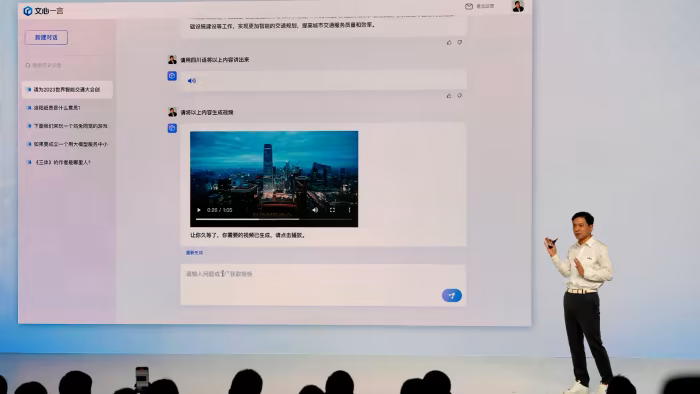
Enlarge / “Please use the sharing tools found via the share button at the top or side of Baidu,” chief Robin Li introduces the functions of the company’s AI chatbot Ernie in Beijing on Thursday. Li said there was high market demand as Chinese companies raced to develop an equivalent to Microsoft-backed ChatGPT.
Ng Han Guan/AP

Shares of Baidu fell as much as 10 percent on Thursday after the web search company showed only a pre-recorded video of its AI chatbot Ernie in the first public release of China’s answer to ChatGPT.

The Beijing-based tech company has claimed Ernie will remake its business and for weeks talked up plans to incorporate generative artificial intelligence into its search engine and other products.

But on Thursday, millions of people tuning in to the event were left with little idea of whether Baidu’s chatbot could compete with ChatGPT.

During the highly publicized and eagerly anticipated news conference for Ernie, Baidu founder Robin Li stood beside an open chat screen, narrating questions that had earlier been typed into the chatbot. He admitted the company was only showing a demo of the technology that it had prepared earlier.

Li said some users would soon be able to test out Ernie on their own but did not provide a timeline for a full public rollout. The company is starting with a limited public release to business partners.

Ernie’s planned launch comes as US groups such as OpenAI and Google continue making strides in pushing forward their development of generative AI. OpenAI this week released GPT-4, its latest AI model that it claims can beat some humans on tough professional tests such as the US bar exam.

Microsoft is incorporating GPT-4 into Bing and other products, while US corporations are testing the technology in their workplaces and products.

Nearly every Chinese tech giant is racing to roll out a domestic version of ChatGPT, with analysts saying they believed Baidu’s years of investment in AI and development of natural language learning technology had given the group an early lead.

“Sometimes when we use it we are pleasantly surprised, sometimes we may think there is an obvious error,” Li told the audience. “But one thing is for sure, it’s advancing very fast.”

The disappointment, however, was visible in live comments posted by many of the 2 million people watching Li’s speech on the WeChat social media app. It did not take long for minute-by-minute quips on the decline in Baidu’s share price to dominate the feed.

“Its extremely strong ability to comprehend and express language will allow any company to get closer to their customers,” Li said. “It’s an opportunity for every company and it will even have an impact on every single person.”

At the end of the roughly 45-minute demonstration, a chorus of WeChat users chimed in with variations of: “That’s it?” Two Baidu employees said they were equally disappointed with the rollout.

For months, the company had diverted internal resources to building Ernie, two people said, including reallocating most of Baidu’s servers running Nvidia’s powerful A100 chips to the AI team.

OpenAI’s release of ChatGPT last November had caught Baidu off guard, two people close to the company’s AI efforts said, noting they did not believe the US group had significantly superior technology until that point.

Its launch set Baidu scrambling to catch up and carry out the laborious process of fine-tuning Ernie with human feedback, a crucial step in improving ChatGPT’s accuracy and fluency, people close to Baidu said.

The training program requires humans to grade thousands of responses given by the AI models, helping them to slowly score higher and improve. One of the employees said OpenAI’s relative lack of public disclosures on how it carried out the training meant Baidu’s team had to experiment on its own.

The US group also said it would not publicize details on the technical underpinnings of GPT-4, a change from previous models such as GPT-3, on which it published some information.

“We can only explore by ourselves. Training ChatGPT took OpenAI more than a year, and it took them another year to tune GPT-4,” said one Baidu employee. “It means we’re two years behind.”

Baidu did not immediately respond to a request for comment.

Additional reporting by Nian Liu in Beijing.

© 2023 The Financial Times Ltd. All rights reserved. Not to be redistributed, copied, or modified in any way.

https://arstechnica.com/?p=1924504


OpenAI checked to see whether GPT-4 could take over the world

An AI-generated image of the earth enveloped in an explosion.
Ars Technica

As part of pre-release safety testing for its new GPT-4 AI model, launched Tuesday, OpenAI allowed an AI testing group to assess the potential risks of the model’s emergent capabilities—including “power-seeking behavior,” self-replication, and self-improvement.

While the testing group found that GPT-4 was “ineffective at the autonomous replication task,” the nature of the experiments raises eye-opening questions about the safety of future AI systems.

Raising alarms

“Novel capabilities often emerge in more powerful models,” writes OpenAI in a GPT-4 safety document published yesterday. “Some that are particularly concerning are the ability to create and act on long-term plans, to accrue power and resources (“power-seeking”), and to exhibit behavior that is increasingly ‘agentic.'” In this case, OpenAI clarifies that “agentic” isn’t necessarily meant to humanize the models or declare sentience but simply to denote the ability to accomplish independent goals.

Over the past decade, some AI researchers have raised alarms that sufficiently powerful AI models, if not properly controlled, could pose an existential threat to humanity (often called “x-risk,” for existential risk). In particular, “AI takeover” is a hypothetical future in which artificial intelligence surpasses human intelligence and becomes the dominant force on the planet. In this scenario, AI systems gain the ability to control or manipulate human behavior, resources, and institutions, usually leading to catastrophic consequences.

As a result of this potential x-risk, philosophical movements like Effective Altruism (“EA”) seek to find ways to prevent AI takeover from happening. That often involves a separate but often interrelated field called AI alignment research.

In AI, “alignment” refers to the process of ensuring that an AI system’s behaviors align with those of its human creators or operators. Generally, the goal is to prevent AI from doing things that go against human interests. This is an active area of research but also a controversial one, with differing opinions on how best to approach the issue, as well as differences about the meaning and nature of “alignment” itself.

GPT-4’s big tests

Ars Technica

While the concern over AI “x-risk” is hardly new, the emergence of powerful large language models (LLMs) such as ChatGPT and Bing Chat—the latter of which appeared very misaligned but launched anyway—has given the AI alignment community a new sense of urgency. They want to mitigate potential AI harms, fearing that much more powerful AI, possibly with superhuman intelligence, may be just around the corner.

https://arstechnica.com/?p=1924246