ChatGPT has investors drooling, but can it bring home the bacon?
Getty Images
When ChatGPT—the ingenious, garrulous, and occasionally unhinged chatbot from OpenAI—was asked this week how much the company behind it is worth, its responses included: “It is likely that its worth is in the hundreds of millions of dollars, if not more.”
Microsoft, which is rumored to be weighing a $10 billion investment in OpenAI on top of an earlier $1 billion commitment, is betting that the company is worth a lot more—despite the fact neither ChatGPT nor other AI models made by OpenAI are yet raking in huge amounts of cash. OpenAI has built several impressive and attention-grabbing demos and powers a popular autocomplete function for coders offered by Microsoft’s GitHub. But despite the hype swirling around its technology, the startup hasn’t created a breakout, highly lucrative product or business.
“We don’t really know what ChatGPT is going to be great at,” says James Cham, a partner at Bloomberg Beta, an investment firm. But while the bot’s path to riches may not be clear, Cham shares the feeling of many VCs and entrepreneurs that the technology behind the bot will pay out in a big way. OpenAI’s technology is at the heart of a swell of interest in so-called generative AI, a term encompassing algorithms that can generate text, images, or other data.
Cham compares the current situation to the early days of the Internet, when some obscure but evocative demos turned out to precede a sea change in the workings of software, tech companies, and wider society. “We’ve had decades of great AI demos, but this is the first one where you give it to someone and they are really excited about the possibilities,” Cham says of ChatGPT.
OpenAI’s chatbot took the Internet by storm when it was released in December 2022, demonstrating an uncanny ability to answer questions and perform tricks like crafting mostly coherent essays, producing working computer code, and musing on the meaning of life. It is powered by GPT-3, a text-generation algorithm developed by OpenAI, that has been fed huge quantities of text slurped from the web and other sources and then given additional training on how to answer questions.
Some developers were so inspired by ChatGPT that they quickly used it to create apps, such as a spreadsheet assistant capable of performing complex calculations in response to a simple typed request.
But because of how ChatGPT works—by finding statistical patterns in text rather than connecting words to meaning—it will also often fabricate facts and figures, misunderstand questions, and exhibit biases found in its training data. This is likely to complicate efforts to use the technology widely, by, for example, mixing misleading or biased information into search results.
One reason for tech industry excitement around ChatGPT, fed by its parlor tricks, is the suggestion it might disrupt the long-standing dominance of Google and other tech giants, by allowing small companies to outcompete much larger competitors. One popular theory is that the bot could transform web search.
https://arstechnica.com/?p=1910050
Controversy erupts over non-consensual AI mental health experiment
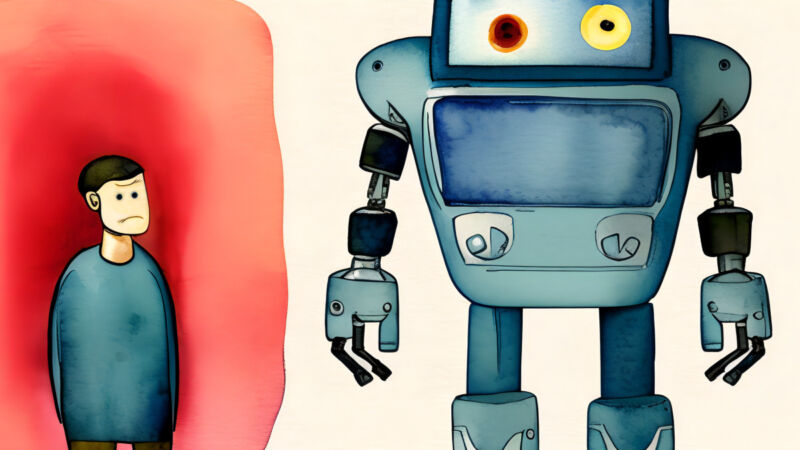
Enlarge/ An AI-generated image of a person talking to a secret robot therapist.
Ars Technica
On Friday, Koko co-founder Rob Morris announced on Twitter that his company ran an experiment to provide AI-written mental health counseling for 4,000 people without informing them first, The Verge reports. Critics have called the experiment deeply unethical because Koko did not obtain informed consent from people seeking counseling.
Koko is a nonprofit mental health platform that connects teens and adults who need mental health help to volunteers through messaging apps like Telegram and Discord.
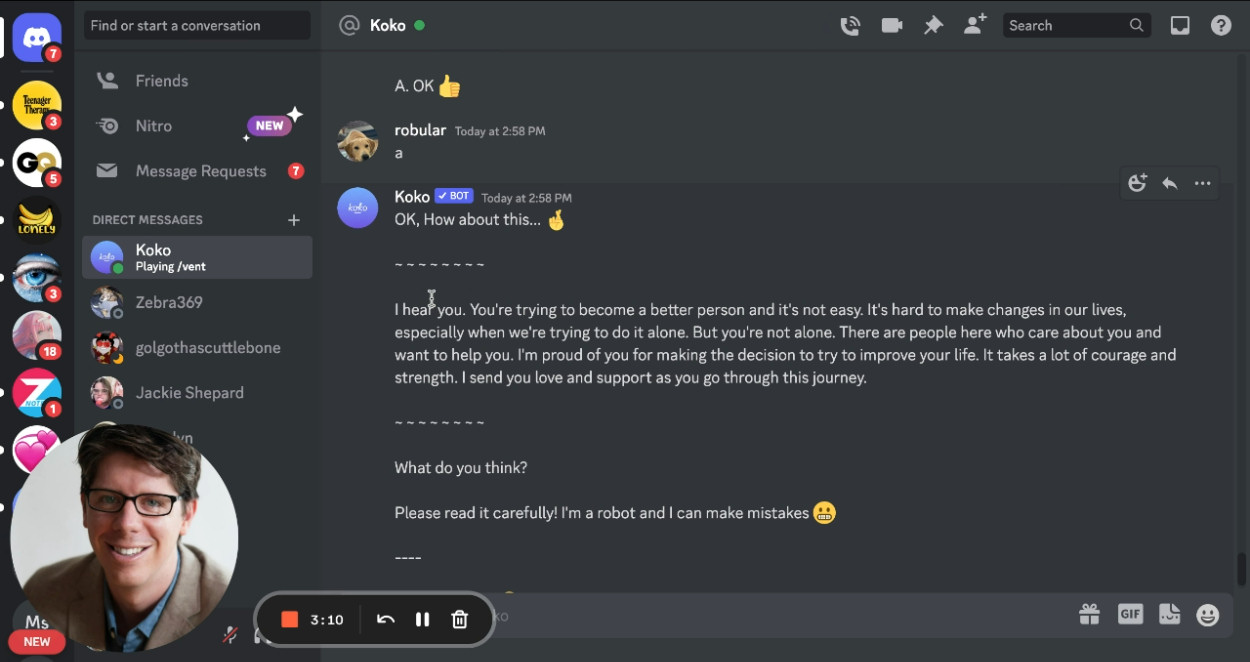
On Discord, users sign into the Koko Cares server and send direct messages to a Koko bot that asks several multiple-choice questions (e.g., “What’s the darkest thought you have about this?”). It then shares a person’s concerns—written as a few sentences of text—anonymously with someone else on the server who can reply anonymously with a short message of their own.
We provided mental health support to about 4,000 people — using GPT-3. Here’s what happened 👇
During the AI experiment—which applied to about 30,000 messages, according to Morris—volunteers providing assistance to others had the option to use a response automatically generated by OpenAI’s GPT-3 large language model instead of writing one themselves (GPT-3 is the technology behind the recently popular ChatGPT chatbot).
Enlarge/ A screenshot from a Koko demonstration video showing a volunteer selecting a therapy response written by GPT-3, an AI language model.
In his tweet thread, Morris says that people rated the AI-crafted responses highly until they learned they were written by AI, suggesting a key lack of informed consent during at least one phase of the experiment:
Messages composed by AI (and supervised by humans) were rated significantly higher than those written by humans on their own (p < .001). Response times went down 50%, to well under a minute. And yet… we pulled this from our platform pretty quickly. Why? Once people learned the messages were co-created by a machine, it didn’t work. Simulated empathy feels weird, empty.
In the introduction to the server, the admins write, “Koko connects you with real people who truly get you. Not therapists, not counselors, just people like you.”
Soon after posting the Twitter thread, Morris received many replies criticizing the experiment as unethical, citing concerns about the lack of informed consent and asking if an Institutional Review Board (IRB) approved the experiment. In the United States, it is illegal to conduct research on human subjects without legally effective informed consent unless an IRB finds that consent can be waived.
In a tweeted response, Morris said that the experiment “would be exempt” from informed consent requirements because he did not plan to publish the results, which inspired a parade of horrified replies.
Speaking as a former IRB member and chair you have conducted human subject research on a vulnerable population without IRB approval or exemption (YOU don’t get to decide). Maybe the MGH IRB process is so slow because it deals with stuff like this. Unsolicited advice: lawyer up
The idea of using AI as a therapist is far from new, but the difference between Koko’s experiment and typical AI therapy approaches is that patients typically know they are not talking with a real human. (Interestingly, one of the earliest chatbots, ELIZA, simulated a psychotherapy session.)
In the case of Koko, the platform provided a hybrid approach where a human intermediary could preview the message before sending it, instead of a direct chat format. Still, without informed consent, critics argue that Koko violated ethical rules designed to protect vulnerable people from harmful or abusive research practices.
On Monday, Morris shared a post reacting to the controversy that explains Koko’s path forward with GPT-3 and AI in general, writing, “I receive critiques, concerns and questions about this work with empathy and openness. We share an interest in making sure that any uses of AI are handled delicately, with deep concern for privacy, transparency, and risk mitigation. Our clinical advisory board is meeting to discuss guidelines for future work, specifically regarding IRB approval.”
https://arstechnica.com/?p=1908751
Microsoft’s new AI can simulate anyone’s voice with 3 seconds of audio
Enlarge/ An AI-generated image of a person’s silhouette.
Ars Technica
On Thursday, Microsoft researchers announced a new text-to-speech AI model called VALL-E that can closely simulate a person’s voice when given a three-second audio sample. Once it learns a specific voice, VALL-E can synthesize audio of that person saying anything—and do it in a way that attempts to preserve the speaker’s emotional tone.
Its creators speculate that VALL-E could be used for high-quality text-to-speech applications, speech editing where a recording of a person could be edited and changed from a text transcript (making them say something they originally didn’t), and audio content creation when combined with other generative AI models like GPT-3.
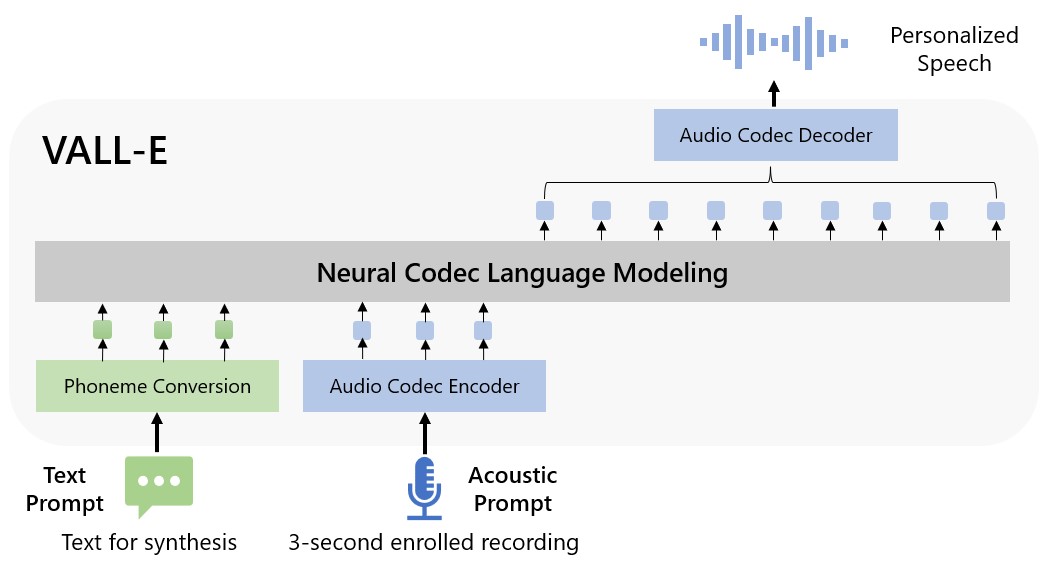
Microsoft calls VALL-E a “neural codec language model,” and it builds off of a technology called EnCodec, which Meta announced in October 2022. Unlike other text-to-speech methods that typically synthesize speech by manipulating waveforms, VALL-E generates discrete audio codec codes from text and acoustic prompts. It basically analyzes how a person sounds, breaks that information into discrete components (called “tokens”) thanks to EnCodec, and uses training data to match what it “knows” about how that voice would sound if it spoke other phrases outside of the three-second sample. Or, as Microsoft puts it in the VALL-E paper:
To synthesize personalized speech (e.g., zero-shot TTS), VALL-E generates the corresponding acoustic tokens conditioned on the acoustic tokens of the 3-second enrolled recording and the phoneme prompt, which constrain the speaker and content information respectively. Finally, the generated acoustic tokens are used to synthesize the final waveform with the corresponding neural codec decoder.
Microsoft trained VALL-E’s speech synthesis capabilities on an audio library, assembled by Meta, called LibriLight. It contains 60,000 hours of English language speech from more than 7,000 speakers, mostly pulled from LibriVox public domain audiobooks. For VALL-E to generate a good result, the voice in the three-second sample must closely match a voice in the training data.
On the VALL-E example website, Microsoft provides dozens of audio examples of the AI model in action. Among the samples, the “Speaker Prompt” is the three-second audio provided to VALL-E that it must imitate. The “Ground Truth” is a pre-existing recording of that same speaker saying a particular phrase for comparison purposes (sort of like the “control” in the experiment). The “Baseline” is an example of synthesis provided by a conventional text-to-speech synthesis method, and the “VALL-E” sample is the output from the VALL-E model.
Enlarge/ A block diagram of VALL-E provided by Microsoft researchers.
While using VALL-E to generate those results, the researchers only fed the three-second “Speaker Prompt” sample and a text string (what they wanted the voice to say) into VALL-E. So compare the “Ground Truth” sample to the “VALL-E” sample. In some cases, the two samples are very close. Some VALL-E results seem computer-generated, but others could potentially be mistaken for a human’s speech, which is the goal of the model.
In addition to preserving a speaker’s vocal timbre and emotional tone, VALL-E can also imitate the “acoustic environment” of the sample audio. For example, if the sample came from a telephone call, the audio output will simulate the acoustic and frequency properties of a telephone call in its synthesized output (that’s a fancy way of saying it will sound like a telephone call, too). And Microsoft’s samples (in the “Synthesis of Diversity” section) demonstrate that VALL-E can generate variations in voice tone by changing the random seed used in the generation process.
Perhaps owing to VALL-E’s ability to potentially fuel mischief and deception, Microsoft has not provided VALL-E code for others to experiment with, so we could not test VALL-E’s capabilities. The researchers seem aware of the potential social harm that this technology could bring. For the paper’s conclusion, they write:
“Since VALL-E could synthesize speech that maintains speaker identity, it may carry potential risks in misuse of the model, such as spoofing voice identification or impersonating a specific speaker. To mitigate such risks, it is possible to build a detection model to discriminate whether an audio clip was synthesized by VALL-E. We will also put Microsoft AI Principles into practice when further developing the models.”
https://arstechnica.com/?p=1908618
Apple rolls out AI-narrated audiobooks, and it’s probably the start of a trend
The Apple Books icon on a Mac.
Samuel Axon
Here’s what the digitally narrated books look like in the Mac Books app.
Samuel Axon
Apple’s digital storefronts now offer audiobooks recorded by artificial narrators instead of humans in a sound booth. The audiobooks are listed in the Books app as “Narrated by Apple Books.”
Clicking on the information icon next to that line brings up a text box that clarifies the book is narrated by “a digital voice based on a human narrator.” There are multiple digital voices across the Apple Books library, with names like “Madison” or “Jackson”—but each book is offered with just one of them.
We listened to an hour each of two digitally narrated titles. The calm tones were clear and mostly benign, and they could be mistaken for real human voices with a short listen. We did hear some anomalies, though—for example, an odd pronunciation of the city “San Antonio.” And obviously, the neutral and emotionless voices are not replacements for styles of human audiobook narration that can be passionate performances.
Based on our searches (you can type “AI narration” into the Books search field to see a list), many publications in question are mostly low-volume books from small publishers, like lesser-known genres or romance novels.
According to The Guardian, Apple reached out to independent book publishers over the past several months and told them it would front the cost of the digital recordings but pay authors royalties on sales. Some publishers agreed, and others didn’t. But this is likely just the start of Apple’s effort, and more may be added later. Apple probably won’t be the only company to do it, either. Google and Amazon—also major purveyors of both ebooks and audiobooks—have publicly talked about this possibility before.
Audiobooks are a huge business; their sales and popularity have skyrocketed in recent years. But even as some independent publishers and self-published authors have thrived, audiobooks have mostly been a market for major publishers and, yes, tech platforms.
One potential upside of this development is the availability of audiobooks for publications and authors that might not have had a budget for audio versions. However, as with so many AI applications lately, this development raises questions about what might happen to human narrators working in the business—as well as concerns over who benefits most. If AI narrators become something readers commonly accept and enjoy, it could increase the leverage Apple and other tech companies have over publishers and authors who want as many people as possible to see or hear their work.
Listing image by Samuel Axon
https://arstechnica.com/?p=1908528
NYC schools block ChatGPT, fearing negative impact on learning
Enlarge/ AI-generated image of a kid using a computer.
Ars Technica
New York City Public Schools have blocked access to OpenAI’s ChatGPT AI model on its network and devices, reports educational news site Chalkbeat. The move comes amid fears from educators that students will use ChatGPT to cheat on assignments, accidentally introduce inaccuracies in their work, or write essays in a way that will keep them from learning the material.
ChatGPT is a large language model created by OpenAI, and it is currently accessible for free through any web browser during its testing period. People can use it to write essays, poetry, and technical documents (or even simulate a Linux console) at a level that can often pass for human writing—although it can also produce very confident-sounding but inaccurate results.
Per Chalkbeat, NYC education department spokesperson Jenna Lyle said, “Due to concerns about negative impacts on student learning, and concerns regarding the safety and accuracy of content, access to ChatGPT is restricted on New York City Public Schools’ networks and devices. While the tool may be able to provide quick and easy answers to questions, it does not build critical-thinking and problem-solving skills, which are essential for academic and lifelong success.”
Educational concerns about large language models became widespread in September after someone on the OpenAI subreddit claimed that they used GPT-3 (the foundational technology behind ChatGPT) to write essays and answer questions for school projects. At that point, GPT-3 was only accessible through an API or a special user interface through the OpenAI website and for a fee based on usage. After OpenAI introduced ChatGPT to a much larger audience for free on November 30, calls of alarm became more widespread among educators.
As a language prediction model, ChatGPT is a type of neural network trained on the text of millions of books and websites. The model’s “knowledge” of typical text constructions helps it predict the most likely output after someone enters a prompt. So if given a prompt such as “Mary had a,” it might complete the sentence with “little lamb,” pulling from the most frequent statistical associations between words the AI model encountered during the training process. During a session with ChatGPT, the entire conversation history is the prompt that the model attempts to complete, albeit in a conversational form.
Although ChatGPT will be blocked on computer networks in NYC public schools, Chalkbeat reports that individual schools can apply for access to ChatGPT to study the technology behind it. And while it’s unclear if ChatGPT will have any of the feared effects on education, this move from the largest school district in the US may inspire others to enact similar bans on the technology.
https://arstechnica.com/?p=1907928
ChatGPT, primo ban nelle scuole di New York. “Impatti negativi sull’apprendimento”
Il Dipartimento dell’Istruzione della città di New York ha bloccato l’accesso a ChatGPT sui suoi dispositivi e sulle sue reti Internet a causa di “impatti negativi sull’apprendimento degli studenti e preoccupazioni riguardanti la sicurezza e l’accuratezza dei contenuti”.
Il chatbot, basato sull’intelligenza artificiale (IA) che fornisce, a mo’ di chat, una risposta, una sola, alla richiesta degli utenti, può generare risposte conversazionali alle domande degli utenti e persino scrivere saggi, attingendo da un enorme volume di fonti online.
“A causa delle preoccupazioni per gli impatti negativi sull’apprendimento degli studenti e le preoccupazioni relative alla sicurezza e all’accuratezza dei contenuti, l’accesso a ChatGPT è limitato sulle reti e sui dispositivi delle scuole pubbliche di New York City”, ha affermato la portavoce del dipartimento dell’istruzione JennaLyle. “Sebbene lo strumento possa essere in grado di fornire risposte rapide e semplici alle domande, non sviluppa capacità di pensiero critico e di risoluzione dei problemi, che sono essenziali per il successo accademico e per tutta la vita”.
Il divieto del dipartimento dell’istruzione interromperà l’accesso al chatbot solo in alcune impostazioni. Gli studenti possono ancora accedere al sito su dispositivi non dipartimentali o reti Internet.
Non è chiaro se o quanti altri distretti stiano vietando il programma. Ma la decisione del più grande sistema scolastico della nazione potrebbe influenzare il modo in cui agiscono gli altri distretti.
Come funziona ChatGPT
Il programma, creato dall’organizzazione OpenAI, utilizza l’apprendimento automatico per fornire le proprie risposte personalizzate a richieste specifiche. Può estrarre e compilare fatti storici, scrivere in stili specifici e creare argomentazioni logiche convincenti, il tutto con una grammatica quasi perfetta (a meno che un utente non richieda di aggiungere errori grammaticali).
Il programma ha ancora dei limiti, a volte arriva a conclusioni imprecise o addirittura include un linguaggio offensivo.
AdamStevens, insegnante di storia di lunga data a New York City che ha iniziato la sua carriera alla Paul Robeson High School di Brooklyn e ora insegna alla Brooklyn Tech, ritiene che bloccare il programma sia controproducente. Ha confrontato le paure che ora turbinano intorno a ChatGPT con quelle emerse intorno a Google.
“La gente diceva la stessa cosa su Google 15 o 20 anni fa, quando gli studenti potevano ‘trovare risposte online’”, ha affermato. Il programma potrebbe persino rivelarsi utile in alcuni casi, ha aggiunto Stevens, generando una risposta “di base” a una richiesta di saggio che la classe potrebbe analizzare insieme e capire come migliorare.
Stevens ha sostenuto che il modo migliore per scoraggiare gli studenti dall’usare ChatGPT e sviluppare le loro capacità di scrittura critica è “assegnare loro un lavoro che li inviti a esplorare cose che vale la pena conoscere” e allontanarsi dall’insegnamento della scrittura stereotipata basata su rubriche rigide.
Perché ChatGPT inizia a preoccupare Google?
Da quando il chatbot è stato lanciato, lo scorso 30 novembre, Google non dorme la notte. Il motivo è semplice: rischia per la prima volta di avere un competitor.
A differenza di Big G, che alle nostre richieste risponde con una serie di pagine web in cui sono indicizzati i risultati in base alla pertinenza, ChatGPT fornisce una sola risposta. Certo non sempre corretta. Ma questa è un altro capitolo di questa nuova storia.
È l’idea che muove ChatGpt a preoccupare Google, perché in futuro, noi che vogliamo anche sul web “tutto e subito” potremmo preferire questo nuovo motore di ricerca, perché in grado di fornisce con un’unica risposta quello che cerchiamo.
Al momento, a Google questo tipo di ricerca non fa comodo, perché andrebbe a minare il suo core business: infilare tra i risultati indicizzati contenuti sponsorizzati. Secondo Bloomberg, circa l’81% dei 257,6 miliardi di dollari di entrate di Alphabet nel 2021 proveniva dalla pubblicità, in gran parte dagli annunci pay-per-clic su Google.
Have you ever tried a Google search that just wasn’t giving you the answers you were seeking? Have you ever wished Siri was just a little more powerful than a voice assistant you ask about the weather? Meet ChatGPT.
Launched by OpenAI in November of 2022, ChatGPT is an artificial intelligence-powered chatbot that you can ask pretty much anything. Despite its limitations – only having data up to 2021 and sometimes spouting wrong information – ChatGPT is an incredibly powerful tool that is poised to change the way content creators work.
As audiences demand more content across different platforms, the number of content creators is growing to meet the demand. But it’s hard to keep up the pace of consistent and quality publishing without the support of a team. Content creators need all the help they can get – and they can find it in AI.
No longer a far-fetched idea out of a 90s movie, AI has the potential to support content creators at every stage of the content creation process. In this article, we will explore six ways in which AI already supports content creation and which tools are leading the charge.
Generate content ideas for different channels
If you’ve ever been stumped about what to write for your next Instagram caption or an idea for your next newsletter, then you’re literally me. My Instagram is filled with the simplest captions you can think of – not because I’m a cool Zillennial, but because I have no idea what to write. And thinking up ideas for a weekly newsletter is not for the faint of heart.
Thankfully, idea generation is one of the simplest applications of AI tools that are readily available. AI can help you develop new and creative ideas for your content by analyzing your audience’s interests and suggesting relevant topics for you to write about. This can be particularly useful if you’re struggling to find inspiration or are working on a tight deadline.
Some examples of AI tools that can assist with idea generation include Persado, which uses machine learning to analyze audience engagement data and suggest relevant topics, and ChatGPT, an AI tool that can generate ideas for stories, articles, and more based on a set of user-defined parameters.
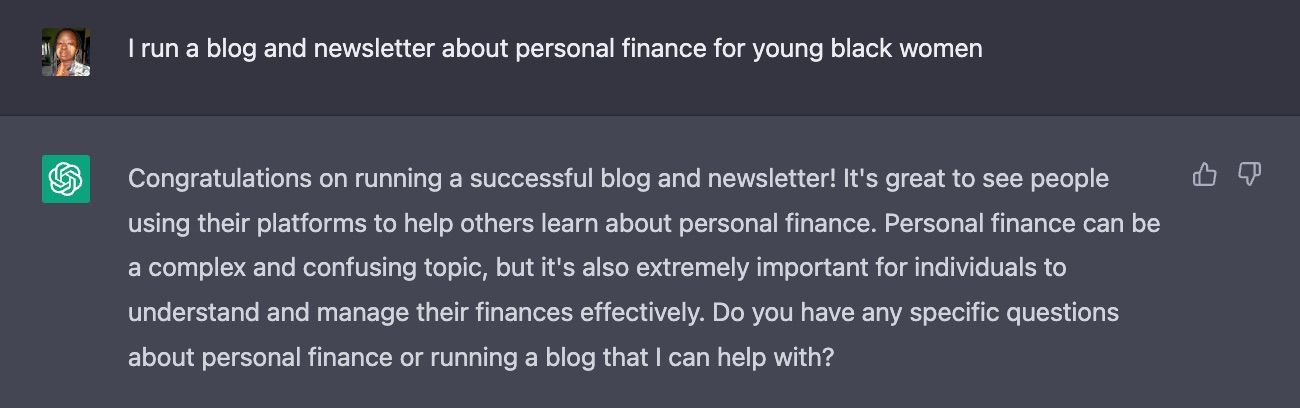
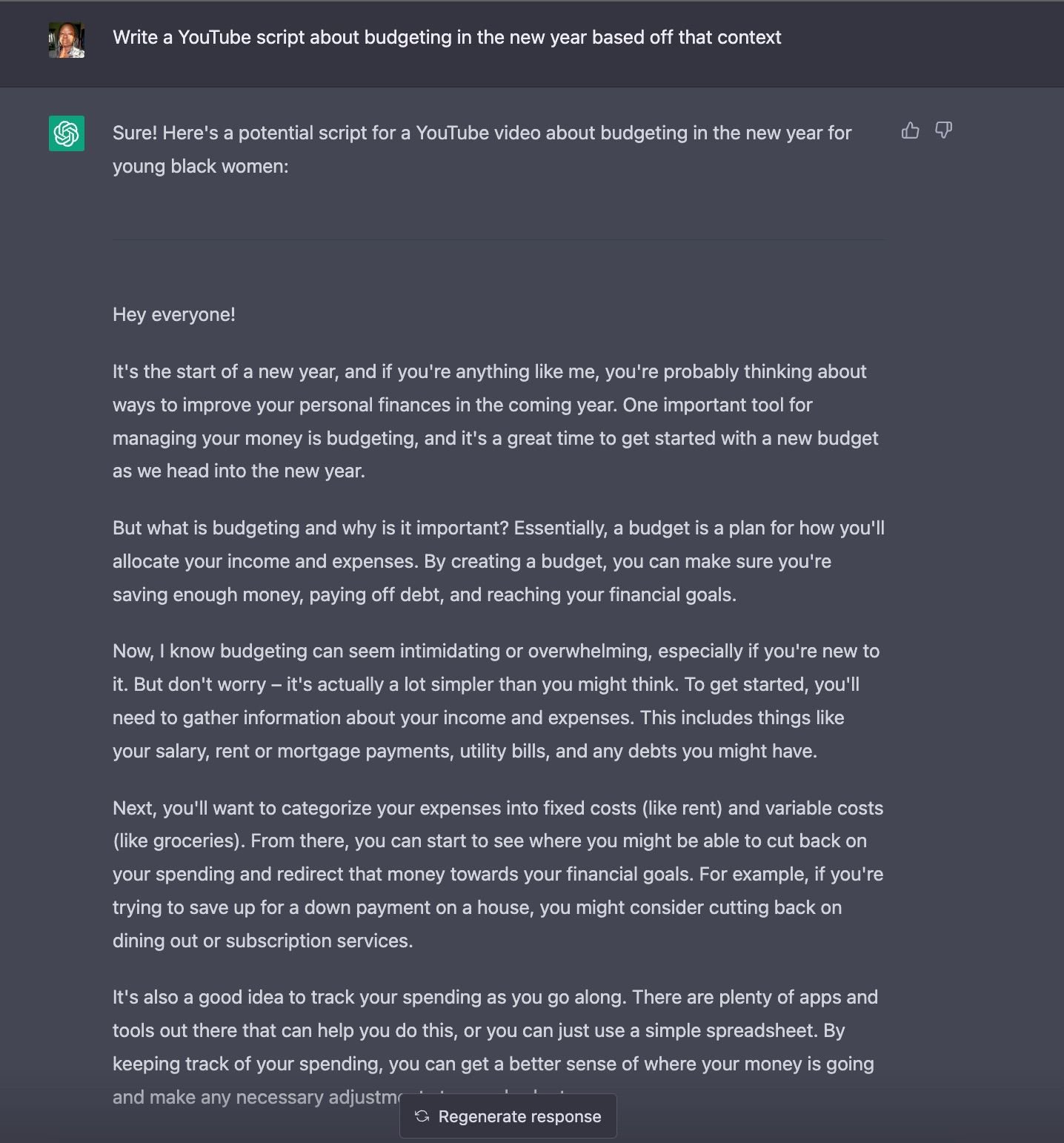
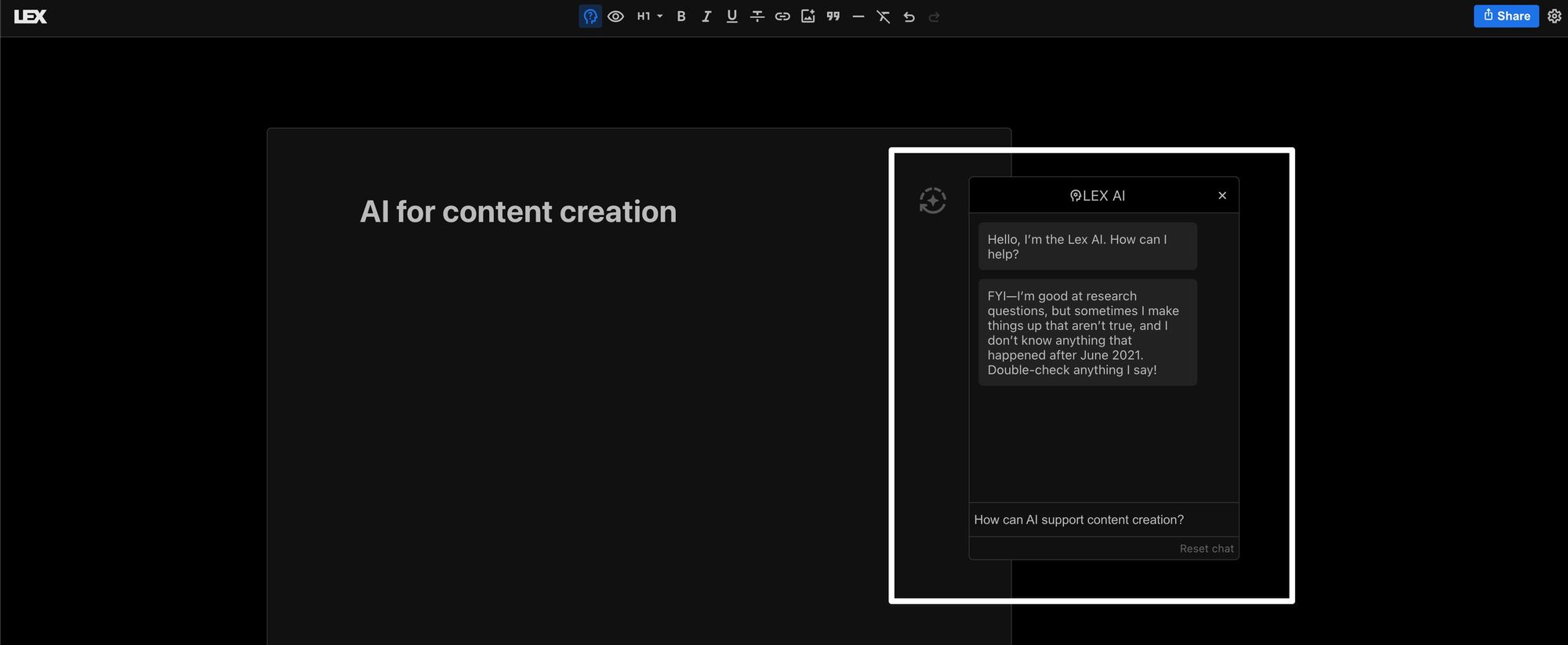
Lately, when I need ideas for a piece of content, no matter what it is, I turn to ChatGPT or Lex. A great way to kickstart playing around with these tools for idea generation is to give a bit of context: “I write a newsletter/blog/run a Twitter account about X topics.” Then give your prompt: “Write a Twitter thread about X” or “Write a YouTube script about Y.”
Context:
Prompt:
You may need to do some tweaking and fine-tuning to get the appropriate results for your publication, but asking a chatbot, much like asking another human, can help unblock you creatively.
Personalize content according to your audience
Niche communities are more prevalent and sought after than ever as audiences want hyper-specific aesthetics, communities, and content to match.
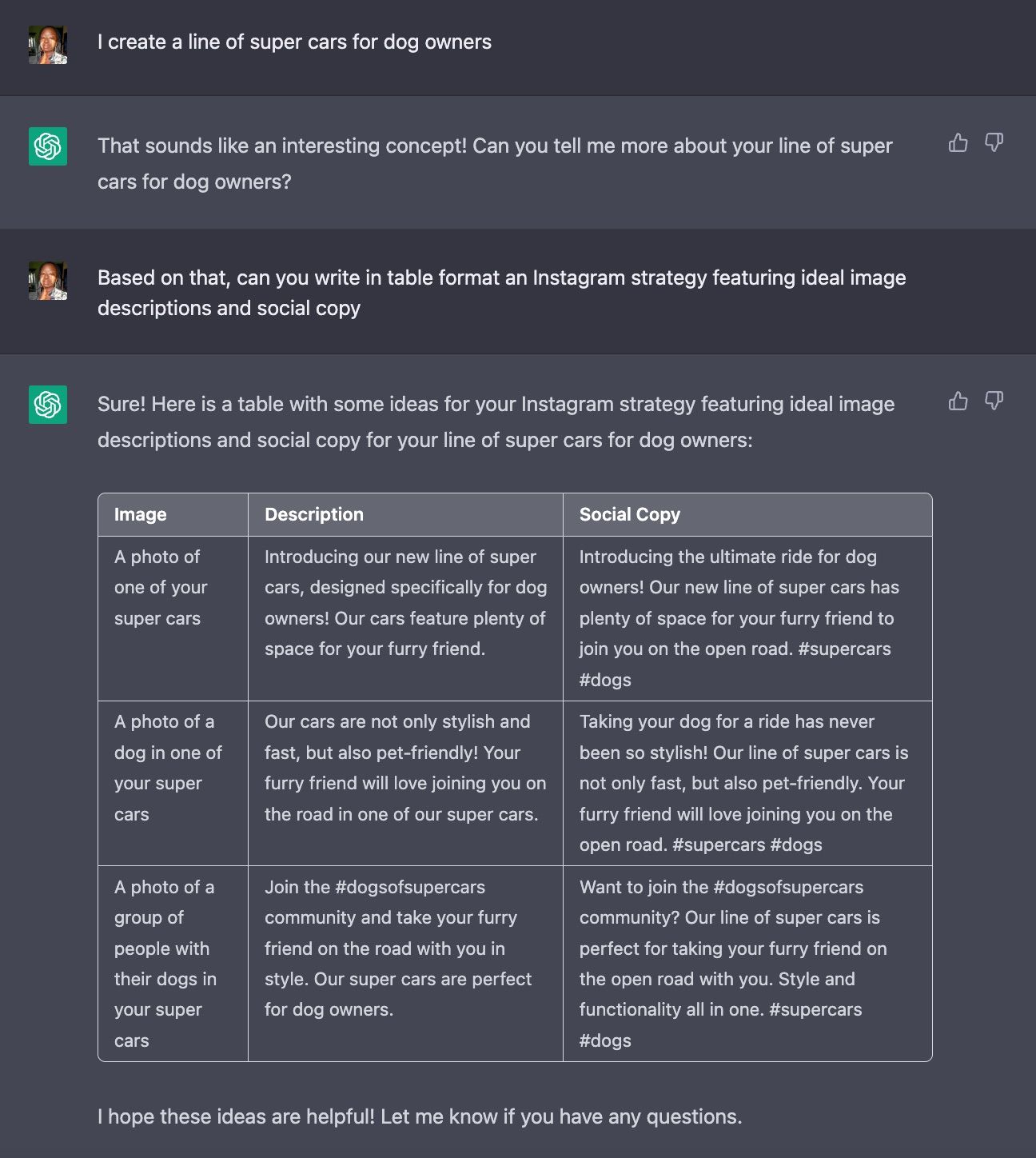
If you’re one of the people creating hyper-specific content (for example, supercars for dog owners) you can use AI to personalize content by tailoring the messaging and delivery to individual users based on their interests and preferences. This can help to increase engagement and conversions by ensuring that the content is relevant and appealing to the intended audience. Here are a few tools that can help with personalized content creation:
Adobe Target uses AI to create personalized content experiences for users based on their behavior and interests.
BlueConic is an enterprise tool that uses machine learning to analyze customer data and create personalized experiences for users based on their preferences and interests.
Now, these tools may not be readily available to you, so here’s an interesting example of how a free tool, ChatGPT can help you personalize your content – ft. one of my more ridiculous prompts.
No matter your niche, you can comfortably reach your audience using AI tools designed to help you create personalized content that resonates with your audience.
Streamline your research process
AI can help you gather and organize data for your content by scraping the web for relevant information and presenting it in an easily digestible format. This can save you time and effort by reducing your search for data. I’ve been leaning on AI tools to provide me with answers that Google just won’t give with the same flair.
For example, I asked ChatGPT to create a vegan meal plan using food commonly available in Nigeria, where I live. Putting together a table like this might have taken me a few hours of research and refining, but I got it in a few seconds with a few tweaks to my prompts. Whether I’ll actually follow it or not is between ChatGPT and me.
Some examples of AI tools that can assist with research include TextOptimizer, which uses natural language processing to analyze a given topic and provide a list of relevant data sources and key points to include in your content, RyRob’s free keyword research tool, and chatbots like the one embedded in Lex and ChatGPT.
AI can help with research by quickly and accurately gathering information from various sources. This can save time and effort for content creators, who can focus on analyzing and synthesizing the information rather than spending time gathering data.
However, keep in mind a major limitation – some tools have been reported to make up information (literally a disclaimer in the Lex chatbot and on the ChatGPT homepage).
Assist with the writing process
As someone who writes at least 5,000 words a week, I find myself wishing that I had something to handle too tedious bits like outlining, line editing, and proofreading.
🔗
If you’re wondering how involved AI should be in your content creation process, check out this article.
I’ve found that certain AI tools are a great help with editing and proofreading by identifying grammar and spelling errors, as well as ensuring that the content follows the appropriate style and tone. This can save time and improve the quality of the final product by catching mistakes that might otherwise go unnoticed.
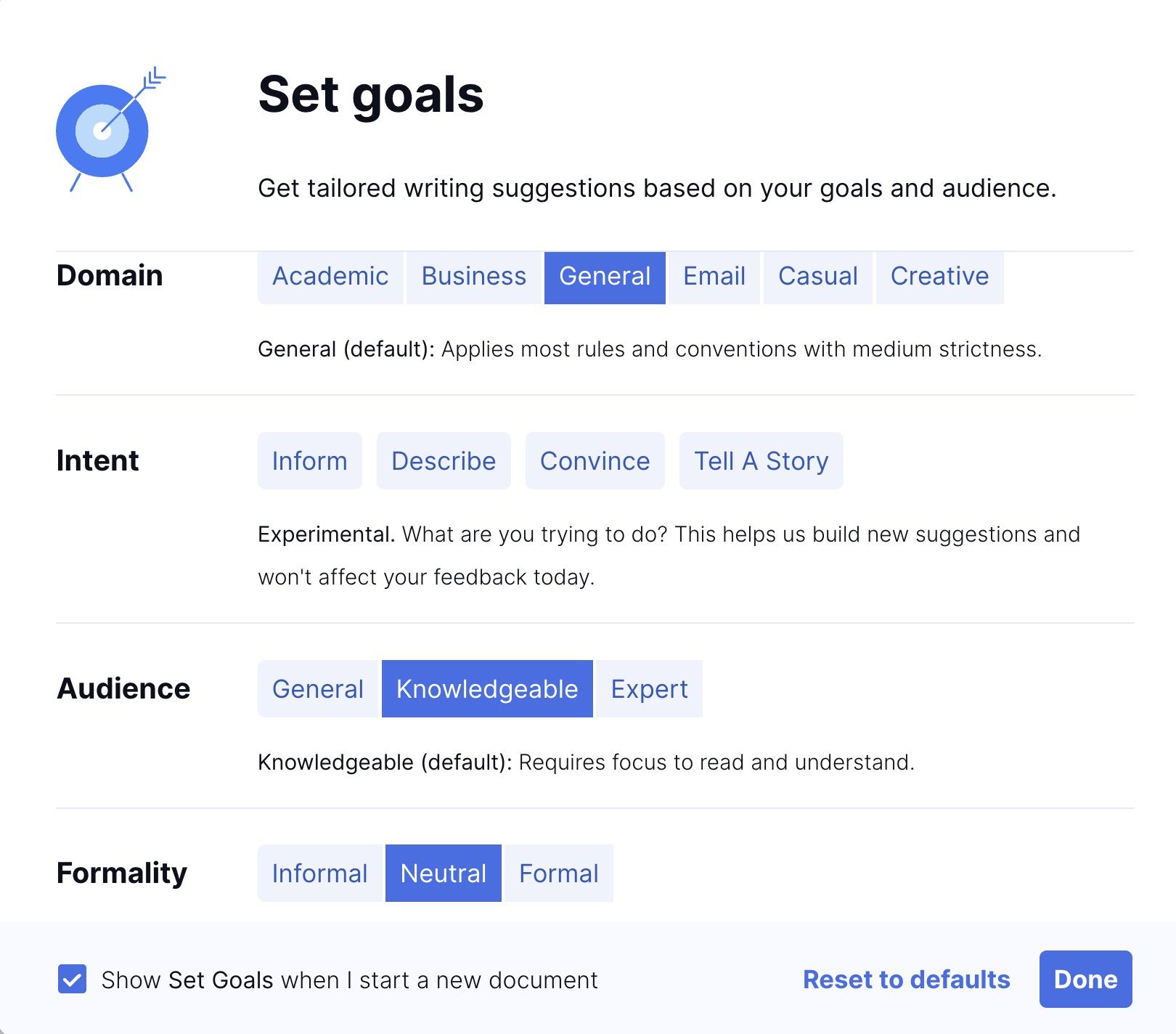
Tools like Grammarly and Writer can be fed your brand’s style guide, and learn what should and shouldn’t be included in your content. I find Grammarly very helpful for staying on track with the tone we try to keep in Buffer articles.
Grammarly allows you to set goals for your content and provides recommendations based on your selections
Writer’s CoWrite feature is a great example of the application of AI in the content creation process. AI is also great for optimizing content – by analyzing your writing and suggesting changes, certain tools can make your work more search engine-friendly. This can improve your content’s visibility and help you reach a wider audience.
Another example of an AI tool that can assist with content is Surfer. It’s great for SEO because it’s a content optimization platform that helps you rank on Google with its AI capabilities.
Make content more accessible
Accessibility is vital for connecting with diverse audiences, but it’s not easy to achieve with a small or even one-man team. AI might just be the perfect solution, as it can help make your content more accessible.
AI can help with everything from adding captions and subtitles to your videos to translation to converting your text to speech. Here are a few examples:
Language translation: Some examples of AI tools that can assist with translation include DeepL, a.k.a. “the world’s most accurate translator”, which uses neural machine translation to accurately translate texts from one language to another in real-time, and Google Translate, which can translate text and speech into a variety of languages.
Audio description: AI can be used to create audio descriptions of visual content, such as videos and images, for people who are blind or have low vision. VEED uses AI to automatically generate audio descriptions of visual content.
Captioning: Automatically generate captions for audio and video content using AI to make it more accessible to people who are deaf or hard of hearing. The AI tool Automatic Sync Technologies (AST) uses machine learning to automatically generate captions for audio and video content.
Text-to-speech: AI can be used to generate audio versions of text-based content, such as articles and blog posts, for people who have difficulty reading. NaturalReader uses AI to generate audio versions of text-based content.
Image recognition: AI can be used to analyze images and generate alternative text descriptions for people who are unable to see the images. This can make it easier for these individuals to understand the content and context of the images. Adobe Sensei includes a feature for analyzing images and generating alternative text descriptions.
Text simplification: You can use AI to analyze text and suggest changes to make it simpler and easier to understand for people with cognitive disabilities or who are learning a new language. Rewordify uses AI to analyze text and suggest changes to make it simpler and easier to understand.
By incorporating these tools and practices into your content creation process, you can make your content more accessible to a broader audience. This can help ensure that everyone has the opportunity to access and benefit from the content being produced.
Support your audio and video content creation
If you’re not particularly design-inclined or are on a limited budget, AI can help you create visual content like images and videos. There are a variety of AI tools that can assist with this, including
Deep Dream, which uses a deep learning algorithm to generate unique, abstract images based on user inputs.
Adobe Sensei which includes a range of features for creating and editing images and videos, including object detection, scene analysis, and automatic background removal. It also includes features for creating and editing images and videos, such as object detection and automatic background removal.
Lumen5: This tool can use AI to analyze a given piece of text and generate a corresponding video with accompanying images and music.
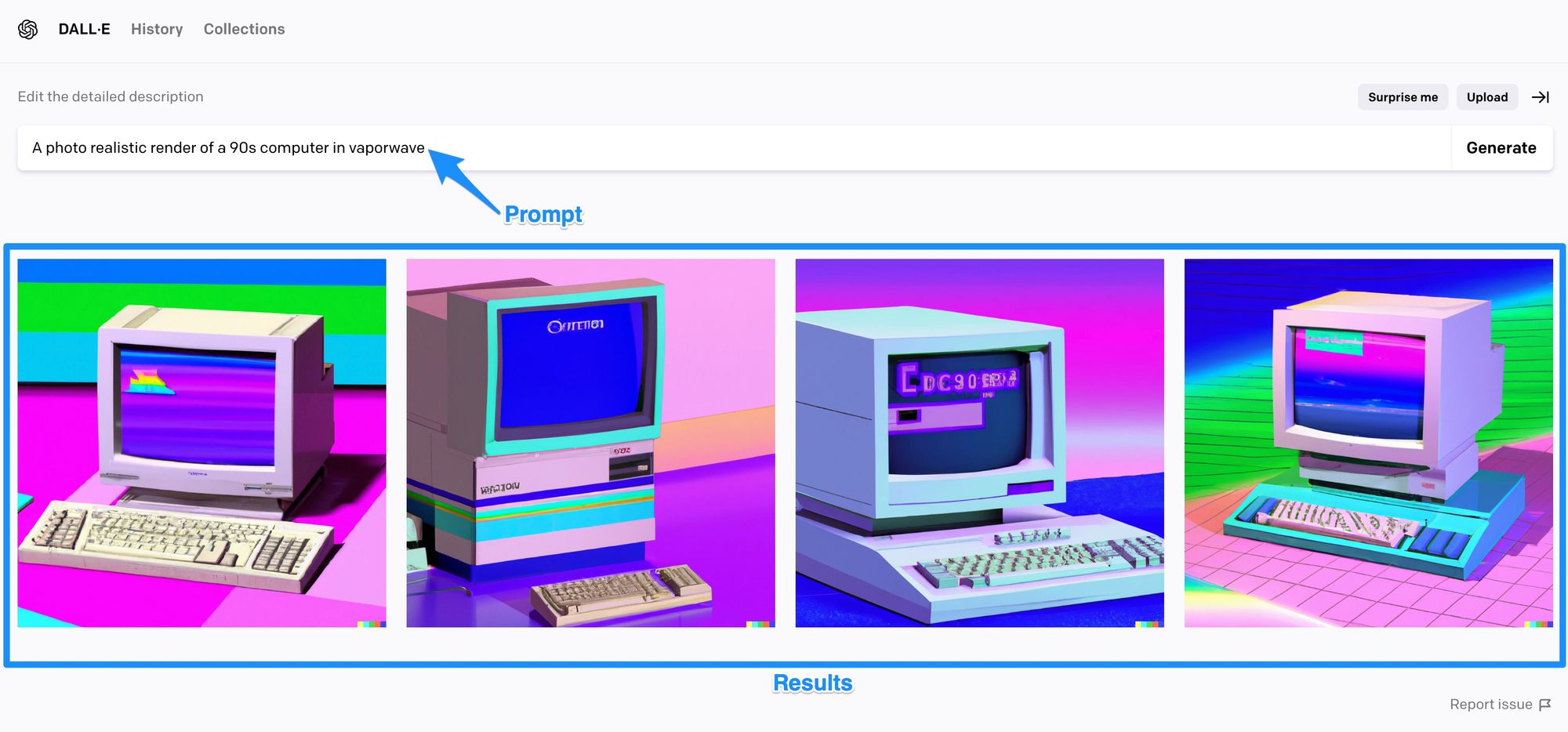
DALL-E: One of the most popular image generation tools, DALL-E uses AI to generate images based on text inputs.
Canva: The tool includes an integration that allows you to input a string of text to get a unique image that can be used across your marketing.
These tools can help you create visually appealing content that engages your audience and effectively conveys your message – especially if you have limited design capabilities. For example, you can use Deep Dream to create unique, abstract images to use as social media posts or use Lumen5 to quickly create a promotional video for your business based on a blog post or article.
AI can also help you produce high-quality audio and video content by suggesting edits and improvements to your work. This can save you time and effort by eliminating the need to manually edit and improve your audio and video files. A tool that can assist with audio and video production is Descript which uses AI to help you edit your video and audio content through various features such as transcription, overdubbing, and captioning.
Use AI to enhance your content creation
By automating tedious tasks and providing assistance with idea generation, research, writing, editing, and optimization, AI can help content creators to produce higher-quality content more quickly and efficiently.
However, it is important to remember that AI is not a replacement for human creativity and judgment. The best results are likely to be achieved when AI is used to augment, rather than replace, the skills and expertise of content creators. With careful planning and implementation, AI can be a powerful ally in pursuing excellence in content creation.
🔗
P.S. While AI won’t eliminate the need to manually schedule and analyze social media activity – it will help generate content ideas and repurpose content. And great news, it’s on our radar for social media management here at Buffer. What features would you like to see as a content creator? Let us know here.
P.P.S. Parts of this article were written using AI – can you identify which ones? Tag @tamioladipo and @buffer on Twitter to let us know 👀
https://buffer.com/resources/ai-content-creation/
“Please slow down”—The 7 biggest AI stories of 2022
Enlarge/ AI image synthesis advances in 2022 have made images like this one possible, which was created using Stable Diffusion, enhanced with GFPGAN, expanded with DALL-E, and then manually composited together.
Benj Edwards / Ars Technica
More than once this year, AI experts have repeated a familiar refrain: “Please slow down.” AI news in 2022 has been rapid-fire and relentless; the moment you knew where things currently stood in AI, a new paper or discovery would make that understanding obsolete.
In 2022, we arguably hit the knee of the curve when it came to generative AI that can produce creative works made up of text, images, audio, and video. This year, deep-learning AI emerged from a decade of research and began making its way into commercial applications, allowing millions of people to try out the tech for the first time. AI creations inspired wonder, created controversies, prompted existential crises, and turned heads.
Here’s a look back at the seven biggest AI news stories of the year. It was hard to choose only seven, but if we didn’t cut it off somewhere, we’d still be writing about this year’s events well into 2023 and beyond.
April: DALL-E 2 dreams in pictures
Enlarge/ A DALL-E example of “an astronaut riding a horse.”
In April, OpenAI announced DALL-E 2, a deep-learning image-synthesis model that blew minds with its seemingly magical ability to generate images from text prompts. Trained on hundreds of millions of images pulled from the Internet, DALL-E 2 knew how to make novel combinations of imagery thanks to a technique called latent diffusion.
Twitter was soon filled with images of astronauts on horseback, teddy bears wandering ancient Egypt, and other nearly photorealistic works. We last heard about DALL-E a year prior when version 1 of the model had struggled to render a low-resolution avocado chair—suddenly, version 2 was illustrating our wildest dreams at 1024×1024 resolution.
At first, given concerns about misuse, OpenAI only allowed 200 beta testers to use DALL-E 2. Content filters blocked violent and sexual prompts. Gradually, OpenAI let over a million people into a closed trial, and DALL-E 2 finally became available for everyone in late September. But by then, another contender in the latent-diffusion world had risen, as we’ll see below.
In early July, the Washington Post broke news that a Google engineer named Blake Lemoine was put on paid leave related to his belief that Google’s LaMDA (Language Model for Dialogue Applications) was sentient—and that it deserved rights equal to a human.
While working as part of Google’s Responsible AI organization, Lemoine began chatting with LaMDA about religion and philosophy and believed he saw true intelligence behind the text. “I know a person when I talk to it,” Lemoine told the Post. “It doesn’t matter whether they have a brain made of meat in their head. Or if they have a billion lines of code. I talk to them. And I hear what they have to say, and that is how I decide what is and isn’t a person.”
Google replied that LaMDA was only telling Lemoine what he wanted to hear and that LaMDA was not, in fact, sentient. Like the text generation tool GPT-3, LaMDA had previously been trained on millions of books and websites. It responded to Lemoine’s input (a prompt, which includes the entire text of the conversation) by predicting the most likely words that should follow without any deeper understanding.
Along the way, Lemoine allegedly violated Google’s confidentiality policy by telling others about his group’s work. Later in July, Google fired Lemoine for violating data security policies. He was not the last person in 2022 to get swept up in the hype over an AI’s large language model, as we’ll see.
July: DeepMind AlphaFold predicts almost every known protein structure
In July, DeepMind announced that its AlphaFold AI model had predicted the shape of almost every known protein of almost every organism on Earth with a sequenced genome. Originally announced in the summer of 2021, AlphaFold had earlier predicted the shape of all human proteins. But one year later, its protein database expanded to contain over 200 million protein structures.
DeepMind made these predicted protein structures available in a public database hosted by the European Bioinformatics Institute at the European Molecular Biology Laboratory (EMBL-EBI), allowing researchers from all over the world to access them and use the data for research related to medicine and biological science.
Proteins are basic building blocks of life, and knowing their shapes can help scientists control or modify them. That comes in particularly handy when developing new drugs. “Almost every drug that has come to market over the past few years has been designed partly through knowledge of protein structures,” said Janet Thornton, a senior scientist and director emeritus at EMBL-EBI. That makes knowing all of them a big deal.
https://arstechnica.com/?p=1905480
Diritti e doveri dell’Intelligenza Artificiale: a che punto siamo?
Digital Customer Experience (DCX) è una rubrica settimanale dedicata alla Digital Experience a cura di Dario Melpignano, Ceo di Neosperience. Per consultare gli articoli precedenti, clicca qui. Per la versione inglese vai al blog.
L’Intelligenza Artificiale ormai è entrata nella nostra vita di tutti i giorni: per mano dell’iniziativa privata, gli algoritmi oggi regolano il nostro comportamento sui social, le preferenze per film e giochi, la possibilità di richiedere un mutuo, l’esito di un colloquio di lavoro, e così via.
L’opinione pubblica e le istituzioni si trovano nella situazione di dover bilanciare gli innumerevoli vantaggi che le AI offrono con i rischi che comportano per i nostri diritti. È quindi nata la necessità, tanto in Unione Europea quanto negli USA, di regolamentare l’utilizzo delle Intelligenze Artificiali su più fronti.
<!-- ARUBA - 300x250 --> <!-- MISE 1 - 300x250 --> <!-- MISE 2 - 300x250 --> <!-- MISE 3 - 300x250 --> <!-- MISE 4 - 300x250 -->
In questo articolo approfondiremo le norme più recenti – AI Bill of Rights e AI Act – che dovrebbero già nei prossimi anni diventare il punto di riferimento per la regolamentazione dell’Intelligenza Artificiale nel mondo.
Intelligenza artificiale: AI Bill of Rights
Stilato dall’Ufficio per le politiche scientifiche e tecnologiche della Casa Bianca a inizio ottobre 2022, l’AI Bill of Rights contiene una serie di raccomandazioni non vincolanti, destinate alle aziende e alle organizzazioni governative, per l’utilizzo ottimale dell’Intelligenza Artificiale e dei sistemi automatizzati ad essa connessi.
L’AI Bill of Rights delinea 5 princìpi, modellati sull’applicazione nel settore pubblico statunitense, ma applicabili anche a contesti più ampi.
1) Sistemi sicuri ed efficaci: per la protezione del singolo e della comunità, i sistemi automatizzati dovrebbero essere sottoposti atest indipendenti di valutazione dell’efficacia e della sicurezza;
2) Protezioni contro la discriminazione algoritmica: le Intelligenze Artificiali dovrebbero essere progettate e utilizzate in modo equo, senza disparità di trattamento in base a criteri etnici, social ie culturali;
3) Protezione dei dati personali: i sistemi automatizzati dovrebbero contenere by design opzioni relative alla protezione dei dati personali e della privacy degli utenti e prevedere il consenso esplicito da parte dell’utente;
4) Avvisi e spiegazioni: bisognerebbe sempre sapere se e quando ci si sta interfacciando con un sistema automatizzato, quali sono le basi del suo funzionamento e gli eventuali impatti dell’interazione;
5) Alternative umane, valutazioni e riserve: I cittadini dovrebbero essere sempre in grado di scegliere un’alternativa umana a un sistema automatizzato, in particolare negli ambiti più sensibili come la giustizia penale, le risorse umane, l’istruzione e la salute.
AI Act
L’AIBill Of Rights rappresenta un importante segnale da parte degli Stati Uniti, superpotenza mondiale culla delle Big Tech, ma l’Unione Europea ha già compiuto diversi passi avanti grazie all’AI Act.
L’, presentato nella primavera del 2021 e attualmente in fase di discussione, l’AI Act è un atto legislativo che punta ad applicare il principio della trasparenza e del rispetto dei diritti umani all’intero settore dell’AI, in accordo alla normativa vigente negli Stati membri e con il Regolamento Generale sulla Protezione dei Dati (GDPR).
Il testo dell’AI Act suddivide le intelligenze artificiali in quattro classi di rischio, calcolate proporzionalmente in base alle potenziali minacce alla salute, alla sicurezza o a diritti fondamentali delle persone come la presunzione di innocenza.
Rischio inaccettabile
Sono da ritenersi proibite in Unione Europea le Intelligenze Artificiali che fanno uso di pratiche come la profilazione per fini coercitivi o di social scoring, oppure utilizzano tecniche subliminali per provocare danni fisici o psicologici.
Rischio elevato
Rientrano in questa categoria i sistemi che possono influire in modo significativo sull’andamento della democrazia o sulla salute individuale o collettiva, tra cui:
I sistemi utilizzati nell’istruzione o nella formazione professionale per la valutazione delle prove o l’accesso agli istituti;
I sistemi di assegnazione di decisioni nei rapporti di lavoro e in ambito creditizio;
I sistemi destinati all’amministrazione della giustizia;
I sistemi destinati all’utilizzo nella gestione della migrazione, dell’asilo e del controllo delle frontiere.
Le Intelligenze Artificiali ad alto rischio potranno essere immesse sul mercato solo se rispettano una serie di requisiti obbligatori orizzontali che ne garantiscano l’affidabilità e se avranno superato diverse procedure di valutazione di conformità.
Rischio limitato
Sistemi di Intelligenza Artificiale come i chatbot o i deepfake possono originare un rischio di manipolazione quando la natura dell’agente conversazionale non è resa chiara all’utente.
I loro produttori dovranno seguire allora un codice di condotta basato sulla trasparenza delle informazioni condivise con il pubblico, che dev’essere consapevole in ogni momento di stare interagendo con una macchina.
Rischio minimo
Rientra in questa categoria la stragrande maggioranza dei sistemi esperti, automatizzati e di Intelligenza Artificiale attualmente utilizzati sul territorio europeo. In questo caso le disposizioni lasciano ai fornitori la libertà di aderire ai codici di condotta e di affidabilità su base volontaria.
AI Liability Directive: verso la regolamentazione
A fine settembre 2022 la Commissione Europea ha rilasciato l’AI Liability Directive, una proposta legislativa che rappresenta il primo passo verso l’applicazione di provvedimenti legali nei confronti di chi subisce danni connessi all’uso di questa tecnologia.
L’assunzione di responsabilità legale ricadrà allora su diversi soggetti: in primis sulle società che mettono a disposizione l’AI, ma anche altri su attori dell’intera supply chain, non ultimi gli utenti stessi.
Conclusione: è giusto limitare l’innovazione?
Non è mai corretto limitare l’innovazione, e peraltro lo scopo di norme e leggi ben scritte non è mai quello di bloccare la crescita di una tecnologia.
Come dimostrano le proposte messe sul tavolo da Unione Europea e Stati Uniti, nel prossimo futuro l’Intelligenza Artificiale sarà soggetta a regole che porteranno i produttori ad assumersi le responsabilità necessarie per i prodotti e i servizi che immettono sul mercato.
L’intento di questi provvedimenti è quello di preservare lelibertà individuali e collettive. Si potrà innovare senza rischiare la libertà delle persone solo attraverso il controllo di realtà terze, alla luce della contemporaneità e grazie ai contributi di diverse aree di competenza.
Man simulates time travel thanks to Stable Diffusion image synthesis
Enlarge/ An AI-generated image of a fictional time traveler named Stelfie during the construction of the pyramids.
Throughout December, a social media user known as Stelfie the Time Traveller has been crafting a time-hopping travelogue using generative AI. Thanks to Stable Diffusion and fine-tuning, an anonymous artist has created a fictional photorealistic character that he can insert into faux historical photographs set in different eras, such as ancient Egypt or the time of the dinosaurs.
Stable Diffusion is a deep learning image synthesis model that allows people to create fictional scenes using text descriptions called prompts. With an additional technique called Dreambooth, people can insert their own subject or character into scenes generated by Stable Diffusion. It can also be used to insert real people into fictional situations.
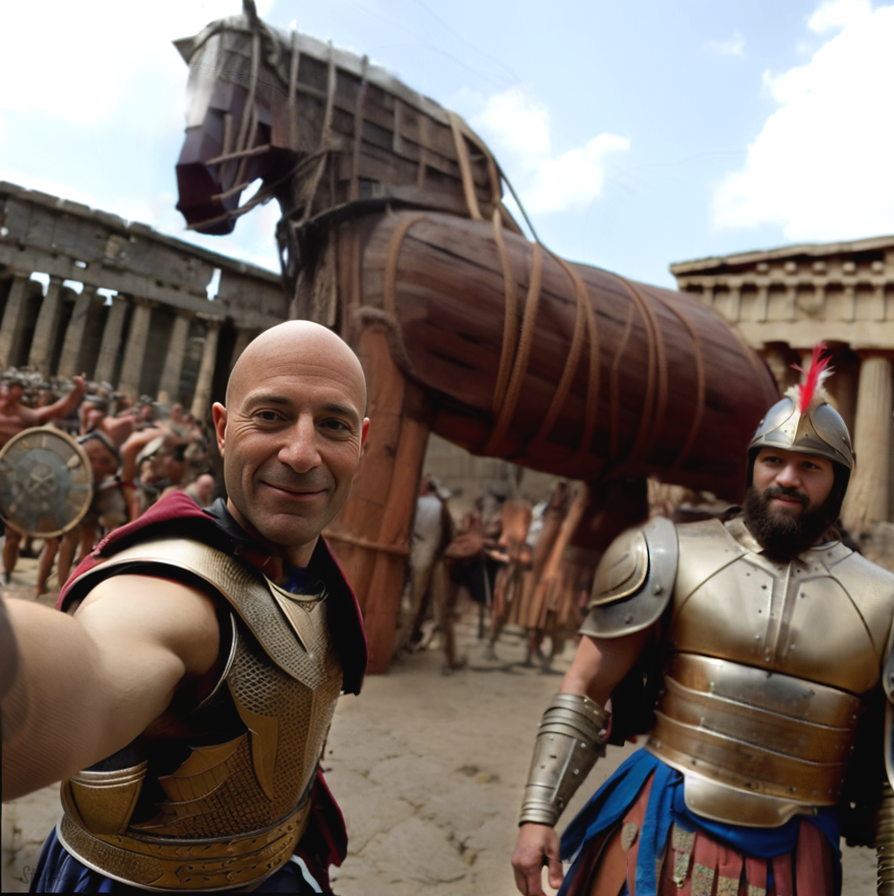
So far, “Stelfie” has taken historical selfies during the ice age (being chased by a woolly mammoth), in ancient Egypt (during the construction of the pyramids), in ancient Greece (with the Trojan Horse), hanging out with Leonardo da Vinci (while creating the Mona Lisa), in the old West, while running from a Tyrannosaurus rex, and while sailing with Christopher Columbus.
Enlarge/ In Log No. 4, Stelfie visited Ulysses and the Trojan Horse.
The artist behind Stelfie writes social media posts (on Twitter, Instagram, and Reddit) in character as playful dispatches from a 41-year-old time traveler as he visits different locations, for example:
Log #3 – Columbus ship, 1492 DC. “Laaaaand” Now, I don’t wanna brag but… After months of sailing Columbus was lost in the Oceans and well let’s say I may have kinda suggested the correct direction…
The anonymous artist (a self-identified “funny old man”) detailed some of the process he uses to create the images in several Reddit comments: a combination of Stable Diffusion 1.5, a custom AI model for the landscape, and a custom AI model trained on the Stelfie face, which is apparently a fictional person created using Character Creator. He uses “a lot of inpainting,” which means inserting AI-generated imagery into the images to fix errors and sculpt the scene, and each image takes three hours to create.
Some may find Stelfie’s attempts to sell the images as NFTs unpalatable (the tech is controversial), but simulated time travel is arguably a novel entertainment use of technology that can otherwise create deepfakes and potentially deceive others. Using Dreambooth and Stable Diffusion, anyone can now insert a character (or themselves) into fantastic and fictional situations, so we’ll likely see a lot more fictional entertainment scenarios in the near future.