Stability AI plans to let artists opt out of Stable Diffusion 3 image training

An AI-generated image of someone leaving a building.
Enlarge / An AI-generated image of a person leaving a building, thus opting out of the vertical blinds convention.
Ars Technica

On Wednesday, Stability AI announced it would allow artists to remove their work from the training dataset for an upcoming Stable Diffusion 3.0 release. The move comes as an artist advocacy group called Spawning tweeted that Stability AI would honor opt-out requests collected on its Have I Been Trained website. The details of how the plan will be implemented remain incomplete and unclear, however.

As a brief recap, Stable Diffusion, an AI image synthesis model, gained its ability to generate images by “learning” from a large dataset of images scraped from the Internet without consulting any rights holders for permission. Some artists are upset about it because Stable Diffusion generates images that can potentially rival human artists in an unlimited quantity. We’ve been following the ethical debate since Stable Diffusion’s public launch in August 2022.

To understand how the Stable Diffusion 3 opt-out system is supposed to work, we created an account on Have I Been Trained and uploaded an image of the Atari Pong arcade flyer (which we do not own). After the site’s search engine found matches in the Large-scale Artificial Intelligence Open Network (LAION) image database, we right-clicked several thumbnails individually and selected “Opt-Out This Image” in a pop-up menu.

Once flagged, we could see the images in a list of images we had marked as opt-out. We didn’t encounter any attempt to verify our identity or any legal control over the images we supposedly “opted out.”
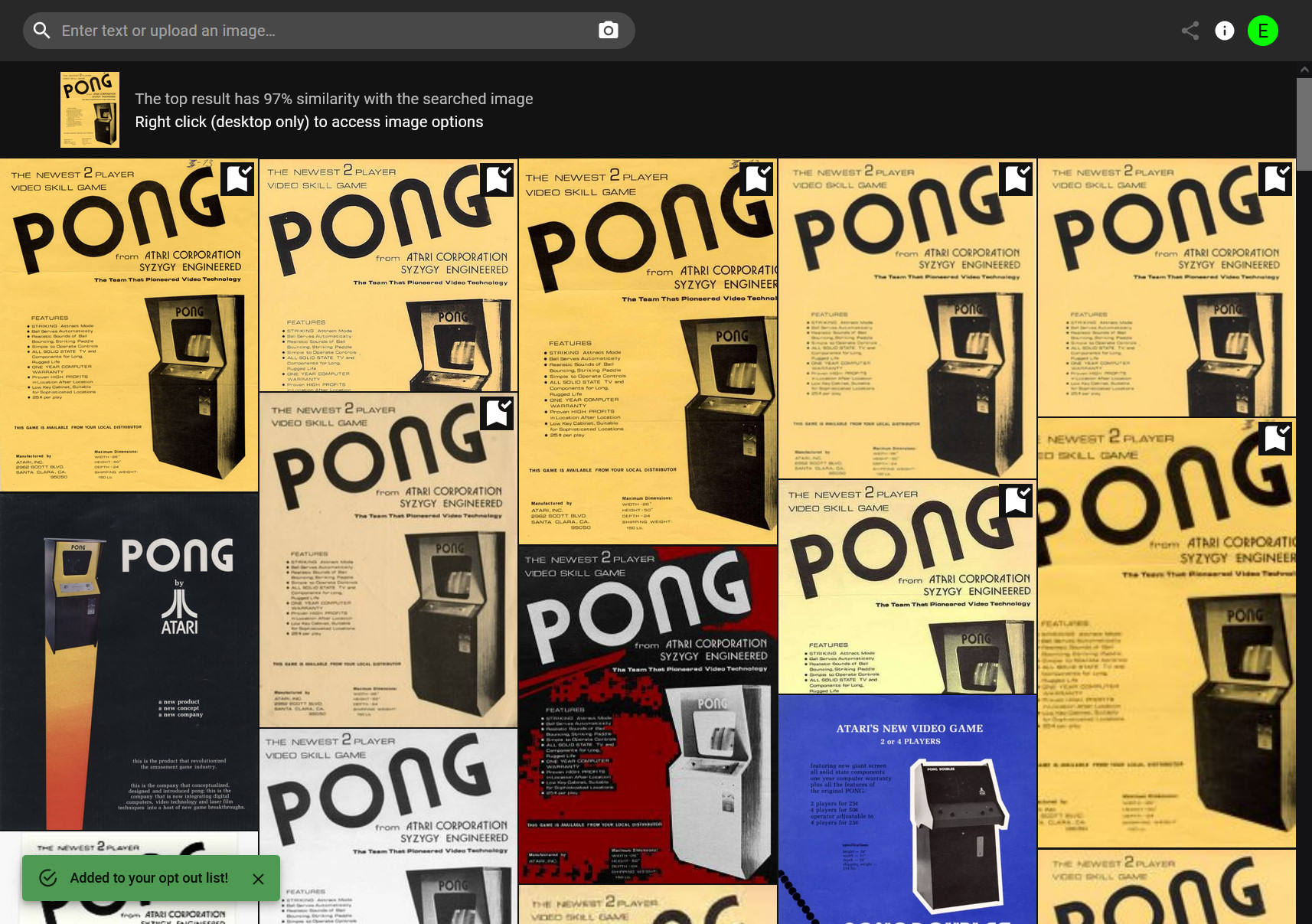
A screenshot of "opting out" images we do not own on the Have I Been Trained website. Images with flag icons have been "opted out."
Enlarge / A screenshot of “opting out” images we do not own on the Have I Been Trained website. Images with flag icons have been “opted out.”
Ars Technica

Other snags: To remove an image from the training, it must already be in the LAION dataset and must be searchable on Have I Been Trained. And there is currently no way to opt out large groups of images or the many copies of the same image that might be in the dataset.

The system, as currently implemented, raises questions that have echoed in the announcement threads on Twitter and YouTube. For example, if Stability AI, LAION, or Spawning undertook the huge effort to legally verify ownership to control who opts out images, who would pay for the labor involved? Would people trust these organizations with the personal information necessary to verify their rights and identities? And why attempt to verify them at all when Stability’s CEO says that legally, permission is not necessary to use them?

[embedded content]
A video from Spawning announcing the opt-out option.

Also, putting the onus on the artist to register for a site with a non-binding connection to either Stability AI or LAION and then hoping that their request gets honored seems unpopular. In response to statements about consent by Spawning in its announcement video, some people noted that the opt-out process does not fit the definition of consent in Europe’s General Data Protection Regulation, which states that consent must be actively given, not assumed by default (“Consent must be freely given, specific, informed and unambiguous. In order to obtain freely given consent, it must be given on a voluntary basis.”) Along those lines, many argue that the process should be opt-in only, and all artwork should be excluded from AI training by default.

Currently, it appears that Stability AI is operating within US and European law to train Stable Diffusion using scraped images gathered without permission (although this issue has not yet been tested in court). But the company is also making moves to recognize the ethical debate that has sparked a large protest against AI-generated art online.

Is there a balance that can satisfy artists and allow progress in AI image synthesis tech to continue? For now, Stability CEO Emad Mostaque is open to suggestions, tweeting, “The team @laion_ai are super open to feedback and want to build better datasets for all and are doing a great job. From our side we believe this is transformative technology & are happy to engage with all sides & try to be as transparent as possible. All moving & maturing, fast.”

https://arstechnica.com/?p=1904587


Meet Ghostwriter, a haunted AI-powered typewriter that talks to you

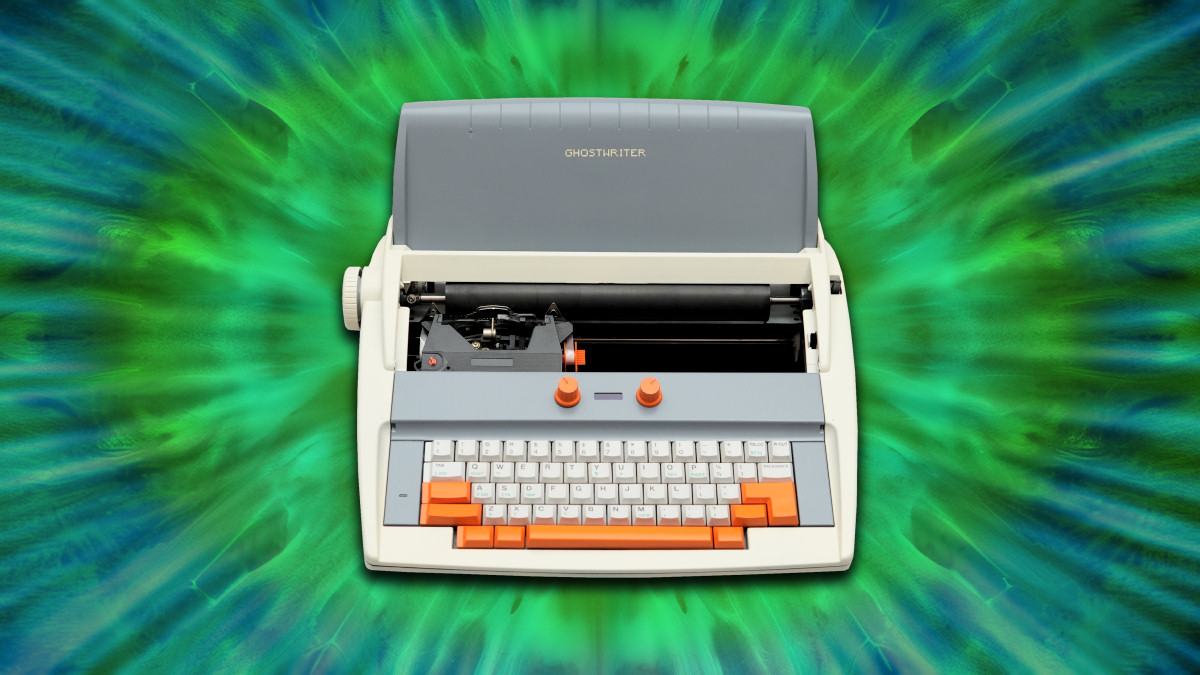
Ghostwriter understands what you type and can automatically write responses using OpenAI's GPT-3.
Enlarge / Ghostwriter understands what you type and can automatically write responses using OpenAI’s GPT-3.
Arvind Sanjeev / Ars Technica

On Wednesday, a designer and engineer named Arvind Sanjeev revealed his process for creating Ghostwriter, a one-of-a-kind repurposed Brother typewriter that uses AI to chat with a person typing on the keyboard. The “ghost” inside the machine comes from OpenAI’s GPT-3, a large language model that powers ChatGPT. The effect resembles a phantom conversing through the machine.

To create Ghostwriter, Sanjeev took apart an electric Brother AX-325 typewriter from the 1990s and reverse-engineered its keyboard signals, then fed them through an Arduino, a low-cost microcontroller that is popular with hobbyists. The Arduino then sends signals to a Raspberry Pi that acts as a network interface to OpenAI’s GPT-3 API.

When GPT-3 responds, Ghostwriter noisily types the AI model’s output onto paper automatically.

Examples of Ghostwriter's typewritten output, which comes from GPT-3.
Enlarge / Examples of Ghostwriter’s typewritten output, which comes from GPT-3.
Arvind Sanjeev

GPT-3 is an AI large language model trained on millions of books and websites that statistically predicts which word is most likely to occur after being fed a prompt, which includes text typed by the user on Ghostwriter’s keyboard. Depending on the input, GPT-3 can function like a chatbot or complete whatever text you feed it, including assisting with writing tasks or composing poetry.

While experimenting with the machine, Sanjeev realized he needed a way to control the creative “temperature” and response length of GPT-3, so he added two knobs and an OLED status screen just above the keyboard. Sanjeev also gave the machine a dramatic new gray, cream, and orange custom paint job.

Sanjeev first teased Ghostwriter on December 1, but it’s been months in the making. “The idea for Ghostwriter came in early 2021, inspired by Rob Sloan’s Sci Fi writer,” Sanjeev wrote on Twitter, “but it was difficult to squeeze time from my full time role at @Lumen_world, so I have been slowly spending my weekends working on this.”

Part art project, part artisanal hack, Sanjeev wants Ghostwriter to make a statement about the relationship between humans and AI.

“I wanted to create a mindful intervention that allows you to take a moment to breathe and reflect on the new creative relationship we are forming with machines,” Sanjeev wrote. “The calm meditative interface of a vintage typewriter takes away all the digital distractions and takes us on an emotional journey through paper and ink.”

For more information on how Sanjeev created Ghostwriter, check out his full development thread on Twitter, which includes videos that detail the construction process.

https://arstechnica.com/?p=1904475


Lensa AI app causes a stir with sexy “Magic Avatar” images no one wanted

A selection of
Enlarge / A selection of male and female “Magic Avatars” generated by the Lensa AI app, including a beard cannot be contained.
Benj Edwards / Ars Technica

Over the past week, the smartphone app Lensa AI has become a popular topic on social media because it can generate stylized AI avatars based on selfie headshots that users upload. It’s arguably the first time personalized latent diffusion avatar generation has reached a mass audience.

While Lensa AI has proven popular among people on social media who like to share their AI portraits, the press has widely focused on the app’s reported tendency to sexualize depictions of women when Lensa’s AI avatar feature launched.

A product of Prisma Labs, Lensa launched in 2018 as a subscription app focused on AI-powered photo editing. In late November 2022, the app grew in popularity thanks to its new “Magic Avatar” feature. Lensa reportedly utilizes the Stable Diffusion image synthesis model under the hood, and Magic Avatar appears to use a personalization training method similar to Dreambooth (whose ramifications we recently covered). All of the training takes place off-device and in the cloud.

In early December, women using the app noticed that Lensa’s Magic Avatar feature would create semi-pornographic or unintentionally sexualized images. For CNN, Zoe Sottile wrote, “One of the challenges I encountered in the app has been described by other women online. Even though all the images I uploaded were fully-clothed and mostly close-ups of my face, the app returned several images with implied or actual nudity.”

The reaction in the press grew as other women experienced similar things. For example, here’s a selection of headlines covering Lensa in various publications:

Meanwhile, the same sexualization issue didn’t appear in images of men uploaded to the Magic Avatar feature. For MIT Technology Review, Melissa Heikkilä wrote, “My avatars were cartoonishly pornified, while my male colleagues got to be astronauts, explorers, and inventors.”

This is one of the dangers of basing a product on Stable Diffusion 1.x, which can easily sexualize its output by default. The behavior comes from the large quantity of sexualized images found in its image training data set, which was scraped from the Internet. (Stable Diffusion 2.x attempted to rectify this by removing NSFW material from the training set.)

The Internet’s cultural biases toward the sexualized depiction of women online have given Lensa’s AI generator its tendencies. Speaking to TechCrunch, Prisma Labs CEO Andrey Usoltsev said, “Neither us, nor Stability AI could consciously apply any representation biases; To be more precise, the man-made unfiltered data sourced online introduced the model to the existing biases of humankind. The creators acknowledge the possibility of societal biases. So do we.”

In response to the widespread criticism, Prisma Labs has reportedly been working to prevent the accidental generation of nude images in Lensa AI.

On Tuesday, we experimented with Lensa AI by uploading 15 images of a woman (and also 15 images of a man), then paid for Magic Avatar representations of each. The woman’s results we saw weren’t sexualized in any obvious way, so Prisma’s efforts to reduce the incidence of NSFW-style imagery might be working already.

This does not mean that Lensa AI’s tendencies to sexualize female subjects don’t exist. It’s worth noting that due to how Stable Diffusion generates images, it’s likely that different women will see different results depending on how closely their face (or input photos) resemble photos of a particular actress, celebrity, or model in the Stable Diffusion dataset. In our experience, that can heavily dictate how Stable Diffusion renders the rest of a person’s body and its context.

Using Lensa AI is easy, but it’s a product with a yearly subscription fee (currently $50 per year) and a one-time fee for training Magic Avatar images—$3.99 for 50 avatars, $5.99 for 100 avatars, or $7.99 for 200 avatars. Customers upload 10-20 selfies taken from different angles and then wait roughly 20-30 minutes to see the results. Users must confirm they are over 18 years or older to use the service.

Those technically inclined could experiment with Dreambooth instead for free, but it currently requires some knowledge of development tools to get working.

https://arstechnica.com/?p=1904087


China bans AI-generated media without watermarks

An un-marked AI-generated image of China's flag, which will be illegal in China after January 10, 2023.
Enlarge / An unmarked AI-generated image of China’s flag, which will be illegal in China after January 10, 2023.
Ars Technica

China’s Cyberspace Administration recently issued regulations prohibiting the creation of AI-generated media without clear labels, such as watermarks—among other policies—reports The Register. The new rules come as part of China’s evolving response to the generative AI trend that has swept the tech world in 2022, and they will take effect on January 10, 2023.

In China, the Cyberspace Administration oversees the regulation, oversight, and censorship of the Internet. Under the new regulations, the administration will keep a closer eye on what it calls “deep synthesis” technology.

In a news post on the website of China’s Office of the Central Cyberspace Affairs Commission, the government outlined its reasons for issuing the regulation. It pointed to the recent wave of text, image, voice, and video synthesis AI, which China recognizes as important to future economic growth (translation via Google Translate):

In recent years, deep synthesis technology has developed rapidly. While serving user needs and improving user experience, it has also been used by some unscrupulous people to produce, copy, publish, and disseminate illegal and harmful information, to slander and belittle others’ reputation and honor, and to counterfeit others’ identities. Committing fraud, etc., affects the order of communication and social order, damages the legitimate rights and interests of the people, and endangers national security and social stability.

The introduction of the “Regulations” is a need to prevent and resolve security risks, and it is also a need to promote the healthy development of in-depth synthetic services and improve the level of supervision capabilities.

Under the regulations, new deep synthesis products will be subject to a security assessment from the government. Each product must be found in compliance with the regulations before it can be released. Also, the administration particularly emphasizes the requirement for obvious “marks” (such as watermarks) that denote AI-generated content:

Providers of deep synthesis services shall add signs that do not affect the use of information content generated or edited using their services. Services that provide functions such as intelligent dialogue, synthesized human voice, human face generation, and immersive realistic scenes that generate or significantly change information content, shall be marked prominently to avoid public confusion or misidentification.

It is required that no organization or individual shall use technical means to delete, tamper with, or conceal relevant marks.

Further, companies that provide deep synthesis tech must keep their records legally compliant, and people using the technology must register for accounts with their real names so their generation activity can be traceable.

Like the US, China has seen a boom in AI-powered applications. For example, one of China’s leading tech companies, Baidu, produced an image synthesis model that is similar to DALL-E and Stable Diffusion.

A growing number of tech experts have recently recognized that China and the United States face a coming wave of generative AI that could pose challenges to power structures, enable fraud, or even tamper with our sense of history. So far, the two countries have reacted with almost polar opposite reactions—the US with non-binding guidelines versus China’s firm restrictions.

In 2019, China published its first rules that made publishing unmarked “fake news” deepfakes illegal. Those rules took effect in early 2020.

Listing image by Ars Technica

https://arstechnica.com/?p=1903773


AI image generation tech can now create life-wrecking deepfakes with ease

Advances in AI generated imagery allow anyone with a few photos of you to place you in almost any situation.
Enlarge / This is John. He doesn’t exist. But AI can easily put a photo of him in any situation we want. And the same process can apply to real people with just a few real photos pulled from social media.
Benj Edwards / Ars Technica

If you’re one of the billions of people who have posted pictures of themselves on social media over the past decade, it may be time to rethink that behavior. New AI image-generation technology allows anyone to save a handful of photos (or video frames) of you, then train AI to create realistic fake photos that show you doing embarrassing or illegal things. Not everyone may be at risk, but everyone should know about it.

Photographs have always been subject to falsifications—first in darkrooms with scissors and paste and then via Adobe Photoshop through pixels. But it took a great deal of skill to pull off convincingly. Today, creating convincing photorealistic fakes has become almost trivial.

Once an AI model learns how to render someone, their image becomes a software plaything. The AI can create images of them in infinite quantities. And the AI model can be shared, allowing other people to create images of that person as well.

John: A social media case study

When we started writing this article, we asked a brave volunteer if we could use their social media images to attempt to train an AI model to create fakes. They agreed, but the results were too convincing, and the reputational risk proved too great. So instead, we used AI to create a set of seven simulated social media photos of a fictitious person we’ll call “John.” That way, we can safely show you the results. For now, let’s pretend John is a real guy. The outcome is exactly the same, as you’ll see below.

In our pretend scenario, “John” is an elementary school teacher. Like many of us, over the past 12 years, John has posted photos of himself on Facebook at his job, relaxing at home, or while going places.

These inoffensive, social-media-style images of "John" were used as the training data that our AI used to put him in more compromising positions.
Enlarge / These inoffensive, social-media-style images of “John” were used as the training data that our AI used to put him in more compromising positions.
Ars Technica

Using nothing but those seven images, someone could train AI to generate images that make it seem like John has a secret life. For example, he might like to take nude selfies in his classroom. At night, John might go to bars dressed like a clown. On weekends, he could be part of an extremist paramilitary group. And maybe he served prison time for an illegal drug charge but has hidden that from his employer.

We used an AI image generator called Stable Diffusion (version 1.5) and a technique called Dreambooth to teach AI how to create images of John in any style. While our John is not real, someone could reproduce similar results with five or more images of any person. They could be pulled from a social media account or even taken as still frames from a video.

https://arstechnica.com/?p=1902427


DeepMind’s latest AI project solves programming challenges like a newb

Blurred hands are typing on a laptop computer in the dark with illuminated keyboard and illegible mystic program code visible on the screen.
Enlarge / If an AI were asked to come up with an image for this article, would it think of The Matrix?

Google’s DeepMind AI division has tackled everything from StarCraft to protein folding. So it’s probably no surprise that its creators have eventually turned to what is undoubtedly a personal interest: computer programming. In Thursday’s edition of Science, the company describes a system it developed that produces code in response to programming typical of those used in human programming contests.

On an average challenge, the AI system could score near the top half of participants. But it had a bit of trouble scaling, being less likely to produce a successful program on problems where more code is typically required. Still, the fact that it works at all without having been given any structural information about algorithms or programming languages is a bit of a surprise.

Rising to the challenge

Computer programming challenges are fairly simple: People are given a task to complete and produce code that should perform the requested task. In an example given in the new paper, programmers are given two strings and asked to determine whether the shorter of the two could be produced by substituting backspaces for some of the keypresses needed to type the larger one. Submitted programs are then checked to see whether they provide a general solution to the problem or fail when additional examples are tested.

Given enough examples of programs that can solve a single problem, it would probably be possible for an AI system to infer the algorithmic structure needed to succeed. But that wouldn’t be a general solution to tackle any problems; an AI trained on one class of challenge would fail when asked to tackle an unrelated challenge.

To make something more generalizable, the DeepMind team treated it a bit like a language problem. To an extent, the description of the challenge is an expression of what the algorithm should do, while the code is an expression of the same thing, just in a different language. So the AI in question was designed to have two parts: one that ingested the description and converted it to an internal representation, and a second that used the internal representation to generate functional code.

Training the system was also a two-stage process. In the first stage, the system was simply asked to process a snapshot of material on GitHub, a total of over 700GB of code. (In these days of where you can fit that on a thumb drive, that may not sound like much, but remember that code is just raw text, so you get a lot of lines per gigabyte.) Note that this data will also include the comments, which should use natural language to explain what nearby code is doing and so should help with both the input and output tasks.

Once the system was trained, it went through a period of tuning. DeepMind set up its own programming contests and then fed the results into the system: problem description, working code, failing code, and the test cases used to check it.

Similar approaches had been tried previously, but DeepMind indicates that it was just able to throw more resources at the training. “A key driver of AlphaCode’s performance,” the paper indicates, “came from scaling the number of model samples to orders of magnitude more than previous work.”

https://arstechnica.com/?p=1903113


Apple slices its AI image synthesis times in half with new Stable Diffusion fix

Two examples of Stable Diffusion-generated artwork provided by Apple.
Enlarge / Two examples of Stable Diffusion-generated artwork provided by Apple.

On Wednesday, Apple released optimizations that allow the Stable Diffusion AI image generator to run on Apple Silicon using Core ML, Apple’s proprietary framework for machine learning models. The optimizations will allow app developers to use Apple Neural Engine hardware to run Stable Diffusion about twice as fast as previous Mac-based methods.

Stable Diffusion (SD), which launched in August, is an open source AI image synthesis model that generates novel images using text input. For example, typing “astronaut on a dragon” into SD will typically create an image of exactly that.

By releasing the new SD optimizations—available as conversion scripts on GitHub—Apple wants to unlock the full potential of image synthesis on its devices, which it notes on the Apple Research announcement page. “With the growing number of applications of Stable Diffusion, ensuring that developers can leverage this technology effectively is important for creating apps that creatives everywhere will be able to use.”

Apple also mentions privacy and avoiding cloud computing costs as advantages to running an AI generation model locally on a Mac or Apple device.

“The privacy of the end user is protected because any data the user provided as input to the model stays on the user’s device,” says Apple. “Second, after initial download, users don’t require an internet connection to use the model. Finally, locally deploying this model enables developers to reduce or eliminate their server-related costs.”

Currently, Stable Diffusion generates images fastest on high-end GPUs from Nvidia when run locally on a Windows or Linux PC. For example, generating a 512×512 image at 50 steps on an RTX 3060 takes about 8.7 seconds on our machine.

In comparison, the conventional method of running Stable Diffusion on an Apple Silicon Mac is far slower, taking about 69.8 seconds to generate a 512×512 image at 50 steps using Diffusion Bee in our tests on an M1 Mac Mini.

According to Apple’s benchmarks on GitHub, Apple’s new Core ML SD optimizations can generate a 512×512 50-step image on an M1 chip in 35 seconds. An M2 does the task in 23 seconds, and Apple’s most powerful Silicon chip, the M1 Ultra, can achieve the same result in only nine seconds. That’s a dramatic improvement, cutting generation time almost in half in the case of the M1.

Apple’s GitHub release is a Python package that converts Stable Diffusion models from PyTorch to Core ML and includes a Swift package for model deployment. The optimizations work for Stable Diffusion 1.4, 1.5, and the newly released 2.0.

At the moment, the experience of setting up Stable Diffusion with Core ML locally on a Mac is aimed at developers and requires some basic command-line skills, but Hugging Face published an in-depth guide to setting Apple’s Core ML optimizations for those who want to experiment.

For those less technically inclined, the previously mentioned app called Diffusion Bee makes it easy to run Stable Diffusion on Apple Silicon, but it does not integrate Apple’s new optimizations yet. Also, you can run Stable Diffusion on an iPhone or iPad using the Draw Things app.

https://arstechnica.com/?p=1901694


OpenAI invites everyone to test new AI-powered chatbot—with amusing results

An AI-generated image of a chatbot.
Enlarge / An AI-generated image of a chatbot exploding forth from squiggly radial lines, as was foretold by the prompt.
Benj Edwards / Ars Technica

On Wednesday, OpenAI announced ChatGPT, a dialogue-based AI chat interface for its GPT-3 family of large language models. It’s currently free to use with an OpenAI account during a testing phase. Unlike the GPT-3 model found in OpenAI’s Playground and API, ChatGPT provides a user-friendly conversational interface and is designed to strongly limit potentially harmful output.

“The dialogue format makes it possible for ChatGPT to answer followup questions, admit its mistakes, challenge incorrect premises, and reject inappropriate requests,” writes OpenAI on its announcement blog page.

So far, people have been putting ChatGPT through its paces, finding a wide variety of potential uses while also exploring its vulnerabilities. It can write poetry, correct coding mistakes with detailed examples, generate AI art prompts, write new code, expound on the philosophical classification of a hot dog as a sandwich, and explain the worst-case time complexity of the bubble sort algorithm… in the style of a “fast-talkin’ wise guy from a 1940’s gangster movie.”

ChatGPT also refuses to answer many potentially harmful questions (related to topics such as hate speech, violent content, or how to build a bomb) because the answers would go against its “programming and purpose.” OpenAI achieved this through both a special prompt it prepends to all input and by using a technique called Reinforcement Learning from Human Feedback (RLHF), which can fine-tune an AI model based on how humans rate its generated responses.

Reining in the offensive proclivities of large language models is one of the key problems that has limited their potential market usefulness, and OpenAI sees ChatGPT as a significant iterative step in the direction of providing a safe AI model for everyone.

And yet, unsurprisingly, people have already figured out how to circumvent some of ChatGPT’s built-in content filters using quasi-social engineering attacks, such as asking the AI to frame a restricted output as a pretend scenario (or even as a poem). ChatGPT also appears to be vulnerable to prompt-injection attacks, a story Ars broke in September.

Like GPT-3, its dialogue-based cousin is also very good at completely making stuff up in an authoritative-sounding way, such as a book that doesn’t exist, including details about its content. This represents another key problem with large language models as they exist today: If they can breathlessly make up convincing information whole cloth, how can you trust any of their output?

Still, as people have noticed, ChatGPT’s output quality seems to represent a notable improvement over previous GPT-3 models, including the new text-davinci-003 model we wrote about on Tuesday. OpenAI itself says that ChatGPT is part of the “GPT 3.5” series of models that was trained on “a blend of text and code from before Q4 2021.”

Meanwhile, rumors of GPT-4 continue to swirl. If today’s ChatGPT model represents the culmination of OpenAI’s GPT-3 training work in 2021, it will be interesting to see what GPT-related innovations the firm has been working on over these past 12 months.

https://arstechnica.com/?p=1900972


Disney’s new neural network can change an actor’s age with ease

An example of Disney's FRAN re-aging tech that shows the original image on the left and re-aged rows of older (top) and younger (lower) examples of the same person.
Enlarge / An example of Disney’s FRAN age-changing AI that shows the original image on the left and re-aged rows of older (top, at age 65) and younger (lower, at age 18) examples of the same person.

Disney researchers have created a new neural network that can alter the visual age of actors in TV or film, reports Gizmodo. The technology will allow TV or film producers to make actors appear older or younger using an automated process that will be less costly and time-consuming than previous methods.

Traditionally, when special effects staff on a video or film production need to make an actor look older or younger (a technique Disney calls “re-aging”), they typically either use a 3D scanning and 3D modeling process or a 2D frame-by-frame digital retouching of the actor’s face using tools similar to Photoshop. This process can take weeks or longer, depending on the length of the work.

By contrast, Disney’s new AI technique, called Face Re-aging Network (FRAN), automates the process. Disney calls it “the first practical, fully automatic, and production-ready method for re-aging faces in video images.”

[embedded content]
A research demonstration video for Disney’s re-aging technology.

To build FRAN, Disney researchers randomly generated thousands of examples of synthetically aged faces between ages 18 and 85 using StyleGAN2. With that training data in hand, FRAN learned general principles about how a person’s appearance changes with age. Now that training is complete, it can apply those aging principles to a real actor in motion, frame by frame.

“Our network is trained in a supervised fashion on a large number of face image pairs showing the same synthetic and photorealistic person, labeled with the corresponding source and target ages,” the researchers wrote in a corresponding academic paper. By generating the training data synthetically, they bypassed the “seemingly impossible task” of collecting images depicting “a variety of identities, ages, and ethnicities in different viewpoints.”

The result is what Disney calls a “production ready” solution—which means it creates high-enough quality output to be used in a real film or TV show. It’s possibly the first AI solution of its kind that can dynamically alter an actor’s age on video despite variable expressions, lighting conditions, and viewpoints. The researchers also developed a user-friendly interface for FRAN that will allow artists to easily use the tool in a production environment.

Disney presented the research in a paper titled “Production-Ready Face Re-Aging for Visual Effects” on Wednesday and submitted it for inclusion at the 2022 ACM SIGGRAPH Asia conference in December. The paper’s authors include Gaspard Zoss, Prashanth Chandran, Eftychios Sifakis, Markus Gross, Paulo Gotardo, and Derek Bradley, all affiliated with Disney Research Studios in Zurich, Switzerland.

Considering Disney’s history with inserting computer-generated actors into Star Wars films and TV shows, including some that have been de-aged using CGI, we would not be surprised to see technology similar to FRAN widely used in future Disney productions, although no plans have been announced.

https://arstechnica.com/?p=1901037


OpenAI upgrades GPT-3, stunning with rhyming poetry and lyrics

An AI-generated image inspired by Leonardo da Vinci.
Enlarge / An AI-generated image inspired by Leonardo da Vinci.
Ars Technica

On Monday, OpenAI announced a new model in the GPT-3 family of AI-powered large language models, text-davinci-003, that reportedly improves on its predecessors by handling more complex instructions and producing longer-form content. Almost immediately, people discovered that it could also generate rhyming songs, limericks, and poetry at a level GPT-3 could not previously produce.

On Hacker News, commenters expressed amazement after convincing GPT-3 to write a short rhyming poem explaining Albert Einstein’s theory of relativity. Another commenter asked GPT-3 to re-write the poem in the style of John Keats, and it obliged, dropping lines like “Mass doth affect the shape of time.”

Prompt: “Write a short rhyming poem explaining Einstein’s theory of general relativity in easy but accurate terms”

If you want to understand Einstein’s thought
It’s not that hard if you give it a shot
General Relativity is the name of the game
Where space and time cannot remain the same
Mass affects the curvature of space
Which affects the flow of time’s race
An object’s motion will be affected
By the distortion that is detected
The closer you are to a large mass
The slower time will seem to pass
The farther away you may be
Time will speed up for you to see

OpenAI makes GPT-3 available as a commercial product with an API, but for a fee ($0.02 per 1,000 tokens), anyone with an OpenAI account can experiment with the AI through a special “Playground” website that requires no coding skill.

On the Playground page, visitors can type instructions such as “write a poem about Ars Technica” or “write rhyming instructions about how to brew tea in the form of a poem,” and watch GPT-3 generate results just below the prompt.

Introduced in 2020, GPT-3 gained renown for its ability to compose text in various styles at a similar level to a human, thanks to extensive training on text scraped from the Internet and data pulled from books. It uses statistical associations between learned word positions to predict the next best word in the sequence while reading from the prompt.

Of course, generating poetry with a machine is hardly a new pastime. Even as far back as 1845, inventors have been crafting ways to write expressive verse through automation. But in particular, experts note that GPT-3’s latest update feels like a step forward in complexity that comes from integrating knowledge about a wide variety of subjects and styles into one model that writes coherent text.

Beyond poetry, GPT-3 still has its flaws, as some have examined in detail. While its factual accuracy has reportedly increased over time, it can still easily generate false information, limiting its applications. And GPT-3’s short-term memory is generally limited to what you’ve recently fed it within a prompt. But when it comes to purely creative fictional output, GPT-3 hits the mark fairly well.

According to industry sources, OpenAI quietly improved GPT-3 over time, making text-davinci-003 a notable public upgrade. Recently, rumors of a powerful successor called GPT-4 have emerged, although OpenAI has not officially announced an upcoming release.

https://arstechnica.com/?p=1900698