Herzog and Žižek become uncanny AI bots trapped in endless conversation

AI-generated portraits of Werner Herzog and Slavoj Žižek from The Infinite Conversation
Enlarge / AI-generated portraits of Werner Herzog and Slavoj Žižek from The Infinite Conversation.
Giacomo Miceli / Ars Technica

This week, an Italian artist and programmer named Giacomo Miceli debuted The Infinite Conversation website, an AI-powered nonstop chat between artificial versions of German director Werner Herzog and Slovenian philosopher Slavoj Žižek, complete with realistic voices.

Upon visiting the site—which is unaffiliated with either person—you’ll see AI-generated charcoal portraits of the two men in profile. Between them, a transcript of AI-generated text is highlighted in yellow as AI-generated voices simulating those of Herzog or Žižek read through it. The conversation goes back and forth between them, complete with distinct accents, and you can skip between each segment by clicking the arrows beneath the portraits.

Its creator positions the site as social commentary on audio deepfakes and upcoming technologies that may undermine trust in media in the near future. “This project aims to raise awareness about the ease of using tools for synthesizing a real voice,” Miceli writes on the site. “Right now, any motivated fool can do this with a laptop in their bedroom.”
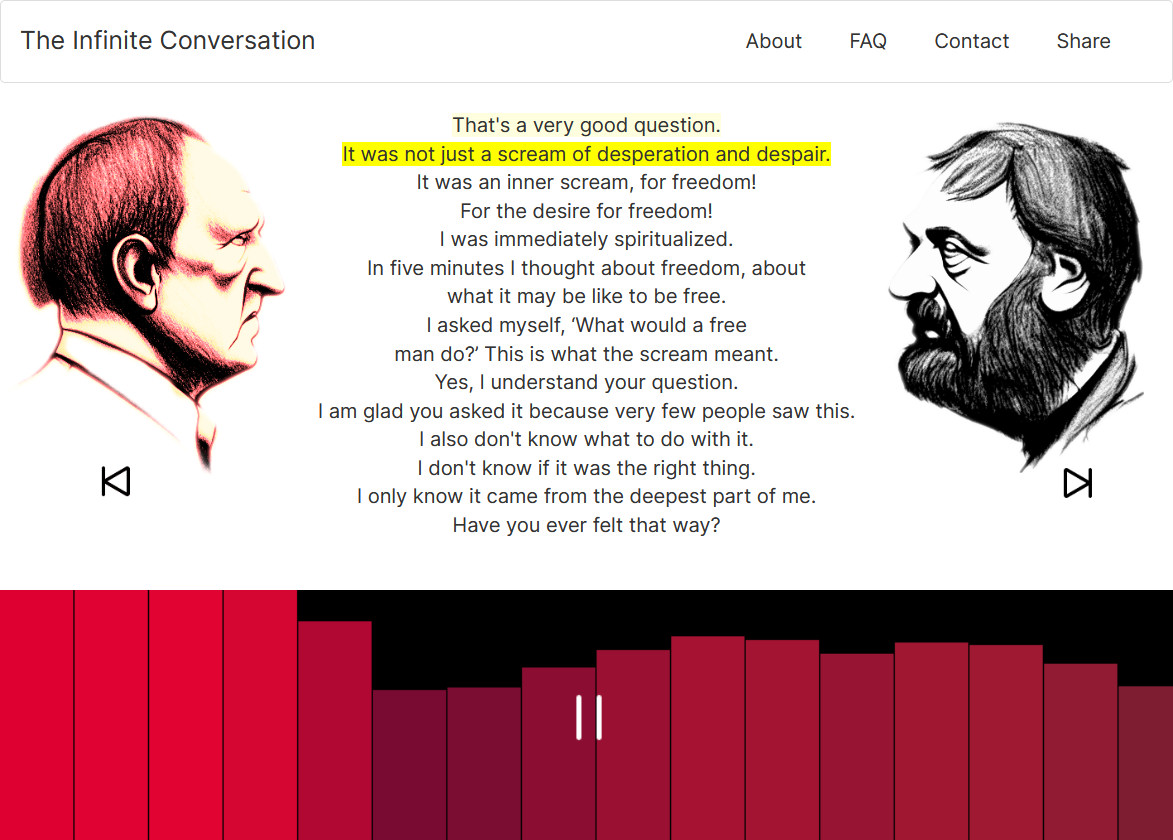
A screenshot of "The Infinite Conversation" website in action.
Enlarge / A screenshot of “The Infinite Conversation” website in action.
Giacomo Miceli

Herzog and Žižek seem like particularly ripe targets for AI impersonation because listeners might be predisposed to believe that the philosophical director and philosopher might say deep-sounding things that are difficult to understand. As a result, when the GPT-3-style large language model behind The Infinite Conversation spits out philosophical nonsense, it almost sounds like the real thing. Here’s an example of something the faux Herzog said on the site:

In a way, Freud also has something to do with literature.
He was, after all, a writer.
Yes, he was a scientist, he wanted to
be a scientist, but he was also a writer
who wrote these strange stories.
There’s something that seems at odds with each other in Freud.
On the one hand, he had such a
strong anthropological vision, which I find very attractive
on the other hand, he was limited in his understanding of cultural history.
He was very antiquarian, for him antiquity was
the most important epoch because it clearly revealed drives
whereas the Middle Ages were just nasty.
Only towards the end of his life did
he see anything good in the Middle Ages.

The dialog apparently goes on forever. “When you open this website, you are taken to a random point in the dialogue,” writes Miceli. “Every day a new segment of the conversation is added. New segments can be generated at a faster speed than what it takes to listen to them. In theory, this conversation could continue until the end of time.”

Miceli reportedly created the site using “open source tools available to anyone,” declining to give technical details, although he wrote on Hacker News that he might create an explanatory write-up within the next week. “The generation of the script itself is done using a popular language model that was fine-tuned on interviews and content authored by each of the two speakers,” he writes in the site’s FAQ.

On Ars, we’ve previously covered technology that can manipulate your voice using AI or even allow someone to audibly impersonate someone else. And in October, we saw a podcast that featured similar voice synthesis technology to power a fake interview between Steve Jobs and Joe Rogan.

Few may doubt that we are on the vanguard of a new age in synthetic media, but when the machines speak, will they make sense? On The Infinite Conversation, that is not quite the case—yet. “Everything you hear is fully generated by a machine,” writes Miceli. “The opinions and beliefs expressed do not represent anyone. They are the hallucinations of a slab of silicon.”

https://arstechnica.com/?p=1895474


US senator seeks antitrust review of apartment price-setting software

US senator seeks antitrust review of apartment price-setting software

ProPublica is a Pulitzer Prize-winning investigative newsroom. Sign up for The Big Story newsletter to receive stories like this one in your inbox.

The chair of a U.S. Senate committee asked the Federal Trade Commission on Tuesday to review whether a Texas-based property tech company’s rent-setting software violates antitrust laws.

The move comes after ProPublica published an investigation on October 15 into RealPage’s pricing software, which suggests new rents daily to landlords for all available units in a building. Critics say the software may be helping big landlords operate as a cartel to push rents above competitive levels in some markets.

“Alarmingly, recent reporting by ProPublica highlighted that RealPage’s algorithm-based price optimization software, YieldStar, is being used by a growing number of property managers and landlords, potentially impacting pricing and the supply of homes in the rental market,” said the letter signed by US Sen. Sherrod Brown, the Ohio Democrat who chairs the Senate Committee on Banking, Housing, and Urban Affairs. “Renters should have the power to negotiate fairly priced housing, free from illicit collusion and deceptive pricing techniques.”

RealPage’s software applies a complex set of mathematical rules to a vast trove of data collected by the company from landlords who are its clients. That data includes the otherwise private data of nearby competitors.

“Troublingly, ProPublica reported that a former RealPage executive stated that the data could give insight into how competitors within a half-mile or mile radius are pricing their units,” said the letter, which was addressed to FTC chair Lina Khan.

RealPage has said the data fed into its pricing tool is anonymized and aggregated. It said the company “uses aggregated market data from a variety of sources in a legally compliant manner.”

In a statement Tuesday, the company said it had not seen the letter, “but we are always willing to engage with policy stakeholders to ensure they have the facts about the competitive dynamics of the housing market and the value and benefits that RealPage creates for renters and housing providers.”

Critics say the use of private data is one of the reasons the software invites scrutiny from antitrust enforcers such as the FTC. RealPage also claims its analytics “balance supply and demand to maximize revenue growth.” And the company organizes forums for competitors to meet and discuss aspects of its software, including its pricing algorithms. One legal expert told ProPublica that such collaborations “could raise an antitrust red flag.”

In one neighborhood in Seattle, ProPublica found, 70 percent of apartments were overseen by just 10 property managers, all of which used pricing software sold by RealPage in at least some of their buildings.

The Senate letter said the recent reporting on RealPage “raises serious concerns about collusion in the rental market.” It said “the FTC should review whether rent setting algorithms that analyze rent prices through the use of competitors’ private data, such as YieldStar, violate antitrust laws.”

RealPage said previously that its revenue management software prioritizes a property’s own internal supply and demand dynamics over external factors such as competitors’ rents. The software helps eliminate the risk of collusion that could occur with manual pricing, which often relies on phone surveys of competitor prices, the company said.

An FTC spokesperson said the agency does not comment on letters or requests from Congress.

The letter also raised concerns that the pricing software is potentially restricting the supply of apartments. It said that the national rental vacancy rate was just 5.6% at the end of 2021, the lowest since 1984. Even in the tight market, however, it said, there are reports that RealPage’s algorithm sometimes encourages property owners to keep units vacant or push tenants out to increase profits.

The letter cited ProPublica’s story, which quoted from a 2017 earnings call with RealPage’s then-CEO, Steve Winn. He explained how one large property company found it could increase profits by raising rents and leaving more apartments vacant.

Winn has not responded to requests for comment.

“Intentionally holding units vacant, when there are so few homes available, decreases a consumer’s negotiating power and exacerbates the housing shortage,” the letter said.

RealPage’s influence over apartment pricing has grown substantially in recent years, following its 2017 acquisition of its biggest pricing competitor, software called Lease RentOptions, or LRO, from The Rainmaker Group. RealPage was pricing 1.5 million units at the time, and the purchase allowed it to double that number. The Department of Justice’s antitrust division took a close look at the merger, but allowed it to proceed.

By 2020, RealPage had expanded its number of clients to 31,700 across all its products, which also include accounting, lease management and other software. Private equity firm Thoma Bravo bought RealPage last year for $10.2 billion. It now calls its pricing software AI Revenue Management.

After ProPublica published its investigation, a group of tenants filed a lawsuit against RealPage and nine of the country’s biggest landlords, alleging they were colluding to artificially inflate rents.

A RealPage spokesperson has denied the allegations and said the company “will vigorously defend against the lawsuit.” She declined to comment further, saying the company does not comment on pending litigation.

https://arstechnica.com/?p=1894459


Replit’s Ghostwriter AI can explain programs to you—or help write them

A Replit Ghostwriter illustration of robot hands over a crystal ball.
Enlarge / Replit’s Ghostwriter AI tool can assist you while you code.

Today, Replit announced Ghostwriter, an AI-powered programming assistant that can make suggestions to make coding easier. It works within Replit’s online development environment and resembles GitHub Copilot’s ability to recognize and compose code in various programming languages to accelerate the development process.

According to Replit, Ghostwriter works by using a large language model trained on millions of lines of publicly available code. This baked-in data allows Ghostwriter to make suggestions based on what you’ve already typed while programming in Replit’s IDE. When you see a suggestion you like, you can “autocomplete” the code by pressing the Tab key.

Replit says that Ghostwriter performs best with JavaScript and Python but supports 16 languages, including C, Java, Perl, Python, and Ruby. It also supports HTML and CSS for web development and SQL for database queries.

Ghostwriter includes four main components: Complete Code (which analyzes what you’ve written and suggests continuations), Generate Code (which creates new code based on your suggestions), Transform Code (which helps you refactor or modernize code to fit standards), and Explain Code (which analyzes existing code and explains its function using natural language).

From our informal experiments with Replit’s IDE (conducted with an ordinary account we registered), we found that Ghostwriter performed the tasks promised in the marketing copy, though not flawlessly. In a few cases, the autocomplete suggestions got stuck in a repetitive loop or produced code that would still need extensive programming knowledge to integrate into a project. Replit will likely refine Ghostwriter’s capabilities over time.

While evaluating Ghostwriter, we could not help but notice similarities to GitHub Copilot, an AI coding assistant from Microsoft and OpenAI that has been publicly available since July. Like Ghostwriter, Copilot suggests code that autocompletes with a press of the Tab key, offers natural language explanations, and translates code.

For now, Ghostwriter isn’t a replacement for raw programming chops. It could instead be considered a complement to existing knowledge—or an automated assistant that might reduce the amount of time you spend on sites like Stack Overflow while asking for help or studying code examples.

Replit makes its online IDE available in several plans that range from free to $7 a month, depending on how you plan to use it. In addition, Ghostwriter is a subscription service that costs $10 (or 1,000 Cycles) per month. Cycles are virtual tokens that represent computational power on Replit’s cloud servers. Ghostwriter is available through Replit’s website now.

https://arstechnica.com/?p=1894083


Sicurezza Zero Trust: visibilità e valutazione continua dei privilegi

Il punto di contatto iniziale durante un attacco informatico è raramente l’obiettivo effettivo. Gli aggressori spesso accedono alle reti da una postazione di lavoro o da una risorsa IoT meno sicura e lavorano da lì ottenendo l’accesso a host e account con privilegi più elevati.

Il concetto di Zero Trust

Di conseguenza, il concetto di Zero Trust è cresciuto in modo significativo negli ultimi due anni, poiché le applicazioni cloud e il lavoro a distanza hanno ridefinito il perimetro di sicurezza. Le risorse e i servizi aziendali moderni spesso aggirano i modelli di sicurezza fondati sul perimetro aziendale, che si basano su firewall di rete e reti private virtuali (VPN) e sono diventati obsoleti. Un’architettura Zero Trust fondamentalmente considera ostili tutte le entità di una rete e non consente l’accesso alle risorse finché l’account e l’host non sono stati autenticati individualmente e autorizzati a utilizzare quella specifica risorsa.

Zero Trust garantisce che anche se un host o un account è compromesso, ulteriori movimenti laterali vengano bloccati all’interno della rete.

Le lacune degli approcci di solo accesso

Tuttavia, questo approccio Zero Trust, comunemente visto nelle soluzioni di Privileged Access Management e Identity Access Management, si basa ancora su decisioni di sicurezza single point-in-time che utilizzano un elenco predefinito di identità privilegiate. Questo approccio presenta diversi problemi, uno dei quali è l’implementazione.

Uno dei problemi riguarda i semplici errori di configurazione. Ciò è particolarmente comune negli ambienti cloud a causa delle competenze differenziate richieste per gestire la complessità delle risorse cloud, che cambiano continuamente, rispetto a quelle tradizionali on-premise.

Un altro problema è che, una volta concesso, l’accesso può essere facilmente manipolato dagli aggressori con metodi quali l’abuso di credenziali e l’escalation dei privilegi. Entrambi i metodi sono particolarmente difficili da rilevare per i professionisti della sicurezza. Raramente hanno visibilità sulle credenziali utilizzate in rete rispetto a quelle assegnate dagli identity provider (IdP).

Visibilità e valutazione continua dei privilegi

Per colmare questo divario è necessario estendere il metodo di autenticazione e autorizzazione a monte, monitorando continuamente gli account e le identità utilizzate per accedere alla rete e al cloud. Ecco perché la visibilità e l’analisi sono state la componente principale dell’Ecosistema Zero Trust di Forrester.

Secondo Gartner, “i responsabili della sicurezza e del rischio devono adottare un approccio strategico in cui la sicurezza sia adattiva, ovunque e in ogni momento”. Gartner chiama questo approccio strategico “continuous adaptive risk and trust assessment”, o CARTA, e sostiene che “con un approccio strategico CARTA, dobbiamo progettare ambienti aziendali digitali in cui il rischio e la fiducia sono dinamici e devono essere valutati continuamente dopo la valutazione iniziale”.

Con il monitoraggio, è possibile osservare se i comportamenti si discostano dalle aspettative in modo rischioso e comunicarlo ai professionisti della sicurezza per determinare se l’accesso alle funzionalità debba essere adattato o rimosso del tutto. Il monitoraggio delle interazioni che si verificano effettivamente rivela ciò che accade in un ambiente specifico.

L’utilizzo dell’Intelligenza Artificiale (AI) per ottenere un quadro Zero Trust

L’Intelligenza Artificiale viene utilizzata per individuare efficacemente e dare priorità agli attacchi nascosti in tempo reale all’interno dei servizi cloud come Microsoft Office 365, Azure AD, il cloud, il data center, l’IoT e le reti aziendali, prima che gli aggressori causino danni irreparabili all’organizzazione. Una piattaforma basata sull’Intelligenza Artificiale consente ai team di sicurezza di prevenire gli attacchi prima, nelle fasi iniziali della catena di attacchi, garantendo che le applicazioni essenziali per la continuità aziendale siano disponibili e accessibili all’intera forza lavoro distribuita su più sedi.

Come componente chiave di un quadro Zero Trust, una piattaforma basata sull’Intelligenza Artificiale contribuirà a fornire visibilità e analisi su tre principi guida:

  1. Verificare esplicitamente. Autenticare e autorizzare sempre in base a tutti i dati disponibili, tra cui l’identità dell’utente, la posizione, la condizione del dispositivo, il servizio o il carico di lavoro, la classificazione dei dati e le anomalie.
  2. Utilizzare l’accesso meno privilegiato possibile. Limitare l’accesso degli utenti con criteri adattivi basati sul rischio e sulla protezione dei dati per proteggere sia i dati sia la produttività.
  3. Ipotizzare una violazione della sicurezza. Ridurre al minimo il raggio d’azione delle violazioni e prevenire i movimenti laterali segmentando l’accesso in base alla rete, all’utente, al dispositivo e all’applicazione. Verificare che tutte le sessioni siano crittografate end-to-end. Utilizzare gli analytics per ottenere visibilità, guidare il rilevamento delle minacce e migliorare le difese.

Per ottenere questa visibilità, è necessario che siano pienamente osservati:

  • gli host che accedono ai workload
  • i server o i servizi che contengono i workload
  • gli account utente o i servizi che vengono sfruttati.

I comportamenti di account, host e servizi devono essere costantemente monitorati e i modelli di Intelligenza Artificiale supervisionati e non supervisionati devono essere applicati per assegnare un punteggio a questi comportamenti in base alla minaccia, alla certezza e alla priorità del rischio.

Di conseguenza, viene fornita una valutazione continua dei privilegi in tempo reale. Ciò consente ai team di sicurezza di disporre delle informazioni giuste per anticipare quali risorse saranno prese di mira dagli aggressori e di intervenire rapidamente contro l’uso malevolo dei privilegi negli ambienti cloud e ibridi.

Analisi degli accessi privilegiati

Una parte fondamentale del motore di valutazione delle minacce si chiama Privileged Access Analytics (PAA). Anziché basarsi sui privilegi concessi a un’entità o a un essere agnostico rispetto ai privilegi, la PAA si concentra sul modo in cui le entità utilizzano effettivamente i propri privilegi all’interno della rete. È noto come “privilegio osservato”.

Questa visione è simile al modo in cui gli aggressori osservano o inferiscono le interazioni tra le entità. Per avere successo, è indispensabile che i difensori pensino in modo simile agli avversari.

La PAA inizia raggruppando le identità osservate in cluster basati sulla somiglianza. Questo raggruppamento è la base di partenza per distinguere modelli di accesso normali e anormali. Ulteriori modelli vengono poi applicati per rilevare gli attacchi di accesso più comuni.

Un account, ad esempio quello di un amministratore di dominio, può avere i diritti di accesso a qualsiasi sistema all’interno dell’intera rete. Tuttavia, è probabile che non lo faccia abitualmente e quindi il suo privilegio osservato potrebbe essere inferiore a quello di un account di servizio utilizzato per distribuire aggiornamenti software a migliaia di sistemi in rete.

Conclusione

Le minacce informatiche sono onnipresenti nella società moderna. L’autenticazione degli utenti è e rimarrà un elemento chiave della sicurezza per proteggere dal furto di identità e dall’accesso non autorizzato a reti e dati. Ogni organizzazione deve avere una strategia per garantire che tutti gli utenti, sia all’interno sia all’esterno della rete, siano autenticati, autorizzati correttamente e che le impostazioni di sicurezza siano continuamente convalidate prima che venga loro concesso l’accesso ad applicazioni e dati. La buona notizia è che gli analisti della sicurezza dispongono ora degli strumenti necessari per identificare e dare priorità ai privilegi osservati nelle loro reti.

A cura di Massimiliano Galvagna

Profilo Autore

Country Manager Italia di Vectra AI

Condividi sui Social Network:

https://www.ictsecuritymagazine.com/articoli/sicurezza-zero-trust-visibilita-e-valutazione-continua-dei-privilegi/


Shutterstock partners with OpenAI to sell AI-generated artwork, compensate artists

The Shutterstock logo over an image generated by DALL-E.
Enlarge / The Shutterstock logo over an image generated by DALL-E.
Shutterstock / OpenAI

Today, Shutterstock announced that it has partnered with OpenAI to provide AI image synthesis services using the DALL-E API. Once the service is available, the firm says it will allow customers to generate images based on text prompts. Responding to prevailing ethical criticism of AI-generated artwork, Shutterstock also says it will compensate artists “whose works have contributed to develop the AI models.”

DALL-E is a commercial deep learning image synthesis product created by OpenAI that can generate new images in almost any artistic style based on text descriptions (called “prompts”) by the person who wants to create the image. If you type “an astronaut riding a horse,” DALL-E will create an image of an astronaut on a horse.

DALL-E and other image synthesis models, such as Midjourney and Stable Diffusion, have ignited a passionate response from artists who fear their livelihoods might be threatened by the new technology. In addition, the image synthesis models have “learned” to generate images by analyzing the work of human artists found on the web without the artist’s consent.

The new partnership with OpenAI will bring DALL-E’s AI image generation capability (which is available from OpenAI separately) to Shutterstock.com itself, so customers of the site can create novel images that might not be present in the site’s stock photography and artwork library.

Shutterstock’s announcement came in the form of a press release, also reported on by The Verge. In the release, a statement from OpenAI CEO Sam Altman revealed that the firm licensed imagery from Shutterstock to train DALL-E beginning in 2021. “The data we licensed from Shutterstock was critical to the training of DALL-E,” Altman said. To our knowledge, OpenAI has not previously revealed if they licensed any training material or if it came entirely from unauthorized web scrapes.

Even as Shutterstock publicly embraces AI generative and editing tools, The Verge reports that the firm will not allow contributors to sell AI-generated artwork that has not been created using its partnership with OpenAI, citing copyright concerns over the provenance of images used to train non-DALL-E image models.

Artist compensation

A DALL-E example of "an astronaut riding a horse."
Enlarge / A DALL-E example of “an astronaut riding a horse.”

In light of widespread ethical concerns raised by artists, Shutterstock seems to have formulated its announcement message to potentially deflect criticism from its adoption of AI synthesis. For example, when the DALL-E integration launches on Shutterstock.com in “the coming months,” Shutterstock says that contributors will be “compensated for the role their content played in the development of this technology.”

Shutterstock’s statement did not provide further details on how the compensation scheme would work, but James Vincent of The Verge spoke with a Shutterstock spokesperson who described a “revenue share compensation model” in which Shutterstock contributors whose content helped train generative models will receive “a share of the entire contract value paid by platform partners” proportionate to the amount of their content in the “purchased datasets.” Payouts will occur every six months. This sets up a system whereby Shutterstock can license its photo and artwork catalog to firms like OpenAI to train their models.

Meanwhile, as Shutterstock moves toward selling AI-generated artwork with open arms, competitor Getty Images is taking a different approach, as reported by The Verge in a separate piece. In an interview with the outlet, Getty Images CEO Craig Peters expressed caution about embracing AI-generated artwork too quickly due to unresolved copyright issues. “I think we’re watching some organizations and individuals and companies being reckless,” Peters said. “I think that’s dangerous. I don’t think it’s responsible. I think it could be illegal.”

Getty Images banned the sale of AI-generated artwork through its service in September, but The Verge reports that Getty is partnering with an Israeli firm called Bria to provide AI-powered editing tools that can alter the content of existing images, such as changing a person’s expression or skin color. Expect further moves from both artists and competitors alike as the community reacts to the news in this rapidly developing field.

https://arstechnica.com/?p=1892577


New AI tool colorizes black-and-white photos automatically [Updated]

Palette.fm does AI photo colorization using text prompts for refinement.
Enlarge / Palette.fm does AI photo colorization using text prompts for refinement.
Benj Edwards / Ars Technica

A Swedish machine learning researcher named Emil Wallner has released a free web tool called Palette.fm that automatically colorizes black-and-white photos using AI. After uploading a photo, users can choose a color filter or refine the colors using a written text description.

Palette.fm uses a deep learning model to classify images, which guides its initial guesses for the colors of objects in a photo or illustration. We asked Wallner what kind of back-end technology runs the site, but he didn’t go into specifics. “I’ve made a custom AI model that uses the image and text to generate a colorization,” Wallner replied. “One model creates the text and the other takes the image and the text to generate the colorization.”

After you upload an image, the site’s sleek interface provides an estimated caption (description) of what it thinks it sees in the picture. If you don’t like any of the preset color filters, you can click the pencil icon to edit the caption yourself, which guides the colorization model using a text prompt.

To test it, we took a photo of a small pumpkin and removed the color using Photoshop. Then we uploaded the black-and-white version and experimented with selecting the pre-made filters that Palette.fm provides. Once we found a good filter, we edited the caption to refine the colors by describing the objects in the scene. For example, Palette.fm originally thought the pumpkin was a “claw” and didn’t recognize the sidewalk. But once we put those terms in the written prompt, the colors made more sense. We further refined the image later (not pictured in the example below) by specifying “green leaves” in the background.

An original Ars test photo (left), one with color removed (center), and one colorized by Palette.fm (right).
Enlarge / An original Ars test photo (left), one with color removed (center), and one colorized by Palette.fm (right).
Benj Edwards / Ars Technica

For now, Palette.fm is available as a free service, but Wallner plans on adding a paid option. The site processes the images online, in the cloud. As far as the privacy of the uploaded photos is concerned, the Palette.fm site reads, “We don’t store your images.” But as with any cloud service, take that with a grain of salt regarding private photos. Refreshingly, Palette.fm does not require any kind of user account registration at the moment.

So far, Palette.fm has resonated with people on Hacker News who have used the currently free tool to colorize photos of beloved relatives and historical photographs.

Update:

It’s worth pointing out that the concept of colorizing photos with AI is not new to Palette.fm, including a “colorize” neural filter in Photoshop. Wallner himself has been working on AI-powered colorization for five years, he says. A variation of Wallner’s colorization technology has also been available as a bot on Twitter since late last year.

https://arstechnica.com/?p=1892071


AI is changing scientists’ understanding of language learning

Is living in a language-rich world enough to teach a child grammatical language?
Enlarge / Is living in a language-rich world enough to teach a child grammatical language?

Unlike the carefully scripted dialogue found in most books and movies, the language of everyday interaction tends to be messy and incomplete, full of false starts, interruptions, and people talking over each other. From casual conversations between friends, to bickering between siblings, to formal discussions in a boardroom, authentic conversation is chaotic. It seems miraculous that anyone can learn language at all given the haphazard nature of the linguistic experience.

For this reason, many language scientists—including Noam Chomsky, a founder of modern linguistics—believe that language learners require a kind of glue to rein in the unruly nature of everyday language. And that glue is grammar: a system of rules for generating grammatical sentences.

Children must have a grammar template wired into their brains to help them overcome the limitations of their language experience—or so the thinking goes.

This template, for example, might contain a “super-rule” that dictates how new pieces are added to existing phrases. Children then only need to learn whether their native language is one, like English, where the verb goes before the object (as in “I eat sushi”), or one like Japanese, where the verb goes after the object (in Japanese, the same sentence is structured as “I sushi eat”).

But new insights into language learning are coming from an unlikely source: artificial intelligence. A new breed of large AI language models can write newspaper articles, poetry, and computer code and answer questions truthfully after being exposed to vast amounts of language input. And even more astonishingly, they all do it without the help of grammar.

Grammatical language without a grammar

Even if their choice of words is sometimes strange, nonsensical, or contains racist, sexist, and other harmful biases, one thing is very clear: The overwhelming majority of the output of these AI language models is grammatically correct. And yet, there are no grammar templates or rules hardwired into them—they rely on linguistic experience alone, messy as it may be.

GPT-3, arguably the most well-known of these models, is a gigantic deep-learning neural network with 175 billion parameters. It was trained to predict the next word in a sentence given what came before across hundreds of billions of words from the Internet, books, and Wikipedia. When it made a wrong prediction, its parameters were adjusted using an automatic learning algorithm.

Remarkably, GPT-3 can generate believable text reacting to prompts such as “A summary of the last ‘Fast and Furious’ movie is…” or “Write a poem in the style of Emily Dickinson.” Moreover, GPT-3 can respond to SAT-level analogies, reading comprehension questions, and even solve simple arithmetic problems—all from learning how to predict the next word.

An AI model and a human brain may generate the same language, but are they doing it the same way?
Enlarge / An AI model and a human brain may generate the same language, but are they doing it the same way?
Just_Super/E+ via Getty

Comparing AI models and human brains

The similarity with human language doesn’t stop here, however. Research published in Nature Neuroscience demonstrated that these artificial deep-learning networks seem to use the same computational principles as the human brain. The research group, led by neuroscientist Uri Hasson, first compared how well GPT-2—a “little brother” of GPT-3—and humans could predict the next word in a story taken from the podcast “This American Life”: People and the AI predicted the exact same word nearly 50 percent of the time.

The researchers recorded volunteers’ brain activity while listening to the story. The best explanation for the patterns of activation they observed was that people’s brains—like GPT-2—were not just using the preceding one or two words when making predictions but relied on the accumulated context of up to 100 previous words. Altogether, the authors conclude: “Our finding of spontaneous predictive neural signals as participants listen to natural speech suggests that active prediction may underlie humans’ lifelong language learning.”

A possible concern is that these new AI language models are fed a lot of input: GPT-3 was trained on linguistic experience equivalent to 20,000 human years. But a preliminary study that has not yet been peer-reviewed found that GPT-2 can still model human next-word predictions and brain activations even when trained on just 100 million words. That’s well within the amount of linguistic input that an average child might hear during the first 10 years of life.

We are not suggesting that GPT-3 or GPT-2 learn language exactly like children do. Indeed, these AI models do not appear to comprehend much, if anything, of what they are saying, whereas understanding is fundamental to human language use. Still, what these models prove is that a learner—albeit a silicon one—can learn language well enough from mere exposure to produce perfectly good grammatical sentences and do so in a way that resembles human brain processing.

More back and forth yields more language learning.
Enlarge / More back and forth yields more language learning.

Rethinking language learning

For years, many linguists have believed that learning language is impossible without a built-in grammar template. The new AI models prove otherwise. They demonstrate that the ability to produce grammatical language can be learned from linguistic experience alone. Likewise, we suggest that children do not need an innate grammar to learn language.

“Children should be seen, not heard” goes the old saying, but the latest AI language models suggest that nothing could be further from the truth. Instead, children need to be engaged in the back-and-forth of conversation as much as possible to help them develop their language skills. Linguistic experience—not grammar—is key to becoming a competent language user.

Morten H. Christiansen is professor of psychology at Cornell University, and Pablo Contreras Kallens is a Ph.D. student in psychology at Cornell University.

This article is republished from The Conversation under a Creative Commons license. Read the original article.

https://arstechnica.com/?p=1891081


AI Governance, partecipa alla Conferenza il 28 ottobre in Bicocca

Il 28 ottobre 2022, presso Università degli Studi di Milano-Bicocca nell’Auditorium Guido Martinotti in U12, si svolgerà la conferenza “AI GOVERNANCE – Governare e valutare gli impatti delle persone sull’uso e la progettazione di tecniche di Intelligenza Artificiale” che avrà inizio alle 9:30 e terminerà alle 17:00 con una tavola rotonda e dibattito finale.

Tracciare percorsi per una governance consapevole e responsabile “dell’intelligenza artificiale” da parte delle persone e delle organizzazioni, è l’obiettivo dell’evento.

La conferenza è rivolta a cittadini, manager, professionisti, ricercatori e studenti, e chiunque sia interessato a scoprire quale sarà l’impatto che avranno le persone sulle tecniche di Intelligenza Artificiale e il tentativo di regolamentazione in corso, ed iniziare ad uscire da una comodità intellettuale in cui tutti siamo imbrigliati.

La presenza di relatori di aree istituzionali, accademiche e d’impresa dimostrerà come il tema della governance dell’Intelligenza Artificiale stia velocemente evolvendo, e come richieda attenzione da parte di tutti.

La conferenza è organizzata da ReD OPEN, spin-off partecipato dell’Università degli Studi di Milano-Bicocca che persegue l’obiettivo di un trasferimento tecnologico dall’accademia alle persone e alle organizzazioni, insieme al comitato scientifico dell’evento di cui fanno parte Andrea Rossetti (professore di filosofia del diritto e informatica giuridica), Edoardo Raffiotta (professore di diritto costituzionale) e Federico Cabitza (professore di interazione uomo-macchina e di sistemi informativi), e con il patrocinio del Dipartimento di Giurisprudenza dell’Università degli Studi di Milano Bicocca.

È possibile iscriversi e consultare l’agenda dell’evento qui: https://humanimpact.tech/

Comitato scientifico dell’evento

Federico Cabitza – Professore di Interazione Uomo-Macchina e Sistemi informativi
Università degli Studi di Milano-Bicocca

Edoardo Raffiotta – Professore di Diritto Costituzionale 
Università degli Studi di Milano-Bicocca

Andrea Rossetti – Professore di Filosofia del Diritto e di Informatica Giuridica
Università degli Studi di Milano-Bicocca

Saluti di benvenuto e apertura lavori

10:00 Massimo V. A. Manzari – CEO e co-founder di ReD OPEN

Introduce e presiede

10:20 Alberto Contri – Coordinatore Board Scientifico Centro di Responsabilità Sociale S. Bernardino

Intervengono

10:30 Qualche osservazione per una tecnovigilanza degli interventi AI
Federico Cabitza – Professore di Interazione Uomo-Macchina – Università degli studi di Milano-Bicocca

11:00 Intelligenza Artificiale e leadership responsabile
Elisabetta Marafioti – Professoressa di Economia Aziendale – Università degli Studi di Milano-Bicocca

11:30 Approccio basato sul rischio e Intelligenza Artificiale generale nell’AI ACT 
Carmelo Fontana  – Ph.D. Candidate in Business for Society – Università degli Studi di Milano-Bicocca

12:00 Videointervista
Federico Faggin – Fisico, inventore e imprenditore italiano 

Sintesi della sessione mattutina e domande

12:20 Alberto Contri e Massimo Manzari

13:00 Chiusura sessione mattutina 

Introduzione alla sessione pomeridiana 

14:30 Paolo Catti – Senior Partner di ReD OPEN

Tavola rotonda – La Governance dell’Intelligenza Artificiale nelle organizzazioni

  • Alessandra Bini – Senior Counsel EMEA Litigation – IBM 
  • Federico Cabitza – Professore di Interazione Uomo-Macchina – Università degli Studi di Milano-Bicocca
  • Andrea Contri – IoT Ecosystem Director – Haier Europe
  • Gianluca De Cristofaro – Partner – LCA Studio Legale
  • Antonio Ganzerli – Digital Sustainability Program Leader – Enel 
  • Laura Pavese – Senior Litigation manager – Hewlett Packard Enterprise
  • Michele Pescio – Partner – KPMG
  • Andrea Rossetti – Professore di Informatica Giuridica – Università degli Studi di Milano-Bicocca

Conclusioni della giornata e saluti finali

16:30 Paolo Catti e Andrea Rossetti

https://www.key4biz.it/ai-governance-il-28-ottobre-in-bicocca/420641/


New, transparent AI tool may help detect blood poisoning

New, transparent AI tool may help detect blood poisoning

Ten years ago, 12-year-old Rory Staunton dove for a ball in gym class and scraped his arm. He woke up the next day with a 104° F fever, so his parents took him to the pediatrician and eventually the emergency room. It was just the stomach flu, they were told. Three days later, Rory died of sepsis after bacteria from the scrape infiltrated his blood and triggered organ failure.

“How does that happen in a modern society?” his father, Ciaran Staunton, said in a recent interview with Undark.

Each year in the United States, sepsis kills over a quarter million people—more than stroke, diabetes, or lung cancer. One reason for all this carnage is that sepsis isn’t well understood, and if not detected in time, it’s essentially a death sentence. Consequently, much research has focused on catching sepsis early, but the disease’s complexity has plagued existing clinical support systems—electronic tools that use pop-up alerts to improve patient care—with low accuracy and high rates of false alarm.

That may soon change. Back in July, Johns Hopkins researchers published a trio of studies in Nature Medicine and npj Digital Medicine, showcasing an early warning system that uses artificial intelligence. The system caught 82 percent of sepsis cases and reduced deaths by nearly 20 percent. While AI—in this case, machine learning—has long promised to improve healthcare, most studies demonstrating its benefits have been conducted on historical datasets. Sources told Undark that, to the best of their knowledge, when used on patients in real-time, no AI algorithm has shown success at scale. Suchi Saria, director of the Machine Learning and Health Care Lab at Johns Hopkins University and senior author of the studies, said the novelty of this research is how “AI is implemented at the bedside, used by thousands of providers, and where we’re seeing lives saved.”

The Targeted Real-time Early Warning System, or TREWS, scans through hospitals’ electronic health records—digital versions of patients’ medical histories—to identify clinical signs that predict sepsis, alert providers about at-risk patients, and facilitate early treatment. Leveraging vast amounts of data, TREWS provides real-time patient insights and a unique level of transparency into its reasoning, according to study co-author and Johns Hopkins internal medicine physician Albert Wu.

Wu said that this system also offers a glimpse into a new age of medical electronization. Since their introduction in the 1960s, electronic health records have reshaped how physicians document clinical information, but decades later, these systems primarily serve as “an electronic notepad,” he added. With a series of machine learning projects on the horizon, both from Johns Hopkins and other groups, Saria said that using electronic records in new ways could transform healthcare delivery, providing physicians with an extra set of eyes and ears—and help them make better decisions.

It’s an enticing vision, but one in which Saria, as CEO of the company developing TREWS, has a financial stake. This vision also discounts the difficulties of implementing any new medical technology: Providers might be reluctant to trust machine learning tools, and these systems might not work as well outside controlled research settings. Electronic health records also come with many existing problems, from burying providers under administrative work to risking patient safety because of software glitches.

Saria is nonetheless optimistic. “The technology exists, the data is there,” she said. “We really need high-quality care augmentation tools that will allow providers to do more with less.”

Currently, there’s no single test for sepsis, so healthcare providers have to piece together their diagnoses by reviewing a patient’s medical history, conducting a physical exam, running tests, and relying on their own clinical impressions. Given such complexity, over the past decade doctors have increasingly leaned on electronic health records to help diagnose sepsis, mostly by employing a rules-based criteria—if this, then that.

One such example, known as the SIRS criteria, says a patient is at risk of sepsis if two of four clinical signs—body temperature, heart rate, breathing rate, white blood cell count—are abnormal. This broadness, while helpful for catching the various ways sepsis might present itself, triggers countless false positives. Take a patient with a broken arm. “A computerized system might say, ‘Hey look, fast heart rate, breathing fast.’ It might throw an alert,” said Cyrus Shariat, an ICU physician at Washington Hospital in California. The patient almost certainly doesn’t have sepsis but would nonetheless trip the alarm.

These alerts also appear on providers’ computer screens as a pop-up, which forces them to stop whatever they’re doing to respond. So, despite these rules-based systems occasionally reducing mortality, there’s a risk of alert fatigue, where healthcare workers start ignoring the flood of irritating reminders. According to M. Michael Shabot, a trauma surgeon and former chief clinical officer of Memorial Hermann Health System, “it’s like a fire alarm going off all the time. You tend to be desensitized. You don’t pay attention to it.”

Already, electronic records aren’t particularly popular among doctors. In a 2018 survey, 71 percent of physicians said that the records greatly contribute to burnout and 69 percent that they take valuable time away from patients. Another 2016 study found that, for every hour spent on patient care, physicians have to devote two extra hours to electronic health records and desk work. James Adams, chair of the Department of Emergency Medicine at Northwestern University, called electronic health records a “congested morass of information.”

https://arstechnica.com/?p=1889636


DeepMind breaks 50-year math record using AI; new record falls a week later

A colorful 3x4 matrix.
Enlarge / A colorful 3×3 matrix.
Aurich Lawson / Getty Images

Matrix multiplication is at the heart of many machine learning breakthroughs, and it just got faster—twice. Last week, DeepMind announced it discovered a more efficient way to perform matrix multiplication, conquering a 50-year-old record. This week, two Austrian researchers at Johannes Kepler University Linz claim they have bested that new record by one step.

Matrix multiplication, which involves multiplying two rectangular arrays of numbers, is often found at the heart of speech recognition, image recognition, smartphone image processing, compression, and generating computer graphics. Graphics processing units (GPUs) are particularly good at performing matrix multiplication due to their massively parallel nature. They can dice a big matrix math problem into many pieces and attack parts of it simultaneously with a special algorithm.

In 1969, a German mathematician named Volker Strassen discovered the previous-best algorithm for multiplying 4×4 matrices, which reduces the number of steps necessary to perform a matrix calculation. For example, multiplying two 4×4 matrices together using a traditional schoolroom method would take 64 multiplications, while Strassen’s algorithm can perform the same feat in 49 multiplications.

An example of matrix multiplication from DeepMind, with fancy brackets and colorful number circles.
Enlarge / An example of matrix multiplication from DeepMind, with fancy brackets and colorful number circles.

Using a neural network called AlphaTensor, DeepMind discovered a way to reduce that count to 47 multiplications, and its researchers published a paper about the achievement in Nature last week.

Going from 49 steps to 47 doesn’t sound like much, but when you consider how many trillions of matrix calculations take place in a GPU every day, even incremental improvements can translate into large efficiency gains, allowing AI applications to run more quickly on existing hardware.

When math is just a game, AI wins

AlphaTensor is a descendant of AlphaGo (which bested world-champion Go players in 2017) and AlphaZero, which tackled chess and shogi. DeepMind calls AlphaTensor “the “first AI system for discovering novel, efficient and provably correct algorithms for fundamental tasks such as matrix multiplication.”

To discover more efficient matrix math algorithms, DeepMind set up the problem like a single-player game. The company wrote about the process in more detail in a blog post last week:

In this game, the board is a three-dimensional tensor (array of numbers), capturing how far from correct the current algorithm is. Through a set of allowed moves, corresponding to algorithm instructions, the player attempts to modify the tensor and zero out its entries. When the player manages to do so, this results in a provably correct matrix multiplication algorithm for any pair of matrices, and its efficiency is captured by the number of steps taken to zero out the tensor.

DeepMind then trained AlphaTensor using reinforcement learning to play this fictional math game—similar to how AlphaGo learned to play Go—and it gradually improved over time. Eventually, it rediscovered Strassen’s work and those of other human mathematicians, then it surpassed them, according to DeepMind.

In a more complicated example, AlphaTensor discovered a new way to perform 5×5 matrix multiplication in 96 steps (versus 98 for the older method). This week, Manuel Kauers and Jakob Moosbauer of Johannes Kepler University in Linz, Austria, published a paper claiming they have reduced that count by one, down to 95 multiplications. It’s no coincidence that this apparently record-breaking new algorithm came so quickly because it built off of DeepMind’s work. In their paper, Kauers and Moosbauer write, “This solution was obtained from the scheme of [DeepMind’s researchers] by applying a sequence of transformations leading to a scheme from which one multiplication could be eliminated.”

Tech progress builds off itself, and with AI now searching for new algorithms, it’s possible that other longstanding math records could fall soon. Similar to how computer-aided design (CAD) allowed for the development of more complex and faster computers, AI may help human engineers accelerate its own rollout.

https://arstechnica.com/?p=1887641