A dish of neurons may have taught itself to play Pong (badly)
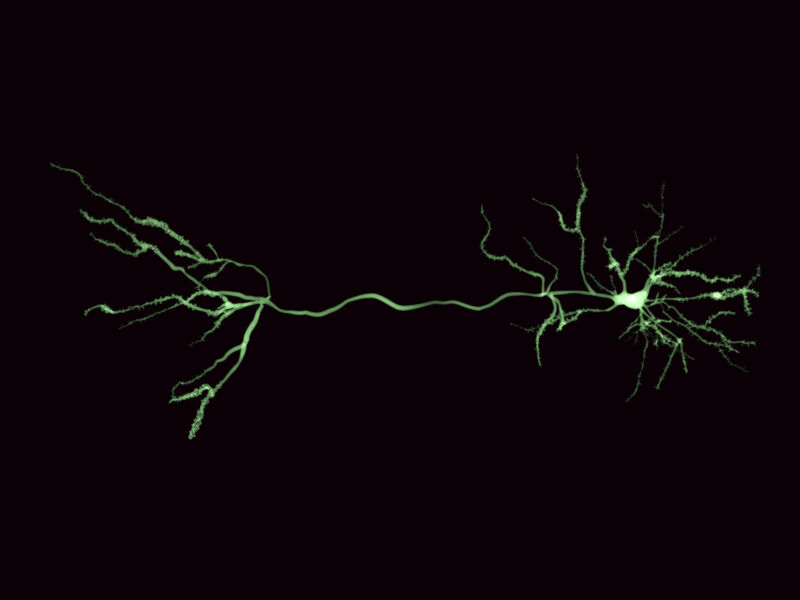
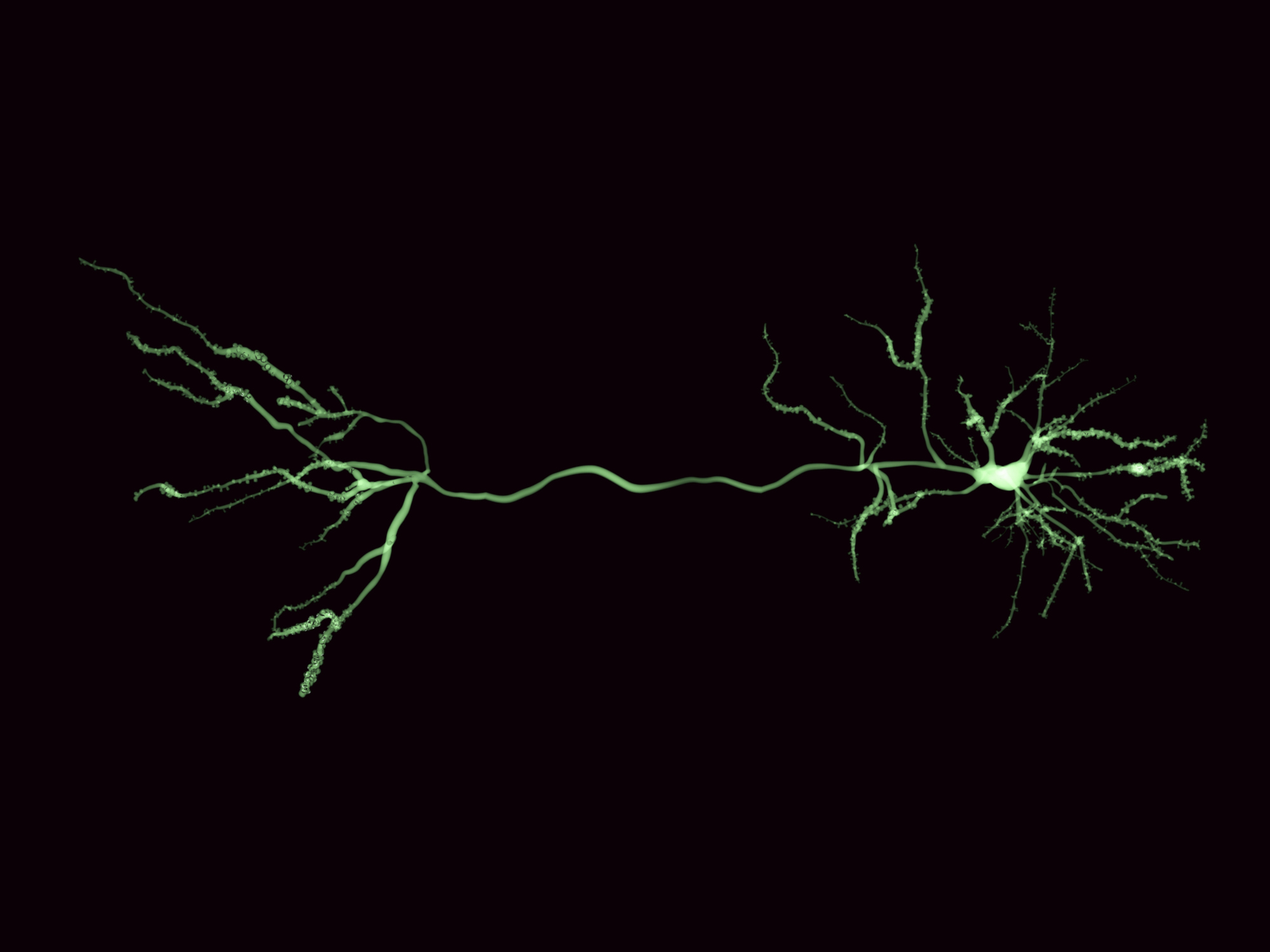
Image of a cell with lots of small, thin processes extending from it.
Enlarge / In culture, nerve cells spontaneously form the structures needed to communicate with each other.

One of the more exciting developments in AI has been the development of algorithms that can teach themselves the rules of a system. Early versions of things like game-playing algorithms had to be given the basics of a game. But newer versions don’t need that—they simply need a system that keeps track of some reward like a score, and they can figure out which actions maximize that without needing a formal description of the game’s rules.

A paper released by the journal Neuron takes this a step further by using actual neurons grown in a dish full of electrodes. This added an additional level of complication, as there was no way to know what neurons would actually find rewarding. The fact that the system seems to have worked may tell us something about how neurons can self-organize their responses to the outside world.

Say hello to DishBrain

The researchers behind the new work, who were primarily based in Melbourne, Australia, call their system DishBrain. And it’s based on, yes, a dish with a set of electrodes on the floor of the dish. When neurons are grown in the dish, these electrodes can do two things: sense the activity of the neurons above them or stimulate those electrodes. The electrodes are large relative to the size of neurons, so both the sensing and stimulation (which can be thought of as similar to reading and writing information) involve a small population of neurons, rather than a single one.

Beyond that, it’s a standard culture dish, meaning a variety of cell types can be grown in it—for some control experiments, the researchers used cells that don’t respond to electrical signals. For these experiments, the researchers tested two types of neurons: some dissected from mouse embryos, and others produced by inducing human stem cells to form neurons. In both cases, as seen in other experiments, the neurons spontaneously formed connections with each other, creating networks that had spontaneous activity.

While the hardware is completely flexible, the researchers configured it as part of a closed-loop system with a computer controller. In this configuration, electrodes in a couple of regions of the dish were defined as taking input from the DishBrain; they’re collectively termed the motor region since they control the system’s response.

Another eight regions were designated to receive input in the form of stimulation by the electrodes, which act a bit like a sensory area of the brain. The computer could also use these electrodes to provide feedback to the system, which we’ll get into below.

Collectively, these provide everything necessary for a neural network to learn what’s going on in the computer environment. The motor electrodes allow the neurons to alter the behavior of the environment, and the sensory ones receive both input on the state of the environment as well as a signal that indicates whether its actions were successful. The system is generic enough that all sorts of environments could be set up in the computer portion of the experiment—pretty much anything where simple inputs alter the environment.

The researchers chose Pong.

https://arstechnica.com/?p=1889781


Fake Joe Rogan interviews fake Steve Jobs in an AI-powered podcast

AI-generated illustration of three Steve Jobs faces.
Enlarge / Which Steve Jobs is the real one?
Ars Technica

A voice synthesis company based in Dubai published a fictional podcast interview between Joe Rogan and Steve Jobs using realistic voices digitally cloned from both men. It takes place during the “first episode” of a purported podcast series called “Podcast.ai,” created by Play.ht, which sells voice synthesis services.

In the interview, you first hear a replication of Rogan’s voice created by voice cloning technology similar to that which we’ve covered before on Ars. Deep learning technology has allowed AI models to replicate distinctive voices with a high degree of accuracy, such as in the case of Darth Vader in Disney’s Obi-Wan Kenobi TV series.

To achieve the effect, someone must first train the AI model on existing samples of the voice that will be cloned. Rogan is a prime target for AI voice training by deep learning models because ample quantities of his isolated voice exist on his podcasts. In fact, The Verge covered a PR stunt by an AI company called Dessa synthesizing Rogan in 2019.

Where this instance of AI tomfoolery becomes more interesting is that Play.ht additionally roped in the voice of deceased Apple CEO Steve Jobs. His voice, while robotically choppy at times, recalls his Apple keynotes and All Things Digital interviews from the late 2000s. And Play.ht claims that the text of the interview was generated by AI as well, possibly from a large language model (LLM) similar to GPT-3.

“Transcripts are generated with fine-tuned language models,” writes Play.ht on the Podcast.ai website. “For example, the Steve Jobs episode was trained on his biography and all recordings of him we could find online so the AI could accurately bring him back to life.”

In keeping with its LLM roots, the 19-minute interview doesn’t make much sense. After a while, parts of the fictional interview begin to sound like conceptual mashups of common Jobs talking points, including aesthetics, revolutionary products, competitors such as Google, Microsoft, and Adobe, and the triumphs of the original Macintosh.

For example, during a section of the interview, fake Jobs delves into criticism of Microsoft that is very similar the what the real Jobs said in a famous 1995 interview for Triumph of the Nerds, but it’s not a carbon copy—and you can tell the voice is synthesized if you compare the two. “That’s the problem I’ve always had with Microsoft,” fake Jobs says. “In many ways they’re smart people and they’ve done good work, but they’ve never had any taste. They’ve never had any aesthetic sense.”

Whether it’s legal to use Jobs’ or Rogan’s vocal likenesses in this manner—particularly to promote a commercial product—remains to be seen. And despite the PR-stunt nature of the podcast, the concept of entirely fictional celebrity podcasts got our attention. As voice synthesis becomes more widespread and potentially undetectable, we’re looking at a future where media artifacts from any era will likely be completely fluid and malleable, shapeable to fit any narrative. In this particular fictional world, Jobs is a huge Rogan fan.

“It’s nice to sit back in the car and listen to you rant,” he says.

https://arstechnica.com/?p=1889202


Tesla shows off underwhelming human robot prototype at AI Day 2022

The walking Optimus prototype demonstrated at the AI Day 2022 event.
Enlarge / The walking Optimus prototype demonstrated at the AI Day 2022 event.

Today at Tesla’s “AI Day” press event, Tesla CEO Elon Musk unveiled an early prototype of its Optimus humanoid robot, which emerged from behind a curtain, walked around, waved, and “raised the roof” with its hands to the beat of techno music.

It was a risky reveal for the prototype, which seemed somewhat unsteady on its feet. “Literally the first time the robot has operated without a tether was on stage tonight,” said Musk. Shortly afterward, Tesla employees rolled a sleeker-looking Optimus model supported by a stand onto the stage that could not yet stand on its own. It waved and lifted its legs. Later, it slumped over while Musk spoke.

[embedded content]
Video of Tesla AI Day 2022

The entire live robot demonstration lasted roughly seven minutes, and the firm also played a demonstration video of the walking Optimus prototype picking up a box and putting it down, watering a plant, and moving metal parts in a factory-like setting—all while tethered to an overhead cable. The video also showed a 3D-rendered view of the world that represents what the Optimus robot can see.

Three stages of the Tesla Optimus robot so far, presented at AI Day 2022.
Enlarge / Three stages of the Tesla Optimus robot so far, presented at AI Day 2022.

Tesla first announced its plans to built a humanoid robot during its AI Day event in August of last year. During that earlier event, a human dressed in a spandex suit resembling a robot and did the Charleston on stage, which prompted skepticism in the press.

At the AI Event today, Musk and his team emphasized that the walking prototype was an early demo developed in roughly six months using “semi-off the shelf actuators,” and that the sleeker model much more closely resembled the “Version 1” unit they wanted to ship. He said it would probably be able to walk in a few weeks.

Goals of the Optimus project include high-volume production (possibly “millions of units sold,” said Musk), low-cost (“probably less than $20,000”), and high-reliability. Comparing the plans for Optimus to existing humanoid robots from competitors, Musk also emphasized that the Optimus robot should have the brains-on-board to work autonomously, citing Tesla’s work with its automotive Autopilot system.

Tesla shared some specifications of its "Latest Generation" prototype Optimus robot.
Enlarge / Tesla shared some specifications of its “Latest Generation” prototype Optimus robot.

Shortly afterward, Musk handed over the stage to Tesla engineers that gave overviews about developing the power systems, actuators, and joint mechanisms that would make Optimus possible, replete with fancy graphs but with few concrete specifics about how they would apply to a shipping product. “We are carrying over most of our design experience from the car to the robot,” said one engineer, while another engineer said they drew much of their inspiration from human biology, especially in joint design.

Earlier in the demonstration, Musk said that they were having the event to “convince some of the most talented people in the world to come to Tesla and help bring this to fruition.” Musk also emphasized the publicly-owned nature of Tesla several times, mentioning that if the public doesn’t like what Tesla is doing they could purchase stock and vote against it. “If I go crazy, you can fire me,” he said.

After the entire two-and-a-half hour presentation, which also included lengthy updates on Tesla’s work with Autopilot AI, the Tesla team gathered on stage to give detailed answered questions from the audience for over an hour.

[This is a developing story and will be updated as new information comes in.]

https://arstechnica.com/?p=1886068


Deepfake Bruce Willis may be the next Hollywood star, and he’s OK with that

Deepfake Bruce Willis as he appeared in a 2021 commercial for Russian mobile company MegaFon.
Enlarge / Deepfake Bruce Willis as he appeared in a 2021 commercial for Russian mobile company MegaFon.

Bruce Willis has sold the “digital twin” rights to his likeness for commercial video production use, according to a report by The Telegraph. This move allows the Hollywood actor to digitally appear in future commercials and possibly even films, and he has already appeared in a Russian commercial using the technology.

Willis, who has been diagnosed with a language disorder called aphasia, announced that he would be “stepping away” from acting earlier this year. Instead, he will license his digital rights through a company called Deepcake. The company is based in Tbilisi, Georgia, and is doing business in America while being registered as a corporation in Delaware.

[embedded content]
In 2021, a deepfake Bruce Willis appeared in a Russian cell phone commercial for MegaFon.

Deepcake obtained Willis’ likeness by training a deep learning neural network model on his appearances in blockbuster action films from the 1990s. With his facial appearance known, the model can then apply Willis’ head to another actor with a similar build in a process commonly called a deepfake. Deepfakes have become popular in recent years on TikTok, with unauthorized deepfakes of Tom Cruise and Keanu Reeves gathering large followings.

In a statement on Deepcake’s website, Willis reportedly said:

I liked the precision of my character. It’s a great opportunity for me to go back in time. The neural network was trained on [the] content of Die Hard and Fifth Element, so my character is similar to the images of that time.

With the advent of the modern technology, I could communicate, work, and participate in filming, even being on another continent. It’s a brand new and interesting experience for me, and I [am] grateful to our team.

According to Deepcake’s website, the firm aims to disrupt the traditional casting process by undercutting it in price, saying that its method “allows us to succeed in tasks minus travel expenses, expensive filming days, insurance, and other costs. You pay for endorsement contract with the celeb’s agent, and a fee for Deepcake’s services. This is game-changingly low.”

While the Telegraph report claims that Willis is “the first Hollywood star to sell his rights to allow a ‘digital twin’ of himself to be created for use on screen,” Ars Technica could not verify that claim outside of the context of a first license with the firm Deepcake. Evidence suggests that a similar licensing precedent exists—in Hollywood, deepfakes have already been used in several Star Wars films and TV shows, for example.

Looking deeper, the concept of having a “digital twin” isn’t new to Willis, either. In 1998, he starred in a PlayStation video game called Apocalypse that involved digitizing his face and capturing the motion of his body as he acted out scenes. Still, it’s notable to see an aging actor sidelined by illness who is willing to volunteer a digital double to work for him. James Earl Jones did so recently with his voice for Darth Vader. It’s possible we’ll see much more of this as deepfake technology improves.

https://arstechnica.com/?p=1885857


Commissione Ue, nuove norme per l’IA. Regole uniformi e risarcimento danni per i consumatori

Via libera dalla Commissione Ue a due proposte (una nuova direttiva e una revisione di una direttiva esistente) sulla responsabilità oggettiva dei produttori per prodotti difettosi e per rendere più facile ottenere un risarcimento per le vittime di danni correlati all’intelligenza artificiale.

Nel dettaglio, la revisione della direttiva sulla responsabilità dei produttori modernizza e rafforza le attuali regole per il risarcimento di lesioni personali, danni a cose o perdite di dati causate da prodotti non sicuri, dalle sedie da giardino ai macchinari avanzati.

La revisione della direttiva punta a:

  • modernizzare le regole di responsabilità per i modelli di business dell’economia circolare, nel caso un prodotto venga drasticamente modificato;
  • modernizzare le norme sulla responsabilità dei prodotti nell’era digitale, consentendo il risarcimento del danno quando prodotti come robot, droni o sistemi domestici intelligenti sono resi non sicuri, ad esempio, dagli aggiornamenti software o quando il produttore non garantisce la sicurezza informatica.

La stessa revisione della direttiva mira a creare condizioni più eque tra produttori Ue e non Ue; e a mettere i consumatori su un piano di parità con i produttori, ad esempio introducendo una maggiore flessibilità nei limiti di tempo per presentare reclami e alleviando l’onere della prova per le vittime in casi complessi, come quelli che coinvolgono i prodotti farmaceutici o l’AI.

La nuova direttiva sulla responsabilità dell’Intelligenza artificiale

Per quanto riguarda la nuova direttiva sulla responsabilità AI, le nuove norme puntano a stabilire regole uniformi per l’accesso alle informazioni e – anche in questo caso – per l’alleggerimento dell’onere della prova in relazione ai danni causati dai sistemi di intelligenza artificiale, stabilendo un quadro più ampio di protezione delle vittime (siano esse individui o imprese). La nuova direttiva armonizzerà alcune regole per i reclami al di fuori dell’ambito della direttiva sulla responsabilità dei produttori, nei casi in cui il danno sia causato da comportamenti illeciti. Questo copre, ad esempio, violazioni della privacy o danni causati da problemi di sicurezza.

La direttiva semplifica inoltre il procedimento giudiziario per le vittime nella dimostrazione della colpa, attraverso due novità. In primo luogo, in caso di colpa rilevante con un probabile nesso causale con le prestazioni di un AI, la cosiddetta “presunzione di causalità” affronterà le difficoltà incontrate dalle vittime nel dover spiegare in dettaglio come il danno sia stato causato da una specifica colpa o omissione. In secondo luogo, le vittime avranno più strumenti per ottenere una riparazione giudiziaria, introducendo un diritto di accesso alle prove da parte di aziende e fornitori, in casi in cui sia coinvolta una intelligenza artificiale ad alto rischio.

“Le nuove regole – evidenzia la Commissione in una nota – trovano un equilibrio tra la tutela dei consumatori e la promozione dell’innovazione, eliminando ulteriori ostacoli all’accesso delle vittime all’indennizzo, stabilendo nel contempo garanzie per il settore IA introducendo, ad esempio, il diritto di combattere un’azione di responsabilità basata su una presunzione di causalità”. Gli effetti della nuova direttiva, dopo cinque anni dalla sue entrata in vigora, dovranno essere valutati dalla Commissione europea.

Reynders: “le nuove tecnologie come i droni o i servizi di consegna gestiti dall’IA possono funzionare solo se i consumatori si sentono sicuri e protetti“

“Vogliamo che le tecnologie dell’intelligenza artificiale prosperino nell’UE, e perché questo sia possibile occorre che le persone abbiano fiducia nelle innovazioni digitali”, ha annunciato la Vicepresidente per i Valori e la trasparenza Věra Jourová. “Con la proposta odierna sulla responsabilità civile per l’intelligenza artificiale diamo ai consumatori strumenti di ricorso in caso di danni da essa causati, affinché possano beneficiare dello stesso livello di protezione di cui godono nel caso delle tecnologie tradizionali, e garantiamo – conclude Jourova – la certezza del diritto per il nostro mercato interno.”

“La direttiva sulla responsabilità per danno da prodotti difettosi è da quarant’anni una pietra angolare del mercato interno”, spiega il Commissario per il Mercato interno Thierry Breton. “La proposta odierna la renderà adatta a rispondere alle sfide dei decenni a venire. Le nuove norme terranno conto delle catene globali del valore, promuoveranno l’innovazione e la fiducia dei consumatori e garantiranno – ha aggiunto Breton – una maggiore certezza del diritto per le imprese che partecipano alla transizione verde e digitale.”

 “Nel tenere presente l’enorme potenziale delle nuove tecnologie, dobbiamo sempre garantire la sicurezza dei consumatori. Disporre di adeguate norme di protezione per i cittadini dell’UE costituisce la base per la fiducia dei consumatori e quindi per il successo dell’innovazione”, ha dichiarato il Commissario per la Giustizia Didier Reynders. “Le nuove tecnologie come i droni o i servizi di consegna gestiti dall’IA possono funzionare solo se i consumatori si sentono sicuri e protetti. Oggi proponiamo norme moderne in materia di responsabilità che risponderanno precisamente a questa esigenza. Stiamo adattando il nostro quadro giuridico alle realtà della trasformazione digitale,” ha concluso.

AI4Europe

Recentemente la Commissione europea ha annunciato 9 milioni di euro di finanziamento per un nuovo progetto e una piattaforma di intelligenza artificiale che mira sostanzialmente a fungere da catalizzatore per aiutare l’innovazione basata sull’IA: AI4Europe.

Il progetto,  supportato da un consorzio di altri 23 partner in 15 paesi europei, ha come obiettivo lo sviluppo di una piattaforma di AI-on-demand in grado di “riunire la comunità dell’IA promuovendo al contempo i valori europei”. La piattaforma offrirà servizi, dati e strumenti interoperabili da diverse comunità correlate e fornirà soluzioni per facilitare la produttività, la riproducibilità e la collaborazione della ricerca.

https://www.key4biz.it/lunione-europea-vara-nuove-regole-per-lintelligenza-artificiale/417533/


Better than JPEG? Researcher discovers that Stable Diffusion can compress images

An illustration of compression
Enlarge / These jagged, colorful blocks are exactly what the concept of image compression looks like.
Benj Edwards / Ars Technica

Last week, Swiss software engineer Matthias Bühlmann discovered that the popular image synthesis model Stable Diffusion could compress existing bitmapped images with fewer visual artifacts than JPEG or WebP at high compression ratios, though there are significant caveats.

Stable Diffusion is an AI image synthesis model that typically generates images based on text descriptions (called “prompts”). The AI model learned this ability by studying millions of images pulled from the Internet. During the training process, the model makes statistical associations between images and related words, making a much smaller representation of key information about each image and storing them as “weights,” which are mathematical values that represent what the AI image model knows, so to speak.

When Stable Diffusion analyzes and “compresses” images into weight form, they reside in what researchers call “latent space,” which is a way of saying that they exist as a sort of fuzzy potential that can be realized into images once they’re decoded. With Stable Diffusion 1.4, the weights file is roughly 4GB, but it represents knowledge about hundreds of millions of images.

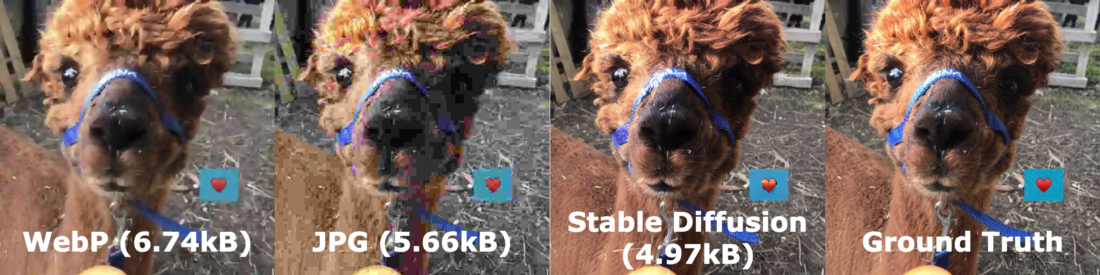
Examples of using Stable Diffusion to compress images.
Enlarge / Examples of using Stable Diffusion to compress images.

While most people use Stable Diffusion with text prompts, Bühlmann cut out the text encoder and instead forced his images through Stable Diffusion’s image encoder process, which takes a low-precision 512×512 image and turns it into a higher-precision 64×64 latent space representation. At this point, the image exists at a much smaller data size than the original, but it can still be expanded (decoded) back into a 512×512 image with fairly good results.

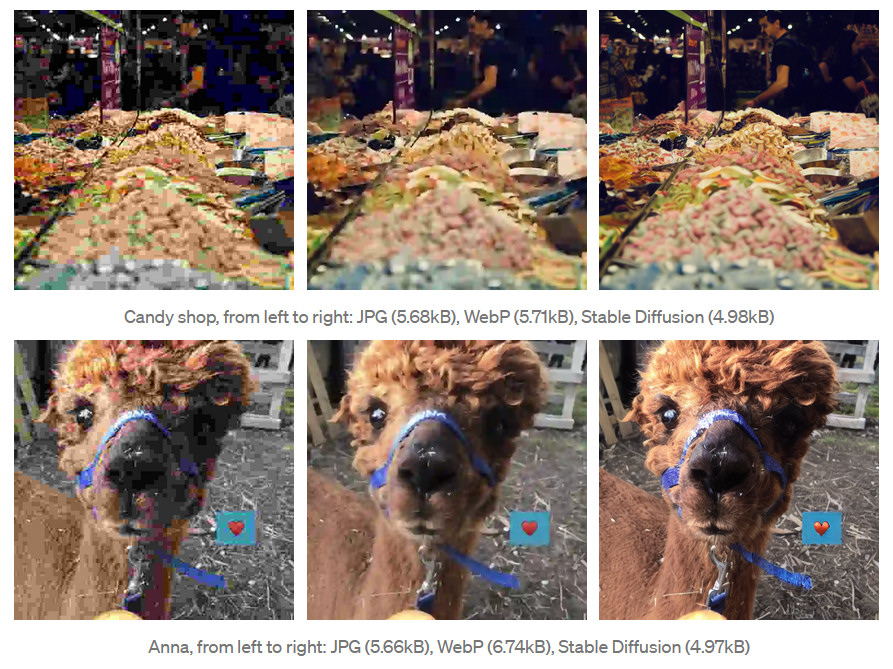
While running tests, Bühlmann found that a novel image compressed with Stable Diffusion looked subjectively better at higher compression ratios (smaller file size) than JPEG or WebP. In one example, he shows a photo of a llama (originally 768KB) that has been compressed down to 5.68KB using JPEG, 5.71KB using WebP, and 4.98KB using Stable Diffusion. The Stable Diffusion image appears to have more resolved details and fewer obvious compression artifacts than those compressed in the other formats.

Experimental examples of using Stable Diffusion to compress images. SD results are on the far right.
Enlarge / Experimental examples of using Stable Diffusion to compress images. SD results are on the far right.

Bühlmann’s method currently comes with significant limitations, however: It’s not good with faces or text, and in some cases, it can actually hallucinate detailed features in the decoded image that were not present in the source image. (You probably don’t want your image compressor inventing details in an image that don’t exist.) Also, decoding requires the 4GB Stable Diffusion weights file and extra decoding time.

While this use of Stable Diffusion is unconventional and more of a fun hack than a practical solution, it could potentially point to a novel future use of image synthesis models. Bühlmann’s code can be found on Google Colab, and you’ll find more technical details about his experiment in his post on Towards AI.

https://arstechnica.com/?p=1882929


AI model from OpenAI automatically recognizes speech and translates it to English

A pink waveform on a blue background, poetically suggesting audio.
Benj Edwards / Ars Technica

On Wednesday, OpenAI released a new open source AI model called Whisper that recognizes and translates audio at a level that approaches human recognition ability. It can transcribe interviews, podcasts, conversations, and more.

OpenAI trained Whisper on 680,000 hours of audio data and matching transcripts in approximately 10 languages collected from the web. According to OpenAI, this open-collection approach has led to “improved robustness to accents, background noise, and technical language.” It can also detect the spoken language and translate it to English.

OpenAI describes Whisper as an encoder-decoder transformer, a type of neural network that can use context gleaned from input data to learn associations that can then be translated into the model’s output. OpenAI presents this overview of Whisper’s operation:

Input audio is split into 30-second chunks, converted into a log-Mel spectrogram, and then passed into an encoder. A decoder is trained to predict the corresponding text caption, intermixed with special tokens that direct the single model to perform tasks such as language identification, phrase-level timestamps, multilingual speech transcription, and to-English speech translation.

By open-sourcing Whisper, OpenAI hopes to introduce a new foundation model that others can build on in the future to improve speech processing and accessibility tools. OpenAI has a significant track record on this front. In January 2021, OpenAI released CLIP, an open source computer vision model that arguably ignited the recent era of rapidly progressing image synthesis technology such as DALL-E 2 and Stable Diffusion.

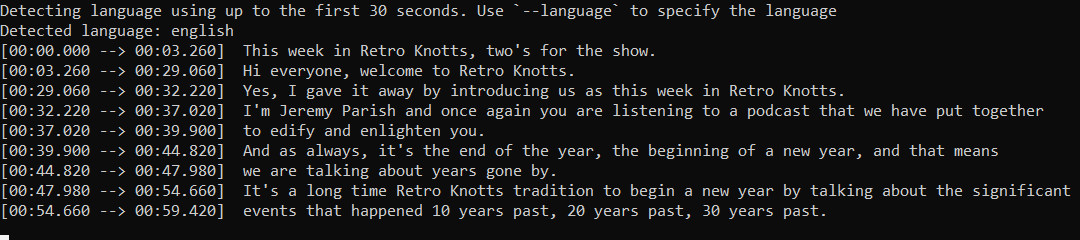
At Ars Technica, we tested Whisper from code available on GitHub, and we fed it multiple samples, including a podcast episode and a particularly difficult-to-understand section of audio taken from a telephone interview. Although it took some time while running through a standard Intel desktop CPU (the technology doesn’t work in real time yet), Whisper did a good job of transcribing the audio into text through the demonstration Python program—far better than some AI-powered audio transcription services we have tried in the past.

Example console output from the OpenAI's Whisper demonstration program as it transcribes a podcast.
Enlarge / Example console output from the OpenAI’s Whisper demonstration program as it transcribes a podcast.
Benj Edwards / Ars Technica

With the proper setup, Whisper could easily be used to transcribe interviews, podcasts, and potentially translate podcasts produced in non-English languages to English on your machine—for free. That’s a potent combination that might eventually disrupt the transcription industry.

As with almost every major new AI model these days, Whisper brings positive advantages and the potential for misuse. On Whisper’s model card (under the “Broader Implications” section), OpenAI warns that Whisper could be used to automate surveillance or identify individual speakers in a conversation, but the company hopes it will be used “primarily for beneficial purposes.”

https://arstechnica.com/?p=1883524


Artist finds private medical record photos in popular AI training data set

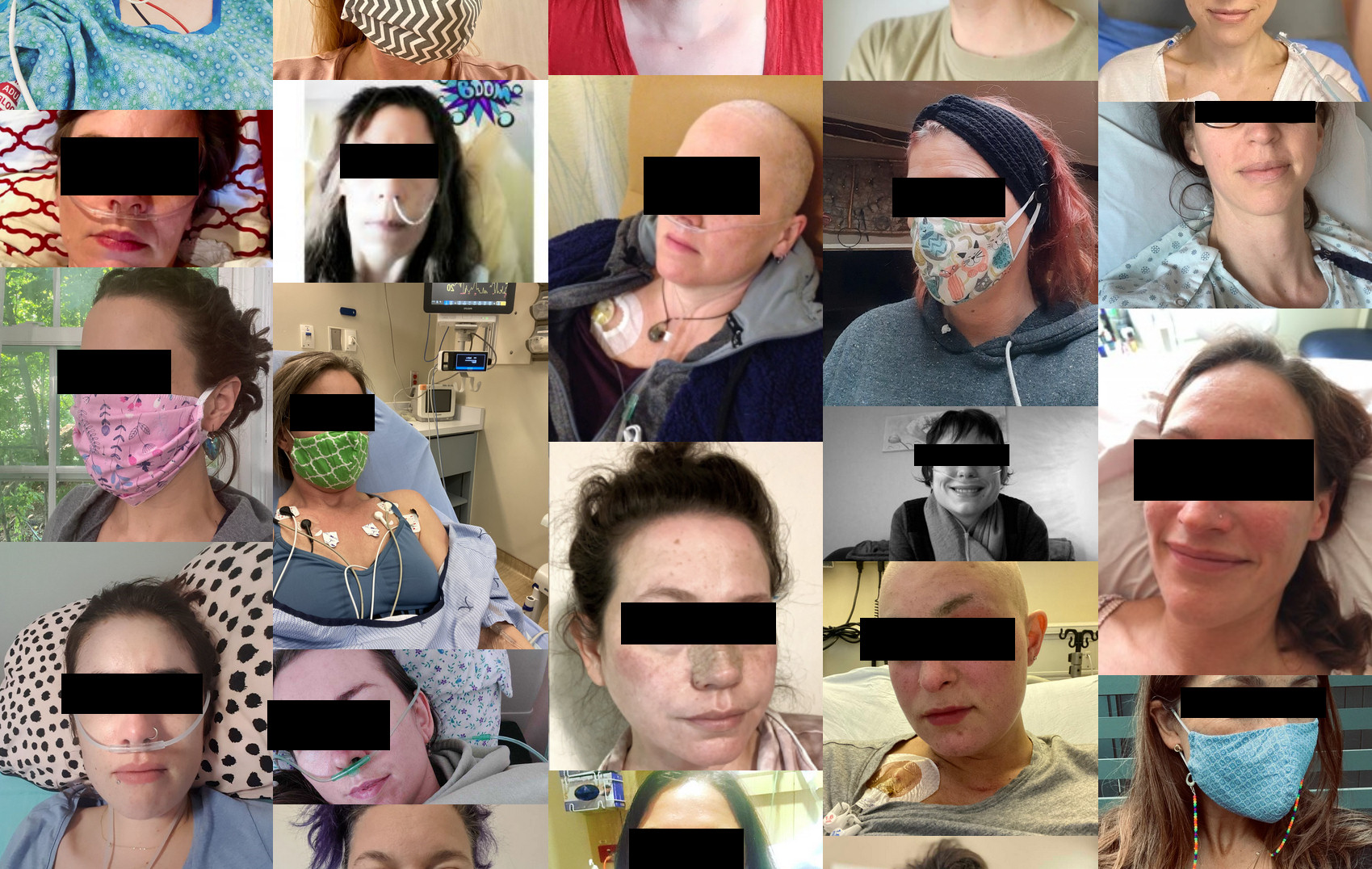
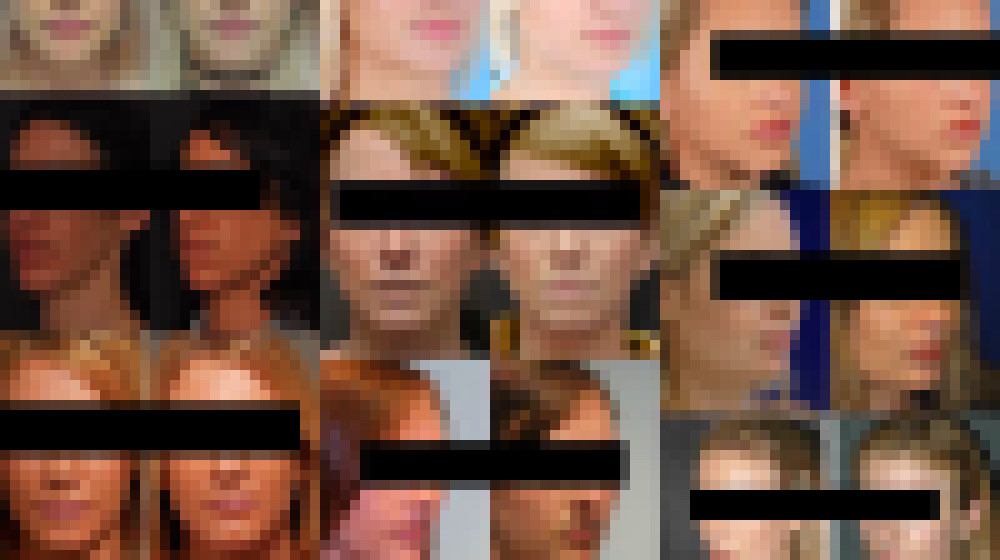
Censored medical images found in the LAION-5B data set used to train AI. The black bars and distortion have been added.
Enlarge / Censored medical images found in the LAION-5B data set used to train AI. The black bars and distortion have been added.
Ars Technica

Late last week, a California-based AI artist who goes by the name Lapine discovered private medical record photos taken by her doctor in 2013 referenced in the LAION-5B image set, which is a scrape of publicly available images on the web. AI researchers download a subset of that data to train AI image synthesis models such as Stable Diffusion and Google Imagen.

Lapine discovered her medical photos on a site called Have I Been Trained, which lets artists see if their work is in the LAION-5B data set. Instead of doing a text search on the site, Lapine uploaded a recent photo of herself using the site’s reverse image search feature. She was surprised to discover a set of two before-and-after medical photos of her face, which had only been authorized for private use by her doctor, as reflected in an authorization form Lapine tweeted and also provided to Ars.

Lapine has a genetic condition called Dyskeratosis Congenita. “It affects everything from my skin to my bones and teeth,” Lapine told Ars Technica in an interview. “In 2013, I underwent a small set of procedures to restore facial contours after having been through so many rounds of mouth and jaw surgeries. These pictures are from my last set of procedures with this surgeon.”

The surgeon who possessed the medical photos died of cancer in 2018, according to Lapine, and she suspects that they somehow left his practice’s custody after that. “It’s the digital equivalent of receiving stolen property,” says Lapine. “Someone stole the image from my deceased doctor’s files and it ended up somewhere online, and then it was scraped into this dataset.”

Lapine prefers to conceal her identity for medical privacy reasons. With records and photos provided by Lapine, Ars confirmed that there are medical images of her referenced in the LAION data set. During our search for Lapine’s photos, we also discovered thousands of similar patient medical record photos in the data set, each of which may have a similar questionable ethical or legal status, many of which have likely been integrated into popular image synthesis models that companies like Midjourney and Stability AI offer as a commercial service.

This does not mean that anyone can suddenly create an AI version of Lapine’s face (as the technology stands at the moment)—and her name is not linked to the photos—but it bothers her that private medical images have been baked into a product without any form of consent or recourse to remove them. “It’s bad enough to have a photo leaked, but now it’s part of a product,” says Lapine. “And this goes for anyone’s photos, medical record or not. And the future abuse potential is really high.”

Who watches the watchers?

LAION describes itself as a nonprofit organization with members worldwide, “aiming to make large-scale machine learning models, datasets and related code available to the general public.” Its data can be used in various projects, from facial recognition to computer vision to image synthesis.

For example, after an AI training process, some of the images in the LAION data set become the basis of Stable Diffusion’s amazing ability to generate images from text descriptions. Since LAION is a set of URLs pointing to images on the web, LAION does not host the images themselves. Instead, LAION says that researchers must download the images from various locations when they want to use them in a project.

The LAION data set is replete with potentially sensitive images collected from the Internet, such as these, which are now being integrated into commercial machine learning products. Black bars have been added by Ars for privacy purposes.
Enlarge / The LAION data set is replete with potentially sensitive images collected from the Internet, such as these, which are now being integrated into commercial machine learning products. Black bars have been added by Ars for privacy purposes.
Ars Technica

Under these conditions, responsibility for a particular image’s inclusion in the LAION set then becomes a fancy game of pass the buck. A friend of Lapine’s posed an open question on the #safety-and-privacy channel of LAION’s Discord server last Friday asking how to remove her images from the set. LAION engineer Romain Beaumont replied, “The best way to remove an image from the Internet is to ask for the hosting website to stop hosting it,” wrote Beaumont. “We are not hosting any of these images.”

In the US, scraping publicly available data from the Internet appears to be legal, as the results from a 2019 court case affirm. Is it mostly the deceased doctor’s fault, then? Or the site that hosts Lapine’s illicit images on the web?

Ars contacted LAION for comment on these questions but did not receive a response by press time. LAION’s website does provide a form where European citizens can request information removed from their database to comply with the EU’s GDPR laws, but only if a photo of a person is associated with a name in the image’s metadata. Thanks to services such as PimEyes, however, it has become trivial to associate someone’s face with names through other means.

Ultimately, Lapine understands how the chain of custody over her private images failed but still would like to see her images removed from the LAION data set. “I would like to have a way for anyone to ask to have their image removed from the data set without sacrificing personal information. Just because they scraped it from the web doesn’t mean it was supposed to be public information, or even on the web at all.”

https://arstechnica.com/?p=1882591


Deepfake audio has a tell and researchers can spot it

Deepfake audio has a tell and researchers can spot it

Imagine the following scenario. A phone rings. An office worker answers it and hears his boss, in a panic, tell him that she forgot to transfer money to the new contractor before she left for the day and needs him to do it. She gives him the wire transfer information, and with the money transferred, the crisis has been averted.

The worker sits back in his chair, takes a deep breath, and watches as his boss walks in the door. The voice on the other end of the call was not his boss. In fact, it wasn’t even a human. The voice he heard was that of an audio deepfake, a machine-generated audio sample designed to sound exactly like his boss.

Attacks like this using recorded audio have already occurred, and conversational audio deepfakes might not be far off.

Deepfakes, both audio and video, have been possible only with the development of sophisticated machine learning technologies in recent years. Deepfakes have brought with them a new level of uncertainty around digital media. To detect deepfakes, many researchers have turned to analyzing visual artifacts—minute glitches and inconsistencies—found in video deepfakes.

[embedded content]
This is not Morgan Freeman, but if you weren’t told that, how would you know?

Audio deepfakes potentially pose an even greater threat, because people often communicate verbally without video—for example, via phone calls, radio, and voice recordings. These voice-only communications greatly expand the possibilities for attackers to use deepfakes.

To detect audio deepfakes, we and our research colleagues at the University of Florida have developed a technique that measures the acoustic and fluid dynamic differences between voice samples created organically by human speakers and those generated synthetically by computers.

Organic vs. synthetic voices

Humans vocalize by forcing air over the various structures of the vocal tract, including vocal folds, tongue, and lips. By rearranging these structures, you alter the acoustical properties of your vocal tract, allowing you to create over 200 distinct sounds, or phonemes. However, human anatomy fundamentally limits the acoustic behavior of these different phonemes, resulting in a relatively small range of correct sounds for each.

[embedded content]
How your vocal organs work.

By contrast, audio deepfakes are created by first allowing a computer to listen to audio recordings of a targeted victim speaker. Depending on the exact techniques used, the computer might need to listen to as little as 10 to 20 seconds of audio. This audio is used to extract key information about the unique aspects of the victim’s voice.

The attacker selects a phrase for the deepfake to speak and then, using a modified text-to-speech algorithm, generates an audio sample that sounds like the victim saying the selected phrase. This process of creating a single deepfaked audio sample can be accomplished in a matter of seconds, potentially allowing attackers enough flexibility to use the deepfake voice in a conversation.

Detecting audio deepfakes

The first step in differentiating speech produced by humans from speech generated by deepfakes is understanding how to acoustically model the vocal tract. Luckily scientists have techniques to estimate what someone—or some being such as a dinosaur—would sound like based on anatomical measurements of its vocal tract.

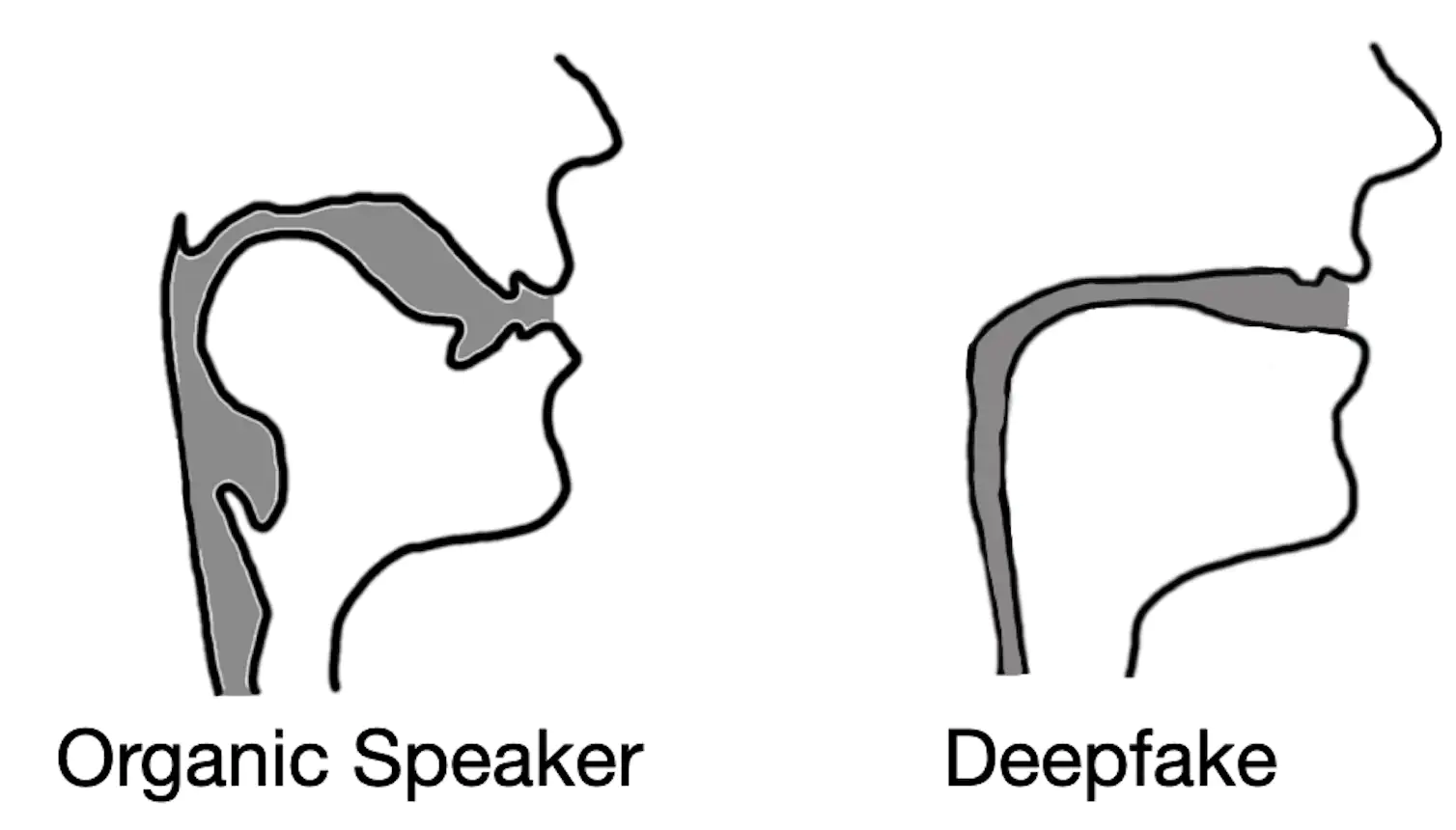
We did the reverse. By inverting many of these same techniques, we were able to extract an approximation of a speaker’s vocal tract during a segment of speech. This allowed us to effectively peer into the anatomy of the speaker who created the audio sample.

Deepfaked audio often results in vocal tract reconstructions that resemble drinking straws rather than biological vocal tracts.
Enlarge / Deepfaked audio often results in vocal tract reconstructions that resemble drinking straws rather than biological vocal tracts.

From here, we hypothesized that deepfake audio samples would fail to be constrained by the same anatomical limitations humans have. In other words, the analysis of deepfaked audio samples simulated vocal tract shapes that do not exist in people.

Our testing results not only confirmed our hypothesis but revealed something interesting. When extracting vocal tract estimations from deepfake audio, we found that the estimations were often comically incorrect. For instance, it was common for deepfake audio to result in vocal tracts with the same relative diameter and consistency as a drinking straw, in contrast to human vocal tracts, which are much wider and more variable in shape.

This realization demonstrates that deepfake audio, even when convincing to human listeners, is far from indistinguishable from human-generated speech. By estimating the anatomy responsible for creating the observed speech, it’s possible to identify whether the audio was generated by a person or a computer.

Why this matters

Today’s world is defined by the digital exchange of media and information. Everything from news to entertainment to conversations with loved ones typically happens via digital exchanges. Even in their infancy, deepfake video and audio undermine the confidence people have in these exchanges, effectively limiting their usefulness.

If the digital world is to remain a critical resource for information in people’s lives, effective and secure techniques for determining the source of an audio sample are crucial.
Logan Blue is a PhD student in computer and information science and engineering at the University of Florida, and Patrick Traynor is professor of computer and information science and engineering at the University of Florida.

This article is republished from The Conversation under a Creative Commons license. Read the original article.

https://arstechnica.com/?p=1882806


AI software helps bust image fraud in academic papers

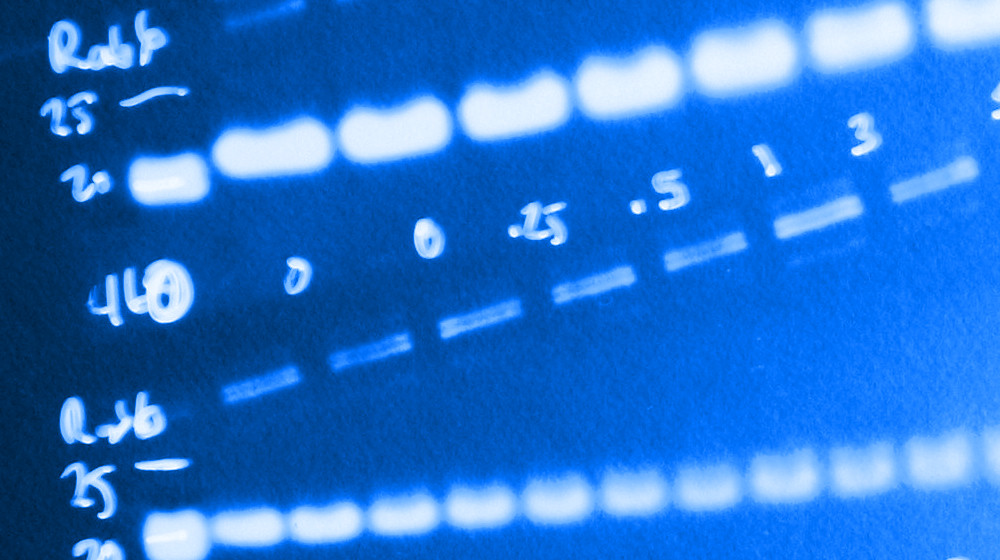
Negative photo image of a western blot test result.
Enlarge / Colorized photo image of a Western blot test result.

Scientific publishers such as the American Association for Cancer Research (AACR) and Taylor & Francis have begun attempting to detect fraud in academic paper submissions with an AI image-checking program called Proofig, reports The Register. Proofig, a product of an Israeli firm of the same name, aims to help use “artificial intelligence, computer vision and image processing to review image integrity in scientific publications,” according to the company’s website.

During a trial that ran from January 2021 to May 2022, AACR used Proofig to screen 1,367 papers accepted for publication, according to The Register. Of those, 208 papers required author contact to clear up issues such as mistaken duplications, and four papers were withdrawn.

In particular, many journals need help detecting image duplication fraud in Western blots, which are a specific style of protein-detection imagery consisting of line segments of various widths. Subtle differences in a blot’s appearance can translate to dramatically different conclusions about test results, and many cases of academic fraud have seen unscrupulous researchers duplicate, crop, stretch, and rotate Western blots to make it appear like they have more (or different) data than they really do. Detecting duplicate images can be tedious work for human eyes, which is why some firms like Proofig and ImageTwin, a German firm, are attempting to automate the process.

But both Proofig’s and ImageTwin’s solutions currently have significant limitations, according to The Register. First, human expertise is still necessary to interpret detection results and reduce false positives. Second, Proofig is currently expensive due to its computationally intensive process, costing $99 to analyze 120 images for an individual (the journals have negotiated cheaper rates). Currently, both high cost and the requirement for manual oversight is keeping the journals from analyzing every paper at the submission stage. Instead, they have been reserving its use for later in the publication process.

Academic fraud, while uncommon, can still have a devastating effect on a publication’s reputation. Between the massive volume of academic papers being published today and recent revelations about image fraud in widely cited Alzheimer’s research, the field does seem ripe for computer vision tools that can assist humans with fraud detection. Their overall effectiveness—and how widely they become adopted—is still a developing story.

https://arstechnica.com/?p=1882596