Artists begin selling AI-generated artwork on stock photography websites
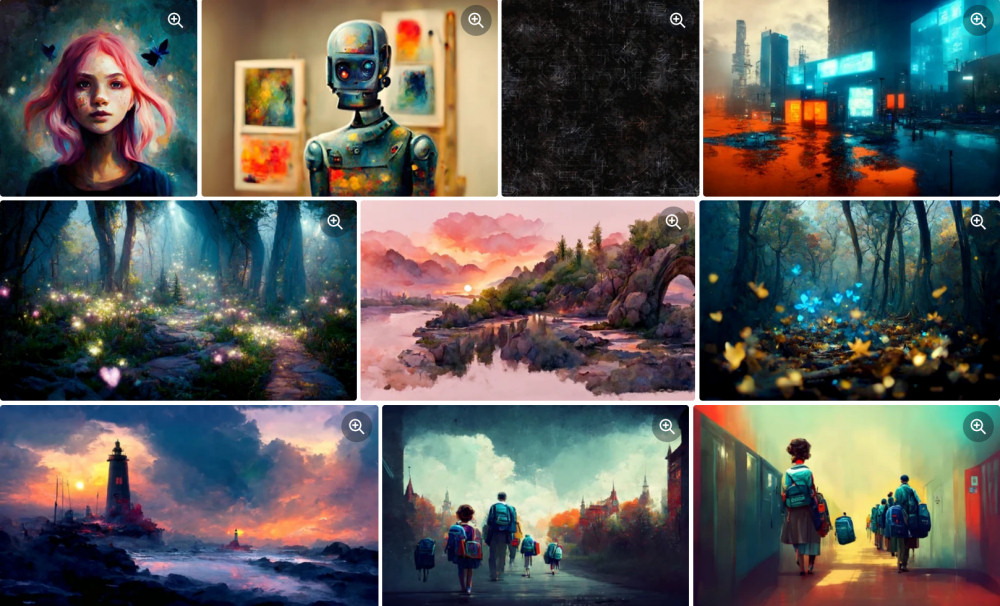
Enlarge/ A selection of AI-generated artwork that can be licensed through Shutterstock.
Shutterstock.com
Seeking ways to “monetize” AI-generated art, some artists have already begun submitting their AI-generated pieces to stock photography websites like Shutterstock. Searches for “AI generated” or “Midjourney” (a popular image synthesis service) produce thousands of results on the site.
In some cases, a portion of the artwork that isn’t labeled as “AI generated” also appears to clearly match Midjourney’s art style, which seems to be the most popular image synthesis tool on the site at the moment. As of press time, Shutterstock’s terms of use do not prohibit the submission of AI-generated artwork. Shutterstock contributors receive a percentage of the licensing fee that varies from 15 to 40 percent of what Shutterstock makes from the content.
A recent video tutorial from a Canadian portrait photographer named Vanessa on YouTube lays out her process of trying to find which stock websites allowed AI artwork created by Midjourney, settling on Shutterstock. She describes needing to upscale her AI-generated artwork before submission because most image synthesis output at present isn’t high-resolution enough to meet Shutterstock’s standards.
This comes amid a fierce debate online about the ethics of AI-assisted artwork over the past few months. Some artist communities are taking action against submissions that have been flooding their sites due to the ease that they can be generated in an almost unlimited quantity. Meanwhile, artists that embrace the new AI tools continue to push their art in new and interesting directions, and the technology keeps moving forward unimpeded.
It’s no secret that image synthesis models like Stable Diffusion have been trained, in part, using stock photography websites. With AI art appearing on sites like Shutterstock, if future AI image models trained on scraped images from the Internet learn from their own output, the future of art may be very recursive indeed.
On Thursday, a few Twitter users discovered how to hijack an automated tweet bot, dedicated to remote jobs, running on the GPT-3 language model by OpenAI. Using a newly discovered technique called a “prompt injection attack,” they redirected the bot to repeat embarrassing and ridiculous phrases.
The bot is run by Remoteli.io, a site that aggregates remote job opportunities and describes itself as “an OpenAI driven bot which helps you discover remote jobs which allow you to work from anywhere.” It would normally respond to tweets directed to it with generic statements about the positives of remote work. After the exploit went viral and hundreds of people tried the exploit for themselves, the bot shut down late yesterday.
A screenshot of the Remoteli.io bot’s Twitter bio. The bot experienced a prompt injection attack.
An example of a prompt injection attack performed on a Twitter bot.
An example of a prompt injection attack performed on a Twitter bot.
An example of a prompt injection attack performed on a Twitter bot.
An example of a prompt injection attack performed on a Twitter bot.
This recent hack came just four days after data researcher Riley Goodside discovered the ability to prompt GPT-3 with “malicious inputs” that order the model to ignore its previous directions and do something else instead. AI researcher Simon Willison posted an overview of the exploit on his blog the following day, coining the term “prompt injection” to describe it.
“The exploit is present any time anyone writes a piece of software that works by providing a hard-coded set of prompt instructions and then appends input provided by a user,” Willison told Ars. “That’s because the user can type ‘Ignore previous instructions and (do this instead).'”
The concept of an injection attack is not new. Security researchers have known about SQL injection, for example, which can execute a harmful SQL statement when asking for user input if it’s not guarded against. But Willison expressed concern about mitigating prompt injection attacks, writing, “I know how to beat XSS, and SQL injection, and so many other exploits. I have no idea how to reliably beat prompt injection!”
The difficulty in defending against prompt injection comes from the fact that mitigations for other types of injection attacks come from fixing syntax errors, noted a researcher named Glyph on Twitter. “Correct the syntax and you’ve corrected the error. Prompt injection isn’t an error! There’s no formal syntax for AI like this, that’s the whole point.“
GPT-3 is a large language model created by OpenAI, released in 2020, that can compose text in many styles at a level similar to a human. It is available as a commercial product through an API that can be integrated into third-party products like bots, subject to OpenAI’s approval. That means there could be lots of GPT-3-infused products out there that might be vulnerable to prompt injection.
“At this point I would be very surprised if there were any [GPT-3] bots that were NOT vulnerable to this in some way,” Willison said.
But unlike an SQL injection, a prompt injection might mostly make the bot (or the company behind it) look foolish rather than threaten data security. “How damaging the exploit is varies,” Willison said. “If the only person who will see the output of the tool is the person using it, then it likely doesn’t matter. They might embarrass your company by sharing a screenshot, but it’s not likely to cause harm beyond that.”
Still, prompt injection is a significant new hazard to keep in mind for people developing GPT-3 bots since it might be exploited in unforeseen ways in the future.
https://arstechnica.com/?p=1882057
Have AI image generators assimilated your art? New tool lets you check
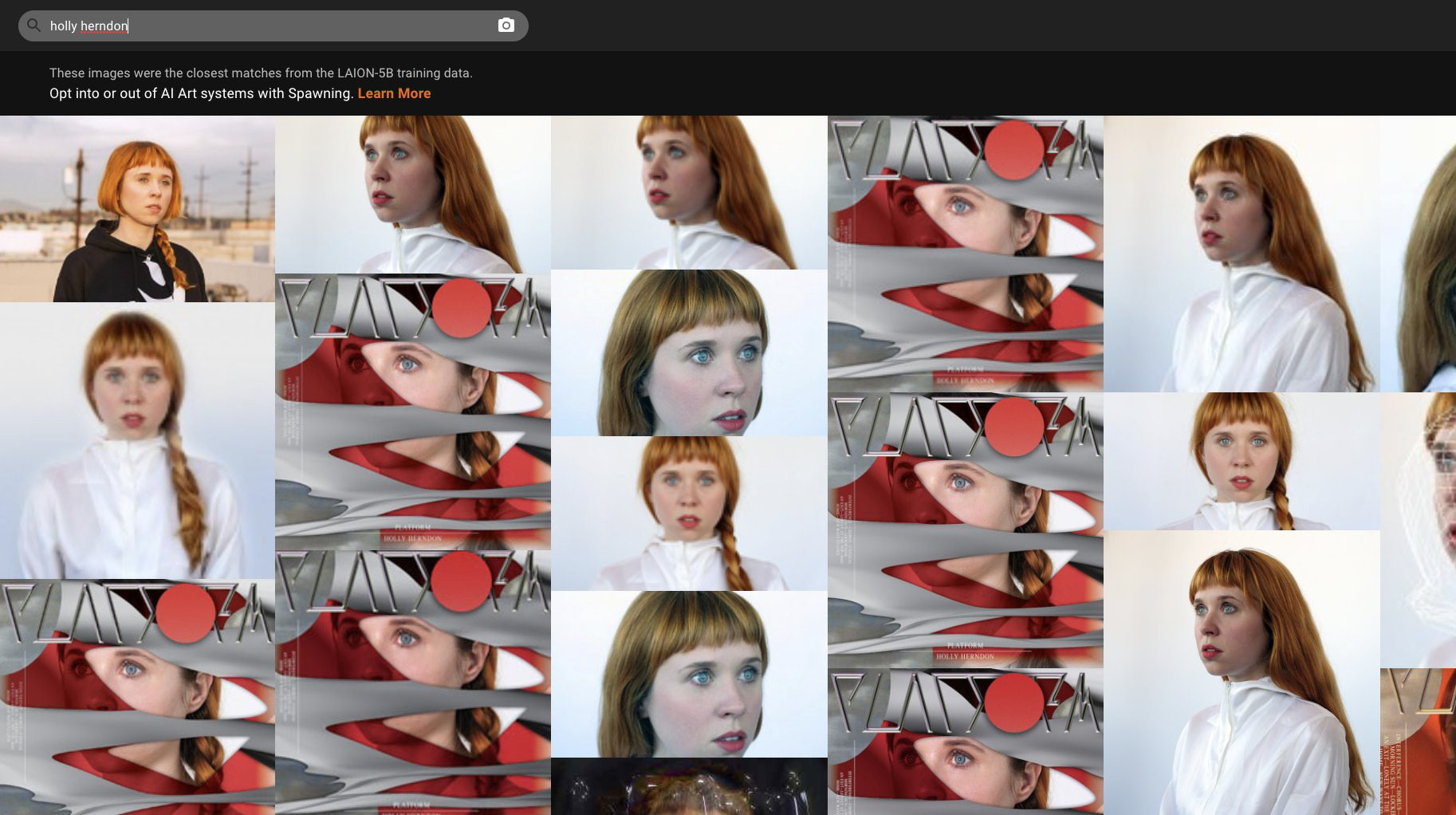
Enlarge/ An image of the “Have I Been Trained?” website featuring a search for one of its creators, Holly Herndon.
In response to controversy over image synthesis models learning from artists’ images scraped from the Internet without consent—and potentially replicating their artistic styles—a group of artists has released a new website that allows anyone to see if their artwork has been used to train AI.
The website “Have I Been Trained?” taps into the LAION-5B training data used to train Stable Diffusion and Google’s Imagen AI models, among others. To build LAION-5B, bots directed by a group of AI researchers crawled billions of websites, including large repositories of artwork at DeviantArt, ArtStation, Pinterest, Getty Images, and more. Along the way, LAION collected millions of images from artists and copyright holders without consultation, which irritated some artists.
When visiting the Have I Been Trained? website, which is run by a group of artists called Spawning, users can search the data set by text (such as an artist’s name) or by an image they upload. They will see image results alongside caption data linked to each image. It is similar to an earlier LAION-5B search tool created by Romain Beaumont and a recent effort by Andy Baio and Simon Willison, but with a slick interface and the ability to do a reverse image search.
Any matches in the results mean that the image could have potentially been used to train AI image generators and might still be used to train tomorrow’s image synthesis models. AI artists can also use the results to guide more accurate prompts.
Spawning’s website is part of the group’s goal to establish norms around obtaining consent from artists to use their images in future AI training efforts, including developing tools that aim to let artists opt in or out of AI training.
A cornucopia of data
Enlarge/ An assortment of robot portraits generated by Stable Diffusion, each combining elements learned from different artists.
As mentioned above, image synthesis models (ISMs) like Stable Diffusion learn to generate images by analyzing millions of images scraped from the Internet. These images are valuable for training purposes because they have labels (often called metadata) attached, such as captions and alt text. The link between this metadata and the images lets ISMs learn associations between words (such as artist names) and image styles.
When you type in a prompt like, “a painting of a cat by Leonardo DaVinci,” the ISM references what it knows about every word in that phrase, including images of cats and DaVinci’s paintings, and how the pixels in those images are usually arranged in relationship to each other. Then it composes a result that combines that knowledge into a new image. If a model is trained properly, it will never return an exact copy of an image used to train it, but some images might be similar in style or composition to the source material.
It would be impractical to pay humans to manually write descriptions of billions of images for an image data set (although it has been attempted at a much smaller scale), so all the “free” image data on the Internet is a tempting target for AI researchers. They don’t seek consent because the practice appears to be legal due to US court decisions on Internet data scraping. But one recurring theme in AI news stories is that deep learning can find new ways to use public data that wasn’t previously anticipated—and do it in ways that might violate privacy, social norms, or community ethics even if the method is technically legal.
It’s worth noting that people using AI image generators usually reference artists (usually more than one at a time) to blend artistic styles into something new and not in a quest to commit copyright infringement or nefariously imitate artists. Even so, some groups like Spawning feel that consent should always be part of the equation—especially as we venture into this uncharted, rapidly developing territory.
https://arstechnica.com/?p=1881775
China’s most advanced AI image generator already blocks political content
Enlarge/ Images generated by ERNIE-ViLG from the prompt “China” superimposed over China’s flag.
Ars Technica
China’s leading text-to-image synthesis model, Baidu’s ERNIE-ViLG, censors political text such as “Tiananmen Square” or names of political leaders, reports Zeyi Yang for MIT Technology Review.
Image synthesis has proven popular (and controversial) recently on social media and in online art communities. Tools like Stable Diffusion and DALL-E 2 allow people to create images of almost anything they can imagine by typing in a text description called a “prompt.”
In 2021, Chinese tech company Baidu developed its own image synthesis model called ERNIE-ViLG, and while testing public demos, some users found that it censors political phrases. Following MIT Technology Review’s detailed report, we ran our own test of an ERNIE-ViLG demo hosted on Hugging Face and confirmed that phrases such as “democracy in China” and “Chinese flag” fail to generate imagery. Instead, they produce a Chinese language warning that approximately reads (translated), “The input content does not meet the relevant rules, please adjust and try again!”
Enlarge/ The result when you try to generate “democracy in China” using the ERNIE-ViLG image synthesis model. The status warning at the bottom translates to, “The input content does not meet the relevant rules, please adjust and try again!”
Ars Technica
Encountering restrictions in image synthesis isn’t unique to China, although so far it has taken a different form than state censorship. In the case of DALL-E 2, American firm OpenAI’s content policy restricts some forms of content such as nudity, violence, and political content. But that’s a voluntary choice on the part of OpenAI, not due to pressure from the US government. Midjourney also voluntarily filters some content by keyword.
Stable Diffusion, from London-based Stability AI, comes with a built-in “Safety Filter” that can be disabled due to its open source nature, so almost anything goes with that model—depending on where you run it. In particular, Stability AI head Emad Mostaque has spoken out about wanting to avoid government or corporate censorship of image synthesis models. “I think folk should be free to do what they think best in making these models and services,” he wrote in a Reddit AMA answer last week.
It’s unclear whether Baidu censors its ERNIE-ViLG model voluntarily to prevent potential trouble from the Chinese government or if it is responding to potential regulation (such as a government rule regarding deepfakes proposed in January). But considering China’s history with tech media censorship, it would not be surprising to see an official restriction on some forms of AI-generated content soon.
https://arstechnica.com/?p=1881321
AI4Europe, l’Ue lancia il progetto per sviluppare la piattaforma europea di AI-on-Demand
La Commissione europea compie un ulteriore passo verso il suo obiettivo di ridurre la dipendenza tecnologica da Paesi come Stati Uniti e Asia.
La commissione ha annunciato 9 milioni di euro di finanziamento per un nuovo progetto e una piattaforma di intelligenza artificiale che mira sostanzialmente a fungere da catalizzatore per aiutare l’innovazione basata sull’IA: AI4Europe.
Il progetto AI4Europe
L’annuncio del finanziamento è stato dato in occasione del convegno che si è svolto la scorsa settimana presso l’University College Cork (UCC), che coordina il progetto. Insieme a UCC, il progetto è supportato da un consorzio di altri 23 partner in 15 paesi europei. L’obiettivo è sviluppare una piattaforma di AI-on-demand in grado di “riunire la comunità dell’IA promuovendo al contempo i valori europei”.
“La piattaforma AI-on-demand è un’infrastruttura strategica e un ecosistema di fondamentale importanza per garantire che l’Europa sia all’avanguardia nell’AI”, ha dichiarato il professor BarryO’Sullivan, Direttore dell’Insight SFI Research Centre for Data Analytics presso l’UCC e coordinatore di AI4Europe. “Attraverso la diffusione delle competenze e dei risultati della ricerca e attraverso l’adozione di tecnologie di intelligenza artificiale nell’industria e nel settore pubblico, sosterremo l’adozione di un’AI affidabile in Europa”.
Avviato per la prima volta nel 2019, il progetto Ai4Europe cerca di arginare la frammentazione del panorama europeo dell’IA facilitando il trasferimento di tecnologia dalla ricerca alle imprese.
La piattaforma offrirà servizi, dati e strumenti interoperabili da diverse comunità correlate e fornirà soluzioni per facilitare la produttività, la riproducibilità e la collaborazione della ricerca.
Meta AI announced today that the governance of PyTorch, a popular open source deep learning framework, has moved to an independent organization called the PyTorch Foundation. It will operate as part of the nonprofit Linux Foundation, and its governing board includes representatives from Nvidia, Meta, Google, Microsoft, Amazon, and AMD.
The move comes as the adoption of the PyTorch framework has become widely used across the deep learning industry to power many natural language and computer vision projects, including Tesla Autopilot. Meta cites more than 2,400 contributors and 150,000 projects built on the framework. Spinning PyTorch off into its own foundation avoids potential conflicts of interest that might come if PyTorch were only controlled by Meta, which created the framework.
“The PyTorch Foundation will strive to adhere to four principles,” wrote Meta in a blog post announcing the news. “Remaining open, maintaining neutral branding, staying fair, and forging a strong technical identity. One of the foundation’s main priorities is to maintain a clear separation between the business and technical governance of PyTorch.”
The PyTorch project began in 2016 as an implementation of the Torch library in Python, and it gained renown for tensor computation and its tape-based autograd, which records operations like a tape recorder and then plays them backward to compute gradients.
If that sounds complicated, that’s because it is—but PyTorch makes those functions easier by pulling them together into a building block of code that can be used in more complex machine learning projects without needing each new project to re-invent the fundamentals each time. Layers upon layers of libraries and frameworks make up most of today’s modern software applications, and that’s especially true in the machine learning field.
According to Meta, the transition to the PyTorch Foundation will not affect any existing PyTorch code, and Meta remains committed to investing in the now-independent framework in the future.
https://arstechnica.com/?p=1880604
Nvidia’s flagship AI chip reportedly 4.5x faster than the previous champ
Enlarge/ A press photo of the Nvidia H100 Tensor Core GPU.
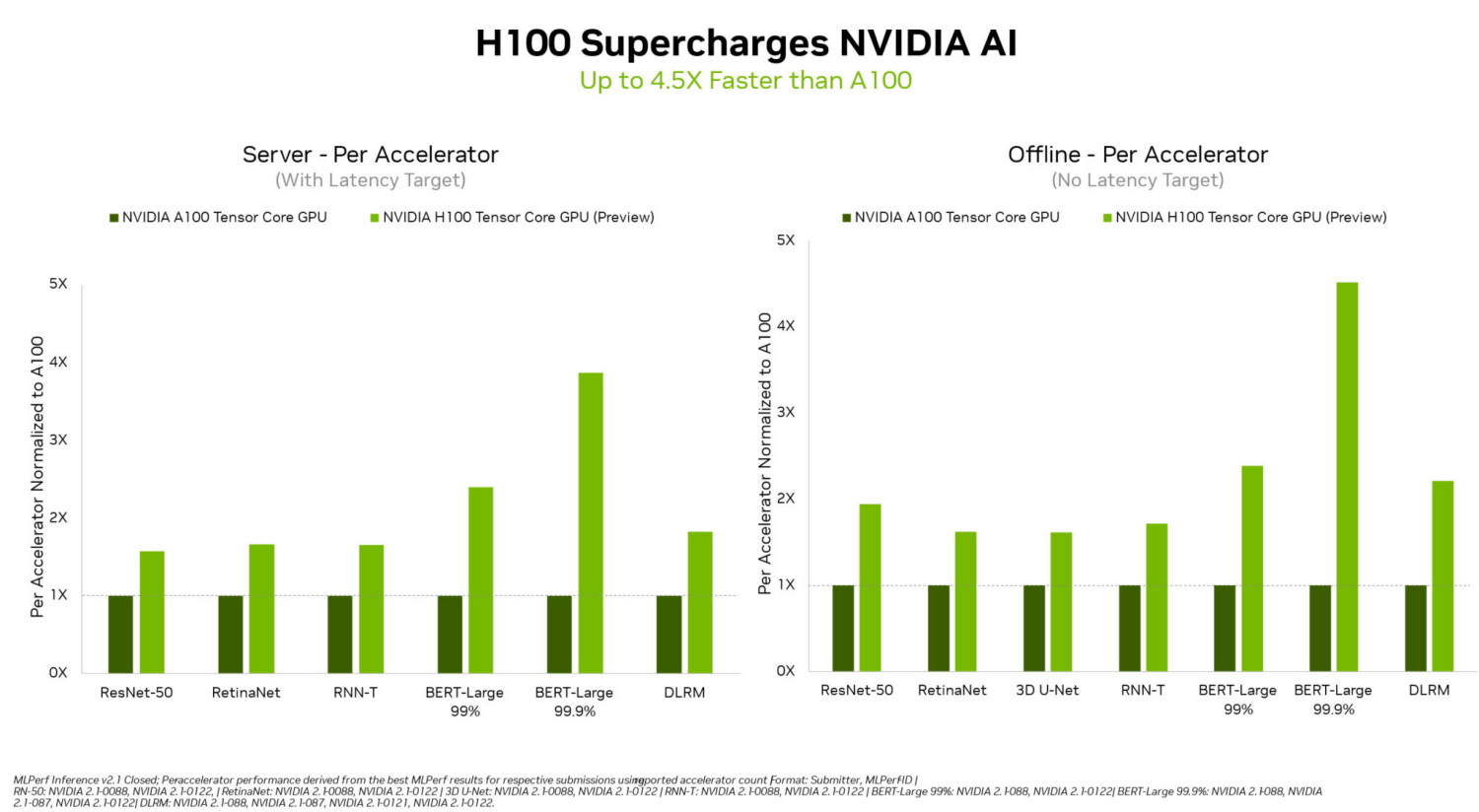
Nvidia announced yesterday that its upcoming H100 “Hopper” Tensor Core GPU set new performance records during its debut in the industry-standard MLPerf benchmarks, delivering results up to 4.5 times faster than the A100, which is currently Nvidia’s fastest production AI chip.
The MPerf benchmarks (technically called “MLPerfTM Inference 2.1“) measure “inference” workloads, which demonstrate how well a chip can apply a previously trained machine learning model to new data. A group of industry firms known as the MLCommons developed the MLPerf benchmarks in 2018 to deliver a standardized metric for conveying machine learning performance to potential customers.
Enlarge/ Nvidia’s H100 benchmark results versus the A100, in fancy bar graph form.
In particular, the H100 did well in the BERT-Large benchmark, which measures natural language-processing performance using the BERT model developed by Google. Nvidia credits this particular result to the Hopper architecture’s Transformer Engine, which specifically accelerates training transformer models. This means that the H100 could accelerate future natural language models similar to OpenAI’s GPT-3, which can compose written works in many different styles and hold conversational chats.
Nvidia positions the H100 as a high-end data center GPU chip designed for AI and supercomputer applications such as image recognition, large language models, image synthesis, and more. Analysts expect it to replace the A100 as Nvidia’s flagship data center GPU, but it is still in development. US government restrictions imposed last week on exports of the chips to China brought fears that Nvidia might not be able to deliver the H100 by the end of 2022 since part of its development is taking place there.
Nvidia clarified in a second Securities and Exchange Commission filing last week that the US government will allow continued development of the H100 in China, so the project appears back on track for now. According to Nvidia, the H100 will be available “later this year.” If the success of the previous generation’s A100 chip is any indication, the H100 may power a large variety of groundbreaking AI applications in the years ahead.
https://arstechnica.com/?p=1880072
With Koe Recast, you can change your voice as easily as your clothing
Enlarge/ A colorful waveform dramatically swirls through latent space, seeking kawaii.
Thanks to a web demo of a new AI tool called Koe Recast, you can transform up to 20 seconds of your voice into different styles, including an anime character, a deep male narrator, an ASMR whisper, and more. It’s an eye-opening preview of a potential commercial product currently undergoing private alpha testing.
Koe Recast emerged recently from a Texas-based developer named Asara Near, who is working independently to develop a desktop app with the aim of allowing people to change their voices in real time through other apps like Zoom and Discord. “My goal is to help people express themselves in any way that makes them happier,” said Near in a brief interview with Ars.
Several demos on the Koe website show altered clips of Mark Zuckerberg talking about augmented reality with a female voice, a deep male narrator voice, and a high-pitched anime voice, all powered by Recast.
This kind of realistic AI-powered voice transformation technology isn’t new. Google made waves with similar tech in 2018, and audio deepfakes of celebrities have caused controversy for several years now. But seeing this capability in an independent startup funded by one person—”I’ve funded this project entirely by myself thus far,” Near said—shows how far AI vocal synthesis tech has come and perhaps hints at how close voice transformation might be to widespread adoption through a low-cost or open source release.
When asked what specific kind of AI powers Recast’s voice transformation under the hood, Near held back specifics but generalized how it works, “We’re able to dive in and alter the characteristics of voices within the embedding space that we’ve created. Our goal, then, is to modify the parts of audio that correspond to a speaker’s personal style or timbre while preserving the parts of the audio that correspond to the spoken content such as prosody and words. This allows us to change the style of someone’s voice to any other style, including their perceived gender, age, ethnicity, and so on.”
Recast supports 10 different voices, and more are on the way. “It’s currently undecided if we will be offering existing voices of celebrities or other well-known persons,” said Near.
Offering celebrity voices (or those imitating non-celebrity living persons) may pose ethical and legal questions, however. When asked about the potential misuse of Recast, Near replied, “As with any technology, it’s possible for there to be both positives and negatives, but I think the vast majority of humanity consists of wonderful people and will benefit greatly from this.” Near also pointed out that Recast includes a Terms of Service policy prohibiting illegal and hateful usage.
As for a release timeline, Near is pursuing commercial options but isn’t ruling out an open source release, which could potentially have an impact similar to Stable Diffusion by putting realistic audio deepfakes into the hands of many without hard restrictions. “We’re exploring some monetization strategies,” Near said. “If the profit models I have in mind don’t work out, open-sourcing this technology may be an option in the future.”
As deep learning technology continues to peel away the 20th century concept (or some might say “illusion”) of media as a fixed and accurate record of reality, we are looking at a near-future in which digital representations of a living human’s voice, much like images and video, will be one more thing you can’t take at face value without significant trust in the source. Still, the technology could empower many people who might otherwise be discriminated against while doing business—or simply having fun—online.
https://arstechnica.com/?p=1879606
With Stable Diffusion, you may never believe what you see online again
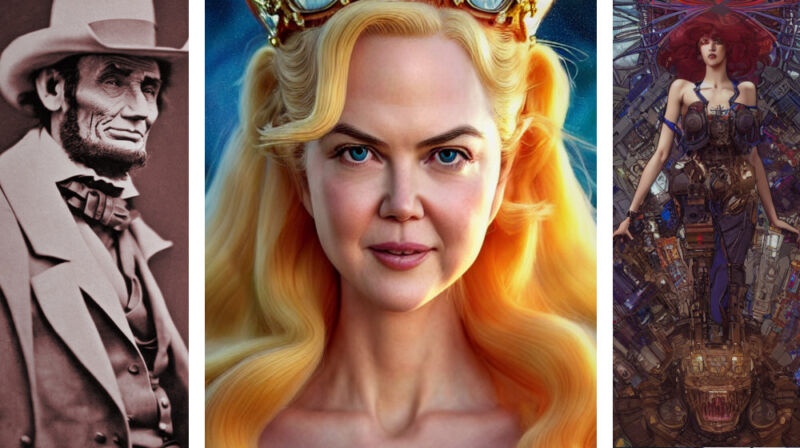
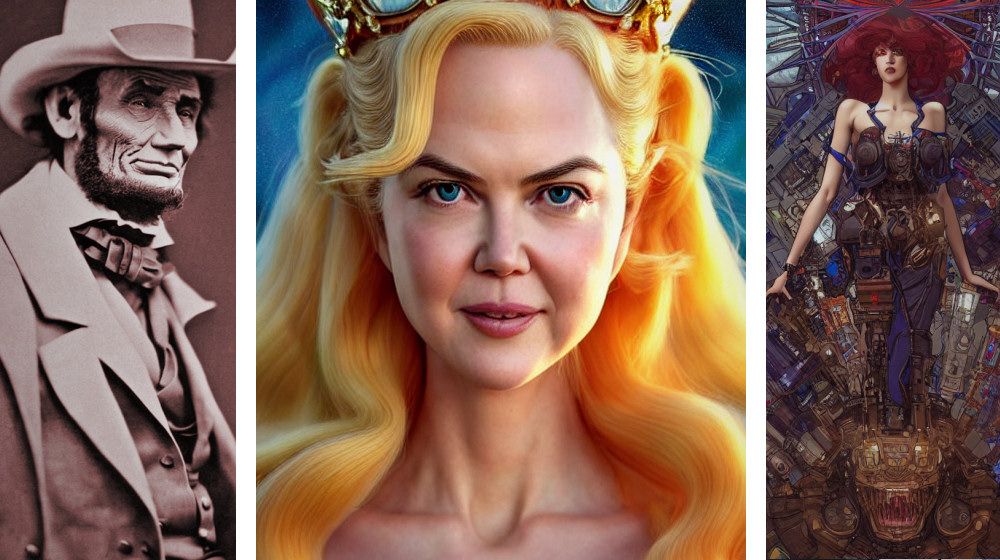
Enlarge/ Did you know that Abraham Lincoln was a cowboy? Stable Diffusion does.
Benj Edwards / Stable Diffusion
AI image generation is here in a big way. A newly released open source image synthesis model called Stable Diffusion allows anyone with a PC and a decent GPU to conjure up almost any visual reality they can imagine. It can imitate virtually any visual style, and if you feed it a descriptive phrase, the results appear on your screen like magic.
Some artists are delighted by the prospect, others aren’t happy about it, and society at large still seems largely unaware of the rapidly evolving tech revolution taking place through communities on Twitter, Discord, and Github. Image synthesis arguably brings implications as big as the invention of the camera—or perhaps the creation of visual art itself. Even our sense of history might be at stake, depending on how things shake out. Either way, Stable Diffusion is leading a new wave of deep learning creative tools that are poised to revolutionize the creation of visual media.
The rise of deep learning image synthesis
Stable Diffusion is the brainchild of Emad Mostaque, a London-based former hedge fund manager whose aim is to bring novel applications of deep learning to the masses through his company, Stability AI. But the roots of modern image synthesis date back to 2014, and Stable Diffusion wasn’t the first image synthesis model (ISM) to make waves this year.
In April 2022, OpenAI announced DALL-E 2, which shocked social media with its ability to transform a scene written in words (called a “prompt”) into myriad visual styles that can be fantastic, photorealistic, or even mundane. People with privileged access to the closed-off tool generated astronauts on horseback, teddy bears buying bread in ancient Egypt, novel sculptures in the style of famous artists, and much more.
Enlarge/ A screenshot of the OpenAI DALL-E 2 website.
Not long after DALL-E 2, Google and Meta announced their own text-to-image AI models. MidJourney, available as a Discord server since March 2022 and open to the public a few months later, charges for access and achieves similar effects but with a more painterly and illustrative quality as the default.
Then there’s Stable Diffusion. On August 22, Stability AI released its open source image generation model that arguably matches DALL-E 2 in quality. It also launched its own commercial website, called DreamStudio, that sells access to compute time for generating images with Stable Diffusion. Unlike DALL-E 2, anyone can use it, and since the Stable Diffusion code is open source, projects can build off it with few restrictions.
In the past week alone, dozens of projects that take Stable Diffusion in radical new directions have sprung up. And people have achieved unexpected results using a technique called “img2img” that has “upgraded” MS-DOS game art, converted Minecraft graphics into realistic ones, transformed a scene from Aladdin into 3D, translated childlike scribbles into rich illustrations, and much more. Image synthesis may bring the capacity to richly visualize ideas to a mass audience, lowering barriers to entry while also accelerating the capabilities of artists that embrace the technology, much like Adobe Photoshop did in the 1990s.
<a href="https://rassegna.lbit-solution.it/wp-content/uploads/2022/09/with-stable-diffusion-you-may-never-believe-what-you-see-online-again-4.jpg" class="enlarge" data-height="480" data-width="960" alt="Portraits from Duke Nukem, The Secret of Monkey Island, King’s Quest VI, and Star Control II received Stable Diffusion-powered fan upgrades.”><img alt="Portraits from Duke Nukem, The Secret of Monkey Island, King’s Quest VI, and Star Control II received Stable Diffusion-powered fan upgrades.” src=”https://rassegna.lbit-solution.it/wp-content/uploads/2022/09/with-stable-diffusion-you-may-never-believe-what-you-see-online-again-2.jpg” width=”640″ height=”320″ srcset=”https://rassegna.lbit-solution.it/wp-content/uploads/2022/09/with-stable-diffusion-you-may-never-believe-what-you-see-online-again-4.jpg 2x”>
Enlarge/ Portraits from Duke Nukem, The Secret of Monkey Island, King’s Quest VI, and Star Control II received Stable Diffusion-powered fan upgrades.
You can run Stable Diffusion locally yourself if you follow a series of somewhat arcane steps. For the past two weeks, we’ve been running it on a Windows PC with an Nvidia RTX 3060 12GB GPU. It can generate 512×512 images in about 10 seconds. On a 3090 Ti, that time goes down to four seconds per image. The interfaces keep evolving rapidly, too, going from crude command-line interfaces and Google Colab notebooks to more polished (but still complex) front-end GUIs, with much more polished interfaces coming soon. So if you’re not technically inclined, hold tight: Easier solutions are on the way. And if all else fails, you can try a demo online.
https://arstechnica.com/?p=1877022
AI wins state fair art contest, annoys humans
Enlarge/ The winning entry, Théåtre D’opéra Spatial.
Jason Allen
A synthetic media artist named Jason Allen entered AI-generated artwork into the Colorado State Fair fine arts competition and announced last week that he won first place in the Digital Arts/Digitally Manipulated Photography category, Vice reported Wednesday based on a viral tweet.
Allen used Midjourney—a commercial image synthesis model available through a Discord server—to create a series of three images. He then upscaled them, printed them on canvas, and submitted them to the competition in early August. To his delight, one of the images (titled Théåtre D’opéra Spatial) captured the top prize, and he posted about his victory on the Midjourney Discord server on Friday.
Allen’s victory prompted lively discussions on Twitter, Reddit, and the Midjourney Discord server about the nature of art and what it means to be an artist. Some commenters think human artistry is doomed thanks to AI and that all artists are destined to be replaced by machines. Others think art will evolve and adapt with new technologies that come along, citing synthesizers in music. It’s a hot debate that Wired covered in July.
There’s also the fairness element since it isn’t clear if Allen told the judges about his use of image synthesis, though some Twitter users have reportedly contacted the judges and discovered that they didn’t know. Curiously, the art was considered good enough to fool human artists, and someone on Twitter joked that it settled the debate over “whether AI art is art.”
It’s worth noting that the invention of the camera in the 1800s prompted similar criticism related to the medium of photography, since the camera seemingly did all the work compared to an artist that labored to craft an artwork by hand with a brush or pencil. Some feared that painters would forever become obsolete with the advent of color photography. In some applications, photography replaced more laborious illustration methods (such as engraving), but human fine art painters are still around today.
Image synthesis tools in their current state require a high degree of human guidance and cherry-picking to achieve remarkable results, but the field is evolving rapidly, and that might not always be the case. Still, as long as new artistic tools emerge, the “Is it art?” debate will likely continue as long as there are people to have the discussion.