Latest success from Google’s AI group: Controlling a fusion reactor

A dark space with a toroidal material that glows purple.
Enlarge / Plasma inside the tokamak at the EPFL.

As the world waits for construction of the largest fusion reactor yet, called ITER, smaller reactors with similar designs are still running. These reactors, called tokamaks, help us test both hardware and software. The hardware testing helps us refine things like the materials used for container walls or the shape and location of control magnets.

But arguably, the software is the most important. To enable fusion, the control software of a tokamak has to monitor the state of the plasma it contains and respond to any changes by making real-time adjustments to the system’s magnets. Failure to do so can result in anything from a drop in energy (which leads to the failure of any fusion) to seeing the plasma spill out of containment (and scorch the walls of the container).

Getting that control software right requires a detailed understanding of both the control magnets and the plasma the magnets manipulate. Or it would be more accurate to say, getting that control software right has required. Because today, Google’s DeepMind AI team is announcing that its software has been successfully trained to control a tokamak.

Out of control

Developing the control software for a tokamak is a complicated process. Based on past experience with similar designs, engineers can extract some of the basic principles needed for the software to function, like what sensor inputs to read and how to respond to changes in them. But there are always quirks based on the design of the hardware and energies of the plasma being used. So, there tends to be an iterative process of measuring and modeling, followed by tweaks to the control process, all the while keeping the performance sufficient to make adjustments in near real time.

The resulting control software tends to be fairly specialized. If researchers want to experiment with a very different geometry for the plasma in the tokamak, a significant revision to the software may be required.

Researchers in the field had already identified artificial intelligence as a possible solution. Give the right AI sufficient examples, and it could figure out which control configurations produce the desired properties in the plasma. That would free people to focus on the desired end-state they wanted and then just letting the software produce it for them so that they could study it. An AI should also be more flexible; once it is trained on how to control the system, it should be able to produce very different plasma configurations for study without the need for reprogramming.

To move forward on this idea, all we needed were AI experts and a tokamak. For the new paper, the AI team came from Google’s DeepMind division, famed for developing software that could handle everything from protein folding to StarCraft. The tokamak comes courtesy of the Swiss Plasma Center at the EPFL in Lausanne.

Trained to fuse

Since setting the AI loose on actual hardware during the training process could be a disaster, the team started out with a tokamak simulator specific for the Swiss Plasma Center hardware. This was largely accurate, and they programmed limits into the AI that kept it from directing the plasma into a configuration where the simulator produced inaccurate results. DeepMind then trained a deep-reinforcement-learning program to reach a variety of plasma configurations by letting it control the simulator.

During training, an intervening layer of software provided a reward function that indicated how close the plasma’s properties were to the desired state. Another algorithm, termed a “critic,” learned the expected rewards for various changes to the tokamak’s control magnets. These were used by the actual control neural network to learn which actions it should take.

The critic was elaborate and computationally expensive, but it was only used during the training portion. When training was done, the control algorithm had learned which actions to take to reach a variety of states, and the critic could be discarded.

In order to allow real-time performance, the trained controller was bundled as an executable. The standard control software would be used to activate the tokamak and bring a plasma up to high energies. Once the plasma was stable, it handed off control to the AI.

It works!

The resulting software performed pretty much as you would want it to when set loose on actual hardware. The software could control experimental runs that targeted different conditions over time—in one test case, it ramped up the energy, held the plasma steady, then altered the plasma’s geometry, then relocated the plasma within the tokamak before ramping the energy back down. In another, it held two separate plasma structures in the same tokamak simultaneously.

Some of the different geometries produced by the DeepMind AI.
Enlarge / Some of the different geometries produced by the DeepMind AI.

The paper describing this work has a large list of the things that the authors needed. That list includes a tokamak simulator that was both detailed enough to be accurate but compact enough to provide feedback quickly enough to make reinforcement learning possible. The training set had to include both common conditions similar to where control was handed to it and unusual conditions that let it learn how to transition those to experimental configurations. Additionally, the researchers needed to develop software that was detailed enough to evaluate a huge range of potential control options but also able to train a fast-performing controller that could be compiled into an executable.

The people behind this work are also excited about what it might presage for future work. Rather than simply limiting things to modeling existing hardware, they suggest that it should be possible to give an iteration of this software a desired plasma configuration, and let it identify the hardware geometry that will allow it to create that. Alternately, it could optimize the performance of existing hardware.

Now we just need to wait for a fusion reactor worthy of the AI’s attention.

Nature, 2022. DOI: 10.1038/s41586-021-04301-9  (About DOIs).

https://arstechnica.com/?p=1834881


Hydrogen-soaked crystal lets neural networks expand to match a problem

Image of a stylized circuit layout.

Training AIs remains very processor-intensive, in part because traditional processing architectures are poor matches for the sorts of neural networks that are widely used. This has led to the development of what has been termed neuromorphic computing hardware, which attempts to model the behavior of biological neurons in hardware.

But most neuromorphic hardware is implemented in silicon, which limits it to behaviors that are set at the hardware level. A group of US researchers is now reporting a type of non-silicon hardware that’s substantially more flexible. It works by controlling how much hydrogen is present in an alloy of nickel, with the precise amount of hydrogen switching a single device among four different behaviors, each of which is useful for performing neural-network operations.

Give it the gas

The material being used here is one of a class of compounds called perovskite nickelates. Perovskite is a general term for a specific arrangement of atoms in a crystalline structure; a wide variety of chemicals can form perovskites. In this case, the crystal is formed from a material that’s a mix of neodymium, nickel, and oxygen.

The crystal structure has enough open space that it can readily absorb and hold onto hydrogen. Once the hydrogen is incorporated, its electron will often end up being transferred to one of the nickel atoms. This changes the electrical properties of the atom and, in doing so, changes the conductivity of the material in general. The degree to which they change depends on how much hydrogen is present.

Since the hydrogen ends up with a positive charge after giving up its electron, it can be controlled by externally applied electric fields. So, by controlling the electrical environment, it’s possible to redistribute the hydrogen within the perovskite structure. That will then change the conductive properties of the material.

The researchers show that these states are meta-stable: they’ll change if an external force is applied but will remain stable for up to six months without the need to refresh the hydrogen. It’s not clear whether it needs to be refreshed at that point or whether that’s simply the latest they checked.

In any case, the researchers create a device simply by hooking up the perovskite to electrodes in a hydrogen atmosphere. (Getting the hydrogen into the material requires one electrode to be made from platinum or palladium.) From there, they demonstrated that it can be reliably switched among four states.

One state allows it to act as a resistor, meaning the device can act as a memristor. Similarly, it’ll behave as a memcapacitor, holding charge if set in that state. When in spiking neuron mode, it will accumulate multiple signals, at which point its resistance changes dramatically. This mimics how a neuron requires incoming spikes to exceed a threshold before it switches into an active state. Finally they had a configuration that acted like a synapse (at least in neural-network terms), transforming an input based on its strength.

Obviously, it’s possible to do similar things with dedicated devices for each of the four functions if you’re willing to activate and shut off different parts of a chip when needed. But many of these behaviors are analog, something that silicon requires even more hardware to emulate. Here, all this is done with a single bit of material between two electrodes.

https://arstechnica.com/?p=1831782


Attempt to compare different types of intelligence falls a bit short

Attempt to compare different types of intelligence falls a bit short

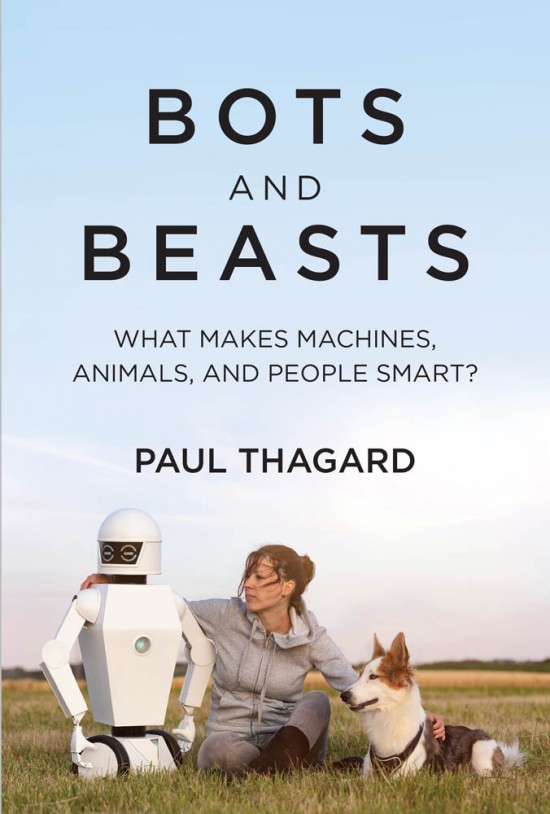
“What makes machines, animals, and people smart?” asks the subtitle of Paul Thagard’s new book. Not “Are computers smarter than humans? or “will computers ever be smarter than humans?” or even “are computers and animals conscious, sentient, or self-aware (whatever any of that might mean)?” And that’s unfortunate, becausethough most people are probably more concerned with questions like those.

Thagard is a philosopher and cognitive scientist, and he has written many books about the brain, the mind, and society. In this one, he defines what intelligence is and delineates the 12 features and 8 mechanisms that he thinks It’s built from,comprise it which allows him toso that he can compare the intelligences of these three very different types of beings.

He starts with a riff on the Aristotelian conception of virtue ethics. IWhereas in that case, a good person is defined as someone who possesses certain virtues;, in Thagard’sthis case, a smart person is defined as someone who epitomizes certain ways of thinking. Confucius, Mahatma Ghandi and Angela Merkel excelled at social innovation; Thomas Edison and George Washington Carver excelled at technological innovation; he lists Beethoven, Georgia O’Keeffe, Jane Austen, and Ray Charles as some of his favorite artistic geniuses; and Charles Darwin and Marie Curie serve as his paragons of scientific discoverers. Each of these people epitomizes different aspects of human intelligence, including creativity, emotion, problem solving, and using analogies.

A passing grade

Next he chooses six smart computers and six smart animals and grades them on how they measure up to people on these different features and mechanisms of intelligence. The computers are IBM Watson, DeepMind AlphaZero, self-driving cars, Alexa, Google Translate, and recommender algorithms; the animals are bees, octopuses, ravens, dogs, dolphins, and chimps.

All fare pretty abysmally on his report card. Animals as a class do better, but computers are evolving much more quickly. The upshot of his argument is that while some computers can beat the best humans at Jeopardy, Go, chess, debate, somemost medical diagnoses, and navigation, they are not smarter than humans because they have a low EQ. Or they may be smarter than some humans at some things, but they are not smarter than humanity with its diverse range of specializations.

Animals, on the other hand, can use their bodies to act upon the world and perceive that world—–often better than people—–but can’t reason. It’s almost as if humans were animals with computing devices in our heads.

While we’re making comparisons…

After the grading the book becomes pretty wide ranging, with each chapter tackling a big topic that could be better handled in its own book (and often has been). Human Advantages and When Did Minds Begin got better treatment in Darwin’s Unfinished Symphony; The Morality of Bots and Beasts and the Ethics of AI have been better covered in countless works of fiction, like I, Robot, Blade Runner, and Mary Doria Russell’s The Sparrow, to mention a very few. These works not only raise the same ideas, they do so in a more nuanced, thought provoking, and much more interesting way.

Thargard lists his features and mechanisms of intelligence, and he lists the specific characteristics that give advantages to humans, and he lists the principles that should dictate the future development of AI, and… that’s pretty much all of his arguments. This book has a lot of lists. Like a lot. It makes his points straightforward and methodical, but also so, so boring to read.

He doesn’t claim that computers can’t or will never have emotions; he just concludes that they probably won’t, because why would anyone ever want to make computers with emotions? So for now our spot at the pinnacle of intelligence seems safe. But if we ever meet up with a C-3PO (“human cyborg relations”) or a Murderbot, we might be in trouble.

https://arstechnica.com/?p=1822807


To see proteins change in a quadrillionth of a second, use AI

To see proteins change in a quadrillionth of a second, use AI
Westend61 | Getty Images

Have you ever had an otherwise perfect photo ruined by someone who moved too quickly and caused a blur? Scientists have the same issue while recording images of proteins that change their structure in response to light. This process is common in nature, so for years researchers have tried to capture its details. But they have long been thwarted by how incredibly fast it happens.

Now a team of researchers from the University of Wisconsin Milwaukee and the Center for Free-Electron Laser Science at the Deutsches Elektronen-Synchrotron in Germany have combined machine learning and quantum mechanical calculations to get the most precise record yet of structural changes in a photoactive yellow protein (PYP) that has been excited by light. Their study, published in November in Nature, showed that they were able to make movies of processes that occur in quadrillionths of a second.

When PYP absorbs light, it absorbs its energy, then rearranges itself. Because the protein’s function inside the cell is determined by its structure, whenever PYP folds or bends after being illuminated, this triggers huge changes. One important example of proteins interacting with light is in plants during photosynthesis, says Abbas Ourmazd, a physicist at UWM and coauthor on the study. More specifically, PYP is similar to proteins in our eyes that help us see at night, when a protein called retinal changes shape, activating some of our photoreceptor cells, explains Petra Fromme, director of the Biodesign Center for Applied Structural Discovery at Arizona State University, who was not involved with the study. PYP’s shape change also helps some bacteria detect blue light that may be damaging to their DNA so they can move away from it, Fromme notes.

Details of this important light-induced molecular shape-shifting, called isomerization, have eluded scientists for years. “When you look at any textbook, it always says that this isomerization is instant upon light excitation,” says Fromme. But, for scientists, “an instant” is not unquantifiable—the changes in the protein’s structure happen in the remarkably short amount of time known as a femtosecond, or a quadrillionth of a second. A second is to a femtosecond what 32 million years is to a second, Fromme says.

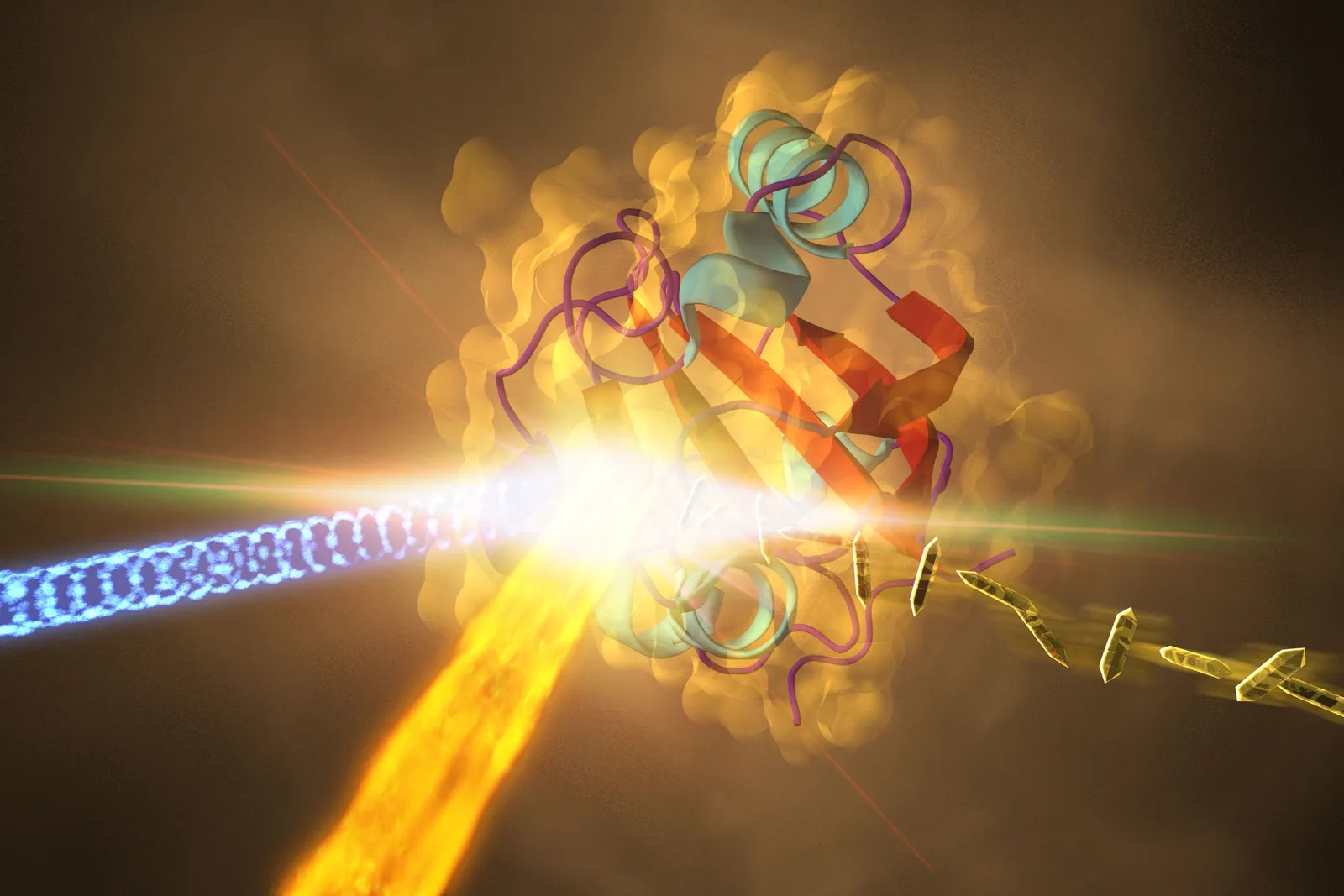
Scientists experimentally probe these incredibly short timescales with similarly short flashes of X-rays. The new study used data obtained in this way by a team led by UWM physicist Marius Schmidt at a special facility at the SLAC National Accelerator Laboratory in California. Here, the researchers first illuminated PYP with light. Then they hit it with an ultrashort X-ray burst. The X-rays that bounced off of the protein—called diffracted X-rays—reflected its most recent structure in the same way that light reflected from objects helps make conventional photographs. The briefness of the pulses allowed scientists to get something like a snapshot of the positions of all of the protein’s atoms as they moved, similar to the way a camera with a very fast shutter can capture the different positions of a cheetah’s legs as it runs.

This illustration depicts an experiment at SLAC that revealed how a protein from photosynthetic bacteria changes shape in response to light.
Enlarge / This illustration depicts an experiment at SLAC that revealed how a protein from photosynthetic bacteria changes shape in response to light.

But even the shortest X-ray flashes have typically not made for a fast enough “shutter” to get a femtosecond-by-femtosecond record of a protein’s shape change. “A major problem in analyzing diffraction signals is that the X-ray source is noisy,” says Shaul Mukamel, a chemist at the University of California, Irvine who was not part of the study. In other words, the X-ray flash always leads to at least some blurriness. Imagine the protein as a contortionist folding itself into a pretzel. Using X-rays, scientists can get a clear image of its relaxed pose immediately after it absorbs the light energy that spurs the contortion, and of its intertwined limbs at the end. But any images of its in-between motions would be fuzzy.

https://arstechnica.com/?p=1819726


The movement to hold AI accountable gains more steam

The movement to hold AI accountable gains more steam
MirageC | Getty Images

Algorithms play a growing role in our lives, even as their flaws are becoming more apparent: a Michigan man wrongly accused of fraud had to file for bankruptcy; automated screening tools disproportionately harm people of color who want to buy a home or rent an apartment; Black Facebook users were subjected to more abuse than white users. Other automated systems have improperly rated teachers, graded students, and flagged people with dark skin more often for cheating on tests.

Now, efforts are underway to better understand how AI works and hold users accountable. New York’s City Council last month adopted a law requiring audits of algorithms used by employers in hiring or promotion. The law, the first of its kind in the nation, requires employers to bring in outsiders to assess whether an algorithm exhibits bias based on sex, race, or ethnicity. Employers also must tell job applicants who live in New York when artificial intelligence plays a role in deciding who gets hired or promoted.

In Washington, DC, members of Congress are drafting a bill that would require businesses to evaluate automated decision-making systems used in areas such as health care, housing, employment, or education, and report the findings to the Federal Trade Commission; three of the FTC’s five members support stronger regulation of algorithms. An AI Bill of Rights proposed last month by the White House calls for disclosing when AI makes decisions that impact a person’s civil rights, and it says AI systems should be “carefully audited” for accuracy and bias, among other things.

Elsewhere, European Union lawmakers are considering legislation requiring inspection of AI deemed high-risk and creating a public registry of high-risk systems. Countries including China, Canada, Germany, and the UK have also taken steps to regulate AI in recent years.

Julia Stoyanovich, an associate professor at New York University who served on the New York City Automated Decision Systems Task Force, says she and students recently examined a hiring tool and found it assigned people different personality scores based on the software program with which they created their résumé. Other studies have found that hiring algorithms favor applicants based on where they went to school, their accent, whether they wear glasses, or whether there’s a bookshelf in the background.

Stoyanovich supports the disclosure requirement in the New York City law, but she says the auditing requirement is flawed because it only applies to discrimination based on gender or race. She says the algorithm that rated people based on the font in their résumé would pass muster under the law because it didn’t discriminate on those grounds.

“Some of these tools are truly nonsensical,” she says. “These are things we really should know as members of the public and just as people. All of us are going to apply for jobs at some point.”

Some proponents of greater scrutiny favor mandatory audits of algorithms similar to the audits of companies’ financials. Others prefer “impact assessments” akin to environmental impact reports. Both groups agree that the field desperately needs standards for how such reviews should be conducted and what they should include. Without standards, businesses could engage in “ethics washing” by arranging for favorable audits. Proponents say the reviews won’t solve all problems associated with algorithms, but they would help hold the makers and users of AI legally accountable.

A forthcoming report by the Algorithmic Justice League (AJL), a private nonprofit, recommends requiring disclosure when an AI model is used and creating a public repository of incidents where AI caused harm. The repository could help auditors spot potential problems with algorithms and help regulators investigate or fine repeat offenders. AJL cofounder Joy Buolamwini coauthored an influential 2018 audit that found facial-recognition algorithms work best on white men and worst on women with dark skin.

https://arstechnica.com/?p=1818000


This intrepid robot is the Wall-E of the deep sea

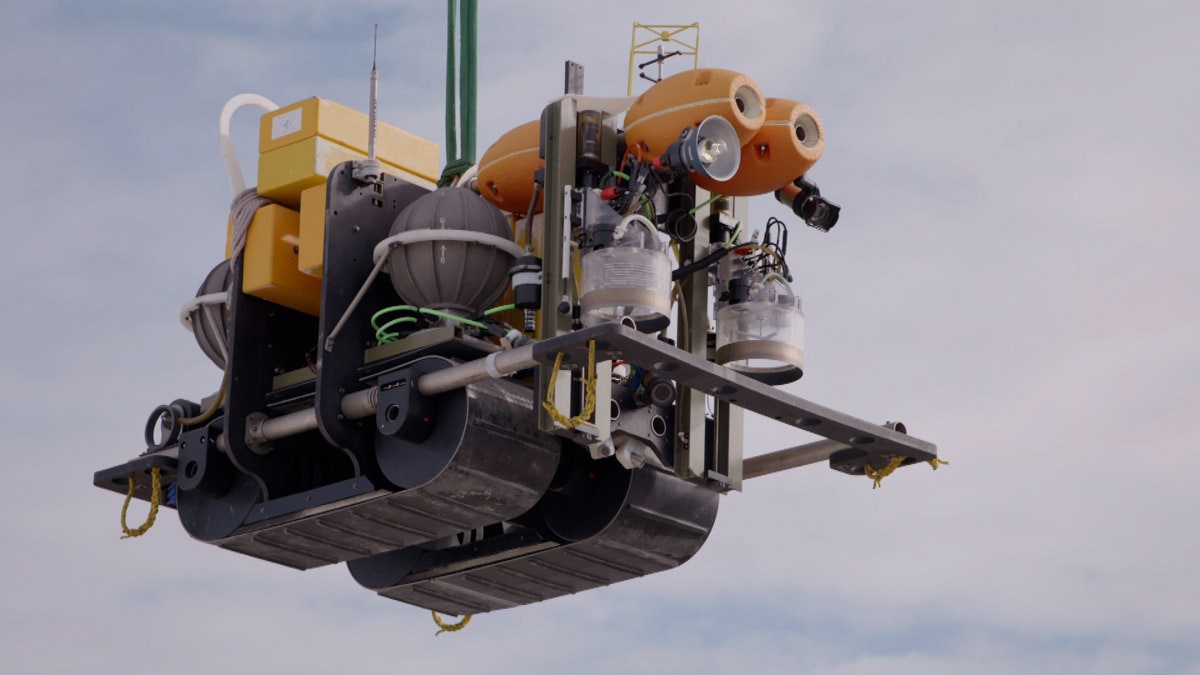
With extra-wide tracks and a bunch of other clever features, the Benthic Rover II can roam the seafloor for years at a time.
Enlarge / With extra-wide tracks and a bunch of other clever features, the Benthic Rover II can roam the seafloor for years at a time.
Madison Pobis | MBARI

The Benthic Rover II is the size of a compact car, although it rocks fat treads, making it more like a scientific tank. That, along with the two googly-eye-like flotation devices on its front, gives it a sort of WALL-E vibe. Only instead of exploring a garbage-strewn landscape, BR-II roams the Pacific seafloor, 13,000 feet deep. The robot’s mission: to prowl the squishy terrain in search of clues about how the deep ocean processes carbon.

That mission begins with a wild ride, 180 miles off the coast of Southern California. Scientists at the Monterey Bay Aquarium Research Institute lower BR-II into the water and then … drop it. Completely untethered, the robot free-falls for two and a half hours, landing on the abyssal plains—great stretches of what you might generously call muck. “It’s mushy and dusty at the same time,” says MBARI electrical engineer Alana Sherman, coauthor on a new paper in Science Robotics describing findings from the robot’s adventures. “Which is part of the reason it’s a tracked vehicle, and it has these really wide treads.” That extra surface area distributes the robot’s weight so it doesn’t sink into the sand.

If you wanted to devise the perfect way to torture a robot, the deep sea would be it. At these depths the water is cold, salty (and therefore corrosive), and highly pressurized; there’s a whole lot of liquid pushing down on the robot.

Like the Mars rovers, this robot must be autonomous. In fact, in some ways it’s even more difficult to keep tabs on a rover 13,000-feet deep than it is a rover on another planet. Radio waves travel well in space, it’s just that they take up to 20 minutes each way to make the trip between Earth and Mars—and good luck remotely piloting a rover in real time with that kind of delay. But radio waves hate water. So, instead, BR-II uses acoustic signals to talk to another robot, a floating glider that MBARI scientists release from shore four times a year. The glider, essentially a very expensive surfboard, travels to the rover’s approximate location, pings it, collects status updates and sample data, and fires that information to a satellite for the researchers to access.

A rattail fish captured on BR-II's camera.
Enlarge / A rattail fish captured on BR-II’s camera.
Notice the simplistic muckiness of the seafloor.
Enlarge / Notice the simplistic muckiness of the seafloor.
Since MBARI scientists can’t just sit in their labs and pilot the rover, it’s on its own. But its directives are simple. Parked on the seafloor, it lowers two oxygen sensors into the muck. This gives the robot a measure of the biological activity in the sediment, as microbes consume oxygen and spit out carbon dioxide. The rover also has a fluorescence camera system that casts a blue light, which makes the chlorophyll in organic matter glow. This gives the robot an idea of how much detritus from surface waters, known as “marine snow,” is making its way down to the seafloor.

The rover sits in one place like this for 48 hours, then moves forward 33 feet. That’s all. “It would not know if it drove off a cliff—all it knows is I’m supposed to drive forward 10 meters,” says Sherman. “But luckily, there are no cliffs around, so we take advantage of the simplicity of the environment to keep the robot more simple.”

Still, there’s a problem: the oversized treads make a mess of the seafloor. “Even though it is moving very slowly, it doesn’t take much to create this huge dust storm,” says Sherman. “We always want to be driving into the current so that it can push the sediment that is disturbed behind us.” So before the rover moves, it uses a sensor to get an idea of the current direction of the … er, current, then heads straight for it.

The benthic rover does this for a whole year, unsupervised: park, take measurements, move 33 feet, repeat. Then the scientists steam out in their research boat to give it a battery change.

https://arstechnica.com/?p=1812769


Open-sourcing of protein-structure software is already paying off

Image of different categories of protein complexes.
Humphreys et. al.

It is now relatively trivial to determine the order of amino acids in a protein. Figuring out how that order translates to a complicated three-dimensional structure that performs a specific function, however, is extremely challenging. But after decades of slow progress, Google’s DeepMind AI group announced that it has made tremendous strides toward solving the problem. In July, the system, called AlphaFold, was made open source. At the same time, a group of academic researchers released its own protein-folding software, called RoseTTAFold, built in part using ideas derived from DeepMind’s work.

How effective are these tools? Even if they aren’t as good as some of the statistics suggested, it’s clear they’re far better than anything we’ve ever had. So how will scientists use them?

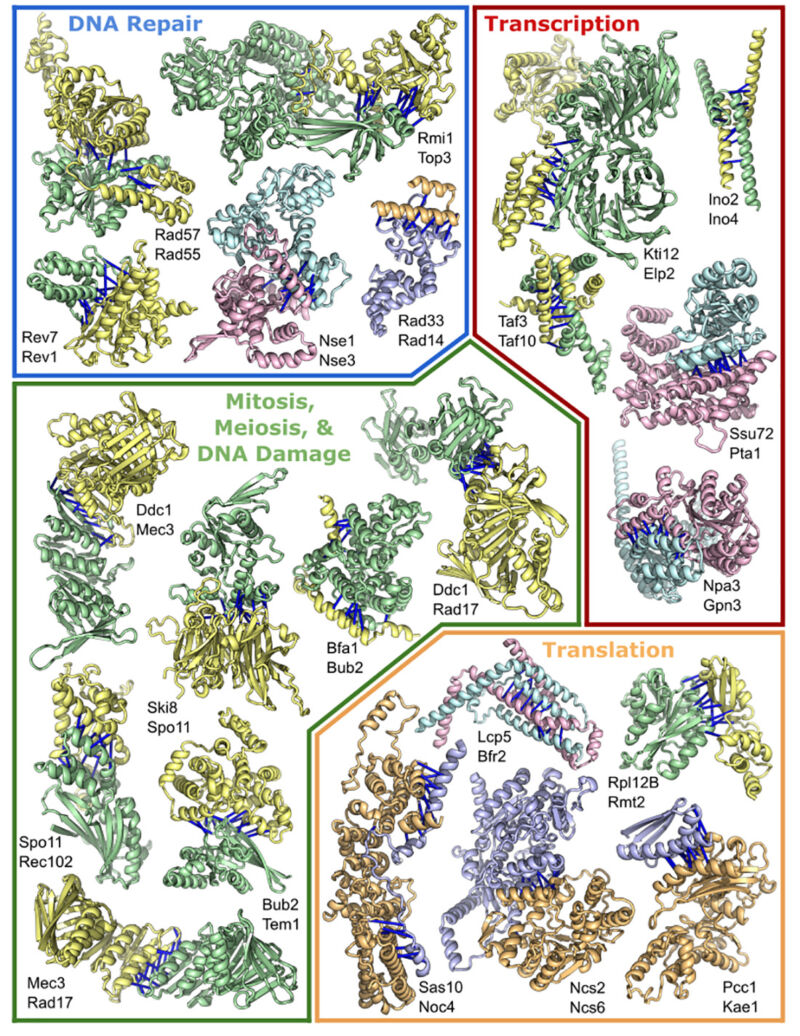
This week, a large research collaboration set the software loose on a related problem: how these individual three-dimensional structures come together to form the large, multi-protein complexes that perform some of the most important functions in biology.

Beyond 3D

Many individual proteins work just fine on their own, but some aspects of biology require the careful coordination of multiple chemical changes performed as a series of ordered, sequential steps. And for those processes, it’s often easiest for the proteins that need to coordinate to be part of a single complex. For example, the complex that makes copies of our chromosomes typically consists of more than a dozen proteins. Photosystem I, part of plants’ photosynthetic process, is similar in scale. The ribosome, which translates the information in messenger RNAs into the amino acid sequence of proteins, can require over 75 proteins in some species.

Putting these and other complexes together requires the proper folding of their component proteins into the right three-dimensional shapes—the problem that AlphaFold and RoseTTAFold were designed to solve. Once that folding is done, however, the proteins have to interact with each other, fitting together in the right orientation and stabilizing these interactions through contacts among their amino acids (meaning that a positive charge on one protein would be matched by a negative charge on its partner, and so on).

To an extent, the information obtained from AlphaFold and RoseTTAFold should be helpful for this application, because solving the individual structures of proteins should tell us something about the surfaces that could interact. But the methods used by the algorithms turned out to be specifically useful for assembling multi-protein complexes.

RoseTTAFold, for example, solves protein structures in part by chopping their amino acid sequence up into smaller pieces and solving each of them before assembling them into a more complete protein. But the system’s creators found that if RoseTTAFold was given pieces of two different proteins that interact, it would happily assemble both proteins in a way that also captured their interactions, including the right orientation and spacing.

Evolution giveth—and taketh away

The other useful feature is that both algorithms lean heavily on evolution to make their structural predictions. A key step for each is identifying many proteins that are related through common descent and likely to share a common structure. These proteins provide important constraints on the structures that are possible within a given family of related sequences. Certain amino acids interfere with helical structure formation, for example.

Protein complexes can face similar constraints, but there’s an important difference. Let’s say protein A has an amino acid with a positive charge that interacts with a negative one on protein B. If a mutation changes A so that it now has a negative charge, the interaction between the two would be greatly weakened. But protein B could compensate for that issue if a mutation swapped its negative charge for a positive one.

Following pairs of proteins as they change over the course of evolution can provide an indication of whether any changes in one are compensated for by changes in the other. The absence of these sorts of changes can tell us that the proteins are unlikely to interact.

To keep the analysis computationally tractable, the researchers simply paired each protein with everything else in the genome. They found pairwise interactions and later used those interactions to build up larger complexes. However, even knowing potential pairs of interactions left complexes that were limited to a small number of proteins; and attempting to build up something as big as DNA polymerase would have overwhelmed the computational hardware the researchers had access to.

https://arstechnica.com/?p=1812830


Tagalong robots follow you to learn where you go

Tagalong robots follow you to learn where you go
Piaggio Fast Forward


When Amazon introduced its home robot Astro earlier this year, it first showcased the robot following behind a person. It’s a simple idea that has captured people’s imaginations with depictions in science fiction, like R2-D2 and BB-8 from Star Wars, and in reality, with research projects like DARPA’s robotic pack mule.

Follower robots have been tapped for senseless pursuits like carrying a single bottle of water, but robots can also carry tools in a warehouse or just-picked fruit from an orchard to a packing station. Artificially intelligent machines trained to follow people or other machines can transform how we think about everyday objects, like carry-on luggage or a set of golf clubs. Now the makers of follower robots want to coordinate movement around the modern workplace.

Follower robots have been under development since the late 1990s, beginning on the ground and extending underwater and into the sky. Initial forms relied on following the location of a tag in a person’s pocket, but advances in deep learning and computer vision now allow AI to navigate by “seeing” the world through cameras and other sensors.

In farm fields, Burro offers what looks like an autonomous driving pallet on the body of a four-wheel ATV that can move freely between the rows of California fruit orchards.

To train a Burro robot, you simply press a Follow button and start walking; at the end of the path, you press the button again. Using up to 20 cameras, computer vision, and GPS, Burro follows you and memorizes the route. It can then ferry goods unassisted and communicate the path to other Burro robots.

A Burro weighs up to 500 pounds and can carry as much as 1,000 pounds. Table grape growers are using Burros to ferry fruit from laborers in vineyards to people packing the goods in clamshells before loading them onto trucks for transport to grocery stores.

Roughly 100 Burro devices are currently operating in southern California vineyards after three years of trials. The company hopes to quadruple that number with help from $10 million in new funding completed this fall.

Burro CEO Charlie Andersen says the robots have logged nearly 50,000 hours in the past five years in blueberry, blackberry, raspberry, and grape fields, as well as at plant nurseries.

Some of the new funding will go toward creating software to tackle the technical challenge of managing hundreds of rovers in the field. Burro is also working to integrate tech from Bloomfield Robotics that uses computer vision and AI to predict grape yields and monitor crops for disease or fungus. In the long run, Burro wants to provide a platform to coordinate predictive AI and machines in motion for fruit and nut orchards and vineyards.

Beyond incorporating computer vision, Burro is testing attaching robotic arms to its pallets to cut grapes from vines so a robot can harvest, prune, and de-leaf vineyards. “We are gripping and clipping, but not doing post-gripping trimming, which is immensely complex and we don’t think will be viable in commercial settings in the near term,” Andersen says.

Fruit and nut growers are increasingly incorporating computer vision into their work. Tastry, for example, uses AI to look for combinations of grapes that can mask smoky flavors at vineyards tainted by wildfires, and a cross-disciplinary team of biologists and AI researchers working with the US Department of Agriculture is seeking ways to protect vineyards from fungus that can spoil a crop.

Walt Duflock helps run a 10,000-acre farm in California’s Monterey County for cattle, table grapes, and other crops. He’s also VP of innovation for the Western Growers Association, a consortium of farmers that represents half of the fruit-, vegetable-, and nut-growing operations in the US.

Duflock first met Burro’s founders while working as a mentor for the Thrive agriculture startup accelerator. He thinks automation is necessary to address labor shortages in agriculture, particularly for harvesting. Over time, he thinks robots like Burro can eliminate up to 20 percent of labor on farms.

https://arstechnica.com/?p=1810830


AI, Wiewiórowski (EDPS) ‘Ue non ancora pronta per il riconoscimento facciale’

Il Garante Privacy europeo Wojciech Wiewiórowski (European Data Protection Supervisor) ritiene che l’Europa non sia ancora pronta per il riconoscimento facciale per il controllo pubblico delle persone.

“La società europea non è ancora pronta”, ha detto Wojciech Wiewiórowski told in un’intervista a Politico. 

La tecnologia e le sue applicazioni hanno diviso l’Europa. La proposta Ue di legislazione sull’AI mette al bando la maggior parte delle applicazioni di identificazione biometrica da remoto, a partire dal riconoscimento facciale nei luoghi pubblici dalle forze dell’ordine, ma fa delle eccezioni per combattere la criminalità “grave”, che potrebbe includere il terrorismo.

Leggi anche: Intelligenza artificiale affidabile ed etica. Le regole dell’Ue. Vestager: “Da noi no sorveglianza di massa”

Siamo pronti per un controllo permanente?

Chi sostiene l’uso della tecnologia, vale a dire le forze dell’ordine e alcuni governi più attenti alla sicurezza, dice che la polizia ha bisogno della tecnologia per catturare i criminali. Ma attivisti per la privacy, alcuni legislatori europei e lo stesso Wiewiórowski sono invece a favore di un divieto assoluto.

L’uso della tecnologia “trasformerebbe la società, trasformerebbe i nostri cittadini, trasformerebbe i luoghi in cui viviamo, in luoghi in cui siamo permanentemente riconoscibili… Non sono sicuro che la società sia davvero pronta per questo”, dice Wiewiórowski.

Attenzione alle deroghe

L’organizzazione da lui guidata, l’EDPS, è l’autorità interna per la protezione dei dati dell’UE, che garantisce che le singole agenzie nazionali dell’UE si attengano alle rigide norme sulla privacy del continente. Fornisce inoltre consulenza alla Commissione europea sulle sue iniziative legislative.

Wiewiórowski ha lanciato un monito: consentire delle eccezioni all’uso delle tecnologie potrebbe aprire la porta a tutti i tipi di sorveglianza, compreso il riconoscimento emotivo, e potrebbe essere aperto anche alle società private.

“Molti politici credono che l’uso di queste tecnologie debba essere consentito ad altre organizzazioni, altre entità, il che è un po’ sorprendente per me in realtà”, ha detto Wiewiórowski.

Essere più specifici

Wiewiórowski ha inoltre sottolineato che i legislatori devono ancora definire che cosa intendono esattamente per intelligenza artificiale che vogliono regolare, un fattore che potrebbe avere un peso significativo su quali aziende e quali applicazioni saranno regolamentate.

L’appello di Wiewiórowski è stato raccolto dai paesi della Ue, che a loro volta hanno chiesto definizioni più precise su quale tipo di intelligenza artificiale debba ricadere sotto la legislazione europea. Danimarca, Francia, Italia e altri paesi hanno lamentato che l’AI Act è troppo ampio, e rischia di imbrigliare modelli statistici di base in una regolamentazione pesante.

Riferendosi all’ampia rete della legislazione, Wiewiórowski ha affermato: “Stiamo usando la nozione di marketing dell’intelligenza artificiale per le tecnologie e sappiamo che la maggior parte di queste tecnologie non sono in realtà così intelligenti”.

“Dobbiamo stare più attenti a quello che pensiamo di ricomprendere e quello che resterà fuori dalla regolazione. Se qualcosa è sofisticato non significa che si tratti di intelligenza artificiale”, ha detto aggiungendo che in base all’attuale bozza di legge, sistemi che controllano i limiti di velocità in autostrada (autovelox ndr) rientrerebbero nella definizione di intelligenza artificiale.

https://www.key4biz.it/ai-wiewiorowski-edps-ue-non-ancora-pronta-per-il-riconoscimento-facciale/380538/


Four revelations from the Facebook Papers

Four revelations from the Facebook Papers
Aurich Lawson | Getty Images

Facebook is battling its gravest crisis since the Cambridge Analytica scandal after a whistleblower accusing the company of placing “profit over safety” shed light on its inner workings through thousands of pages of leaked memos.

The documents were disclosed to US regulators and provided to Congress in redacted form by Frances Haugen’s legal counsel. A consortium of news organisations, including the Financial Times, has obtained the redacted versions received by Congress.

Earlier this month, Haugen testified in Congress that the social media company does not do enough to ensure the safety of its 2.9 billion users, plays down the harm it can cause to society and has repeatedly misled investors and the public. The Wall Street Journal also ran a series of articles called the Facebook Files.

Here are four surprising revelations the documents contain:

Facebook has a huge language problem

Facebook is often accused of failing to moderate hate-speech on its English-language sites but the problem is much worse in countries that speak other languages, even after it promised to invest more after being blamed for its role in facilitating genocide in Myanmar in 2017.

One 2021 document warned on its very low number of content moderators in Arabic dialects spoken in Saudi Arabia, Yemen and Libya. Another study of Afghanistan, where Facebook has 5 million users, found even the pages that explained how to report hate speech were incorrectly translated.

Facebook allocated only 13 percent of its budget for developing misinformation detection algorithms to the world outside the US
Enlarge / Facebook allocated only 13 percent of its budget for developing misinformation detection algorithms to the world outside the US
Washington Post | Getty Images

The failings occurred even though Facebook’s own research marked some of the countries as “high risk” because of their fragile political landscape and frequency of hate speech.

According to one document, the company allocated 87 percent of its budget for developing its misinformation detection algorithms to the US in 2020, versus 13 percent to the rest of the world.

Haugen said Facebook should be transparent on the resources it has by country and language.

Facebook often does not understand how its algorithms work

Several documents show Facebook stumped by its own algorithms.

One September 2019 memo found that men were being served up 64 percent more political posts than women in “nearly every country,” with the issue being particularly large in African and Asian countries.

While men were more likely to follow accounts producing political content, the memo said Facebook’s feed ranking algorithms had also played a significant role.

Facebook found that men were being served up 64 percent more political posts than women in "nearly every country."
Enlarge / Facebook found that men were being served up 64 percent more political posts than women in “nearly every country.”
Ben Stansall | Getty Images

A memo from June 2020 found it was “virtually guaranteed” that Facebook’s “major systems do show systemic biases based on the race of the affected user.”

The author suggested that perhaps the news feed ranking is more influenced by people who share frequently than those who share and engage less often, which may correlate with race. That results in content from certain races being prioritised over others.

https://arstechnica.com/?p=1807384