These virtual obstacle courses help real robots learn to walk

[embedded content]
A clip from the simulation where virtual robots learn to climb steps.

An army of more than 4,000 marching doglike robots is a vaguely menacing sight, even in a simulation. But it may point the way for machines to learn new tricks.

The virtual robot army was developed by researchers from ETH Zurich in Switzerland and chipmaker Nvidia. They used the wandering bots to train an algorithm that was then used to control the legs of a real-world robot.

In the simulation, the machines—called ANYmals—confront challenges like slopes, steps, and steep drops in a virtual landscape. Each time a robot learned to navigate a challenge, the researchers presented a harder one, nudging the control algorithm to be more sophisticated.

From a distance, the resulting scenes resemble an army of ants wriggling across a large area. During training, the robots were able to master walking up and down stairs easily enough; more complex obstacles took longer. Tackling slopes proved particularly difficult, although some of the virtual robots learned how to slide down them.

When the resulting algorithm was transferred to a real version of ANYmal, a four-legged robot roughly the size of a large dog with sensors on its head and a detachable robot arm, it was able to navigate stairs and blocks but suffered problems at higher speeds. Researchers blamed inaccuracies in how its sensors perceive the real world compared to the simulation,

Similar kinds of robot learning could help machines learn all sorts of useful things, from sorting packages to sewing clothes and harvesting crops. The project also reflects the importance of simulation and custom computer chips for future progress in applied artificial intelligence.

“At a high level, very fast simulation is a really great thing to have,” says Pieter Abbeel, a professor at UC Berkeley and cofounder of Covariant, a company that is using AI and simulations to train robot arms to pick and sort objects for logistics firms. He says the Swiss and Nvidia researchers “got some nice speed-ups.”

AI has shown promise for training robots to do real-world tasks that cannot easily be written into software, or that require some sort of adaptation. The ability to grasp awkward, slippery, or unfamiliar objects, for instance, is not something that can be written into lines of code.

The 4,000 simulated robots were trained using reinforcement learning, an AI method inspired by research on how animals learn through positive and negative feedback. As the robots move their legs, an algorithm judges how this affects their ability to walk, and tweaks the control algorithms accordingly.

https://arstechnica.com/?p=1802542


How AI is making information more usefulHow AI is making information more usefulSenior Vice President

Using MUM, we can even show related topics that aren’t explicitly mentioned in the video, based on our advanced understanding of information in the video. In this example, while the video doesn’t say the words “macaroni penguin’s life story,” our systems understand that topics contained in the video relate to this topic, like how macaroni penguins find their family members and navigate predators. The first version of this feature will roll out in the coming weeks, and we’ll add more visual enhancements in the coming months.

Across all these MUM experiences, we look forward to helping people discover more web pages, videos, images and ideas that they may not have come across or otherwise searched for. 

A more helpful Google

The updates we’re announcing today don’t end with MUM, though. We’re also making it easier to shop from the widest range of merchants, big and small, no matter what you’re looking for. And we’re helping people better evaluate the credibility of information they find online. Plus, for the moments that matter most, we’re finding new ways to help people get access to information and insights. 

All this work not only helps people around the world, but creators, publishers and businesses as well.  Every day, we send visitors to well over 100 million different websites, and every month, Google connects people with more than 120 million businesses that don’t have websites, by enabling phone calls, driving directions and local foot traffic.

As we continue to build more useful products and push the boundaries of what it means to search, we look forward to helping people find the answers they’re looking for, and inspiring more questions along the way.


A new formula may help black patients’ access to kidney care

A new formula may help black patients’ access to kidney care
Getty Images

For decades, doctors and hospitals saw kidney patients differently based on their race. A standard equation for estimating kidney function applied a correction for Black patients that made their health appear rosier, inhibiting access to transplants and other treatments.

On Thursday, a task force assembled by two leading kidney care societies said the practice is unfair and should end.

The group, a collaboration between the National Kidney Foundation and the American Society of Nephrology, recommended use of a new formula that does not factor in a patient’s race. In a statement, Paul Palevsky, the foundation’s president, urged “all laboratories and health care systems nationwide to adopt this new approach as rapidly as possible.” That call is significant because recommendations and guidelines from professional medical societies play a powerful role in shaping how specialists care for patients.

A study published in 2020 that reviewed records for 57,000 people in Massachusetts found that one-third of Black patients would have had their disease classified as more severe if they had been assessed using the same version of the formula as white patients. The traditional kidney calculation was an example of a class of medical algorithms and calculators that have recently come under fire for conditioning patient care based on race, which is a social category not biological one.

A review published last year listed more than a dozen such tools, in areas such as cardiology and cancer care. It helped prompt a surge of activism against the practice from diverse groups, including medical students and lawmakers such as Senator Elizabeth Warren (D-Massachusetts) and the chair of the House Ways and Means Committee, Richard Neal (D-Massachusetts).

Recently there are signs the tide is turning. The University of Washington dropped the use of race in kidney calculations last year after student protests led to a reconsideration of the practice. Mass General Brigham and Vanderbilt hospitals also abandoned the practice in 2020.

In May, a tool used to predict the chance a woman who previously had a cesarean section could safely give birth via vaginal delivery was updated to no longer automatically assign lower scores to Black and Hispanic women. A calculator that estimates the chances a child has a urinary tract infection was updated to no longer slash the scores for patients who are Black.

The prior formula for assessing kidney disease, known as CKD-EPI, was introduced in 2009, updating a 1999 formula that used race in a similar way. It converts the level of a waste product called creatinine in a person’s blood into a measure of overall kidney function called estimated glomerular filtration rate, or eGFR. Doctors use eGFR to help classify the severity of a person’s illness and determine if they qualify for various treatments, including transplants. Healthy kidneys produce higher scores.

The equation’s design factored in a person’s age and sex but also boosted the score of any patient classified as Black by 15.9 percent. That feature was included to account for statistical patterns seen in the patient data used to inform the design of CKD-EPI, which included relatively few people who were Black or from other racial minorities. But it meant a person’s perceived race could shift how their disease was measured or treated. A person with both Black and white heritage, for example, could flip a health system’s classification of their illness depending on how their doctor saw them or how they identified.

Nwamaka Eneanya, an assistant professor at University of Pennsylvania and a member of the task force behind Thursday’s recommendation, says she knows of one biracial patient with severe kidney disease who after learning about how the equation worked requested that she be classified as white to increase her chances of being listed for advanced care. Eneanya says a shift away from the established equation is long overdue. “Using someone’s skin color to guide their clinical pathway is wholeheartedly wrong—you introduce racial bias into medical care when you do that,” she says.

Eneanya was a coauthor of the 2020 study on the potential impact of using race in the kidney function equation. It found 64 cases where recalculating a Black person’s score using the same method as for white patients would have qualified them for a kidney transplant waiting list. None of those patients had been evaluated for transplant, suggesting that doctors didn’t question the race-based recommendations.

Researchers published a new version of the equation Thursday in The New England Journal of Medicine that does not use race and was developed using a larger collection of data than that used to craft the original eGFR equation. They report that it should produce fairer results across different demographics than simply using the established equation for non-Black patients for everyone. The group also reported that using an additional method of estimating kidney function, based on a less widely used blood test for the compound cystatin C, can be even more accurate across different demographics.

There’s still some disagreement among researchers as to whether the kidney society’s approach is best. Another paper published in The New England Journal on Thursday by researchers from institutions including UC San Francisco, Kaiser Permanente, and Stanford concluded that using creatinine levels to estimate kidney function without race risked introducing errors, and that adopting cystatin C-based equations was preferable.

In some ways, updating the equation a health care provider uses in nephrology is relatively simple—it requires only a small change to a health system’s electronic records system. Changing an ingrained tradition of health care is more complex. The group behind Thursday’s recommendation cautioned that some patients may need their care reassessed, and that new guidelines and educational materials are needed to help doctors and patients.

Vanessa Grubbs, a nephrologist who coauthored a petition signed by nearly 2,000 doctors pressuring the kidney societies to act, welcomed Thursday’s news while noting that it was decades overdue. She hopes to see her specialty ultimately shift toward the more accurate but less established cystatin C test, but also grapple with broader problems she sees highlighted in the kidney calculation debate.

“What really needs to happen is a racial reckoning within medicine itself,” Grubbs says. “There remains a fixation, an obsession really, with trying to inject biological meaning into race—particularly Black race.”

In May, the American Medical Association sounded a similar note, unveiling a plan to push for health equity centered on racial justice. “Oppression, exclusion, and racism harm and kill, sapping our society of its full potential in all corners, and especially in health,” the document said. It cited problems including low diversity among doctors, a lack of research on health disparities, and the use of race in clinical tools and algorithms.’

This story originally appeared on wired.com.

https://arstechnica.com/?p=1798361


Everything you need to know about the Google MUM update

30-second summary:

  • Google’s Multitask Unified Model (MUM) update landed in June 2021, seeking to deliver search results that overcome language and format barriers to deliver an improved search experience
  • The Google MUM update uses an innovative solution that accesses a wealth of previously hidden information around a core query, providing more of what we want without having to carry out multiple different searches
  • Google MUM can understand and translates 75 different languages, including text and images
  • MUM will see us bid farewell to BERT

They say Mum always knows best but can the same be said for Google’s MUM update? Giant search engine, Google, launched their latest update as the answer we have been looking for to make internet searching more intuitive and inclusive.

But what does this mean for website owners, SEO practitioners, and agencies providing marketing services?

What is Google’s MUM update?

The Google Multitask Unified Model (MUM) update, aims to answer modern search demands by using an AI-powered algorithm to improve online search capability. When searching the internet, contradictory to expectations users are faced with multiple searches, geographical, and language barriers due to a lack of intuition on the search engine.

Google’s MUM will remove the need to carry out multiple searches that users currently do in order to compare and gain deeper insights. It has the ability to understand and bring solutions based not just on textual content but also an interpretation of images, videos, and podcasts in a way that was never possible before.

It understands 75 different languages which implies that it can pool and serve results to give users the most holistic and comprehensive search experience, answering even the most complex queries.

Google MUM will redefine search relevance changing the way people accesses and use information across the world wide web. This however, needs to be taken with a pinch of salt that not all content can be trusted and would eventually boil down to user discretion.

The MUM update means searches will serve information that provides helpful, related insights, and will reach further for these sources than any other search engine update before it.

Google believes that the MUM update is the answer.

Although in its early days the algorithm will continue to see iterations but it certainly looks to be an exciting move that Google is committed to build on. How? Google intends to follow these in order to ensure they can make it “the world’s best MUM” and remove any machine learning biases:

  • Human feedback from raters using the Search Quality Rater Guidelines will help understand how people find information
  • Similar to 2019’s BERT update, MUM too will undergo the same process applied to Google search models
  • Applying learnings from their latest research on how to reduce the carbon footprint of large neural network training systems to ensure search continues to function as efficiently as possible

Why MUM matters

MUM interprets meaning in a people-friendly way, breaking down language barriers to provide us with the most comprehensive search engine capability ever.

It’s fast, far-reaching, and thorough as compared to any previous search engine update. This matters in a world where users want detailed, relevant, and accurate answers in seconds – anywhere, anytime.

This will remove silos in search dropping all the veils of language barriers and lack of intuition. It will view user queries, questions and comparison needs from all angles reducing the time we spend trying to find the right answers to elicit what we need.

For a long time, keywords and SEO content have been a critical part of how information is served and how it needs to match intent. Over recent years whilst this has remained important to draw attention to specifics, it has changed slightly to be more phrase friendly, finding keywords used in a more natural context. This certainly benefits the MUM search algorithm. It can provide nuanced answers to questions, using NLP, and in-depth world knowledge to gather additional information supplements by a mix of formats – text, images, or even video and audio in the future.

The benefits of MUM

Its ability to think beyond the question or statement will tap into multiple dimensions of the SERP and SEO as a result. Users, businesses, and content creators are being encouraged to say goodbye to the “exact response days” and tap into the user intent and journey that is layered, complex, and sometimes more generalized.

Google MUM’s AI smarts will be another piece in mastering and understanding user intent and thought processes.

Imagine wanting to travel to a country and the questions you currently have to ask to find all you need to know. Firstly, you might wonder how you get there. Then you may search for where to stay, what’s in the area, for visas or vaccinations required and perhaps a bit about the weather and activities available. The list goes on and so does the time taken to search and sift through results.

We now want more, right away, and Google MUM is the beginning of meeting these needs.

Eliminating language barriers

MUM will find results in other languages, opening up a treasure chest of local and more insightful information than any previous Google search technology has ever offered. It aims to become your very own expert and translator, with the added value that you can expect from an enthusiastic human – succinctly delivered, plentiful detailed, and readily given in a language you understand, just like engaging with a human expert.

Searches are no longer inhibited by the words we choose. People can elicit more specific answers to questions by including an image, video or web page in our search. This ensure greater access to international content that previous search engines would not have recognized.

This breaking down of language barriers will allow users, SEOs, and businesses to see more localized insights and responses. On the SEO and digital marketing front, this also means – more competition! Local people create many reviews on areas or facilities, yet we currently miss what could be the best answer to our review style questions due to language barriers.

Unless users search sufficiently and widely using local terms, spellings or language nuances, they never discover pieces of information that would be an integral part of decision making.

Making multi-modal matter

While MUM will know it all (hopefully) since it uses the T5 text-to-text framework and is 1,000 times more powerful than BERT. We will still see answers to straightforward questions. But the ones that are less simple or don’t have a straight answer will flourish with this multi-modal approach. Imagine, what if the answer lies in an image that could be in Japanese?

AI and the search engine

Search engines have driven the way content is created, focusing heavily on keywords, phrases, intent, and other key factors. So should AI change how businesses, SEOs, and agencies think about attracting visitors and engaging them while ensuring we use the exposure Google MUM can offer? This is a far greater intelligent search algorithm that understands nuances and will bring more relevant and varied content to the fore.

Content that is wrongly pitched will disappear more readily than ever before. This reinstates how important the user experience, content, overall SEO, accessibility, and intent are for success in the age of digital. Content must, therefore, be better than a few placed keywords to make it anywhere in page rankings and it must make optimal use of multimedia formats that Google MUM looks at. End-users are MUM’s focus and that must be at the front of how content marketers work. This is important to remember when considering redesigning your website. We see it reinforcing the need for quality SEO and key phrase content if you want to be noticed.

Google MUM has a far greater ability to answer comparison style questions too.

“Will I find the same weather in Turkey as Egypt?” style questions will bring answers in one go. Previously we would have to dig around the information for each country and compare information ourselves. Not only will one question suffice to elicit temperatures for each, but it will offer added value information on each country that it knows people may have gone on to search. It may include relevant comparisons between the two countries, such as vaccinations or visa information, dress codes or helpful information that its AI capability recognizes as appropriate.

MUM vs BERT

Like every launch, the latest proclaims to be the best. BERT (Bidirectional Encoder Representations from Transformers) was launched in 2019 and understood searches better than we have ever been able to before. Around this time, keywords became key phrases seeking to provide results based on user intent. In other words, content had to answer common questions.

Numbers tell us that MUM is 1000 times more powerful than BERT, so will MUM always know best? It undoubtedly would seem that this changes the face of search and SEO as we know it in 2021.

What you need to do

  • Create content that remains high quality and focused yet opens up the possibilities that tangential linking can bring to comparison and related topics. Content must answer questions and provide the right level of added value, including appropriate use of multimedia formats so that MUM will notice you. Written content, including blog posts and articles, is still a key player in attracting attention. There is increased importance on backing this up with podcasts, images, audio, and video content – this would help when MUM’s new iterations come into play.
  • Google MUM will know it is relevant and add it to search results. Your content will now compete amongst the most significant contributions around the world. While it removes language barriers, it would still be wise to have multi-lingual SEO as part of your strategy. This will dramatically affect the regional power of content, so use it to your advantage, ramping up regional relevance, neighborhood interests, or specifics both verbally and visually.
  • Produce content that builds brand recognition and loyalty using informative, engaging writing, images, and other media. Remember to add structured data to your page to give clues about the content. Brands and advertisers need to be mindful that this is an AI-centric update and would learn as it goes. We know that whilst Google MUM will widen search answers, there will always be people that know where to look and who to rely on for trusted content, so the expanded pool of SERP competition will not typically minimize your current audience as long as you continue to remain reliable. Bottom line is – Continue to build your expertise and authority in the industry so you can ‘EAT’ your competition.

In all honesty, with fewer tricks to hide behind, what you need to make sure of when creating MUM-friendly content simply translates to quality. If it is interesting, relevant, and valuable to your end user, then it will be seen. It will widen the potential audience and bring more significant competition for visibility, and that is just as likely to be a good thing as bad for many.

Conclusion

Are we genuinely heading to an internet-driven world without barriers? While Google’s MUM seeks to understand more about what we might be looking for than any search engine has ever before, will this open up the search-scape to a truly more worldly experience? We can’t answer all the questions and there are many still to be asked as the rollout gathers pace. Only time will tell us how Google improvise MUM in the future. After all, technology and innovation never stand still for long.

Joe Dawson is Director of strategic growth agency Creative.onl, based in the UK. He can be found on Twitter @jdwn.

Subscribe to the Search Engine Watch newsletter for insights on SEO, the search landscape, search marketing, digital marketing, leadership, podcasts, and more.

Join the conversation with us on LinkedIn and Twitter.

The post Everything you need to know about the Google MUM update appeared first on Search Engine Watch.

https://www.searchenginewatch.com/2021/09/02/everything-you-need-to-know-about-the-google-mum-update/



Now that machines can learn, can they unlearn?

Now that machines can learn, can they unlearn?
Andriy Onufriyenko | Getty Images

Companies of all kinds use machine learning to analyze people’s desires, dislikes, or faces. Some researchers are now asking a different question: How can we make machines forget?

A nascent area of computer science dubbed machine unlearning seeks ways to induce selective amnesia in artificial intelligence software. The goal is to remove all trace of a particular person or data point from a machine learning system, without affecting its performance.

If made practical, the concept could give people more control over their data and the value derived from it. Although users can already ask some companies to delete personal data, they are generally in the dark about what algorithms their information helped tune or train. Machine unlearning could make it possible for a person to withdraw both their data and a company’s ability to profit from it.

Although intuitive to anyone who has rued what they shared online, that notion of artificial amnesia requires some new ideas in computer science. Companies spend millions of dollars training machine-learning algorithms to recognize faces or rank social posts, because the algorithms often can solve a problem more quickly than human coders alone. But once trained, a machine-learning system is not easily altered, or even understood. The conventional way to remove the influence of a particular data point is to rebuild a system from the beginning, a potentially costly exercise. “This research aims to find some middle ground,” says Aaron Roth, a professor at the University of Pennsylvania who is working on machine unlearning. “Can we remove all influence of someone’s data when they ask to delete it, but avoid the full cost of retraining from scratch?”

Work on machine unlearning is motivated in part by growing attention to the ways artificial intelligence can erode privacy. Data regulators around the world have long had the power to force companies to delete ill-gotten information. Citizens of some locales, like the EU and California, even have the right to request that a company delete their data if they have a change of heart about what they disclosed. More recently, US and European regulators have said the owners of AI systems must sometimes go a step further: deleting a system that was trained on sensitive data.

Last year, the UK’s data regulator warned companies that some machine-learning software could be subject to GDPR rights such as data deletion, because an AI system can contain personal data. Security researchers have shown that algorithms can sometimes be forced to leak sensitive data used in their creation. Early this year, the US Federal Trade Commission forced facial recognition startup Paravision to delete a collection of improperly obtained face photos and machine-learning algorithms trained with them. FTC commissioner Rohit Chopra praised that new enforcement tactic as a way to force a company breaching data rules to “forfeit the fruits of its deception.”

The small field of machine unlearning research grapples with some of the practical and mathematical questions raised by those regulatory shifts. Researchers have shown they can make machine-learning algorithms forget under certain conditions, but the technique is not yet ready for prime time. “As is common for a young field, there’s a gap between what this area aspires to do and what we know how to do now,” says Roth.

One promising approach proposed in 2019 by researchers from the universities of Toronto and Wisconsin-Madison involves segregating the source data for a new machine-learning project into multiple pieces. Each is then processed separately, before the results are combined into the final machine-learning model. If one data point later needs to be forgotten, only a fraction of the original input data needs to be reprocessed. The approach was shown to work on data of online purchases and a collection of more than a million photos.

Roth and collaborators from Penn, Harvard, and Stanford recently demonstrated a flaw in that approach, showing that the unlearning system would break down if submitted deletion requests came in a particular sequence, either through chance or from a malicious actor. They also showed how the problem could be mitigated.

Gautam Kamath, a professor at the University of Waterloo also working on unlearning, says the problem that project found and fixed is an example of the many open questions remaining about how to make machine unlearning more than just a lab curiosity. His own research group has been exploring how much a system’s accuracy is reduced by making it successively unlearn multiple data points.

Kamath is also interested in finding ways for a company to prove—or a regulator to check—that a system really has forgotten what it was supposed to unlearn. “It feels like it’s a little way down the road, but maybe they’ll eventually have auditors for this sort of thing,” he says.

Regulatory reasons to investigate the possibility of machine unlearning are likely to grow as the FTC and others take a closer look at the power of algorithms. Reuben Binns, a professor at Oxford University who studies data protection, says the notion that individuals should have some say over the fate and fruits of their data has grown in recent years in both the US and Europe.

It will take virtuoso technical work before tech companies can actually implement machine unlearning as a way to offer people more control over the algorithmic fate of their data. Even then, the technology might not change much about the privacy risks of the AI age.

Differential privacy, a clever technique for putting mathematical bounds on what a system can leak about a person, provides a useful comparison. Apple, Google, and Microsoft all fete the technology, but it is used relatively rarely, and privacy dangers are still plentiful.

Binns says that while it can be genuinely useful, “in other cases it’s more something a company does to show that it’s innovating.” He suspects machine unlearning may prove to be similar, more a demonstration of technical acumen than a major shift in data protection. Even if machines learn to forget, users will have to remember to be careful who they share data with.

This story originally appeared on wired.com.

https://arstechnica.com/?p=1788910


Samsung has its own AI-designed chip. Soon, others will too

Samsung has its own AI-designed chip. Soon, others will too
Getty Images

Samsung is using artificial intelligence to automate the insanely complex and subtle process of designing cutting-edge computer chips.

The South Korean giant is one of the first chipmakers to use AI to create its chips. Samsung is using AI features in new software from Synopsys, a leading chip design software firm used by many companies. “What you’re seeing here is the first of a real commercial processor design with AI,” says Aart de Geus, the chairman and co-CEO of Synopsys.

Others, including Google and Nvidia, have talked about designing chips with AI. But Synopsys’ tool, called DSO.ai, may prove the most far-reaching because Synopsys works with dozens of companies. The tool has the potential to accelerate semiconductor development and unlock novel chip designs, according to industry watchers.

Synopsys has another valuable asset for crafting AI-designed chips: years of cutting-edge semiconductor designs that can be used to train an AI algorithm.

A spokesperson for Samsung confirms that the company is using Synopsys AI software to design its Exynos chips, which are used in smartphones, including its own branded handsets, as well as other gadgets. Samsung unveiled its newest smartphone, a foldable device called the Galaxy Z Fold3, earlier this week. The company did not confirm whether the AI-designed chips have gone into production yet, or what products they may appear in.

Across the industry, AI appears to be changing the way chips are made.

A Google research paper published in June described using AI to arrange the components on the Tensor chips that it uses to train and run AI programs in its data centers. Google’s next smartphone, the Pixel 6, will feature a custom chip manufactured by Samsung. A Google spokesperson declined to say whether AI helped design the smartphone chip.

Chipmakers including Nvidia and IBM are also dabbling in AI-driven chip design. Other makers of chip-design software, including Cadence, a competitor to Synopsys, are also developing AI tools to aid with mapping out the blueprints for a new chip.

Mike Demler, a senior analyst at the Linley Group who tracks chip-design software, says artificial intelligence is well suited to arranging billions of transistors across a chip. “It lends itself to these problems that have gotten massively complex,” he says. “It will just become a standard part of the computational tool kit.”

Using AI tends to be expensive, Demler says, because it requires a lot of cloud computing power to train a powerful algorithm. But he expects it to become more accessible as the cost of computing drops and models become more efficient. He adds that many tasks involved in chip design cannot be automated, so expert designers are still needed.

Modern microprocessors are incredibly complex, featuring multiple components that need to be combined effectively. Sketching out a new chip design normally requires weeks of painstaking effort as well as decades of experience. The best chip designers employ an instinctive understanding of how different decisions will affect each step of the design process. That understanding cannot easily be written into computer code, but some of the same skill can be captured using machine learning.

The AI approach used by Synopsys, as well as by Google, Nvidia, and IBM, uses a machine-learning technique called reinforcement learning to work out the design of a chip. Reinforcement learning involves training an algorithm to perform a task through reward or punishment, and it has proven an effective way of capturing subtle and hard-to-codify human judgment.

The method can automatically draw up the basics of a design, including the placement of components and how to wire them together, by trying different designs in simulation and learning which ones produce the best results. This can speed the process of designing a chip and allow an engineer to experiment with novel designs more efficiently. In a June blog post, Synopsys said one North American manufacturer of integrated circuits had improved the performance of a chip by 15 percent using the software.

Most famously, reinforcement learning was used by DeepMind, a Google subsidiary, in 2016 to develop AlphaGo, a program capable of mastering the board game Go well enough to defeat a world-class Go player.

De Geus says his company realized that reinforcement learning could also be useful for chip design. “A bit over a year and a half ago, for the first time, we were able to get the same results as a team of experts would get in multiple months in just a few weeks,” de Geus says. He will present details of the technology and its development at HotChips, a semiconductor technology conference, on August 23.

Stelios Diamantidis, senior director of artificial intelligence solutions at Synopsys, says the DSO.ai software can be configured to prioritize different goals, such as performance or energy efficiency.

Semiconductors, as well as the tools used to make them, have become increasingly prized assets. The US government has sought to restrict the supply of chipmaking technology to China, a key rival, and some politicians have called for software to be added to the export controls list.

The emerging era of AI-designed chips also raises the prospect of simultaneously using AI to customize software to run more efficiently on a chip. This might include the neural network algorithms that run on specialized AI chips and are commonly used in modern AI.

“AI-powered codesign of software and hardware is a rapidly growing direction,” says Song Han, a professor at MIT who specializes in AI chip design. “We have seen promising results.”

This story originally appeared on wired.com.

https://arstechnica.com/?p=1787115


La spesa in ‘Umanità aumentata’ nella Ue supererà 100 miliardi nel 2025

La spesa complessiva nella cosiddetta “Umanità aumentata” (‘Augmented Humanity’) è destinata a superare 100 miliardi di dollari nel 2025, secondo stime di IDC, secondo cui questo mercato aumenterà di pari passi con la domanda di “impiegati aumentati” e della necessità di sbloccare sempre nuove capacità umane e di fornire esperienze sempre più umanizzate.

Augmented reality, cos’è

Secondo le stime di IDC, quindi, il mercato della Augmented Humanity, composto da tecnologie come realtà aumentata e virtuale (AR/VR), biometria, esoscheletri, Affecting computing (vale a dire il ramo specifico dell’intelligenza artificiale che si propone di realizzare calcolatori in grado di riconoscere ed esprimere emozioni), tecnologie wireless ingeribili (ad esempio delle smart pills, pilloe intelligenti che una volta inghiottite consentono il monitoraggio di determinati parametri medici), tecnologie iniettabili (come i chip sotto pelle) e tecnologie impiantabili, interfacce neuronali, wearables e smart device, raggiungerà un giro d’affari di 50 miliardi di dollari nel 2021 per arrivare a più di 100 miliardi nel 2025.

L’obiettivo di questo genere di tecnologie è quello di migliorare la qualità della vita delle persone e la loro performance lavorativa.

In molti casi queste tecnologie sono simili al prolungamento e al potenziamento fisico/psichico di arti/facoltà umane. L’obiettivo è aumentare e potenziare le facoltà umane, automatizzare processi di business o lavoretti domestici, sbloccare nuove capacità, promuovere la trasformazione del lavoro, rendere possibili delle esperienze clienti umanizzate.

Esigenze dei consumatori cambiano rapidamente

Le esigenze dei consumatori cambiano rapidamente, ma la razionalizzazione e l’automazione delle faccende domestiche e di routine rimangono una priorità. In effetti, gli investimenti in dispositivi intelligenti e indossabili rimarranno elevati e guideranno una quota significativa del mercato complessivo dell’AH. Allo stesso tempo, le aziende sono alla ricerca di modi basati sulla tecnologia per guidare l’innovazione e raggiungere KPI rilevanti come riduzione dei costi, aumento della produttività e miglioramento della sicurezza dei dipendenti. L’integrazione è fondamentale e in futuro assisteremo a forti investimenti in tecnologie integrate come fotocamere a capsule abilitate per l’intelligenza artificiale e dispositivi indossabili collegati con AR.

L’umanità aumentata ha l’obiettivo di rimuove le barriere di accessibilità che limitano gli esseri umani nello svolgimento delle loro attività quotidiane e mira a fornire a persone e dipendenti, a casa e sul lavoro, soluzioni innovative basate sui dati per consentire loro di raggiungere livelli che non potrebbero raggiungere senza il supporto della tecnologia.

https://www.key4biz.it/la-spesa-in-umanita-aumentata-nella-ue-superera-100-miliardi-nel-2025/368353/


IoT, servizi di Machine Learning e AI a quota 3,6 miliardi di dollari nel 2026

La prossima nuova ondata di sviluppo dell’IoT sarà totalmente convergente con il dominio dei Big data. Nel contempo, in ambito tecnologico il valore si sta trasferendo sempre più dall’hardware al software e agli analytics e ai servizi a valore aggiunto, come ad esempio il Machine learning e l’Intelligenza artificiale. Secondo stime di ABI Research, Machine learning e Intelligenza artificiale applicati all’IoT sono destinati a crescere di circa il 40% all’anno nei prossimi 5 anni, per raggiungere un valore di 3,6 miliardi di dollari nel 2026.

Data analytics IoT, mercato meno colpito dalla pandemia

Se da una parte il Covid 19 ha colpito duramente molti settori, il mercato dei data analytics IoT è stato meno toccato dalla pandemia. Di fatto, molti vendor di analytics nati durante il Covid e attivi nel Cloud hanno paradossalmente guadagnato terreno grazie al virus. Il mercato del controllo remoto, dell’asset management, della manutenzione predittiva sono in spolvero e la crescita della domanda lo dimostra.

Machine learning, Cloud e AI in crescita

Ed è così che cresce in modo rapido ed accelerato il mercato del Machine learnging e dell’AI, così come le soluzioni in Cloud facilmente implementabili. Grandi player del Cloud hanno creato grossi depositi per i dati raccolti durante la pandemia. Dati che per ora sono ancora non monetizzati ma che in futuro potrebbero essere sfruttati per creare prodotti destinati in futuro al mercato sanitario. Un business potenziale che si potrebbe allargare in futuro a mercati collaterali come quello farmaceutico, biomedicale e alla telemedicina.

IoT e Machine learning in fase embrionale

I big data e l’analisi dei dati potrebbero non rappresentare un rimedio per il virus, ma le tecnologie abilitate per i dati IoT si sono rivelate essenziali per ridurre l’ansia dell’opinione pubblica, per monitorare i pazienti e preparare l’infrastruttura per nuovi focolai. “L’utilizzo dell’intelligenza artificiale e del machine learning è aumentato durante la pandemia, tuttavia, i progetti di intelligenza artificiale greenfield hanno registrato un rallentamento significativo. L’intelligenza artificiale e il machine learning nell’IoT sono nella loro fase iniziale di adozione, la mancanza dello sviluppo di un’infrastruttura abilitata ai dati ha impedito una rapida adozione del machine learning a livello operativo quando il COVID-19 ha accelerato“, secondo ABI Research.

https://www.key4biz.it/iot-servizi-di-machine-learning-e-ai-a-quota-36-miliardi-di-dollari-nel-2026/368331/


Sean Gallagher and an AI expert break down our crazy machine-learning adventure

Sean Gallagher and an AI expert break down our crazy machine-learning adventure

We’ve spent the past few weeks burning copious amounts of AWS compute time trying to invent an algorithm to parse Ars’ front-page story headlines to predict which ones will win an A/B test—and we learned a lot. One of the lessons is that we—and by “we,” I mainly mean “me,” since this odyssey was more or less my idea—should probably have picked a less, shall we say, ambitious project for our initial outing into the machine-learning wilderness. Now, a little older and a little wiser, it’s time to reflect on the project and discuss what went right, what went somewhat less than right, and how we’d do this differently next time.

Our readers had tons of incredibly useful comments, too, especially as we got into the meaty part of the project—comments that we’d love to get into as we discuss the way things shook out. The vagaries of the edit cycle meant that the stories were being posted quite a bit after they were written, so we didn’t have a chance to incorporate a lot of reader feedback as we went, but it’s pretty clear that Ars has some top-shelf AI/ML experts reading our stories (and probably groaning out loud every time we went down a bit of a blind alley). This is a great opportunity for you to jump into the conversation and help us understand how we can improve for next time—or, even better, to help us pick smarter projects if we do an experiment like this again!

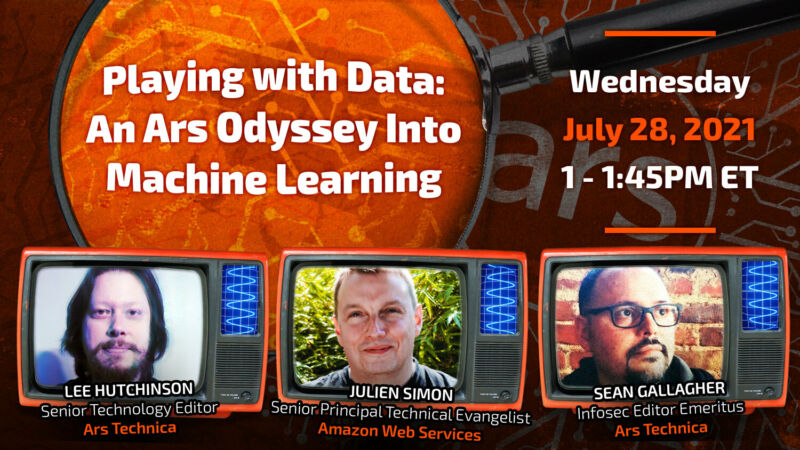
Our chat kicks off on Wednesday, July 28, at 1:00 pm Eastern Time (that’s 10:00 am Pacific Time and 17:00 UTC). Our three-person panel will consist of Ars Infosec Editor Emeritus Sean Gallagher and me, along with Amazon Senior Principal Technical Evangelist (and AWS expert) Julien Simon. If you’d like to register so that you can ask questions, use this link here; if you just want to watch, the discussion will be streamed on the Ars Twitter account and archived as an embedded video on this story’s page. Register and join in or check back here after the event to watch!

https://arstechnica.com/?p=1783029


Researchers demonstrate that malware can be hidden inside AI models

This photo has a job application for Boston University hidden within it. The technique introduced by Wang, Liu, and Cui could hide data inside an image classifier rather than just an image.
Enlarge / This photo has a job application for Boston University hidden within it. The technique introduced by Wang, Liu, and Cui could hide data inside an image classifier rather than just an image.

Researchers Zhi Wang, Chaoge Liu, and Xiang Cui published a paper last Monday demonstrating a new technique for slipping malware past automated detection tools—in this case, by hiding it inside a neural network.

The three embedded 36.9MiB of malware into a 178MiB AlexNet model without significantly altering the function of the model itself. The malware-embedded model classified images with near-identical accuracy, within 1% of the malware-free model. (This is possible because the number of layers and total neurons in a convolutional neural network is fixed prior to training—which means that, much like in human brains, many of the neurons in a trained model end up being either largely or entirely dormant.)

Just as importantly, squirreling the malware away into the model broke it up in ways that prevented detection by standard antivirus engines. VirusTotal, a service that “inspects items with over 70 antivirus scanners and URL/domain blocklisting services, in addition to a myriad of tools to extract signals from the studied content,” did not raise any suspicions about the malware-embedded model.

The researchers’ technique chooses the best layer to work with in an already-trained model and then embeds the malware into that layer. In an existing trained model—for example, a widely available image classifier—there may be an undesirably large impact on accuracy due to not having enough dormant or mostly dormant neurons.

If the accuracy of a malware-embedded model is insufficient, the attacker may choose instead to begin with an untrained model, add a lot of extra neurons, and then train the model on the same data set that the original model used. This should produce a model with a larger size but equivalent accuracy, plus the approach provides more room to hide nasty stuff inside.

The good news is that we’re effectively just talking about steganography—the new technique is a way to hide malware, not execute it. In order to actually run the malware, it must be extracted from the poisoned model by another malicious program and then reassembled into its working form. The bad news is that neural network models are considerably larger than typical photographic images, offering attackers the ability to hide far more illicit data inside them without detection.

Cybersecurity researcher Dr. Lukasz Olejnik told Motherboard that he didn’t think the new technique offered much to an attacker. “Today, it would not be simple to detect it by antivirus software, but this is only because nobody is looking.” But the technique does represent yet another way to potentially smuggle data past digital sentries and into a potentially less-protected interior network.

https://arstechnica.com/?p=1782634