Author pulls software that used deep learning to virtually undress women
AntonioGuillem
On Wednesday, a Vice article alerted the world to the creation of DeepNude, a computer program that uses neural networks to transform an image of a clothed woman into a realistic rendering of what she might look like naked.
The software attracted widespread condemnation. This is an “invasion of sexual privacy,” legal scholar Danielle Citron told Vice.
The software’s anonymous creator explained how it worked to Vice’s Samantha Cole:
The software is based on pix2pix, an open-source algorithm developed by University of California, Berkeley researchers in 2017. Pix2pix uses generative adversarial networks (GANs), which work by training an algorithm on a huge dataset of images—in the case of DeepNude, more than 10,000 nude photos of women, the programmer said—and then trying to improve against itself.
The software focused on women because it was easier to find pictures of nude women, the programmer said. If you run the program on a clothed picture of a man, it will depict him naked with female private parts.
The DeepNude website was quickly swamped with downloads and was soon taken down. On Thursday morning, the team behind DeepNude promised to upgrade the website, fix some bugs in the software, and bring it online in a few days.
But the public backlash against the software proved too powerful. By Thursday afternoon, the software’s author announced that it was being taken down permanently.
In a statement announcing the decision, the anonymous creator noted that the program included watermarks in generated photographs as a “safety measure” to prevent them from being misused—presumably referring to would-be users presenting a fake image as if were real. However, he said, “if 500,000 people use it, the probability that people will misuse it is too high. The world is not yet ready for DeepNude.”
Critics questioned whether there was any way to use the software that wasn’t a “misuse.” In any event, the software is no longer available, at least from official sources. Pirated copies continue to circulate online.
https://arstechnica.com/?p=1529245
LA SFIDA DI OGGI E’ SOPRAVVIVERE ALLA QUARTA RIVOLUZIONE INDUSTRIALE
Completamente diversa dalla seconda di fine ‘900 che aveva creato molta occupazione lavorativa e redditi sicuri !
Attualmente invece si realizza il Reddito di cittadinanza, possiamo considerarlo uno strumento efficace per trovare lavoro oppure è di fatto una misura di Welfare?
Senza dubbio il Reddito di Cittadinanza ce l’hanno “venduto” come una misura di sviluppo economico ma attualmente qual’è l’incidenza prevista sul Pil del 2019 ? Si parla di un costo di 6,1 miliardi di € a fronte di un impatto aggiuntivo sul Pil di 1,8 miliardi di €, poco, se si vuol far ripartire un Paese che da anni si trova in una situazione di stagnazione.
I limiti per l’accesso alla misura, creati soprattutto per evitare truffe o comportamenti antisociali, hanno selezionato molto la platea dei fruitori e probabilmente porteranno ad un impatto sui consumi inferiore a quello atteso.
I vantaggi macroeconomici dei progetti di sviluppo legati al Reddito di Cittadinanza andranno valutati più avanti nel tempo, con riferimento all’inversione del contributo alle imprese che assumono i fruitori per il periodo residuo o all’autofinanziamento per l’apertura di una micro impresa propria.
Inoltre, i nostri centri per l’impiego e i navigator saranno in grado di occupare la maggior parte dei fruitori del reddito ? In Germania sappiamo che questo sistema funziona.
Di fatto il Reddito di Cittadinanza è una misura di Welfare che probabilmente andava introdotta in un periodo più positivo, preferendo al suo posto una non rinviabile quanto necessaria politica di investimenti e riduzione del cuneo fiscale. Tanto più che l’Italia è uno dei Paesi con Germania e Belgio che ha il cuneo più alto in Europa, pur avendo stipendi non commisurati all’effettivo costo della vita.
Tuttavia il reddito di cittadinanza è importante come “precedente legislativo” che potrebbe essere l’antenato di una risposta macroeconomica futura necessaria.
Infatti la robotica digitale e l’Intelligenza Artificiale in pochi anni sostituiranno parte dell’occupazione lavorativa umana, a partire dalle mansioni meno qualificate e particolarmente ripetitive : coinvolto anzitutto il settore manifatturiero, dei trasporti, della vendita alimentare al dettaglio, del commercio on-line.
Già case di produzione di auto e importanti note aziende di vendita on line sostituiscono i robot al personale umano come soluzione di maggiore produttività e minor costo. Già vediamo casse automatiche nei nostri supermercati o punti vendita alimentari completamente senza personale in Europa. Già in alcune nostre località di mare quest’estate i robot sostituiranno i camerieri stagionali in alberghi, come anche avviene in alcuni bar. Già negli USA le consegne avvengono con droni e in Italia è appena stata concessa la sperimentazione per i primi veicoli su strada senza conducente.
Progressivamente, nei prossimi decenni, è probabile che verranno sostituite anche le professioni più qualificate, si pensi ai già esistenti casi di androidi giapponesi al posto di giornalisti di rassegna stampa televisiva e, in futuro, ai legali, ai medici, contabili, ecc.
Sarà pertanto essenziale la riqualificazione lavorativa volta a essere in grado di affiancare le macchine intelligenti; tuttavia le tipologie, il numero di posti e le ore di lavoro sono destinati a diminuire, lo prevede il progresso della Quarta Rivoluzione Industriale delle innovazioni digitali, che non si può arrestare ma che non può prescindere da una valutazione etica.
Il lavoro è un diritto garantito dall’Art. 1 della Costituzione Italiana e, prima ancora, dal Diritto naturale.
Nella società attuale in cui capitalismo e globalizzazione economica hanno portato alla concentrazione nelle mani del 5% della popolazione del 90 % della ricchezza totale, quando avverrà una forte riduzione o quasi scomparsa del lavoro per via del progresso digitale, IA-Robot e Yuman-one si contrapporranno, necessitando di una composizione etica che subordini le macchine all’uomo ; ipotizzando un modello futuro positivo in cui lo Stato garantisca un reddito universale o acquisito per nascita per soddisfare i bisogni primari.
Il reddito di Cittadinanza potrebbe essere “l’antenato” del futuro Reddito di Nascita che assorba anche il sistema di previdenza in una logica redistributiva della ricchezza.
Dario Polini e Valentina Lucarelli
Grazie al nostro canale Telegram potete rimanere aggiornati sulla pubblicazione di nuovi articoli di Scenari Economici.
Why Google believes machine learning is its future
Enlarge/ Google CEO Sundar Pichai speaks during the Google I/O Developers Conference on May 7, 2019.
David Paul Morris/Bloomberg via Getty Images
One of the most interesting demos at this week’s Google I/O keynote featured a new version of Google’s voice assistant that’s due out later this year. A Google employee asked the Google Assistant to bring up her photos and then show her photos with animals. She tapped one and said, “Send it to Justin.” The photo was dropped into the messaging app.
From there, things got more impressive.
“Hey Google, send an email to Jessica,” she said. “Hi Jessica, I just got back from Yellowstone and completely fell in love with it.” The phone transcribed her words, putting “Hi Jessica” on its own line.
“Set subject to Yellowstone adventures,” she said. The assistant understood that it should put “Yellowstone adventures” into the subject line, not the body of the message.
Then without any explicit command, the woman went back to dictating the body of the message. Finally she said “send it,” and Google’s assistant did.
[embedded content]
Google is also working to expand the assistant’s understanding of personal references, the company said. If a user says, “Hey Google, what’s the weather like at Mom’s house,” Google will be able to figure out that “mom’s house” refers to the home of the user’s mother, look up her address, and provide a weather forecast for her city.
Google says that its next-generation assistant is coming to “new Pixel phones”—that is, the phones that come after the current Pixel 3 line—later this year.
Obviously, there’s a big difference between a canned demo and a shipping product. We’ll have to wait and see if typical interactions with the new assistant work this well. But Google seems to be making steady progress toward the dream of building a virtual assistant that can competently handle even complex tasks by voice.
A lot of the announcements at I/O were like this: not the announcement of major new products, but the use of machine learning techniques to gradually make a range of Google products more sophisticated and helpful. Google also touted a number of under-the-hood improvements to its machine learning software, which will allow both Google-created and third-party software to use more sophisticated machine learning techniques.
In particular, Google is making a big push to shift machine learning operations from the cloud onto peoples’ mobile devices. This should allow ML-powered applications to be faster, more private, and able to operate offline.
Google has led the charge on machine learning
Enlarge/ A circuit board containing Google’s tensor processor unit.
If you ask machine learning experts when the current deep learning boom started, many will point to a 2012 paper known as “AlexNet” after lead author Alex Krizhevsky. The authors, a trio of researchers from the University of Toronto, entered the ImageNet competition to classify images into one of a thousand categories.
The ImageNet organizers supplied more than a million labeled example images to train the networks. AlexNet achieved unprecedented accuracy by using a deep neural network, with eight trainable layers and 650,000 neurons. They were able to train such a massive network on so much data because they figured out how to harness consumer-grade GPUs, which are designed for large-scale parallel processing.
AlexNet demonstrated the importance of what you might call the three-legged stool of deep learning: better algorithms, more training data, and more computing power. Over the last seven years, companies have been scrambling to beef up their capabilities on all three fronts, resulting in better and better performance.
Google has been leading this charge almost from the beginning. Two years after AlexNet won an image recognition competition called ImageNet in 2012, Google entered the contest with an even deeper neural network and took top prize. The company has hired dozens of top-tier machine learning experts, including the 2014 acquisition of deep learning startup DeepMind, keeping the company at the forefront of neural network design.
The company also has unrivaled access to large data sets. A 2013 paper described how Google was using deep neural networks to recognize address numbers in tens of millions of images captured by Google Street View.
Google has been hard at work on the hardware front, too. In 2016, Google announced that it had created a custom chip called a Tensor Processing Unit specifically designed to accelerate the operations used by neural networks.
“Although Google considered building an Application-Specific Integrated Circuit (ASIC) for neural networks as early as 2006, the situation became urgent in 2013,” Google wrote in 2017. “That’s when we realized that the fast-growing computational demands of neural networks could require us to double the number of data centers we operate.”
This is why Google I/O has had such a focus on machine learning for the last three years. The company believes that these assets—a small army of machine learning experts, vast amounts of data, and its own custom silicon—make it ideally positioned to exploit the opportunities presented by machine learning.
This year’s Google I/O didn’t actually have a lot of major new ML-related product announcements because the company has already baked machine learning into many of its major products. Android has had voice recognition and the Google Assistant for years. Google Photos has long had an impressive ML-based search function. Last year, Google introduced Google Duplex, which makes a reservation on behalf of a user with an uncannily realistic human voice created by software.
Instead, I/O presentations on machine learning focused on two areas: shifting more machine learning activity onto smartphones and using machine learning to help disadvantaged people—including people who are deaf, illiterate, or suffering from cancer.
Squeezing machine learning onto smartphones
Justin Sullivan/Getty Images
Past efforts to make neural networks more accurate have involved making them deeper and more complicated. This approach has produced impressive results, but it has a big downside: the networks often wind up being too complex to run on smartphones.
People have mostly dealt with this by offloading computation to the cloud. Early versions of Google and Apple’s voice assistants would record audio and upload it to the companies servers for processing. That worked all right, but it had three significant downsides: it had higher latency, it had weaker privacy protection, and the feature would only work online.
So Google has been working to shift more and more computation on-device. Current Android devices already have basic on-device voice recognition capabilities, but Google’s virtual assistant requires an Internet connection. Google says that situation will change later this year with a new offline mode for Google Assistant.
This new capability is a big reason for the lightning-fast response times demonstrated by this week’s demo. Google says the assistant will be “up to 10 times faster” for certain tasks.
https://arstechnica.com/?p=1502677
Google bans adverts for anti-censorship sites in China
Google has sported a rocky relationship with China for more than 10 years. While the company’s on again, off again approach to the Internet’s largest ‘untapped’ market has always been tempestuous, recent developments suggest the tech giant may be yielding to its own growth imperative and bending to the government’s demands once more.
For more than a year, the debate has raged over accusations that the Chinese military is capitalizing on Google’s research and business activities in China. General Joseph Dunford, chairman of the US Joint Chiefs of Staff, told a Senate committee in March that Google’s work in China indirectly benefits the Chinese military, an accusation soon echoed by President Donald Trump.
Anxiety surrounding Google’s international and institutional affairs is nothing new. Last year, the company faced huge criticism after word leaked that it was building artificial intelligence (AI) tools to analyze drone footage for the Pentagon’s ‘Project Maven’. Executives experienced similar uproar over ‘Project Dragonfly’ in 2018, a secretive effort to develop a censored search engine for the Chinese market. This prompted outcry from employees and politicians who criticized Google for helping China withhold information from its citizens. CEO Sundar Pichai has since pledged not to go forward with the censored search product—at least for the time being.
Google has generally limited its operations in the Chinese market since 2010 when it pulled the majority of its products amidst a battle over censorship. Some branches of operation have been maintained, most of which relate to the distribution of Android software and Google Adverts on third-party websites. Despite this tumultuous history, the company’s latest movements have been speculatively characterized as an attempt to regain favor with Chinese officials in a bid to gain a foothold in the country’s heavily regulated internet market.
A bow to state censorship?
Following calls from China’s market regulator for internet platforms to strengthen their censorship and monitoring of advertisements, it was recently revealed that Google has now banned the distribution of advertisements in China for websites that review anti-censorship software – the very tools that many Chinese people rely on to access Google’s services.
Two companies reviewing virtual private network (VPN) software – tools that allow users to circumvent surveillance and censorship – have reported Google refusing to sell their ads to Chinese users after doing so for over two years.
Representatives from Google have issued a response stating:
“This is not new. […] It is currently Google policy to disallow [sic] promoting VPN services in China due to the local legal restrictions […] We have long-standing policies prohibiting ads in our network for private servers in countries where such servers are illegal. All advertisers have to comply with local laws.”
Though the software is essential for Chinese citizens to use Google’s search engine, email, and cloud services, VPN providers and associated websites are now blocked from promoting themselves through Google ads in the country, despite the fact they do not explicitly violate Chinese law.
Speaking to the Financial Times, Charlie Smith of GreatFire.org, a censorship monitoring organization criticized Google’s blunt action in relation to these advertisers as being too broad. He said:
“…there are legally registered VPNs operating in China, so either Google has not kept up to date with local regulations, or they are overstepping their boundaries.”
As it stands, there is no explicit, all-out ban on VPN providers or review websites in China, though providers do need to obtain a license to operate in the country.
The advertisements in question did not explicitly violate Chinese law, which suggests that Google may be following its own prerogative rather than meeting a legal obligation. What’s more, non-Chineselanguage ads appear to be unaffected by the restrictions, which suggests that Google has come under pressure from Beijing to block ads aimed specifically at Chinese citizens rather than those targeting foreigners. Spokespeople have yet to answer whether the ban was put in place of the company’s own accord or as a response to requests from Chinese authorities.
Freedom of information
Google’s choice to capitulate to the censorship of advertisements raises questions about the company’s complicity in political restrictions on the freedom of information. Controls such as those in China favor only the information that promotes government interests.
When Google shut down its Chinese search engine nine years ago, it announced it was no longer willing to censor search results, thus devastating its relationship with the country’s officials. Just last year, the company’s official position on content moderation stated its loyalty to political neutrality:
“Google is committed to free expression — supporting the free flow of ideas is core to our mission. […] Giving preference to content of one political ideology over another would fundamentally conflict with our goal of providing services that work for everyone.”
It’s clear that future access to the Chinese market requires complicity with state censorship tools, and these developments suggest that Google is willing to bow down to the government’s demands in order to achieve this. The decision to remove advertisements for legitimate security tools further deprives Chinese users of the ability to find uncensored material and undermines the company’s claim to political neutrality. It raises a particular question: If Google is in the business of expanding access to information, why do they not conceive of their business in these terms in China?
Share this article
Related articles
A fragmented Internet
There is more resting on Google’s movements in China than whether it might be putting profits over principles. The company’s relationship with the world’s second-largest economy tells a wider story of what happens in a world where the Internet is split in two at a time when our realities are largely driven by what we read on the web.
China’s escalation of media and communication controls over the past decade has manufactured an Internet and information economy entirely disparate from the model that dictates our lives in the West. Choosing to support this distinction does nothing but widen the digital wedge driving China and Western countries apart, and enables anything but the free flow of ideas. If China and the US continue to live in separate “cyber worlds” and absorb two distinct information realities, how can we expect the two entities to effectively cooperate on the world stage and negotiate political issues outside of internet governance?
Even in an environment where Western users are calling for platforms to limit user freedoms in exchange for security, it is only appropriate to recoil at the idea of a global platform that wilfully bans material in support of an authoritarian regime.
What it means for search marketers
China boasts a thriving digital economy. If you’re looking to grow your business and haven’t yet capitalized on this market, you may be missing out on tens of millions of relevant queries.
If you’re focused on improving organic performance alone, Google’s international decisions will have little impact. Instead, you’ll need to focus on Baidu. One of the world’s largest internet companies, Baidu’s search engine has an index of over 750 million web pages and accounts for well over 70% of Chinese internet search queries. Like Google, Baidu also offers music streaming services, maps, images, data storage and, most importantly for business growth, pay-per-click ads.
If you’re targeting Chinese users through Google Ads, Google’s strategic decisions will be paramount. It’s likely that this ban and those yet to come will affect other Google-owned services like Google Marketing Platform and Google Ad Manager.
The impact of these decisions will depend on the nature of your website, product, or service, as well as your target audience. If you intend to target Chinese users rather than foreign visitors to China, or your business provides a service that might be deemed incompatible with China’s agenda even if it’s not technically illegal, it may face a similar fate. Though you may be unaffected thus far, it’s essential to stay on top of Google’s relationship with large markets like China to predict potential impediments to your marketing efforts and formulate an effective alternative strategy.
William Chalk is a cybersecurity researcher and digital privacy specialist. He covers these issues for leading tech publications to help support our digital freedoms. He can be found on Twitter .
Want to stay on top of the latest search trends?
Get top insights and news from our search experts.
Related reading
Understand the best metrics for your business when it comes to SEO, view them from a technical and commercial perspective. Lots of screenshots included.
A PWA is a mobile-friendly website that behaves like an app but doesn’t need to be downloaded to be used. Starbucks’ and Forbes’ case studies included.
What is considered duplicate content? What steps can you take to make sure it doesn’t hamper your SEO efforts? Pressing SEO questions answered.
If you care about where and how you appear on search engines, Google Search Console and its updates will be of much interest to you.
Want to stay on top of the latest search trends?
Get top insights and news from our search experts.
Google debuts “next-generation” Assistant, coming to next Pixel phones
Google/Screenshot
Google on Tuesday debuted an updated version of its Google Assistant platform during the keynote of its Google I/O developers conference.
The company said it is internally calling this the “next-generation” Assistant and that it will first become available on Google’s “new Pixel phones” later this year. (Not to be confused with the budget-friendly Pixel 3a phones Google also announced on Tuesday.)
Google is touting significant performance improvements with the updated Assistant, claiming that it can process and understand voice requests “in real time” and deliver results “up to 10 times faster” than its current iteration. The company says this is primarily due to it condensing the AI models used to interpret speech down to a half a gigabyte, which is small enough for them to process directly on a smartphone instead of requiring remote servers.
During a brief demo, the company demonstrated using the Assistant to perform multiple requests in rapid succession. A user will seemingly be able to open apps, set timers, reply to texts, activate the flashlight, browse Google Photos, get a car from a ride-sharing service like Lyft, and do other typical Google Assistant things with minimal wait time or the need to say “Hey Google!” at any point in between.
[embedded content]
Another demo showcased the Assistant’s ability to compose and send emails entirely through voice commands. This includes knowing when to delineate between a greeting and the first sentence of the email and when a user is asking to title the subject line.
Interestingly, feedback for these commands appears to be relegated to the bottom right corner of a phone’s status bar, where the “recent apps” button was traditionally placed on Android phones.
Google did not divulge many more details on the “next-gen” Assistant beyond that. It’s not clear whether the feature will only work on a high-end flagship like the next Pixels or if it will be relegated to Google phones alone to start. But the company says it envisions this as nothing less than a “paradigm shift” that makes it easier for people to get around their phones more with their voice. If nothing else, the upgrade is another opportunity for Google to show how advanced its assistant technology is compared to competing platforms like Apple’s Siri.
Enlarge/ What Google Assistant’s new driving mode will look like.
Google/Screenshot
Beyond all of that, the company said that the Assistant will gain a “Picks for you” feature on smart display devices later this summer that will suggest personalized recipes, podcasts, and “events” when asked. An updated “You” tab in the Assistant’s settings menu should make it easier to update what personal info the digital helper can access as well.
Finally, the company announced that a new “Driving Mode” will come built into the Assistant; it’s activated by saying, “Hey Google, let’s drive.” Driving Mode will include personalized shortcuts and suggestions—think the ability to resume a podcast where it was last paused, links to frequent contacts, or a link to directions for a dinner reservation you may have in Google Calendar—along with the usual navigation, calling, and media options.
This all veers a bit close to Google’s existing Android Auto platform, but having it contained within Google Assistant could be convenient. Google says it will be available “this summer” on all Android phones with the Assistant. Building on that, the company says the Assistant will come to Waze in the coming weeks.
https://arstechnica.com/?p=1501323
How AI is powering real-time SEO research: Insights and optimization
The shift to real-time data analysis and optimization has supercharged marketing in a way that frankly should have SEOs on the edge of their seats.
As organizations struggle to make sense of and activate their data, SEOs can combine their deep experience with massive amounts of data to make smarter business decisions and have an edge. Things are about to get real, very real.
Automation in marketing no doubt was (and still is) a game-changer for consultancies, agencies, and clients. Straight-up automation brought efficiency and order to the workflow. Now, you can expand your capabilities even further with the AI layer.
According to a study by the Economist, 75% of executives say AI will be “actively implemented” in companies within the next three years. Business leaders aren’t feeling so great about how it’s being implemented, though. Although 92% of C-level executives with some of the world’s biggest brands recently reported that the pace of their big data and AI investments are accelerating, 77% also said that business adoption of AI initiatives is a major challenge.
Where’s the disconnect? It’s telling that 93% of those interviewed identified people and process as obstacles. In this post, we’re going to explore the different ways SEOs can lead the charge in AI-powered insights and optimizations. We are entering a new era of real-time SEO and insights are being powered by machine learning and AI.
Understanding the opportunities in evolving SERPs
Google has gone all-in on AI, and it’s driving increasingly complex yet engaging and functional enhanced search results. With RankBrain, Google uses machine learning to analyze the context of content and serve more accurate organic search, image, and video results.
How does it work? Roger Rogerson dug up a succinct explanation in a recent column:
“… RankBrain uses artificial intelligence to embed vast amounts of written language into mathematical entities — called vectors — that the computer can understand. If RankBrain sees a word or phrase it isn’t familiar with, the machine can make a guess as to what words or phrases might have a similar meaning and filter the result accordingly, making it more effective at handling never-before-seen search queries. …”
RankBrain isn’t just using natural language processing (NL) to better understand the intent behind each query. It’s converting words to data, plotting it on a chart, and examining the relationships that exist between terms. What it “learns” then drives rankings and different types of results in the blink of an eye for each new query.
How can you use this to your advantage?
Content optimization is more important than ever. The bar for quality is high, and Google needs to be able to see how each piece of content, whether text, image, or video is the best answer for specific types of queries. But optimizing content once, before it’s published, isn’t going to cut it anymore. SEOs need AI-powered automation to audit site content, resolve errors, and suggest new optimizations on an ongoing basis, based on real-time data, and consumer behaviors.
Automate competitive research and find opportunities to increase your share of voice with smart monitoring that identifies content that is outranking yours. See exactly where you need to build out content and what it needs to include in order to regain your rankings.
Stay ahead of SERP changes with AI-powered analysis. By the time you manually evaluate the SERPs that Google returns for even a few keyword phrases, you’re making optimizations based on old data. Get ahead of the game with real-time SEO insights that tell you exactly what you need to do to take over competitors on the terms that offer your greatest opportunities.
Share this article
Related articles
Making smarter optimizations with AI-powered insights
A typical SEO practitioner uses six separate tools cobbled together and spends four hours a day on research, reporting, and analysis. This is no longer necessary, though. BrightEdge Instant for example (disclosure, my company’s innovation) provides marketers with real-time recommendations and data so marketers take action to optimize content, all within one unified platform.
Voice-enabled technologies, now used in more than 20% of mobile queries, are one opportunity you can’t afford to overlook. Amazon Alexa, Google Assistant, and other digital assistants rely on AI to converse with consumers and respond to their needs. You need to understand the conversational journey and the next three follow-up questions someone is going to ask but are probably wading through a list of keywords from Keyword Planner. You’re manually looking for conversational searches or turning to a point solution with display-only capabilities (without search volume) that is disconnected from your SEO workflow.
SEOs need to be able to analyze when and why people use voice search in order to provide the types of answers digital assistants can use. Structured data is a great way to achieve this, but right now more than 80% of the world’s data is unstructured (SEW offers a guide to help you get started here).
Keyword research is another opportunity to save time and improve performance by working AI into your workflow. Given the large proportion of queries that Google says have local intent, you need to understand the location for every part of your business worldwide. For businesses with hundreds of thousands of locations worldwide, it’s impossible to accurately research and report on keyword performance in each of your key markets. Using an AI-powered tool here allows you to scale research across thousands of locations and dozens of languages, all on one platform. You can make smart, high impact decisions that give you the competitive edge quickly and seamlessly, and this is without a mess of Excel sheets.
How can you use this to your advantage?
Make voice a reality by taking a data-driven, AI-enabled approach to understanding the conversations happening in your space. Doing so will help you identify top-of-the-funnel, awareness-generating question keywords, analyze the keyword landscape, and understand which portion of your keywords are quick answers, and which percentage you are winning.
Look for a tool that uses the power of AI to curate the most relevant topics and keywords to go after. Automation can exponentially amplify your efforts to evaluate a seed list, but it’s the AI layer that supercharges it by understanding intent, producing and evaluating a massive list of related terms in real-time, identifying current trends, and helping you to prioritize your efforts.
Don’t forget about video! YouTube is the second largest search engine in the world and consumers increasingly look there as part of their shopping process (especially in the early stages of their buying journey). Measuring video performance and rankings immediately and on an ongoing basis enables you to respond to real-time insights, and make optimizations to improve performance in the critical post-publication period.
SEOs cannot afford to be late adopters in the AI arena and laggards in relation to real-time SEO. Today, you need to be able to anticipate searcher needs and have technology in place to trigger the optimizations that will return your content as the top answer for relevant queries. Want to learn more? Make sure you caught my last column, Five ways SEOs can utilize data with insights, automation, and personalization.
Jim Yu is the founder and CEO of leading enterprise SEO and content performance platform BrightEdge. He can be found on Twitter .
Want to stay on top of the latest search trends?
Get top insights and news from our search experts.
Related reading
If you care about where and how you appear on search engines, Google Search Console and its updates will be of much interest to you.
In Nov 2017, Venngage enjoyed 275,000 visitors a month from organic search traffic. Today (16 months later) it’s 900,000. Details of how they did it.
DuckDuckGo could be your new default search engine if you want to focus on privacy and security. What it’s like using it nowadays?
We reviewed the best practices of ecommerce leaders and success stories of smaller merchants. Three life hacks to make product pages convert more visitors.
Want to stay on top of the latest search trends?
Get top insights and news from our search experts.
Photographs Without Photographers: Our Future in AI Photography is Coming, Fast!
What About Smart Cameras?
We all know about smart cars and smartphones. But what about smart cameras? We don’t often call them that, perhaps because we feel, compared to smart camera phones, that larger cameras have been getting smarter at a snail’s pace. Well, not anymore. Assisted intelligence has arrived.
NVIDIA has a “smart paintbrush,” a tool for taking basic sketches and turning them into photo-realistic landscape images. While it exists as a demonstration and an academic hard copy paper, the NVIDIA app will grow faster than we can imagine.
Algorithms are no longer in a childlike stage but are like fast-growing teen-agers with expanding brains that are thinking deeper thoughts. Today, AI technology two things: machine learning and machine vision. Its software is virtually sentient ax it takes over over repetitive tasks like tagging the “best” photos from your day’s shoot. While guiding us toward new horizons in photography, it makes us wonder, where is the photographer in this AI world?
These programs, apps, and algorithms seem a natural part of the photo editing process while they are working in the background as assistants. If it makes sense, think of them as Augmented Intelligence, and Assisted Intelligence, as well as Artificial Intelligence. Possibly, given that algorithms are fully embedded into our cell phones, by the end of 2019, some form of Assisted Intelligence will be part of ALL cameras and camera-phone interfaces.
Assisted Intelligence (AI) Today
Assisted intelligence began with small steps. One of the first was an algorithm that let us float the ISO so that the camera would vary the ASA according to the aperture and shutter settings for the scene. Beyond floating ISO, there is a rapidly expanding series of programs for photographers: picture styles, depth sensing for soft backgrounds, wireless and blue-tooth camera controls, portrait modes, real-time image scene recognition, picture editors. While none of these programs and algorithms come close to the complex, evolved neural networks of our visual cortex, they promise to save time by taking over automatic functions in photography.
Five Examples of Emerging AI
With that said, we must think of these AI features as flexible. They are not alterations in the physics, chemistry or the optics of photography. Instead, they are are changes in programming, coding, searching, indexing and user interfaces. Thus, they are easily updated and patched into cameras and into editing software.
Here are 5 examples of the ideas, companies, and editors in 2019 for AI:
1. Deep Learning
A company called Meero, makes photographs for real estate, food, and commercial. They developed a cutting-edge algorithm they say was inspired by how the human brain works. Can an algorithm perform as well as a professional photographer when executing an aesthetic, nuanced, complex task? Meero thinks it can, proposing that gradient-based learning is the solution.
In their software, they use a deep neural network that mimics the way the brain works to make use of the errors the network’s neurons output and then compute its gradient using convex optimization methods. They draw from 25 million photographs in their database. By then, using the chain-rule to correct errors from the end to the beginning of the network, and repeating the operation millions of times using Meero’s database, the proprietary deep learning algorithm performs as well or faster than a professional photographer to enhance photographs for commercial sale.
Arsenal is a smart camera assistant, essential a device you put atop your camera to set up your camera settings with your smartphone. It has many features such as time lapse, focus stacking, sharing to the web, remote release, and allowing long-exposure or time exposure photos, such as blurring flowing water, without neutral density (ND) filters.
Our first of two editors is from Skylum. Skylum offers Photolemur and Luminar 3. Photolumur edits a picture automatically to get the “best” possible version. Luminar uses only one slider to adjust contrast, tone, sharpness, noise reduction automatically. These programs also add sun rays, enhance skies, and use just one slider to automatically improve a photo.
A second AI program, Adobe Sensei, does many things, but to mention just one, it lets you alter expression and perspective with no distortion. For example, the mouth can be changed from a frown to a smile, and eyes enlarged or reduced with just a click. If one person in a family portrait did not smile, Adobe Sensei can, with face recognition, add a touch of a smile. The software unifies machine learning and AI, so you can search for, and find, specifics, such as a red bridge with a shallow depth of field. The program acts as a content assistant to find content with me machine learning that improves its performance when it is given more information. For instance, tasks like cropping, tagging adding a folder of swatches can be automated by Adobe AI runtime. The developers say that Adobe Sensei’s deep learning is loosely modeled on how brain neurons communicate with each other to score which images are best.
EyeEm Vision is cutting edge AI. For each photo you take, the program automatically tags, captions and keywords your metadata so you can search it in your library. It even filters your photo library to rate all photographs as to how well they match your self-described style.
5. ON1 Photo Raw 2019
In this picture editor, the quick mask tool uses AI technology to easily help you select, fine tune, and apply a mask to your photograph. This saves time because the assistant does all the work selecting that was previously done by hand with Tools in a tools menu. For example, a boring sky can be quickly selected and an interesting sky put in its place.
Summary
AI software developers are offering us methods to make our pictures look better. They also tell us that these AI programs will let us “make great images faster” and let “our pictures look the best without wasting time.”
The pace that AI software is merging with our cameras is faster than light. For some photographic tasks, training and knowledge are minimized, complexities and inconveniences are removed, and the AI software assistant performs tasks more rapidly than a human editor. Nothing can go wrong, right?
Well, think of autofocus. While it is faster than human focusing by hand in many situations, for some scenes and especially with lower end cameras, autofocus may still create problems, like hunting to lock in on focusing on an object in low light. Even given all the powerful tools of Assisted Intelligence, there will always be a place for well-trained, experienced photographers who know the decisive moment to capture peak emotion and the touch of humanity.
Five ways SEOs can utilize data with insights, automation, and personalization
Constantly evolving search results driven by Google’s increasing implementation of AI are challenging SEOs to keep pace. Search is more dynamic, competitive, and faster than ever before.
Where SEOs used to focus almost exclusively on what Google and other search engines were looking for in their site structure, links, and content, digital marketing now revolves solidly around the needs and intent of consumers.
This past year was perhaps the most transformative in SEO, an industry expected to top $80 billion in spending by 2020. AI is creating entirely new engagement possibilities across multiple channels and devices. Consumers are choosing to find and interact with information by voice search, or even on connected IoT appliances, and other devices. Brands are being challenged to reimagine the entire customer journey and how they optimize content for search, as a result.
How do you even begin to prioritize when your to-do list and the data available to you are growing at such a rapid pace? The points shared below intend to help you with that.
From analysis to activation, data is key
SEO is becoming less a matter of simply optimizing for search. Today, SEO success hinges on our ability to seize every opportunity. Research from my company’s Future of Marketing and AI Study highlights current opportunities in five important areas.
1. Data cleanliness and structure
As the volume of data consumers are producing in their searches and interactions increases, it’s critically important that SEOs properly tag and structure the information we want search engines to match to those queries. Google offers rich snippets and cards that enable you to expand and enhance your search results, making them more visually appealing but also adding functionality and opportunities to engage.
Google has experimented with a wide variety of rich results, and you can expect them to continue evolving. Therefore, it’s best practice to properly mark up all content so that when a rich search feature becomes available, your content is in place to capitalize on the opportunity.
While Google is using AI to interpret queries and understand results, marketers are deploying AI to analyze data, recognize patterns and deliver insights as output at rates humans simply cannot achieve. AI is helping SEOs in interpreting market trends, analyzing site performance, gathering and understanding competitor performance, and more.
It’s not just that we’re able to get insights faster, though. The insights available to us now may have gone unnoticed, if not for the in-depth analysis we can accomplish with AI.
Machines are helping us analyze different types of media to understand the content and context of millions of images at a time and it goes beyond images and video. With Google Lens, for example, augmented reality will be used to glean query intent from objects rather than expressed words.
Opportunities for SEOs include:
Greater ability to define opportunity space more precisely in a competitive context. Understand underlying need in a customer journey
Deploying longer-tail content informed by advanced search insights
Better content mapping to specific expressions of consumer intent across the buying journey
3. Real-time response and interactions
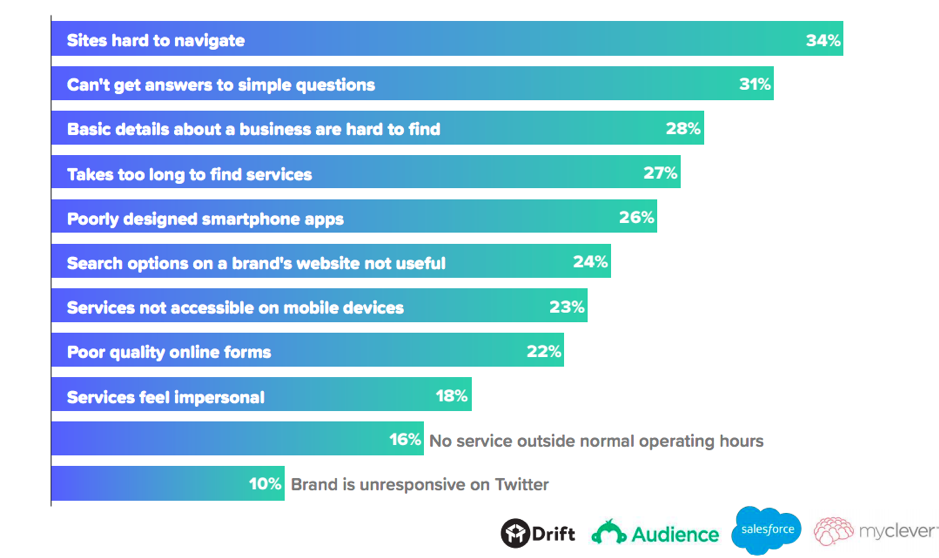
In a recent “State of Chatbots” report, researchers asked consumers to identify problems with traditional online experiences by posing the question, “What frustrations have you experienced in the past month?”
As you can see, at least seven of the top consumer frustrations listed above can be solved with properly programmed chatbots. It’s no wonder that they also found that 69% of consumers prefer chatbots for quick communication with brands.
Search query and online behavior data can make smart bots so compelling and efficient in delivering on consumer needs that in some cases, the visitor may not even realize it’s an automated tool they’re dealing with. It’s a win for the consumer, who probably isn’t there for a social visit anyway as well as for the brand that seeks to deliver an exceptional experience even while improving operational efficiency.
SEOs have an opportunity to:
Facilitate more productive online store consumer experiences with smart chatbots.
Redesign websites to support visual and voice search.
Deploy deep learning, where possible, to empower machines to make decisions, and respond in real-time.
Share this article
Related articles
4. Smart automation
SEOs have been pretty ingenious at automating repetitive, time-consuming tasks such as pulling rankings reports, backlink monitoring, and keyword research. In fact, a lot of quality digital marketing software was born out of SEOs automating their own client work.
Now, AI is enabling us to make automation smarter by moving beyond simple task completion to prioritization, decision-making, and executing new tasks based on those data-backed decisions.
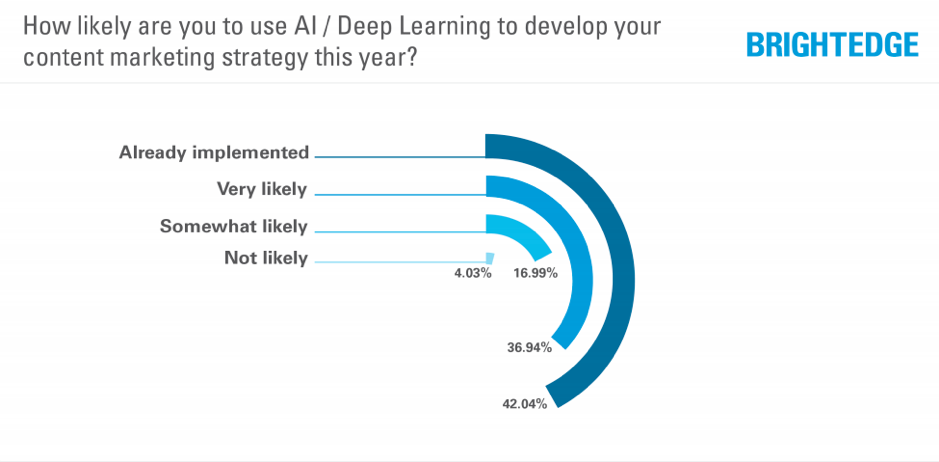
Content marketing is one area where AI can have a massive impact, and marketers are on board. We found that just four percent of respondents felt they were unlikely to use AI/deep learning in their content strategy in 2018, and over 42% had already implemented it.
In content marketing, AI can help us quickly analyze consumer behavior and data, in order to:
Identify content opportunities
Build optimized content
Promote the right content to the most motivated audience segments and individuals
5. Personalizations that drive business results
Personalization was identified as the top trend in marketing at the time of our survey, followed closely by AI (which certainly drives more accurate personalizations). In fact, you could argue that the top four trends namely, personalization, AI, voice search, and mobile optimization are closely connected if not overlapping in places.
Across emails, landing pages, paid advertising campaigns, and more, search insights are being injected into and utilized across multiple channels. These intend to help us better connect content to consumer needs.
Each piece of content produced must be purposeful. It needs to be optimized for discovery, a process that begins in content planning as you identify where consumers are going to find and engage with each piece. Smart content is personalized in such a way that it meets a specific consumer’s need, but it must deliver on the monetary needs of the business, as well.
How SEOs are uniquely positioned to drive smarter digital marketing forward
As the marketing professionals have one foot in analysis and the other solidly planted in creative, SEOs have a unique opportunity to lead smart utilization and activation of all manners of consumer data.
You understand the critical importance of clean data input (or intelligent systems that can clean and make sense of unstructured data) and differentiating between first and third-party data. You understand economies of scale in SEO and the value in building that scalability into systems from the ground up.
SEOs have long nurtured a deep understanding of how people search for and discover information, and how technology delivers. Make the most of your current opportunities by picking your low-hanging fruit opportunities for quick wins. Focus your efforts on putting the scalable, smart systems in place that will allow you to anticipate consumer needs, react quickly, report SEO appropriately, and convey business results to the stakeholders who will determine budgets in future.
Jim Yu is the founder and CEO of leading enterprise SEO and content performance platform BrightEdge. He can be found on Twitter .
You might like to read these next:
Want to stay on top of the latest search trends?
Get top insights and news from our search experts.
Related reading
All you need to know about using APIs for better, more productive SEO tasks — content curation, keyword analysis, link monitoring, site performance, etc.
Simple technical SEO issues on reliable comparison sites can hamper customer experiences. Here are six of the most common issues and their solutions.
80% of users admit that a poor search experience can make them leave a web store. How faceted navigation in ecommerce can make or break their experience.
Five strategies to help digital marketers speed up recurring tasks and have more energy to focus on meaningful work. Scripts, excel, bidding, and more.
Want to stay on top of the latest search trends?
Get top insights and news from our search experts.
OpenAI, a non-profit research company investigating “the path to safe artificial intelligence,” has developed a machine learning system called Generative Pre-trained Transformer-2 (GPT-2 ), capable of generating text based on brief writing prompts. The result comes so close to mimicking human writing that it could potentially be used for “deepfake” content. Built based on 40 gigabytes of text retrieved from sources on the Internet (including “all outbound links from Reddit, a social media platform, which received at least 3 karma”), GPT-2 generates plausible “news” stories and other text that match the style and content of a brief text prompt.
The performance of the system was so disconcerting, now the researchers are only releasing a reduced version of GPT-2 based on a much smaller text corpus. In a blog post on the project and this decision, researchers Alec Radford, Jeffrey Wu, Rewon Child, David Luan, Dario Amodei, and Ilya Sutskever wrote:
Due to concerns about large language models being used to generate deceptive, biased, or abusive language at scale, we are only releasing a much smaller version of GPT-2 along with sampling code. We are not releasing the dataset, training code, or GPT-2 model weights. Nearly a year ago we wrote in the OpenAI Charter: “we expect that safety and security concerns will reduce our traditional publishing in the future, while increasing the importance of sharing safety, policy, and standards research,” and we see this current work as potentially representing the early beginnings of such concerns, which we expect may grow over time. This decision, as well as our discussion of it, is an experiment: while we are not sure that it is the right decision today, we believe that the AI community will eventually need to tackle the issue of publication norms in a thoughtful way in certain research areas.
OpenAI is funded by contributions from a group of technology executives and investors connected to what some have referred to as the PayPal “mafia”—Elon Musk, Peter Thiel, Jessica Livingston, and Sam Altman of YCombinator, former PayPal COO and LinkedIn co-founder Reid Hoffman, and former Stripe Chief Technology Officer Greg Brockman. Brockman now serves as OpenAI’s CTO. Musk has repeatedly warned of the potential existential dangers posed by AI, and OpenAI is focused on trying to shape the future of artificial intelligence technology—ideally moving it away from potentially harmful applications.
Given present-day concerns about how fake content has been used to both generate money for “fake news” publishers and potentially spread misinformation and undermine public debate, GPT-2’s output certainly qualifies as concerning. Unlike other text generation “bot” models, such as those based on Markov chain algorithms, the GPT-2 “bot” did not lose track of what it was writing about as it generated output, keeping everything in context.
While the model required multiple tries to get a good sample, GPT-2 generated “good” results based on “how familiar the model is with the context,” the researchers wrote. “When prompted with topics that are highly represented in the data (Brexit, Miley Cyrus, Lord of the Rings, and so on), it seems to be capable of generating reasonable samples about 50 percent of the time. The opposite is also true: on highly technical or esoteric types of content, the model can perform poorly.”
There were some weak spots encountered in GPT-2’s word modeling—for example, the researchers noted it sometimes “writes about fires happening under water.” But the model could be fine-tuned to specific tasks and perform much better. “We can fine-tune GPT-2 on the Amazon Reviews dataset and use this to let us write reviews conditioned on things like star rating and category,” the authors explained.
That kind of performance would raise all sorts of concerns about how things like fake reviews—and pretty much any other sort of commenting—could be “deepfaked” for economic or political reasons. And that’s precisely why OpenAI’s researchers are holding off on publishing a more complete version of their model for now.
https://arstechnica.com/?p=1457603
Yes, “algorithms” can be biased. Here’s why
Enlarge/ Seriously, it’s enough to make researchers cry.
Dr. Steve Bellovin is professor of computer science at Columbia University, where he researches “networks, security, and why the two don’t get along.” He is the author of Thinking Security and the co-author of Firewalls and Internet Security: Repelling the Wily Hacker. The opinions expressed in this piece do not necessarily represent those of Ars Technica.
Newly elected Rep. Alexandria Ocasio-Cortez (D-NY) recently stated that facial recognition “algorithms” (and by extension all “algorithms”) “always have these racial inequities that get translated” and that “those algorithms are still pegged to basic human assumptions. They’re just automated assumptions. And if you don’t fix the bias, then you are just automating the bias.”
She was mocked for this claim on the grounds that “algorithms” are “driven by math” and thus can’t be biased—but she’s basically right. Let’s take a look at why.
First, some notes on terminology—and in particular a clarification for why I keep putting scare quotes around the word “algorithm.” As anyone who has ever taken an introductory programming class knows, algorithms are at the heart of computer programming and computer science. (No, those two are not the same, but I won’t go into that today.) In popular discourse, however, the word is widely misused.
Let’s start with the Merriam-Webster dictionary definition, which defines “algorithm” as:
[a] procedure for solving a mathematical problem (as of finding the greatest common divisor) in a finite number of steps that frequently involves repetition of an operation broadly: a step-by-step procedure for solving a problem or accomplishing some end
It is a step-by-step procedure. The word has been used in that sense for a long time, and extends back well before computers. Merriam-Webster says it goes back to 1926, though the Oxford English Dictionary gives this quote from 1811:
It [sc. the calculus of variations] wants a new algorithm, a compendious method by which the theorems may be established without ambiguity and circumlocution.
Today, though, the word “algorithm” often means the mysterious step-by-step procedures used by the biggest tech companies (especially Google, Facebook, and Twitter) to select what we see. These companies do indeed use algorithms—but ones having very special properties. It’s these properties that make such algorithms useful, including for facial recognition. But they are also at the root of the controversy over “bias.”
The algorithms in question are a form of “artificial intelligence” (AI). Again, from Merriam-Webster, AI is:
[a] branch of computer science dealing with the simulation of intelligent behavior in computers.
The technical field under the name “AI” goes back to the mid-1950s, and many AI techniques have been tried in the intervening decades. By far the most successful is known as machine learning (ML), which is “the process by which a computer is able to improve its own performance (as in analyzing image files) by continuously incorporating new data into an existing statistical model.” And one of the most popular ML techniques today is the use of neural networks, which are “a computer architecture in which a number of processors are interconnected in a manner suggestive of the connections between neurons in a human brain and which is able to learn by a process of trial and error.” (I won’t try to explain what neural networks are, but here is an excellent explanation of how they’re used for image recognition.)
So: algorithm, artificial intelligence, machine learning, neural networks. In popular cant, these refer to the same thing: computer programs that learn. And they learn by being fed training data, which we’ll get into more below.
There’s another important thing to know about these system: they are not, in any way, shape, or form, “intelligent.” They can do many things that intelligent beings can do, but they aren’t creative. Fundamentally, ML systems are about finding patterns, whether obvious or subtle.
These patterns come from the training data, which is the information initially fed into ML systems. Modern systems continuously update themselves. Every time you click on a link from, say, a Google search, the system updates itself: this link, for this person, is a more likely response to some particular query than is some other link.
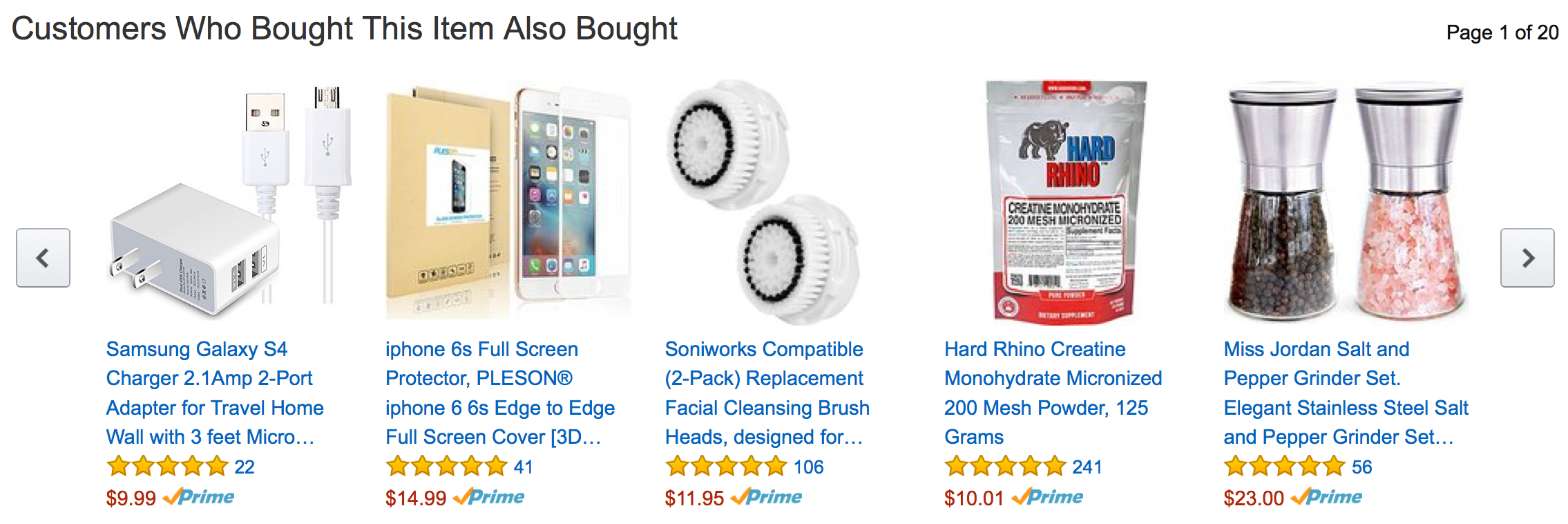
These patterns don’t have to make sense to a human! Consider this selection of products below that Amazon once offered me. For the life of me, I can’t see any correlation between a phone charger, creatine, and a salt-and-pepper grinder set—but the Amazon algorithm found one.
This is what’s important: machine-learning systems—”algorithms”—produce outputs that reflect the training data over time. If the inputs are biased (in the mathematical sense of the word), the outputs will be, too. Often, this will reflect what I will call “sociological biases” around things like race, gender, and class. This is usually unintentional, though malicious individuals can deliberately feed poisoned training data into ML systems (as happened to Microsoft’s Tay chatbot).
Even with the best intentions, eliminating sociological bias is very hard. Consider mortgage lending. I very much doubt that any major lender in the US is explicitly including race in credit-scoring algorithms (which would be highly illegal) or to help them “redline” neighborhoods (which has been illegal for more than 50 years). But there are plenty of other things beside race itself that correlate with race.
Amazon learned this the hard way when it tried using an internal ML system to screen resumes and found that the system became, in effect, biased against women:
Amazon’s system taught itself that male candidates were preferable. It penalized resumes that included the word “women’s,” as in “women’s chess club captain.” And it downgraded graduates of two all-women’s colleges, according to people familiar with the matter…
Amazon edited the programs to make them neutral to these particular terms. But that was no guarantee that the machines would not devise other ways of sorting candidates that could prove discriminatory, the people said.
This is the sort of thing that Rep. Ocasio-Cortez was discussing—despite being “just math,” the results of many “algorithmic” systems can be biased. Though this is probably not because of deliberate efforts by developers, it’s a problem nevertheless:
All of this is a remarkably clear-cut illustration of why many tech experts are worried that, rather than remove human biases from important decisions, artificial intelligence will simply automate them. An investigation by ProPublica, for instance, found that algorithms judges use in criminal sentencing may dole out harsher penalties to black defendants than white ones. Google Translate famously introduced gender biases into its translations. The issue is that these programs learn to spot patterns and make decisions by analyzing massive data sets, which themselves are often a reflection of social discrimination. Programmers can try to tweak the AI to avoid those undesirable results, but they may not think to, or be successful even if they try.
What should be done? The obvious answer is to design ML systems that explain the reasoning behind their outputs so that biased results can be found and problems eliminated. It’s a wonderful idea, but it’s beyond the current state of the art. “Accountable machine learning” is a hot research area, but it’s just that: research.
If a real solution to the problem doesn’t exist, what should we do now? One thing is to exercise far more care in the selection of training data. Failure to do that was the likely root cause of Google Images labeling two African-Americans as gorillas. Sometimes, fixing the training data can help.
Of course, this assumes that developers are even aware of the bias problem. Thus, another thing to do is to test for biased outputs—and some sensitive areas, such as the criminal justice system, simply do not use these kinds of tools.
On rare occasions, a simple fix is possible. In 2004, when Google had a problem with neo-Nazi sites showing up as high-ranked outputs for searches on “Jew,” the company internally purchased an “ad” for that keyword (which led to this explanation). In a nutshell, legitimate queries and pages tended to say “Judaism” or “Jewish;” bigots used “Jew” more.
(Why is this no longer the problem it once was? I’m not 100 percent certain, but my guess is that, at least in part, it was fixed in a different way. Google these days puts a lot of effort into trying to “understand” queries. One thing they do is “stemming:” reducing search terms to root words. Thus, searches for “Jew” and “Jewish” today both find the same documents.)
Given that ML systems (including facial recognition systems) can produce biased output, how should society treat them? Remember that, often, the choice is not between algorithmic output and perfection but between algorithmic decisions and human ones—and humans are demonstrably biased, too. That said, there are several reasons to be wary of the “algorithmic” approach.
GIGO
One reason is that people put too much trust in computer output. Every beginning programmer is taught the acronym “GIGO:” garbage in, garbage out. To end users, though, it’s often “garbage in, gospel out”—if the computer said it, it must be so. (This tendency is exacerbated by bad user interfaces that make overriding the computer’s recommendation difficult or impossible.) We should thus demand less bias from computerized systems precisely to compensate for their perceived greater veracity.
The second reason for caution is that computers are capable of doing things—even bad things—at scale. There is at least the perceived risk that, say, computerized facial recognition will be used for mass surveillance. Imagine the consequences if a biased but automated system differentially misidentified African-Americans as wanted criminals. Humans are biased, too, but they can’t make nearly as many errors per second.
Our test, then, should be one called disparate impact. “Algorithmic” systems should be evaluated for bias, and their deployment should be guided appropriately. Furthermore, the more serious the consequences, the higher the standard should be before use.