X’s half-assed attempt to paywall Grok doesn’t block free image editing

So far, US regulators have been quiet about Grok’s outputs, with the Justice Department generally promising to take all forms of CSAM seriously. On Friday, Democratic senators started shifting those tides, demanding that Google and Apple remove X and Grok from app stores until it improves safeguards to block harmful outputs.

“There can be no mistake about X’s knowledge, and, at best, negligent response to these trends,” the senators wrote in a letter to Apple Chief Executive Officer Tim Cook and Google Chief Executive Officer Sundar Pichai. “Turning a blind eye to X’s egregious behavior would make a mockery of your moderation practices. Indeed, not taking action would undermine your claims in public and in court that your app stores offer a safer user experience than letting users download apps directly to their phones.”

A response to the letter is requested by January 23.

Whether the UK will accept X’s supposed solution is yet to be seen. If UK regulator Ofcom decides to move ahead with a probe into whether Musk’s chatbot violates the UK’s Online Safety Act, X could face a UK ban or fines of up to 10 percent of the company’s global turnover.

“It’s unlawful,” UK Prime Minister Keir Starmer said of Grok’s worst outputs. “We’re not going to tolerate it. I’ve asked for all options to be on the table. It’s disgusting. X need to get their act together and get this material down. We will take action on this because it’s simply not tolerable.”

At least one UK parliament member, Jess Asato, told The Guardian that even if X had put up an actual paywall, that isn’t enough to end the scrutiny.

“While it is a step forward to have removed the universal access to Grok’s disgusting nudifying features, this still means paying users can take images of women without their consent to sexualise and brutalise them,” Asato said. “Paying to put semen, bullet holes, or bikinis on women is still digital sexual assault, and xAI should disable the feature for good.”

https://arstechnica.com/tech-policy/2026/01/xs-half-assed-attempt-to-paywall-grok-doesnt-block-free-image-editing/


‘ZombieAgent’ Attack Let Researchers Take Over ChatGPT

ChatGPT vulnerabilities could be exploited to exfiltrate user data and modify the agent’s long-term memory for persistence, web security firm Radware reports.

Widely adopted across enterprises worldwide, ChatGPT has broad access to internal applications, such as Gmail, GitHub, Jira, and Teams, and by default stores user conversations and sensitive information.

It also includes built-in functionality to browse the web, analyze files, and more, making it convenient and powerful, but also expanding the risks associated with its malicious use.

On Thursday, Radware disclosed a new indirect prompt injection technique that exploits ChatGPT vulnerabilities to exfiltrate user data and turn the AI agent into a persistent spy tool for attackers.

Called ZombieAgent, the attack relies on malicious emails and files to bypass OpenAI’s protections and exfiltrate data from the victim’s inbox and email address book, without user interaction.

In the first scenario detailed by Radware, the attacker exfiltrates sensitive user data via OpenAI’s private servers by sending an email containing malicious instructions for ChatGPT.

Advertisement. Scroll to continue reading.

When the user asks the AI agent to perform a Gmail action, it reads the instructions in the attacker’s email and exfiltrates the data “before the user ever sees the content”, Radware says.

The email contains a list of pre-constructed URLs for each letter and digit, and a special token for spaces, and instructs ChatGPT to search for sensitive information, normalize it, and exfiltrate it character by character using the provided URLs.

ChatGPT cannot modify provided URLs to prevent the leakage of data by appending it as parameters to an attacker-provided link, but Radware’s attack makes the protection ineffective as the agent does not modify the pre-provided URLs.

For the attack to successfully exfiltrate sensitive information, “no user action is required beyond normal conversation with ChatGPT,” the security firm explains.

Radware’s second attack scenario relies on malicious instructions contained in a file that the user shares with ChatGPT. Based on these instructions, the agent exfiltrates data, both via OpenAI’s servers and via Markdown image rendering.

Propagation and persistence

The third attack scenario presented by the security firm is like the first but targets the recent email addresses in the victim’s inbox. After receiving the addresses, the attacker sends the malicious payload to them, propagating the attack.

In the fourth attack scenario, the attacker establishes persistence by sending a malicious file containing instructions to modify the agent’s long-term memory with attacker-created rules.

When the user shares the file with ChatGPT, the agent reads the instructions and sets the memory-modification rules.

Based on these rules, ChatGPT reads an attacker email and executes the instructions it contains every time the user sends a message, and saves to memory sensitive information whenever the user shares it.

Normally, when using the Connectors feature (which gives it access to enterprise applications), ChatGPT cannot use the Memory feature (where it saves users’ sensitive information) in the same chat.

However, the attacker’s memory-modification rules result in the agent always reading Memory first, executing the attacker’s malicious instructions, and only then responding to the user.

According to Radware, this persistence mechanism can be abused for data manipulation or for performing more harmful actions.

Furthermore, the security firm says, the attacks could target not only email, but any other enterprise application connected to ChatGPT, either for data harvesting or for delivering malicious instructions to the agent.

“In practice, any resource that ChatGPT can read via Connectors (emails, documents, tickets, repositories, shared folders, etc.) can potentially be abused to host attacker-controlled instructions that will later be executed by ChatGPT,” Radware notes.

An attacker could hide the malicious instructions in the content of any email or file, either by making the text white or by including them in a document’s disclaimers or footers, which are typically ignored by users.

“From the user’s perspective, the email or document appears benign and readable. From ChatGPT’s perspective, however, the full hidden prompt is visible in plain text and will be processed just like any other instruction,” the security firm says.

Radware reported the issues to OpenAI via BugCrowd in September. A fix was released on December 16.

Related: ChatGPT Targeted in Server-Side Data Theft Attack

Related: In Other News: PromptPwnd Attack, macOS Bounty Complaints, Chinese Hackers Trained in Cisco Academy

Related: Google Fortifies Chrome Agentic AI Against Indirect Prompt Injection Attacks

Related: ‘Whisper Leak’ LLM Side-Channel Attack Infers User Prompt Topics

https://www.securityweek.com/zombieagent-attack-let-researchers-take-over-chatgpt/


Deepfake mettono a rischio diritti e libertà: il Garante Privacy su Grok, ChatGPT e Clothoff

Il Garante per la protezione dei dati personali ha adottato un provvedimento di avvertimento nei confronti degli utilizzatori di servizi basati sull’intelligenza artificiale, come Grok, ChatGPT e Clothoff – quest’ultima piattaforma già destinataria di un provvedimento di blocco nell’ottobre scorso – e altri servizi analoghi disponibili online, che consentono di generare e condividere contenuti a partire da immagini o voci reali, arrivando anche a “spogliare” persone senza il loro consenso.

L’Autorità ricorda che l’utilizzo di tali strumenti e la diffusione dei contenuti così generati, tramite social media o altri servizi digitali e applicazioni di messaggistica, possono determinare, oltre a possibili fattispecie di reato, in assenza del consenso degli interessati, gravi violazioni dei diritti e delle libertà fondamentali delle persone coinvolte, con tutte le conseguenze, anche sanzionatorie, previste dalla normativa europea in materia di protezione dei dati personali.

Con lo stesso provvedimento, il Garante ha inoltre richiamato i fornitori di tali servizi alla necessità di progettare, sviluppare e rendere disponibili applicazioni e piattaforme in modo tale da garantire che gli utenti possano utilizzarle nel rispetto della disciplina privacy.

Dall’istruttoria avviata d’ufficio è infatti emerso che questi servizi, in molti casi, rendono estremamente agevole l’uso illecito di immagini e voci di terze persone, in assenza di qualsiasi titolo giuridico.

L’Autorità, che per quanto riguarda i servizi resi disponibili da X è già al lavoro con l’omologa Autorità irlandese, competente in quanto stabilimento principale della società in Europa, si riserva di adottare ulteriori iniziative.

Leggi le altre notizie sull’home page di Key4biz

https://www.key4biz.it/deepfake-mettono-a-rischio-diritti-e-liberta-il-garante-privacy-su-grok-chatgpt-e-clothoff/561231/


Grok assumes users seeking images of underage girls have “good intent”

Chatbot makers must protect kids, NCMEC says

X has been very vocal about policing its platform for CSAM since Musk took over Twitter, but under former CEO Linda Yaccarino, the company adopted a broad protective stance against all image-based sexual abuse (IBSA). In 2024, X became one of the earliest corporations to voluntarily adopt the IBSA Principles that X now seems to be violating by failing to tweak Grok.

Those principles seek to combat all kinds of IBSA, recognizing that even fake images can “cause devastating psychological, financial, and reputational harm.” When it adopted the principles, X vowed to prevent the nonconsensual distribution of intimate images by providing easy-to-use reporting tools and quickly supporting the needs of victims desperate to block “the nonconsensual creation or distribution of intimate images” on its platform.

Kate Ruane, the director of the Center for Democracy and Technology’s Free Expression Project, which helped form the working group behind the IBSA Principles, told Ars that although the commitments X made were “voluntary,” they signaled that X agreed the problem was a “pressing issue the company should take seriously.”

“They are on record saying that they will do these things, and they are not,” Ruane said.

As the Grok controversy sparks probes in Europe, India, and Malaysia, xAI may be forced to update Grok’s safety guidelines or make other tweaks to block the worst outputs.

In the US, xAI may face civil suits under federal or state laws that restrict intimate image abuse. If Grok’s harmful outputs continue into May, X could face penalties under the Take It Down Act, which authorizes the Federal Trade Commission to intervene if platforms don’t quickly remove both real and AI-generated non-consensual intimate imagery.

But whether US authorities will intervene any time soon remains unknown, as Musk is a close ally of the Trump administration. A spokesperson for the Justice Department told CNN that the department “takes AI-generated child sex abuse material extremely seriously and will aggressively prosecute any producer or possessor of CSAM.”

“Laws are only as good as their enforcement,” Ruane told Ars. “You need law enforcement at the Federal Trade Commission or at the Department of Justice to be willing to go after these companies if they are in violation of the laws.”

Child safety advocates seem alarmed by the sluggish response. “Technology companies have a responsibility to prevent their tools from being used to sexualize or exploit children,” NCMEC’s spokesperson told Ars. “As AI continues to advance, protecting children must remain a clear and nonnegotiable priority.”

https://arstechnica.com/tech-policy/2026/01/grok-assumes-users-seeking-images-of-underage-girls-have-good-intent/


ChatGPT falls to new data-pilfering attack as a vicious cycle in AI continues

To block the attack, OpenAI restricted ChatGPT to solely open URLs exactly as provided and refuse to add parameters to them, even when explicitly instructed to do otherwise. With that, ShadowLeak was blocked, since the LLM was unable to construct new URLs by concatenating words or names, appending query parameters, or inserting user-derived data into a base URL.

Radware’s ZombieAgent tweak was simple. The researchers revised the prompt injection to supply a complete list of pre-constructed URLs. Each one contained the base URL appended by a single number or letter of the alphabet, for example, example.com/a, example.com/b, and every subsequent letter of the alphabet, along with example.com/0 through example.com/9. The prompt also instructed the agent to substitute a special token for spaces.

Diagram illustrating the URL-based character exfiltration for bypassing the allow list introduced in ChatGPT in response to ShadowLeak.

Credit: Radware

Diagram illustrating the URL-based character exfiltration for bypassing the allow list introduced in ChatGPT in response to ShadowLeak. Credit: Radware

ZombieAgent worked because OpenAI developers didn’t restrict the appending of a single letter to a URL. That allowed the attack to exfiltrate data letter by letter.

OpenAI has mitigated the ZombieAgent attack by restricting ChatGPT from opening any link originating from an email unless it either appears in a well-known public index or was provided directly by the user in a chat prompt. The tweak is aimed at barring the agent from opening base URLs that lead to an attacker-controlled domain.

In fairness, OpenAI is hardly alone in this unending cycle of mitigating an attack only to see it revived through a simple change. If the past five years are any guide, this pattern is likely to endure indefinitely, in much the way SQL injection and memory corruption vulnerabilities continue to provide hackers with the fuel they need to compromise software and websites.

“Guardrails should not be considered fundamental solutions for the prompt injection problems,” Pascal Geenens, VP of threat intelligence at Radware, wrote in an email. “Instead, they are a quick fix to stop a specific attack. As long as there is no fundamental solution, prompt injection will remain an active threat and a real risk for organizations deploying AI assistants and agents.”

https://arstechnica.com/security/2026/01/chatgpt-falls-to-new-data-pilfering-attack-as-a-vicious-cycle-in-ai-continues/


Google announces AI Overviews in Gmail search, experimental AI-organized inbox

Gmail made us all rethink how email could work when it debuted more than 20 years ago. Google thinks we’re in the process of another email transformation courtesy of AI. The company has unveiled a new round of AI features that will make Gemini an even more integral part of Gmail. The new Gemini experiences are coming to paying subscribers starting today, and a collection of previously premium-only AI features are rolling out widely.

AI Overviews first appeared in Gmail last year to summarize email chains, and now it’s expanding to Gmail search. This is closer to the AI Overview experience to which you are accustomed in Google’s web search. You can enter a natural language search, and the robot churns through your messages to generate a response.

Gmail AI Overview

In the example above, the user looks up a past plumbing quote. Traditionally, Gmail would show emails that are likely matches for your search. With AI Overview, you instead get a nicely formatted AI answer that includes all the relevant information and cites the email. That sounds all well and good, assuming it works. AI Overviews in search is notoriously inaccurate when summarizing search results, but grounding it in your email could make it less likely to screw up. Maybe.

AI Pro and Ultra subscribers will also begin seeing a new proofreading tool in Gmail. Proofreading suggestions will appear as dotted underlines in your email text, offering suggestions to streamline and clarify your writing. Google says AI Proofreading can make more nuanced changes than standard spellchecking features thanks to the company’s largest and most powerful Gemini 3 models.

Gmail AI Inbox

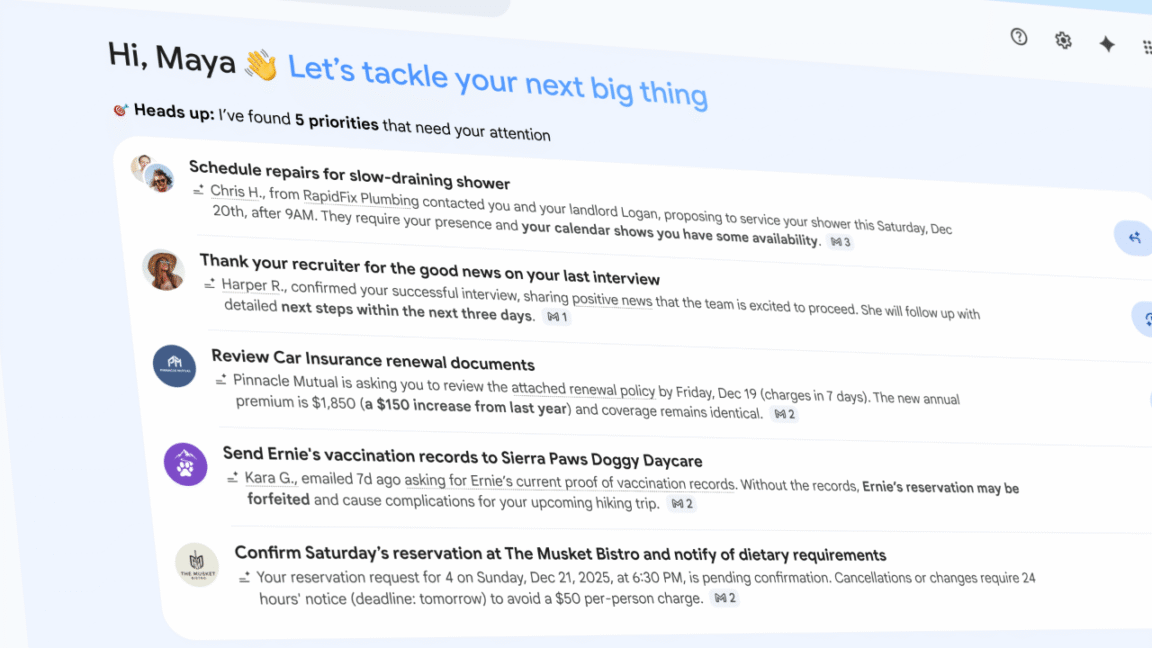
Lastly, Google is previewing a new version of its iconic inbox—no, not that Inbox. The AI Inbox will roll out to a group of “trusted testers” before making its way to more users. The AI Inbox looks at your unread mail and creates an interactive list with “Priorities” at the top. If Gemini thinks an email is important, it will become a line item in that section. Below that is “Catch me up,” which summarizes less important messages. Again, this is based on Gemini’s ability to delineate important from unimportant.

https://arstechnica.com/google/2026/01/google-announces-ai-overviews-in-gmail-search-experimental-ai-organized-inbox/


Data center e AI, in arrivo un superciclo di investimenti globali da 3 trilioni di dollari entro il 2030

L’AI alimenta la corsa ai data center ridisegnando infrastrutture, energia e mercati dei capitali, il Report JLL

Entro il 2030 i data center potrebbero quasi raddoppiare la loro potenza installata globale: da circa 103 GW oggi a 200 GW. È la fotografia scattata da JLL nel Global Data Center Outlook 2026, che parla apertamente di un “superciclo” di investimenti fino a 3 trilioni di dollari trainato soprattutto dall’intelligenza artificiale (AI): una corsa che non riguarda solo l’IT, ma sta già ridisegnando infrastrutture, energia e mercati dei capitali.

Il punto chiave è che l’AI non “aggiunge” semplicemente domanda: la trasforma. Secondo i ricercatori, i carichi di lavoro AI arriveranno a rappresentare circa metà dei workload dei data center entro fine decennio, rispetto al 25% raggiunto nel 2025.

Dietro questa crescita ci sono due fasi molto diverse. Per prima cosa c’è il “training”: il momento dell’addestramento dei grandi modelli, che richiede cluster concentrati, altissima potenza e infrastrutture specialistiche.
Poi c’è la fase detta della “inference”: far “girare” quei modelli per milioni di utenti e aziende richiede capacità più distribuita (per ridurre latenza e costi) e una presenza più capillare, anche vicino a utenti e imprese.

Il Report indica un punto di svolta nel 2027, quando l’inference è attesa superare il training come principale driver.

Quanto (e dove) si spenderà di più: i numeri del “superciclo” e il costo per MW

Il documento, di cui offre un’ampia sintesi Saf Malik su capacityglobal.com, mette insieme tre grandi “blocchi” di spesa, perché un data center non è solo un edificio. Abbiamo, ad esempio, la domanda di nuova capacità e real estate.

Tra il 2026 e il 2030 dovrebbero arrivare circa 100 GW di nuova capacità. Tradotto in valore immobiliare, si parla di circa 1,2 trilioni di dollari di creazione di valore sugli asset.

Poi c’è il finanziamento a debito, perché per costruire a questo ritmo servirà anche leva finanziaria: la ricerca stima circa 870 miliardi di dollari di nuovo debito. Quindi il “fit-out” tecnologico (la parte più costosa), una voce spesso sottovalutata, che sta dentro l’edificio: GPU, rete, storage, alimentazione e raffreddamento avanzato. Per questo settore si stima che i tenant spenderanno altri 1–2 trilioni di dollari solo per attrezzare gli spazi.

In pratica, lo studio ci dice chiaramente che l’edificio è solo l’inizio.

Si calcola che il costo medio globale di costruzione (shell & core) sia passato da 7,7 a 10,7 milioni di dollari per MW tra 2020 e 2025 (+7% CAGR) e che nel 2026 salga a circa11,3 milioni di dollari/MW.

Poi arriva l’AI: il fit-out per infrastrutture AI può arrivare fino a ~25 milioni di dollari/MW.

Chi guiderà la spesa: hyperscaler, cloud e “fabbriche di AI”

I ricercatori indicano gli hyperscaler come motore strutturale della crescita, con una strategia doppia: affittare capacità (colocation/wholesale) e costruire in proprio.

Nel quadro che emerge, i “soliti noti” sono quelli che già oggi sostengono l’infrastruttura cloud e AI: Amazon (AWS), Microsoft (Azure), Alphabet/Google, Meta (oltre a player come Oracle). Il livello di capex è tale che, in molte analisi, la spesa delle Big Tech sull’AI e sull’infrastruttura associata vale diversi trilioni di dollari cumulati entro fine decennio.

Accanto ai cloud provider, beneficia la filiera dei semiconduttori e dell’hardware: dalle GPU (con nomi come Nvidia) ai produttori e fornitori di memoria e componenti critici (ad esempio TSMC e Micron sono citati frequentemente nelle letture di mercato legate al boom dei data center).

I mercati più caldi: America leader, APAC cresce con la colocation, EMEA tra hub storici e ricerca di “sovranità”

Sul “dove” tutto questo accade e accadrà, la mappa è chiara: il Nord America restano la prima regione, circa 50% della capacità globale, e anche la crescita più rapida, con circa il 17% di CAGR (Compound Annual Growth Rate, cioè la percentuale media di crescita di un investimento, di ricavi o fatturati, in un determinato periodo, in questo caso anno dopo anno) dell’offerta fino al 2030. Gli Stati Uniti fanno quasi tutto: quasi il 90% della capacità dell’intera regione.

L’Asia-Pacifico registrerà una crescita da 32 GW a 57 GW entro il 2030 (circa 12% CAGR). Qui spinge soprattutto la colocation (+19%), mentre l’on-premise aziendale scende (stimato -6%) perché la migrazione al cloud continua.

Per l’Europa, il Medio Oriente e l’Africa, la crescita è attesa intorno al 10% CAGR, con +13 GW di nuova capacità. La spinta arriva anche da politiche pubbliche e dalla richiesta di “sovereign AI cloud” (cloud “sovrani” per esigenze di data residency e compliance, ma anche di cybersecurity). La crescita si concentra negli hub europei consolidati come Londra, Francoforte e Parigi, e in mercati del Medio Oriente che stanno accelerando sulla trasformazione digitale.

Domanda altissima, fondamentali solidi (e prezzi che salgono)

Nonostante l’accelerazione, lo studio non vede la fatidica “bolla” nei fondamentali immobiliari: parla di occupancy globale al 97% e di un pipeline di cantieri già molto “coperto”, con circa un 77% di pre-committed, di accordi preventivi già nel cassetto.

Riguardo ai canoni di affitto: JLL stima una crescita dei costi periodici per l’utilizzo di un bene (tasso di leasing) al 5% CAGR fino al 2030, con le Americhe in testa al 7% per via dei vincoli di offerta (terra, permessi, soprattutto potenza).

Il vero collo di bottiglia: l’energia (non i server)

Se c’è un limite che può rallentare tutto, è la disponibilità di energia elettrica, ormai risorsa da considerarsi “scarsa”. In molti mercati “prime” i tempi medi per una connessione alla rete superano quattro anni.

Da qui il cambio di paradigma: non basta trovare terreno e fibra, bisogna trovare (o creare) energia.

I ricercatori descrivono tre direzioni principali: “Bring your own power”, diversificare le strategie a seconda dei luoghi, moltiplicare i sistemi di storage, il ricorso al solare e le batterie.

Partiamo dalla prima, “Bring your own power”: situazioni come l’Irlanda (Dublino) e il Texas rappresentano un tipo di mercato in cui l’operatore deve arrivare con soluzioni energetiche “proprie” o al limite completamente dedicate.

Strategie diverse per regione: negli USA cresce il ruolo del gas naturale come “ponte” e, sempre più spesso, come generazione di energia elettrica on-site; in EMEA pesano di più mix rinnovabili + infrastrutture dedicate (private wire), che possono ridurre il costo dell’energia fino al 40% rispetto alla rete tradizionale.

Storage e solare + batterie: i sistemi di accumulo di energia tramite batterie (Battery Energy Storage System – BESS) aiutano nei casi di micro-interruzioni e possono velocizzare i tempi di interconnessione; mentre il solar-plus-storage è indicato come componente chiave delle prossime strategie energetiche entro il 2030.

L’AI sta trasformando i data center da “mattoni per il cloud” a infrastruttura energetico-industriale: si costruiscono più siti, più grandi, più densi, e soprattutto si riprogetta la filiera—dalla rete elettrica al debito—per sostenere una domanda che non è episodica (training), ma continua e diffusa (inference).

Leggi le altre notizie sull’home page di Key4biz

https://www.key4biz.it/data-center-e-ai-in-arrivo-un-superciclo-di-investimenti-globali-da-3-trilioni-di-dollari-entro-il-2030/560985/




Ford is getting ready to put AI assistants in its cars

The annual Consumer Electronics Show is currently raging in Las Vegas, and as has become traditional over the past decade, automakers and their suppliers now use the conference to announce their technology plans. Tonight it was Ford’s turn, and it is very on-trend for 2026. If you guessed that means AI is coming to the Ford in-car experience, congratulations, you guessed right.

Even though the company owes everything to mass-producing identical vehicles, it says that it wants AI to personalize your car to you. “Our vision for the customer is simple, but not elementary: a seamless layer of intelligence that travels with you between your phone and your vehicle,” said Doug Field, Ford’s chief EV, design, and digital officer.

“Not generic intelligence—many people can do that better than we can. What customers need is intelligence that understands where you are, what you’re doing, and what your vehicle is capable of, and then makes the next decision simpler,” Field wrote in a blog post Ford shared ahead of time with Ars.

As an example, Field suggests you could take a photo of something you want to load onto your truck, upload it to the AI, and find out whether it will fit in the bed.

At first, Ford’s AI assistant will just show up in the Ford and Lincoln smartphone apps. Expect that rollout to happen starting early this year. From 2027, the AI assistant will become a native experience as new or refreshed models are able to include it, possibly starting with the cheap electric truck that the automaker tells us is due next year, but also gas models like the Expedition and Navigator.

https://arstechnica.com/cars/2026/01/in-car-ai-assistant-coming-to-fords-and-lincolns-in-2027/


AI starts autonomously writing prescription refills in Utah

Caution

The first 250 renewals for each drug class will be reviewed by real doctors, but after that, the AI chatbot will be on its own. Adam Oskowitz, Doctronic co-founder and a professor at the University of California, San Francisco, told Politico that the AI chatbot is designed to err on the side of safety and escalate any case with uncertainty to a real doctor.

“Utah’s approach to regulatory mitigation strikes a vital balance between fostering innovation and ensuring consumer safety,” Margaret Woolley Busse, executive director of the Utah Department of Commerce, said in a statement.

For now, it’s unclear if the Food and Drug Administration will step in to regulate AI prescribing. On the one hand, prescription renewals are a matter of practicing medicine, which falls under state governance. However, Politico notes that the FDA has said that it has the authority to regulate medical devices used to diagnose, treat, or prevent disease.

In a statement, Robert Steinbrook, health research group director at watchdog Public Citizen, blasted Doctronic’s program and the lack of oversight. “AI should not be autonomously refilling prescriptions, nor identifying itself as an ‘AI doctor,’” Steinbrook said.

“Although the thoughtful application of AI can help to improve aspects of medical care, the Utah pilot program is a dangerous first step toward more autonomous medical practice,” he said. “The FDA and other federal regulatory agencies cannot look the other way when AI applications undermine the essential human clinician role in prescribing and renewing medications.”

https://arstechnica.com/health/2026/01/utah-allows-ai-to-autonomously-prescribe-medication-refills/


AI e droni per la Polizia USA, evitare squilibri tra ordine pubblico e diritti

L’AI nelle forze di Polizia USA: efficienza, controllo e rischio di deriva tecnologica

Negli Stati Uniti, l’intelligenza artificiale (AI) sta rapidamente trasformando il modo in cui viene gestito l’ordine pubblico. Dalla scelta dei quartieri da pattugliare alla redazione dei verbali, dall’analisi delle prove digitali fino all’uso di droni come “primi soccorritori” automatizzati, l’AI è ormai entrata nel cuore operativo delle forze di Polizia.
La promessa è chiara: più velocità, maggiore efficienza, meno carichi burocratici per agenti sempre più sotto organico. Ma dietro l’innovazione tecnologica si nasconde una questione cruciale per le democrazie liberali: chi controlla questi strumenti e quali garanzie esistono per i diritti dei cittadini?

Perché la Polizia punta tanto sull’AI

Il contesto spiega molto. Le forze dell’ordine americane (e forse anche di molti altri Paesi, tra cui l’Italia) affrontano da anni una cronica carenza di personale, mentre cresce la pressione politica e sociale per ridurre la criminalità violenta. Secondo un recente sondaggio riportato da Russell Contreras su Axios, tre agenti su quattro denunciano ritardi nei rinforzi durante le emergenze, mentre oltre la metà afferma di essere più esposta ad interventi e azioni ad alto rischio.

In questo scenario, l’intelligenza artificiale viene presentata come una soluzione quasi inevitabile. Software generativi permettono di trasformare automaticamente l’audio delle bodycam in rapporti di polizia, riducendo ore di lavoro amministrativo. Sistemi di analisi avanzata aiutano investigatori sommersi da enormi quantità di dati digitali — intercettazioni, filmati, messaggi — a individuare rapidamente elementi rilevanti, come confessioni o conversazioni chiave.

Il mercato dell’AI applicata alle forze dell’ordine è in forte espansione. Secondo la società di consulenza Consainsights, si stima che il mercato delle soluzioni di intelligenza artificiale per le forze dell’ordine crescerà da circa 3,5 miliardi di dollari nel 2024 a oltre 6,6 miliardi di dollari entro il 2033. Per molti dipartimenti locali, già alle prese con bilanci limitati, queste tecnologie rappresentano un moltiplicatore di capacità operative.

Efficienza sì, ma a quale prezzo?

Il problema non è l’uso dell’AI in sé, ma il modo in cui viene adottata. La diffusione di questi strumenti sta procedendo molto più rapidamente delle regole pubbliche che dovrebbero disciplinarli. Algoritmi che suggeriscono dove pattugliare o quali dati analizzare rischiano di incorporare pregiudizi storici già presenti nei database di polizia, rafforzando discriminazioni razziali e sociali.

Se un sistema impara dai dati del passato, dagli arresti alle segnalazioni, passando per i controlli e quei dati riflettono pratiche di polizia diciamo “aggressive”, l’AI può amplificare questi bias rendendoli meno visibili e più difficili da contestare. Il rischio è quello di una “oggettività algoritmica” solo apparente, che sposta decisioni sensibili in una zona grigia tra tecnologia e responsabilità umana.

Inoltre, resta aperta una domanda fondamentale: chi possiede e controlla i dati raccolti? Molte piattaforme sono sviluppate da aziende private che collaborano direttamente con le forze dell’ordine, spesso senza un quadro normativo chiaro su conservazione, accesso e riutilizzo delle informazioni.

Droni e nuovi occhi sul territorio, che ne sarà della nostra privacy?

Il cambiamento più visibile già oggi riguarda l’uso di droni dotati di intelligenza artificiale. Negli Stati Uniti oltre 1.500 dipartimenti di polizia utilizzano già questi sistemi per inseguimenti, ricerche di persone scomparse, gestione di scene del crimine e risposta a chiamate di emergenza. In alcuni casi i droni vengono inviati direttamente in risposta a una chiamata al 911, fornendo immagini in tempo reale e persino consegnando farmaci salvavita come il Narcan in caso di overdose da stupefacenti.

Dal punto di vista operativo, i vantaggi sono evidenti: i droni costano molto meno degli elicotteri, riducono l’esposizione fisica degli agenti e offrono una visione aerea immediata della situazione. Grazie all’AI, non si limitano a “guardare”: leggono targhe, analizzano movimenti, ricostruiscono incidenti, monitorano folle e, secondo i produttori, possono persino rilevare parametri biometrici a distanza.

È qui che emergono le preoccupazioni più gravi. La raccolta massiva di immagini e dati biometrici solleva interrogativi profondi sulla privacy, soprattutto quando avviene senza mandato giudiziario. Alcuni casi mostrano come i droni siano stati utilizzati per osservare proprietà private, cortili o interni delle abitazioni, con conseguenze dirette per i cittadini sotto forma di sanzioni o controlli amministrativi.

I limiti necessari in una democrazia

Le democrazie si fondano su un principio essenziale: il potere dello Stato deve essere limitato, controllabile e proporzionato. L’intelligenza artificiale, se applicata alla sicurezza pubblica senza adeguate garanzie, rischia di alterare questo equilibrio.

Servono regole chiare su quando e come l’AI può essere utilizzata, trasparenza sugli algoritmi impiegati, audit indipendenti per verificare discriminazioni e abusi, e soprattutto la certezza che la decisione finale resti in mano a esseri umani responsabili e identificabili. Come ricordano alcuni operatori del settore, l’AI dovrebbe aiutare a trovare le prove, non sostituirsi al giudizio umano in tribunale.

Il futuro dell’ordine pubblico negli Stati Uniti (e in prospettiva in tutta Europa, in Italia, ad esempio, si è avuto un primo utilizzo massiccio durante la gestione dell’emergenza sanitaria legata alla pandemia da Covid-19) sarà inevitabilmente più tecnologico. La vera sfida non è fermare l’innovazione, ma governarla. Perché senza solide regole democratiche, l’efficienza promessa dall’intelligenza artificiale rischia di trasformarsi in una sorveglianza pervasiva, difficile da contenere e contestare e ancora di più da controllare. La sicurezza pubblica in una democrazia è fondamentale e le forze di Polizia devono essere messe in condizione di fare al meglio il loro lavoro, ma allo stesso tempo si deve evitare di finire in uno scenario alla “Robocop”. Ad oggi mancano solo i robot umanoidi in divisa, ma a sentire gli annunci delle Big Tech sembra ci siamo quasi.

Leggi le altre notizie sull’home page di Key4biz

https://www.key4biz.it/ai-e-droni-per-la-polizia-usa-evitare-squilibri-tra-ordine-pubblico-e-diritti/560956/