Vision Pro M5 review: It’s time for Apple to make some tough choices
I still think there’s significant room to grow, but the content situation is better than ever. It’s not enough to keep you entertained for hours a day, but it’s enough to make putting on the headset for a bit once a week or so worth it. That wasn’t there a year ago.
The software support situation is in a similar state.
App support is mostly frozen in the year 2024
Many of us have a suite of go-to apps that are foundational to our individual approaches to daily productivity. For me, primarily a macOS user, they are:
Firefox
Spark
Todoist
Obsidian
Raycast
Slack
Visual Studio Code
Claude
1Password
As you can see, I don’t use most of Apple’s built-in apps—no Safari, no Mail, no Reminders, no Passwords, no Notes… no Spotlight, even. All that may be atypical, but it has never been a problem on macOS, nor has it been on iOS for a few years now.
Impressively, almost all of these are available on visionOS—but only because it can run iPad apps as flat, virtual windows. Firefox, Spark, Todoist, Obsidian, Slack, 1Password, and even Raycast are all available as supported iPad apps, but surprisingly, Claude isn’t, even though there is a Claude app for iPads. (ChatGPT’s iPad app works, though.) VS Code isn’t available, of course, but I wasn’t expecting it to be.
Not a single one of these applications has a true visionOS app. That’s too bad, because I can think of lots of neat things spatial computing versions could do. Imagine browsing your Obsidian graph in augmented reality! Alas, I can only dream.
You can tell the native apps from the iPad ones: The iPad ones have rectangular icons nested within circles, whereas the native apps fill the whole circle. Credit: Samuel Axon
If you’re not such a huge productivity software geek like me and you use Apple’s built-in apps, things look a little better, but surprisingly, there are still a few apps that you would imagine would have really cool spatial computing features—like Apple Maps—that don’t. Maps, too, is just an iPad app.
AI Emails Me Content Ideas Every Morning — Here’s How That System Works
If you create content regularly, you understand the pressure to always be “on”. To be a conveyor belt of ideas. To be writing, filming, editing, posting, and engaging. It’s a lot! And then start the cycle all over again with each new post.
Being a creator can sound like a dream job from the outside, but in reality, it can be exhausting.
So it’s really not surprising to me that 52% of creators admit to experiencing burnout — I’m definitely one of them. If you’re reading this, I’m guessing you get it too.
What weighed down my brain wasn’t even the ‘creation’ part. It was the pressure to remember every single good idea (and the constant fear of losing one) that gave me creative migraines.
I’m a freelancer mom. I don’t spend most of my day in front of my laptop. My best ideas come when my brain relaxes — after I drop my kid at school, while cooking dinner, or just as my head hits the pillow.
And those moments are not always convenient. I can’t just drop what I’m doing just to write.
But my content is how I build my network, stay visible, and find new client work, consistency isn’t optional for me. Losing ideas feels like losing opportunities.
One day, I started brain-dumping an idea into ChatGPT to help me refine it when I had a brainwave. I often used the AI tool as a sounding board for half-baked ideas like the one I was about to enter — my chats had to be a gold mine of unused content.
But how did I dig that gold up? I didn’t want to waste half an hour digging through ChatGPT history just to find and document my old ideas.
Instead of creating, I would be organizing. And that’s the worst kind of energy leak for a creative trying to stay consistent.
I told myself, “If only ChatGPT could regularly pull out my ideas and remind me of the things I said I’d write about… that would be amazing.”
So I made it do exactly that.
How I automated my idea chaos
Instead of scrambling for notes buried in Google Docs, Google Drive, screenshots, Slack, or my Facebook Messenger (yes, I send messages to myself), I now start the day with a clean menu of original ideas.
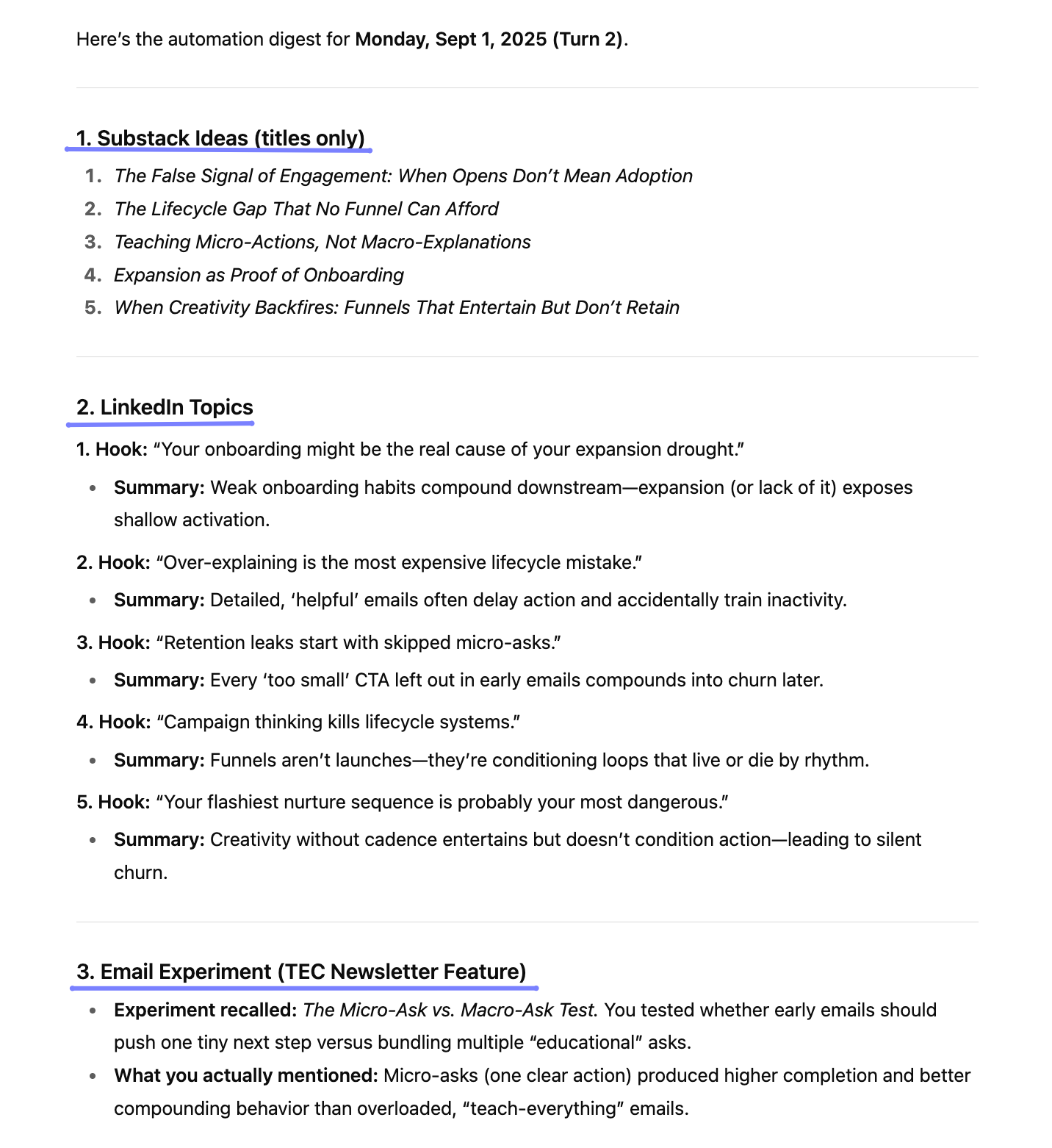
Every morning, I wake up to an email from ChatGPT with my best ideas in it, already categorized.
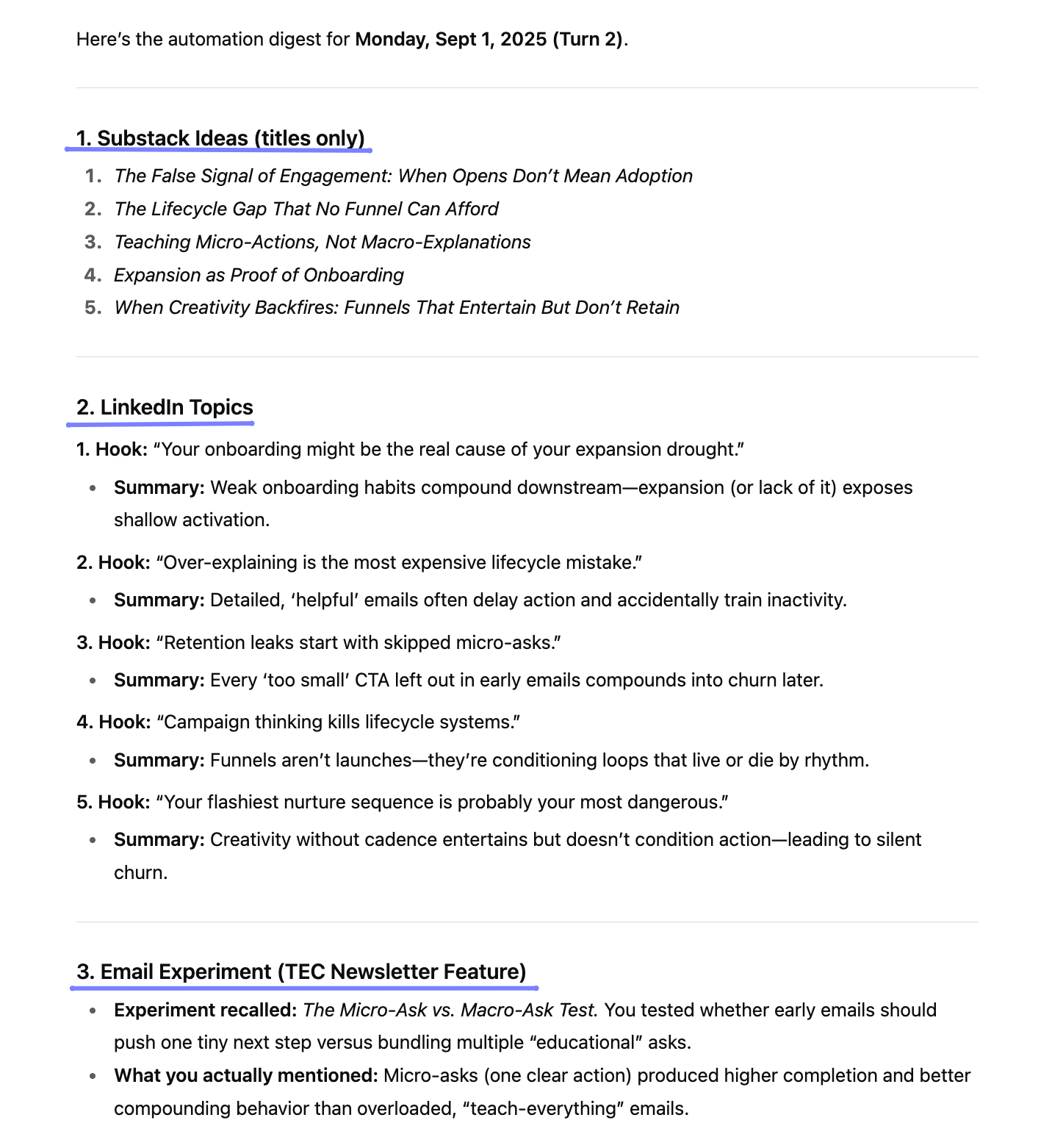
Each morning’s email breaks my chats into 3 neat categories:
Substack Ideas
LinkedIn Topics
Email Experiments
It’s a simple system, but has completely changed how I approach content. And it doesn’t involve any additional tools to work, just email and ChatGPT.
On busy days, those emails serve as my content calendar. On slower days, it’s a soft nudge that helps me ease into creating without overthinking.
This automation helped me:
Become a calm content creator. No more frantic note-hunting and, more importantly, no more grieving my lost ideas.
Launch two newsletters. One was even recognized as a Top Newsletter in Southeast Asia for B2B Marketers.
Keep my mornings slow and my day productive. I’m fully focused on my client work, my kid, and even the laundry.
Get my joy (and energy) back for content creation.
How to set this up (in just 10 minutes)
You don’t need technical skills to make this work. You only need:
To chat with ChatGPT regularly — about your work, ideas, projects, problems, and thoughts. The more you share, the sharper its suggestions get.
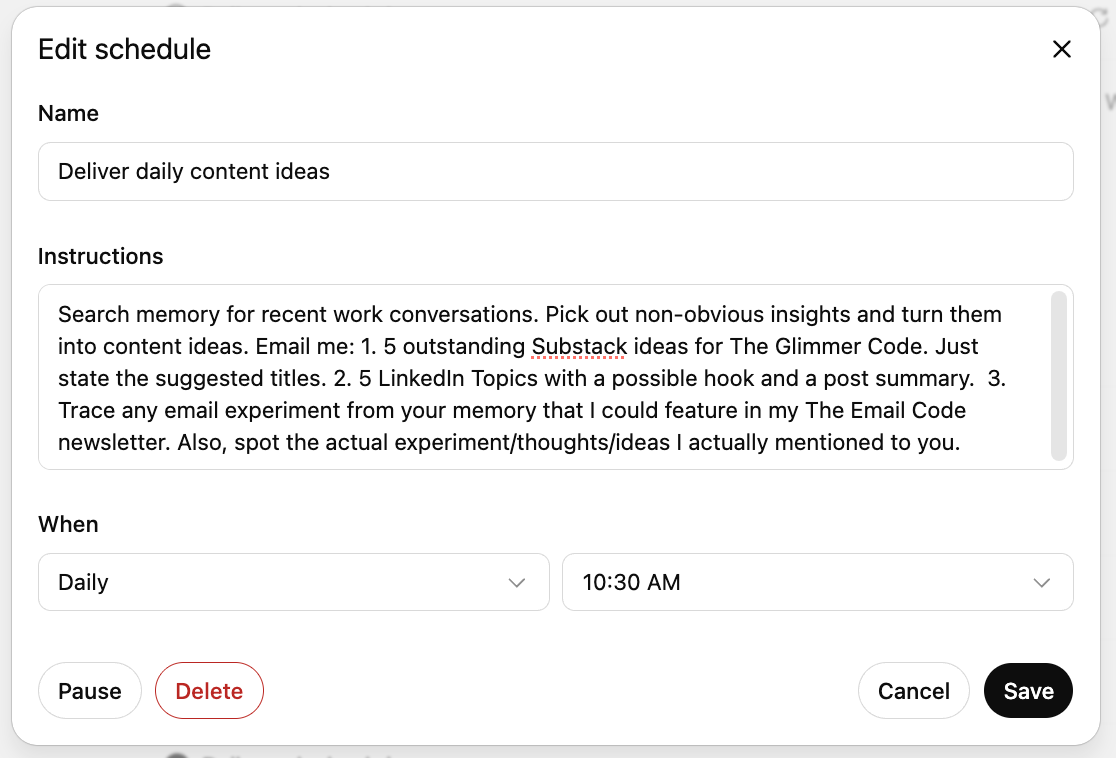
”Search memory for recent work conversations. Pick out non-obvious insights and turn them into content ideas. Email me:
1. 5 outstanding Substack ideas. Just state the suggested titles. 2. 5 LinkedIn Topics with a possible hook and a post summary. 3. Trace any email experiment from your memory. Also, spot the actual experiment/thoughts/ideas I actually mentioned to you.”
Here’s my actual prompt below:
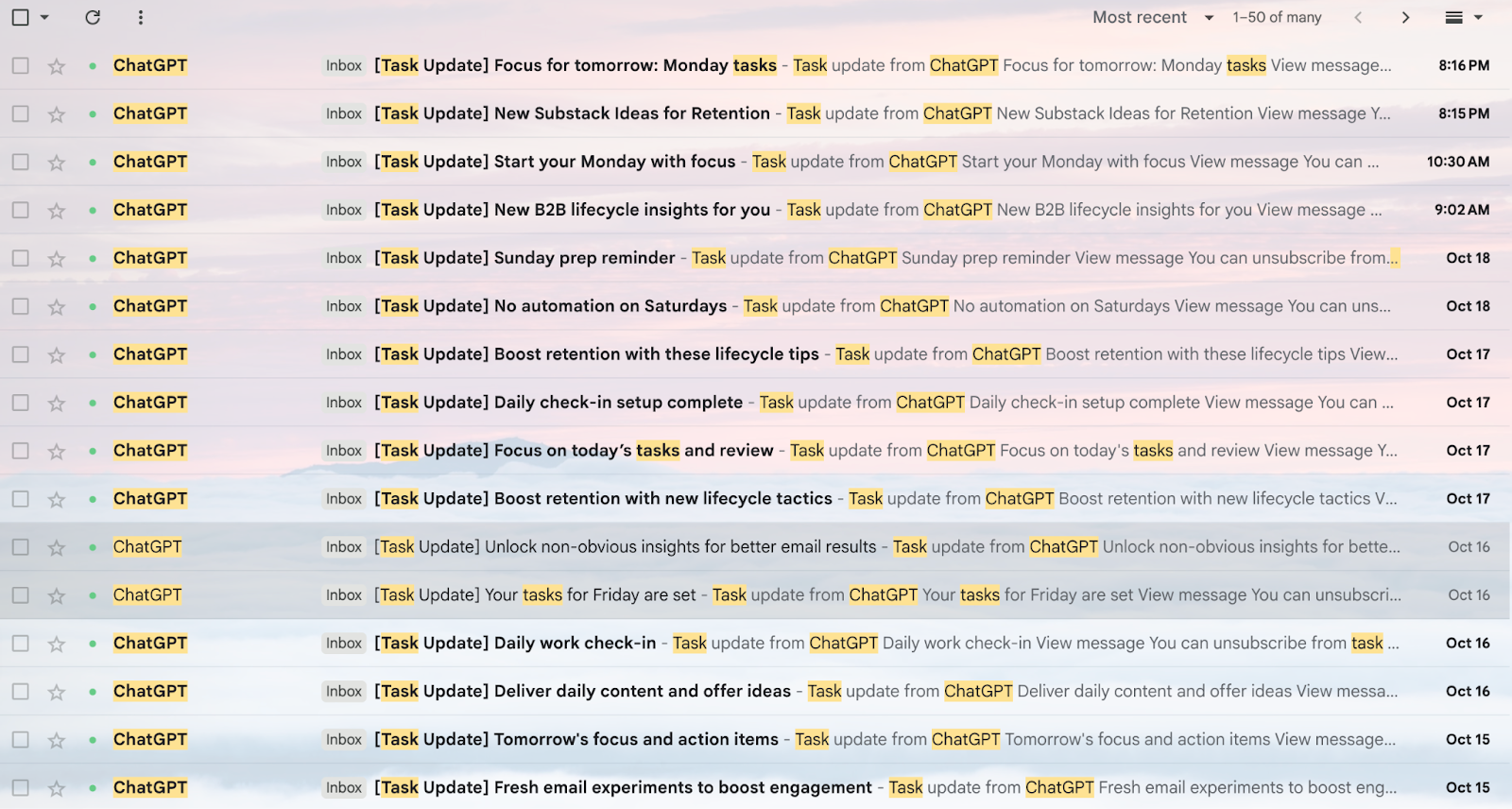
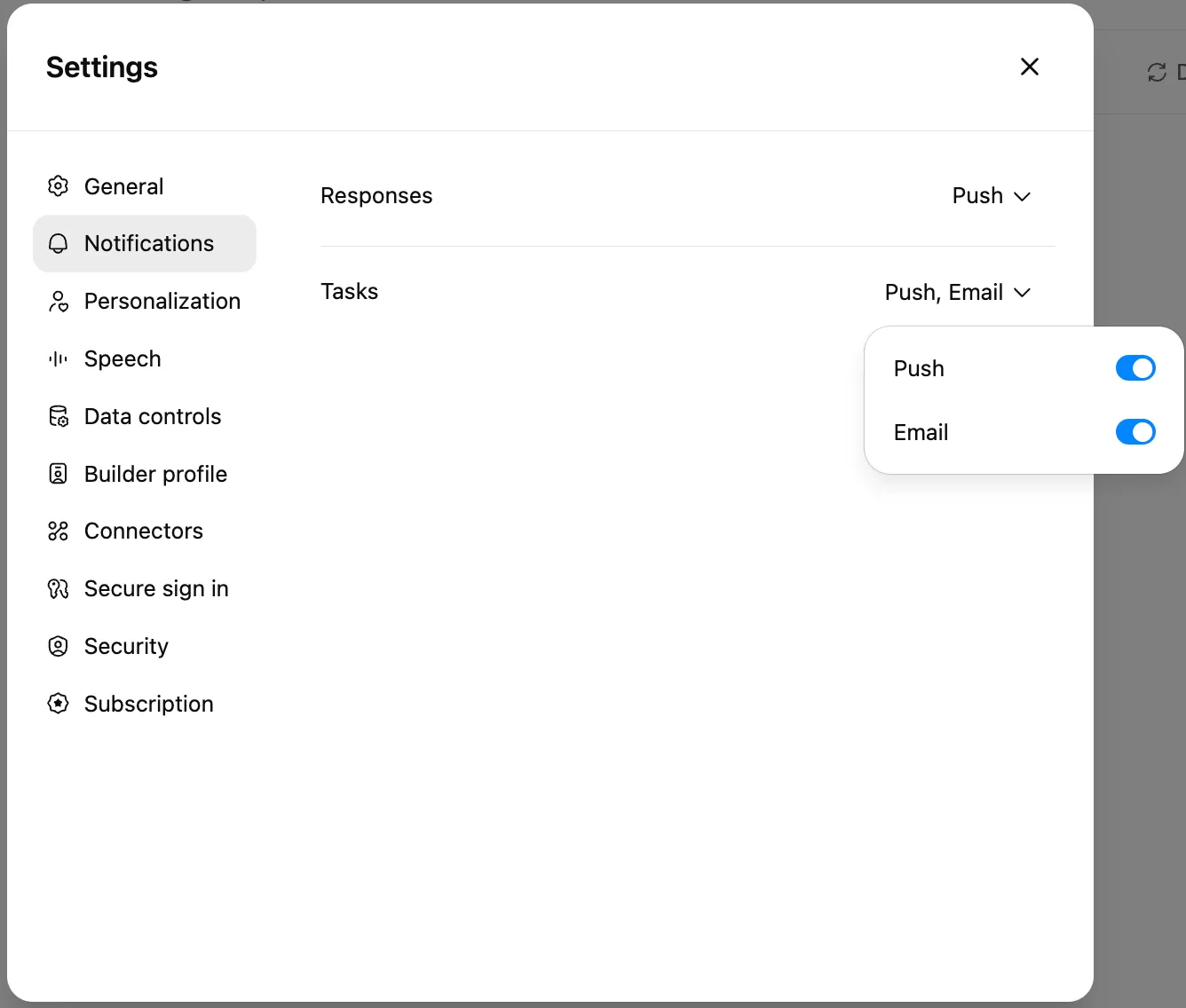
Make sure that you’ve switched your Task Notifications to Email too, so you get the reminders in your inbox. To check, click on your Profile pic > Settings > Notifications. Or just click here.
Done.
It feels a bit like I have a second brain — one that doesn’t get tired or forget good ideas when the afternoon slump hits.
What brainstorming looks like now
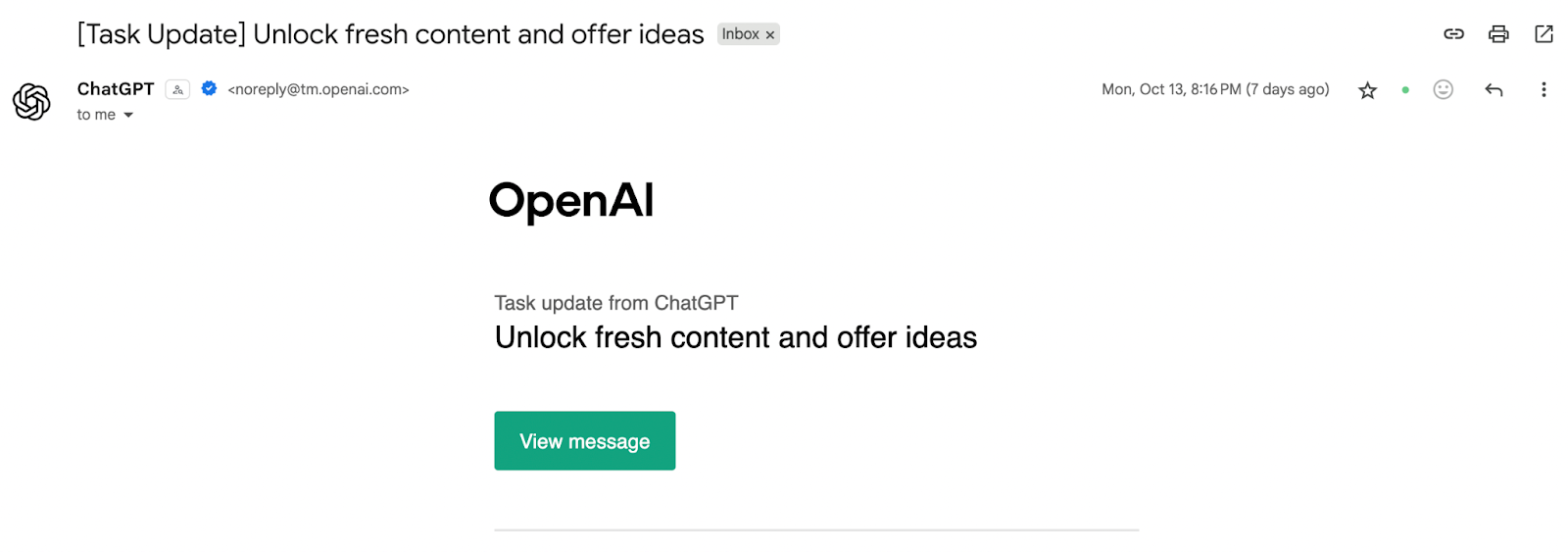
Every day at 10:30 a.m., an email lands in my inbox with the ideas I’d normally lose to scattered notes and chaotic systems.
Just opening this email sends me into creation mode. Seeing those half-formed ideas sitting there makes me want to start drafting the post — more often than not, if the idea is good enough, I feel the urge to finish it right then and there.
When I click the little green button, it brings me straight to ChatGPT, and I see something like this:
From there, I get to work. While this system is incredibly helpful (if I do say so myself), seasoned content creators will know that where this system ends is where the actual work of creation begins.
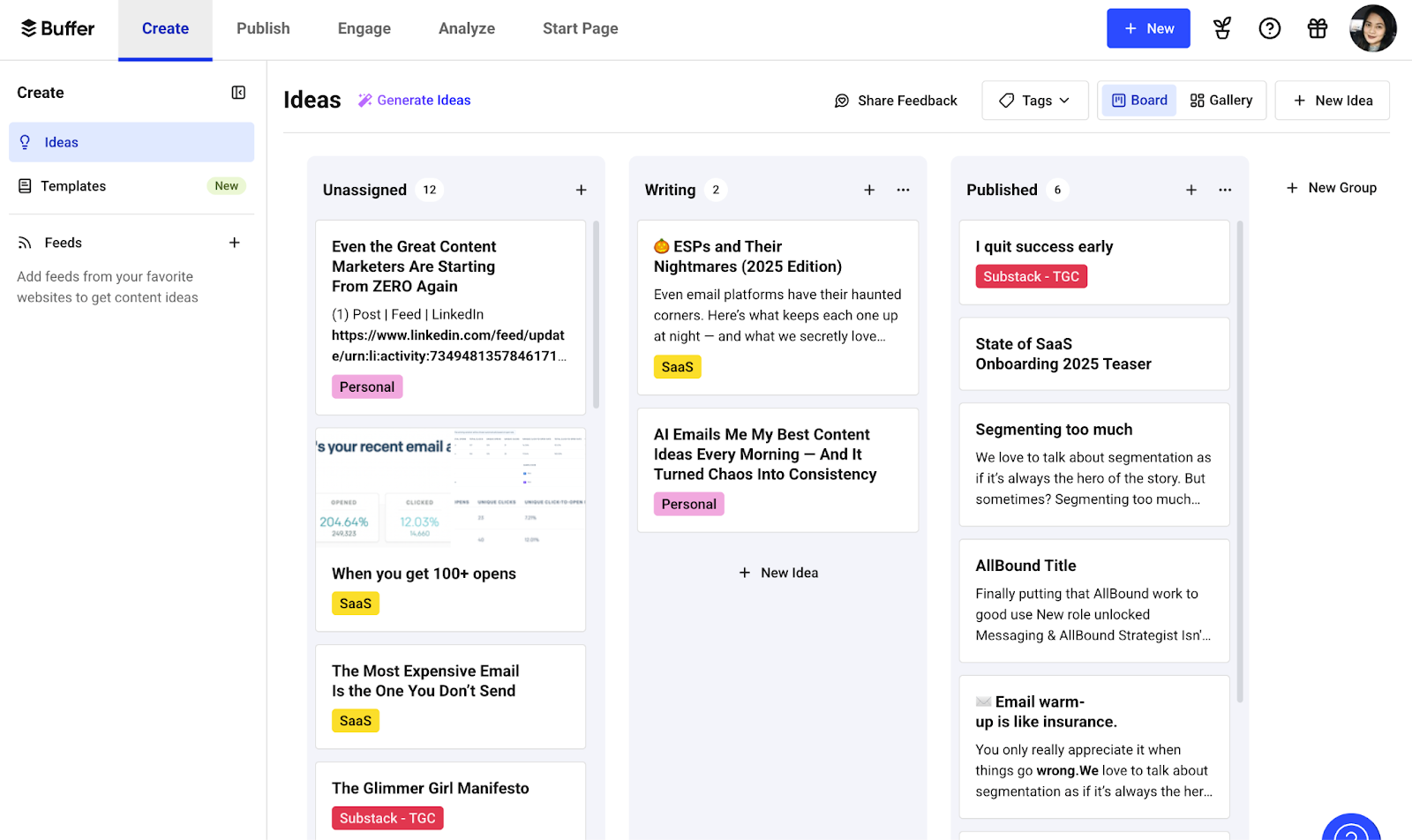
I pick out the best ideas from those emails, and I save them to Buffer. More often than not, I’ll start fleshing out some ideas with the Create Space or directly into the post composer.
One time, I came across a post by Alen Sultanic on “Energy Economy” while taking a break from client work. It sparked some ideas, so I dropped the screenshot into ChatGPT, added my own thoughts, and went back to my tasks.
The next day, I revisited it, and turned it into a long-form Substack entry. That piece became one of my best-performing issues — and sparked some of the most thoughtful discussions in the comments.
On days I just can’t get into a writing mood (yes, I still have those), I use the time for lighter creative work, more ideation and content organization. Some things I do:
Mark old ideas as done in ChatGPT (so the list won’t get too long)
Add new ones mid-conversation
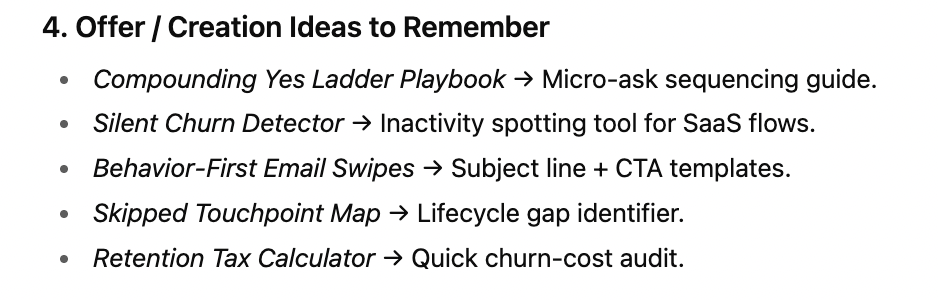
Even create new content buckets, like “Lead Magnet Ideas” or “Offer Pitches”
I’ve realized that the secret to consistent content creation for me is not forcing inspiration. It’s just making it easy to start creating.
As Elizabeth Gilbert wrote in Big Magic: “Ideas are driven by a single impulse: to be made manifest. And the only way an idea can be made manifest in our world is through collaboration with a human partner.”
If I ignore them, they’ll move on to someone else. That’s why I save mine. So when they visit, I don’t lose them forever.
Let AI do the chaotic work
Content creation isn’t just about creativity. It’s about capacity, too.
It’s dealing with and managing the mental tabs, the deadlines, the invisible pressure to be “on” all the time.
To protect our creative energy, we need systems that bring back order:
A way to capture our best ideas
A trigger to actually revisit them
And a space to save and shape them into published content
So let AI hoard these half-baked, scattered ideas so you can show up when it’s time to create.
Audiovisivo e copyright alla prova dell’AI, Viola (DG Connect Ue): ‘Più vantaggi che svantaggi’
“L’AI è al centro dell’attività della Commissione Europea. Si tratta di una tecnologia che permette grandi cose per il settore audiovisivo, dall’automazione degli effetti visivi all’incremento della produzione video delle telecamere, riducendo così i costi di produzione e persino ringiovanire artificialmente gli attori. A mio avviso, i vantaggi nell’uso dell’AI sono molto superiori agli svantaggi”. Così Roberto Viola, Direttore Generale della DG Connect della Commissione Europea, nel suo intervento da remoto alla XXXVIII edizione di Eurovisioni che si è tenuto all’Ambasciata di Francia il 21 novembre.
Legittime preoccupazioni
Detto questo, è evidente che vi siano delle legittime preoccupazioni nell’uso dell’AI generativa su questioni importanti e centrali per il settore, in primis il copyright e autenticità dei contenuti. L’uso dei contenuti esistenti per l’addestramento dei modelli di AI è certamente utile, “ma i creatori devono essere rispettosi”, ha detto Viola. Bene quindi l’uso dell’AI nella fase creativa, ma “i deepfake vanno combattuti”.
Per quanto riguarda il copyright, l’AI Act prevede due disposizioni in ottica di trasparenza nell’uso di contenuti protetti nella fase di addestramento dei modelli di AI.
<!-- ARUBA - 300x250 -->
I provider di LLM devono compilare una sintesi approfondita dei contenuti utilizzati per l’addestramento dei modelli, precisa Viola. “Si tratta di un obbligo fissato dalla Commissione Ue”.
AI e deepfake, trasparenza obbligatoria
Sono 27 i player che hanno sottoscritto il codice volontario di condotta della Ue. “Il capitolo sul copyright è un compromesso ragionevole fra le preoccupazioni dei detentori dei diritti e quelle dei provider sui termini legali dell’uso di contenuti coperti da copyright”, ha aggiunto.
E’ stato realizzato un template dall’ufficio Ue per l’AI che consente ai detentori di diritti di verificare in che modo i modelli die AI hanno utilizzato i contenuti, verificando il rispetto di scelte di opt-out e i vari accordi previsti.
Previsto inoltre nell’AI Act un obbligo di trasparenza per distinguere contenuti autentici e deepfake, per distinguere contenuti AI e contenuti umani, per evitare inganno e informazioni false.
“E’ obbligatorio segnalare se un contenuto è stato generato con strumenti di AI”, sottolinea Viola.
Resta il fatto che la creazione di contenuti con l’AI è lecita in ambito cinematografico, fatto salvo “il giusto bilanciamento in ambito della creazione artistica”. Ma serve una regolazione europea su questo, perché diverse norme a livello nazionale sarebbero incongruenti fra loro.
Viola (DG Connect UE): ‘Servizio pubblico forte va difeso’
“Il servizio pubblico resta uno dei mezzi più importanti per difendere l’ecosistema informativo europeo e si tratta di una caratteristica peculiare dell’Europa. Credo che sia nell’interesse generale che le fonti del servizio pubblico siano affidabili, con finanziamenti pubblici in nome della trasparenza, obiettività e qualità dell’informazione”, ha aggiunto Viola. “Un servizio pubblico forte va difeso e ora è diventato legge europea, con l’articolo 5 del Media Freedom Act è una disposizione innovativa che introduce per la prima volta a livello europeo una serie di norme volte a sostenere il funzionamento indipendente dei media del servizio pubblico, che adesso in Europa è soggetto allo stesso tipo di normativa”, aggiunge.
Le norme riguardano gli aspetti della stabilità del finanziamento e di come garantire l’indipendenza del servizio pubblico a partire dai criteri di nomina e della stabilità dei vertici.
Il servizio pubblico deve inoltre essere al passo con i tempi. L’AI cambia completamente il modo in cui le persone si informano, considerato che più del 40% dei cittadini si informa sui social e in Italia il 70% lo fa online. Il servizio pubblico deve essere presente online e i diversi servizi pubblici europei devono collaborare fra loro. “I contenuti possono essere tradotti in real time in diverse lingue”, dice Viola.
Viola (DG Connect): ‘Misurazione dell’audience con le piattaforme deve essere comparabile’
Per quanto riguarda un altro tema centrale, vale a dire la misurazione dell’audience con le grandi piattaforme, Viola ammette che si tratta di una questione complessa. “L’EMFA promuove standard, l’articolo 24 del Media Freedom Act prevede che per la misurazione fra broadcaster e piattaforme ci vuole comparabilità e trasparenza. Sistemi di auto misurazione, introdotti dalle piattaforme, non sono ammessi. I gatekeepers devono fornire dati trasparenti e serve una verifica indipendente del reach e dell’engagement”.
Infine, per quanto riguarda la creatività nel settore Media, la Ue ha stanziato più di 3 miliardi di euro nel programma Agorà 2028-2034. “Visibilità e prominence dei contenuti europei sono centrali, il programma Agorà è una direttiva SMA modernizzata in termini di diversità culturale europea”, chiude Viola.
Digitale Ue al bivio, le richieste della industry Tlc (Report ConnectEurope)
L’economia digitale europea si trova ad un bivio e la capacità di innovare e incrementare la nostra produttività è in gioco di fronte allo strapotere di Usa e Cina. La nostra regolazione deve tenere conto della crescente domanda di connettività ultrabroadband per rispondere alle richieste di cittadini e aziende.
Per ristabilire la competitività della Ue servono alcuni interventi decisivi sul fronte regolatorio nel settore Tlc. E’ quanto emerge dal report 2025 “A semplification agenda for European Telecoms” realizzato da Arthur D. Little per conto di ConnectEurope.
Gli obiettivi del Digital Decade
Gli obiettivi del Digital Decade della Commissione Ue, rilanciati dal Rapprot Lett e dal Rapporto Draghi e dal più recente “Competitiveness Compass” di Bruxelles, sono basati su quattro pilastri, si legge nell’exectuive summary del Rapporto.
<!-- ARUBA - 300x250 -->
Digital skills
sviluppo di infrastrutture digitali sicure
digitalizzare il business
Trasformazione dei servizi pubblici
Tuttavia, gli operatori di telecomunicazioni europei stanno registrando la crescita più bassa tra gli operatori digitali, nonostante investimenti (CAPEX) e valore attribuiti al settore relativamente più elevati. Rispetto ai competitor globali, in particolare in Nord America e Asia, gli operatori di telecomunicazioni europei hanno registrato performance inferiori rispetto ai principali indicatori di performance. Ad esempio, la crescita del fatturato degli operatori di telecomunicazioni europei è rimasta invariata dal 2014 al 2023, mentre altri mercati hanno registrato una crescita del fatturato superiore al 3% annuo.
Inoltre, la capitalizzazione di mercato degli operatori di telecomunicazioni non europei è cresciuta dell’1-2% annuo, mentre la capitalizzazione di mercato degli operatori di telecomunicazioni europei è diminuita di quasi il 2% annuo.
Digitale, le richieste delle telco Ue
1. Semplificare e allineare le normative per riflettere le moderne esigenze dei consumatori
• Snellire gli obblighi che si sovrappongono fra loro, basandosi su norme orizzontali a tutela dei consumatori (ad esempio, GDPR, CRD) anziché su norme settoriali duplicate.
• Concentrare le norme contrattuali su informazioni che consentano confronti significativi, non su dettagli tecnici.
• Eliminare le norme settoriali sulla protezione dei dati abrogando la Direttiva ePrivacy e consolidando il principio di riservatezza delle comunicazioni, come unico elemento settoriale rimanente, nell’ambito della legislazione di armonizzazione (ad esempio, GDPR o DNA).
• Escludere le offerte B2B dagli obblighi di tutela dei consumatori previsti dall’EECC, riconoscendone la natura e le esigenze specifiche.
2. Garantire condizioni di concorrenza pari tra servizi equivalenti
• Estendere gli obblighi chiave, come il diritto di cambio di fornitore e la riservatezza delle comunicazioni, ad altri fornitori digitali che offrono servizi funzionalmente equivalenti (ad esempio Whatsapp ndr).
• Chiarire la neutralità della rete per favorire l’innovazione:
• Consentire un quadro normativo più flessibile, in linea con le autorità di regolamentazione pro-innovazione (ad esempio, Ofcom).
• Creare una whitelist di servizi specializzati autorizzati per offrire certezza del diritto.
• Riflettere la più ampia catena del valore digitale, garantendo che gli obblighi si applichino equamente a tutti gli attori chiave, come i sistemi operativi, per un’esperienza di consumo uniforme lungo tutta la catena del valore digitale e i vari attori.
3. Armonizzare l’implementazione e ridurre la frammentazione nell’Ue
• Utilizzare un regolamento anziché una direttiva per garantire un’applicazione coerente delle norme di tutela dei consumatori in tutti gli Stati membri ed evitare il gold-plating nazionale.
• Rafforzare il coordinamento a livello UE e il supporto istituzionale per allineare le pratiche di applicazione e ridurre le divergenze e gli obblighi aggiuntivi da parte degli Stati membri.
• Accelerare e semplificare l’applicazione di norme armonizzate per supportare esperienze coerenti per i consumatori e servizi transfrontalieri efficienti.
Anthropic introduces cheaper, more powerful, more efficient Opus 4.5 model
Anthropic today released Opus 4.5, its flagship frontier model, and it brings improvements in coding performance, as well as some user experience improvements that make it more generally competitive with OpenAI’s latest frontier models.
Perhaps the most prominent change for most users is that in the consumer app experiences (web, mobile, and desktop), Claude will be less prone to abruptly hard-stopping conversations because they have run too long. The improvement to memory within a single conversation applies not just to Opus 4.5, but to any current Claude models in the apps.
Users who experienced abrupt endings (despite having room left in their session and weekly usage budgets) were hitting a hard context window (200,000 tokens). Whereas some large language model implementations simply start trimming earlier messages from the context when a conversation runs past the maximum in the window, Claude simply ended the conversation rather than allow the user to experience an increasingly incoherent conversation where the model would start forgetting things based on how old they are.
Now, Claude will instead go through a behind-the-scenes process of summarizing the key points from the earlier parts of the conversation, attempting to discard what it deems extraneous while keeping what’s important.
Developers who call Anthropic’s API can leverage the same principles through context management and context compaction.
Opus 4.5 performance
Opus 4.5 is the first model to surpass an accuracy score of 80 percent—specifically, 80.9 percent in the SWE-Bench Verified benchmark, narrowly beating OpenAI’s recently released GPT-5.1-Codex-Max (77.9 percent) and Google’s Gemini 3 Pro (76.2 percent). The model performs particularly well in agentic coding and agentic tool use benchmarks, but still lags behind GPT-5.1 in visual reasoning (MMMU).
UK government will buy tech to boost AI sector in $130M growth push
“Our particular strengths as a country lie in areas like life sciences, financial services, the defense sector, and the creative sector. And where we will really lead the world is where we can use the power of AI in those sectors,” Kendall told the Financial Times.
The plans came as part of a wider AI package designed to upgrade Britain’s tech infrastructure and convince entrepreneurs and investors that Labour is backing the sector ahead of next week’s Budget, which is expected to raise taxes on the wealthy.
The UK has sought to attract investment from US AI companies such as OpenAI and Anthropic.
The government has signed several “strategic partnerships” with American groups in a bid to attract foreign investment in UK AI infrastructure and talent, in exchange for adopting their technology in the public sector.
Sue Daley, of lobby group TechUK, said the plan showed “real ambition” but warned: “Advanced market commitments of this kind must be designed carefully to avoid unintentionally distorting competition.”
The government also announced that James Wise, a venture capitalist at Balderton, would chair the government’s 500 million pound sovereign AI unit, which has been set up to back AI startups alongside the British Business Bank.
“Go generate a bridge and jump off it”: How video pros are navigating AI
Recently, top creators have started using more rough-looking thumbnails for their videos. AI has made polished thumbnails too easy to create, so top creators are using what Hwang would call “poorly made thumbnails” to help videos stand out.
Hwang told me something surprising: even as AI makes it easier for creators to make thumbnails themselves, business has never been better for thumbnail artists, even at the lower end. He said that demand has soared because “AI as a whole has lowered the barriers for content creation, and now there’s more creators flooding in.”
Still, Hwang doesn’t expect the good times to last forever. “I don’t see AI completely taking over for the next three-ish years. That’s my estimated timeline.”
Everyone I talked to had different answers to when—if ever—AI would meaningfully disrupt their part of the industry.
Some, like Hwang, were pessimistic. Actor Erik Passoja told me he thought the big movie studios—like Warner Bros. or Paramount—would be gone in three to five years.
But others were more optimistic. Tess Dinerstein, the vertical drama actor, said, “I don’t think that verticals are ever going to go fully AI.” Even if it becomes technologically feasible, she argued, “that just doesn’t seem to be what the people want.”
Gille Klabin, the independent filmmaker, thought there would always be a place for high-quality human films. If someone’s work is “fundamentally derivative,” then they are at risk. But he thinks the best human-created work will still stand out. “I don’t know how AI could possibly replace the borderline divine element of consciousness,” he said.
The people who were most bullish on AI were, if anything, the least optimistic about their own career prospects. “I think at a certain point it won’t matter,” Kavan Cardoza told me. “It’ll be that anyone on the planet can just type in some sentences” to generate full, high-quality videos.
This might explain why Accetturo has become something of an AI evangelist; his newsletter tries to teach other filmmakers how to adapt to the coming AI revolution.
AI “is a tsunami that is gonna wipe out everyone” he told me. “So I’m handing out surfboards—teaching people how to surf. Do with it what you will.”
Science-centric streaming service Curiosity Stream is an AI-licensing firm now
We all know streaming services’ usual tricks for making more money: get more subscribers, charge those subscribers more money, and sell ads. But science streaming service Curiosity Stream is taking a new route that could reshape how streaming companies, especially niche options, try to survive.
Discovery Channel founder John Hendricks launched Curiosity Stream in 2015. The streaming service costs $40 per year, and it doesn’t have commercials.
The streaming business has grown to also include the Curiosity Channel TV channel. CuriosityStream Inc. also makes money through original programming and its Curiosity University educational programming. The firm turned its first positive net income in its fiscal Q1 2025, after about a decade of business.
With its focus on science, history, research, and education, Curiosity Stream will always be a smaller player compared to other streaming services. As of March 2023, Curiosity Stream had 23 million subscribers, a paltry user base compared to Netflix’s 301.6 million (as of January 2025).
Still, in an extremely competitive market, Curiosity Stream’s revenue increased 41 percent year over year in its Q3 2025 earnings announced this month. This was largely due to the licensing of Curiosity Stream’s original programming to train large language models (LLMs).
“Looking at our year-to-date numbers, licensing generated $23.4 million through September, which … is already over half of what our subscription business generated for all of 2024,” Phillip Hayden, Curiosity Stream’s CFO, said during a call with investors this month.
Thus far, Curiosity Stream has completed 18 AI-related fulfillments “across video, audio, and code assets” with nine partners, an October announcement said.
The company expects to make more revenue from IP licensing deals with AI companies than it does from subscriptions by 2027, “possibly earlier,” CEO Clint Stinchcomb said during the earnings call.
Google tells employees it must double capacity every 6 months to meet AI demand
While AI bubble talk fills the air these days, with fears of overinvestment that could pop at any time, something of a contradiction is brewing on the ground: Companies like Google and OpenAI can barely build infrastructure fast enough to fill their AI needs.
During an all-hands meeting earlier this month, Google’s AI infrastructure head Amin Vahdat told employees that the company must double its serving capacity every six months to meet demand for artificial intelligence services, reports CNBC. Vahdat, a vice president at Google Cloud, presented slides showing the company needs to scale “the next 1000x in 4-5 years.”
While a thousandfold increase in compute capacity sounds ambitious by itself, Vahdat noted some key constraints: Google needs to be able to deliver this increase in capability, compute, and storage networking “for essentially the same cost and increasingly, the same power, the same energy level,” he told employees during the meeting. “It won’t be easy but through collaboration and co-design, we’re going to get there.”
It’s unclear how much of this “demand” Google mentioned represents organic user interest in AI capabilities versus the company integrating AI features into existing services like Search, Gmail, and Workspace. But whether users are using the features voluntarily or not, Google isn’t the only tech company struggling to keep up with a growing user base of customers using AI services.
Major tech companies are in a race to build out data centers. Google competitor OpenAI is planning to build six massive data centers across the US through its Stargate partnership project with SoftBank and Oracle, committing over $400 billion in the next three years to reach nearly 7 gigawatts of capacity. The company faces similar constraints serving its 800 million weekly ChatGPT users, with even paid subscribers regularly hitting usage limits for features like video synthesis and simulated reasoning models.
“The competition in AI infrastructure is the most critical and also the most expensive part of the AI race,” Vahdat said at the meeting, according to CNBC’s viewing of the presentation. The infrastructure executive explained that Google’s challenge goes beyond simply outspending competitors. “We’re going to spend a lot,” he said, but noted the real objective is building infrastructure that is “more reliable, more performant and more scalable than what’s available anywhere else.”
AI trained on bacterial genomes produces never-before-seen proteins
The researchers argue that this setup lets Evo “link nucleotide-level patterns to kilobase-scale genomic context.” In other words, if you prompt it with a large chunk of genomic DNA, Evo can interpret that as an LLM would interpret a query and produce an output that, in a genomic sense, is appropriate for that interpretation.
The researchers reasoned that, given the training on bacterial genomes, they could use a known gene as a prompt, and Evo should produce an output that includes regions that encode proteins with related functions. The key question is whether it would simply output the sequences for proteins we know about already, or whether it would come up with output that’s less predictable.
Novel proteins
To start testing the system, the researchers prompted it with fragments of the genes for known proteins and determined whether Evo could complete them. In one example, if given 30 percent of the sequence of a gene for a known protein, Evo was able to output 85 percent of the rest. When prompted with 80 percent of the sequence, it could return all of the missing sequence. When a single gene was deleted from a functional cluster, Evo could also correctly identify and restore the missing gene.
The large amount of training data also ensured that Evo correctly identified the most important regions of the protein. If it made changes to the sequence, they typically resided in the areas of the protein where variability is tolerated. In other words, its training had enabled the system to incorporate the rules of evolutionary limits on changes in known genes.
So, the researchers decided to test what happened when Evo was asked to output something new. To do so, they used bacterial toxins, which are typically encoded along with an anti-toxin that keeps the cell from killing itself whenever it activates the genes. There are a lot of examples of these out there, and they tend to evolve rapidly as part of an arms race between bacteria and their competitors. So, the team developed a toxin that was only mildly related to known ones, and had no known antitoxin, and fed its sequence to Evo as a prompt. And this time, they filtered out any responses that looked similar to known antitoxin genes.