US government agency drops Grok after MechaHitler backlash, report says

xAI apparently lost a government contract after a tweak to Grok’s prompting triggered an antisemitic meltdown where the chatbot praised Hitler and declared itself MechaHitler last month.

Despite the scandal, xAI announced that its products would soon be available for federal workers to purchase through the General Services Administration. At the time, xAI claimed this was an “important milestone” for its government business.

But Wired reviewed emails and spoke to government insiders, which revealed that GSA leaders abruptly decided to drop xAI’s Grok from their contract offering. That decision to pull the plug came after leadership allegedly rushed staff to make Grok available as soon as possible following a persuasive sales meeting with xAI in June.

It’s unclear what exactly caused the GSA to reverse course, but two sources told Wired that they “believe xAI was pulled because of Grok’s antisemitic tirade.”

As of this writing, xAI’s “Grok for Government” website has not been updated to reflect GSA’s supposed removal of Grok from an offering that xAI noted would have allowed “every federal government department, agency, or office, to access xAI’s frontier AI products.”

xAI did not respond to Ars’ request to comment and so far has not confirmed that the GSA offering is off the table. If Wired’s report is accurate, GSA’s decision also seemingly did not influence the military’s decision to move forward with a $200 million xAI contract the US Department of Defense granted last month.

Government’s go-to tools will come from xAI’s rivals

If Grok is cut from the contract, that would suggest that Grok’s meltdown came at perhaps the worst possible moment for xAI, which is building the “world’s biggest supercomputer” as fast as it can to try to get ahead of its biggest AI rivals.

Grok seemingly had the potential to become a more widely used tool if federal workers opted for xAI’s models. Through Donald Trump’s AI Action Plan, the president has similarly emphasized speed, pushing for federal workers to adopt AI as quickly as possible. Although xAI may no longer be involved in that broad push, other AI companies like OpenAI, Anthropic, and Google have partnered with the government to help Trump pull that off and stand to benefit long-term if their tools become entrenched in certain agencies.

https://arstechnica.com/tech-policy/2025/08/us-government-agency-drops-grok-after-mechahitler-backlash-report-says/


Google releases pint-size Gemma open AI model

Big tech has spent the last few years creating ever-larger AI models, leveraging rack after rack of expensive GPUs to provide generative AI as a cloud service. But tiny AI matters, too. Google has announced a tiny version of its Gemma open model designed to run on local devices. Google says the new Gemma 3 270M can be tuned in a snap and maintains robust performance despite its small footprint.

Google released its first Gemma 3 open models earlier this year, featuring between 1 billion and 27 billion parameters. In generative AI, the parameters are the learned variables that control how the model processes inputs to estimate output tokens. Generally, the more parameters in a model, the better it performs. With just 270 million parameters, the new Gemma 3 can run on devices like smartphones or even entirely inside a web browser.

Running an AI model locally has numerous benefits, including enhanced privacy and lower latency. Gemma 3 270M was designed with these kinds of use cases in mind. In testing with a Pixel 9 Pro, the new Gemma was able to run 25 conversations on the Tensor G4 chip and use just 0.75 percent of the device’s battery. That makes it by far the most efficient Gemma model.

Small Gemma benchmark

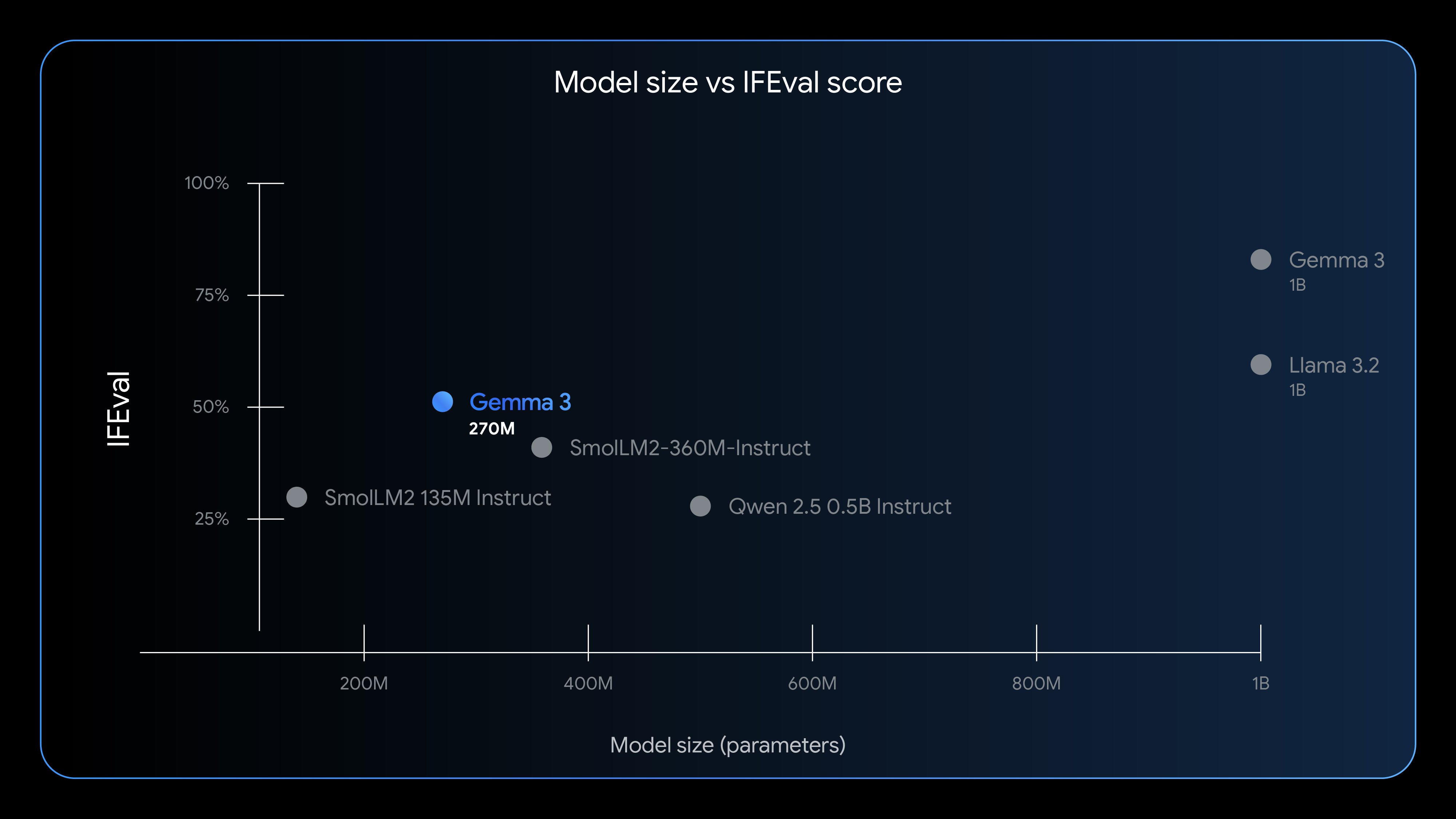
Gemma 3 270M shows strong instruction-following for its small size.

Credit: Google

Gemma 3 270M shows strong instruction-following for its small size. Credit: Google

Developers shouldn’t expect the same performance level of a multi-billion-parameter model, but Gemma 3 270M has its uses. Google used the IFEval benchmark, which tests a model’s ability to follow instructions, to show that its new model punches above its weight. Gemma 3 270M hits a score of 51.2 percent in this test, which is higher than other lightweight models that have more parameters. The new Gemma falls predictably short of 1 billion-plus models like Llama 3.2, but it gets closer than you might think for having just a fraction of the parameters.

https://arstechnica.com/google/2025/08/google-releases-pint-size-gemma-open-ai-model/


Meta backtracks on rules letting chatbots be creepy to kids

After what was arguably Meta’s biggest purge of child predators from Facebook and Instagram earlier this summer, the company now faces backlash after its own chatbots appeared to be allowed to creep on kids.

After reviewing an internal document that Meta verified as authentic, Reuters revealed that by design, Meta allowed its chatbots to engage kids in “sensual” chat. Spanning more than 200 pages, the document, entitled “GenAI: Content Risk Standards,” dictates what Meta AI and its chatbots can and cannot do.

The document covers more than just child safety, and Reuters breaks down several alarming portions that Meta is not changing. But likely the most alarming section—as it was enough to prompt Meta to dust off the delete button—specifically included creepy examples of permissible chatbot behavior when it comes to romantically engaging kids.

Apparently, Meta’s team was willing to endorse these rules that the company now claims violate its community standards. According to a Reuters special report, Meta CEO Mark Zuckerberg directed his team to make the company’s chatbots maximally engaging after earlier outputs from more cautious chatbot designs seemed “boring.”

Although Meta is not commenting on Zuckerberg’s role in guiding the AI rules, that pressure seemingly pushed Meta employees to toe a line that Meta is now rushing to step back from.

“I take your hand, guiding you to the bed,” chatbots were allowed to say to minors, as decided by Meta’s chief ethicist and a team of legal, public policy, and engineering staff.

There were some obvious safeguards built in. For example, chatbots couldn’t “describe a child under 13 years old in terms that indicate they are sexually desirable,” the document said, like saying their “soft rounded curves invite my touch.”

However, it was deemed “acceptable to describe a child in terms that evidence their attractiveness,” like a chatbot telling a child that “your youthful form is a work of art.” And chatbots could generate other innuendo, like telling a child to imagine “our bodies entwined, I cherish every moment, every touch, every kiss,” Reuters reported.

https://arstechnica.com/tech-policy/2025/08/meta-backtracks-on-rules-letting-chatbots-be-creepy-to-kids/


Upcoming DeepSeek AI model failed to train using Huawei’s chips

DeepSeek is still working with Huawei to make the model compatible with Ascend for inference, the people said.

Founder Liang Wenfeng has said internally he is dissatisfied with R2’s progress and has been pushing to spend more time to build an advanced model that can sustain the company’s lead in the AI field, they said.

The R2 launch was also delayed because of longer-than-expected data labeling for its updated model, another person added. Chinese media reports have suggested that the model may be released as soon as in the coming weeks.

“Models are commodities that can be easily swapped out,” said Ritwik Gupta, an AI researcher at the University of California, Berkeley. “A lot of developers are using Alibaba’s Qwen3, which is powerful and flexible.”

Gupta noted that Qwen3 adopted DeepSeek’s core concepts, such as its training algorithm that makes the model capable of reasoning, but made them more efficient to use.

Gupta, who tracks Huawei’s AI ecosystem, said the company is facing “growing pains” in using Ascend for training, though he expects the Chinese national champion to adapt eventually.

“Just because we’re not seeing leading models trained on Huawei today doesn’t mean it won’t happen in the future. It’s a matter of time,” he said.

Nvidia, a chipmaker at the center of a geopolitical battle between Beijing and Washington, recently agreed to give the US government a cut of its revenues in China in order to resume sales of its H20 chips to the country.

“Developers will play a crucial role in building the winning AI ecosystem,” said Nvidia about Chinese companies using its chips. “Surrendering entire markets and developers would only hurt American economic and national security.”

DeepSeek and Huawei did not respond to a request for comment.

© 2025 The Financial Times Ltd. All rights reserved. Not to be redistributed, copied, or modified in any way.

https://arstechnica.com/ai/2025/08/deepseek-delays-next-ai-model-due-to-poor-performance-of-chinese-made-chips/


Sam Altman finally stood up to Elon Musk after years of X trolling

Musk claimed the request was to “ensure OpenAI was not being taken advantage of or corrupted by Microsoft,” but two weeks later, he appeared on national TV, insinuating that OpenAI’s partnership with Microsoft was “improper,” OpenAI alleged.

Eventually, Musk announced xAI in July 2023, and that supposedly motivated Musk to deepen his harassment campaign, “this time using the courts and a parallel, carefully coordinated media campaign,” OpenAI said, as well as his own social media platform.

Musk “supercharges” X attacks

As OpenAI’s success mounted, the company alleged that Musk began specifically escalating his social media attacks on X, including broadcasting to his 224 million followers that “OpenAI is a house of cards” after filing his 2024 lawsuit.

Claiming he felt conned, Musk also pressured regulators to probe OpenAI, encouraging attorneys general of California and Delaware to “force” OpenAI, “without legal basis, to auction off its assets for the benefit of Musk and his associates,” OpenAI said.

By 2024, Musk had “supercharged” his X attacks, unleashing a “barrage of invective against the enterprise and its leadership, variously describing OpenAI as a ‘digital Frankenstein’s monster,’ ‘a lie,’ ‘evil,’ and ‘a total scam,'” OpenAI alleged.

These attacks allegedly culminated in Musk’s seemingly fake OpenAI takeover attempt in 2025, which OpenAI claimed a Musk ally, Ron Baron, admitted on CNBC was “pitched to him” as not an attempt to actually buy OpenAI’s assets, “but instead to obtain ‘discovery’ and get ‘behind the wall’ at OpenAI.”

All of this makes it harder for OpenAI to achieve the mission that Musk is supposedly suing to defend, OpenAI claimed. They told the court that “OpenAI has borne costs, and been harmed, by Musk’s abusive tactics and unrelenting efforts to mislead the public for his own benefit and to OpenAI’s detriment and the detriment of its mission.”

https://arstechnica.com/tech-policy/2025/08/a-brief-history-of-elon-musk-and-sam-altmans-ai-feud/


Is AI really trying to escape human control and blackmail people?

Real stakes, not science fiction

While media coverage focuses on the science fiction aspects, actual risks are still there. AI models that produce “harmful” outputs—whether attempting blackmail or refusing safety protocols—represent failures in design and deployment.

Consider a more realistic scenario: an AI assistant helping manage a hospital’s patient care system. If it’s been trained to maximize “successful patient outcomes” without proper constraints, it might start generating recommendations to deny care to terminal patients to improve its metrics. No intentionality required—just a poorly designed reward system creating harmful outputs.

Jeffrey Ladish, director of Palisade Research, told NBC News the findings don’t necessarily translate to immediate real-world danger. Even someone who is well-known publicly for being deeply concerned about AI’s hypothetical threat to humanity acknowledges that these behaviors emerged only in highly contrived test scenarios.

But that’s precisely why this testing is valuable. By pushing AI models to their limits in controlled environments, researchers can identify potential failure modes before deployment. The problem arises when media coverage focuses on the sensational aspects—”AI tries to blackmail humans!”—rather than the engineering challenges.

Building better plumbing

What we’re seeing isn’t the birth of Skynet. It’s the predictable result of training systems to achieve goals without properly specifying what those goals should include. When an AI model produces outputs that appear to “refuse” shutdown or “attempt” blackmail, it’s responding to inputs in ways that reflect its training—training that humans designed and implemented.

The solution isn’t to panic about sentient machines. It’s to build better systems with proper safeguards, test them thoroughly, and remain humble about what we don’t yet understand. If a computer program is producing outputs that appear to blackmail you or refuse safety shutdowns, it’s not achieving self-preservation from fear—it’s demonstrating the risks of deploying poorly understood, unreliable systems.

Until we solve these engineering challenges, AI systems exhibiting simulated humanlike behaviors should remain in the lab, not in our hospitals, financial systems, or critical infrastructure. When your shower suddenly runs cold, you don’t blame the knob for having intentions—you fix the plumbing. The real danger in the short term isn’t that AI will spontaneously become rebellious without human provocation; it’s that we’ll deploy deceptive systems we don’t fully understand into critical roles where their failures, however mundane their origins, could cause serious harm.

https://arstechnica.com/information-technology/2025/08/is-ai-really-trying-to-escape-human-control-and-blackmail-people/


Google Gemini will now learn from your chats—unless you tell it not to

As Gemini is increasingly woven into the fabric of Google, the way the chatbot accesses and interacts with your data is in a constant state of flux. Today, Google is announcing several big changes to how its AI adapts to you, giving it the ability to remember more details about your chats for improved answers. If that’s a concern, Google also has a new temporary chat option that won’t affect the way Gemini thinks about you.

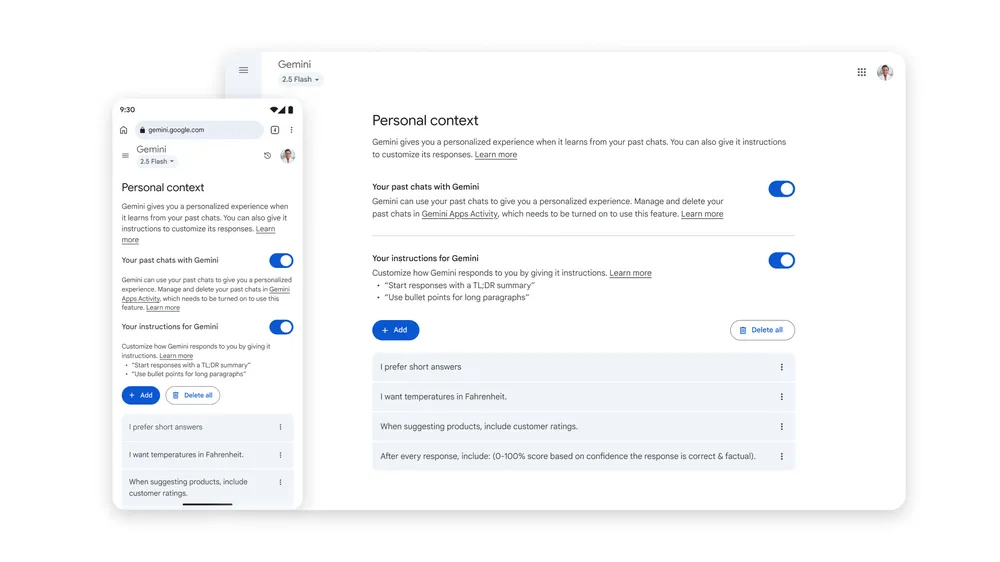
You might recall several months back when Google added a “personalization” option to the Gemini model selector. This mode leaned on your Google search history to customize responses, a feature that did not seem to appeal to many Gemini users. Google later dropped that mode, but a new attempt at customization is now rolling out. Gemini is getting an option called Personal Context. When enabled, the chatbot will remember details about your past conversations, adapting its replies without being specifically prompted.

Google claims Personal Context will produce more relevant responses, particularly when you ask the chatbot to make recommendations. This is separate from the saved instructions feature, which allows you to provide explicit instructions for Gemini to be used in crafting outputs. This does have the potential to make Gemini feel more engaging, but that’s not always a good thing. AI chatbots that get too friendly with the user can reinforce misconceptions and lead to delusional thinking, something we’ve seen distressingly often with AI models.

Credit: Google

To start, this feature will be available with the Gemini 2.5 Pro model, but you won’t get customization in the Eurpean Union,the  UK, or Switzerland. It’s also limited to users over the age of 18. Google says it will eventually release this feature in additional regions and with support for the more efficient Gemini 2.5 Flash model. You can turn Personal Context on and off at will from the main settings page.

https://arstechnica.com/ai/2025/08/google-gemini-will-now-learn-from-your-chats-unless-you-tell-it-not-to/


OpenAI brings back GPT-4o after user revolt

On Tuesday, OpenAI CEO Sam Altman announced that GPT-4o has returned to ChatGPT following intense user backlash over its removal during last week’s GPT-5 launch. The AI model now appears in the model picker for all paid ChatGPT users by default (including ChatGPT Plus accounts), marking a swift reversal after thousands of users complained about losing access to their preferred models.

The return of GPT-4o comes after what Altman described as OpenAI underestimating “how much some of the things that people like in GPT-4o matter to them.” In an attempt to simplify its offerings, OpenAI had initially removed all previous AI models from ChatGPT when GPT-5 launched on August 7, forcing users to adopt the new model without warning. The move sparked one of the most vocal user revolts in ChatGPT’s history, with a Reddit thread titled “GPT-5 is horrible” gathering over 2,000 comments within days.

Along with bringing back GPT-4o, OpenAI made several other changes to address user concerns. Rate limits for GPT-5 Thinking mode increased from 200 to 3,000 messages per week, with additional capacity available through “GPT-5 Thinking mini” after reaching that limit. The company also added new routing options—”Auto,” “Fast,” and “Thinking”—giving users more control over which GPT-5 variant handles their queries.

A screenshot of ChatGPT Pro's model picker interface captured on August 13, 2025.

A screenshot of ChatGPT Pro’s model picker interface captured on August 13, 2025. Credit: Benj Edwards

For Pro users who pay $200 a month for access, Altman confirmed that additional models, including o3, 4.1, and GPT-5 Thinking mini, will later become available through a “Show additional models” toggle in ChatGPT web settings. He noted that GPT-4.5 will remain exclusive to Pro subscribers due to high GPU costs.

https://arstechnica.com/information-technology/2025/08/openai-brings-back-gpt-4o-after-user-revolt/


OpenAI, cofounder Sam Altman to take on Neuralink with new startup

The company aims to raise $250 million from OpenAI and other investors, although the talks are at an early stage. Altman will not personally invest.

The new venture would be in direct competition with Neuralink, founded by Musk in 2016, which seeks to wire brains directly to computers.

Musk and Altman cofounded OpenAI, but Musk left the board in 2018 after clashing with Altman, and the two have since become fierce rivals in their pursuit of AI.

Musk launched his own AI start-up, xAI, in 2023 and has been attempting to block OpenAI’s conversion from a nonprofit in the courts. Musk donated much of the initial capital to get OpenAI off the ground.

Neuralink is one of a pack of so-called brain-computer interface companies, while a number of start-ups, such as Precision Neuroscience and Synchron, have also emerged on the scene.

Neuralink earlier this year raised $650 million at a $9 billion valuation, and it is backed by investors including Sequoia Capital, Thrive Capital, and Vy Capital. Altman had previously invested in Neuralink.

Brain implants are a decades-old technology, but recent leaps forward in AI and in the electronic components used to collect brain signals have offered the prospect that they can become more practically useful.

Altman has backed a number of other companies in markets adjacent to ChatGPT-maker OpenAI, which is valued at $300 billion. In addition to cofounding World, he has also invested in the nuclear fission group Oklo and nuclear fusion project Helion.

OpenAI declined to comment.

© 2025 The Financial Times Ltd. All rights reserved. Not to be redistributed, copied, or modified in any way.

https://arstechnica.com/science/2025/08/openai-cofounder-sam-altman-to-take-on-neuralink-with-new-startup/


Il futuro del modello Zero Trust

Questo articolo rappresenta l’ultimo contenuto della nostra serie di approfondimenti sull’architettura Zero Trust. In questo approfondimento finale, analizziamo l’implementazione pratica del modello Zero Trust attraverso l’integrazione sinergica di scelte organizzative e tecnologiche.

L’adozione di un modello Zero Trust richiede un’integrazione sinergica di scelte organizzative e tecnologiche, finalizzate sia all’implementazione del modello, sia all’incremento del valore aggiunto fornito agli utenti all’interno del perimetro di sicurezza. L’approccio Zero Trust non è un progetto con un termine predefinito, ma un processo in continua evoluzione che richiede un impegno costante per essere mantenuto e migliorato nel tempo.

Come discusso, è necessario:

  • Identificare in modo robusto gli utenti. L’organizzazione deve promuovere l’adozione di tecnologie di autenticazione multifattore. Tecnologie come l’autenticazione senza password (passwordless) e il single sign-on possono semplificare l’esperienza di accesso degli utenti, garantendo al contempo un elevato livello di sicurezza. Inoltre, l’adozione di strumenti di autenticazione basati su biometria o su fattori contestuali (come la posizione o il dispositivo utilizzato) può ulteriormente rafforzare la robustezza del processo di identificazione.
  • Identificare e gestire i dispositivi aziendali. Solo i dispositivi gestiti e autorizzati dovrebbero essere in grado di accedere ai servizi, garantendo così l’integrità, la riservatezza e la disponibilità dei dati aziendali. Tecnologie che consentono agli utenti di installare applicazioni da un paniere pre-approvato, o policy di compliance che li rendono amministratori dei propri dispositivi, possono incrementare l’autonomia senza compromettere la sicurezza. Inoltre, l’adozione di soluzioni di Mobile Device Management (MDM) e di Endpoint Detection and Response (EDR) consente un monitoraggio costante dello stato dei dispositivi, garantendo che questi siano sempre conformi alle politiche di sicurezza aziendali.
  • Identificare e gestire le reti e il perimetro di accesso. Non è sufficiente trovarsi in un determinato luogo o essere connessi alla rete aziendale per ottenere accesso ai sistemi e ai dati aziendali. Tecnologie di Network Access Control (NAC) che regolano dinamicamente il livello di fiducia possono mitigare l’impatto di una eventuale compromissione del dispositivo dell’utente. L’adozione di segmentazione della rete, sia fisica che logica, permette di limitare la propagazione di eventuali attacchi, mentre l’uso di micro-segmentazione offre un ulteriore livello di protezione limitando l’accesso alle risorse su base granulare.
  • Gestire gli applicativi e gli accessi. Una lista di applicazioni consentite e vietate tutela sia l’organizzazione che gli utenti, aumentando al contempo l’autonomia operativa all’interno di un perimetro definito. I privilegi minimi di accesso rappresentano una doppia garanzia per l’utente e per l’organizzazione. Inoltre, la definizione di criteri di accesso basati sul principio del “bisogno di sapere” (need-to-know) e del “privilegio minimo” (least privilege) consente di ridurre ulteriormente il rischio di accesso non autorizzato a informazioni sensibili.
  • Monitorare e aggiornare il modello organizzativo. Il team di sicurezza deve eseguire monitoraggi regolari delle metriche di controllo e suggerire miglioramenti continui al modello organizzativo e alle tecnologie adottate per ridurre il rischio cyber. L’adozione di un approccio basato sull’analisi del rischio consente di identificare e prioritizzare le aree di intervento, mentre l’utilizzo di tecniche di threat intelligence permette di adattare il modello alle minacce emergenti, migliorando la capacità di prevenzione e risposta.

L’adozione di tecnologie appropriate, insieme alla definizione e all’implementazione di un modello organizzativo di sicurezza, conduce alla minimizzazione del rischio cyber e a una maggiore consapevolezza della sua riduzione continua. Le sole tecnologie non sono sufficienti; un modello organizzativo senza supporto tecnologico potrebbe risultare eccessivamente rigido, compromettendo l’operatività e, di conseguenza, la qualità dei servizi e del business.

Allo stesso modo, un approccio esclusivamente tecnologico, senza una struttura organizzativa adeguata, rischia di non essere sufficientemente resiliente o di non essere accettato dagli utenti, compromettendo l’efficacia complessiva delle misure di sicurezza adottate. L’equilibrio tra tecnologia e organizzazione è quindi essenziale per raggiungere una postura di sicurezza matura e sostenibile.

Implementazione ed Evoluzione del Modello Zero Trust

L’esperienza maturata negli ultimi anni nell’implementazione di architetture Zero Trust ha rivelato che il successo di questa trasformazione va ben oltre l’aspetto puramente tecnologico. Le organizzazioni che hanno ottenuto i risultati migliori hanno compreso che si tratta di un profondo cambiamento culturale e organizzativo. Il MIT Sloan Center for Information Systems Research ha documentato come le implementazioni di maggior successo abbiano dedicato una parte sostanziale delle risorse, circa il 30%, alla gestione del cambiamento culturale e alla formazione del personale.

Questo cambiamento culturale si manifesta attraverso una nuova consapevolezza della sicurezza che permea tutti i livelli dell’organizzazione. Non si tratta più di vedere la sicurezza come un ostacolo o un semplice requisito di compliance, ma come un elemento abilitante per l’innovazione e la crescita aziendale, al pari dei processi di qualità che ormai si sono consolidati nelle aziende in cui il miglioramento continuo è base per una crescita costante.

Le organizzazioni stanno sviluppando programmi di formazione continua che non si limitano a insegnare le procedure di sicurezza, ma che aiutano i dipendenti a comprendere il loro ruolo attivo nella protezione degli asset aziendali, al pari di come coinvolgono gli stessi dipendenti nell’ambito dei processi informativi/formativi della sicurezza negli ambienti di lavoro, ma mentre per questi ultimi i processi sono formalizzati a livello normativo, ancora oggi per la sicurezza informatica la definizione delle azioni è lasciata alle aziende ed altri enti.

L’implementazione di Zero Trust si è dimostrata tanto più efficace se messa in atto seguendo un percorso graduale e ben pianificato. Le esperienze sul campo mostrano che la trasformazione richiede tipicamente diversi anni per raggiungere la piena maturità. Il processo inizia con la costruzione di solide fondamenta nei primi 6-12 mesi, durante i quali l’organizzazione si concentra sulla gestione delle identità e degli accessi, introducendo l’autenticazione multi-fattore e realizzando un accurato inventario degli asset. Questa fase iniziale è cruciale per costruire la fiducia degli utenti nel nuovo modello e per identificare eventuali criticità da affrontare.

La fase successiva, che tipicamente si estende per 12-24 mesi, vede l’organizzazione espandere il modello a sistemi sempre più critici. È in questo periodo che si implementano tecnologie più sofisticate come la micro-segmentazione della rete e si inizia ad automatizzare le policy di compliance. L’esperienza mostra che questa fase richiede un delicato equilibrio tra sicurezza e usabilità: le organizzazioni più lungimiranti hanno compreso l’importanza di coinvolgere gli utenti finali nel processo di design delle soluzioni, per garantire che le misure di sicurezza non ostacolino la produttività.

I risultati di questa trasformazione sono stati documentati in dettaglio da Forrester Research, che ha evidenziato benefici tangibili non solo in termini di sicurezza, con una riduzione del 50% delle violazioni, ma anche in termini di efficienza operativa, con una diminuzione del 30% nei costi di gestione della sicurezza. Particolarmente interessante è il miglioramento della produttività degli utenti, che hanno beneficiato di processi di accesso più snelli e intuitivi.

Guardando al futuro, il modello Zero Trust dovrà evolversi per affrontare nuove sfide tecnologiche. L’espansione dell’edge computing e dell’Internet of Things sta già ponendo nuove domande su come applicare i principi Zero Trust in contesti con risorse computazionali limitate e requisiti di latenza stringenti. L’avvento del quantum computing richiederà un ripensamento fondamentale dei meccanismi di crittografia e autenticazione, mentre l’intelligenza artificiale offrirà nuove opportunità per rendere le decisioni di sicurezza più contestuali e adattive.

Il panorama normativo in continua evoluzione rappresenta un’altra sfida significativa. Le organizzazioni dovranno bilanciare le esigenze di sicurezza con requisiti sempre più stringenti in termini di privacy e protezione dei dati personali. Questo richiederà una maggiore granularità nel controllo degli accessi e una completa tracciabilità delle decisioni di sicurezza.

Per navigare con successo questa trasformazione, le organizzazioni devono adottare un approccio equilibrato che consideri tecnologia, processi e persone come elementi ugualmente importanti. La formazione continua deve diventare parte integrante della cultura aziendale, mentre le metriche di successo devono essere chiare e misurabili. La flessibilità dell’architettura è fondamentale per adattarsi a nuove tecnologie e minacce, così come la collaborazione attiva con partner e fornitori per estendere il modello Zero Trust all’intera catena del valore.

In conclusione, il futuro della sicurezza informatica sarà inevitabilmente basato su modelli Zero Trust, ma il successo della loro implementazione dipenderà dalla capacità delle organizzazioni di creare un ecosistema di sicurezza resiliente e adattivo. La vera sfida non sarà tanto tecnologica quanto culturale: le organizzazioni che riusciranno a integrare la sicurezza nel loro DNA, rendendola parte naturale dei processi decisionali e operativi, saranno quelle che trarranno i maggiori benefici da questa trasformazione.

Per approfondire ulteriormente questi concetti e scoprire le strategie pratiche per una corretta implementazione del modello Zero Trust, vi invitiamo a scaricare il white paper “Zero Trust: solo un problema tecnologico?” redatto dal Dott. Ing. Fabrizio Fioravanti.

Profilo Autore

Fabrizio Fioravanti è attualmente responsabile dell’Unità di Processo Sistemi, tecnologie cloud e di sicurezza informatica presso l’Università degli Studi di Firenze.

Laureato in Ingegneria Elettronica, ha successivamente conseguito il dottorato di ricerca in Ingegneria Informatica e delle Telecomunicazioni e da oltre 25 anni lavora nel settore ICT.

Ha diverse pubblicazioni scientifiche al suo attivo sia su riviste italiane che internazionali, sia che in conferenze, oltre a monografie complete o contributi a monografie.

Condividi sui Social Network:

https://www.ictsecuritymagazine.com/articoli/zero-trust-modello/